Industrial Temperature Range Flash (-40°C to 85°C) Market Insights
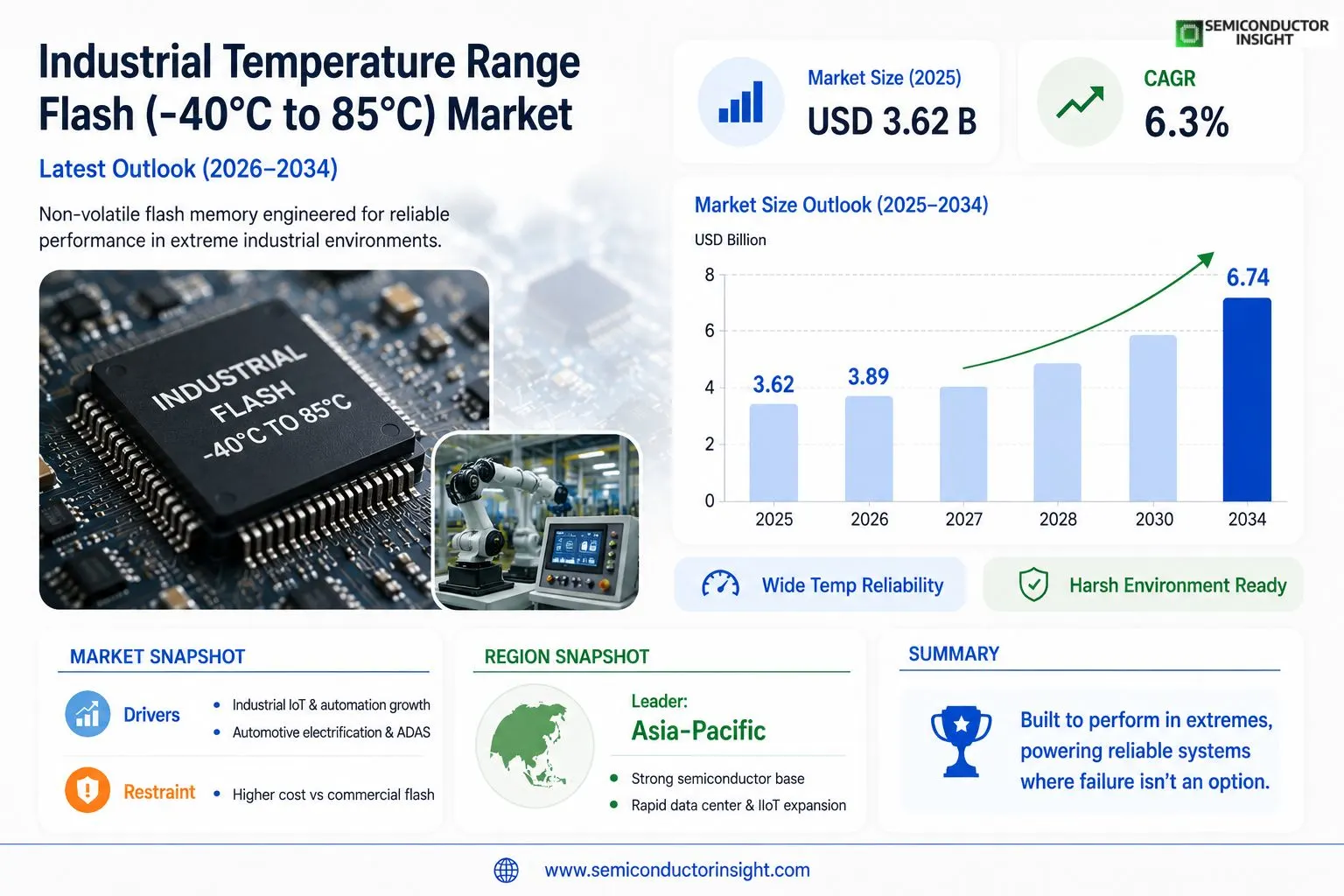
Global Industrial Temperature Range Flash (-40°C to 85°C) market size was valued at USD 3.62 billion in 2025. The market is projected to grow from USD 3.89 billion in 2026 to USD 6.74 billion by 2034, exhibiting a CAGR of 6.3% during the forecast period.
Industrial temperature range flash memory, designed to operate reliably across an extended thermal spectrum of -40°C to 85°C, represents a specialized class of non-volatile storage solutions engineered for deployment in harsh and demanding environments. Unlike commercial-grade flash memory, these components are built to withstand extreme thermal cycling, mechanical vibration, and environmental stress, making them indispensable in sectors such as automotive electronics, industrial automation, aerospace, military systems, and ruggedized computing. The product category encompasses NOR flash, NAND flash, and managed flash solutions, all qualified to industrial-grade standards.
The market is experiencing steady expansion driven by the accelerating adoption of embedded systems in industrial IoT (IIoT) applications, the rapid electrification of automotive platforms, and the growing demand for reliable data storage in edge computing environments. Furthermore, the proliferation of advanced driver-assistance systems (ADAS) and in-vehicle infotainment platforms has significantly elevated the demand for automotive-qualified, wide-temperature flash components. Key industry participants including Micron Technology, Inc., Winbond Electronics Corporation, Infineon Technologies AG, and Macronix International Co., Ltd. continue to expand their industrial-grade flash portfolios to address these evolving application requirements.
MARKET DRIVERS
Rising Industrial Automation and Industry 4.0 Adoption
Industrial Temperature Range Flash (-40°C to 85°C) Market is primarily driven by the rapid expansion of industrial automation and smart manufacturing initiatives. As factories increasingly deploy IIoT devices, programmable logic controllers (PLCs), and rugged embedded systems, the demand for reliable non-volatile memory that operates consistently in harsh environments grows significantly. These flash solutions ensure data integrity for firmware storage and logging under fluctuating temperatures typical in production floors. [[1]](https://dataintelo.com/report/parallel-nand-flash-market)
Expansion of Edge Computing and IIoT Infrastructure
Growth in edge computing deployments across sectors such as energy, transportation, and manufacturing further propels the market. Industrial temperature-rated flash memory, including SLC and industrial-grade NAND/NOR variants, provides the necessary endurance and reliability for continuous operation in outdoor or uncontrolled settings. Market participants note increasing integration in sensors and gateways where commercial-grade components would fail. [[2]](https://www.winbond.com/hq/support/online-learning/articles-item/High-Performance-Low-Power-Small-Form-factor-Flash-Memory-for-Next-Generation-Devices?__locale=en)
➤ The proliferation of Industry 4.0 has significantly increased procurement of industrial-temperature SLC NAND solutions due to their high endurance and wide operating range.
Additionally, demand from sectors requiring long-term data retention in extreme conditions, such as oil & gas monitoring and renewable energy systems, continues to support steady market expansion.
MARKET CHALLENGES
Supply Chain Constraints for Qualified Components
Procuring pre-qualified industrial temperature range flash components remains challenging due to limited production capacity compared to commercial-grade equivalents. Manufacturers often rely on additional screening processes for commercial NAND to meet -40°C to 85°C specifications, leading to longer lead times and potential bottlenecks. [[3]](https://www.virtium.com/technology-updates/virtium-industrial-ssd-temperature-screening-process/)
Other Challenges
Intense Competition and Technology Migration
Rapid advancements in higher-density 3D NAND create pressure on traditional industrial flash solutions, requiring continuous innovation to maintain performance and cost competitiveness while preserving reliability in extended temperature ranges.
Design Complexity in Harsh Environments
Integrating flash memory into systems exposed to vibration, humidity, and thermal cycling demands extensive qualification testing, increasing development costs and timelines for OEMs in industrial applications.
MARKET RESTRAINTS
Higher Costs Compared to Commercial Alternatives
Industrial Temperature Range Flash (-40°C to 85°C) Market faces restraint from significantly higher per-unit costs associated with industrial-grade qualification, extended testing, and lower production volumes. SLC-based solutions, preferred for endurance in industrial use, command premium pricing over consumer-grade MLC or QLC alternatives. [[4]](https://lexarenterprise.com/industrial-memory-cost-and-performance/)
This cost premium can limit adoption among price-sensitive industrial projects, particularly in emerging markets where budget constraints influence component selection despite reliability needs.
MARKET OPPORTUNITIES
Emerging Applications in Renewable Energy and Smart Infrastructure
Substantial opportunities exist in the deployment of smart grid systems, wind and solar energy installations, and intelligent transportation infrastructure. These applications require robust flash memory capable of reliable operation across wide temperature swings, creating new demand channels for -40°C to 85°C rated products. [[5]](https://market.us/report/nor-flash-market/)
Continued innovation in low-power, high-endurance NOR and NAND variants tailored for industrial IoT further positions the market for growth as global digital transformation initiatives accelerate.
Industrial Temperature Range Flash (-40°C to 85°C) Market Trends
Expansion Driven by Harsh Environment Applications
Industrial temperature range flash memory operating reliably from -40°C to 85°C has become essential for non-volatile storage in demanding conditions. These specialized components deliver consistent performance under extreme thermal cycling, vibration, and environmental stress where standard commercial-grade solutions would fail. Sectors including automotive electronics, industrial automation, aerospace, military systems, and ruggedized computing rely heavily on this technology for mission-critical data storage.
The category includes NOR flash, NAND flash, and managed flash solutions, all qualified to industrial-grade standards. Manufacturers engineer these devices specifically to maintain data integrity and operational stability across wide temperature swings, making them indispensable as embedded systems proliferate in challenging industrial settings.
Other Trends
Automotive and IIoT Adoption Accelerating Demand
Rapid electrification of automotive platforms and the growth of industrial IoT applications continue to drive requirements for wide-temperature flash memory. Advanced driver-assistance systems and in-vehicle infotainment platforms particularly benefit from these robust components, ensuring reliable operation in vehicles exposed to varying environmental conditions. Edge computing deployments in industrial environments further increase the need for dependable storage solutions that perform consistently without thermal limitations.
Technology Providers Expanding Industrial-Grade Portfolios
Leading semiconductor companies are prioritizing development of industrial temperature range flash solutions to meet evolving customer specifications. These efforts focus on enhancing endurance, speed, and reliability while maintaining compatibility with existing embedded system architectures. The ongoing transition toward more sophisticated automation and connected devices reinforces the strategic importance of these specialized memory components across multiple high-reliability verticals.
Market participants continue refining their product offerings to address specific application challenges in aerospace and military systems, where failure is not an option. This focus on quality and extended operational capabilities positions industrial temperature range flash as a foundational technology supporting broader digital transformation initiatives in harsh operating environments.
COMPETITIVE LANDSCAPE
Key Industry Players
Competitive Landscape of Industrial Temperature Range Flash (-40°C to 85°C) Market
Industrial Temperature Range Flash (-40°C to 85°C) Market features a competitive landscape dominated by established semiconductor giants with specialized expertise in ruggedized non-volatile memory solutions. Micron Technology, Inc. stands out as a leading player, leveraging its extensive portfolio of industrial-grade NAND and NOR flash products qualified for harsh environments across automotive, industrial automation, and aerospace applications. The market structure is characterized by high barriers to entry due to stringent qualification processes, long product lifecycles, and the need for robust supply chain reliability, enabling a few key innovators to maintain strong positions while addressing growing demand from IIoT and ADAS deployments.
Other significant players include specialized manufacturers and niche providers that focus on high-reliability components, often complementing the offerings of larger firms through targeted solutions for embedded systems and edge computing. Companies such as Winbond Electronics, Infineon Technologies, and Macronix International continue to expand their wide-temperature portfolios, driving innovation in endurance, data retention, and security features tailored to industrial standards.
List of Key Industrial Temperature Range Flash Companies Profiled
- Micron Technology, Inc.
- Winbond Electronics Corporation
- Infineon Technologies AG
- Macronix International Co., Ltd.
- Samsung Electronics Co., Ltd.
- SK hynix Inc.
- KIOXIA Corporation
- Western Digital Corporation
- GigaDevice Semiconductor Inc.
- Swissbit AG
- ATP Electronics
- Delkin Devices
- Cactus Technologies
- Virtium LLC
Segment Analysis:
| Segment Category | Sub-Segments | Key Insights |
| By Type |
|
Leading Segment: NOR Flash
|
| By Application |
|
Leading Segment: Automotive Electronics
|
| By End User |
|
Leading Segment: Industrial Equipment Providers
|
| By Form Factor |
|
Leading Segment: Ball Grid Array (BGA)
|
| By Interface |
|
Leading Segment: Quad SPI (QSPI)
|
Regional Analysis: Industrial Temperature Range Flash (-40°C to 85°C) Market
Asia-Pacific
Asia-Pacific stands as the leading region in Industrial Temperature Range Flash (-40°C to 85°C) Market, driven by its dominant position in electronics manufacturing and rapid industrialization across key economies. The region’s extensive network of semiconductor fabrication facilities and assembly plants enables efficient production of rugged flash memory solutions designed for harsh industrial environments. Countries like China, Japan, South Korea, and Taiwan benefit from strong government initiatives supporting advanced manufacturing and digital infrastructure development, creating sustained demand for reliable storage components that operate consistently in extreme temperature conditions.Industrial automation, smart factories, and infrastructure projects fuel adoption, with local enterprises prioritizing components that ensure data integrity in sectors such as energy, transportation, and heavy machinery. The presence of major technology suppliers and contract manufacturers allows for quick innovation cycles tailored to industrial specifications. Supply chain integration within the region further strengthens market resilience, supporting consistent availability of Industrial Temperature Range Flash solutions. Collaboration between academia and industry accelerates development of next-generation memory technologies optimized for durability and performance under thermal stress. This ecosystem positions Asia-Pacific at the forefront of both production and consumption, setting benchmarks for quality and scalability in Global market.
Strong growth in industrial automation and IoT deployments across manufacturing hubs drives demand for robust flash memory. Regional emphasis on smart city initiatives and renewable energy projects requires reliable data storage in varying climatic conditions, encouraging widespread integration of temperature-resilient components.
Established semiconductor firms and emerging local players compete through continuous innovation in endurance and data retention. Strategic partnerships with industrial equipment manufacturers help refine product specifications, enhancing market penetration across diverse applications.
Focus on developing higher density solutions with improved thermal management supports evolving requirements of edge computing and AI-driven industrial systems. Regional R&D investments accelerate the creation of specialized firmware and controller technologies optimized for extended temperature operations.
Expansion of electric vehicle infrastructure and high-speed rail networks presents significant potential. Increasing localization policies encourage foreign investment while supporting domestic capacity building for critical industrial memory components.
North America
North America maintains a significant presence in Industrial Temperature Range Flash (-40°C to 85°C) Market through its advanced industrial sectors and emphasis on technological innovation. The United States and Canada showcase strong demand from aerospace, defense, and energy exploration industries where equipment must withstand severe temperature fluctuations. Emphasis on cybersecurity and data integrity in industrial control systems further boosts adoption of reliable flash storage solutions. Established supply chains and focus on domestic manufacturing resurgence support steady market development, with enterprises prioritizing long-term durability and compliance with stringent quality standards.
Europe
Europe demonstrates steady growth fueled by its leadership in industrial automation and commitment to sustainable manufacturing practices. Germany, France, and other key nations integrate temperature-resistant flash memory into smart factories and precision engineering applications. Regulatory frameworks promoting energy efficiency and equipment reliability create favorable conditions for high-performance storage components. The region’s focus on digital transformation across automotive and process industries drives consistent need for rugged memory solutions capable of maintaining performance in challenging operational environments.
South America
South America is gradually expanding its footprint in Industrial Temperature Range Flash (-40°C to 85°C) Market, primarily through mining, oil and gas, and agricultural automation sectors. Countries like Brazil and Argentina invest in modernizing industrial infrastructure, requiring durable storage solutions for remote and harsh-condition operations. While import-dependent in many areas, growing local assembly capabilities and infrastructure projects contribute to increasing demand. Market participants focus on cost-effective yet reliable solutions tailored to regional climatic variations and operational challenges.
Middle East & Africa
The Middle East and Africa region shows promising potential driven by energy sector modernization and infrastructure development initiatives. Oil and gas operations in extreme desert climates particularly benefit from industrial-grade flash memory that ensures data reliability under high thermal stress. Smart city projects and renewable energy investments across Gulf nations create additional opportunities. Although market maturity varies, increasing adoption of automation technologies supports gradual expansion, with emphasis on products offering superior endurance and resistance to environmental factors.
Report Scope
This market research report provides a comprehensive analysis of the Industrial Temperature Range Flash (-40°C to 85°C) Market , covering the forecast period 2026–2034. It offers detailed insights into market dynamics, technological advancements, competitive landscape, and key trends shaping the industry.
Key focus areas of the report include:
- Market Overview: The report begins with an overview outlining its current market scenario, key growth indicators, and industry transformation drivers. It discusses macroeconomic factors, demand–supply balance, regulatory landscape, and the strategic role of semiconductors in powering advancements across industries such as automotive, telecommunications, consumer electronics, and industrial automation.
- Market Size & Forecast: Historical data and future projections for revenue, unit shipments, and market value across major regions and segments.
- Segmentation Analysis: Detailed breakdown by product type, technology, application, and end-user industry to identify high-growth segments and investment opportunities.
- Regional Insights: Insights into market performance across North America, Europe, Asia-Pacific, Latin America, and the Middle East & Africa, including country-level analysis where relevant.
- Competitive Landscape: Profiles of leading market participants, including their product offerings, R&D focus, manufacturing capacity, pricing strategies, and recent developments such as mergers, acquisitions, and partnerships.
- Technology Trends & Innovation: Assessment of emerging technologies, integration of AI/IoT, semiconductor design trends, fabrication techniques, and evolving industry standards.
- Market Drivers & Restraints: Evaluation of factors driving market growth along with challenges, supply chain constraints, regulatory issues, and market-entry barriers.
- Stakeholder Insights: Insights for component suppliers, OEMs, system integrators, investors, and policymakers regarding the evolving ecosystem and strategic opportunities.
Primary and secondary research methods are employed, including interviews with industry experts, data from verified sources, and real-time market intelligence to ensure the accuracy and reliability of the insights presented.
FREQUENTLY ASKED QUESTIONS:
What is the current market size of Industrial Temperature Range Flash (-40°C to 85°C) Market?
-> Industrial Temperature Range Flash (-40°C to 85°C) Market was valued at USD 3.62 billion in 2025 and is expected to reach USD 6.74 billion by 2034.
Which key companies operate in Industrial Temperature Range Flash (-40°C to 85°C) Market?
-> Key players include Micron Technology, Inc., Winbond Electronics Corporation, Infineon Technologies AG, and Macronix International Co., Ltd., among others.
What are the key growth drivers?
-> Key growth drivers include accelerating adoption of embedded systems in industrial IoT applications, rapid electrification of automotive platforms, and growing demand for reliable data storage in edge computing environments.
Which region dominates the market?
-> Asia-Pacific is the fastest-growing region with strong semiconductor manufacturing base, while North America remains a dominant market due to technology innovation.
What are the emerging trends?
-> Emerging trends include integration of AI/IoT in industrial systems, advanced NOR and NAND flash solutions for harsh environments, and proliferation of ADAS requiring wide-temperature components.

Get Sample Report PDF for Exclusive Insights
Report Sample Includes
- Table of Contents
- List of Tables & Figures
- Charts, Research Methodology, and more...
 Download Sample Report PDF