Industrial Power Management IC Market Insights
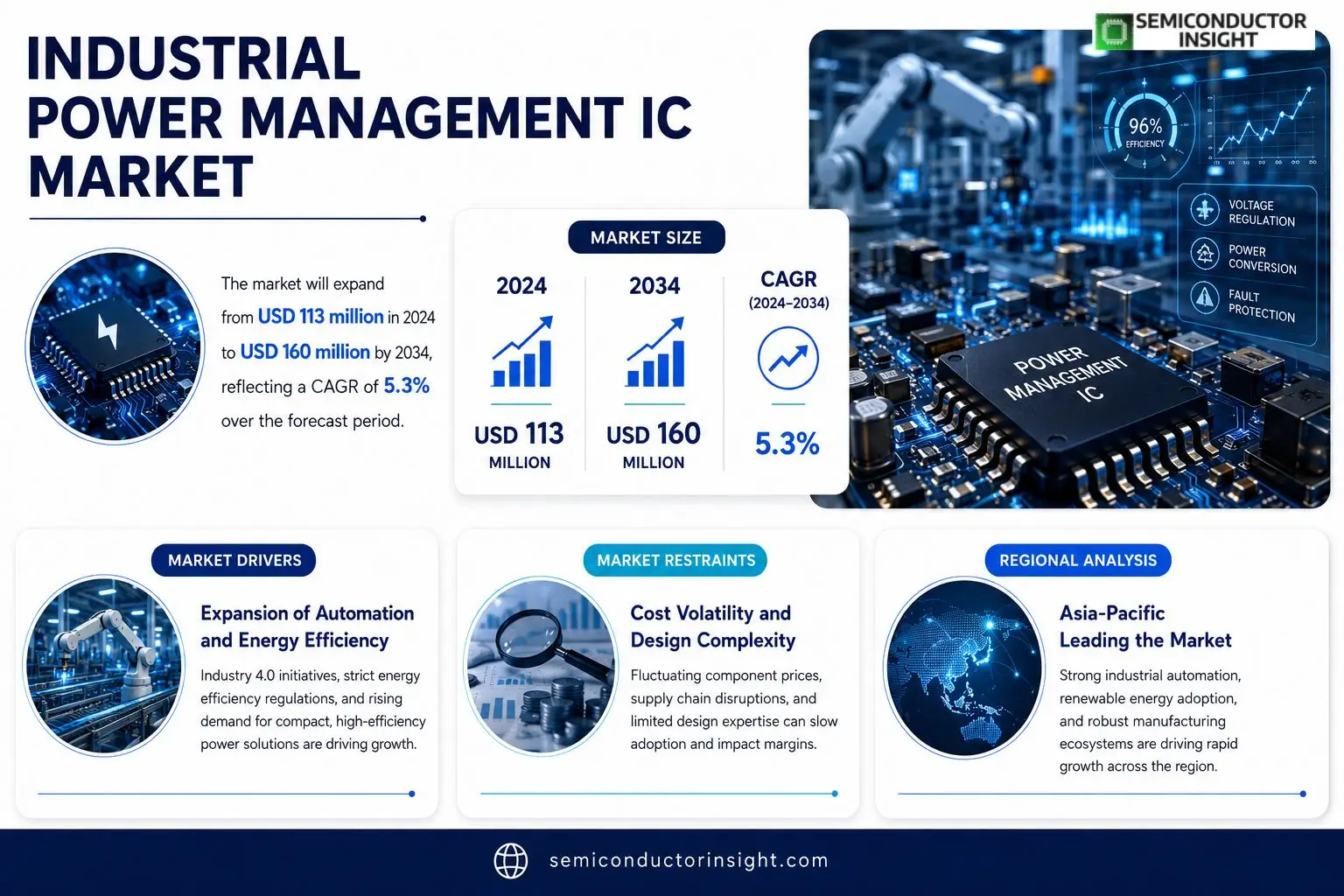
Industrial Power Management IC market size was valued at USD 113 million in 2024. The market will expand from USD 113 million in 2024 to USD 160 million by 2034, reflecting a CAGR of 5.3% over the forecast period.
Industrial Power Management ICs are highly integrated semiconductor devices that provide efficient power conversion, regulation and control for industrial equipment. They combine step‑down converters, voltage regulators, gate drivers and LED drivers into a single chip, reducing external components and improving system reliability for factory automation, robotics, power tools and green‑energy installations.The upward trend is driven by the adoption of Industry 4.0 concepts that require compact, high‑efficiency power solutions; however, manufacturers must navigate strict safety certifications and occasional component shortages. Recent launches from Analog Devices and Texas Instruments demonstrate how vendors are targeting higher efficiency levels while broadening functional portfolios.
MARKET DRIVERS
Rising Energy‑Efficiency Regulations
TIndustrial Power Management IC Market is feeling the impact of increasingly strict energy‑efficiency mandates across major economies. Manufacturers are compelled to redesign equipment so that power loss stays within tighter limits, and power‑management integrated circuits provide the granular control required to meet those criteria. Companies that embed advanced regulation loops can differentiate their offerings and secure premium contracts.
Expansion of Automation in Production Lines
Automation initiatives are reshaping factories, and each robotic cell or programmable logic controller relies on stable, high‑density power distribution. Power‑management ICs enable dynamic voltage scaling, reducing heat generation while maintaining performance—an essential trade‑off for continuous‑run environments. The shift toward modular, reconfigurable equipment amplifies demand for versatile IC solutions.
➤ Design engineers are now prioritizing ICs that combine multiple regulation functions, cutting board space and simplifying Bill of Materials.
Beyond compliance and automation, the broader trend toward digitization—such as edge‑computing nodes on the factory floor—requires reliable power conditioning. Vendors that offer integrated monitoring features position themselves as strategic partners, allowing customers to collect telemetry without additional components.
MARKET CHALLENGES
Component Cost Volatility
Fluctuations in raw‑material pricing have introduced uncertainty for tIndustrial Power Management IC Market. When silicon wafer yields dip, manufacturers face higher unit costs, which can erode margin expectations for end‑users seeking cost‑effective power solutions.
Other Challenges
Supply‑Chain Fragmentation
logistics disruptions have lengthened lead times for critical substrates. As a result, design cycles are being extended, and firms are forced to hold larger safety stocks, pressuring cash flow.
Technical Integration Barriers
Legacy equipment often depends on discrete power components, making retrofits with modern ICs complex. Engineers must manage compatibility with established control architectures, which can slow adoption despite clear efficiency gains.
MARKET RESTRAINTS
Limited Design Expertise
The shortage of engineers proficient in low‑power IC topology constrains the pace at which tIndustrial Power Management IC Market can grow. Training programs have not kept pace with the rapid evolution of mixed‑signal designs, leading firms to rely on external consultants, which adds cost and time.
Regulatory Certification Overheads
Obtaining certification for power devices in safety‑critical sectors (e.g., automotive, aerospace) involves extensive testing that can extend product‑launch timelines. The additional compliance budget often discourages smaller players from entering the market, limiting competitive pressure.
MARKET OPPORTUNITIES
Integration of AI‑Driven Power Analytics
Embedding AI algorithms within power‑management ICs opens avenues for predictive maintenance and adaptive energy usage. Companies that can deliver on‑chip analytics will enable customers to shift from reactive to proactive power strategies, creating a differentiated value proposition.
Emergence of Wide‑Bandgap Materials
Silicon‑carbide and gallium‑nitride technologies are beginning to appear in power‑management applications. Their superior switching characteristics promise lower losses at higher frequencies, a combination that aligns perfectly with the needs of high‑performance industrial equipment.
Growth of Renewable‑Energy Integration
Industrial sites are increasingly coupling on‑site generation (solar, wind) with battery storage. Power‑management ICs that can handle bidirectional flow and efficiently coordinate charging cycles will become essential components of these hybrid systems.
Industrial Power Management IC Market Trends
Higher Integration for Industry‑4.0 Deployments
The shift toward tightly integrated power solutions is reshaping tIndustrial Power Management IC Market. Engineers are consolidating multiple regulation stages into single chips, which trims board space and reduces part counts. This consolidation supports the dense sensor arrays and edge‑computing nodes typical of smart factories, where every millimeter of PCB real‑estate is at a premium. By embedding fault‑protection, telemetry, and digital control within the same silicon, manufacturers are able to improve overall system reliability while simplifying design verification. The net effect is a faster time‑to‑market for new automation equipment, as product teams spend less effort on peripheral component selection and more on algorithmic differentiation.
Other Trends
Segment Shifts in Converter Architectures
Within the broader category of step‑down converters, a noticeable trend is the migration from traditional linear regulators to synchronous buck topologies that can sustain higher efficiency under variable load. This evolution is prompted by the growing prevalence of battery‑backed industrial IoT nodes, where every percentage point of efficiency translates directly into longer operational periods between maintenance cycles. Simultaneously, gate‑driver ICs are embedding advanced diagnostics that pre‑emptively flag MOSFET stress, enabling predictive maintenance strategies that align with broader asset‑management platforms. The combination of these architectural refinements is nudging the market toward solutions that not only manage power but also provide actionable intelligence to plant‑floor managers.
Geographic Demand Realignment
Regional adoption patterns are evolving as European manufacturers accelerate retrofits of legacy equipment to meet stringent energy‑efficiency directives, while Asian producers are scaling up green‑energy‑linked automation lines. The United States remains a strong hub for high‑performance motor‑control modules, yet investment momentum is shifting toward offshore design centers that can leverage cost‑effective silicon fabs in South‑East Asia. This geographic rebalancing creates a competitive environment where suppliers must offer localized technical support and flexible supply‑chain options to capture market share across divergent regulatory landscapes.
COMPETITIVE LANDSCAPE
Key Industry Players
Industrial Power Management IC Market – Competitive Overview
Analog Devices and Texas Instruments dominate the industrial power‑management segment, each commanding a double‑digit share of revenue worldwide. Their portfolios combine highly integrated step‑down converters, voltage regulators and gate‑driver families that address the demanding efficiency targets of factory‑automation and robotics platforms. Both firms have leveraged extensive design‑win programs with Tier‑1 equipment manufacturers, turning their silicon into de‑facto standards for smart‑factory deployments. Recent product roadmaps emphasise tighter thermal performance and built‑in diagnostics, which reinforce the incumbents’ competitive moat and create high barriers for newcomers seeking volume scale.Beyond the two market leaders, a cadre of specialised players enriches the ecosystem. ROHM, STMicroelectronics and NXP focus on niche voltage‑regulator families tailored for IIoT gateways, while Infineon and Renesas excel in gate‑driver solutions for high‑power motor drives. ON Semiconductor and Toshiba maintain strong positions in LED‑driver and power‑module integrations, particularly for energy‑efficiency retrofits. Regional champions such as Microchip Technology (North America) and Maxim Integrated (now part of Analog Devices) sustain market depth through cost‑effective offerings that appeal to mid‑tier system integrators. Emerging Asian suppliers, including Skyworks Solutions and Power Integrations, are gaining traction in low‑voltage conversion for green‑energy interfaces, gradually reshaping the supply‑chain dynamics.
List of Key Industrial Power Management IC Companies Profiled
- Analog Devices
- Texas Instruments
- ROHM Semiconductor
- Microchip Technology
- STMicroelectronics
- NXP Semiconductors
- Infineon Technologies
- Renesas Electronics
- ON Semiconductor
- Toshiba
- Maxim Integrated
- Skyworks Solutions
- Power Integrations
- Broadcom
- Dialog Semiconductor
Segment Analysis:
| Segment Category | Sub-Segments | Key Insights |
| By Type |
|
Step‑Down Converter
|
| By Application |
|
Smart Factories
|
| By End User |
|
Robotics
|
| By Functionality |
|
Power Sequencing
|
| By Integration Level |
|
System‑in‑Package
|
Regional Analysis: Industrial Power Management IC Market
Asia‑Pacific
Tier‑1 silicon firms partner with regional system integrators to co‑create power blocks that align with localized standards, shortening time‑to‑market and reducing redesign cycles for downstream customers.
Vast wafer‑fab capacity enables aggressive price positioning, while advanced packaging lines support heterogeneous integration, allowing compact footprints essential for constrained industrial enclosures.
Energy‑efficiency guidelines introduced by governments push OEMs to adopt ICs with higher conversion efficiency, prompting a migration away from legacy linear regulators toward digital‑controlled solutions.
Expansion of Industry 4.0 platforms fuels demand for power modules that can handle dynamic load profiles, prompting vendors to embed telemetry features for remote health monitoring.
North America
North America remains a hub for advanced research and high‑margin applications, particularly in aerospace, defense, and automotive electrification. U.S. firms lean heavily on custom power‑management silicon to meet stringent reliability standards, while Canada’s focus on renewable‑energy equipment drives niche demand for low‑loss converters. The market’s trajectory is shaped by a willingness to invest in next‑generation architectures, such as silicon‑carbide based drivers, which promise superior thermal performance in harsh industrial settings. Companies that can demonstrate verifiable lifecycle support and compliance with federal safety directives tend to secure premium contracts in this environment.
Europe
European manufacturers exhibit a strong preference for sustainability‑driven design, reflected in the EU’s rigorous ecodesign regulations. Countries like Germany and Sweden prioritize modular power solutions that facilitate easy upgrades and end‑of‑life recycling. Industrial sectors such as machinery and process automation seek ICs that provide granular control over power consumption, aligning with the continent’s carbon‑neutral ambitions. The market rewards suppliers that embed traceability and documentation features, enabling customers to meet audit requirements without sacrificing performance.
South America
Growth in South America is anchored by expanding renewable‑energy installations and a gradual shift toward automation in mining and agriculture. Brazil’s emerging smart‑grid projects demand resilient power‑management chips that operate reliably under variable voltage conditions. Regional players often favor cost‑effective solutions that balance efficiency with ruggedness, prompting a market niche for hardened ICs with extended temperature ranges. Companies that can supply localized technical support and flexible volume arrangements find a receptive audience across the continent.
Middle East & Africa
The Middle East & Africa region is experiencing a modest but steady uptake of industrial power‑management technologies, driven by oil‑field automation and large‑scale infrastructure development. Nations such as the United Arab Emirates and South Africa invest in digital‑control systems that require highly dependable ICs capable of withstanding extreme ambient temperatures. Market participants that pair robust design margins with localized training programs are better positioned to capitalize on government‑backed projects aimed at boosting operational efficiency.
Report Scope
This market research report provides a comprehensive analysis of the Industrial Power Management IC Market , covering the forecast period 2026–2034. It offers detailed insights into market dynamics, technological advancements, competitive landscape, and key trends shaping the industry.
Key focus areas of the report include:
- Market Overview: The report begins with an overview outlining its current market scenario, key growth indicators, and industry transformation drivers. It discusses macroeconomic factors, demand–supply balance, regulatory landscape, and the strategic role of semiconductors in powering advancements across industries such as automotive, telecommunications, consumer electronics, and industrial automation.
- Market Size & Forecast: Historical data and future projections for revenue, unit shipments, and market value across major regions and segments.
- Segmentation Analysis: Detailed breakdown by product type, technology, application, and end-user industry to identify high-growth segments and investment opportunities.
- Regional Insights: Insights into market performance across North America, Europe, Asia-Pacific, Latin America, and the Middle East & Africa, including country-level analysis where relevant.
- Competitive Landscape: Profiles of leading market participants, including their product offerings, R&D focus, manufacturing capacity, pricing strategies, and recent developments such as mergers, acquisitions, and partnerships.
- Technology Trends & Innovation: Assessment of emerging technologies, integration of AI/IoT, semiconductor design trends, fabrication techniques, and evolving industry standards.
- Market Drivers & Restraints: Evaluation of factors driving market growth along with challenges, supply chain constraints, regulatory issues, and market-entry barriers.
- Stakeholder Insights: Insights for component suppliers, OEMs, system integrators, investors, and policymakers regarding the evolving ecosystem and strategic opportunities.
Primary and secondary research methods are employed, including interviews with industry experts, data from verified sources, and real-time market intelligence to ensure the accuracy and reliability of the insights presented.
FREQUENTLY ASKED QUESTIONS:
What is the current market size of Industrial Power Management IC Market?
-> TIndustrial Power Management IC Market was valued at USD 113 million in 2024 and is expected to reach USD 160 million by 2034, growing at a CAGR of 5.3% during the forecast period.
Which key companies operate in Industrial Power Management IC Market?
-> Key players include Analog Devices, Texas Instruments, ROHM Semiconductor, Microchip Technology, STMicroelectronics, NXP Semiconductors, Infineon, Renesas Electronics, Onsemi, Toshiba, among others.
What are the key growth drivers?
-> Key growth drivers include the rise of Industry 4.0 driving demand for highly integrated Power Management ICs, the need for higher efficiency and reduced external components, and expanding applications in factory automation, robotics, power equipment, and green energy systems.
Which region dominates the market?
-> The report highlights strong growth across multiple regions, with particular emphasis on rapid expansion in the Asia Pacific region due to extensive industrial automation and renewable energy adoption.
What are the emerging trends?
-> Emerging trends include greater integration of Power Management ICs for Industry 4.0, development of smart and highly efficient power solutions, and increasing adoption in renewable energy and intelligent industrial equipment.
Get Sample Report PDF for Exclusive Insights
Report Sample Includes
- Table of Contents
- List of Tables & Figures
- Charts, Research Methodology, and more...
 Download Sample Report PDF