In-Vehicle Networking (IVN) Switch & PHY Market Insights
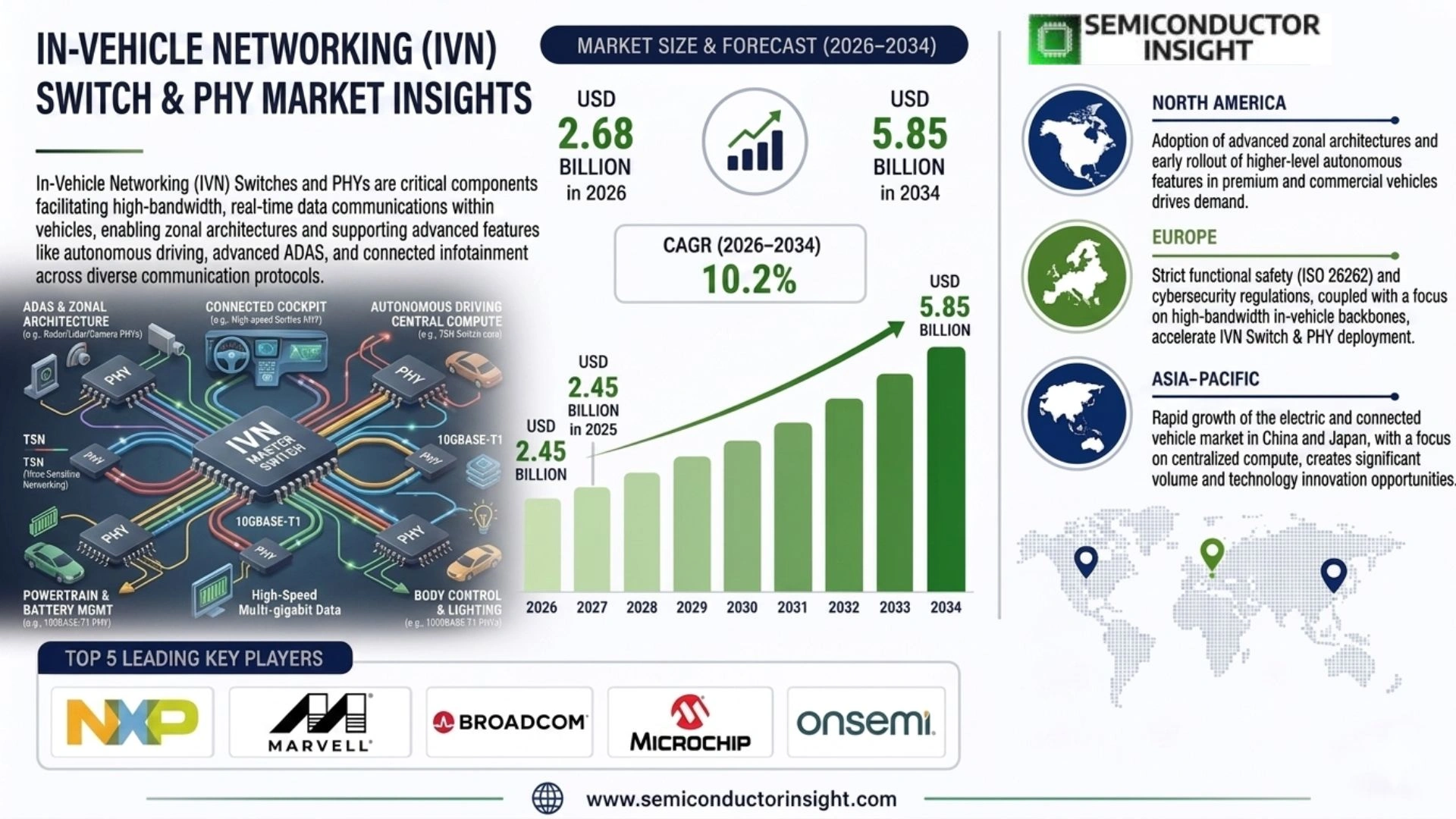
In-Vehicle Networking (IVN) Switch & PHY Market size was valued at USD 2.45 billion in 2025. The market is projected to grow from USD 2.68 billion in 2026 to USD 5.85 billion by 2034, exhibiting a CAGR of 10.2% during the forecast period.
In-Vehicle Networking (IVN) Switch and PHY components are critical semiconductor solutions that enable high-speed, reliable data communication between various electronic control units (ECUs) within modern vehicles. These technologies facilitate the efficient transfer of information across automotive networks, supporting advanced features such as advanced driver assistance systems (ADAS), infotainment, powertrain management, and over-the-air updates. Switches manage data traffic routing while Physical Layer (PHY) transceivers handle signal transmission and reception over the vehicle’s wiring infrastructure, often leveraging protocols like Automotive Ethernet, CAN FD, and emerging multi-gigabit standards.
The market is experiencing robust growth due to several factors, including the rapid proliferation of electric vehicles (EVs), the push toward software-defined vehicles, and increasing demand for higher bandwidth to support sensor-rich architectures in autonomous driving applications. Furthermore, stricter safety regulations and consumer expectations for seamless connectivity are accelerating the shift from traditional bus systems to more sophisticated Ethernet-based networks. Key players continue to innovate with integrated switch-PHY solutions that offer lower power consumption, enhanced security features, and better electromagnetic compatibility. For instance, recent advancements have focused on multi-gigabit Ethernet PHYs capable of supporting data rates up to 10 Gbps, addressing the needs of next-generation vehicle platforms. Major contributors operating in this space maintain broad portfolios addressing diverse vehicle segments from passenger cars to commercial fleets.
MARKET DRIVERS
Rising Demand for Connected and Autonomous Vehicles
In-Vehicle Networking (IVN) Switch & PHY Market is propelled by the accelerating adoption of connected vehicles and advanced driver-assistance systems (ADAS). Modern vehicles require high-bandwidth, low-latency communication between numerous electronic control units (ECUs), sensors, and actuators, driving the need for sophisticated Ethernet-based switches and physical layer (PHY) components.
Shift Toward Automotive Ethernet and Zonal Architectures
Traditional protocols like CAN are being supplemented or replaced by automotive Ethernet solutions that offer significantly higher data rates,up to 100 times faster in some implementations. This transition supports data-intensive applications such as high-resolution cameras, LiDAR, and real-time processing essential for autonomous driving features. The emergence of zonal architectures further optimizes wiring harnesses while enhancing scalability and performance of IVN switches and PHYs.
➤ Integration of 5G, edge computing, and Time-Sensitive Networking (TSN) standards enables deterministic, low-latency communication critical for safety applications in next-generation vehicles.
Regulatory pushes for vehicle safety and emissions reduction, combined with consumer demand for seamless infotainment and connectivity, continue to fuel investments in robust IVN infrastructure, positioning the market for sustained expansion.
MARKET CHALLENGES
Cybersecurity Vulnerabilities in Connected Networks
As vehicles become more connected, the expanded attack surface of in-vehicle networks presents significant security concerns. IVN Switch & PHY solutions must incorporate advanced encryption and intrusion detection to protect against potential cyber threats that could compromise vehicle safety and data privacy.
Other Challenges
Integration Complexity with Legacy Systems
Automotive manufacturers face hurdles in seamlessly integrating new high-speed Ethernet switches and PHYs with existing CAN, LIN, and FlexRay architectures, requiring sophisticated gateways and increasing development timelines.
Thermal and Power Management Issues
High-performance networking components generate substantial heat and consume power, challenging designers to maintain efficiency within the constrained automotive environment without compromising reliability.
MARKET RESTRAINTS
High Development and Integration Costs
In-Vehicle Networking (IVN) Switch & PHY Market faces notable restraints from elevated costs associated with designing, testing, and qualifying advanced components for automotive-grade reliability. These expenses include compliance with stringent functional safety standards (ISO 26262) and environmental qualifications, which can slow adoption particularly among cost-sensitive vehicle segments.
Space and Power Constraints in Vehicle Design
Limited physical space and strict power budgets in modern vehicles restrict the deployment of additional networking hardware. Manufacturers must balance performance demands of high-bandwidth switches and PHYs with requirements for compact form factors and energy efficiency, particularly in electric vehicles where battery range is paramount.
MARKET OPPORTUNITIES
Advancements in TSN and Multi-Gigabit Ethernet
Significant opportunities exist in the development and adoption of Time-Sensitive Networking (TSN) enabled switches and higher-speed PHYs (including 2.5G, 5G, and 10GBASE-T1). These technologies support the deterministic performance required for software-defined vehicles and advanced ADAS, opening new avenues for innovation and market differentiation.
Expansion in Electric and Autonomous Vehicle Segments
The rapid growth of electric vehicles (EVs) and autonomous driving platforms creates substantial demand for scalable IVN solutions. Opportunities abound in zonal controllers, camera bridges, and high-bandwidth backbone networks that facilitate efficient data flow for battery management, sensor fusion, and vehicle-to-everything (V2X) communication.
Trends
Rapid Shift to Automotive Ethernet Networks
In-Vehicle Networking (IVN) Switch & PHY Market is witnessing significant transformation driven by the increasing complexity of vehicle electronics. In-Vehicle Networking (IVN) Switch and PHY components serve as essential semiconductor solutions enabling high-speed, reliable data communication between various electronic control units (ECUs) in modern vehicles. These technologies efficiently transfer information across automotive networks, supporting critical applications including advanced driver assistance systems (ADAS), infotainment systems, powertrain management, and over-the-air updates.
Other Trends
Evolution of Integrated Switch-PHY Solutions
Manufacturers are focusing on developing integrated switch-PHY solutions that deliver lower power consumption, enhanced security features, and improved electromagnetic compatibility. This integration addresses the demanding requirements of next-generation vehicle platforms while optimizing space and performance within the vehicle architecture.
Support for Sensor-Rich Autonomous Architectures
The proliferation of electric vehicles and software-defined vehicles continues to accelerate demand for higher bandwidth capabilities. In-Vehicle Networking (IVN) Switch & PHY technologies are evolving to manage data traffic from numerous sensors required for autonomous driving applications, facilitating seamless routing and signal transmission across sophisticated network infrastructures.
Advancements in Multi-Gigabit Ethernet PHYs
Recent innovations in In-Vehicle Networking (IVN) Switch & PHY Market emphasize multi-gigabit Ethernet PHYs capable of supporting data rates up to 10 Gbps. These advancements enable the transition from traditional bus systems like CAN FD to more advanced Ethernet-based networks. Industry players maintain broad portfolios that address diverse vehicle segments ranging from passenger cars to commercial fleets, ensuring compatibility with varying performance and reliability needs. Stricter safety regulations and consumer demand for seamless connectivity further propel this evolution toward sophisticated, high-performance networking solutions that form the backbone of future mobility platforms.
COMPETITIVE LANDSCAPE
Key Industry Players
In-Vehicle Networking (IVN) Switch & PHY Market: Dynamic Competition Among Semiconductor Leaders
The In-Vehicle Networking (IVN) Switch and PHY market is led by specialized semiconductor companies with deep expertise in automotive-grade Ethernet solutions. Broadcom and NXP Semiconductors dominate the competitive landscape, leveraging extensive portfolios of multi-gigabit PHY transceivers and intelligent switches that support high-bandwidth applications in ADAS, infotainment, and software-defined vehicles. These leaders maintain strong market positions through continuous innovation in power efficiency, functional safety (ISO 26262), and electromagnetic compatibility, addressing the stringent requirements of next-generation vehicle architectures transitioning to zonal and centralized networking.
Other significant players include established chipmakers and emerging specialists focusing on niche innovations such as secure switches, high-speed PHYs, and integrated solutions for electric and autonomous vehicles. Companies like Marvell (Infineon), Renesas, Texas Instruments, and Microchip Technology contribute specialized offerings that enhance market diversity, driving competition in areas like multi-gigabit Ethernet and cost-optimized solutions for mass-market vehicles while supporting the industry shift toward higher data rates and reliable connectivity.
List of Key In-Vehicle Networking (IVN) Switch & PHY Companies Profiled
- Broadcom
- NXP Semiconductors
- Marvell / Infineon (Brightlane)
- Renesas Electronics
- Texas Instruments
- Microchip Technology
- STMicroelectronics
- Analog Devices
- Qualcomm Technologies
- Intel Corporation
- ON Semiconductor
- Cadence Design Systems
- Vector Informatik
- TTTech Auto
Segment Analysis:
| Segment Category | Sub-Segments | Key Insights |
| By Type |
|
Integrated Switch-PHY Solutions represent the leading segment due to their ability to combine routing and signal transmission functions in compact, power-efficient packages. These solutions streamline vehicle architecture by reducing component count and wiring complexity while enhancing overall system reliability. They excel in supporting high-bandwidth requirements for real-time data processing in sensor-intensive environments. Key advantages include improved electromagnetic compatibility and seamless integration with existing ECU networks, making them ideal for next-generation vehicle platforms focused on performance and efficiency. |
| By Application |
|
ADAS emerges as the dominant application segment as vehicles incorporate more sophisticated sensor arrays and real-time decision-making capabilities. IVN Switch and PHY technologies enable the high-speed, low-latency communication essential for fusing data from cameras, radar, and lidar systems. This supports advanced safety features and paves the way for higher levels of vehicle autonomy. The segment benefits from continuous innovation in multi-gigabit Ethernet standards that ensure robust data integrity even in challenging electromagnetic environments, facilitating smoother integration of complex algorithms. |
| By End User |
|
Passenger Vehicles lead this segment through widespread adoption of premium connectivity and safety features across mass-market models. Manufacturers prioritize IVN solutions that deliver reliable high-speed networking to support rich infotainment experiences and personalized user interfaces. The focus remains on scalable architectures that accommodate evolving consumer demands for seamless over-the-air updates and enhanced digital cockpits, driving continuous refinement of switch and PHY components for optimal thermal and power performance in compact vehicle spaces. |
| By Protocol |
|
Automotive Ethernet stands out as the leading protocol due to its superior bandwidth capabilities and flexibility in handling diverse data streams. It facilitates the transition toward software-defined vehicles by providing a unified networking backbone that supports future-proof scalability. This protocol excels in delivering deterministic performance required for safety-critical applications while maintaining backward compatibility with legacy systems during the migration phase. Enhanced security features and better support for time-sensitive networking further solidify its position in modern vehicle designs. |
| By Vehicle Type |
|
Electric Vehicles lead this category as they demand sophisticated networking solutions to manage complex battery systems, power distribution, and thermal controls alongside entertainment and autonomy features. IVN Switch and PHY components play a vital role in enabling efficient domain controllers that reduce wiring harness weight while improving energy efficiency. The segment emphasizes low-power designs and robust cybersecurity measures tailored to the unique architecture of battery-electric platforms, accelerating innovation in high-speed data pathways for comprehensive vehicle intelligence. |
Regional Analysis: In-Vehicle Networking (IVN) Switch & PHY Market
Asia-Pacific
Leading technology centers in Japan, South Korea, and China drive breakthroughs in Ethernet-based IVN switches and PHY chips. These hubs emphasize integration with AI-driven systems and support for multi-gigabit data rates critical for advanced driver assistance and autonomous capabilities.
A robust local supply chain for semiconductor components enables faster development cycles for In-Vehicle Networking (IVN) Switch & PHY solutions. Regional manufacturers excel in balancing performance, thermal management, and cost efficiency for high-volume electric vehicle production.
Government initiatives promoting smart mobility and vehicle electrification create favorable conditions for IVN technology adoption. Policies encourage investment in R&D for secure, reliable networking solutions that meet stringent functional safety requirements.
Close partnerships between regional OEMs and IVN component providers accelerate customization of switch and PHY technologies. This synergy supports the shift toward centralized computing platforms while maintaining backward compatibility with legacy protocols.
North America
North America maintains a strong position in In-Vehicle Networking (IVN) Switch & PHY Market through its focus on innovation and premium vehicle segments. The region excels in developing cutting-edge Ethernet switches that support software-defined vehicle architectures and advanced cybersecurity features. Major automakers prioritize high-reliability PHY components for applications in autonomous driving and connected services. Collaborative ecosystems involving technology firms and research institutions drive advancements in low-latency networking solutions essential for real-time decision making in intelligent vehicles. Emphasis on functional safety and compliance with regional standards further strengthens the adoption of sophisticated IVN technologies across passenger and commercial vehicle platforms.
Europe
Europe demonstrates leadership in regulatory-driven advancements within In-Vehicle Networking (IVN) Switch & PHY Market. Strict safety and environmental standards push OEMs toward highly efficient and secure networking solutions. The region focuses on zonal controller architectures that optimize bandwidth usage through advanced switch fabrics and PHY interfaces. European manufacturers emphasize sustainability in component design while integrating robust security protocols to protect against cyber threats. Strong emphasis on collaborative research projects accelerates the development of next-generation IVN technologies that support both electric mobility and highly automated driving systems across the continent.
South America
South America is gradually expanding its footprint in In-Vehicle Networking (IVN) Switch & PHY Market, primarily through increasing vehicle electrification efforts and local assembly operations. The region benefits from growing investments in automotive manufacturing that incorporate modern networking solutions for improved vehicle performance and connectivity. While adoption rates vary by country, demand rises for reliable IVN switches and PHY components that support basic to mid-level advanced driver assistance features. Local partnerships with global suppliers help bridge technology gaps and facilitate knowledge transfer, positioning the region for steady growth as consumer preferences shift toward smarter and more connected vehicles.
Middle East & Africa
The Middle East and Africa region shows emerging potential in In-Vehicle Networking (IVN) Switch & PHY Market, fueled by infrastructure development and rising demand for premium vehicles. Strategic initiatives to diversify economies include investments in automotive technology hubs that incorporate advanced in-vehicle networking capabilities. Focus areas include connectivity solutions suitable for harsh environmental conditions and support for fleet management applications. Although the market remains developing, growing awareness of autonomous and electric mobility creates opportunities for deployment of efficient IVN switch and PHY technologies tailored to regional requirements and climate challenges.
Report Scope
This market research report provides a comprehensive analysis of the In-Vehicle Networking (IVN) Switch & PHY Market , covering the forecast period 2026–2034. It offers detailed insights into market dynamics, technological advancements, competitive landscape, and key trends shaping the industry.
Key focus areas of the report include:
- Market Overview: The report begins with an overview outlining its current market scenario, key growth indicators, and industry transformation drivers. It discusses macroeconomic factors, demand–supply balance, regulatory landscape, and the strategic role of semiconductors in powering advancements across industries such as automotive, telecommunications, consumer electronics, and industrial automation.
- Market Size & Forecast: Historical data and future projections for revenue, unit shipments, and market value across major regions and segments.
- Segmentation Analysis: Detailed breakdown by product type, technology, application, and end-user industry to identify high-growth segments and investment opportunities.
- Regional Insights: Insights into market performance across North America, Europe, Asia-Pacific, Latin America, and the Middle East & Africa, including country-level analysis where relevant.
- Competitive Landscape: Profiles of leading market participants, including their product offerings, R&D focus, manufacturing capacity, pricing strategies, and recent developments such as mergers, acquisitions, and partnerships.
- Technology Trends & Innovation: Assessment of emerging technologies, integration of AI/IoT, semiconductor design trends, fabrication techniques, and evolving industry standards.
- Market Drivers & Restraints: Evaluation of factors driving market growth along with challenges, supply chain constraints, regulatory issues, and market-entry barriers.
- Stakeholder Insights: Insights for component suppliers, OEMs, system integrators, investors, and policymakers regarding the evolving ecosystem and strategic opportunities.
Primary and secondary research methods are employed, including interviews with industry experts, data from verified sources, and real-time market intelligence to ensure the accuracy and reliability of the insights presented.
FREQUENTLY ASKED QUESTIONS:
What is the current market size of In-Vehicle Networking (IVN) Switch & PHY Market?
-> In-Vehicle Networking (IVN) Switch & PHY Market was valued at USD 2.45 billion in 2025 and is expected to reach USD 5.85 billion by 2034.
Which key companies operate In-Vehicle Networking (IVN) Switch & PHY Market?
-> Key players include leading semiconductor providers specializing in automotive networking solutions, among others.
What are the key growth drivers?
-> Key growth drivers include the rapid proliferation of electric vehicles (EVs), the push toward software-defined vehicles, and increasing demand for higher bandwidth to support sensor-rich architectures in autonomous driving applications.
Which region dominates the market?
-> Asia-Pacific is the fastest-growing region due to strong automotive manufacturing base and EV adoption, while Europe remains a dominant market driven by stringent safety regulations.
What are the emerging trends?
-> Emerging trends include multi-gigabit Ethernet PHYs up to 10 Gbps, integrated switch-PHY solutions with enhanced security, and the shift to Ethernet-based networks from traditional bus systems.

Get Sample Report PDF for Exclusive Insights
Report Sample Includes
- Table of Contents
- List of Tables & Figures
- Charts, Research Methodology, and more...
 Download Sample Report PDF