Implantable Telemetry (MICS band) Transceiver IC Market Insights
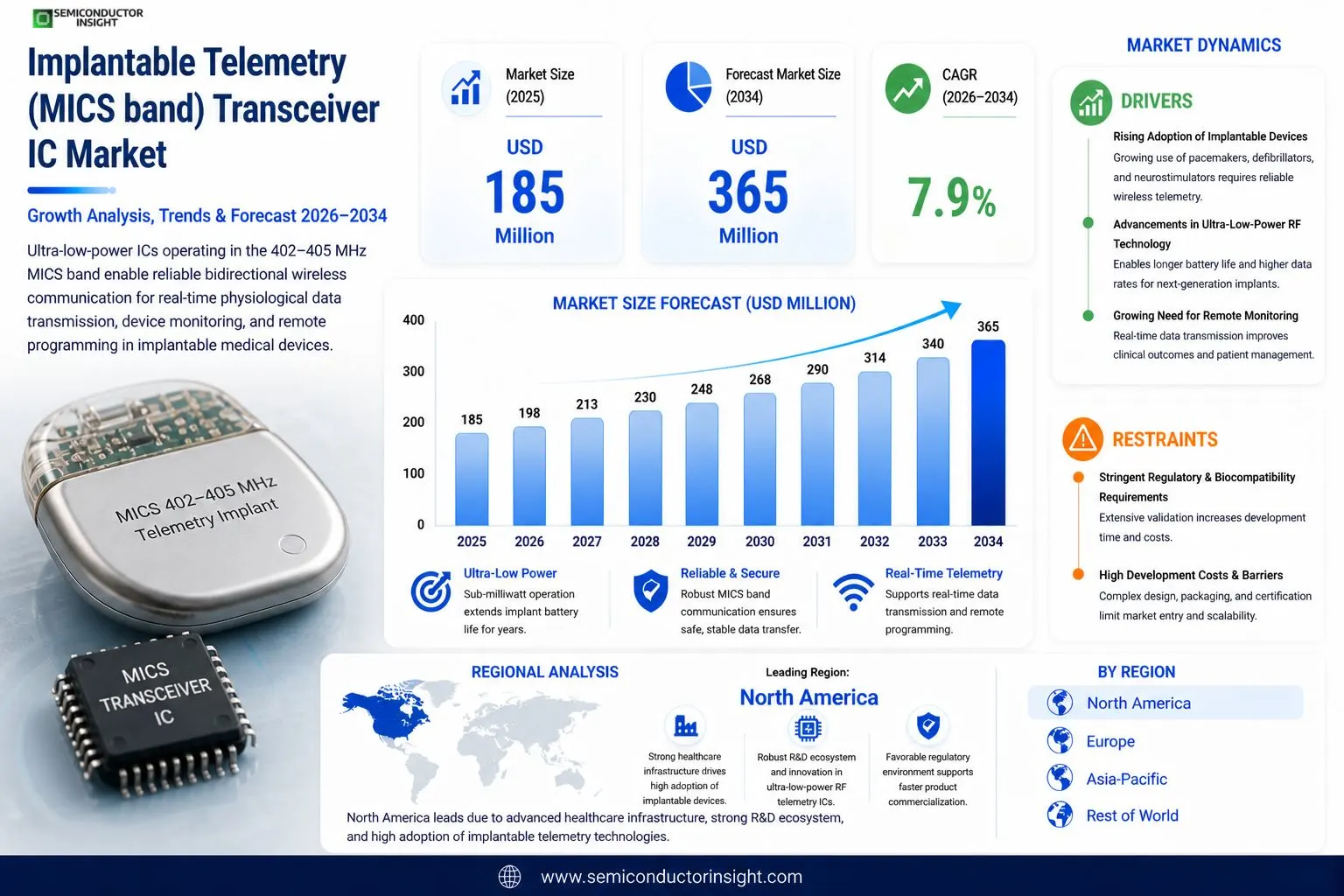
Global Implantable Telemetry (MICS band) Transceiver IC market size was valued at USD 185 million in 2025. The market is projected to grow from USD 198 million in 2026 to USD 365 million by 2034, exhibiting a CAGR of 7.9% during the forecast period.
Implantable Telemetry (MICS band) Transceiver ICs are specialized semiconductor components designed for ultra-low-power, short-range wireless communication in medical implants. Operating primarily in the 402-405 MHz Medical Implant Communications Service (MICS) band, these integrated circuits enable reliable bidirectional data transfer between implanted devices and external programmers or monitors. They support critical functions such as real-time physiological parameter transmission, device status monitoring, and remote programming while consuming minimal battery power to extend implant longevity.
The market is experiencing steady growth due to several factors, including the rising adoption of active implantable medical devices like cardiac pacemakers, defibrillators, and neurostimulators that require robust wireless telemetry. Advancements in semiconductor miniaturization and low-power RF design have further enabled smaller, more efficient implants with enhanced data rates and improved reliability in the challenging in-body environment. Additionally, the increasing prevalence of chronic cardiovascular and neurological conditions is driving demand for continuous remote patient monitoring solutions. Key players continue to innovate in this niche space, with established solutions such as Microchip Technology’s ZL70103 family demonstrating widespread deployment across millions of devices worldwide, underscoring the technology’s maturity and clinical acceptance.
MARKET DRIVERS
Rising Demand for Wireless Implantable Medical Devices
Implantable Telemetry (MICS band) Transceiver IC Market is propelled by the growing adoption of wireless communication in active implantable devices such as pacemakers, defibrillators, and neurostimulators. The MICS band (402-405 MHz) enables reliable, low-power, short-range data transmission that supports remote patient monitoring and reduces the need for frequent in-clinic visits.
Advancements in Ultra-Low-Power RF Technology
Continuous improvements in ultra-low-power transceiver designs allow extended battery life in implantable devices while maintaining high data rates compared to older inductive coupling methods. Integrated solutions featuring MICS-band transceivers with efficient wake-up mechanisms using 2.45 GHz ISM band options have become standard in next-generation implants.
➤ The shift toward real-time physiological data transmission has significantly enhanced clinical outcomes by enabling timely interventions for cardiac and neurological conditions.
Expansion of remote monitoring capabilities in healthcare systems further accelerates demand for specialized MICS transceiver ICs optimized for biocompatibility, miniaturization, and regulatory compliance in Class III medical devices.
MARKET CHALLENGES
Stringent Regulatory and Biocompatibility Requirements
Developing Implantable Telemetry (MICS band) Transceiver IC components requires extensive validation to meet international medical device standards, including electromagnetic compatibility, specific absorption rate limits, and long-term reliability inside the human body. These processes extend development timelines and increase costs for semiconductor suppliers.
Other Challenges
Power Management Constraints
Achieving sub-milliwatt operation during active transmission while supporting periodic low-power sniff modes remains technically demanding, particularly as device functionality and data throughput requirements increase.
Integration Complexity
Combining RF transceivers with sensing, processing, and antenna matching elements in highly miniaturized form factors presents ongoing design and manufacturing hurdles for medical-grade applications.
MARKET RESTRAINTS
Limited Supplier Ecosystem and Technology Maturity
Implantable Telemetry (MICS band) Transceiver IC Market faces restraint from a concentrated supply base, with established solutions centered around proven ultra-low-power architectures originally developed for medical implants. This limits rapid innovation and can create dependency on single-source components for critical telemetry functions.
High Development Costs and Certification Barriers
Substantial investment is required for RF IC design, packaging, and extensive clinical testing to ensure safety and performance of MICS-band devices. These factors raise entry barriers for new participants and can slow the pace of market expansion despite underlying clinical demand.
MARKET OPPORTUNITIES
Emergence of Advanced Remote Monitoring Applications
Growing integration of Implantable Telemetry (MICS band) Transceiver IC technology into next-generation cardiac monitors, neuromodulation devices, and chronic disease management implants presents significant growth potential. The ability to support higher data rates and secure bidirectional communication opens avenues for personalized medicine and AI-driven diagnostics.
Expansion into Emerging Markets and New Device Categories
Increasing healthcare infrastructure investment in developing regions, combined with demand for miniaturized insertable sensors and leadless devices, creates opportunities for optimized MICS transceiver solutions that balance performance, power efficiency, and cost-effectiveness.
Implantable Telemetry (MICS band) Transceiver IC Market Trends
Advancements in Ultra-Low-Power RF Design
Implantable Telemetry (MICS band) Transceiver ICs continue to evolve with a strong emphasis on ultra-low-power operation to support extended battery life in active implantable medical devices. These specialized integrated circuits, operating in the 402-405 MHz Medical Implant Communications Service band, enable reliable bidirectional communication for real-time transmission of physiological data while minimizing energy consumption. Established solutions such as the Microchip ZL70103 family demonstrate proven performance with current draws below 6 mA during active transmit or receive modes and nanoampere-level consumption in sleep states, supporting millions of deployed devices worldwide.
Other Trends
Integration with Miniaturized Implant Architectures
The push toward smaller implant form factors has driven semiconductor advancements in Implantable Telemetry (MICS band) Transceiver IC Market. Designers are achieving greater levels of integration that combine RF transceiver functions with matching networks and filtering components, reducing overall device footprint. This trend aligns with the growing use of these ICs in cardiac pacemakers, defibrillators, and neurostimulators, where space constraints and biocompatibility requirements are paramount. Enhanced data rates compared to legacy inductive coupling methods allow for more efficient remote programming and monitoring sessions.
Support for Remote Patient Monitoring Expansion
Rising demand for continuous monitoring of chronic cardiovascular and neurological conditions is influencing development priorities in Implantable Telemetry (MICS band) Transceiver IC Market. These components facilitate secure, short-range wireless links that transmit device status and patient parameters to external programmers with improved reliability in the challenging in-body radio environment. Ongoing innovations focus on maintaining signal integrity while addressing electromagnetic interference and tissue absorption effects. Manufacturers continue to refine wake-up mechanisms, including options in the 2.45 GHz ISM band, to balance responsiveness with power efficiency.
The maturation of MICS band technology has supported broader clinical acceptance of active implantable devices requiring robust telemetry. As semiconductor miniaturization progresses, transceiver ICs are enabling next-generation implants with better performance characteristics without compromising longevity or safety. This positions the technology as a foundational element for future advancements in personalized and connected healthcare solutions.
COMPETITIVE LANDSCAPE
Key Industry Players
Implantable Telemetry (MICS band) Transceiver IC Market Analysis
The competitive landscape of Implantable Telemetry (MICS band) Transceiver IC Market is shaped predominantly by specialized semiconductor providers and major implantable medical device manufacturers that integrate ultra‑low‑power RF telemetry solutions into their systems. Microchip Technology remains the most influential player, with its ZL70103/4 MICS-band transceiver IC family widely adopted across millions of active implantable medical devices globally. Its extensive clinical validation, low-power RF architecture, and strong partnerships with leading OEMs solidify its dominant market position. The market structure is moderately concentrated, with high regulatory, technical, and biocompatibility barriers limiting the number of qualified semiconductor participants.
Beyond the primary IC supplier, several implantable device manufacturers and advanced component specialists contribute to the competitive ecosystem through in-house telemetry development, ASIC collaborations, or proprietary module-level solutions. Companies such as Medtronic, Abbott, and Boston Scientific continue to enhance their implant communication capabilities to support remote monitoring and next‑generation digital health platforms. Meanwhile, firms like Cirtec Medical and Integer Holdings provide custom microelectronics, packaging, and integration services that enable miniaturized, power-efficient telemetry architectures tailored to specific clinical applications. These players collectively reinforce innovation within the MICS-band implantable connectivity domain.
List of Key Implantable Telemetry (MICS band) Transceiver IC Market Companies Profiled
- Microchip Technology
- Medtronic
- Abbott Laboratories
- Biotronik
- Boston Scientific
- Integer Holdings
- Cirtec Medical
- Micro Systems Engineering GmbH (MSE)
- Heraeus Medical Components
- Murata Manufacturing
- TDK Corporation
- Greatbatch Medical
- Cactus Semiconductor (a Cirtec company)
- Silex Microsystems
- Schott AG (implantable hermetic packaging solutions)
Segment Analysis:
| Segment Category | Sub-Segments | Key Insights |
| By Type |
|
MICS Band Transceiver ICs dominate the market due to the dedicated use of the 402–405 MHz band for implantable medical devices, ensuring minimal interference and highly reliable in-body communication.
|
| By Application |
|
Cardiac Rhythm Management Devices lead adoption as these implants rely heavily on continuous bi-directional telemetry for monitoring and remote adjustments.
|
| By End User |
|
Medical Device Manufacturers represent the primary end users as they incorporate telemetry ICs into next-generation implants.
|
| By Functional Capability |
|
Low-Power Telemetry ICs dominate due to their alignment with implant longevity requirements and stringent clinical reliability standards.
|
| By Integration Level |
|
Fully Integrated System-on-Chip (SoC) Solutions lead due to their compact size, energy efficiency, and compatibility with next-generation miniaturized implants.
|
Regional Analysis: Implantable Telemetry (MICS band) Transceiver IC Market
North America
The United States FDA and Health Canada maintain well-defined regulatory pathways for MICS band-enabled implantable devices. These frameworks instill market confidence and encourage sustained R&D investment. Regulatory clarity, combined with the FCC’s protection of the 402–405 MHz MICS band, ensures that implantable telemetry transceiver ICs can be deployed with minimal interference, supporting reliable device-to-programmer communication critical for patient safety.
North America hosts a dense concentration of semiconductor design firms and medical technology innovators actively developing ultra-low-power MICS band transceiver ICs. Leading institutions and private enterprises are exploring advanced chip architectures that support bidirectional telemetry, encrypted data transmission, and multi-protocol compatibility, positioning the region at the forefront of implantable wireless communication technology for the foreseeable future.
The region’s highly developed hospital networks and widespread use of cardiac implantable electronic devices, neurostimulators, and drug delivery systems create a strong and sustained demand base for MICS band transceiver IC solutions. The growing integration of remote monitoring platforms within standard clinical care protocols further accelerates adoption, as healthcare providers increasingly rely on continuous wireless telemetry to manage complex chronic disease populations.
Leading North American medical device manufacturers are actively pursuing strategic alliances with IC design houses to co-develop proprietary MICS band transceiver solutions tailored to specific therapeutic areas. Mergers, acquisitions, and licensing agreements are reshaping the competitive landscape, enabling faster time-to-market and broader clinical validation, which collectively strengthen the region’s commanding share of Global implantable telemetry transceiver IC market.
Europe
Europe represents the second most significant regional market for Implantable Telemetry (MICS band) Transceiver IC Market, underpinned by a mature medical device industry, harmonized regulatory processes under the EU Medical Device Regulation, and a strong culture of clinical research excellence. Countries such as Germany, the Netherlands, France, and the United Kingdom are home to globally recognized cardiac and neurological centers that increasingly rely on implantable wireless telemetry for long-term patient management. The European market is further supported by targeted funding initiatives from the European Commission aimed at advancing digital health and connected medical device ecosystems. Demand for MICS band transceiver ICs is particularly prominent in cardiac rhythm management applications, where remote follow-up of implanted devices has become a clinical standard of care across major health systems. The region’s emphasis on data privacy, governed by the General Data Protection Regulation, is also shaping how implantable telemetry systems are designed, prompting manufacturers to prioritize secure, encrypted wireless communication at the IC level.
Asia-Pacific
The Asia-Pacific region is emerging as one of the fastest-growing markets for Implantable Telemetry (MICS band) Transceiver IC solutions, propelled by expanding healthcare access, rising chronic disease burden, and increasing government investment in medical technology infrastructure. Japan and South Korea lead the regional landscape with sophisticated domestic medical device industries and strong adoption of advanced implantable technologies. China is undergoing a significant transformation in its healthcare ecosystem, with national policies promoting domestic medical device innovation and reducing dependence on imported semiconductor components. India is gradually increasing its relevance in the market through growing procedural volumes and expanding private hospital infrastructure. The region’s large and aging population, combined with rising awareness of cardiac and neurological conditions, is expected to generate sustained demand for implantable devices with reliable wireless telemetry capabilities throughout the forecast period. Localized manufacturing and design initiatives are also beginning to reshape supply chain dynamics across Asia-Pacific.
South America
South America occupies a developing but gradually expanding position in Global Implantable Telemetry (MICS band) Transceiver IC Market. Brazil serves as the regional anchor, hosting the largest healthcare infrastructure in Latin America and a growing base of interventional cardiology and neurology centers capable of implanting advanced wireless-enabled medical devices. Argentina and Colombia are also beginning to demonstrate measurable adoption of implantable telemetry-capable devices in tertiary care settings. The region faces challenges including economic volatility, healthcare funding constraints, and limited local manufacturing capacity for advanced semiconductor components, which continue to temper growth. However, improving regulatory alignment with international medical device standards and increased penetration of private healthcare insurance are expected to create incremental market opportunities. Partnerships between multinational device companies and regional distributors are facilitating greater access to MICS band-enabled implantable systems across South America’s key urban healthcare markets.
Middle East & Africa
The Middle East and Africa region represents an early-stage but strategically important market for Implantable Telemetry (MICS band) Transceiver IC Market. The Gulf Cooperation Council countries, particularly the United Arab Emirates and Saudi Arabia, are at the forefront of regional healthcare modernization, with large-scale investments in tertiary hospital infrastructure and a growing appetite for technologically advanced medical devices. Vision 2030 initiatives across the region are prioritizing healthcare quality improvement, which indirectly supports adoption of implantable devices with sophisticated telemetry capabilities. South Africa serves as the most developed market on the African continent for implantable medical technologies, though broader sub-Saharan Africa remains constrained by limited healthcare funding and infrastructure gaps. Over the 2026–2034 period, improving medical tourism infrastructure and increasing awareness of cardiac implantable devices are anticipated to generate gradual but meaningful demand for MICS band transceiver IC-enabled solutions across select Middle Eastern and African markets.
Report Scope
This market research report provides a comprehensive analysis of the Implantable Telemetry (MICS band) Transceiver IC Market , covering the forecast period 2026–2034. It offers detailed insights into market dynamics, technological advancements, competitive landscape, and key trends shaping the industry.
Key focus areas of the report include:
- Market Overview: The report begins with an overview outlining its current market scenario, key growth indicators, and industry transformation drivers. It discusses macroeconomic factors, demand–supply balance, regulatory landscape, and the strategic role of semiconductors in powering advancements across industries such as automotive, telecommunications, consumer electronics, and industrial automation.
- Market Size & Forecast: Historical data and future projections for revenue, unit shipments, and market value across major regions and segments.
- Segmentation Analysis: Detailed breakdown by product type, technology, application, and end-user industry to identify high-growth segments and investment opportunities.
- Regional Insights: Insights into market performance across North America, Europe, Asia-Pacific, Latin America, and the Middle East & Africa, including country-level analysis where relevant.
- Competitive Landscape: Profiles of leading market participants, including their product offerings, R&D focus, manufacturing capacity, pricing strategies, and recent developments such as mergers, acquisitions, and partnerships.
- Technology Trends & Innovation: Assessment of emerging technologies, integration of AI/IoT, semiconductor design trends, fabrication techniques, and evolving industry standards.
- Market Drivers & Restraints: Evaluation of factors driving market growth along with challenges, supply chain constraints, regulatory issues, and market-entry barriers.
- Stakeholder Insights: Insights for component suppliers, OEMs, system integrators, investors, and policymakers regarding the evolving ecosystem and strategic opportunities.
Primary and secondary research methods are employed, including interviews with industry experts, data from verified sources, and real-time market intelligence to ensure the accuracy and reliability of the insights presented.
FREQUENTLY ASKED QUESTIONS:
What is the current market size of Implantable Telemetry (MICS band) Transceiver IC Market?
-> Global Implantable Telemetry (MICS band) Transceiver IC Market was valued at USD 185 million in 2025 and is expected to reach USD 365 million by 2034, growing at a CAGR of 7.9% during the forecast period 2026–2034.
Which key companies operate in Implantable Telemetry (MICS band) Transceiver IC Market?
-> Key players operating in Implantable Telemetry (MICS band) Transceiver IC Market include Microchip Technology, among others. Microchip Technology’s ZL70103 family has demonstrated widespread deployment across millions of devices worldwide, underscoring the technology’s maturity and clinical acceptance.
What are the key growth drivers?
-> Key growth drivers include the rising adoption of active implantable medical devices such as cardiac pacemakers, defibrillators, and neurostimulators, advancements in semiconductor miniaturization and low-power RF design, and the increasing prevalence of chronic cardiovascular and neurological conditions driving demand for continuous remote patient monitoring solutions.
Which region dominates the market?
-> Asia-Pacific is among the fastest-growing regions in Implantable Telemetry (MICS band) Transceiver IC Market, while North America remains a dominant market driven by high adoption of advanced implantable medical devices and robust healthcare infrastructure.
What are the emerging trends?
-> Emerging trends include ultra-low-power RF design innovations, integration of bidirectional wireless telemetry operating in the 402–405 MHz MICS band, development of smaller and more efficient implants with enhanced data rates, and growing emphasis on real-time physiological parameter transmission and remote programming capabilities for implantable medical devices.

Get Sample Report PDF for Exclusive Insights
Report Sample Includes
- Table of Contents
- List of Tables & Figures
- Charts, Research Methodology, and more...
 Download Sample Report PDF