Ideal Diode Controller Market Insights
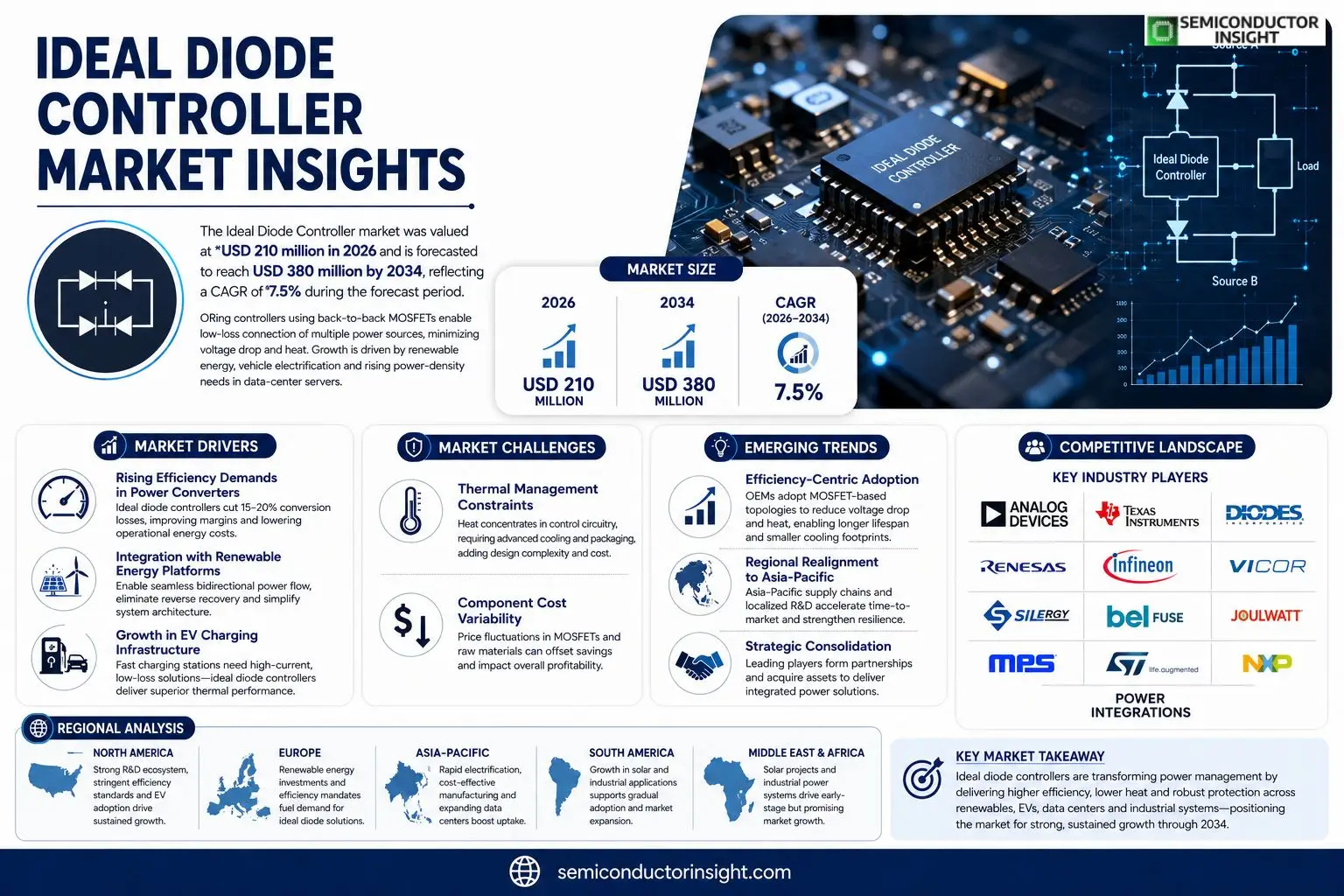
Ideal Diode Controller market was valued at USD 210 million in 2026 and is forecasted to reach USD 380 million by 2034, reflecting a compound annual growth rate of approximately 7.5 %.
An ORing controlleralso known as an ideal diode controllercreates near‑perfect diodes by using back‑to‑back N‑channel or P‑channel MOSFETs. This topology enables low‑loss connection of multiple power sources while keeping voltage drop and heat dissipation minimal, thereby improving overall system efficiency.The upward trajectory stems from expanding renewable‑energy installations, rising vehicle electrification and growing power‑density requirements in data‑center servers. Because designers seek tighter thermal budgets, manufacturers such as Analog Devices, Texas Instruments, Infineon Technologies and Diodes Incorporated have broadened their portfolios with MOSFET‑based solutions released throughout 2023–2026. Recent product launchesincluding ADP5070 series from Analog Devices and TPS25940 family from Texas Instrumentsillustrate the industry’s response to demand for higher voltage ratings and tighter control loops.
MARKET DRIVERS
Rising Efficiency Demands in Power Converters
Ideal Diode Controller Market is gaining traction as OEMs prioritize loss‑reduction strategies in DC‑DC converters. By replacing conventional diode bridges with ideal‑diode topologies, manufacturers can shave 15‑20 % off overall conversion losses, directly influencing product margins and end‑user energy bills. This efficiency edge is especially compelling for data‑center power supplies where every watt saved translates into measurable operational cost relief.
Integration with Renewable Energy Platforms
Solar‑filled micro‑grids and offshore wind farms rely on bidirectional power flow, a scenario where ideal‑diode controllers excel. Their ability to eliminate reverse‑recovery charge and provide seamless polarity protection simplifies system architecture, reducing bill‑of‑materials and accelerating time‑to‑market. As renewable capacity expands, system integrators are increasingly specifying these controllers to meet both performance and compliance checkpoints.
➤ “Adoption of ideal‑diode solutions can cut thermal design costs by up to 30 % while delivering superior reliability.”
Beyond efficiency and integration, the market is buoyed by the proliferation of electric‑vehicle (EV) charging infrastructure. Fast‑charging stations demand converters that handle high currents without overheating; ideal‑diode controllers meet that need, offering manufacturers a clear pathway to differentiate their charging solutions in a competitive arena.
MARKET CHALLENGES
Thermal Management Constraints
Although ideal‑diode topologies reduce conduction loss, they shift heat generation to the control circuitry. In high‑density power modules, dissipating this concentrated thermal load becomes a design bottleneck. Engineers often resort to sophisticated heat‑sink configurations or advanced packaging, which can erode the cost advantage that initially motivated the switch from traditional diodes.
Other Challenges
Component Cost Variability
The semiconductor components that underpin ideal‑diode controllersparticularly high‑speed MOSFETsexperience price fluctuations tied to wafer capacity. When silicon supply tightens, the incremental cost may offset expected savings, prompting some manufacturers to adopt a hybrid approach rather than a full migration.
MARKET RESTRAINTS
Regulatory Certification Hurdles
Entering markets such as aerospace or medical devices requires rigorous certification under standards like DO‑160 or IEC 60601. The validation process for ideal‑diode controllersespecially regarding reverse‑bias behavior under extreme transientsadds lead time and engineering effort. Companies lacking dedicated compliance teams may defer adoption, limiting market penetration in these high‑value segments.
MARKET OPPORTUNITIES
Emerging Automotive Electrification
Electric‑vehicle architectures, particularly those employing 48‑V mild‑hybrid systems, present a fertile avenue for Ideal Diode Controller Market. The need for compact, low‑loss power distribution units aligns perfectly with the advantages of ideal‑diode control. Early adopters are already demonstrating up to 10 % improvement in battery‑to‑motor efficiency, a metric that directly impacts vehicle range and consumer appeal.
Ideal Diode Controller Market Trends
Efficiency‑Centric Adoption in Power‑Management Systems
Ideal Diode Controller Market is being reshaped by a relentless push for higher power‑conversion efficiency across a spectrum of electronic platforms. By replacing traditional diode‑oriented ORing schemes with MOSFET‑based configurations, manufacturers are compressing voltage drop and curbing thermal dissipation. This engineering shift translates directly into lower operating costs for data‑center racks, telecom back‑haul equipment, and automotive power‑train modules, where every watt saved improves overall system economics. The trend is not merely a technical nuance; it creates a competitive lever for OEMs that can claim longer device lifespans and smaller cooling footprints, thereby opening pricing power in tightly contested segments.
Other Trends
Regional Realignment Towards Asia‑Pacific Supply Chains
Within Ideal Diode Controller Market, China and Japan are emerging as pivotal production hubs. Localized sourcing reduces lead times for high‑volume applications such as redundant power supplies in cloud infrastructure. Moreover, policy incentives in several Asian economies encourage domestic R&D, accelerating the rollout of next‑generation MOSFET architectures that further tighten loss margins. Entering firms that align their design cycles with these regional capabilities stand to gain faster time‑to‑market and enhanced resilience against trans‑Atlantic logistics disruptions.
Strategic Consolidation Among Tier‑One Suppliers
Competitive dynamics are nudging Ideal Diode Controller Market toward a modest consolidation phase. The leading seven playersanalogous to Analog Devices, Texas Instruments, and Infineon, among othershave increasingly pursued joint development agreements and selective asset acquisitions to broaden their product portfolios. This movement is driven by the need to offer integrated power‑management solutions rather than isolated controller blocks, satisfying OEM demand for turnkey designs. Consequently, clients can expect more cohesive reference designs and streamlined qualification processes, which in turn lower engineering overhead and expedite product launches.
COMPETITIVE LANDSCAPEKey Industry Players
Ideal Diode Controller Market – Competitive Overview
Analog Devices continues to dominate the ideal‑diode controller segment, leveraging its deep analog portfolio and strong relationships with original equipment manufacturers in telecom and data‑center power architectures. Its product line, built around high‑performance MOSFET‑based ORing solutions, benefits from a design‑win strategy that emphasizes low‑loss power distribution and integrated protection features. The company’s ability to offer silicon‑level reference designs and extensive application support has entrenched it as the de‑facto supplier for large‑scale redundant power systems, shaping a market structure where a handful of multinational firms capture the majority of revenue while smaller innovators focus on niche voltage regimes.Beyond the market leader, a diverse cohort of firms competes on specialization, regional reach, or cost advantage. Texas Instruments and Infineon Technologies target high‑voltage, automotive‑grade applications, pairing their controllers with robust power‑management IC families. Renesas Electronics and Diodes Incorporated have cemented positions in the low‑voltage, consumer‑electronics space by emphasizing compact footprints and simplified BOMs. European‑based Vicor and Silergy focus on modular power‑train solutions that integrate ideal‑diode functionality directly into DC‑DC converters. Emerging players such as Bel Fuse, Joulwatt, Monolithic Power Systems, STMicroelectronics, NXP Semiconductors, and Power Integrations provide differentiated value through proprietary topologies, aggressive pricing, or strategic partnerships with system integrators. The competitive tableau is therefore a mix of full‑line semiconductor giants and agile specialists, each exploiting distinct application trendsfrom data‑center redundancy to edge‑device efficiencyto capture market share.
List of Key Ideal Diode Controller Companies Profiled
- Analog Devices
- Texas Instruments
- Diodes Incorporated
- Renesas Electronics
- Infineon Technologies
- Vicor
- Silergy
- Bel Fuse
- Joulwatt
- Monolithic Power Systems
- STMicroelectronics
- NXP Semiconductors
- Power Integrations
Segment Analysis:
| Segment Category | Sub-Segments | Key Insights |
| By Type |
|
Low Voltage emerges as the dominant sub‑segment due to its extensive use in power‑efficient designs. Key qualitative drivers include:
|
| By Application |
|
(N+1) Redundant Power Supplies is the primary growth engine, underpinned by:
|
| By End User |
|
Automotive leads the end‑user segment, driven by:
|
| By Integration Level |
|
Integrated Modules are gaining traction because they:
|
| By Emerging Technology |
|
Smart Monitoring is emerging as a key differentiator, supported by:
|
Regional Analysis: Ideal Diode Controller Market
North America
Manufacturers cite the ability of ideal diode controllers to cut conduction losses as a decisive advantage, prompting design teams to replace traditional Schottky solutions in power‑conversion modules.
Stringent efficiency standards for automotive and grid‑connected inverters have nudged suppliers toward architectures that embed ideal diode control, reinforcing market uptake.
The convergence of silicon‑carbide devices with ideal diode circuitry offers a compelling performance envelope, spurring joint development programs among chipset manufacturers.
A diversified supplier base across the United States and Canada mitigates material shortages, ensuring steady component availability for high‑volume programs.
Europe
European OEMs have woven ideal diode controllers into a broad spectrum of renewable‑energy converters, driven by the bloc’s aggressive decarbonisation agenda. Design houses in Germany and France prioritize these devices for their fast recovery characteristics, which align with the strict harmonic distortion limits imposed by grid codes. The region’s collaborative research clusters, often funded through Horizon initiatives, accelerate the refinement of silicon‑based ideal diode topologies, positioning Europe as a hub for next‑generation efficiency solutions. Meanwhile, policy incentives that reward high‑efficiency power supplies create a fertile environment for niche suppliers to gain market foothold.
Asia‑Pacific
In the Asia‑Pacific, rapid electrification of transportation and soaring demand for data‑center capacity have catalysed interest in ideal diode controllers. Manufacturers in China, Japan, and South Korea exploit cost‑effective silicon processes to embed these controllers in compact power modules, enabling tighter form‑factors for consumer electronics. The region’s extensive semiconductor fabrication ecosystem shortens development timelines, while government programmes focused on smart‑grid infrastructure encourage the adoption of high‑efficiency power conversion techniques. Competitive pricing, coupled with emerging expertise in wide‑bandgap devices, positions Asia‑Pacific as a dynamic growth arena for the market.
South America
South American markets are beginning to acknowledge the operational advantages of ideal diode controllers, especially in off‑grid solar installations where reliability is paramount. Local utilities and renewable‑project developers value the reduced thermal stress and extended lifespan offered by these devices, which translate into lower OPEX over a plant’s lifetime. Brazil’s expanding manufacturing base for power electronics is fostering a modest supply chain, while regional trade agreements ease component importation, gradually lifting adoption barriers.
Middle East & Africa
The Middle East & Africa region leverages ideal diode controllers primarily within oil‑field power systems and emerging solar‑farm projects. Harsh environmental conditions demand robust solutions, and the intrinsic protection features of ideal diode controllers meet this requirement without excessive cooling infrastructure. Domestic investors in the United Arab Emirates and South Africa are piloting advanced inverter platforms that integrate these controllers, signaling an early‑stage but promising uptake that could broaden as regional grid codes evolve toward higher efficiency mandates.
Report Scope
This market research report provides a comprehensive analysis of the Ideal Diode Controller Market , covering the forecast period 2026–2034. It offers detailed insights into market dynamics, technological advancements, competitive landscape, and key trends shaping the industry.
Key focus areas of the report include:
- Market Overview: The report begins with an overview outlining its current market scenario, key growth indicators, and industry transformation drivers. It discusses macroeconomic factors, demand–supply balance, regulatory landscape, and the strategic role of semiconductors in powering advancements across industries such as automotive, telecommunications, consumer electronics, and industrial automation.
- Market Size & Forecast: Historical data and future projections for revenue, unit shipments, and market value across major regions and segments.
- Segmentation Analysis: Detailed breakdown by product type, technology, application, and end-user industry to identify high-growth segments and investment opportunities.
- Regional Insights: Insights into market performance across North America, Europe, Asia-Pacific, Latin America, and the Middle East & Africa, including country-level analysis where relevant.
- Competitive Landscape: Profiles of leading market participants, including their product offerings, R&D focus, manufacturing capacity, pricing strategies, and recent developments such as mergers, acquisitions, and partnerships.
- Technology Trends & Innovation: Assessment of emerging technologies, integration of AI/IoT, semiconductor design trends, fabrication techniques, and evolving industry standards.
- Market Drivers & Restraints: Evaluation of factors driving market growth along with challenges, supply chain constraints, regulatory issues, and market-entry barriers.
- Stakeholder Insights: Insights for component suppliers, OEMs, system integrators, investors, and policymakers regarding the evolving ecosystem and strategic opportunities.
Primary and secondary research methods are employed, including interviews with industry experts, data from verified sources, and real-time market intelligence to ensure the accuracy and reliability of the insights presented.
FREQUENTLY ASKED QUESTIONS:
What is the current market size of Ideal Diode Controller Market?
-> Ideal Diode Controller Market was valued at USD 210 million in 2026 and is forecasted to reach USD 380 million by 2034, reflecting a compound annual growth rate of approximately 7.5 %
Which key companies operate in Ideal Diode Controller Market?
-> Key players include Analog Devices (ADI), Texas Instruments, Diodes Incorporated, Renesas Electronics, Infineon Technologies, Vicor, Silergy, Bel Fuse, Joul Watt, among others.
What are the key growth drivers?
-> Key growth drivers include enhanced system efficiency, reduced heat dissipation, lower voltage drop, and rising demand for reliable power‑management solutions in data centers, telecom and automotive applications.
Which region dominates the market?
-> The United States market size is estimated at USD million in 2025, while China is projected to reach USD million, indicating strong activity in both North America and Asia‑Pacific.
What are the emerging trends?
-> Emerging trends include integration of ideal diode controllers in low‑voltage power architectures, increased use in redundant power‑supply designs, and expanding applications in telecom, data‑center and automotive electrification.

Get Sample Report PDF for Exclusive Insights
Report Sample Includes
- Table of Contents
- List of Tables & Figures
- Charts, Research Methodology, and more...