Hyperspectral Image Sensor (Linear, Snapshot) Market Insights
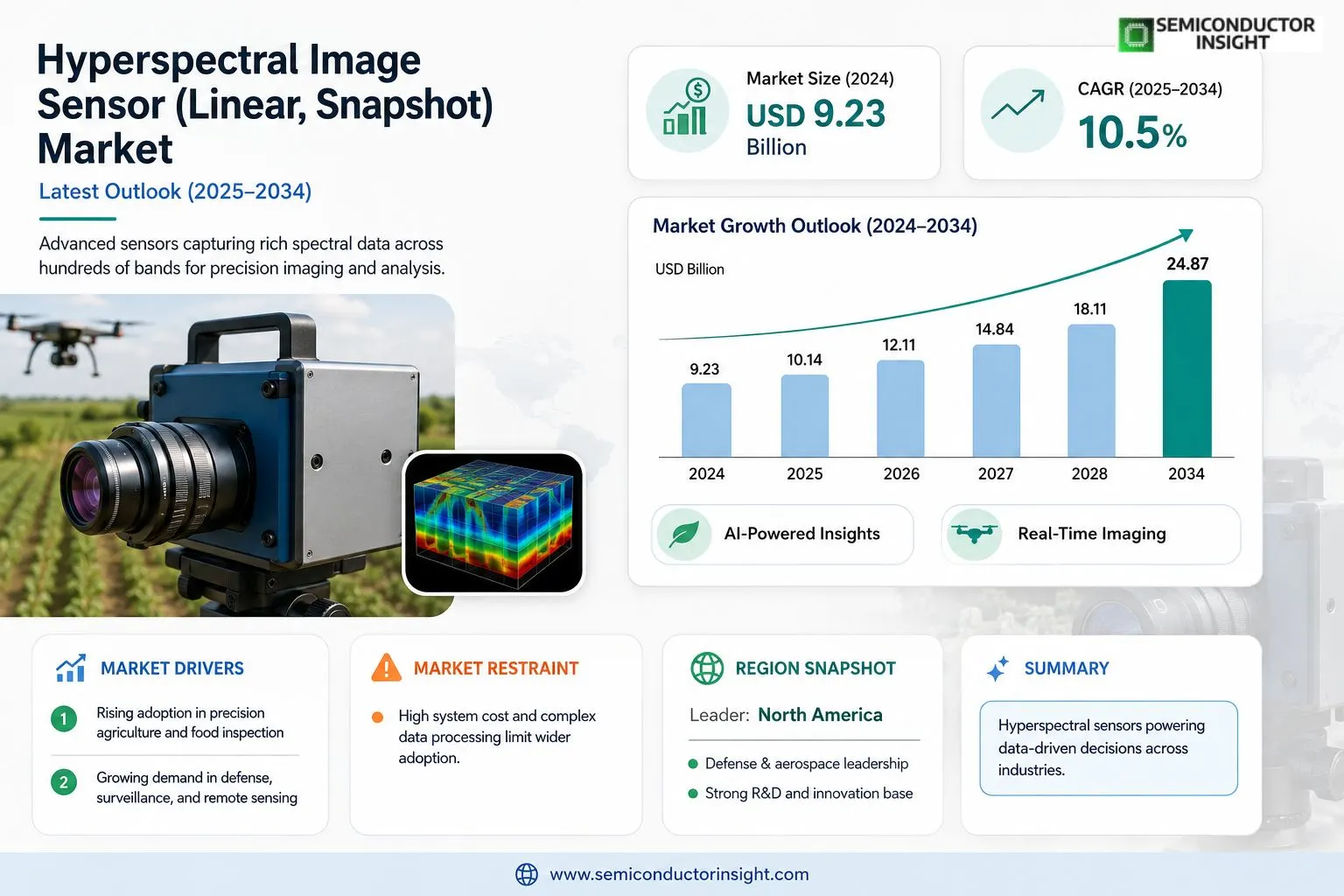
Global Hyperspectral Image Sensor (Linear, Snapshot) Market size was valued at USD 9.23 billion in 2024. The market is projected to grow from USD 10.14 billion in 2025 to USD 24.87 billion by 2034, exhibiting a CAGR of 10.5% during the forecast period.
Hyperspectral image sensors are advanced optical devices capable of capturing and processing light across a wide spectrum of wavelengths , far beyond what the human eye can perceive. Available in two primary configurations, linear (pushbroom) sensors and snapshot sensors, these instruments collect spectral data across hundreds of contiguous bands simultaneously. Linear sensors acquire data line-by-line as the sensor moves across a scene, while snapshot sensors capture the full spectral cube in a single exposure, enabling real-time imaging without mechanical scanning.
The market is witnessing robust growth driven by expanding adoption across precision agriculture, defense and surveillance, environmental monitoring, food quality inspection, and medical diagnostics. The increasing integration of hyperspectral imaging with artificial intelligence and machine learning platforms is significantly enhancing data interpretation capabilities, further accelerating deployment across industries. Key players operating in the market include Specim Spectral Imaging Ltd., Headwall Photonics, Teledyne DALSA, Resonon Inc., and BaySpec Inc., among others, each offering competitive portfolios tailored to both airborne and ground-based applications.
MARKET DRIVERS
Rising Adoption of Hyperspectral Imaging in Precision Agriculture and Food Quality Inspection
Hyperspectral Image Sensor (Linear, Snapshot) Market is experiencing robust growth driven by the accelerating adoption of hyperspectral imaging technologies across precision agriculture, food safety, and quality control applications. Both linear (pushbroom) and snapshot hyperspectral sensors are increasingly being deployed in drone-based and ground-level crop monitoring systems, enabling farmers and agronomists to detect plant stress, nutrient deficiencies, and disease outbreaks at early stages. The ability of these sensors to capture hundreds of spectral bands simultaneously provides a level of analytical depth that conventional RGB or multispectral cameras cannot match, making them indispensable tools in modern smart farming operations.
Expanding Role in Defense, Surveillance, and Remote Sensing Applications
Defense and intelligence agencies worldwide are significantly increasing their investments in airborne and satellite-based hyperspectral imaging systems, propelling demand for both linear and snapshot sensor configurations. Hyperspectral image sensors are used in target detection, camouflage identification, mineral mapping, and environmental monitoring from aerial platforms. Governments across North America, Europe, and Asia-Pacific are funding next-generation reconnaissance and earth observation programs that rely heavily on high-performance hyperspectral sensor arrays. This sustained defense and remote sensing demand represents one of the most consistent and capital-intensive growth drivers in the overall Hyperspectral Image Sensor Market.
➤ Snapshot hyperspectral sensors, which capture full spatial and spectral data in a single exposure, are gaining particular traction in dynamic, real-time industrial inspection environments where linear scanning is impractical due to moving targets or time constraints.
The pharmaceutical and life sciences sectors are also emerging as significant contributors to market growth. Hyperspectral image sensors are being integrated into pharmaceutical manufacturing lines for tablet coating inspection, counterfeit drug detection, and raw material verification. Their non-destructive, chemical-specific imaging capability aligns well with stringent regulatory quality standards, driving sustained procurement cycles. The intersection of hyperspectral sensing with artificial intelligence and machine learning-based spectral analysis is further amplifying the technology’s value proposition, reducing analysis time and enabling real-time decision-making on production floors.
MARKET CHALLENGES
High System Complexity and Substantial Upfront Capital Investment Limiting Wider Deployment
Despite compelling application prospects, Hyperspectral Image Sensor (Linear, Snapshot) Market faces notable challenges related to the high cost and complexity of complete hyperspectral imaging systems. Both linear and snapshot sensor configurations require precise optical components, spectral calibration hardware, high-performance computing infrastructure for data processing, and specialized software for spectral analysis. The total cost of ownership for an end-to-end hyperspectral imaging solution remains prohibitively high for small and medium-sized enterprises, particularly in developing markets. This financial barrier constrains the pace of market penetration in cost-sensitive industries and regions.
Data Volume, Processing Bottlenecks, and Shortage of Trained Spectral Analysis Specialists
Hyperspectral sensors generate exceptionally large datasets , a single snapshot hyperspectral sensor capturing hundreds of spectral bands per frame can produce data volumes that overwhelm conventional processing pipelines. The hyperspectral data cube processing demands significant computational resources and expertise in chemometrics, spectroscopy, and machine learning. A persistent shortage of professionals trained in hyperspectral data analysis creates operational bottlenecks for end users, slowing the realization of actionable insights and limiting the scalability of deployments across industries such as mining, environmental monitoring, and semiconductor inspection.
Other Challenges
Environmental Sensitivity and Calibration Drift
Both linear and snapshot hyperspectral image sensors are sensitive to environmental factors including temperature variations, illumination inconsistencies, and vibration, which can introduce spectral calibration drift over time. Maintaining measurement accuracy in field-deployed or airborne systems requires regular recalibration protocols, adding to operational cost and complexity. For industrial inline inspection systems, even minor calibration deviations can result in measurement errors that compromise product quality decisions.
Limited Standardization Across Sensor Platforms
The absence of universally accepted standards for spectral resolution, output data formats, and calibration methodologies across different hyperspectral image sensor manufacturers creates interoperability challenges. End users integrating sensors from multiple vendors or transitioning between linear and snapshot sensor architectures often encounter compatibility issues with existing data analysis software and workflows, increasing integration timelines and total deployment costs.
MARKET RESTRAINTS
Size, Weight, and Power Constraints Restricting Integration into Compact and UAV-Based Platforms
One of the primary restraints impacting Hyperspectral Image Sensor (Linear, Snapshot) Market is the physical form factor and power consumption characteristics of current sensor designs. Traditional linear hyperspectral sensors, while delivering high spectral and spatial resolution, tend to be bulkier and heavier than their multispectral counterparts, making integration into small unmanned aerial vehicles (UAVs), handheld devices, and satellite nanosatellites challenging. Although snapshot hyperspectral sensors offer a more compact form factor, they often involve trade-offs in spectral resolution or spatial coverage. These SWaP (Size, Weight, and Power) limitations constrain deployment flexibility, particularly in applications demanding miniaturized, field-portable solutions.
Competition from Multispectral and RGB-Based Imaging Alternatives in Cost-Sensitive Applications
In several application segments, hyperspectral image sensors face direct competition from lower-cost multispectral imaging systems that offer sufficient spectral discrimination for less demanding analytical tasks. In agricultural monitoring, for example, multispectral cameras delivering four to eight spectral bands are often considered adequate for vegetation index calculations, reducing the perceived necessity for full hyperspectral coverage. The significantly lower price point of multispectral sensors, combined with greater availability of off-the-shelf analysis tools, continues to restrain the addressable market for hyperspectral image sensors in price-sensitive or lower-complexity deployments.
Export Controls and Regulatory Restrictions on High-Performance Spectral Imaging Technologies
High-performance hyperspectral image sensors designed for defense, intelligence, and advanced remote sensing applications are frequently subject to stringent export control regulations, including restrictions under international arms control frameworks. These regulatory constraints limit the ability of manufacturers in the United States, Europe, and other major producing regions to sell advanced linear and snapshot hyperspectral sensor systems to certain international markets, effectively capping total addressable market size and complicating global distribution strategies for sensor vendors.
MARKET OPPORTUNITIES
Integration of Snapshot Hyperspectral Sensors with AI-Driven Inline Industrial Inspection Systems
The convergence of snapshot hyperspectral image sensors with artificial intelligence-powered image analysis platforms represents one of the most transformative opportunities in the current market landscape. As manufacturing industries accelerate their adoption of Industry 4.0 principles, demand is rising sharply for real-time, non-contact quality inspection systems capable of detecting chemical composition anomalies, surface defects, and contaminants at production line speeds. Snapshot hyperspectral sensors , by virtue of their ability to acquire complete spectral data cubes in a single frame , are uniquely suited to this inline inspection paradigm. Partnerships between hyperspectral sensor manufacturers and AI software developers are expected to unlock significant new revenue streams across semiconductor, plastics recycling, and specialty chemicals manufacturing sectors.
Miniaturization Trends and Growing Demand for Portable Hyperspectral Sensing Solutions
Advances in photonic integrated circuit technology, CMOS sensor fabrication, and optical filter manufacturing are enabling a new generation of miniaturized hyperspectral image sensors suitable for handheld, wearable, and smartphone-integrated applications. This miniaturization trend is opening previously inaccessible market segments including point-of-care medical diagnostics, field-based geological prospecting, counterfeit detection in retail environments, and consumer food safety testing. Companies developing compact linear and snapshot hyperspectral sensor modules that can interface with mobile computing platforms are positioned to address a rapidly expanding addressable market that extends well beyond traditional industrial and defense end-users.
Emerging Opportunities in Environmental Monitoring, Carbon Mapping, and Climate Science Applications
Growing global commitment to environmental sustainability, carbon accounting, and climate change mitigation is generating new institutional demand for hyperspectral imaging technologies in environmental monitoring applications. Space agencies, environmental research institutions, and governmental bodies are investing in hyperspectral satellite constellations and airborne survey programs designed to map greenhouse gas emissions, monitor deforestation, assess ocean health, and characterize mineral composition for critical raw material surveys. Both linear pushbroom sensors aboard satellite platforms and snapshot sensors used in airborne survey aircraft are benefiting from this policy-driven investment cycle, creating durable, long-term procurement opportunities for Hyperspectral Image Sensor Market participants with proven remote sensing heritage.
Hyperspectral Image Sensor (Linear, Snapshot) Market Trends
AI and Machine Learning Integration Reshaping Hyperspectral Data Analysis
One of the most transformative trends in Hyperspectral Image Sensor (Linear, Snapshot) Market is the deepening integration of artificial intelligence and machine learning with hyperspectral imaging platforms. Traditionally, processing the vast volumes of spectral data generated by linear and snapshot sensors required significant manual intervention and specialized expertise. Today, AI-driven algorithms are automating spectral classification, anomaly detection, and pattern recognition across hundreds of contiguous spectral bands, dramatically reducing time-to-insight. This convergence is particularly impactful in precision agriculture and medical diagnostics, where rapid, accurate data interpretation is critical. As AI frameworks become more accessible and computationally efficient, adoption of hyperspectral imaging systems across both airborne and ground-based applications is accelerating considerably.
Other Trends
Precision Agriculture Driving Demand for Real-Time Spectral Imaging
The agriculture sector has emerged as a significant end-user driving demand within Hyperspectral Image Sensor (Linear, Snapshot) Market. Snapshot sensors, which capture the full spectral cube in a single exposure without mechanical scanning, are increasingly deployed on drones and unmanned aerial vehicles for crop health monitoring, soil analysis, and yield estimation. Their ability to deliver real-time spectral data enables farmers and agronomists to make faster, more informed decisions regarding irrigation, fertilization, and pest management. Linear pushbroom sensors, on the other hand, remain preferred for large-scale aerial surveys where spatial resolution and spectral fidelity are paramount.
Expanding Role in Food Quality Inspection and Environmental Monitoring
Beyond agriculture, hyperspectral image sensors are gaining traction in food quality inspection and environmental monitoring applications. In food processing facilities, both linear and snapshot sensors are being utilized to detect contaminants, assess freshness, and ensure regulatory compliance , capabilities that conventional imaging technologies cannot match. Simultaneously, environmental agencies and research institutions are deploying hyperspectral sensors to monitor deforestation, water quality, and atmospheric pollution with unprecedented spectral precision. These broadening application areas are contributing to sustained demand across Hyperspectral Image Sensor (Linear, Snapshot) Market globally.
Defense, Surveillance, and Medical Diagnostics Fueling Market Momentum
Defense and surveillance represent another high-growth vertical influencing trends in Hyperspectral Image Sensor (Linear, Snapshot) Market. Military organizations are increasingly investing in airborne hyperspectral systems for target identification, camouflage detection, and battlefield intelligence gathering. Concurrently, the medical diagnostics sector is exploring the use of snapshot hyperspectral sensors for non-invasive tissue analysis, surgical guidance, and disease identification at the cellular level. Leading market participants including Specim Spectral Imaging Ltd., Headwall Photonics, Teledyne DALSA, Resonon Inc., and BaySpec Inc. continue to innovate their product portfolios to address the evolving requirements of these diverse and demanding end-use sectors.
COMPETITIVE LANDSCAPE
Key Industry Players
Hyperspectral Image Sensor (Linear, Snapshot) Market , Competitive Dynamics and Leading Innovators
Global hyperspectral image sensor market is characterized by a moderately consolidated competitive landscape, with a blend of established technology giants and specialized niche innovators vying for market share. Specim Spectral Imaging Ltd. maintains a prominent position as one of the foremost pioneers in pushbroom (linear) hyperspectral sensor technology, offering solutions widely adopted across precision agriculture, airborne remote sensing, and industrial inspection. Teledyne DALSA, backed by the broader Teledyne Technologies portfolio, brings significant manufacturing scale and R&D depth to both linear and snapshot sensor platforms, serving defense, scientific, and machine vision segments globally. Headwall Photonics is recognized for its ruggedized, compact hyperspectral imaging instruments engineered for UAV integration and field deployment, while Resonon Inc. provides competitively priced systems targeting academic, research, and industrial applications. The market’s growth trajectory , projected to reach USD 24.87 billion by 2034 at a CAGR of 10.5% , is intensifying competitive activity, with players increasingly integrating AI-driven spectral analysis pipelines to differentiate their offerings and expand addressable use cases across environmental monitoring, food quality inspection, and medical diagnostics.
Beyond the leading players, a number of specialized firms are carving out significant positions within targeted verticals. BaySpec Inc. has established credibility in snapshot hyperspectral sensors with compact form factors suited for pharmaceutical inspection and life sciences. Norsk Elektro Optikk (NEO) delivers advanced airborne hyperspectral systems with proven deployments in environmental and geological survey applications. Cubert GmbH focuses on snapshot imaging solutions, particularly for drone-based precision agriculture, while Perception Robic and Corning Inc. (through its subsidiary) contribute optical components and integrated sensor assemblies to the ecosystem. Photon etc. and Surface Optics Corporation cater to high-precision laboratory and defense-grade hyperspectral imaging requirements. The competitive intensity is further amplified by emerging players leveraging CMOS-based snapshot sensor architectures to reduce cost and enable real-time spectral capture, challenging incumbent linear sensor manufacturers and broadening the overall market’s commercial appeal.
List of Key Hyperspectral Image Sensor Companies Profiled
- Specim Spectral Imaging Ltd.
- Teledyne DALSA
- Headwall Photonics
- Resonon Inc.
- BaySpec Inc.
- Norsk Elektro Optikk AS (NEO)
- Cubert GmbH
- Photon etc.
- Surface Optics Corporation
- Corning Inc.
- Imec (Interuniversity Microelectronics Centre)
- Ximea GmbH
- Applied Spectral Imaging
- Perception Park GmbH
- inno-spec GmbH
Segment Analysis:
| Segment Category | Sub-Segments | Key Insights |
| By Type |
|
Linear (Pushbroom) Sensors dominate the hyperspectral image sensor market owing to their well-established maturity and proven reliability across a wide range of demanding deployment scenarios.
|
| By Application |
|
Precision Agriculture stands as the leading application segment, driven by the transformative role hyperspectral imaging plays in enabling data-driven crop management and sustainable farming practices.
|
| By End User |
|
Government and Defense Agencies represent the leading end user segment in the hyperspectral image sensor market, underpinned by substantial and sustained investment in intelligence, surveillance, and reconnaissance capabilities worldwide.
|
| By Platform |
|
Airborne Platforms (UAVs / Drones) have emerged as the dominant deployment platform for hyperspectral image sensors, fundamentally reshaping how spectral data is collected across diverse operational environments.
|
| By Spectral Range |
|
Visible and Near-Infrared (VNIR) sensors lead this segment by virtue of their broad applicability, cost-effectiveness, and compatibility with a wide range of commercial and scientific imaging scenarios.
|
Regional Analysis: Hyperspectral Image Sensor (Linear, Snapshot) Market
North America
North America’s defense sector remains one of the most significant end-users of hyperspectral image sensor technologies. Military surveillance, target identification, and battlefield intelligence applications have driven sustained procurement of both linear and snapshot sensor systems. Government contracts and classified research programs continue to push the performance boundaries of hyperspectral imaging, fostering innovation that eventually permeates commercial markets.
The agricultural heartlands of the United States and Canada have embraced hyperspectral image sensors to optimize crop health monitoring, soil analysis, and yield forecasting. Drone-mounted snapshot sensors enable rapid, large-area field assessments, while linear sensors support ground-based scanning equipment. This convergence of agri-tech and hyperspectral imaging is reshaping modern farming practices across the continent.
North American food processing and industrial manufacturing sectors are rapidly integrating hyperspectral image sensors into quality control workflows. The ability to detect contaminants, assess material composition, and identify product defects without physical contact makes both linear and snapshot sensor formats highly attractive. Regulatory pressures around food safety and product consistency are further accelerating adoption across processing plants and packaging facilities.
The concentration of world-class universities, national laboratories, and technology incubators across North America creates a fertile environment for hyperspectral sensor innovation. Collaborative research initiatives between institutions such as NASA, NIST, and leading universities continue to yield advances in sensor miniaturization, spectral resolution, and real-time data processing , directly influencing the commercial trajectory of the hyperspectral image sensor market.
Europe
Europe represents the second most mature regional market for hyperspectral image sensor technologies, underpinned by a tradition of precision engineering, strong environmental policy frameworks, and robust public investment in earth observation programs. The European Space Agency’s ongoing satellite missions have created substantial demand for high-performance linear hyperspectral sensors, while the region’s automotive and pharmaceutical industries are exploring snapshot sensor formats for quality assurance applications. Germany, France, and the Netherlands are recognized hubs for optical and photonics manufacturing, enabling regional producers to compete at a global level. The European Union’s emphasis on sustainable agriculture and environmental compliance has further expanded the addressable market, with hyperspectral imaging being deployed for land use monitoring, forestry management, and water quality assessment. As regulatory standards around material traceability and product authenticity tighten, European manufacturers across multiple verticals are expected to deepen their reliance on hyperspectral image sensor solutions through 2034.
Asia-Pacific
Asia-Pacific is emerging as the fastest-growing regional market in Global hyperspectral image sensor landscape, propelled by rapid industrialization, expanding agricultural sectors, and aggressive government investment in remote sensing infrastructure. China has made particularly significant strides, with state-backed programs funding the development and deployment of hyperspectral satellite and UAV systems for environmental monitoring and resource management. Japan and South Korea contribute through their advanced electronics manufacturing capabilities, enabling cost-competitive production of both linear and snapshot sensor components. India’s growing interest in precision agriculture and disaster management is further broadening the regional demand base. As the Asia-Pacific region intensifies its focus on food security, urbanization management, and industrial automation, the hyperspectral image sensor market is poised for sustained and accelerating expansion across diverse application segments.
South America
South America presents a developing but strategically significant market for hyperspectral image sensor technologies, with growth primarily anchored in the region’s vast agricultural and mining industries. Brazil, as the region’s largest economy, is at the forefront of adopting hyperspectral imaging for soybean, sugarcane, and coffee crop monitoring, where spectral data enables more precise input management and yield optimization. Argentina and Chile are similarly exploring sensor-based solutions for viticulture and livestock management. The mining-rich nations of Peru and Chile have identified hyperspectral sensors as valuable tools for mineral mapping and exploration efficiency. While infrastructure limitations and import dependency pose near-term constraints, increasing engagement from international technology providers and multilateral development programs is expected to gradually expand hyperspectral image sensor penetration across South America’s key productive sectors through the forecast period.
Middle East & Africa
The Middle East and Africa region occupies an early-stage but opportunity-rich position in Global hyperspectral image sensor market. In the Middle East, nations such as the UAE and Saudi Arabia are channeling investment into smart agriculture and environmental monitoring as part of broader economic diversification strategies, creating initial demand for hyperspectral imaging solutions. Remote sensing applications for oil and gas exploration also represent a meaningful entry point for linear sensor technologies in the Gulf region. Across Africa, hyperspectral image sensors are gaining traction in applications related to land degradation monitoring, mineral exploration, and food security assessment , sectors of critical national importance. While market development is constrained by limited local manufacturing capacity and technology awareness, international partnerships, satellite data access programs, and development-focused funding initiatives are gradually building a foundation for longer-term hyperspectral sensor market growth across the region.
Report Scope
This market research report provides a comprehensive analysis of the Hyperspectral Image Sensor (Linear, Snapshot) Market , covering the forecast period 2026–2034. It offers detailed insights into market dynamics, technological advancements, competitive landscape, and key trends shaping the industry.
Key focus areas of the report include:
- Market Overview: The report begins with an overview outlining its current market scenario, key growth indicators, and industry transformation drivers. It discusses macroeconomic factors, demand–supply balance, regulatory landscape, and the strategic role of semiconductors in powering advancements across industries such as automotive, telecommunications, consumer electronics, and industrial automation.
- Market Size & Forecast: Historical data and future projections for revenue, unit shipments, and market value across major regions and segments.
- Segmentation Analysis: Detailed breakdown by product type, technology, application, and end-user industry to identify high-growth segments and investment opportunities.
- Regional Insights: Insights into market performance across North America, Europe, Asia-Pacific, Latin America, and the Middle East & Africa, including country-level analysis where relevant.
- Competitive Landscape: Profiles of leading market participants, including their product offerings, R&D focus, manufacturing capacity, pricing strategies, and recent developments such as mergers, acquisitions, and partnerships.
- Technology Trends & Innovation: Assessment of emerging technologies, integration of AI/IoT, semiconductor design trends, fabrication techniques, and evolving industry standards.
- Market Drivers & Restraints: Evaluation of factors driving market growth along with challenges, supply chain constraints, regulatory issues, and market-entry barriers.
- Stakeholder Insights: Insights for component suppliers, OEMs, system integrators, investors, and policymakers regarding the evolving ecosystem and strategic opportunities.
Primary and secondary research methods are employed, including interviews with industry experts, data from verified sources, and real-time market intelligence to ensure the accuracy and reliability of the insights presented.
FREQUENTLY ASKED QUESTIONS:
What is the current market size of Hyperspectral Image Sensor (Linear, Snapshot) Market?
-> Global Hyperspectral Image Sensor (Linear, Snapshot) Market size was valued at USD 9.23 billion in 2024. The market is projected to grow from USD 10.14 billion in 2025 to USD 24.87 billion by 2034, exhibiting a CAGR of 10.5% during the forecast period.
Which key companies operate in Hyperspectral Image Sensor (Linear, Snapshot) Market?
-> Key players include Specim Spectral Imaging Ltd., Headwall Photonics, Teledyne DALSA, Resonon Inc., and BaySpec Inc., among others, each offering competitive portfolios tailored to both airborne and ground-based applications.
What are the key growth drivers?
-> Key growth drivers include expanding adoption across precision agriculture, defense and surveillance, environmental monitoring, food quality inspection, and medical diagnostics, along with the increasing integration of hyperspectral imaging with artificial intelligence and machine learning platforms that significantly enhance data interpretation capabilities.
Which region dominates the market?
-> Asia-Pacific is among the fastest-growing regions in Hyperspectral Image Sensor (Linear, Snapshot) Market, driven by increasing investments in defense, agriculture, and industrial automation, while North America remains a dominant market owing to advanced technological infrastructure and strong defense sector demand.
What are the emerging trends?
-> Emerging trends include integration of AI and machine learning with hyperspectral imaging systems, adoption of snapshot sensors for real-time imaging without mechanical scanning, and growing deployment of linear (pushbroom) sensors in airborne and ground-based applications across industries such as environmental monitoring and medical diagnostics.

Get Sample Report PDF for Exclusive Insights
Report Sample Includes
- Table of Contents
- List of Tables & Figures
- Charts, Research Methodology, and more...