Hot Swap Controller Market Insights
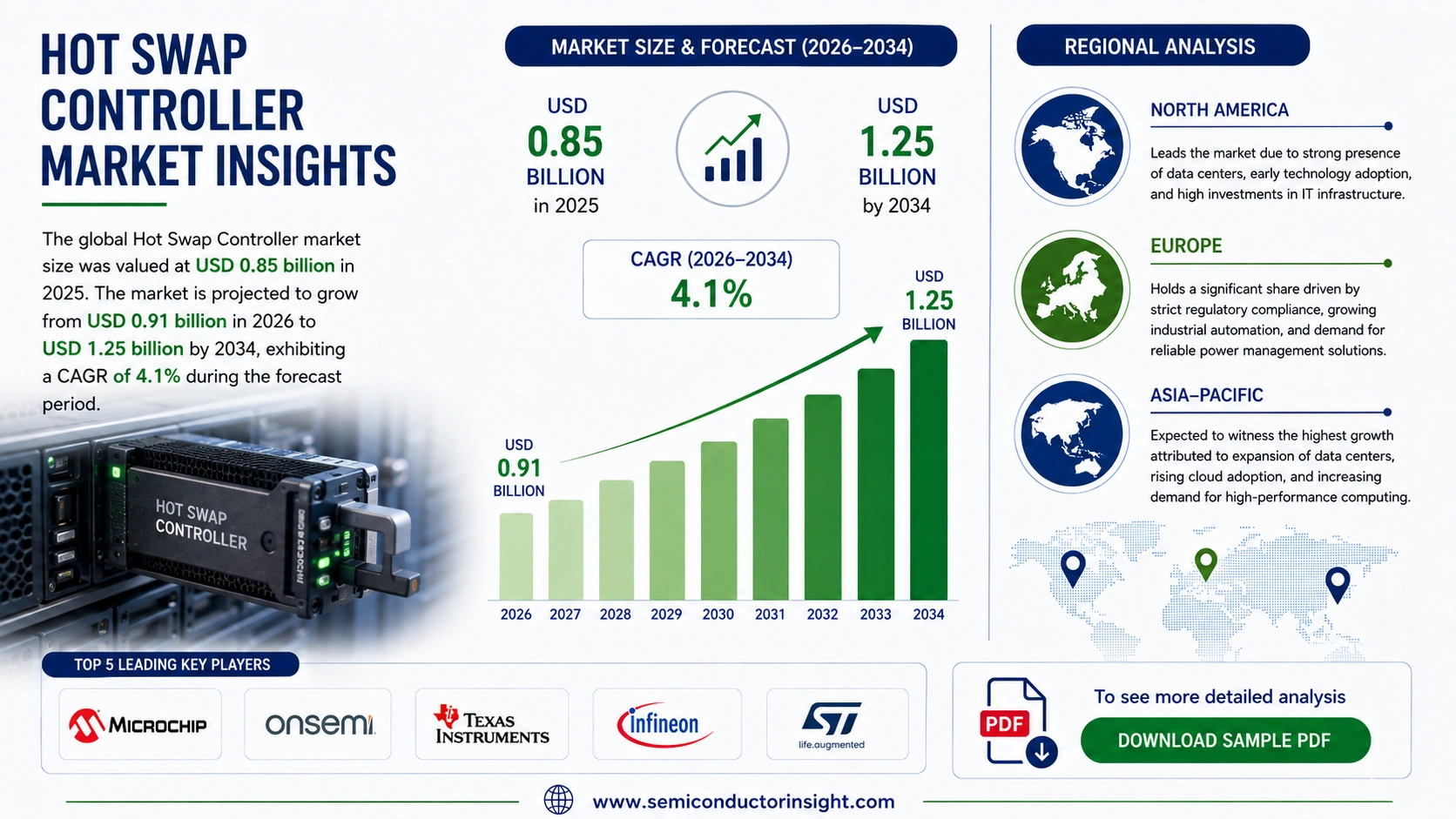
Hot Swap Controller Market size was valued at USD 0.85 billion in 2025. The market is projected to grow from USD 0.91 billion in 2026 to USD 1.25 billion by 2034, exhibiting a CAGR of 4.1% during the forecast period.
Hot swap controllers are specialized integrated circuits designed to facilitate the safe insertion and removal of circuit boards or components from a live system without interrupting overall operation. These devices manage inrush current limiting, overcurrent protection, and voltage monitoring to prevent damage to the backplane or other connected components during hot-swapping processes. Common applications include data centers, telecommunications equipment, servers, industrial automation systems, and high-availability computing environments where continuous uptime is critical.
The market is experiencing steady growth due to several factors, including the rapid expansion of data center infrastructure driven by cloud computing and AI workloads, increasing demand for reliable power management in telecom and networking equipment, and the need for enhanced system reliability in industrial settings. Furthermore, advancements in power electronics and the proliferation of modular system designs are contributing to market expansion. Key players continue to innovate with more efficient and programmable solutions. For instance, leading companies are focusing on controllers that support higher voltage architectures suitable for modern AI servers. Texas Instruments, Analog Devices, Microchip Technology, and Infineon Technologies are some of the key players that operate in the market with a wide range of portfolios.
MARKET DRIVERS
Expansion of Hyperscale Data Centers
Hot Swap Controller Market is experiencing robust growth primarily driven by the rapid expansion of hyperscale data centers worldwide. These facilities require advanced power management solutions to ensure uninterrupted operations during component maintenance or upgrades. Hot swap controllers enable seamless insertion and removal of boards in live systems, minimizing downtime in mission-critical environments supporting cloud computing and AI workloads.
Rising Demand for Reliable Power Management
Continuous innovation in electronic systems, including servers, storage, network switches, and telecom equipment, has increased the need for sophisticated hot swap solutions. Manufacturers are launching new products with enhanced features like digital telemetry and higher voltage handling to meet evolving industry requirements. The proliferation of 5G infrastructure and industrial automation further accelerates adoption across telecommunications and manufacturing sectors.
➤ The market is forecast to grow at a CAGR of approximately 8.2% between 2024 and 2029, adding USD 469.1 million in value.
Additional momentum comes from the automotive sector, particularly electric vehicles and advanced driver-assistance systems, where reliable power distribution is essential for safety and performance. These factors collectively position Hot Swap Controller Market for sustained expansion.
MARKET CHALLENGES
Thermal Management Issues
Thermal management remains a significant hurdle Hot Swap Controller Market. High-power density designs in modern systems generate substantial heat during hot swap operations, potentially leading to performance degradation or component failure. Designers must implement effective cooling strategies in compact environments like data center racks.
Other Challenges
Integration Complexity
Incorporating hot swap controllers into existing legacy systems can be technically demanding, requiring careful engineering to maintain signal integrity and power efficiency.
Supply Chain and Regulatory Pressures
Fluctuations in semiconductor component availability and evolving global standards for energy efficiency and safety add layers of complexity for market participants.
MARKET RESTRAINTS
High Implementation Costs
Advanced hot swap controllers with features such as overcurrent protection, telemetry, and high-voltage capabilities command premium pricing. This can restrain adoption, particularly among smaller enterprises or in cost-sensitive consumer electronics applications withHot Swap Controller Market.
Integration challenges with space-constrained or power-budget-limited designs further limit widespread deployment in certain segments.
MARKET OPPORTUNITIES
Emerging Technologies and IoT Expansion
Hot Swap Controller Market presents substantial opportunities through the growth of IoT devices, edge computing, and renewable energy systems. These applications demand flexible, reliable power solutions that support modular maintenance without service interruption.
Advancements in electric vehicles and smart manufacturing create new avenues for specialized controllers, while ongoing digital transformation initiatives continue to drive demand for high-availability infrastructure.
Hot Swap Controller Market Trends
Data Center Expansion Driving Demand for Advanced Hot Swap Solutions
Hot Swap Controller Market continues to evolve as data center infrastructure expands rapidly to support cloud computing and artificial intelligence workloads. These specialized integrated circuits enable safe insertion and removal of circuit boards in live systems, managing inrush current limiting, overcurrent protection, and voltage monitoring to maintain operational continuity. As hyperscale facilities prioritize high-availability architectures, hot swap controllers have become essential for preventing damage during maintenance and upgrades without system downtime.
Other Trends
Telecommunications and Networking Equipment Modernization
Telecommunications providers are increasingly adopting hot swap technology to enhance reliability in networking equipment. Hot swap controllers facilitate seamless power management in modular systems where continuous uptime is non-negotiable. This trend is supported by the rollout of 5G infrastructure and edge computing deployments, which require robust power solutions capable of handling dynamic load conditions.
Industrial Automation and High-Availability Systems
In industrial settings, the need for enhanced system reliability is accelerating the integration of hot swap controllers. Manufacturing facilities and automation systems utilize these devices to minimize operational disruptions during component replacement. The focus on Industry 4.0 initiatives further reinforces demand for power management solutions that support modular and scalable designs.
Technological Innovations in Power Electronics
Manufacturers Hot Swap Controller Market are advancing programmable and efficient solutions tailored for modern applications. Innovations include support for higher voltage architectures suitable for AI servers and next-generation computing environments. Leading companies such as Texas Instruments, Analog Devices, Microchip Technology, and Infineon Technologies continue to expand their portfolios with devices that offer improved monitoring capabilities and integration features. The shift toward modular system designs across multiple sectors is creating sustained opportunities for these specialized components, as organizations prioritize both performance and reliability in power delivery systems.
COMPETITIVE LANDSCAPE
Key Industry Players
Competitive Landscape of Hot Swap Controller Market
Hot Swap Controller Market is moderately consolidated, with leading semiconductor companies dominating through extensive product portfolios, technological innovation, and strong presence in data centers, telecommunications, and industrial automation sectors. Texas Instruments and Analog Devices stand out as primary market leaders, leveraging advanced power management solutions that offer superior inrush current limiting, precise monitoring, and high-voltage support tailored for AI-driven server infrastructure and high-availability systems.
Other significant players focus on niche applications and specialized features, including programmable controllers and integration with broader power management ICs. Companies such as Infineon Technologies, Microchip Technology, and ON Semiconductor continue to expand their offerings to address growing demands for system reliability and modular designs, fostering competitive dynamics centered on efficiency, safety features, and compatibility with next-generation power architectures.
List of Key Hot Swap Controller Companies Profiled
- Texas Instruments
- Analog Devices
- Infineon Technologies
- Microchip Technology
- ON Semiconductor
- Renesas Electronics
- NXP Semiconductors
- STMicroelectronics
- Monolithic Power Systems
- Semtech Corporation
- Allegro MicroSystems
- ROHM Semiconductor
- Diodes Incorporated
- Alpha and Omega Semiconductor
- Vicor Corporation
Segment Analysis:
| Segment Category | Sub-Segments | Key Insights |
| By Type |
|
Digital Hot Swap Controllers represent the leading segment due to their superior monitoring capabilities and integration with system management buses. These controllers provide real-time telemetry on voltage, current, and power metrics, enabling proactive fault detection in mission-critical environments. They facilitate seamless communication with microcontrollers and host processors for enhanced system intelligence. Their flexibility in configuration supports complex power architectures common in modern modular designs, making them ideal for applications requiring precise control and diagnostics. |
| By Application |
|
Data Centers and Servers emerge as the dominant application segment. These controllers ensure uninterrupted operation during board insertion and removal in high-availability computing setups. They effectively manage inrush currents and provide robust protection against faults in dense server racks powered by demanding AI and cloud workloads. Their implementation supports hot-pluggable power supplies and storage modules, enhancing overall system reliability and maintainability in environments where downtime carries significant operational impact. |
| By End User |
|
IT and Telecom Service Providers constitute the leading end-user segment. These organizations prioritize solutions that maintain continuous uptime in core network infrastructure and computing facilities. Hot swap controllers enable safe maintenance procedures without service interruptions, which is vital for meeting stringent service level agreements. They integrate effectively with existing power distribution systems in carrier-grade equipment and large-scale data processing centers, delivering the reliability necessary for handling massive data traffic and critical communications workloads. |
| By Voltage Rating |
|
High Voltage Controllers lead this category as they accommodate the elevated power requirements of contemporary server architectures and advanced computing platforms. These devices offer superior protection margins for systems operating at higher bus voltages while maintaining safe insertion and removal processes. They support robust thermal management and fault isolation features essential for power-hungry applications. Their design flexibility allows seamless adaptation to evolving platform specifications in data-intensive environments. |
| By Channel Configuration |
|
Multi-Channel Controllers stand out as the preferred choice for sophisticated power management needs. They consolidate control functions across multiple power rails within a single device, reducing component count and board space requirements. This configuration streamlines system design while providing coordinated protection and sequencing capabilities. Their use promotes higher efficiency in densely packed electronic assemblies where synchronized hot-swap operations across various subsystems are necessary for optimal performance and reliability. |
Regional Analysis: Hot Swap Controller Market
Asia-Pacific
The region benefits from concentrated innovation clusters in Taiwan, South Korea, and China that foster rapid prototyping and deployment of sophisticated hot swap controllers. Companies leverage proximity to component suppliers to reduce development cycles and integrate advanced protection features against power surges and thermal issues.
Massive rollout of hyperscale data centers and 5G base stations creates continuous opportunities for hot swap solutions. Business strategies center on providing reliable power management that minimizes downtime in mission-critical environments across rapidly urbanizing markets.
Deep vertical integration allows regional manufacturers to control quality and customization for hot swap controllers. Strategies focus on building resilient local ecosystems that respond quickly to evolving requirements in automotive and industrial sectors.
Growing emphasis on green electronics drives development of low-power hot swap controllers. Market participants align strategies with regional carbon reduction goals through efficient designs that support energy-conscious data centers and industrial applications.
North America
North America maintains a strong position Hot Swap Controller Market through its leadership in high-end server technologies and enterprise data infrastructure. The region excels in developing premium solutions featuring intelligent monitoring and predictive maintenance capabilities. Companies prioritize robust compliance with stringent safety standards while innovating for edge computing and AI-driven workloads. Business strategies often revolve around strategic partnerships with cloud service providers to embed advanced hot swap functionality directly into next-generation hardware platforms. Emphasis on cybersecurity integration within power management systems further differentiates offerings in this mature yet innovative market landscape.
Europe
Europe demonstrates steady growth Hot Swap Controller Market, supported by its advanced industrial automation sector and commitment to digital sovereignty. Regulatory frameworks encouraging energy efficiency shape product development toward controllers with superior thermal management and minimal standby power consumption. Regional strategies focus on serving telecommunications operators upgrading legacy infrastructure and automotive manufacturers transitioning to electric platforms. Collaborative research initiatives between academia and industry accelerate the adoption of cutting-edge hot swap technologies tailored for harsh industrial environments and sustainable data center operations across the continent.
South America
South America is emerging as a promising area withHot Swap Controller Market as countries expand their telecommunications and renewable energy infrastructure. Market dynamics reflect increasing investments in reliable power systems for mining operations and expanding data connectivity projects. Local enterprises and international players are adapting strategies to address unique environmental challenges while delivering cost-effective solutions. The focus remains on building foundational capabilities in power management technologies that support long-term regional digital transformation goals and industrial modernization efforts through the forecast period.
Middle East & Africa
The Middle East and Africa region shows accelerating interest in Hot Swap Controller solutions amid ambitious smart city initiatives and oil & gas sector digitalization. Strategic investments in data centers to support growing digital economies drive demand for reliable hot-plug capabilities. Business approaches emphasize partnerships for technology transfer and localization to serve remote industrial sites and telecommunications expansions. The market benefits from government-backed infrastructure projects that require uninterrupted power systems, positioning hot swap controllers as essential components in building resilient technological foundations across diverse climatic and operational conditions.
Report Scope
This market research report provides a comprehensive analysis of the Hot Swap Controller Market , covering the forecast period 2026–2034. It offers detailed insights into market dynamics, technological advancements, competitive landscape, and key trends shaping the industry.
Key focus areas of the report include:
- Market Overview: The report begins with an overview outlining its current market scenario, key growth indicators, and industry transformation drivers. It discusses macroeconomic factors, demand–supply balance, regulatory landscape, and the strategic role of semiconductors in powering advancements across industries such as automotive, telecommunications, consumer electronics, and industrial automation.
- Market Size & Forecast: Historical data and future projections for revenue, unit shipments, and market value across major regions and segments.
- Segmentation Analysis: Detailed breakdown by product type, technology, application, and end-user industry to identify high-growth segments and investment opportunities.
- Regional Insights: Insights into market performance across North America, Europe, Asia-Pacific, Latin America, and the Middle East & Africa, including country-level analysis where relevant.
- Competitive Landscape: Profiles of leading market participants, including their product offerings, R&D focus, manufacturing capacity, pricing strategies, and recent developments such as mergers, acquisitions, and partnerships.
- Technology Trends & Innovation: Assessment of emerging technologies, integration of AI/IoT, semiconductor design trends, fabrication techniques, and evolving industry standards.
- Market Drivers & Restraints: Evaluation of factors driving market growth along with challenges, supply chain constraints, regulatory issues, and market-entry barriers.
- Stakeholder Insights: Insights for component suppliers, OEMs, system integrators, investors, and policymakers regarding the evolving ecosystem and strategic opportunities.
Primary and secondary research methods are employed, including interviews with industry experts, data from verified sources, and real-time market intelligence to ensure the accuracy and reliability of the insights presented.
FREQUENTLY ASKED QUESTIONS:
What is the current market size of Hot Swap Controller Market?
-> Hot Swap Controller Market was valued at USD 0.85 billion in 2025 and is expected to reach USD 1.25 billion by 2034.
Which key companies operate Hot Swap Controller Market?
-> Key players include Texas Instruments, Analog Devices, Microchip Technology, and Infineon Technologies, among others.
What are the key growth drivers?
-> Key growth drivers include rapid expansion of data center infrastructure driven by cloud computing and AI workloads, increasing demand for reliable power management in telecom and networking equipment, and the need for enhanced system reliability in industrial settings.
Which region dominates the market?
-> Asia-Pacific is the fastest-growing region, while North America remains a dominant market.
What are the emerging trends?
-> Emerging trends include advancements in power electronics, programmable solutions, and higher voltage architectures suitable for modern AI servers.

Get Sample Report PDF for Exclusive Insights
Report Sample Includes
- Table of Contents
- List of Tables & Figures
- Charts, Research Methodology, and more...
 Download Sample Report PDF