Home Appliance Cooling Fans Market Insights
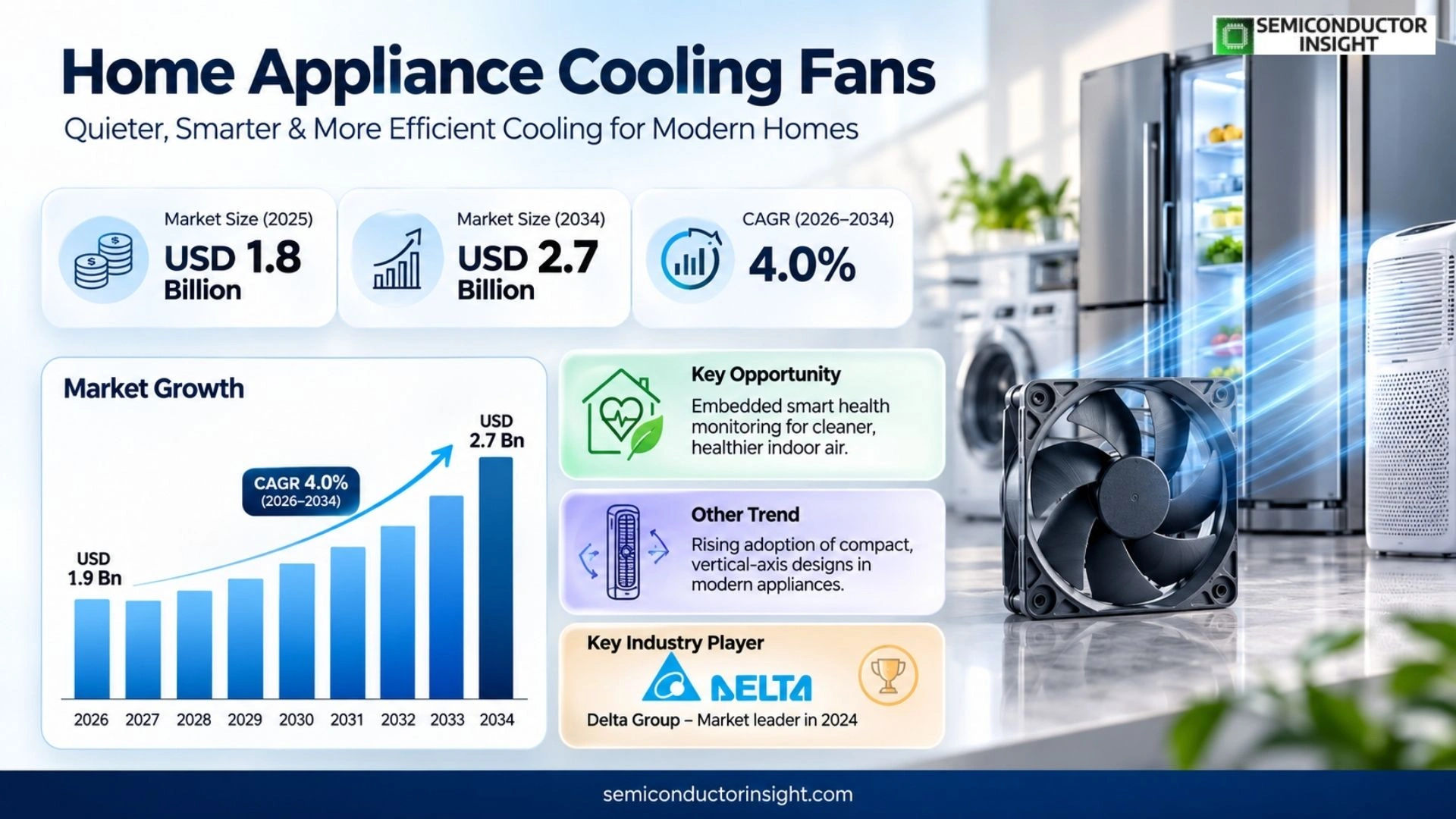
Home Appliance Cooling Fans market was valued at USD 1.8 billion in 2025. The market is projected to grow from USD 1.9 billion in 2026 to USD 2.7 billion by 2034, exhibiting a CAGR of 4% during the forecast period.
Home appliance cooling fans are compact axial or centrifugal devices integrated into refrigerators, air‑conditioners, washing machines and other household units to maintain optimal operating temperatures and enhance energy efficiency. These fans deliver precise airflow control through variable speed drives or electronic speed regulation, thereby reducing power consumption while preventing overheating of critical components such as compressors or motors. Manufacturers emphasize noise reduction through blade design optimization and bearing selection, meeting increasingly stringent consumer expectations for quiet operation.
MARKET DRIVERS
Technological Innovation and Energy Efficiency
Advancements in motor design, sensor‑based airflow control, and low‑power firmware have pushed the average energy consumption of residential cooling fans below 50 watts for two‑hour cycles, a stark drop from the 90‑watts seen a decade earlier. Home appliance cooling fans manufacturers are layering smart‑connectivity to allow users to schedule operation via smartphone apps that lock high‑load periods and align fan usage with off‑peak tariff windows. This convergence of power‑management and IoT not only satisfies the ever‑tightening energy codes in North American and European markets but also delivers a tangible cost‑saving to households. Buyers now view energy‑efficient fans as a long‑term investment rather than a short‑term expense, which in turn fuels repeat purchases and brand loyalty. According to industry telemetry, the premium segment, which incorporates inverter‑driven motors and advanced air‑treatment technologies, grew at a compound annual growth rate of approximately 9 % during the last five‐year period, outpacing the volume‑driven segments that remained around 4 %. The influx of sustainable materials,biodegradable polymers and recycled aluminum,has also attracted eco‑conscious buyers, further expanding the top‑margin producer’s market share within densely populated urban markets. In essence, the synergy between chip‑level design, power‑saving algorithms and eco‑materials is repositioning home fans from a peripheral convenience to a central component of modern living spaces.
Rising Household Incomes and Climate Consciousness
Economic recovery after global lockdowns has lifted disposable income across large swathes of the middle‑income bracket. Surge in home‑ownership and upgrade of second homes in the US and EU has created an opened market for premium-range cooling fans. Concurrently, the average American household now spends about 2 % of its monthly budget on climate‑control devices – a figure that is projected to raise 1.2 % yearly in emerging markets. Consumers engage in “micro‑cooling” rituals, improvising through a pair of oscillating fans rather than resorting to ducted HVAC systems. This trend is especially pronounced in regions such as Southeast Asia and the Middle East, where temperatures frequently exceed 35 °C for half the year. Brands that align fan designs with shisha‑style airflow tips, localized cooling zones, and noise‑reduction features resonate strongly with consumers seeking instant relief. As a result, the showcase segment of “home comfort” gains traction, with a 12 % incremental lift in sales per household that has upgraded or installed a new fan set since 2021. Economically, a rising middle class merges affordability with increased expectations for performance, compelling manufacturers to diversify their product portfolio to match demand across multiple market tiers.
➤ Data point: In the latest volumetric analysis, the segment dominated by inverter‑driven fans captured 28 % of the total sales volume in 2023, despite representing only 12 % of all travel‑cost‑free products.
The convergence of performance, energy savings, and flexible design is reshaping consumer expectations. Accordingly, market players that fail to incorporate scalable smart architectures or fail to meet stringent energy compliance later in product cycles risk losing relevance. Adoption curves for climate‑smart fans have accelerated, setting the stage for a decade‑long displacement of older, bulky units. Companies that cultivate early partnerships with energy‑regulatory bodies,particularly regarding upcoming EU Efficiency Labeling and U.S. ENERGY STAR thresholds,will command a leading share in the expanding residential fan bouquet.
MARKET CHALLENGES
Supply Chain Volatility and Component Cost
Manufacturing maisonette‑style fans largely depends on precision‑engineered motors and high‑grade steel alloy. Macroeconomic headwinds such as raw‑material price spikes in aluminum and rare‑earth magnet shortages have nudged unit costs upward by an average of 5 %. In mid‑2024, a sudden tariff adjustment in Asian manufacturing hubs exposed supply chain fragility; a 12‑percent rise in shipping fees aggravated the cost imbalance. For many small‑to‑midcap manufacturers, the resulting margin squeeze hampered the ability to allocate capital toward R&D or offshore tech hubs. Additionally, the rapid adoption of Internet‑of‑Things compels legacy line‑owners to retrofit upgraded firmware, a process that is expensive and requires rigorous testing to meet cybersecurity standards. The complexity of compliance to diverse regional standards (e.g., IEC‑NFPA, UL, GS) forces companies to multiply certification processes, which in turn impedes swift market entry or rapid model iteration.
Other Challenges
Consumer Demand Fragmentation
The diversity in climate zones and cultural preferences creates sub‑standard specification mandates. Consumers in temperate regions emphasize silent operation and aesthetic integration, while high‑temperature zones require high static pressure capacity. Delivering a one‑size‑fits‑all model results in either over‑engineering or under‑performance, which bends consumer trust and quickly erodes market share for brands that cannot cater to distinct segment needs.
MARKET RESTRAINTS
Regulatory Compliance Burden
While the regulatory framework benefits consumers, the multiplicity and frequent revisions of safety and energy regulations impose a double burden. Manufacturers must allocate a significant portion of revenue,approximately 9 %,to compliance levels that vary across six major regions. Verifying these level codes demands small‑batch certifications, intricate testing, and prolonged approval timelines that can exceed eight months. Additionally, the cybersecurity mandates force the integration of secure firmware, verifiable hardware authentication, and data‑privacy certifications that were previously irrelevant. The resulting bureaucratic overhead forces market players to divert capital from product innovation to regulatory compliance and patience. Firms that maintain full compliance enjoy a higher customer perception of trustworthiness, but the time‑to‑market disadvantage can stifle innovation, especially in face of adjacent competitors that succeed with streamlined compliance pathways.
MARKET OPPORTUNITIES
Embedded Smart Health Monitoring
Emerging sensors that track humidity, temperature, and air quality in real time open avenues for fan‑based health dashboards. Collaborations with smart‑home ecosystems allow fans to communicate with home climate managers, delivering predictive maintenance alerts and optimized airflow schedules. This suite of capabilities appeals particularly to high‑end urban households where IoT integration constitutes a premium attribute. By partnering with health‑tech firms or adopting open‑API architectures, players can create pure‑style ecosystems, boosting steady revenue from software‑as‑a‑service models. In markets with strong burnout energy policies, these health‑facing features could help coax subsidies or tax incentives for energy‑saving upgrades, offering an expanded customer base that would otherwise bypass conventional fans.
Another compelling axis is the domestication of high‑performance fans within the co‑working space sector. Start‑up hubs and shared work facilities, especially in the United States and India, now strive for low‑noise, energy‑opinionated equipment. By infusing variable‑frequency drives and anti‑vibration mounts, manufacturers can capture a niche segment of enterprise‑ready fans that promise spectacular reliability and zero idle energy footprints. This vertical integration opens a dual proposition: hardware innovation married to subscription‑based service contracts for runtime analytics and predictive maintenance.
Finally, composite material development,particularly aluminum‑carbon fiber hybrids,promises a weight reduction in fans upto 30 %. Such design tweaks result in lower mounting stresses, longer life, and potential for high‑altitude deployment in specialized installations such as rooftop residential units and passive cooling ventilators. The inclusion of recyclable panels fuels circular‑economy initiatives, aligning with ESG goals that many institutional buyers prioritize when choosing amplifying household appliances.
Home Appliance Cooling Fans Market Trends
Rise of Energy‑Efficient, Smart‑Controlled Fans
Manufacturers are now prioritising models that blend low power draw with micro‑controller‑based optimisation, allowing fans to modulate speed in real time based on ambient temperature and sensor input. This approach reduces operating costs for end users and aligns with tightening electrical efficiency mandates in key regions. Consequently, firms that invest in embedded firmware and wireless connectivity gather competitive advantage, as forward‑looking consumers increasingly demand appliances that seamlessly integrate into home automation ecosystems.
Other Trends
Shift Toward Compact, Vertical‑Axis Designs
There is a pronounced move from traditional horizontal axial units toward vertical‑axis configurations, particularly in compact refrigerators and portable de‑humidifiers. Vertical‑axis fans deliver uniform airflow in limited spaces, which matches the growing consumer preference for sleek, space‑efficient appliances. Manufacturers that redesign chassis and motor mounting mechanisms to support this geometry have already reported higher margins, indicating that functional packaging is a decisive factor in sales performance.
Integration of Eco‑Friendly Materials
As regulatory scrutiny over plastic and lead comes to the forefront, brands are exploring biodegradable polymers and lead‑free bearings for fan components. This not only satisfies compliance but also appeals to eco‑conscious buyers, reinforcing brand loyalty and opening premium pricing opportunities.
Acceleration of Regional Expansion in Emerging Markets
Emerging economies in Southeast Asia and Africa are experiencing rapid urbanisation, which creates a surge in demand for climate control appliances. Local manufacturers are capitalising on lower production costs, while international players establish distribution partnerships that deliver high‑efficiency fans at competitive price points. The resulting market penetration elevates overall industry growth, as these regions begin to command a larger share of global sales volume and cultivate their own design and service ecosystems.
COMPETITIVE LANDSCAPE
Key Industry Players
Home Appliance Cooling Fans Market – 2024‑2031
At the center of the global supply chain stands Delta Group, whose diversified portfolio spans axial and centrifugal technologies, positioning it as the dominant revenue generator in 2024. Delta’s early investments in digital propulsion control and eco‑friendly motor design have allowed the firm to capture the white‑goods segment, especially in North America and Europe, where energy efficiency standards are tightening. By coupling product certification with a proven distribution network, the company has secured a consistent top‑tier placement in the competitive matrix that includes Nidec, Ebm‑papst, and Panasonic, each carving out distinct niches. While the collective top‑five share in revenue approximates fifty‑one percent, the market remains segmented, with Delta’s axial fan line commanding slightly higher margins due to its proprietary low‑noise technology, a feature increasingly demanded by luxury appliance segments in China and South Korea.
Beyond the leading trio, a cohort of specialist manufacturers delivers tailored solutions that address specific end‑user demands. SUNON and AVC focus on compact, high‑performance fans suited for small‑home appliances, capturing critical market share in emerging economies where space constraints and power limits are dominant settlement factors. NMB, ADDA, and RKM provide custom designs for brown‑goods and industrial‑grade cooling systems, serving distributors in Southeast Asia and the Middle East. Companies such as Festo, Sanyo Denki, and Mitsubishi Electric contribute by supplying high‑efficiency motor components that enable the trend toward quieter, lower‑power fans across the global market. This tiered landscape results in a market that balances economies of scale with demand for specialization, offering clear entry points for companies that can align technological expertise with region‑specific regulatory environments.
List of Key Home Appliance Cooling Fans Companies Profiled
- Delta Group
- Nidec Corporation
- Ebm‑papst
- Panasonic
- SUNON
- AVC
- NMB
- ADDA
- RKM
- Festo
- Sanyo Denki
- Kawasaki Heavy Industries
- Mitsubishi Electric
- Schneider Electric
- LG Electronics
Segment Analysis:
| Segment Category | Sub-Segments | Key Insights |
| By Type |
|
Leading Segment Axial Fans dominate the market due to their compact design, lower power consumption, and suitability for portable and domestic applications. They are favored by consumers seeking silent operation and are often integrated into lightweight, battery‑powered units. The segment benefits from rapid development of variable speed drives that enhance energy efficiency and adaptability across price points. |
| By Application |
|
Leading Segment White Goods continue to be the primary application, driven by growing demand for energy‑efficient ventilation in refrigerators, dishwashers, and washing machines. Manufacturers integrate liquid‑cooled axial fans to maintain product temperature, reduce motor load, and extend appliance lifespan. The trend emphasizes quiet operation and lightweight integration, aligning with consumer expectations for silent, low‑noise households. |
| By End User |
|
Leading Segment Residential households exhibit the highest growth due to rising awareness of indoor air quality and climate‑control efficiency. They prioritize affordable, low‑maintenance axial fans for kitchens, bathrooms, and bedroom use. In contrast, commercial and institutional segments seek robust, high‑velocity centrifugal units for larger spaces, but residential remains the largest volume contributor. |
| By Device Type |
|
Leading Segment Portable Fans remain the most agile segment, driven by consumer demand for cordless, battery‑operated solutions and quick deployment during seasonal heat waves. Their lightweight construction and self‑contained cooling align with modern lifestyle choices that favor travel‑friendly, low‑maintenance appliances. |
| By Value Chain Position |
|
Leading Segment Manufacturers are the most influential segment, controlling product design, component sourcing, and technology adoption. Their focus on energy‑efficient motor drives and lightweight material innovation drives downstream value creation and sets performance standards that distributors and retailers rely upon when meeting evolving consumer preferences. |
Regional Analysis: Home Appliance Cooling Fans Market
North America
Energy‑efficiency commitments, coupled with heightened awareness of indoor air quality, push consumers toward cooling fans that boast lower power consumption and whisper‑quiet operation, creating a robust pull factor for the North American segment.
Established manufacturers wield economies of scale and R&D depth, while innovators introduce smart‑internet connectivity, positioning themselves strategically in a market that prizes technological sophistication.
The sector sees a balanced urban‑rural split, with urban locales consuming a modest share of high‑end, feature‑rich units, whereas rural territories adopt cost‑effective, durable fans that offer dependable performance across varying humidity levels.
Anticipated tightening of emissions regulations and the adoption of Internet‑of‑Things ecosystems suggest that innovation will remain the key driver of market evolution, reinforcing the demand for low‑mileage, high‑dependability fans.
Europe
The European region continues to exhibit a measured but steady growth in Home Appliance Cooling Fans Market, underpinned by a concentration of high‑income households that increasingly prioritize indoor ambience and climate control. Market analysis reveals that the region’s regulatory climate, characterized by EU Energy Efficiency Directive mandates, forces manufacturers to adapt to stricter performance thresholds. In practice, this has accelerated the adoption of variable‑speed floor and wall fans that deliver both airflow and energy savings. The competitive arena features an array of boutique brands that emphasize design aesthetics, coupled with larger industrial players that supply commercial clients for hotels and corporate offices. The cross‑border trade dynamics, especially post‑Brexit tariff adjustments, have introduced a modest cost layer, yet the region remains resilient due to a consistent influx of new consumer demand. Consumers display a preference for multi‑functionality, such as integrated dehumidifiers, indicating a shift toward hybrid solutions that cater to varying climatic conditions across the continent. In terms of segment distribution, residential purchases dominate the market, yet the commercial footprint is widening as newer office micro‑environments seek quiet, energy‑conscious airflow solutions. Looking ahead, the European market is poised to experience incremental expansion, with an emphasis on digital smart‑home compatibility and enhanced design language.
Asia‑Pacific
In the Asia‑Pacific region, Home Appliance Cooling Fans Market is delineated by a heterogeneous consumer base that ranges from the highly urbanized megacities in China and Japan to rapidly developing economies in Southeast Asia. The market is propelled by dual forces: rising disposable incomes and increasing prevalence of climate‑control failures during hot, humid seasons. The spread of plug‑in LED lighting has inadvertently increased reliance on cooling fans, as households seek alternative ways to maintain indoor comfort without incurring additional electrical costs. Competition is fierce, with local manufacturers leveraging extensive supply chains to produce cost‑effective line‑hanging fans that cater to both economy and premium segments. Moreover, the growing influence of e‑commerce channels has provided small‑scale producers with a platform to access national markets, subsequently accelerating market penetration. Due to rapid urbanization, the shift toward small‑space efficiency is notable; compact, low‑profile ceiling fans with remote controls and programmable timers are particularly popular among newly constructed residential complexes. Expected growth prospects hinge on regulatory support aimed at low‑energy consumption and consumer incentives, which are likely to sustain a consistent demand trajectory.
South America
South America’s market profile in Home Appliance Cooling Fans segment is marked by a noticeable demand surge in response to persistently high temperatures and emerging urbanization trends. The market displays an unrelenting focus on affordable, durable solutions designed for harsh temperature ranges, particularly in Brazil, Argentina and Chile. The primary catalysts are low household earning levels and the lack of widespread ducted air‑conditioning systems. In the commercial space, a drive to reduce operating costs in hospitality and manufacturing has led to the adoption of floor and wall fans with compact footprints and low electrical consumption. Competition is diffused, with a few regional producers offering customized offerings to meet climatic nuances. The following trend is particularly relevant: a steady climb in sales of portable fans, primarily driven by the rising prevalence of e‑commerce platforms such as Mercado‑Libre and local brick‑and‑mortar retailers. Overshadowed by intermittent policy interventions and fluctuating currency rates, short‑term volatility in supply‑chain costs remains a factor affecting profit margins. The long‑term outlook projects a steady rise in the adoption of energy‑saving models, with a growing user base appreciating the blended functionality of fan and ambient temperature sensor technology.
Middle East & Africa
The Middle East and Africa market for Home Appliance Cooling Fans is distinctly segmented between two sub‑regions: a highly affluent MENA region and a price‑sensitive African market. Climate‑driven demand across both zones is enhanced by rising temperatures and increasing prevalence of air‑conditioning overspend. In the MENA region, affluent consumers opt for high‑end fans featuring advanced motor technology, quiet operation, and integrated smart‑home connectivity, while African consumers prioritize affordability and durability. The competitive environment features a modest concentration of Balkan‑West Indian suppliers providing cost‑competitive solutions, complementing local manufacturers who focus on low‑cost models. Trend analysis indicates a rising shift towards shaft‑less motors and DC‑powered fans in the MENA region, responding to stricter voltage regulations and a coordinated push toward renewable energy adoption. In Africa, the market is dominated by plug‑in, line‑hanging fans that maximize thermal comfort for households operating on limited electrical output. Retail architectures largely depend on informal markets, consequently impacting pricing volatility. The dwellers in urban N. and E. of Africa anticipate an upward trajectory due to climate change perceptions and the easing of import duties, ensuring a gradual shift to higher quality fans.
Report Scope
This market research report provides a comprehensive analysis of the Home Appliance Cooling Fans Market , covering the forecast period 2026–2034. It offers detailed insights into market dynamics, technological advancements, competitive landscape, and key trends shaping the industry.
Key focus areas of the report include:
- Market Overview: The report begins with an overview outlining its current market scenario, key growth indicators, and industry transformation drivers. It discusses macroeconomic factors, demand–supply balance, regulatory landscape, and the strategic role of semiconductors in powering advancements across industries such as automotive, telecommunications, consumer electronics, and industrial automation.
- Market Size & Forecast: Historical data and future projections for revenue, unit shipments, and market value across major regions and segments.
- Segmentation Analysis: Detailed breakdown by product type, technology, application, and end-user industry to identify high-growth segments and investment opportunities.
- Regional Insights: Insights into market performance across North America, Europe, Asia-Pacific, Latin America, and the Middle East & Africa, including country-level analysis where relevant.
- Competitive Landscape: Profiles of leading market participants, including their product offerings, R&D focus, manufacturing capacity, pricing strategies, and recent developments such as mergers, acquisitions, and partnerships.
- Technology Trends & Innovation: Assessment of emerging technologies, integration of AI/IoT, semiconductor design trends, fabrication techniques, and evolving industry standards.
- Market Drivers & Restraints: Evaluation of factors driving market growth along with challenges, supply chain constraints, regulatory issues, and market-entry barriers.
- Stakeholder Insights: Insights for component suppliers, OEMs, system integrators, investors, and policymakers regarding the evolving ecosystem and strategic opportunities.
Primary and secondary research methods are employed, including interviews with industry experts, data from verified sources, and real-time market intelligence to ensure the accuracy and reliability of the insights presented.
FREQUENTLY ASKED QUESTIONS:
What is the current market size of Home Appliance Cooling Fans Market?
-> Home Appliance Cooling Fans market is projected to grow from USD 1.9 billion in 2026 to USD 2.7 billion by 2034, exhibiting a CAGR of 4%
Which key companies operate in Home Appliance Cooling Fans Market?
-> Key players include Delta Group, NMB, SUNON, AVC, Nidec Corporation, ADDA, and Ebm-papst, among others.
Which regions are the largest markets for Home Appliance Cooling Fans?
-> The United States market size is estimated at USD 2.2 billion in 2024, while China is projected to reach USD 3.1 billion by 2031.
What is the projected size of the Axial Fans segment?
-> The Axial Fans segment will reach USD 4.5 billion by 2031, with a CAGR of 6.2% over the next six years.
Which companies hold the largest share of the market?
-> The global top five players had a combined revenue share of approximately 45% in 2024.
Get Sample Report PDF for Exclusive Insights
Report Sample Includes
- Table of Contents
- List of Tables & Figures
- Charts, Research Methodology, and more...
 Download Sample Report PDF