High Voltage DC Capacitors Market Insights
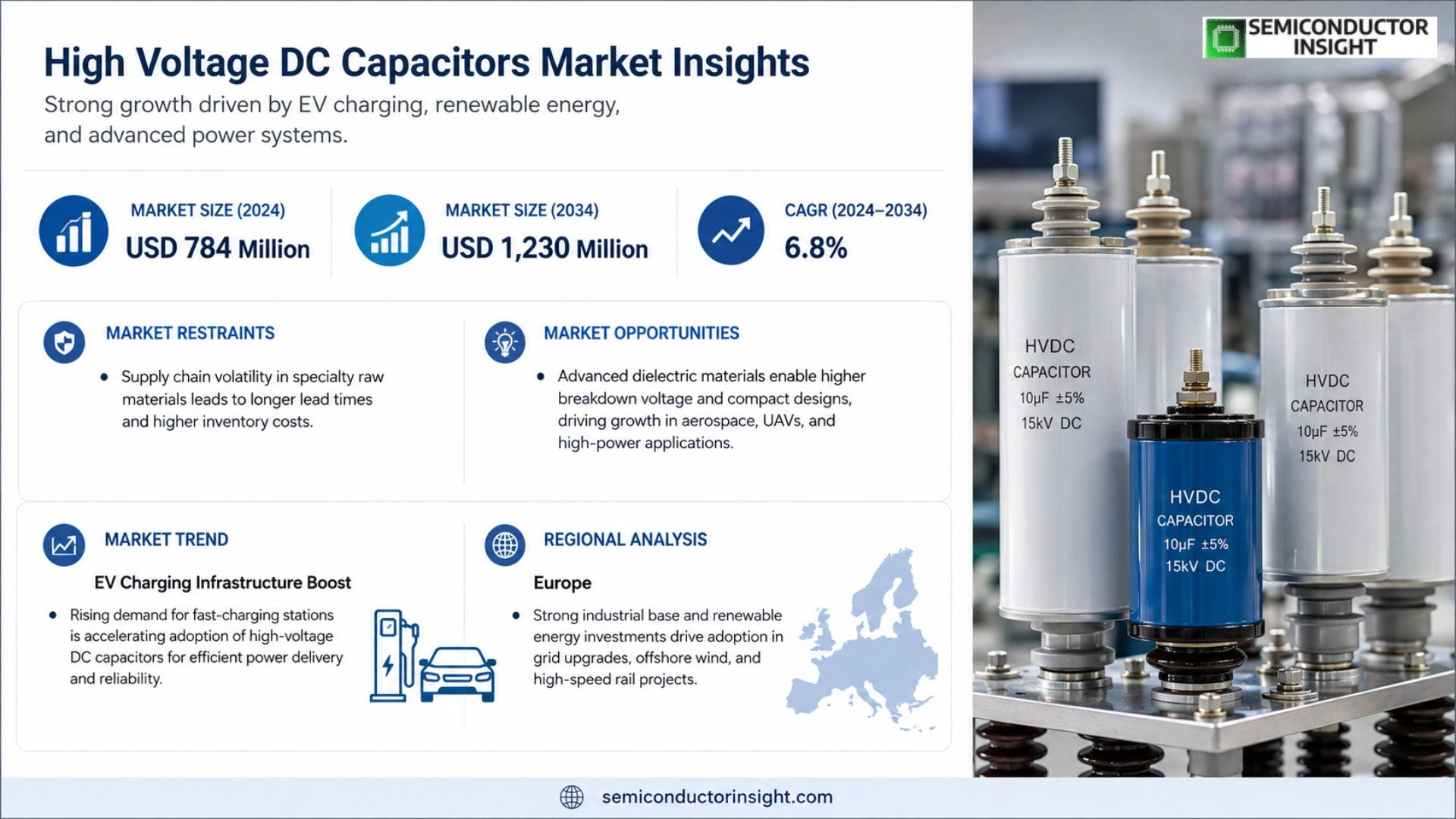
High Voltage DC Capacitors Market is set to rise from USD 784 million in 2024 to USD 1,230 million by 2034, reflecting a CAGR of 6.8% over the forecast period.
High Voltage DC Capacitors are engineered for dc supplies or general‑purpose applications, particularly where high current pulses are required. Their use in power transmission systems, electric‑vehicle charging stations and renewable‑energy installations fuels demand, while rapid progress in electric transportation and grid‑storage technologies creates fresh opportunities.
The market attracts investors and manufacturers because sales are climbing steadily across power, automotive and renewable sectors. Recent product introductions by ABB, Siemens and TDK emphasize higher voltage ratings and enhanced reliability, addressing the need for compact, high‑performance components in evolving energy infrastructure.
MARKET DRIVERS
Electrification of Transportation
The shift toward electric vehicles has raised demand for components that can withstand high potentials. High Voltage DC Capacitors serve as critical energy storage nodes in traction inverters, prompting OEMs to prioritize suppliers with robust performance credentials.
Renewable Energy Integration
Wind farms and solar installations increasingly rely on DC‑linked architectures. The need to smooth voltage spikes and buffer intermittency pushes system designers toward capacitors that combine low ESR with high dielectric strength.
➤ Manufacturers cite a 12% uptick in orders from grid‑scale projects over the past twelve months.
These forces collectively elevate High Voltage DC Capacitors Market, encouraging multinationals to expand capacity and invest in next‑generation dielectric materials.
Strategic partnerships between capacitor makers and vehicle manufacturers are emerging, allowing faster co‑development cycles and reinforcing supply reliability for high‑performance electric drivetrains.
MARKET CHALLENGES
Stringent Safety Regulations
Certification regimes for high‑voltage storage impose rigorous testing, stretching development cycles and increasing capital outlay for firms lacking in‑house compliance expertise.
Other Challenges
Cost Sensitivity
End‑users in cost‑constrained segments, such as consumer‑grade power tools, demand price‑competitive solutions, pressuring manufacturers to balance material costs with performance.
Technical Complexity
Designing capacitors that meet both high breakdown voltage and low loss criteria requires sophisticated simulation tools, which many smaller players find prohibitive.
MARKET RESTRAINTS
Supply Chain Volatility
Fluctuations in specialty film and ceramic raw material availability translate into lead‑time extensions, making it harder for producers to guarantee timely deliveries to high‑volume customers.
Companies are responding by diversifying supplier bases and increasing inventory buffers, which, while raising holding costs, helps sustain order fulfillment rates.
MARKET OPPORTUNITIES
Advanced Dielectric Materials
Research into nanocomposite dielectrics promises higher breakdown voltages without proportional increases in size. Early adopters stand to differentiate their product lines, opening new revenue streams within High Voltage DC Capacitors Market.
Light‑weight high‑voltage storage is becoming a requirement for electric propulsion systems in UAVs and small satellites, presenting a niche yet high‑margin segment for agile players.
High Voltage DC Capacitors Market Trends
Accelerating Adoption in Electric‑Vehicle Charging Networks
The surge in electric‑vehicle registrations has reshaped power distribution planning, especially at fast‑charging sites where voltage levels often exceed 1 kV. Engineers now prioritize high‑voltage DC capacitors that can absorb and release large current pulses without degrading performance. Suppliers are retooling production lines to deliver tighter tolerance film capacitors, while OEMs incorporate modular capacitor banks to shorten station dwell time. This shift not only tightens the link between component reliability and service uptime but also spurs strategic partnerships between capacitor makers and charging‑infrastructure firms. For stakeholders in High Voltage DC Capacitors Market, the trend translates into an expanded design envelope and a clearer path toward differentiated product portfolios.
Other Trends
Renewable Energy Grid Integration
Utility‑scale solar and wind farms increasingly adopt DC‑centric architectures to minimize conversion losses. Within such frameworks, high‑voltage DC capacitors serve as buffer elements that level intermittent generation spikes and support inverter stability. Manufacturers are experimenting with hybrid dielectric technologies to boost energy density while preserving low loss characteristics required by grid‑level applications. As regulatory bodies endorse DC micro‑grid concepts, demand for capacitors that can endure prolonged high‑voltage exposure rises noticeably. Companies that align R&D pipelines with these grid‑integration requirements position themselves to capture emerging revenue streams in the broader power sector.
Military & Aerospace Pulse‑Power Requirements
Defense platforms and advanced aerospace systems rely on rapid discharge of energy for radar, laser, and electromagnetic‑pulse operations. High Voltage DC Capacitors Market experiences heightened attention from this segment because the devices must combine ultra‑high voltage ratings with exceptional pulse‑current handling and temperature resilience. Manufacturers are introducing ruggedized ceramic‑based solutions that meet stringent qualification standards while offering modest size reductions. Procurement cycles in defense departments often favor suppliers with proven track records and the ability to provide lifecycle support, prompting incumbent firms to deepen technical collaborations with aerospace integrators. This niche, though comparatively small, drives innovation that frequently cascades into commercial offerings, enriching the overall technology base.
COMPETITIVE LANDSCAPE
Key Industry Players
High Voltage DC Capacitors: Competitive Overview 2024‑2031
ABB remains the market anchor in the high‑voltage DC capacitor segment, leveraging its extensive power‑electronics portfolio and global service network. Its ability to supply fully integrated solutions for grid‑scale transmission, EV‑charging stations, and offshore wind converters translates into a disproportionate share of revenue despite a fragmented field of midsize rivals. The top‑five manufacturers together account for roughly half of total sales, indicating a competitive environment where scale, application‑specific engineering, and after‑sales support differentiate the leaders from pure component suppliers.
Beyond the tier‑one cohort, a diverse set of specialists is reshaping niche opportunities. Sun.King Technology Group and International Capacitors have intensified focus on plastic‑film formats for renewable‑energy inverters, while Siemens and Alstom exploit their legacy in rail and aerospace to capture high‑reliability contracts. Eaton, TDK, and Vishay broaden their product breadth through incremental upgrades to ceramic and hybrid devices. Emerging challengers such as KEMET, Murata, Panasonic, Samsung Electro‑Mechanics, Hitachi, and AVX are pursuing aggressive R&D roadmaps aimed at higher pulse current capability and reduced ESR, positioning themselves for specialized OEM selections.
List of Key High Voltage DC Capacitors Companies Profiled
- ABB
- Sun.King Technology Group
- International Capacitors
- Siemens
- Alstom
- Eaton
- TDK
- Vishay
- KEMET
- Murata
- Panasonic
- Samsung Electro‑Mechanics
- Hitachi
- AVX
- Rohm
Segment Analysis:
| Segment Category | Sub-Segments | Key Insights |
| By Type |
|
Plastic Film Capacitors
|
| By Application |
|
Energy & Power Transmission
|
| By End User |
|
Power Transmission Utilities
|
| By Voltage Range |
|
High Voltage (35 kV +)
|
| By Technology Trend |
|
Pulse‑Power Optimized Capacitors
|
Regional Analysis: High Voltage DC Capacitors Market
EU directives on grid reliability and carbon neutrality compel utilities to explore DC solutions for long‑distance transmission. Incentive schemes for offshore wind projects directly stimulate demand for high‑voltage capacitors, prompting manufacturers to certify products against stringent safety standards.
A well‑established network of silicon and dielectric material suppliers reduces lead times. Recent collaborations between capacitor producers and automotive battery firms improve component traceability, fostering confidence among grid operators.
The transport sector, especially high‑speed rail, increasingly adopts DC traction systems that rely on reliable capacitors. Simultaneously, large‑scale renewable installations require robust voltage regulation, positioning utilities as primary customers.
Established European firms maintain an edge through patented dielectric technologies, yet new entrants from Eastern Europe are leveraging cost‑effective production to capture niche segments, intensifying price competition.
North America
In North America, High Voltage DC Capacitors Market is shaped by a blend of legacy grid infrastructure and aggressive renewable‑energy rollout. The United States, with its extensive transmission corridors, sees utilities retrofitting existing lines to handle higher DC voltages, while Canada’s emphasis on hydroelectric expansion provides a natural fit for DC capacitor applications. Corporate investment in data‑center resiliency also fuels demand, as operators seek steady power quality. Competitive pressure stems from both global incumbents with deep R&D budgets and regional manufacturers that benefit from lower labor costs, creating a diverse supplier landscape.
Asia‑Pacific
Asia‑Pacific demonstrates a rapid scaling of renewable assets, notably in China and India, where megawatt‑scale solar and wind farms rely on DC interconnectors. The region’s fast‑track approval processes accelerate project timelines, prompting capacitor makers to prioritize speed‑to‑market capabilities. However, fragmented standards across countries pose integration challenges, urging manufacturers to adopt flexible design platforms. Emerging economies are also investing in high‑speed rail networks, adding another vector of demand for high‑voltage DC components, while local supply chains evolve to meet these distinctive requirements.
South America
South America’s market evolution is anchored by large‑scale hydroelectric schemes in Brazil and Paraguay, where DC transmission offers reduced losses over mountainous terrain. Nations are beginning to explore offshore wind potential along the Atlantic coast, a move that could amplify capacitor consumption. Limited local production capacity means the region imports most high‑voltage components, creating opportunities for foreign firms that can navigate import regulations and offer after‑sale support. Market participants are closely watching regional trade agreements that could lower tariff barriers and expand access to advanced capacitor technologies.
Middle East & Africa
In the Middle East & Africa, soaring electricity demand and ambitious solar‑park projects drive interest in DC solutions that can bridge desert‑based generation with coastal consumption hubs. The United Arab Emirates and Saudi Arabia are investing heavily in grid modernization, and this creates a niche for high‑voltage capacitors that can tolerate extreme temperature fluctuations. African nations, while still developing core grid infrastructure, view DC technology as a catalyst for leap‑frogging traditional AC limitations. Supplier strategies that incorporate robust thermal management and localized maintenance services are likely to secure the most lucrative contracts in this diverse region.
Report Scope
This market research report provides a comprehensive analysis of the High Voltage DC Capacitors Market , covering the forecast period 2026–2034. It offers detailed insights into market dynamics, technological advancements, competitive landscape, and key trends shaping the industry.
Key focus areas of the report include:
- Market Overview: The report begins with an overview outlining its current market scenario, key growth indicators, and industry transformation drivers. It discusses macroeconomic factors, demand–supply balance, regulatory landscape, and the strategic role of semiconductors in powering advancements across industries such as automotive, telecommunications, consumer electronics, and industrial automation.
- Market Size & Forecast: Historical data and future projections for revenue, unit shipments, and market value across major regions and segments.
- Segmentation Analysis: Detailed breakdown by product type, technology, application, and end-user industry to identify high-growth segments and investment opportunities.
- Regional Insights: Insights into market performance across North America, Europe, Asia-Pacific, Latin America, and the Middle East & Africa, including country-level analysis where relevant.
- Competitive Landscape: Profiles of leading market participants, including their product offerings, R&D focus, manufacturing capacity, pricing strategies, and recent developments such as mergers, acquisitions, and partnerships.
- Technology Trends & Innovation: Assessment of emerging technologies, integration of AI/IoT, semiconductor design trends, fabrication techniques, and evolving industry standards.
- Market Drivers & Restraints: Evaluation of factors driving market growth along with challenges, supply chain constraints, regulatory issues, and market-entry barriers.
- Stakeholder Insights: Insights for component suppliers, OEMs, system integrators, investors, and policymakers regarding the evolving ecosystem and strategic opportunities.
Primary and secondary research methods are employed, including interviews with industry experts, data from verified sources, and real-time market intelligence to ensure the accuracy and reliability of the insights presented.
FREQUENTLY ASKED QUESTIONS:
What is the current market size of High Voltage DC Capacitors Market?
-> High Voltage DC Capacitors Market is set to rise from USD 784 million in 2024 to USD 1,230 million by 2034, reflecting a CAGR of 6.8%
Which key companies operate in High Voltage DC Capacitors Market?
-> Key players include ABB, Sun.King Technology Group, International Capacitors, Siemens, Alstom, Eaton, TDK, Vishay, among others.
What are the key growth drivers?
-> Key growth drivers include power transmission systems, electric vehicle charging infrastructure, and the renewable energy sector.
Which region dominates the market?
-> Asia-Pacific holds the largest market share, driven by rapid adoption of electric transportation and renewable energy initiatives.
What are the emerging trends?
-> Emerging trends include advancements in electric transportation, renewable energy integration, and innovative high‑current pulse applications.

Get Sample Report PDF for Exclusive Insights
Report Sample Includes
- Table of Contents
- List of Tables & Figures
- Charts, Research Methodology, and more...
 Download Sample Report PDF