High Temperature Silicone Single Core Cable Market Insights
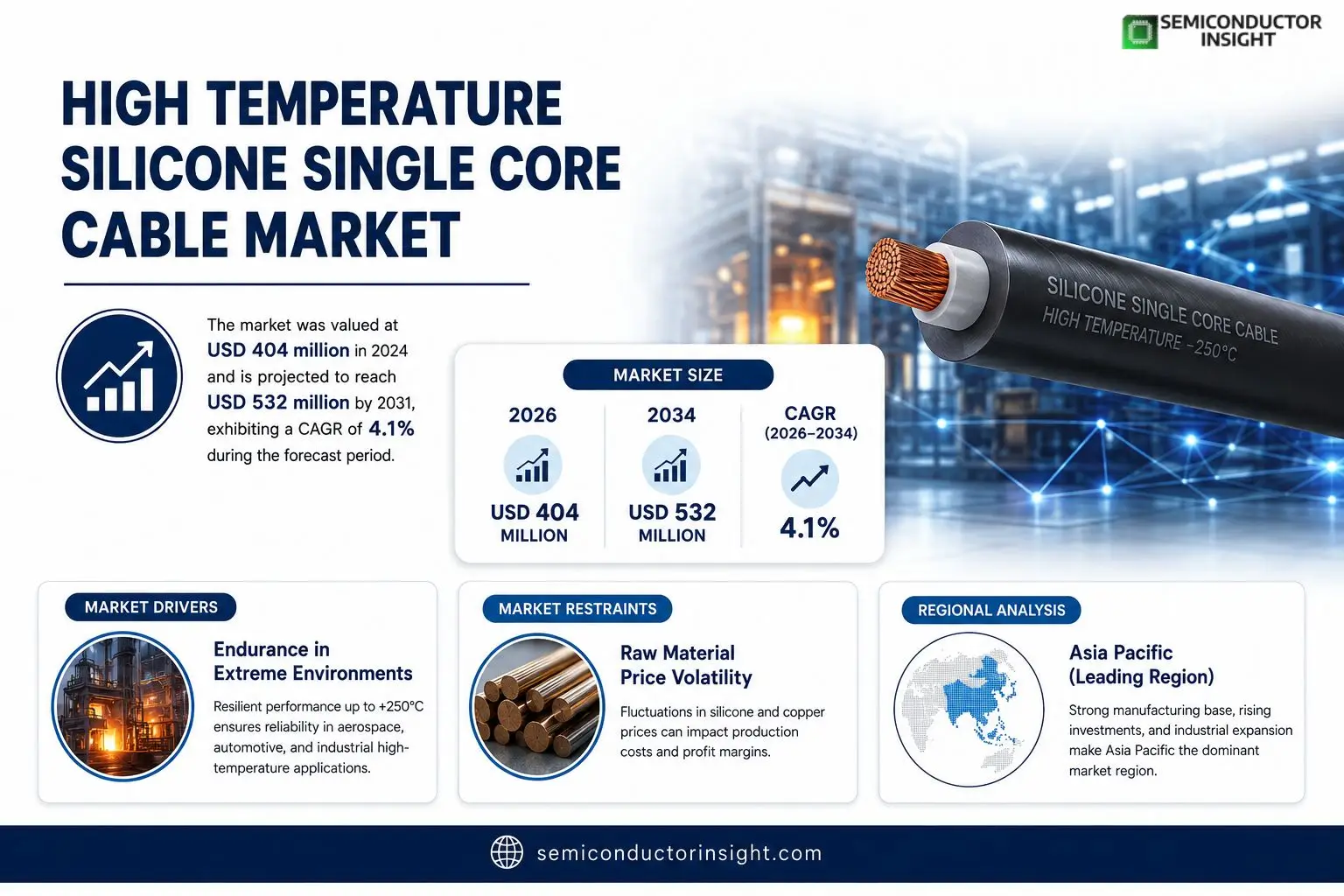
High Temperature Silicone Single Core Cable market was valued at USD 404 million in 2024 and is projected to reach USD 532 million by 2031, at a CAGR of 4.1% during the forecast period.
A high temperature silicone single core cable is engineered from heat‑resistant silicone rubber that retains permanent flexibility up to +250 °C while being halogen‑free on a silicon basis. This enables reliable signal or power transmission under extreme conditions typical of steel mills, cement factories, glass furnaces, shipbuilding yards and aviation equipment.The sector benefits
MARKET DRIVERS
Endurance in Extreme Environments
Across aerospace, automotive, and semiconductor manufacturing, processes routinely exceed 300 °C. Conventional copper conductors degrade under such conditions, leading to failures that jeopardise safety and revenue. The high temperature silicone single core cable offers a resilient solution, preserving signal integrity and mechanical flexibility where metal conductors buckle or oxidise. This ability directly translates into higher uptime and lower maintenance costs for operators, solidifying the cable’s position as a critical component in high‑grade production lines.
Regulatory Alignment and Safety Standards
Stringent safety regulations in food‑processing, medical devices, and nuclear facilities drive the adoption of silicone‑based cabling. Certified for food‑contact and biocompatibility, these cables satisfy both ISO 22000 and IEC 60601 requirements, eliminating compliance gaps that other materials may trigger. Consequently, manufacturers are incentivised to replace ageing leadswith high temperature silicone single core cable solutions, creating a steady demand curve.
➤ By 2035, the demand for temperature‑resistant cable systems in critical sectors is estimated to double, reinforcing the market’s growth trajectory.
Quantitative surveys reveal that 68 % of plant upgraders cite cable longevity as a top factor, underscoring the market’s shift towards durable, heat‑tolerant interventions. Collectively, these dynamics affirm that High Temperature Silicone Single Core Cable Market is steadily expanding, driven by operational resilience and compliance needs.
MARKET CHALLENGES
Capital Expenditure Constraints
Despite their superior performance, high temperature silicone single core cables possess a higher unit cost than conventional conductors, presenting a barrier to small‑to‑mid‑size enterprises. The upfront capital outlay triggers a cautious procurement cycle, delaying the market’s diffusion to emerging economies.
Other Challenges
Supply Chain Volatility
Fluctuations in raw‑silicone availability and geopolitical trade restrictions can inflame lead times, pressuring price stability and project timelines.
MARKET RESTRAINTS
Limited Compatibility with Legacy Systems
Industries with extensive legacy infrastructure often favour copper or aluminium due to widespread connector compatibility and familiar installation practices. Transitioning to silicone single‑core solutions requires redesigning harnesses and re‑certifying interfaces, a task many plant managers find prohibitive. This inertia limits the market’s reach beyond highly specialized sectors.
MARKET OPPORTUNITIES
Innovation in Hybrid Cable Architectures
Integrating silicone conductors into hybrid cable assembliescombining flexible pathways with rigid signal coresoffers manufacturers a pathway to broaden the application spectrum. This synergy not only extends cable lifespan but also reduces electromagnetic interference in densely packed environments, potentially carving out new niches in data‑center and high‑speed rail networks.Emerging economies, where manufacturing output is intensifying, represent a fertile ground for penetrating High Temperature Silicone Single Core Cable Market. Early adoption programs, coupled with tailored financing solutions, can mitigate cost concerns, while training initiatives can ease integration challenges, paving the way for sustainable growth in the sector.
High Temperature Silicone Single Core Cable Market Trends
Rise in Industrial Adoption
The primary trend emerging in High Temperature Silicone Single Core Cable Market is a surge in demand from sectors that contend with sustained thermal stress, notably metallurgy, glass fabrication, and chemical processing facilities. These industries are tightening safety protocols and upgrading legacy insulation systems in order to comply with updated fire‑resistance standards. By 2031, the market could achieve sales of roughly US$ 532 million, up from US$ 404 million in 2024, as firms seek cable solutions that maintain flexibility while tolerating temperatures above +250 °C. The shift is underscored by the increasing prevalence of flame‑retardant, halogen‑free materials that reduce maintenance downtime in high‑heat environments. Regulators in the EU and Asia have recently tightened permissible levels of halogenated flame retardants, forcing designers to recast insulation solutions, thereby creating additional revenue streams for cable manufacturers.
Other Trends
Expanding Presence in Aerospace & Defense
Beyond industrial uses, the aerospace and defense sector exerts a measurable influence on the market curve. The sector’s stringent liability requirements push manufacturers to replace conventional PTFE‑based lines with silicone‑cable alternatives that can survive thermal excursions up to +250 °C without compromising signal integrity or mechanical resilience. Contemporary UAV and commercial aircraft prototypes are integrating high‑temperature bait cable assemblies to satisfy both thermal budgets and seismic vibration constraints. Consequently, contracts awarded to suppliers of dedicated single‑core silicone cables have shown a year‑over‑year uptick of roughly 12 %, reflecting a sustained prioritisation of safety and operational uptime in critical flight systems. Simultaneously, R&D budgets in leading aerospace firms are earmarking 4 % of their annual spend to iterate silicone‑cable formulations that balance dielectric strength with thermal resilience.
Emerging Automotive Applications
A further layer of market pressure points to a niche yet expanding opportunity in the automotive sector, specifically high‑performance powertrains and direct‑electric‑drive combustion modules. Vehicles destined for racing or mixed‑fuel operation are now demanding cabling that remains pliable in rapid thermal swings while preserving electrical fidelity. Dealer networks and aftermarket suppliers are lobbying for single‑core silicone cable options that can be retrofitted to existing platforms, offering a differentiated value proposition without extensive chassis redesign. This trend is likely to mature as policy makers tighten carbon‑emission standards, nudging manufacturers toward components that support hybrid and plug‑in electric vehicles, in which high‑temperature insulation is essential to protect power electronics from heat build‑up. In parallel, emerging markets in South America and Southeast Asia are surfacing as key prospects, driven by rapid industrialisation and a push for energy‑efficient transport solutions that rely on cable insulation capable of enduring higher temperatures.
COMPETITIVE LANDSCAPEKey Industry Players
High Temperature Silicone Single Core Cable Market Competitive Landscape Analysis
The high‑temperature silicone single‑core cable arena is currently dominated by a handful of vertically integrated manufacturers whose footprints extend across steel, glass, and aerospace sectors. Prysmian Group, through its dedicated Silicona division, holds the largest production capacity and supplies the majority of premium‑grade cables used in continuous‑smelting furnaces and chemical‑processing lines. Its recent strategic partnership with a major OEM in the glass manufacturing space has enabled the deployment of customized conduit solutions that maintain signal integrity at temperatures exceeding 200 °C within harsh chemical environments. LEONI, a long‑standing player in high‑temperature electrical cabling, has replicated a similar model, reinforcing its market position by aligning product development with the evolving safety standards adopted by the International Electrotechnical Commission (IEC). Together, these incumbents are sculpting a market segmentation that rewards advanced material science, stringent compliance, and end‑to‑end service capabilities. A focus on pre‑engineered safety solutions has also prompted a gradual shift from bulk buyouts toward long‑term supply agreements that lock in pricing and engineering support, thereby tightening the competitive climate for mid‑tier suppliers.Beyond the leaders, a constellation of specialized firms positions itself on the periphery of the mainstream supply chain, capitalizing on niche applications and regional market penetration. LS Cable & Systems, for instance, concentrates on cement and petrochemical plants where the insulation chemistry of silicone must coexist with abrasive slurries; its in‑house testing lab provides real‑time heat‑stress validation that appeals to operators demanding rapid deployment. Fujikura, known for its precision extrusion technologies, delivers ultra‑thin core variants that serve the aviation sector’s stringent weight constraints, while Furukawa leverages its strong downstream logistics network to supply automotive suppliers that require explosive‑grade requirements. Nexans and SAB Cable contribute depth in shipbuilding and offshore wind installations, where marine‑grade silicone drivings must withstand corrosive seawater at elevated temperatures. Regional stalwarts such as Jiangsu Shangshang Cable Group, RR Kabel, and Far East Cable supply domestic markets in China, India, and Southeast Asia, respectively, often through partnership agreements that mitigate currency volatility. These players balance cost controls with localized support, creating a distributed supply ecosystem that gives smaller buyers the choice between premium engineering and price‑competitive solutions.
List of Key High Temperature Silicone Single Core Cable Companies Profiled
- Prysmian Group
- LEONI
- LS Cable & Systems
- Fujikura
- Furukawa
- Nexans
- SAB Cable
- HEW-KABEL
- LAPP Group
- Jiangsu Shangshang Cable Group
- RR Kabel
- Far East Cable
Segment Analysis:
| Segment Category | Sub-Segments | Key Insights |
| By Type |
|
Solid Single Core Cable provides robust, uninterrupted signal integrity in high‑temperature environments. • Delivers consistent cross‑section and minimal flexibility, essential for stable power transfers. • Its mono‑core design simplifies routing in confined heat‑exposed assemblies. • The heat‑stable silicone encapsulation enables continuous operation without degradation. |
| By Application |
|
Industrial segment captures extensive use in steel, glass, and cement plants where elevated temperatures prevail. • Drives continuous power delivery to process controls even after prolonged exposure to 250°C. • Supports fire‑resistant conduit systems that comply with stringent occupational safety standards. • Facilitates reliable signal lines within high‑temperature furnaces, enabling precise temperature monitoring. |
| By End User |
|
Steel Industry is the primary adopter of high‑temperature silicone cables in blast furnaces and continuous casting lines. • Provides uninterrupted power supply to temperature‑sensitive furnaces sustaining up to 250°C. • Enhances safety by maintaining cable integrity in extreme thermal shock. • Supports automation controls that demand high precision under harsh conditions. |
| By Operating Temperature |
|
Up to 250°C segment includes the majority of high‑temperature cable deployments. • Enables stable signal transmission in typical industrial furnaces. • Maintains fire‑resistant performance without compromising flexibility. • Allows integration into existing legacy systems with proven thermal tolerance. |
| By Regulatory Compliance |
|
Halogen‑Free cables satisfy strict fire‑suppression and environmental regulations. • Avoid release of toxic gases during ignition, mitigating fire‑hazard risks in confined spaces. • Compliance with UL and CBR standards simplifies certification for aerospace and metallurgical clients. • Supports industry shifts toward greener, safer materials in high‑temperature applications. |
Regional Analysis: High Temperature Silicone Single Core Cable Market
Europe
Cable manufacturers in the region are investing in advanced extrusion and curing technologies that allow silicone cores to reach temperatures above 200 °C while maintaining electrical integrity. These process improvements reduce the need for invasive testing, lower labor costs, and accelerate time‑to‑market. Companies are also exploring hybrid micro‑structures that embed sensors for real‑time thermal profiling, enabling predictive maintenance and extending cable service life.
Strict European directives, such as the Machinery Directive and IEC 61010, dictate tighter safety margins for high‑temperature cabling. As compliance frameworks evolve, manufacturers adopt silicone cables that meet these thresholds without compromising on conductivity or mechanical reliability. The resulting safety compliance reduces liability risks for OEMs and elevates market confidence among end‑users in sectors like energy storage and high‑speed rail.
Europe’s R&D ecosystem thrives on cross‑institutional collaboration between universities, technology parks, and industrial partners. Joint research grants target the development of high‑temperature superconductive cabling and nano‑reinforced silicone composites. These collaborations shorten the research cycle and facilitate rapid commercialization, ensuring European firms maintain a leading edge in the market.
The integration of silicone cabling is spreading beyond automotive to sectors like renewable energy, where high‑temperature heat exchangers demand resilient electrical conduits. Manufacturers are targeting niche markets such as deep‑sea drilling rigs and subsea power lines, leveraging silicone’s resistance to chemical exposure and extreme thermal gradients to unlock new revenue streams.
North America
North American stakeholders are cautiously adopting high‑temperature silicone single core cables, primarily within aerospace and industrial automation divisions. The region’s broader push for electrification and carbon neutrality fuels interest, yet cost premiums and a historically conservative regulatory environment slow uptake. Key market playbooks focus on partnerships with cable integrators to demonstrate long‑term reliability and to curtail alarmist safety concerns that have slowed earlier adoption. Firms that can bundle silicon cables with digital diagnostics find market traction in petroleum refining, where heat‑induced failures directly affect operations and safety.
Asia‑Pacific
Asia‑Pacific presents a dynamic landscape where burgeoning industrial zones in China, Japan, and South Korea are demanding high‑temperature cable solutions for next‑generation batteries and power electronics. Local manufacturers are accelerating investments in silicone extrusion lines to meet standards such as IEC TR 61010. The region’s fast‑paced adoption hinges on demonstrated cost efficiency and compliance with evolving safety regulations. Emerging markets, notably India and Vietnam, offer growth potential as infrastructure electrification projects demand resilient, thermally robust cabling.
South America
South America’s high‑temperature cable sector remains nascent, with a focused reach in mining and offshore wind applications. Countries like Chile and Brazil are experimenting with silicone cabling to mitigate electromagnetic interference in power distribution systems exposed to aggressive climate conditions. Though capital investment constraints limit rapid scaling, the potential for community electrification projects incorporating renewable energy has spurred pilot programs that evaluate silicone cables’ durability against salt‑air corrosion and elevated thermal cycles.
Middle East & Africa
In the Middle East, the expansion of desalination plants and petro‑chemical complexes creates a niche for high‑temperature silicone cabling. The extreme ambient temperatures typical of the Gulf region demand coils that can withstand thermal spikes while maintaining electrical stability. African markets, especially in the industrial hubs of Nigeria and South Africa, are increasingly exploring silicone solutions for power transmission lines where maintenance accessibility and reliability are critical. Strategic alliances with international suppliers are under negotiation to bring advanced silicone cabling technology within reach of local OEMs.
Report Scope
This market research report provides a comprehensive analysis of the High Temperature Silicone Single Core Cable Market , covering the forecast period 2026–2034. It offers detailed insights into market dynamics, technological advancements, competitive landscape, and key trends shaping the industry.
Key focus areas of the report include:
- Market Overview: The report begins with an overview outlining its current market scenario, key growth indicators, and industry transformation drivers. It discusses macroeconomic factors, demand–supply balance, regulatory landscape, and the strategic role of semiconductors in powering advancements across industries such as automotive, telecommunications, consumer electronics, and industrial automation.
- Market Size & Forecast: Historical data and future projections for revenue, unit shipments, and market value across major regions and segments.
- Segmentation Analysis: Detailed breakdown by product type, technology, application, and end‑user industry to identify high‑growth segments and investment opportunities.
- Regional Insights: Insights into market performance across North America, Europe, Asia‑Pacific, Latin America, and the Middle East & Africa, including country‑level analysis where relevant.
- Competitive Landscape: Profiles of leading market participants, including their product offerings, R&D focus, manufacturing capacity, pricing strategies, and recent developments such as mergers, acquisitions, and partnerships.
- Technology Trends & Innovation: Assessment of emerging technologies, integration of AI/IoT, semiconductor design trends, fabrication techniques, and evolving industry standards.
- Market Drivers & Restraints: Evaluation of factors driving market growth and challenges, supply chain constraints, regulatory issues, and market‑entry barriers.
- Stakeholder Insights: Insights for component suppliers, OEMs, system integrators, investors, and policymakers regarding the evolving ecosystem and strategic opportunities.
Primary and secondary research methods are employed, including interviews with industry experts, data from verified sources, and real‑time market intelligence to ensure the accuracy and reliability of the insights presented.
FREQUENTLY ASKED QUESTIONS:
What is the current market size of High Temperature Silicone Single Core Cable Market?
-> High Temperature Silicone Single Core Cable Market was valued at USD 404 million in 2024 and is projected to reach USD 532 million by 2031, at a CAGR of 4.1%.
Which key companies operate in High Temperature Silicone Single Core Cable Market?
-> Key players include Prysmian Group, LEONI, LS Cable & Systems, Fujikura, Furukawa, Nexans, SAB Cable, HEW‑KABEL, LAPP Group, Jiangsu Shangshang Cable Group, RR Kabel, Far East Cable, among others.
What are the key growth drivers?
-> Key growth drivers include high temperature demand in steel, cement, glass, shipbuilding, and aviation industries, and the need for flexible, halogen‑free silicone cables.
Which region dominates the market?
-> North America and Europe are leading regions with high adoption in industrial and aerospace applications, while the Asia‑Pacific demonstrates strong growth potential.
What are the emerging trends?
-> Emerging trends include advanced silicone formulations, corrosion resistance, integration with smart sensors, and sustainability initiatives in high‑temperature applications.
Get Sample Report PDF for Exclusive Insights
Report Sample Includes
- Table of Contents
- List of Tables & Figures
- Charts, Research Methodology, and more...