SEMICONDUCTOR INSIGHT
MARKET RESEARCH REPORT

Heat Spreaders Market

2026 to 2034
MARKET INTELLIGENCE
ACROSS KEY REGIONS
2026 EDITION
ELECTRONIC COMPONENTS Semiconductor Market Research

Heat Spreaders Market

Size, Trends, Business Strategies 2026-2034

◷
UPDATED 24 September 2026
▤
REPORT LENGTH Detailed Report
▣
REPORT CODE 5ae296de8543
▯
FORMATS PDF

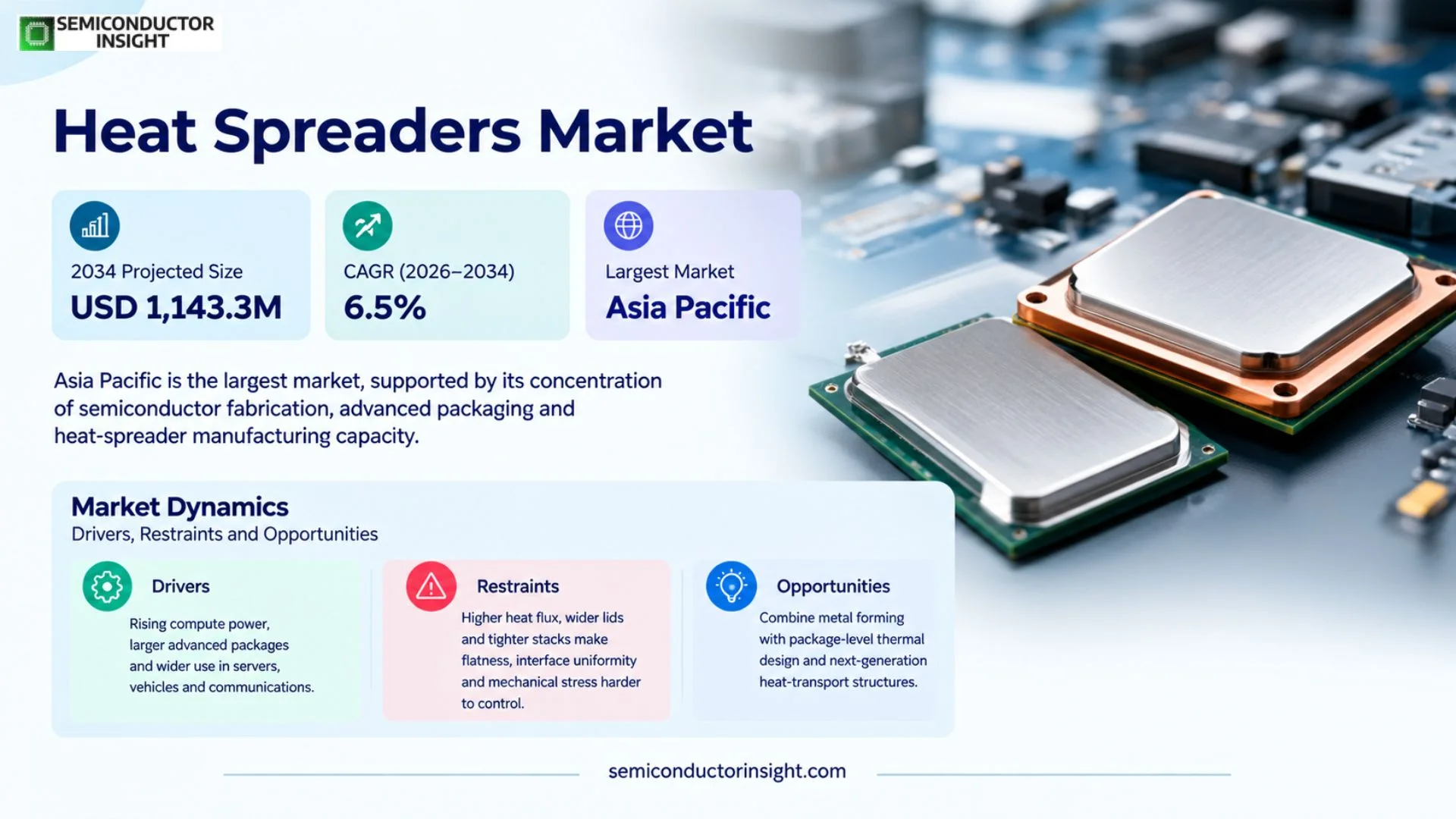
Heat Spreaders Market is projected to reach USD 1,143.3 million by 2034, representing a 6.5% CAGR during 2026–2034. Asia Pacific is the largest market, supported by its concentration of semiconductor fabrication, advanced packaging and heat-spreader manufacturing capacity.

Get the sample PDF with study scope, segmentation and methodology details.

Key Statistics

2025 Market Size
USD 648.6 million
2034 Projected Size
USD 1,143.3 million
CAGR (2026–2034)
6.5%
Largest Market in 2025
Asia Pacific

Key Takeaways

  • Flip-chip heat spreaders remain the core high-performance architecture because direct die-to-lid thermal paths are widely used in processors and other high-power packages where package warpage, interface pressure and heat flux must be controlled together rather than treated as separate design problems.
  • Server, data-center and AI processor packages are the strongest growth application. The IEA reported that global data-center electricity demand reached 485 TWh in 2025 and that electricity use by AI-focused data centers increased 50% during the year, intensifying thermal-design requirements around accelerator packages and high-density compute nodes.
  • Asia Pacific is the largest market and production base. The region combines leading-edge foundry output, advanced packaging, electronics assembly and a dense heat-spreader supplier base across Taiwan, Japan, China and neighboring manufacturing hubs, creating shorter qualification loops between package designers and thermal-component manufacturers.
  • Copper remains the reference material because it balances conductivity, manufacturability and cost. SHINKO specifies C1020 and C1100 copper for commercial heat spreaders, while vapor-chamber and multi-step designs are expanding where conventional solid-metal lids face rising thermal resistance or footprint constraints.
  • The key restraint is mechanical and thermal co-optimization. Larger dies, chiplets, interposers and stacked packages increase the risk that lid flatness, thermal-interface thickness, coefficient-of-thermal-expansion mismatch or mounting pressure will undermine theoretical conductivity gains, making tolerance control and package-level validation essential.

Heat Spreaders Market Overview

Heat Spreaders Market is rebased to USD 648.6 million in 2025 and is projected to reach USD 1,143.3 million by 2034, representing a 6.5% CAGR during 2026–2034. Asia Pacific is the largest market, supported by its concentration of semiconductor fabrication, advanced packaging and heat-spreader manufacturing capacity.

Base year: 2025 · Estimated year: 2026 · Forecast period: 2026–2034 · Values in USD million unless otherwise stated

A heat spreader is a high-thermal-conductivity metallic structure positioned over or around a semiconductor die to distribute concentrated heat over a larger surface before it reaches the heat sink, cold plate or other cooling assembly. Commercial designs are commonly stamped or machined from copper and then plated for corrosion resistance and package assembly. SHINKO lists copper grades C1020 and C1100, outer dimensions from 10 mm to 100 mm and thicknesses from 1.0 mm to 4.5 mm across its heat-spreader offering, illustrating the dimensional range required by modern package families.

The market is increasingly shaped by power density rather than by processor unit shipments alone. A server accelerator with a larger die, interposer or chiplet assembly can require a larger or more engineered spreader, tighter flatness control and a higher-performance thermal interface than a mainstream client processor. This raises component value per package even when finished-system volumes are lower. The same mechanism is appearing in automotive SoCs, communication processors and FPGA packages as compute density rises and sustained junction-temperature limits become harder to meet with traditional stamped lids.

Thermal management is also becoming more tightly connected with advanced packaging. TSMC reported that it completed certification of a 5.5-times reticle-size CoWoS advanced-packaging solution in 2025 and planned volume production in 2026 for higher-performance AI and HPC requirements. Larger interposers and multi-die packages distribute heat unevenly across a broader footprint, which increases the commercial value of spreader geometry, interface uniformity and vapor-chamber alternatives. The resulting opportunity therefore extends beyond metal volume into precision forming, surface engineering and package-specific thermal design.

Segment Analysis: By Type

By type, the market is segmented into Flip Chip Heat Spreader and BGA Heat Spreader. Flip-chip designs hold the stronger position in high-performance computing because the lid sits over a face-down die or multi-die assembly with a direct thermal interface, while BGA heat spreaders remain important across packaged processors and devices where board-level reliability, footprint and mechanical protection are central to the package design.

Type Technical role Market position and purchasing logic
Flip Chip Heat Spreader Flip-chip packages place the active die close to the lid through a thermal-interface material, allowing heat to travel vertically from the silicon into a conductive spreader and then into the system cooling solution. The configuration is well suited to CPUs, GPUs, AI accelerators and high-end communication processors because it can support broad die footprints and high sustained heat flux while also providing package stiffening and mechanical protection. This type is the principal value pool for high-performance packages. Purchase decisions are driven by thermal resistance, lid flatness, plating quality, dimensional stability and compatibility with the package substrate and TIM process. As chiplets and large interposers expand, suppliers that can form multi-step or pedestal geometries and hold tight tolerances can defend higher engineering content than commodity stamped lids, while qualification history remains essential because a spreader change can alter package stress and long-term reliability.
BGA Heat Spreader BGA heat spreaders are integrated with ball-grid-array packages to distribute heat and reinforce the package while maintaining a compact board footprint. They are used across processors, controllers, networking devices and other semiconductor packages where the thermal load exceeds what the mold compound or exposed package surface can dissipate efficiently. Geometry is typically tailored to the package outline, die location and external heat-sink interface rather than treated as a standardized mechanical part. Demand is broad but more application-specific than in leading-edge flip-chip compute. Suppliers compete on tooling economics, stable stamping or machining yields, surface finish and the ability to customize shapes without extending package qualification schedules. Automotive and industrial BGA applications can support durable demand because products remain in production for long periods, while consumer programs create larger but more price-sensitive runs. The commercial advantage comes from maintaining repeatable mechanical performance over the full package lifecycle.

Material and size progression

The report scope also segments heat spreaders by material into Copper, Stainless Steel, Aluminum and Others, and by size into Below 35mm × 35mm, 35mm × 35mm to 50mm × 50mm, and Above 50mm × 50mm. Copper remains the reference material because of its combination of thermal conductivity and established forming processes, while stainless steel can be selected when stiffness, coefficient-of-expansion behavior or package mechanics justify lower conductivity. Larger footprints gain relevance as AI and HPC packages use larger dies, interposers and multi-chip assemblies, increasing the importance of flatness and uniform contact pressure across the lid.

Segment Analysis: By Application

By application, the market covers PC CPU/GPU Package, Server/Data Center/AI Chip Package, Automotive SoC/FPGA Package, Gaming Console and Others. PC processors provide a mature installed base, but server and AI packages are the strongest value-growth area because compute power and cooling requirements are rising faster than unit volumes. Automotive packages add a separate reliability-led demand stream with long qualification cycles and sustained operating-temperature requirements.

Application Demand characteristics and commercial implication
PC CPU/GPU Package Desktop and workstation processors remain a foundational application because thermal spreaders are already designed into many high-power CPU and GPU package architectures. Demand follows processor refresh cycles, gaming and creator workloads, and the migration of higher performance into smaller systems. The segment is mature, so suppliers compete primarily through quality, cost and engineering responsiveness. New value is created when package power, die area or heterogeneous integration requires more complex lid geometry rather than through a simple increase in unit shipments.
Server/Data Center/AI Chip Package This is the strongest growth application because data-center compute density and AI acceleration are increasing sustained thermal loads. The IEA recorded 485 TWh of global data-center electricity consumption in 2025, with AI-focused data-center electricity use rising 50% during the year. That system-level expansion translates into more high-power CPUs, GPUs and accelerators whose packages require low thermal resistance and increasingly sophisticated heat spreading. Vapor chambers, larger lids and package-specific interfaces can therefore capture higher value per socket.
Automotive SoC/FPGA Package Automotive domain controllers, ADAS processors and FPGAs operate under long service-life, vibration and temperature-cycling requirements that make mechanical reliability as important as peak conductivity. SHINKO lists automotive SoC and FPGA packages among commercial heat-spreader applications. Suppliers must support automotive quality systems, traceability and stable processes over multi-year production programs. The opportunity grows as centralized compute and software-defined vehicle architectures consolidate more processing into fewer, hotter devices, but design changes face longer validation cycles than consumer electronics.
Gaming Console Gaming consoles combine high sustained CPU and GPU utilization with fixed acoustic and enclosure constraints, creating a clear need to distribute die heat efficiently into the console cooling assembly. Production is concentrated around platform launches and refresh cycles, so volume can be significant but cyclical. Heat-spreader suppliers benefit when console processors use large integrated dies or advanced packages, yet purchasing pressure is high because console makers optimize every component for mass-production cost, assembly repeatability and long warranty life.
Others Other applications include communication processors, industrial computing, aerospace electronics and specialized accelerators where localized heat flux or rugged packaging requires a metallic spreader. This segment is fragmented but can support attractive engineering margins because geometries and surface finishes are often application-specific. Small-volume programs also act as qualification paths for new thermal structures, including pedestal lids and integrated vapor chambers, before those designs migrate into higher-volume compute packages.

Heat Spreaders Market Size & Share

Regional Analysis

Asia Pacific leads the Heat Spreaders market because semiconductor fabrication, advanced packaging, electronics assembly and a large share of the specialist supplier base are concentrated in the region. North America is a major design and AI-compute demand center, Europe combines automotive and industrial semiconductor demand with advanced packaging investment, while South America and Middle East & Africa remain primarily downstream markets supplied through global semiconductor and electronics chains.

What creates different heat-spreader demand profiles across regions?

Regional demand depends on where high-power chips are fabricated, packaged and qualified as well as where servers, vehicles and electronic systems are deployed. SIA reported global semiconductor sales of USD 791.7 billion in 2025, with annual sales growth of 45.0% in Asia Pacific and all other regions, 30.5% in the Americas, 17.3% in China and 6.3% in Europe, while Japan declined 4.7%. These semiconductor figures are not heat-spreader market shares, but they provide a useful demand backdrop for package-component suppliers.

Region Market position Growth outlook Demand profile Key evidence / access factor
Asia Pacific Largest market and principal production base Highest structural opportunity Foundry, packaging and electronics-manufacturing led Taiwan and Japan host advanced packaging and established heat-spreader suppliers; TSMC qualified 5.5-reticle-size CoWoS in 2025 for 2026 volume production, increasing the relevance of large-footprint thermal management.
North America High-value design and consumption market Strong AI data-center and high-performance computing led The IEA reported global data-center electricity use of 485 TWh in 2025 and 50% growth in AI-focused data-center electricity consumption, supporting rapid demand for high-power accelerator packages developed and deployed by North American platform companies.
Europe Automotive and industrial specialization Moderate to strong Automotive, industrial and research led The region has strong automotive semiconductor demand and ongoing fab investment. Heat-spreader qualification emphasizes long lifecycle, reliability and traceability rather than only peak thermal performance.
South America Smaller downstream market Moderate from a small base Imported electronics and data infrastructure led Local demand is mainly embedded in imported server, communications, automotive and industrial systems. Supplier access therefore depends more on global OEM platforms and regional distribution than on local semiconductor packaging capacity.
Middle East & Africa Emerging downstream market Selective high growth Data-center, telecom and industrial project led Demand is concentrated in imported high-performance systems and new data infrastructure. The market is smaller in semiconductor-package manufacturing terms, so heat-spreader content typically enters through finished processors, modules and systems rather than regional component qualification.
Asia Pacific LARGEST MARKET

Why does Asia Pacific lead the Heat Spreaders market?

Asia Pacific leads because it brings together the highest concentration of semiconductor wafer fabrication, advanced packaging, outsourced assembly and test, electronics manufacturing and specialist heat-spreader suppliers. This creates direct engineering links between package designers and precision-component manufacturers, while the region’s large share of semiconductor production means that thermal components are commonly qualified and sourced close to the package assembly line even when the finished processor is sold globally.

Market positionLargest in 2025
Semiconductor signalAsia Pacific/All Others sales +45.0% in 2025
Demand profileFoundry and advanced-packaging led
Access gatePackage qualification and supplier proximity
Country / hub Position in region What drives demand
Taiwan Advanced-packaging hub Taiwan combines leading foundry and advanced-packaging capability with a cluster of precision-component suppliers. TSMC completed certification of a 5.5-reticle-size CoWoS solution in 2025 and planned volume production in 2026, increasing the thermal-management challenge for large AI and HPC packages. The local packaging ecosystem allows heat-spreader makers to iterate tooling, flatness and interface requirements with customers more quickly than suppliers located far from package assembly.
Japan Thermal-technology and precision-manufacturing hub Japan contributes established thermal-component suppliers including SHINKO and Fujikura. SHINKO offers copper heat spreaders with stamping, machining and surface treatment, while Fujikura is developing vapor-chamber structures for high heat loads. The country’s role is therefore not simply end demand; it provides technology and manufacturing capability that serves processor and automotive package programs across the global semiconductor supply chain.
China & South Korea Large semiconductor and electronics demand centers China and South Korea combine memory, logic, display and electronics manufacturing with rapidly growing data infrastructure. Their demand for package thermal components comes through both domestic semiconductor production and imported advanced processors. Supplier success depends on qualification access, cost competitiveness and the ability to support high-volume programs while meeting the cleanliness, plating and mechanical-control requirements of semiconductor packaging.

Market instances and commercial signals

TSMC’s 2025 annual report states that a 5.5-times mask-size CoWoS advanced-packaging solution completed certification and would enter volume production in 2026. Larger interposers and multi-die packages broaden the heat source across the package, increasing the value of engineered lid geometry and uniform contact. For heat-spreader suppliers, advanced packaging therefore creates demand for larger dimensions and tighter mechanical control rather than only higher unit counts.

SHINKO specifies copper heat spreaders from 10 mm to 100 mm in outer length and thicknesses from 1.0 mm to 4.5 mm, with applications spanning PC and server CPUs, automotive SoC/FPGA devices, communication processors and AI processors. This range demonstrates how one manufacturing platform must support multiple package classes, making flexible tooling and integrated surface treatment commercially important across Asia’s packaging ecosystem.

Fujikura’s September 2025 vapor-chamber heat-spreader development targets heat dissipation up to 600 W and was reported to lower thermal resistance by 13% versus a conventional copper spreader. The development illustrates how Japanese thermal suppliers are extending from solid-metal lids into phase-change structures as AI processor packages place higher heat flux across larger package surfaces.

Country-level revenue, shipment, supplier and application detail for Asia Pacific is covered in the full Heat Spreaders report.
North America AI & HPC DEMAND CENTER

What drives high-value heat-spreader demand in North America?

North America is a major demand center because many leading AI, CPU, GPU, cloud and server platforms are designed or deployed in the region, even when the physical heat spreader is manufactured elsewhere. The commercial pull is strongest at the high-performance end of the market, where accelerator power, rack density and liquid-cooling adoption force processor package designers to optimize the lid, TIM and cold-plate interface together.

Market positionHigh-value demand center
Data-center signal485 TWh global use in 2025
AI signalAI-focused data-center electricity +50% in 2025
Demand profileAI, cloud and HPC led
Country Position in region What drives demand
United States Primary design and data-center market The United States anchors North American demand through AI accelerator, CPU, networking and cloud-platform development. The IEA’s 2025 global data-center electricity figure of 485 TWh and 50% growth in AI-focused data-center electricity use provide the demand backdrop for high-power compute. Thermal-component suppliers gain access primarily through processor package qualifications and system cooling roadmaps rather than through local stamped-metal production alone.
Canada Smaller but growing compute market Canada contributes data-center, AI research and cloud deployments that consume high-performance processors, although semiconductor package manufacturing is limited relative to Asia. Heat-spreader demand is therefore embedded in imported server and accelerator modules. The regional opportunity is strongest for suppliers already qualified on global processor platforms, because the same package thermal solution follows the device across North American data-center deployments.
Mexico Electronics and automotive manufacturing link Mexico adds electronics assembly and automotive production exposure, creating demand for processor and control modules that use thermal-management components. Local demand is tied to North American supply chains and final-system manufacturing rather than leading-edge semiconductor packaging. For heat-spreader suppliers, this means commercial access usually occurs upstream through qualified semiconductor or module suppliers rather than direct sales into independent local packaging programs.

Market instances and commercial signals

The IEA reported global data-center electricity consumption of 485 TWh in 2025 and projected a rise to 950 TWh by 2030. While these figures are global rather than North American market shares, the region hosts many of the cloud and accelerator platforms driving that investment. Higher rack density increases the need for processor packages that transfer heat efficiently into liquid or air-cooling assemblies, raising the value of precise spreaders and integrated thermal structures.

North American system designers are increasingly treating the package lid as part of a complete cooling stack. As liquid cooling expands, spreader flatness, surface finish and the interface to the cold plate become more critical because small contact variations can create local hot spots. This favors suppliers able to provide package-specific geometry and engineering support rather than a fixed catalog lid.

Automotive central-compute adoption adds a second demand stream. Vehicle processors must combine significant compute density with vibration, temperature cycling and long service life. Heat-spreader suppliers qualified on global automotive SoC and FPGA packages can therefore benefit from North American vehicle programs even when the physical parts are produced in Asia.

Country-level revenue, shipment, supplier and application detail for North America is covered in the full Heat Spreaders report.
Europe AUTOMOTIVE & INDUSTRIAL

Why is Europe a reliability-led Heat Spreaders market?

Europe’s heat-spreader demand is weighted toward automotive, industrial and high-reliability electronics, where package lifetime and traceability can matter more than maximum peak compute density. The region also has growing semiconductor manufacturing investment. Suppliers therefore face a market in which reliable mechanical behavior, corrosion protection and long-term process stability are central selection criteria alongside thermal performance.

Market positionSpecialized high-reliability market
2025 semiconductor signalEurope sales +6.3%
Demand profileAutomotive and industrial led
Access gateLong qualification and traceability
Country / cluster Position in region What drives demand
Germany Automotive and industrial center Germany combines vehicle electronics, industrial automation and expanding semiconductor manufacturing, creating demand for processors and power-control devices that require reliable thermal paths. Heat-spreader programs serving German automotive platforms must support long qualification cycles, documented material and plating control and stable production over many years. The commercial opportunity is therefore durable once qualified but slower to enter than consumer electronics.
France & Italy Semiconductor manufacturing centers France and Italy host significant semiconductor manufacturing and R&D, including 300 mm expansion programs. Their heat-spreader demand is linked to industrial, automotive, communication and advanced semiconductor programs. Qualification emphasizes package reliability and supplier continuity, while local fab investment supports a broader ecosystem of materials, equipment and component engineering that can create opportunities for specialized thermal solutions.
United Kingdom & Benelux Design, R&D and equipment ecosystem These markets contribute semiconductor design, research and equipment expertise rather than the largest volume of heat-spreader manufacturing. Demand is concentrated in specialized processors, computing systems and research platforms. Suppliers typically access the region through global package programs or engineering collaboration, making design capability and documentation more important than a purely local high-volume production footprint.

Market instances and commercial signals

SIA reported that European semiconductor sales increased 6.3% in 2025. That broader industry growth is not a heat-spreader market share, but it provides a useful demand signal for automotive, industrial and communication semiconductor packages that use thermal components. The slower rate than Asia and the Americas also reinforces Europe’s more specialized, qualification-driven demand profile rather than a volume-led packaging market.

European automotive electronics create a long-life thermal-management opportunity. Processor packages in ADAS, infotainment and domain control must survive repeated temperature cycling and vibration, so lid geometry, plating and TIM interfaces are validated as part of the package reliability system. Once a heat spreader is qualified, redesign or supplier replacement can be costly, supporting longer supplier relationships.

European semiconductor capacity investment increases the regional engineering base for package materials and thermal solutions. Even where advanced packaging occurs outside Europe, local chip design and manufacturing teams influence package specifications, giving established thermal-component suppliers opportunities to enter programs during the early reliability and assembly-development phase. This makes local technical support and early package co-design increasingly valuable for suppliers seeking durable design positions.

Country-level revenue, shipment, supplier and application detail for Europe is covered in the full Heat Spreaders report.
South America DOWNSTREAM & IMPORT LED

How does heat-spreader demand develop in South America?

South America is primarily a downstream market for heat spreaders because most high-performance processor packages enter the region as imported semiconductors, server modules, communications equipment, vehicles or industrial electronics. Local market growth therefore follows data infrastructure, automotive production and industrial digitalization rather than the build-out of a large semiconductor packaging base.

Market positionSmaller downstream market
Growth outlookModerate from a small base
Demand profileImported systems and automotive led
Access gateGlobal OEM platform qualification
Country Position in region What drives demand
Brazil Largest regional systems market Brazil leads regional demand through data centers, telecommunications, industrial electronics and vehicle production. Heat-spreader content is embedded in processors and control modules rather than sourced as a local commodity. Suppliers therefore benefit indirectly when their qualified package designs are used by global CPU, GPU, networking and automotive semiconductor vendors shipping into Brazilian system manufacturers and infrastructure projects.
Argentina Smaller industrial and automotive demand Argentina contributes automotive and industrial electronics demand but has limited leading-edge semiconductor packaging. Heat-spreader demand is consequently tied to imported modules and equipment. Commercial access is determined by global semiconductor and Tier-1 platforms, while regional distributors and repair channels matter primarily for finished thermal assemblies rather than the package-level spreader itself.
Other South America Project-led demand Other markets are driven by telecommunications, mining, industrial automation and data infrastructure projects that consume servers, networking equipment and power electronics. The heat-spreader opportunity is fragmented and usually invisible at the component-purchasing level because thermal parts arrive already integrated into semiconductor packages. Growth therefore depends on overall deployment of high-compute systems rather than direct regional heat-spreader manufacturing.

Market instances and commercial signals

Growth in regional cloud and telecommunications infrastructure increases the installed base of server CPUs, GPUs and network processors, all of which can contain engineered spreaders. Because the thermal component is qualified upstream with the processor package, regional demand is captured by suppliers that have already won those global semiconductor programs rather than by independent local heat-spreader sales channels.

Automotive manufacturing creates a second path through engine, safety, infotainment and ADAS electronics. As processors become more centralized, each vehicle can carry fewer but more powerful compute devices, raising thermal-management requirements per package. Suppliers qualified on automotive SoCs therefore gain exposure to South American vehicle production without needing a local semiconductor-package factory.

The principal limitation is the small local advanced-packaging base. This reduces direct engineering interaction between heat-spreader manufacturers and regional customers and makes local demand more sensitive to imported system volumes, exchange rates and capital-investment cycles. Global supplier relationships and distributor support therefore matter more than stand-alone regional manufacturing capacity. Local inventory planning is also important because replacement or project demand can be intermittent rather than production-line continuous.

Country-level revenue, shipment, supplier and application detail for South America is covered in the full Heat Spreaders report.
Middle East & Africa EMERGING DATA INFRASTRUCTURE

What is the heat-spreader opportunity in Middle East & Africa?

Middle East & Africa is an emerging downstream market where heat-spreader demand is linked mainly to data-center, telecommunications, industrial and defense electronics deployments. The region has limited semiconductor package manufacturing, so thermal components generally enter inside imported processors and modules. Growth therefore follows project investment and the adoption of high-compute systems rather than local lid-forming capacity.

Market positionEmerging from a small base
Growth outlookSelective high growth
Demand profileData-center and telecom project led
Access gateGlobal processor and system platforms
Country / subregion Position in region What drives demand
Gulf Cooperation Council Data-center investment focus Gulf markets are expanding cloud, AI and digital infrastructure, which increases deployment of high-power processors and networking equipment. Heat-spreader demand remains embedded in those imported semiconductor packages. The opportunity is strongest for suppliers already designed into server and accelerator platforms selected by hyperscale and sovereign data-center projects, rather than through direct regional procurement of standalone heat spreaders.
South Africa Established regional data and industrial hub South Africa supports data-center, telecommunications, mining and industrial-computing demand that uses servers and high-reliability electronics. Package thermal components arrive within global processors and modules. Supplier exposure therefore follows platform adoption and system shipments, while local service and distribution are more relevant to heat sinks and cooling equipment than to the semiconductor lid itself.
North Africa Electronics and automotive manufacturing link North African manufacturing growth in electronics and automotive systems creates incremental demand for control modules and processors. Advanced semiconductor packaging remains limited, so heat-spreader content is captured upstream. Suppliers benefit when global automotive and industrial semiconductor platforms using their qualified thermal components are assembled into regional systems.

Market instances and commercial signals

AI and cloud infrastructure investment can create high thermal-content demand even in regions without semiconductor fabs because accelerator and server packages arrive with their thermal spreaders already integrated. Each new compute deployment therefore represents indirect heat-spreader consumption, with the component value captured earlier in the global supply chain during processor package manufacturing.

Telecommunications and industrial projects create demand for network processors, FPGAs and rugged computing devices that often require engineered thermal paths. Because ambient conditions can be demanding, system designers place strong emphasis on sustained cooling performance. Heat-spreader suppliers benefit when their package designs are qualified for high-temperature or long-life applications before the devices are shipped into the region.

The principal commercial constraint is scale. Project-based purchasing produces uneven demand and offers limited justification for local package-component manufacturing. Global processor and module platforms therefore determine which heat-spreader suppliers participate, while regional growth is most relevant as an additional consumption pool for already-qualified thermal components. Suppliers can serve this demand efficiently through regional distribution and global account programs rather than dedicated local heat-spreader factories.

Country-level revenue, shipment, supplier and application detail for Middle East & Africa is covered in the full Heat Spreaders report.

Key Heat Spreaders Manufacturers and Competitive Landscape

Competition combines high-volume precision metal forming with package-specific thermal engineering. Established suppliers differentiate through stamping and machining capability, surface treatment, dimensional control and proximity to semiconductor packaging customers, while next-generation thermal structures such as vapor chambers introduce a second competitive axis based on heat-transport technology rather than metal forming alone.

SHINKO demonstrates the integrated manufacturing model used by leading suppliers: internal stamping-die design, transfer stamping, machining and surface treatment are combined in one production chain, with copper heat spreaders offered in multiple shapes and sizes. That integration reduces handoffs between tool design and production and helps suppliers respond when a package customer changes die position, lid height, plating or mechanical tolerances during qualification. For buyers, production repeatability and the ability to troubleshoot package-level interactions can be as important as nominal thermal conductivity.

Fujikura illustrates the technology-expansion route. In September 2025 the company disclosed a vapor-chamber heat spreader designed for heat dissipation up to 600 W and reported 13% lower thermal resistance than a conventional copper spreader. Vapor-chamber designs can shift competition toward internal wick structures, working-fluid control and hermetic manufacturing. This does not eliminate the need for stamped copper lids; instead, it creates a higher-performance tier for packages where solid-metal spreading no longer distributes heat quickly enough across the available footprint.

The market also contains regional precision-component specialists, particularly in Taiwan, that benefit from proximity to outsourced assembly, testing and advanced-packaging operations. These firms can compete effectively when customers need fast tooling changes, local engineering support and high-volume cost control. Global materials companies participate where specialty alloys, plating or advanced thermal materials are required, but the final spreader remains a mechanically critical package component whose quality must be proven at the package level.

Tier structure

Competitive tier Representative companies How they compete
Integrated precision heat-spreader manufacturers Shinko Electric Industries; Jentech Precision Industrial; I-Chiun Precision Industry; Favor Precision Technology; Niching Industrial Corporation These suppliers compete through dedicated heat-spreader forming, machining, plating, tooling and semiconductor-package qualification. Their advantage is the ability to translate package drawings into stable high-volume mechanical parts while holding flatness, surface and dimensional tolerances that directly affect thermal-interface thickness and package stress.
Advanced thermal-technology suppliers Fujikura Ltd.; Honeywell Advanced Materials These companies compete through broader thermal-management or advanced-material capability, including heat pipes, vapor chambers, engineered materials and thermal-system expertise. They are positioned to benefit when processor packages move beyond conventional stamped lids and require integrated heat transport or specialty material properties.
Regional precision specialists Fastrong Technologies Corp.; Shandong Ruisi Precision Industry Regional specialists compete on localized production, tooling response, cost and customer-specific mechanical designs. Their growth depends on qualification access to package assemblers and processor programs, because a capable metal-forming line does not automatically translate into semiconductor-grade business without surface cleanliness, traceability and stable high-volume process control.

Key companies profiled

Shinko Electric Industries, Honeywell Advanced Materials, Jentech Precision Industrial, Fujikura Ltd., I-Chiun Precision Industry, Favor Precision Technology, Niching Industrial Corporation, Fastrong Technologies Corp., Shandong Ruisi Precision Industry.

Heat Spreaders Production Capacity Analysis

Heat-spreader capacity is concentrated near semiconductor packaging and electronics manufacturing clusters because qualification changes require close interaction between package designers, assemblers and precision-component suppliers. Capacity is determined not only by stamping press tonnage but also by tool availability, machining, plating, cleanliness, dimensional inspection and the yield at which complex lid geometries can be held over long production runs.

Asia Pacific has the deepest production ecosystem because the region combines foundries, outsourced semiconductor assembly and test, substrate makers and specialist mechanical-component manufacturers. Japan contributes integrated suppliers such as SHINKO and Fujikura, while Taiwan hosts several precision heat-spreader companies listed in the report scope. This concentration reduces logistics time for engineering samples and supports faster package qualification. It also means that advanced compute demand elsewhere in the world can translate into component production in Asia even when the processor is designed or deployed in North America or Europe.

Process capability becomes the binding constraint as geometries become larger or more complex. SHINKO states that it combines transfer stamping with machining for complicated shapes and controls the flow from die-tool design through stamping, machining and surface treatment. Larger lids can amplify flatness and spring-back challenges, while selective plating and multi-step surfaces add operations. Vapor-chamber structures introduce additional capacity requirements because they need sealed internal heat-transport structures rather than a single formed metal body.

Upstream material availability is less concentrated than leading-edge semiconductor fabrication, but copper quality, plating chemistry and precision tooling still affect cost and cycle time. The more important supply risk is qualification concentration: a processor package may be qualified around a specific lid geometry, material, plating and TIM stack. Switching suppliers therefore requires mechanical and thermal revalidation, which can make qualified capacity strategically valuable during demand surges.

Capacity factor Why it matters Commercial implication
Stamping and tooling High-volume transfer stamping creates the basic lid geometry, but die design must account for material spring-back, edge condition and consistent flatness. More complex stepped or pedestal shapes may add machining after forming. Suppliers with internal tool design can shorten engineering changes and reduce dependence on third-party tooling queues, which is valuable when processor packages move rapidly from engineering sample to production.
Surface treatment Nickel and selective gold plating can improve corrosion behavior and package assembly compatibility. Surface finish must remain uniform without introducing contamination or distortion that changes thermal-interface contact. Integrated plating and inspection reduce logistics steps and can improve lot traceability, supporting automotive, server and other applications where package reliability requirements are stringent.
Advanced heat transport Vapor-chamber lids require sealed internal structures, working-fluid control and leak-free production in addition to external dimensional accuracy. This creates a higher-capability capacity tier with greater engineering value but also greater capital, process-control and reliability-validation requirements than a conventional stamped copper spreader.

Heat Spreaders Market Dynamics: Drivers, Restraints and Opportunities

Market growth is being driven by rising compute power, larger advanced packages and the spread of high-performance processors into servers, vehicles and communications equipment. The same trends create technical restraints because higher heat flux, wider lids and tighter package stacks make flatness, interface uniformity and mechanical stress more difficult to control. The strongest opportunities therefore sit where suppliers can combine established high-volume metal forming with package-level thermal design and next-generation heat-transport structures.

MARKET DRIVERS

Drivers Impact Analysis

Factor Direction / Intensity* Commercial transmission mechanism
AI and high-performance computing High Higher accelerator power and larger package footprints increase thermal spreading requirements and raise the value of engineered lids and vapor-chamber structures.
Advanced packaging and chiplets High Large interposers and multi-die packages create uneven heat maps and broader thermal interfaces, increasing the need for package-specific spreader geometry and flatness control.
Automotive compute consolidation Medium ADAS and centralized vehicle processors place more compute in fewer devices, raising sustained heat loads while adding stringent reliability and lifecycle requirements.
Data-center infrastructure expansion High Server deployment and AI-focused electricity consumption are rising rapidly, increasing the installed base of high-power processor packages that use advanced thermal-management components.

AI accelerators raise heat flux and component value

The IEA reported 485 TWh of global data-center electricity consumption in 2025 and a 50% increase in electricity use by AI-focused data centers. That system-level growth is accompanied by denser accelerator deployments and higher rack power, increasing the thermal challenge at the package level. Heat-spreader suppliers benefit not merely from more processors but from greater value per processor when larger lids, tighter flatness, improved plating or vapor-chamber structures are needed to move heat efficiently into cold plates and heat sinks.

Advanced packaging expands the thermal footprint

TSMC certified a 5.5-reticle-size CoWoS advanced-packaging solution in 2025 for volume production in 2026. Larger interposers and multi-die assemblies can create multiple hot spots across a single package and increase the distance heat must travel laterally before reaching the cooling solution. This strengthens demand for engineered heat spreaders that control both heat distribution and mechanical loading, and it rewards suppliers able to support pedestal, multi-step or other geometry changes during package co-design.

Automotive processors require reliable long-life thermal paths

Automotive SoCs and FPGAs increasingly consolidate perception, networking and control functions, raising sustained compute density inside temperature-constrained electronic control units. Heat spreaders used in these packages must survive extended temperature cycling and vibration while maintaining predictable interface pressure and corrosion resistance. Long vehicle qualification and production cycles can create durable supplier relationships, making automotive programs commercially attractive once a design is qualified even though initial qualification takes longer than in consumer electronics.

Thermal performance is becoming a package architecture decision

As processor power rises, thermal management cannot be added after electrical and mechanical package design is complete. Lid thickness, die placement, TIM bond line, surface finish and cooling-interface dimensions all influence final junction temperature and warpage. This pulls heat-spreader suppliers earlier into package development, creating an opportunity to sell engineering support and differentiated geometry rather than competing only on stamped-metal cost. Suppliers with integrated tooling, machining and surface treatment are better positioned for that earlier design role.

MARKET RESTRAINTS

Restraints Impact Analysis*

Factor Direction / Intensity* Commercial transmission mechanism
Package warpage and interface variability High A highly conductive lid cannot deliver expected performance if warpage or bond-line variation creates nonuniform contact, so tighter mechanics increase yield and qualification burden.
Qualification and supplier switching cost Medium to High Changing material, plating, geometry or supplier can alter package stress and thermal resistance, requiring revalidation that slows second sourcing.
Cooling architecture substitution Medium Direct liquid cooling, exposed-die approaches or integrated cold plates can reduce or change the role of a conventional heat spreader in selected high-power packages.
Precision manufacturing cost Medium Large, stepped or vapor-chamber spreaders require more tooling, machining, inspection and process control than simple stamped lids, limiting price compression.

Mechanical tolerances become harder as lids get larger

Larger heat spreaders have more area over which flatness, thickness and surface finish must remain controlled. Small deviations can create an uneven TIM bond line, localized mechanical stress or poor contact with the external cooler. Chiplet packages intensify this issue because multiple dies may sit at different locations under the same lid. Suppliers must invest in tooling simulation, machining and inspection to maintain yield, and package customers may reject parts that meet dimensional drawings but do not deliver the required assembled thermal behavior.

Alternative cooling architectures can redesign the lid function

Very high-power AI systems are increasingly evaluating direct liquid cooling, cold plates, vapor chambers and other approaches that bring heat color:#0f2a56; margin:18px 0 7px; font-weight:700″>Co-design with package and cooling suppliers

Heat spreaders sit between semiconductor package mechanics and system cooling, creating an opportunity for suppliers to participate earlier in thermal co-design. By modeling lid geometry, TIM behavior and heat-sink contact together, suppliers can reduce the risk that a package reaches late qualification with an unmanageable hot spot or warpage problem. Early design involvement also increases switching cost after qualification and can support premium engineering revenue, especially when the spreader uses complex forming, machining, selective plating or internal heat-transport structures.

Heat Spreaders Supply Chain Analysis

Stage 1
Copper, steel and specialty materials
High-purity copper sheet or strip, stainless steel and selected aluminum or engineered materials provide the base thermal and mechanical properties. Material thickness, hardness and surface condition influence stamping behavior and final flatness.
Stage 2
Tooling, forming and machining
Stamping dies create high-volume lid shapes, while machining produces stepped, pedestal or precision features that cannot be formed reliably. Tool quality determines dimensional repeatability and edge condition.
Stage 3
Surface treatment and thermal structures
Nickel or selective gold plating improves corrosion resistance and assembly performance. Advanced designs may add vapor-chamber structures, internal wicks or other heat-transport features that require sealing and leak control.
Stage 4
Package assembly and system integration
Semiconductor assemblers bond the spreader to the package using TIM and structural adhesive, after which server, PC, automotive or communications OEMs integrate the package with a heat sink, cold plate or broader cooling system.

The highest value is captured where suppliers can control multiple adjacent stages rather than selling a simple stamped blank. Integrated die-tool design, forming, machining, plating and inspection shorten feedback loops when a customer changes package dimensions or experiences warpage in assembly. This is particularly important for high-performance processors because small mechanical deviations can change TIM thickness and thermal resistance. Suppliers that own the tooling and finishing process can diagnose problems more quickly and protect qualification schedules.

The principal bottleneck is qualified precision capacity rather than raw metal availability. Copper is broadly traded, but semiconductor-grade spreaders require repeatable flatness, clean surfaces, plating consistency and detailed lot traceability. When a package is qualified around one supplier, a second source may need fresh thermal and mechanical testing. This means supply resilience depends on maintaining qualified tools, plating lines and engineering documentation across more than one location or supplier, especially for server and automotive programs with high consequences from package failure.

Recent Developments in the Heat Spreaders Market

10 September 2025
Fujikura disclosed a 600 W vapor-chamber heat spreader

Fujikura reported development of a vapor-chamber heat spreader capable of handling heat dissipation up to 600 W and delivering 13% lower thermal resistance than a conventional copper spreader. The development is commercially significant because it moves the heat-spreader category toward active two-dimensional heat transport without requiring a completely separate cold-plate architecture, addressing high-power AI and HPC packages where lateral heat spreading is increasingly difficult.

17 April 2026
TSMC outlined 2026 volume production for 5.5-reticle-size CoWoS

TSMC stated in its 2025 annual report that its quality and reliability organization completed certification of a 5.5-times mask-size CoWoS advanced-packaging solution in 2025 and would initiate volume production in 2026. Larger advanced packages increase the area across which heat must be distributed and therefore raise the importance of heat-spreader geometry, flatness and high-performance thermal-interface design for AI and HPC devices.

16 April 2026
IEA reported a 17% rise in data-center electricity use during 2025

The IEA reported that global data-center electricity consumption reached 485 TWh in 2025, up 17%, while electricity use from AI-focused data centers increased 50%. These figures do not measure heat-spreader demand directly, but they document the pace at which high-density compute infrastructure is expanding and strengthen the demand case for advanced thermal components around CPUs, GPUs and AI accelerators.

REPORT SCOPE & SEGMENTATION

Attribute Coverage
Market Heat Spreaders
Base year / forecast 2025 base; 2026 estimate; 2034 forecast; 6.5% CAGR for 2026–2034
By Type Flip Chip Heat Spreader, BGA Heat Spreader
By Application PC CPU/GPU Package, Server/Data Center/AI Chip Package, Automotive SoC/FPGA Package, Gaming Console, Others
By Material Copper, Stainless Steel, Aluminum, Others
By Size Below 35mm × 35mm, 35mm × 35mm to 50mm × 50mm, Above 50mm × 50mm
Regions North America, Europe, Asia Pacific, South America, Middle East & Africa
Companies profiled Shinko Electric Industries, Honeywell Advanced Materials, Jentech Precision Industrial, Fujikura Ltd., I-Chiun Precision Industry, Favor Precision Technology, Niching Industrial Corporation, Fastrong Technologies Corp., Shandong Ruisi Precision Industry

Frequently Asked Questions

What is the Heat Spreaders market size in 2025 and 2034?

The Heat Spreaders market is valued at USD 648.6 million in 2025 and is projected to reach USD 1,143.3 million by 2034. This represents a 6.5% CAGR during 2026–2034. Growth is supported by higher processor power density, larger advanced packages, AI server expansion and increasing use of high-performance computing in vehicles and communications equipment, while mechanical tolerances and cooling-architecture changes limit how quickly new spreader designs can be qualified.

Which type leads the Heat Spreaders market?

Flip Chip Heat Spreader is the leading type because high-performance CPUs, GPUs, AI accelerators and other large packages commonly use a lid or spreader directly above the die through a thermal-interface layer. The architecture provides both thermal spreading and mechanical protection. As chiplets and interposers increase package size, the commercial advantage shifts toward suppliers that can control lid flatness, stepped geometry, plating and package-level stress rather than simply providing a high-conductivity metal plate.

Which application is growing fastest for heat spreaders?

Server, Data Center and AI Chip Packages represent the strongest growth application. The IEA reported 485 TWh of global data-center electricity use in 2025 and a 50% increase in electricity consumption by AI-focused data centers, demonstrating rapid expansion of the high-density compute base. These systems use powerful processors and accelerators whose package thermal designs increasingly require larger lids, lower thermal resistance, better lateral heat distribution and, in the highest-power cases, vapor-chamber or liquid-cooling-compatible structures.

Which region is the largest Heat Spreaders market?

Asia Pacific is the largest market in 2025 because the region combines leading semiconductor fabrication, outsourced assembly and test, advanced packaging, electronics manufacturing and a dense cluster of heat-spreader suppliers. Taiwan and Japan are particularly important to the package ecosystem, while China, South Korea and Southeast Asia add large electronics-manufacturing demand. North America remains a major design and AI-compute consumption center, so the commercial supply chain is globally interdependent even though physical component production is concentrated in Asia.

Why is copper widely used for heat spreaders?

Copper is widely used because it combines high thermal conductivity with established stamping, machining and plating processes. SHINKO specifies C1020 and C1100 copper for heat spreaders ranging from 10 mm to 100 mm in outer dimension and 1.0 mm to 4.5 mm in thickness. Copper is not always the only choice: stainless steel or other materials may be selected when package stiffness, expansion behavior or mechanical constraints outweigh the benefit of maximum conductivity, especially in complex package stacks.

How are chiplets changing heat-spreader design?

Chiplets and large interposers create wider packages with multiple heat sources rather than one compact hot spot. A spreader must distribute heat across this larger area while maintaining even contact, controlling warpage and preserving the mechanical integrity of the package. TSMC’s move toward 5.5-reticle-size CoWoS production illustrates how advanced packaging footprints are expanding. The resulting designs favor larger lids, multi-step or pedestal geometries, careful TIM control and in some cases vapor-chamber structures that improve lateral heat transport.

What is the main restraint on Heat Spreaders market growth?

The main restraint is the difficulty of improving thermal performance without creating mechanical or qualification problems. Larger and thinner package structures are sensitive to lid flatness, adhesive cure, TIM thickness, coefficient-of-expansion mismatch and mounting pressure. A material or geometry change that lowers thermal resistance can still fail package reliability requirements. This forces suppliers and semiconductor customers to run lengthy package-level validation, slows material substitutions and raises the cost of qualifying second sources even when alternative suppliers have adequate metal-forming capability.

What role do vapor chambers play in the Heat Spreaders market?

Vapor chambers create a higher-performance tier by using phase-change heat transport to spread energy laterally across a package faster than a solid metal plate. Fujikura disclosed a vapor-chamber heat spreader rated for heat dissipation up to 600 W and reported 13% lower thermal resistance than a conventional copper spreader. The technology is most relevant where AI accelerators, server processors or other large packages generate localized heat that cannot be distributed effectively across the cooling interface using conduction alone.

Who are the key companies profiled in the Heat Spreaders market?

The report profiles Shinko Electric Industries, Honeywell Advanced Materials, Jentech Precision Industrial, Fujikura Ltd., I-Chiun Precision Industry, Favor Precision Technology, Niching Industrial Corporation, Fastrong Technologies Corp. and Shandong Ruisi Precision Industry. Their competitive positions differ: some focus on semiconductor-grade stamping, machining and plating, while others bring broader thermal-management or materials expertise. Buyers evaluate not only unit price but also tooling responsiveness, package-qualification experience, dimensional capability, traceability and the ability to support increasingly complex thermal structures.

What is the strongest commercial opportunity through 2034?

The strongest opportunity is the move from commodity stamped lids toward engineered thermal structures for AI, HPC, advanced packaging and automotive compute. Suppliers can capture more value by supporting large or stepped spreader geometries, vapor-chamber designs, selective plating and early package co-design. The opportunity is not limited to higher unit volume: increased engineering content per processor can expand revenue even when the number of high-end packages is lower than mainstream consumer devices, provided suppliers can meet stringent reliability and high-volume manufacturing requirements.

Research Sources & Evidence Base

View research sources used for this overview.
  1. Semiconductor Industry Association. Global Annual Semiconductor Sales Increase 25.6% to $791.7 Billion in 2025, 2025 semiconductor sales and regional growth context, published 6 February 2026.
  2. International Energy Agency. Key Questions on Energy and AI – Executive Summary, 2025 data-center electricity consumption and AI-focused data-center growth.
  3. SHINKO Electric Industries. Heat Spreader, commercial heat-spreader materials, size range, manufacturing capabilities and application coverage.
  4. Fujikura Ltd.. Fujikura News September issue No. 506, 600 W vapor-chamber heat spreader and reported thermal-resistance improvement, 10 September 2025.
  5. TSMC. 2025 Annual Report, advanced-packaging scale and 5.5-reticle-size CoWoS volume-production timing.

Heat Spreaders Market Size, Trends, Business Strategies 2026-2034

Get Sample Report PDF for Exclusive Insights

Report Sample Includes

  • Table of Contents
  • List of Tables & Figures
  • Charts, Research Methodology, and more...
Download Sample Report PDF

Download Sample Report

Table of Content

1 Introduction to Research & Analysis Reports
1.1 Heat Spreaders Market Definition
1.2 Market Segments
1.2.1 Segment by Type
1.2.2 Segment by Application
1.3 Global Heat Spreaders Market Overview
1.4 Features & Benefits of This Report
1.5 Methodology & Sources of Information
1.5.1 Research Methodology
1.5.2 Research Process
1.5.3 Base Year
1.5.4 Report Assumptions & Caveats
2 Global Heat Spreaders Overall Market Size
2.1 Global Heat Spreaders Market Size: 2024 VS 2032
2.2 Global Heat Spreaders Market Size, Prospects & Forecasts: 2020-2032
2.3 Global Heat Spreaders Sales: 2020-2032
3 Company Landscape
3.1 Top Heat Spreaders Players in Global Market
3.2 Top Global Heat Spreaders Companies Ranked by Revenue
3.3 Global Heat Spreaders Revenue by Companies
3.4 Global Heat Spreaders Sales by Companies
3.5 Global Heat Spreaders Price by Manufacturer (2020-2025)
3.6 Top 3 and Top 5 Heat Spreaders Companies in Global Market, by Revenue in 2024
3.7 Global Manufacturers Heat Spreaders Product Type
3.8 Tier 1, Tier 2, and Tier 3 Heat Spreaders Players in Global Market
3.8.1 List of Global Tier 1 Heat Spreaders Companies
3.8.2 List of Global Tier 2 and Tier 3 Heat Spreaders Companies
4 Sights by Product
4.1 Overview
4.1.1 Segment by Type – Global Heat Spreaders Market Size Markets, 2024 & 2032
4.1.2 Flip Chip Heat Spreader
4.1.3 BGA Heat Spreader
4.2 Segment by Type – Global Heat Spreaders Revenue & Forecasts
4.2.1 Segment by Type – Global Heat Spreaders Revenue, 2020-2025
4.2.2 Segment by Type – Global Heat Spreaders Revenue, 2026-2032
4.2.3 Segment by Type – Global Heat Spreaders Revenue Market Share, 2020-2032
4.3 Segment by Type – Global Heat Spreaders Sales & Forecasts
4.3.1 Segment by Type – Global Heat Spreaders Sales, 2020-2025
4.3.2 Segment by Type – Global Heat Spreaders Sales, 2026-2032
4.3.3 Segment by Type – Global Heat Spreaders Sales Market Share, 2020-2032
4.4 Segment by Type – Global Heat Spreaders Price (Manufacturers Selling Prices), 2020-2032
5 Sights by Application
5.1 Overview
5.1.1 Segment by Application – Global Heat Spreaders Market Size, 2024 & 2032
5.1.2 PC CPU/GPU Package
5.1.3 Server/Data Center/AI Chip Package
5.1.4 Automotive SoC/FPGA Package
5.1.5 Gaming Console
5.1.6 Others
5.2 Segment by Application – Global Heat Spreaders Revenue & Forecasts
5.2.1 Segment by Application – Global Heat Spreaders Revenue, 2020-2025
5.2.2 Segment by Application – Global Heat Spreaders Revenue, 2026-2032
5.2.3 Segment by Application – Global Heat Spreaders Revenue Market Share, 2020-2032
5.3 Segment by Application – Global Heat Spreaders Sales & Forecasts
5.3.1 Segment by Application – Global Heat Spreaders Sales, 2020-2025
5.3.2 Segment by Application – Global Heat Spreaders Sales, 2026-2032
5.3.3 Segment by Application – Global Heat Spreaders Sales Market Share, 2020-2032
5.4 Segment by Application – Global Heat Spreaders Price (Manufacturers Selling Prices), 2020-2032
6 Sights by Region
6.1 By Region – Global Heat Spreaders Market Size, 2024 & 2032
6.2 By Region – Global Heat Spreaders Revenue & Forecasts
6.2.1 By Region – Global Heat Spreaders Revenue, 2020-2025
6.2.2 By Region – Global Heat Spreaders Revenue, 2026-2032
6.2.3 By Region – Global Heat Spreaders Revenue Market Share, 2020-2032
6.3 By Region – Global Heat Spreaders Sales & Forecasts
6.3.1 By Region – Global Heat Spreaders Sales, 2020-2025
6.3.2 By Region – Global Heat Spreaders Sales, 2026-2032
6.3.3 By Region – Global Heat Spreaders Sales Market Share, 2020-2032
6.4 North America
6.4.1 By Country – North America Heat Spreaders Revenue, 2020-2032
6.4.2 By Country – North America Heat Spreaders Sales, 2020-2032
6.4.3 United States Heat Spreaders Market Size, 2020-2032
6.4.4 Canada Heat Spreaders Market Size, 2020-2032
6.4.5 Mexico Heat Spreaders Market Size, 2020-2032
6.5 Europe
6.5.1 By Country – Europe Heat Spreaders Revenue, 2020-2032
6.5.2 By Country – Europe Heat Spreaders Sales, 2020-2032
6.5.3 Germany Heat Spreaders Market Size, 2020-2032
6.5.4 France Heat Spreaders Market Size, 2020-2032
6.5.5 U.K. Heat Spreaders Market Size, 2020-2032
6.5.6 Italy Heat Spreaders Market Size, 2020-2032
6.5.7 Russia Heat Spreaders Market Size, 2020-2032
6.5.8 Nordic Countries Heat Spreaders Market Size, 2020-2032
6.5.9 Benelux Heat Spreaders Market Size, 2020-2032
6.6 Asia
6.6.1 By Region – Asia Heat Spreaders Revenue, 2020-2032
6.6.2 By Region – Asia Heat Spreaders Sales, 2020-2032
6.6.3 China Heat Spreaders Market Size, 2020-2032
6.6.4 Japan Heat Spreaders Market Size, 2020-2032
6.6.5 South Korea Heat Spreaders Market Size, 2020-2032
6.6.6 Southeast Asia Heat Spreaders Market Size, 2020-2032
6.6.7 India Heat Spreaders Market Size, 2020-2032
6.7 South America
6.7.1 By Country – South America Heat Spreaders Revenue, 2020-2032
6.7.2 By Country – South America Heat Spreaders Sales, 2020-2032
6.7.3 Brazil Heat Spreaders Market Size, 2020-2032
6.7.4 Argentina Heat Spreaders Market Size, 2020-2032
6.8 Middle East & Africa
6.8.1 By Country – Middle East & Africa Heat Spreaders Revenue, 2020-2032
6.8.2 By Country – Middle East & Africa Heat Spreaders Sales, 2020-2032
6.8.3 Turkey Heat Spreaders Market Size, 2020-2032
6.8.4 Israel Heat Spreaders Market Size, 2020-2032
6.8.5 Saudi Arabia Heat Spreaders Market Size, 2020-2032
6.8.6 UAE Heat Spreaders Market Size, 2020-2032
7 Manufacturers & Brands Profiles
7.1 Shinko
7.1.1 Shinko Company Summary
7.1.2 Shinko Business Overview
7.1.3 Shinko Heat Spreaders Major Product Offerings
7.1.4 Shinko Heat Spreaders Sales and Revenue in Global (2020-2025)
7.1.5 Shinko Key News & Latest Developments
7.2 Fujikura
7.2.1 Fujikura Company Summary
7.2.2 Fujikura Business Overview
7.2.3 Fujikura Heat Spreaders Major Product Offerings
7.2.4 Fujikura Heat Spreaders Sales and Revenue in Global (2020-2025)
7.2.5 Fujikura Key News & Latest Developments
7.3 Honeywell Advanced Materials
7.3.1 Honeywell Advanced Materials Company Summary
7.3.2 Honeywell Advanced Materials Business Overview
7.3.3 Honeywell Advanced Materials Heat Spreaders Major Product Offerings
7.3.4 Honeywell Advanced Materials Heat Spreaders Sales and Revenue in Global (2020-2025)
7.3.5 Honeywell Advanced Materials Key News & Latest Developments
7.4 Jentech Precision Industrial
7.4.1 Jentech Precision Industrial Company Summary
7.4.2 Jentech Precision Industrial Business Overview
7.4.3 Jentech Precision Industrial Heat Spreaders Major Product Offerings
7.4.4 Jentech Precision Industrial Heat Spreaders Sales and Revenue in Global (2020-2025)
7.4.5 Jentech Precision Industrial Key News & Latest Developments
7.5 I-Chiun
7.5.1 I-Chiun Company Summary
7.5.2 I-Chiun Business Overview
7.5.3 I-Chiun Heat Spreaders Major Product Offerings
7.5.4 I-Chiun Heat Spreaders Sales and Revenue in Global (2020-2025)
7.5.5 I-Chiun Key News & Latest Developments
7.6 Favor Precision Technology
7.6.1 Favor Precision Technology Company Summary
7.6.2 Favor Precision Technology Business Overview
7.6.3 Favor Precision Technology Heat Spreaders Major Product Offerings
7.6.4 Favor Precision Technology Heat Spreaders Sales and Revenue in Global (2020-2025)
7.6.5 Favor Precision Technology Key News & Latest Developments
7.7 Niching Industrial Corporation
7.7.1 Niching Industrial Corporation Company Summary
7.7.2 Niching Industrial Corporation Business Overview
7.7.3 Niching Industrial Corporation Heat Spreaders Major Product Offerings
7.7.4 Niching Industrial Corporation Heat Spreaders Sales and Revenue in Global (2020-2025)
7.7.5 Niching Industrial Corporation Key News & Latest Developments
7.8 Fastrong Technologies Corp.
7.8.1 Fastrong Technologies Corp. Company Summary
7.8.2 Fastrong Technologies Corp. Business Overview
7.8.3 Fastrong Technologies Corp. Heat Spreaders Major Product Offerings
7.8.4 Fastrong Technologies Corp. Heat Spreaders Sales and Revenue in Global (2020-2025)
7.8.5 Fastrong Technologies Corp. Key News & Latest Developments
7.9 ECE (Excel Cell Electronic)
7.9.1 ECE (Excel Cell Electronic) Company Summary
7.9.2 ECE (Excel Cell Electronic) Business Overview
7.9.3 ECE (Excel Cell Electronic) Heat Spreaders Major Product Offerings
7.9.4 ECE (Excel Cell Electronic) Heat Spreaders Sales and Revenue in Global (2020-2025)
7.9.5 ECE (Excel Cell Electronic) Key News & Latest Developments
7.10 Shandong Ruisi Precision Industry
7.10.1 Shandong Ruisi Precision Industry Company Summary
7.10.2 Shandong Ruisi Precision Industry Business Overview
7.10.3 Shandong Ruisi Precision Industry Heat Spreaders Major Product Offerings
7.10.4 Shandong Ruisi Precision Industry Heat Spreaders Sales and Revenue in Global (2020-2025)
7.10.5 Shandong Ruisi Precision Industry Key News & Latest Developments
7.11 HongRiDa Electronics (HRD)
7.11.1 HongRiDa Electronics (HRD) Company Summary
7.11.2 HongRiDa Electronics (HRD) Business Overview
7.11.3 HongRiDa Electronics (HRD) Heat Spreaders Major Product Offerings
7.11.4 HongRiDa Electronics (HRD) Heat Spreaders Sales and Revenue in Global (2020-2025)
7.11.5 HongRiDa Electronics (HRD) Key News & Latest Developments
7.12 TBT Co., Ltd
7.12.1 TBT Co., Ltd Company Summary
7.12.2 TBT Co., Ltd Business Overview
7.12.3 TBT Co., Ltd Heat Spreaders Major Product Offerings
7.12.4 TBT Co., Ltd Heat Spreaders Sales and Revenue in Global (2020-2025)
7.12.5 TBT Co., Ltd Key News & Latest Developments
8 Global Heat Spreaders Production Capacity, Analysis
8.1 Global Heat Spreaders Production Capacity, 2020-2032
8.2 Heat Spreaders Production Capacity of Key Manufacturers in Global Market
8.3 Global Heat Spreaders Production by Region
9 Key Market Trends, Opportunity, Drivers and Restraints
9.1 Market Opportunities & Trends
9.2 Market Drivers
9.3 Market Restraints
10 Heat Spreaders Supply Chain Analysis
10.1 Heat Spreaders Industry Value Chain
10.2 Heat Spreaders Upstream Market
10.3 Heat Spreaders Downstream and Clients
10.4 Marketing Channels Analysis
10.4.1 Marketing Channels
10.4.2 Heat Spreaders Distributors and Sales Agents in Global
11 Conclusion
12 Appendix
12.1 Note
12.2 Examples of Clients
12.3 DisclaimerList of Tables
Table 1. Key Players of Heat Spreaders in Global Market
Table 2. Top Heat Spreaders Players in Global Market, Ranking by Revenue (2024)
Table 3. Global Heat Spreaders Revenue by Companies, (US$, Mn), 2020-2025
Table 4. Global Heat Spreaders Revenue Share by Companies, 2020-2025
Table 5. Global Heat Spreaders Sales by Companies, (Million Pcs), 2020-2025
Table 6. Global Heat Spreaders Sales Share by Companies, 2020-2025
Table 7. Key Manufacturers Heat Spreaders Price (2020-2025) & (US$/Pcs)
Table 8. Global Manufacturers Heat Spreaders Product Type
Table 9. List of Global Tier 1 Heat Spreaders Companies, Revenue (US$, Mn) in 2024 and Market Share
Table 10. List of Global Tier 2 and Tier 3 Heat Spreaders Companies, Revenue (US$, Mn) in 2024 and Market Share
Table 11. Segment by Type – Global Heat Spreaders Revenue, (US$, Mn), 2024 & 2032
Table 12. Segment by Type – Global Heat Spreaders Revenue (US$, Mn), 2020-2025
Table 13. Segment by Type – Global Heat Spreaders Revenue (US$, Mn), 2026-2032
Table 14. Segment by Type – Global Heat Spreaders Sales (Million Pcs), 2020-2025
Table 15. Segment by Type – Global Heat Spreaders Sales (Million Pcs), 2026-2032
Table 16. Segment by Application – Global Heat Spreaders Revenue, (US$, Mn), 2024 & 2032
Table 17. Segment by Application – Global Heat Spreaders Revenue, (US$, Mn), 2020-2025
Table 18. Segment by Application – Global Heat Spreaders Revenue, (US$, Mn), 2026-2032
Table 19. Segment by Application – Global Heat Spreaders Sales, (Million Pcs), 2020-2025
Table 20. Segment by Application – Global Heat Spreaders Sales, (Million Pcs), 2026-2032
Table 21. By Region – Global Heat Spreaders Revenue, (US$, Mn), 2025-2032
Table 22. By Region – Global Heat Spreaders Revenue, (US$, Mn), 2020-2025
Table 23. By Region – Global Heat Spreaders Revenue, (US$, Mn), 2026-2032
Table 24. By Region – Global Heat Spreaders Sales, (Million Pcs), 2020-2025
Table 25. By Region – Global Heat Spreaders Sales, (Million Pcs), 2026-2032
Table 26. By Country – North America Heat Spreaders Revenue, (US$, Mn), 2020-2025
Table 27. By Country – North America Heat Spreaders Revenue, (US$, Mn), 2026-2032
Table 28. By Country – North America Heat Spreaders Sales, (Million Pcs), 2020-2025
Table 29. By Country – North America Heat Spreaders Sales, (Million Pcs), 2026-2032
Table 30. By Country – Europe Heat Spreaders Revenue, (US$, Mn), 2020-2025
Table 31. By Country – Europe Heat Spreaders Revenue, (US$, Mn), 2026-2032
Table 32. By Country – Europe Heat Spreaders Sales, (Million Pcs), 2020-2025
Table 33. By Country – Europe Heat Spreaders Sales, (Million Pcs), 2026-2032
Table 34. By Region – Asia Heat Spreaders Revenue, (US$, Mn), 2020-2025
Table 35. By Region – Asia Heat Spreaders Revenue, (US$, Mn), 2026-2032
Table 36. By Region – Asia Heat Spreaders Sales, (Million Pcs), 2020-2025
Table 37. By Region – Asia Heat Spreaders Sales, (Million Pcs), 2026-2032
Table 38. By Country – South America Heat Spreaders Revenue, (US$, Mn), 2020-2025
Table 39. By Country – South America Heat Spreaders Revenue, (US$, Mn), 2026-2032
Table 40. By Country – South America Heat Spreaders Sales, (Million Pcs), 2020-2025
Table 41. By Country – South America Heat Spreaders Sales, (Million Pcs), 2026-2032
Table 42. By Country – Middle East & Africa Heat Spreaders Revenue, (US$, Mn), 2020-2025
Table 43. By Country – Middle East & Africa Heat Spreaders Revenue, (US$, Mn), 2026-2032
Table 44. By Country – Middle East & Africa Heat Spreaders Sales, (Million Pcs), 2020-2025
Table 45. By Country – Middle East & Africa Heat Spreaders Sales, (Million Pcs), 2026-2032
Table 46. Shinko Company Summary
Table 47. Shinko Heat Spreaders Product Offerings
Table 48. Shinko Heat Spreaders Sales (Million Pcs), Revenue (US$, Mn) and Average Price (US$/Pcs) & (2020-2025)
Table 49. Shinko Key News & Latest Developments
Table 50. Fujikura Company Summary
Table 51. Fujikura Heat Spreaders Product Offerings
Table 52. Fujikura Heat Spreaders Sales (Million Pcs), Revenue (US$, Mn) and Average Price (US$/Pcs) & (2020-2025)
Table 53. Fujikura Key News & Latest Developments
Table 54. Honeywell Advanced Materials Company Summary
Table 55. Honeywell Advanced Materials Heat Spreaders Product Offerings
Table 56. Honeywell Advanced Materials Heat Spreaders Sales (Million Pcs), Revenue (US$, Mn) and Average Price (US$/Pcs) & (2020-2025)
Table 57. Honeywell Advanced Materials Key News & Latest Developments
Table 58. Jentech Precision Industrial Company Summary
Table 59. Jentech Precision Industrial Heat Spreaders Product Offerings
Table 60. Jentech Precision Industrial Heat Spreaders Sales (Million Pcs), Revenue (US$, Mn) and Average Price (US$/Pcs) & (2020-2025)
Table 61. Jentech Precision Industrial Key News & Latest Developments
Table 62. I-Chiun Company Summary
Table 63. I-Chiun Heat Spreaders Product Offerings
Table 64. I-Chiun Heat Spreaders Sales (Million Pcs), Revenue (US$, Mn) and Average Price (US$/Pcs) & (2020-2025)
Table 65. I-Chiun Key News & Latest Developments
Table 66. Favor Precision Technology Company Summary
Table 67. Favor Precision Technology Heat Spreaders Product Offerings
Table 68. Favor Precision Technology Heat Spreaders Sales (Million Pcs), Revenue (US$, Mn) and Average Price (US$/Pcs) & (2020-2025)
Table 69. Favor Precision Technology Key News & Latest Developments
Table 70. Niching Industrial Corporation Company Summary
Table 71. Niching Industrial Corporation Heat Spreaders Product Offerings
Table 72. Niching Industrial Corporation Heat Spreaders Sales (Million Pcs), Revenue (US$, Mn) and Average Price (US$/Pcs) & (2020-2025)
Table 73. Niching Industrial Corporation Key News & Latest Developments
Table 74. Fastrong Technologies Corp. Company Summary
Table 75. Fastrong Technologies Corp. Heat Spreaders Product Offerings
Table 76. Fastrong Technologies Corp. Heat Spreaders Sales (Million Pcs), Revenue (US$, Mn) and Average Price (US$/Pcs) & (2020-2025)
Table 77. Fastrong Technologies Corp. Key News & Latest Developments
Table 78. ECE (Excel Cell Electronic) Company Summary
Table 79. ECE (Excel Cell Electronic) Heat Spreaders Product Offerings
Table 80. ECE (Excel Cell Electronic) Heat Spreaders Sales (Million Pcs), Revenue (US$, Mn) and Average Price (US$/Pcs) & (2020-2025)
Table 81. ECE (Excel Cell Electronic) Key News & Latest Developments
Table 82. Shandong Ruisi Precision Industry Company Summary
Table 83. Shandong Ruisi Precision Industry Heat Spreaders Product Offerings
Table 84. Shandong Ruisi Precision Industry Heat Spreaders Sales (Million Pcs), Revenue (US$, Mn) and Average Price (US$/Pcs) & (2020-2025)
Table 85. Shandong Ruisi Precision Industry Key News & Latest Developments
Table 86. HongRiDa Electronics (HRD) Company Summary
Table 87. HongRiDa Electronics (HRD) Heat Spreaders Product Offerings
Table 88. HongRiDa Electronics (HRD) Heat Spreaders Sales (Million Pcs), Revenue (US$, Mn) and Average Price (US$/Pcs) & (2020-2025)
Table 89. HongRiDa Electronics (HRD) Key News & Latest Developments
Table 90. TBT Co., Ltd Company Summary
Table 91. TBT Co., Ltd Heat Spreaders Product Offerings
Table 92. TBT Co., Ltd Heat Spreaders Sales (Million Pcs), Revenue (US$, Mn) and Average Price (US$/Pcs) & (2020-2025)
Table 93. TBT Co., Ltd Key News & Latest Developments
Table 94. Heat Spreaders Capacity of Key Manufacturers in Global Market, 2023-2025 (Million Pcs)
Table 95. Global Heat Spreaders Capacity Market Share of Key Manufacturers, 2023-2025
Table 96. Global Heat Spreaders Production by Region, 2020-2025 (Million Pcs)
Table 97. Global Heat Spreaders Production by Region, 2026-2032 (Million Pcs)
Table 98. Heat Spreaders Market Opportunities & Trends in Global Market
Table 99. Heat Spreaders Market Drivers in Global Market
Table 100. Heat Spreaders Market Restraints in Global Market
Table 101. Heat Spreaders Raw Materials
Table 102. Heat Spreaders Raw Materials Suppliers in Global Market
Table 103. Typical Heat Spreaders Downstream
Table 104. Heat Spreaders Downstream Clients in Global Market
Table 105. Heat Spreaders Distributors and Sales Agents in Global Market

List of Figures
Figure 1. Heat Spreaders Product Picture
Figure 2. Heat Spreaders Segment by Type in 2024
Figure 3. Heat Spreaders Segment by Application in 2024
Figure 4. Global Heat Spreaders Market Overview: 2024
Figure 5. Key Caveats
Figure 6. Global Heat Spreaders Market Size: 2024 VS 2032 (US$, Mn)
Figure 7. Global Heat Spreaders Revenue: 2020-2032 (US$, Mn)
Figure 8. Heat Spreaders Sales in Global Market: 2020-2032 (Million Pcs)
Figure 9. The Top 3 and 5 Players Market Share by Heat Spreaders Revenue in 2024
Figure 10. Segment by Type – Global Heat Spreaders Revenue, (US$, Mn), 2024 & 2032
Figure 11. Segment by Type – Global Heat Spreaders Revenue Market Share, 2020-2032
Figure 12. Segment by Type – Global Heat Spreaders Sales Market Share, 2020-2032
Figure 13. Segment by Type – Global Heat Spreaders Price (US$/Pcs), 2020-2032
Figure 14. Segment by Application – Global Heat Spreaders Revenue, (US$, Mn), 2024 & 2032
Figure 15. Segment by Application – Global Heat Spreaders Revenue Market Share, 2020-2032
Figure 16. Segment by Application – Global Heat Spreaders Sales Market Share, 2020-2032
Figure 17. Segment by Application -Global Heat Spreaders Price (US$/Pcs), 2020-2032
Figure 18. By Region – Global Heat Spreaders Revenue, (US$, Mn), 2025 & 2032
Figure 19. By Region – Global Heat Spreaders Revenue Market Share, 2020 VS 2024 VS 2032
Figure 20. By Region – Global Heat Spreaders Revenue Market Share, 2020-2032
Figure 21. By Region – Global Heat Spreaders Sales Market Share, 2020-2032
Figure 22. By Country – North America Heat Spreaders Revenue Market Share, 2020-2032
Figure 23. By Country – North America Heat Spreaders Sales Market Share, 2020-2032
Figure 24. United States Heat Spreaders Revenue, (US$, Mn), 2020-2032
Figure 25. Canada Heat Spreaders Revenue, (US$, Mn), 2020-2032
Figure 26. Mexico Heat Spreaders Revenue, (US$, Mn), 2020-2032
Figure 27. By Country – Europe Heat Spreaders Revenue Market Share, 2020-2032
Figure 28. By Country – Europe Heat Spreaders Sales Market Share, 2020-2032
Figure 29. Germany Heat Spreaders Revenue, (US$, Mn), 2020-2032
Figure 30. France Heat Spreaders Revenue, (US$, Mn), 2020-2032
Figure 31. U.K. Heat Spreaders Revenue, (US$, Mn), 2020-2032
Figure 32. Italy Heat Spreaders Revenue, (US$, Mn), 2020-2032
Figure 33. Russia Heat Spreaders Revenue, (US$, Mn), 2020-2032
Figure 34. Nordic Countries Heat Spreaders Revenue, (US$, Mn), 2020-2032
Figure 35. Benelux Heat Spreaders Revenue, (US$, Mn), 2020-2032
Figure 36. By Region – Asia Heat Spreaders Revenue Market Share, 2020-2032
Figure 37. By Region – Asia Heat Spreaders Sales Market Share, 2020-2032
Figure 38. China Heat Spreaders Revenue, (US$, Mn), 2020-2032
Figure 39. Japan Heat Spreaders Revenue, (US$, Mn), 2020-2032
Figure 40. South Korea Heat Spreaders Revenue, (US$, Mn), 2020-2032
Figure 41. Southeast Asia Heat Spreaders Revenue, (US$, Mn), 2020-2032
Figure 42. India Heat Spreaders Revenue, (US$, Mn), 2020-2032
Figure 43. By Country – South America Heat Spreaders Revenue Market Share, 2020-2032
Figure 44. By Country – South America Heat Spreaders Sales, Market Share, 2020-2032
Figure 45. Brazil Heat Spreaders Revenue, (US$, Mn), 2020-2032
Figure 46. Argentina Heat Spreaders Revenue, (US$, Mn), 2020-2032
Figure 47. By Country – Middle East & Africa Heat Spreaders Revenue, Market Share, 2020-2032
Figure 48. By Country – Middle East & Africa Heat Spreaders Sales, Market Share, 2020-2032
Figure 49. Turkey Heat Spreaders Revenue, (US$, Mn), 2020-2032
Figure 50. Israel Heat Spreaders Revenue, (US$, Mn), 2020-2032
Figure 51. Saudi Arabia Heat Spreaders Revenue, (US$, Mn), 2020-2032
Figure 52. UAE Heat Spreaders Revenue, (US$, Mn), 2020-2032
Figure 53. Global Heat Spreaders Production Capacity (Million Pcs), 2020-2032
Figure 54. The Percentage of Production Heat Spreaders by Region, 2024 VS 2032
Figure 55. Heat Spreaders Industry Value Chain
Figure 56. Marketing Channels