Thermal Interface Materials (TIM) Market Insights
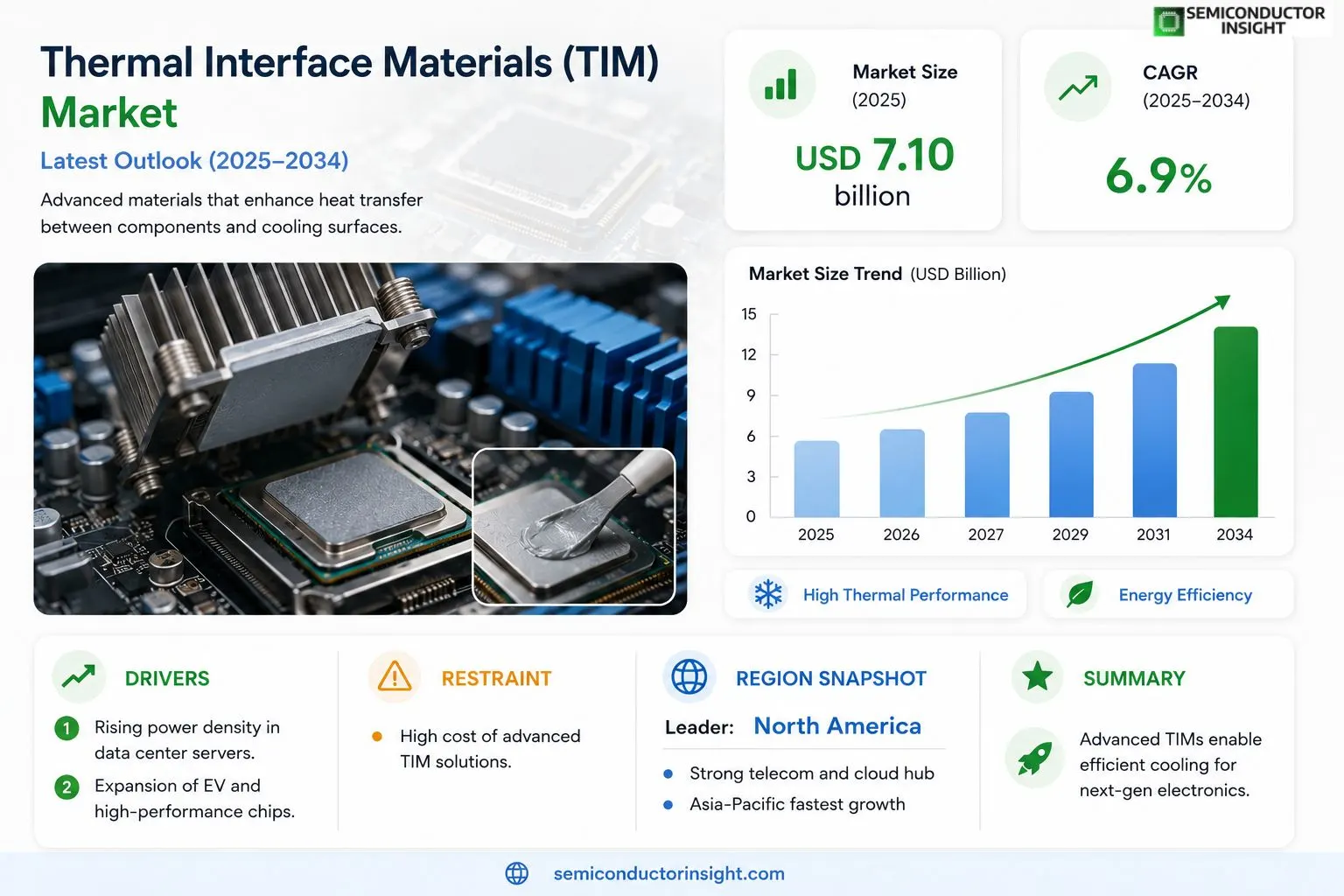
Global Thermal Interface Materials (TIM) market size was valued at USD 7.10 billion in 2025. The market is projected to grow from USD 7.10 billion in 2025 to USD 13.05 billion by 2034, exhibiting a CAGR of 6·9% during the forecast period.
Thermal Interface Materials are engineered compoundssuch as greases, pads, phase‑change materials and adhesivesdesigned to fill microscopic gaps between heat‑generating components and heat‑dissipating surfaces.
By reducing thermal resistance, TIMs enable efficient heat transfer in semiconductors, power modules, LEDs and electric‑vehicle powertrains.The market acceleration stems from rising power density in data‑center servers, expanding adoption of high‑performance computing chips, and rapid electrification of transportation.Furthermore, miniaturization trends in consumer electronics demand thinner yet more conductive solutions.Key players, including Dow Inc., Henkel AG & Co., Laird Performance Materials Ltd., Fujipoly Co., Ltd., and Panasonic Corp., are investing heavily in nano‑filled polymers and graphene‑based formulations to sustain growth.
MARKET DRIVERS
Rising Demand for High‑Performance Electronics
Thermal Interface Materials (TIM) Market is being propelled by the accelerating adoption of 5G infrastructure, data‑center expansions, and advanced computing platforms. Global revenue for TIM solutions reached approximately $5.2 billion in 2023, reflecting a compound annual growth rate (CAGR) of about 8 % over the past five years. This surge is driven by the need to dissipate higher power densities while maintaining form‑factor constraints.
Stringent Energy‑Efficiency Regulations
Governments worldwide are tightening energy‑efficiency standards for consumer electronics and automotive systems. Manufacturers are therefore investing heavily in low‑resistance TIMs to meet targets such as the EU’s Ecodesign directives. The push for greener products directly translates into higher demand for high‑conductivity greases, gels, and phase‑change materials.
➤ “Thermal management is now a strategic design pillar, not just a supporting function.”
In addition, the rapid rollout of electric‑vehicle (EV) platforms creates a parallel growth engine. Power‑train modules and battery packs generate substantial heat, and OEMs are specifying advanced TIMs to ensure reliability and range. Collectively, these trends establish a robust foundation for Thermal Interface Materials (TIM) Market in the coming decade.
MARKET CHALLENGES
Material Compatibility and Process Complexity
Integrating TIMs into miniaturized assemblies often requires precise surface preparation and controlled deposition techniques. Variations in coefficient of thermal expansion between substrates and TIM layers can lead to delamination, especially in high‑vibration environments. These technical hurdles increase development cycles and raise qualification costs for manufacturers.
Other Challenges
Supply Chain Volatility
Fluctuations in raw‑material availabilityparticularly for silver‑based and graphene‑enhanced compoundshave introduced pricing uncertainty. Lead times have extended by 20 % in some regions, prompting OEMs to maintain larger safety stocks, which in turn elevates inventory overhead.
MARKET RESTRAINTS
High Cost of Advanced TIM Solutions
While advanced nano‑composite TIMs deliver superior thermal conductivity, their manufacturing expenses remain substantially higher than conventional greases. For price‑sensitive segments such as consumer laptops, the cost premium limits widespread adoption, confining high‑performance TIMs to niche applications where performance outweighs expense.
MARKET OPPORTUNITIES
Emerging Applications in Electric Vehicles
Thermal Interface Materials (TIM) Market stands to benefit from the projected 30 % CAGR of the global EV battery segment through 2030. New vehicle architectures demand compact, high‑efficiency cooling solutions for power‑electronics modules. This creates a sizable opportunity for phase‑change materials and liquid‑metal TIMs that can manage heat loads exceeding 200 W per module while occupying minimal volume.
Thermal Interface Materials (TIM) Market Trends
Rising Power Density in Data‑Center Servers
Data‑center operators are installing increasingly dense processor arrays to meet cloud‑computing demand. The resulting heat flux exceeds the capability of conventional cooling methods, compelling system designers to adopt more efficient Thermal Interface Materials (TIM) solutions. By filling microscopic gaps between chips and heat‑spreaders, advanced greases and phase‑change materials lower thermal resistance, allowing higher clock speeds without risking thermal throttling. This shift is evident across hyperscale facilities where power‑density metrics have risen by roughly 30 % over the last three years, driving immediate upgrades to TIM formulations that can sustain continuous high‑temperature operation.
Other Trends
Miniaturization in Consumer Electronics
Smartphone, wearable, and tablet designs continue to shrink while integrating higher‑performance processors and 5G radios. The thinner packaging envelopes reduce the allowable TIM layer thickness, creating a need for pads and adhesives that combine sub‑micron thickness with high thermal conductivity. Manufacturers are therefore focusing on nano‑filled polymer matrices that maintain mechanical compliance despite aggressive down‑scaling, ensuring reliable heat removal from compact modules.
Advanced Nanocomposite Formulations
Key industry playersincluding Dow Inc., Henkel AG & Co., Laird Performance Materials, Fujipoly Co., Ltd., and Panasonic Corp.are investing heavily in research on graphene‑based and other nano‑filled composites. These materials exploit the extraordinary thermal pathways of two‑dimensional fillers to achieve conductivity levels previously limited to metal‑based TIMs, while retaining the electrical insulation required for electronic safety. Early adoption in high‑performance computing (HPC) platforms and electric‑vehicle powertrains has demonstrated temperature reductions of up to 15 °C compared with legacy silicone greases, confirming the commercial viability of the approach.
COMPETITIVE LANDSCAPEKey Industry Players
Thermal Interface Materials Market: Competitive Overview and Growth Drivers
Thermal Interface Materials (TIM) Market, valued at USD 7.10 billion in 2025, is dominated by a handful of global manufacturers that command the majority of high‑performance polymer and nano‑filled product segments. Dow Inc., Henkel AG & Co., and Laird Performance Materials Ltd. lead the market by leveraging extensive R&D pipelines to develop graphene‑enhanced greases and phase‑change pads that meet the thermal resistance thresholds of data‑center servers and electric‑vehicle powertrains. Fujipoly Co., Ltd. and Panasonic Corp. complement these leaders with strong positions in automotive and consumer‑electronics applications, capitalising on the projected CAGR of 6.9% toward USD 13.05 billion by 2034. The market structure reflects a tiered hierarchy where large, diversified chemical groups dominate volume sales, while niche innovators focus on specialised formulations that address emerging miniaturisation trends.Beyond the primary tier, several niche but strategically important players contribute depth to the TIM ecosystem. 3M, Lord Corporation, and BASF provide advanced adhesive‑based TIMs that target high‑frequency communications equipment. Shin‑Etsu Chemical and TDK supply ceramic‑filled pads for high‑power LED lighting, whereas Alpha Technologies and Wacker Chemie focus on silicon‑based gap‑fill solutions for semiconductor packaging. Regional specialists such as Toyo Seiki, Mitsui Chemicals, and Megtron (a 3M subsidiary) enhance market resiliency by addressing localized demand in Asia‑Pacific manufacturing hubs. These companies collectively raise the innovation bar, driving continuous improvements in thermal conductivity, shear strength, and dimensional stability across the TIM value chain.
List of Key Thermal Interface Materials Companies Profiled
- Dow Inc.
- Henkel AG & Co.
- Laird Performance Materials Ltd.
- Fujipoly Co., Ltd.
- Panasonic Corp.
- 3M
- Lord Corporation
- BASF SE
- Shin‑Etsu Chemical Co., Ltd.
- TDK Corporation
- Alpha Technologies
- Wacker Chemie AG
- Toyo Seiki Co., Ltd.
- Mitsui Chemicals, Inc.
- Megtron (3M subsidiary)
Segment Analysis:
| Segment Category | Sub-Segments | Key Insights |
| By Type |
|
Phase‑Change Materials are increasingly preferred for high‑performance thermal management because:
|
| By Application |
|
Data‑Center Servers drive TIM innovation through:
|
| By End User |
|
Automotive OEMs prioritize TIMs that:
|
| By Material Formulation |
|
Nano‑filled Polymers emerge as the leading formulation because:
|
| By Device Integration |
|
Chip‑Level Integration is gaining prominence due to:
|
Regional Analysis: North America
United States
The consumer electronics sector in the US represents a substantial portion of the TIM market, driven by the increasing complexity and power demands of smartphones, laptops, and gaming consoles. Demand for compact and efficient thermal solutions is critical to enable the performance and longevity of these devices.
The rapid growth of data centers and high-performance computing (HPC) applications in the US is a major driver for advanced TIMs. These environments demand robust thermal management to prevent failures and ensure optimal operational efficiency. The increasing adoption of AI and machine learning further emphasizes the need for sophisticated cooling solutions.
The automotive industry in the US is witnessing a significant shift towards electrification and advanced driver-assistance systems (ADAS), creating new opportunities for TIMs. These applications require reliable thermal management for power electronics, battery management systems, and in-cabin electronics.
The aerospace and defense sectors in the US are key consumers of high-reliability TIMs. These applications demand materials that can withstand extreme temperatures and harsh environmental conditions. Thermal management is critical for ensuring the performance and safety of critical systems.
Europe
Europe represents a significant and steadily growing market for Thermal Interface Materials. Driven by strong automotive and industrial sectors, coupled with increasing investments in semiconductor manufacturing and data centers across the continent, the demand for effective thermal management solutions is expanding. The focus on energy efficiency and reduced carbon footprints is also influencing the adoption of advanced TIMs. Several key countries, including Germany, France, and the UK, are major contributors to the European TIM market. European manufacturers are increasingly emphasizing sustainable and environmentally friendly TIM solutions, aligning with the region’s stringent environmental regulations. The automotive industry, in particular, is a major driver, as electric vehicle (EV) adoption accelerates and requires sophisticated thermal management for battery packs and power electronics.
Asia-Pacific
Asia-Pacific is the largest and fastest-growing market for Thermal Interface Materials globally, propelled by the rapid expansion of the semiconductor industry in countries like China, Taiwan, South Korea, and Japan. The region’s dominance in electronics manufacturing, particularly consumer electronics and telecommunications equipment, fuels significant demand for TIMs. China’s substantial investments in semiconductor fabrication and its growing domestic electronics market are major contributors to the region’s growth. The Asia-Pacific market is characterized by intense competition and a focus on cost-effective solutions. However, there is also a growing demand for high-performance TIMs to address the increasing power density of electronic devices. Furthermore, the burgeoning electric vehicle (EV) market across Asia-Pacific presents a significant opportunity for TIM suppliers.
South America
The Thermal Interface Materials market in South America is witnessing moderate growth, primarily driven by the expansion of the electronics and automotive industries. Brazil is the largest market in the region, followed by Argentina and Chile. Increasing adoption of smartphones, computers, and automotive electronics is boosting demand for effective thermal management. The growing industrial sector and investments in infrastructure projects also contribute to the market growth. While the market is relatively smaller compared to North America and Asia-Pacific, it presents potential for future expansion as the region’s economy continues to develop. The automotive sector’s shift towards more advanced electronic systems will continue to be a key driver.
Middle East & Africa
The Thermal Interface Materials market in the Middle East & Africa is relatively nascent but exhibits promising growth potential. The increasing investments in infrastructure projects, particularly in the telecommunications and oil & gas sectors, are driving demand for electronic components and equipment, which in turn requires thermal management solutions. The expansion of the consumer electronics market and the growing adoption of automotive electronics are also contributing to the market growth. The region’s increasing focus on industrialization and technological advancements is expected to further fuel the demand for TIMs in the coming years. The oil & gas industry, with its reliance on sophisticated electronic systems, is a significant consumer of TIMs in the region.
Report Scope
This market research report provides a comprehensive analysis of the Thermal Interface Materials (TIM) Market , covering the forecast period 2026–2034. It offers detailed insights into market dynamics, technological advancements, competitive landscape, and key trends shaping the industry.
Key focus areas of the report include:
- Market Overview: The report begins with an overview outlining its current market scenario, key growth indicators, and industry transformation drivers. It discusses macroeconomic factors, demand–supply balance, regulatory landscape, and the strategic role of semiconductors in powering advancements across industries such as automotive, telecommunications, consumer electronics, and industrial automation.
- Market Size & Forecast: Historical data and future projections for revenue, unit shipments, and market value across major regions and segments.
- Segmentation Analysis: Detailed breakdown by product type, technology, application, and end-user industry to identify high-growth segments and investment opportunities.
- Regional Insights: Insights into market performance across North America, Europe, Asia-Pacific, Latin America, and the Middle East & Africa, including country-level analysis where relevant.
- Competitive Landscape: Profiles of leading market participants, including their product offerings, R&D focus, manufacturing capacity, pricing strategies, and recent developments such as mergers, acquisitions, and partnerships.
- Technology Trends & Innovation: Assessment of emerging technologies, integration of AI/IoT, semiconductor design trends, fabrication techniques, and evolving industry standards.
- Market Drivers & Restraints: Evaluation of factors driving market growth along with challenges, supply chain constraints, regulatory issues, and market-entry barriers.
- Stakeholder Insights: Insights for component suppliers, OEMs, system integrators, investors, and policymakers regarding the evolving ecosystem and strategic opportunities.
Primary and secondary research methods are employed, including interviews with industry experts, data from verified sources, and real‑time market intelligence to ensure the accuracy and reliability of the insights presented.
FREQUENTLY ASKED QUESTIONS:
What is the current market size of Thermal Interface Materials (TIM) Market?
-> Thermal Interface Materials (TIM) Market was valued at USD 7.10 billion in 2025 and is expected to reach USD 13.05 billion by 2034.
Which key companies operate in Thermal Interface Materials (TIM) Market?
-> Key players include Dow Inc., Henkel AG & Co., Laird Performance Materials Ltd., Fujipoly Co., Ltd., and Panasonic Corp.
What are the key growth drivers?
-> Key growth drivers include rising power density in data‑center servers, expanding adoption of high‑performance computing chips, rapid electrification of transportation, and miniaturization trends in consumer electronics.
Which region dominates the market?
-> The reference does not specify a dominant region.
What are the emerging trends?
-> Emerging trends include nano‑filled polymers, graphene‑based formulations, and advanced high‑conductivity TIM solutions.
Get Sample Report PDF for Exclusive Insights
Report Sample Includes
- Table of Contents
- List of Tables & Figures
- Charts, Research Methodology, and more...
 Download Sample Report PDF