
Chiplet Market Insights
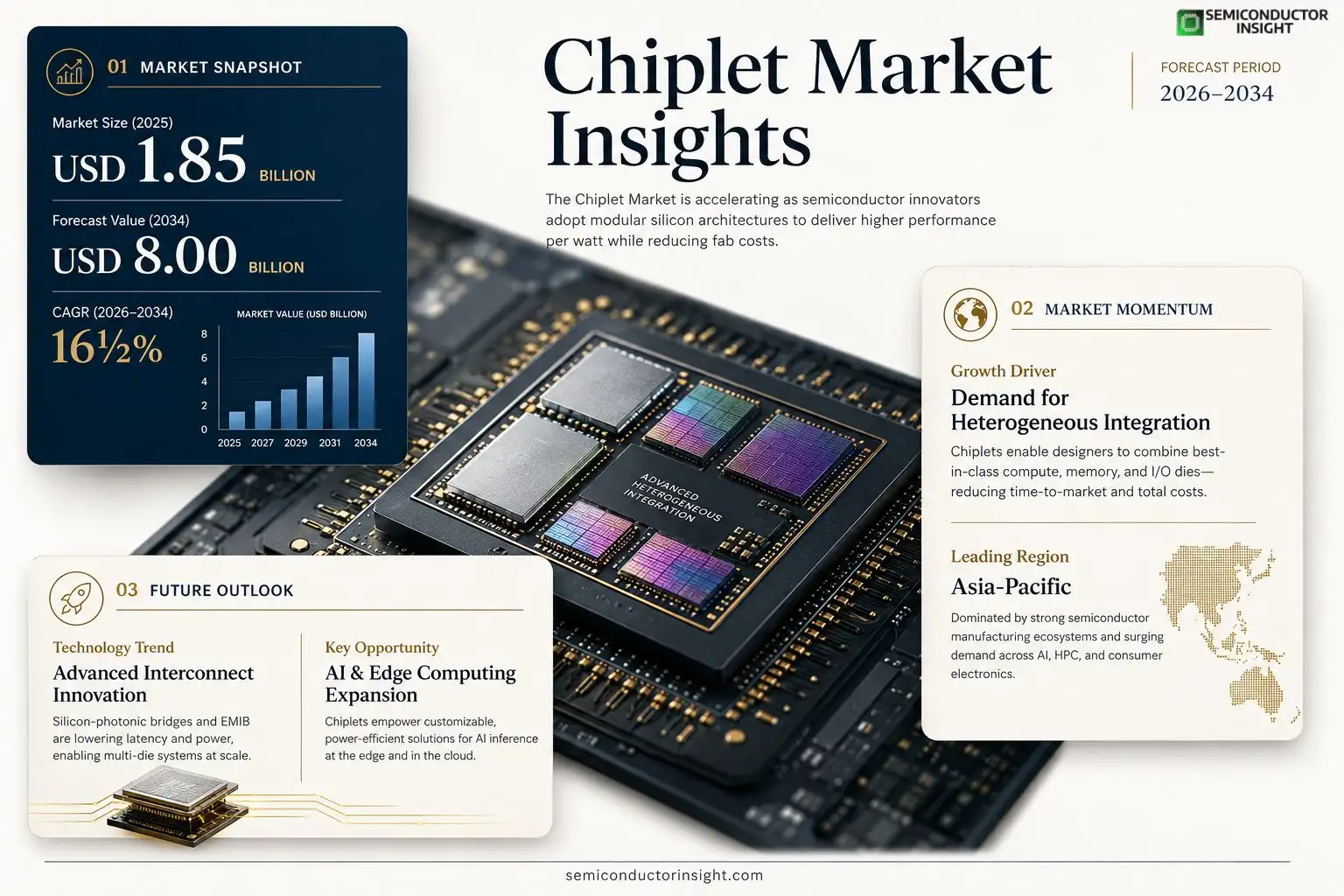
Chiplet Market size was valued at USD 1.85 billion in 2025. The market is projected to grow from USD 2.05 billion in 2026 to USD 8 billion by 2034, exhibiting a CAGR of 16½% during the forecast period.
Chiplets are modular silicon building blocks that can be assembled into heterogeneous system‑in‑package or advanced packaging solutions, allowing designers to combine CPUs, GPUs, high‑speed I/O, memory dies and analog components on a single substrate. Chiplet Market is accelerating because semiconductor manufacturers seek higher performance per watt while curbing fab costs; advances in interconnect technologies such as silicon‑photonic bridges and EMIB further reduce latency between dies.
Furthermore, major players including Intel (Foveros), AMD (Infinity Fabric), TSMC (CoWoS) and Qualcomm are expanding their roadmaps with multi‑chip modules.
Recent collaborations,e.g., AMD’s partnership with Xilinx announced in March 2024,are also driving adoption across AI accelerators and high‑performance computing.
MARKET DRIVERS
Demand for Heterogeneous Integration
Chiplet Market is gaining momentum as system designers seek to combine diverse functional blocks onto a single package, reducing time‑to‑market and development costs. This approach enables manufacturers to leverage best‑in‑class IP blocks, delivering differentiated performance without the overhead of full‑die redesigns.
Advances in Interconnect Technology
Modern silicon‑photonic and high‑density electrical interconnects have lowered latency and power consumption, making chiplet‑based architectures technically viable for high‑performance computing and data‑center workloads. These advances also support finer pitch routing, which is critical for scaling beyond 5 nm nodes.
➤ “The shift toward modular silicon is reshaping design economics, allowing firms to iterate faster while managing fab costs.”
Enterprises are increasingly adopting the chiplet paradigm to meet the rapid growth of AI inference demands, where a mix of compute, memory, and networking die can be customized per workload, driving robust top‑line growth for Chiplet Market.
MARKET CHALLENGES
Design Complexity
Integrating multiple dies introduces intricate layout, thermal management, and verification challenges. Engineers must coordinate cross‑vendor design rules, which can extend validation cycles and increase engineering headcount.
Other Challenges
Supply Chain Constraints
The reliance on specialized packaging facilities and advanced interconnect materials creates bottlenecks, especially when demand spikes for AI accelerators, limiting the ability to scale production smoothly.
MARKET RESTRAINTS
Standardization Gaps
While industry consortia are working toward unified specifications, the lack of universally accepted mechanical and electrical standards hampers broader adoption, as OEMs remain cautious about long‑term compatibility across successive technology generations.
MARKET OPPORTUNITIES
Emerging AI and Edge Computing Applications
AI‑driven workloads at the edge require power‑efficient, high‑bandwidth solutions that chiplet architectures can deliver. By combining low‑power sensor dies with specialized AI inference compute blocks, manufacturers can create differentiated products that address the rapidly expanding edge AI market, opening a substantial growth avenue for Chiplet Market.
Chiplet Market Trends
Integration and Performance Efficiency
The industry is witnessing a shift toward heterogeneous system‑in‑package solutions that enable higher performance per watt while reducing overall fab spend. By assembling modular silicon building blocks, designers can combine CPUs, GPUs, high‑speed I/O, and memory dies on a single substrate. This architectural flexibility is driving broader adoption in data‑center accelerators, edge AI devices, and high‑performance computing platforms.
Other Trends
Advanced Interconnect Technologies
New interconnect approaches such as silicon‑photonic bridges and embedded multi‑die interconnect bridges (EMIB) are substantially lowering latency and power consumption between die stacks. These advances make it feasible to integrate dissimilar process nodes, allowing specialized cores to communicate at speeds previously limited to monolithic designs. The result is a more scalable path for future generations of compute‑intensive products.
Ecosystem Collaboration and Roadmap Expansion
Leading semiconductor firms are extending their roadmaps with multi‑chip modules, and collaborative agreements are accelerating ecosystem maturity. Recent partnerships,such as the joint effort between a major CPU vendor and a programmable logic supplier,illustrate how cross‑vendor cooperation is unlocking new use cases in AI inference and scientific simulation. These collaborations also encourage the development of standardized design tools and verification flows, which lower entry barriers for smaller players seeking to adopt Chiplet Market approach.
Overall, the trend landscape points toward a more modular, interoperable, and performance‑focused semiconductor industry. By leveraging advanced packaging, unified interconnect standards, and strategic alliances, the market is poised to meet the growing demand for compute power without proportionally increasing manufacturing complexity.
COMPETITIVE LANDSCAPEKey Industry Players
Chiplet Market Competitive Landscape Overview
The chiplet ecosystem is anchored by integrated device manufacturers that combine design‑for‑assembly expertise with advanced packaging platforms. Intel’s Foveros 3‑D stacking, AMD’s Infinity Fabric‑enabled multi‑chip modules, and TSMC’s CoWoS interconnect are setting the performance and cost benchmarks that shape the market’s trajectory. Qualcomm leverages its heterogeneous integration roadmap to embed AI accelerators and high‑speed I/O in system‑in‑package solutions, while Samsung’s eXtended Chiplet Packaging (XCP) adds competitive pressure through high‑density interposers. These IDM leaders dominate the top‑line revenue share, benefitting from deep R&D budgets, extensive IP portfolios, and strategic partnerships that accelerate adoption across data‑center, automotive, and edge‑computing segments.Beyond the primary tier, a cohort of niche yet highly innovative firms is expanding the chiplet value chain. Xilinx (now part of AMD) contributes reconfigurable logic that accelerates time‑to‑market for custom AI chips, while Marvell and Broadcom supply high‑speed networking dies that integrate seamlessly with compute chiplets. Foundries offers foundry services tailored to heterogeneous integration, and NXP provides automotive‑grade sensor and MCU chiplets that address safety‑critical applications. Renesas and ARM (through design licensing) round out the ecosystem by delivering low‑power microcontroller and processor architectures that can be combined with specialized dies, fostering diversification of supply and encouraging modular system designs.
List of Key Chiplet Companies Profiled
- Intel
- AMD
- TSMC
- Qualcomm
- Samsung Electronics
- Xilinx
- Marvell Technology Group
- Broadcom Inc.
- Foundries
- NXP Semiconductors
- Renesas Electronics
- Arm Ltd.
Segment Analysis:
| Segment Category | Sub-Segments | Key Insights |
| By Type |
|
Heterogeneous Chiplets
|
| By Application |
|
AI Accelerators
|
| By End User |
|
Cloud Service Providers
|
| By Integration Approach |
|
2.5D Interposers
|
| By Enabling Technology |
|
Silicon Photonic Bridges
|
Regional Analysis: North America
United States
The emphasis on high-performance computing, artificial intelligence, and automotive electronics creates substantial opportunities for **chiplet market** players in the United States. Existing semiconductor giants and emerging startups are actively developing and deploying chiplet-based architectures to address the growing complexity and performance requirements of these applications. Strategic collaborations between chiplet developers, packaging companies, and system integrators are becoming increasingly prevalent, fostering a dynamic and innovative ecosystem within the **chiplet market**.
The development of advanced packaging techniques, such as fan-out wafer-level packaging (FOWLP) and embedded multi-die interconnect bridge (EMIB), is a crucial aspect of the **chiplet market** evolution in North America. These technologies enable higher integration densities and improved performance.
The trend towards heterogeneous integration, combining diverse chiplets for specialized functions, is a defining characteristic of the North American **chiplet market**. This approach allows for optimized performance and efficiency.
Government funding and policies aimed at bolstering domestic semiconductor manufacturing are significantly impacting the **chiplet market** in the United States, fostering innovation and supply chain stability.
Strong collaborations among chiplet developers, packaging providers, and system manufacturers are essential for accelerating the adoption of chiplet-based solutions within the **chiplet market**.
Canada
Canada’s **chiplet market** is experiencing steady growth, benefiting from its close ties with the US semiconductor industry. While not as dominant as its southern neighbor, Canada possesses a skilled workforce and a supportive regulatory environment, fostering the development of specialized chiplet applications. The focus in Canada tends to be on niche areas within the broader **chiplet market**, such as advanced sensors and embedded systems. Strong government support for research and development further contributes to the region’s potential in the **chiplet market**.
Mexico
Mexico’s **chiplet market** is rising, largely driven by its increasing integration into the North American supply chain. The country’s proximity to the US and its established manufacturing infrastructure make it an attractive location for chiplet assembly and testing. The growth of the automotive sector in Mexico is also creating demand for chiplet-based solutions in areas like advanced driver-assistance systems (ADAS) and electric vehicle powertrains within the **chiplet market**.
South America
The **chiplet market** in South America is still in its early stages of development. However, increasing investments in technology and manufacturing across the region are expected to drive future growth. Key opportunities exist in the telecommunications and industrial sectors, where chiplet-based solutions can improve performance and efficiency within the **chiplet market**. The adoption of advanced computing in South American universities and research institutions will also contribute to the growth of the **chiplet market**.
Europe
Europe is actively strengthening its position in the **chiplet market** through substantial investments in research, development, and manufacturing capabilities. The European Chips Act aims to boost domestic semiconductor production and reduce reliance on external suppliers. Several European countries, including Germany, France, and the Netherlands, are home to leading chiplet developers and packaging companies, fostering a competitive **chiplet market**. The focus in Europe is on high-performance computing, automotive, and industrial applications where chiplets offer significant advantages within the **chiplet market**.
Asia-Pacific
The Asia-Pacific region represents a significant and rapidly expanding **chiplet market**. Countries like China, Taiwan, and South Korea are major players in the semiconductor industry and are actively investing in chiplet technologies. The demand for chiplets is particularly strong in the consumer electronics, telecommunications, and automotive sectors. The Asia-Pacific **chiplet market** is characterized by intense competition and rapid innovation, with a growing number of domestic chiplet manufacturers emerging within this dynamic **chiplet market**.
Report Scope
This market research report provides a comprehensive analysis of the Chiplet Market , covering the forecast period 2026–2034. It offers detailed insights into market dynamics, technological advancements, competitive landscape, and key trends shaping the industry.
Key focus areas of the report include:
- Market Overview: The report begins with an overview outlining its current market scenario, key growth indicators, and industry transformation drivers. It discusses macroeconomic factors, demand–supply balance, regulatory landscape, and the strategic role of semiconductors in powering advancements across industries such as automotive, telecommunications, consumer electronics, and industrial automation.
- Market Size & Forecast: Historical data and future projections for revenue, unit shipments, and market value across major regions and segments.
- Segmentation Analysis: Detailed breakdown by product type, technology, application, and end-user industry to identify high-growth segments and investment opportunities.
- Regional Insights: Insights into market performance across North America, Europe, Asia-Pacific, Latin America, and the Middle East & Africa, including country-level analysis where relevant.
- Competitive Landscape: Profiles of leading market participants, including their product offerings, R&D focus, manufacturing capacity, pricing strategies, and recent developments such as mergers, acquisitions, and partnerships.
- Technology Trends & Innovation: Assessment of emerging technologies, integration of AI/IoT, semiconductor design trends, fabrication techniques, and evolving industry standards.
- Market Drivers & Restraints: Evaluation of factors driving market growth along with challenges, supply chain constraints, regulatory issues, and market-entry barriers.
- Stakeholder Insights: Insights for component suppliers, OEMs, system integrators, investors, and policymakers regarding the evolving ecosystem and strategic opportunities.
Primary and secondary research methods are employed, including interviews with industry experts, data from verified sources, and real-time market intelligence to ensure the accuracy and reliability of the insights presented.
FREQUENTLY ASKED QUESTIONS:
What is the current market size of Chiplet Market?
-> Chiplet Market was valued at USD 1.85 billion in 2025 and is expected to reach USD 8 billion by 2034, reflecting a strong growth trajectory.
Which key companies operate in Chiplet Market?
-> Key players include Intel, AMD, TSMC, and Qualcomm, among others.
What are the key growth drivers?
-> Key growth drivers include the need for higher performance per watt, reduction of fab costs, and advances in interconnect technologies such as silicon‑photonic bridges and EMIB.
Which region dominates the market?
-> The provided reference does not specify a dominant geographic region for Chiplet Market.
What are the emerging trends?
-> Emerging trends encompass heterogeneous system‑in‑package integration, AI‑accelerator adoption, and the development of advanced packaging solutions leveraging multi‑chip modules.
Get Sample Report PDF for Exclusive Insights
Report Sample Includes
- Table of Contents
- List of Tables & Figures
- Charts, Research Methodology, and more...
 Download Sample Report PDF


