Heat Sinks for Electronic Equipment Market Insights
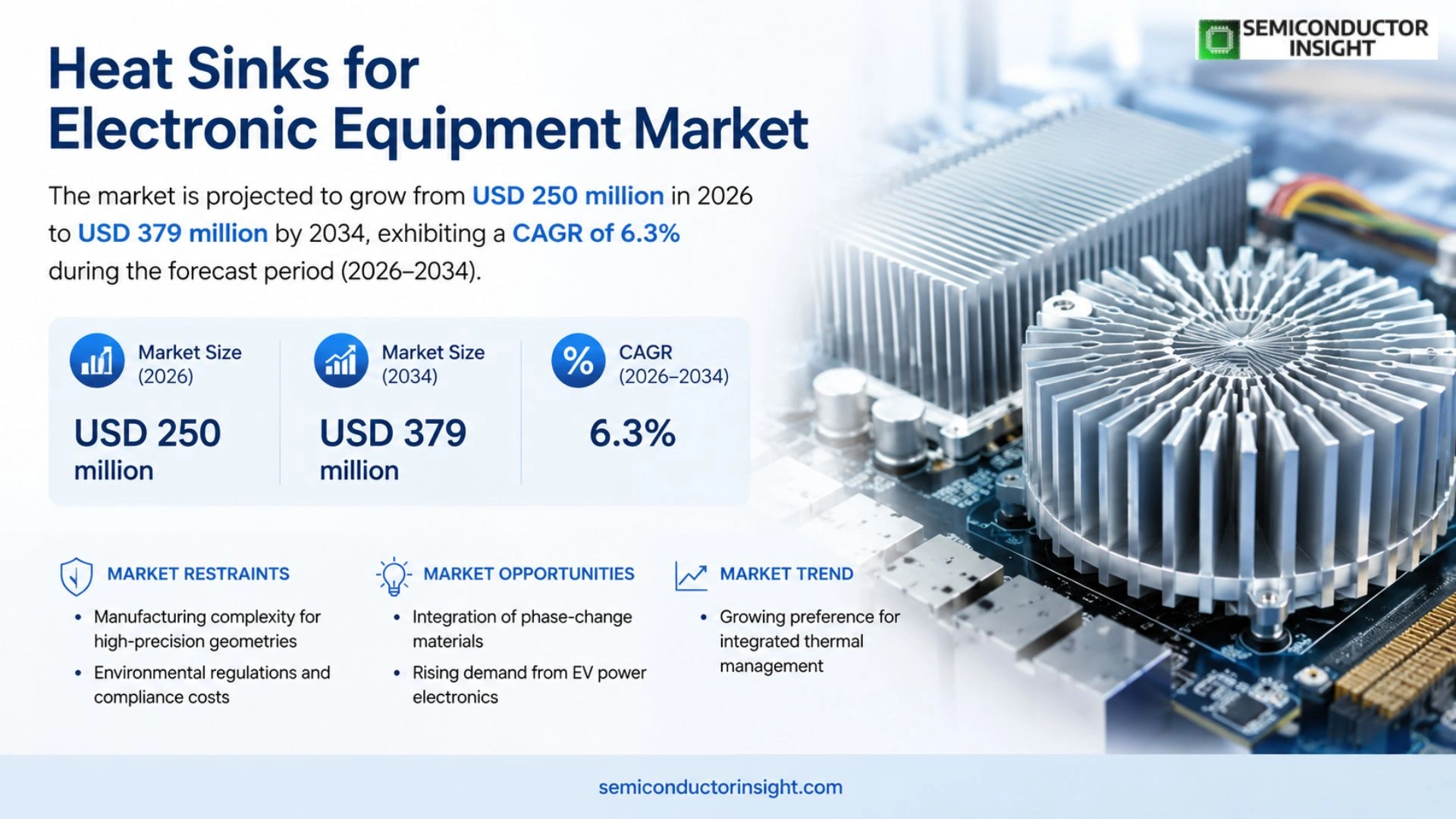
Global Heat Sinks for Electronic Equipment market is projected to grow from USD 250 million in 2026 to USD 379 million by 2034, exhibiting a CAGR of 6.3% during the forecast period.
Heat sinks are thermal‑management components employed across electronic equipment to remove excess heat from devices or individual parts, thereby preserving performance stability and extending product lifespan. They achieve this by expanding surface area and enabling efficient convective or conductive heat transfer through high‑conductivity materials such as aluminum or copper.
The market is experiencing growth because high‑performance computing demand rises, data‑center capacity expands, and electric‑vehicle adoption increases where precise thermal control is essential. Recent initiatives include Sumitomo Precision Products collaborating with leading semiconductor manufacturers on advanced extrusion methods (early 2024), Boyd launching a low‑profile passive series for compact IoT hardware (Q2 2024), and Wakefield Thermal unveiling an active fan‑integrated solution aimed at power‑transistor cooling (Q3 2024).
MARKET DRIVERS
Thermal Management Demands in High‑Performance Devices
Modern processors, power modules and 5G infrastructure generate heat densities that exceed legacy design limits. Manufacturers are therefore compelled to integrate more efficient heat‑dissipating components, creating a steady pull for advanced heat sink solutions. Design engineers are revisiting material choices and fin geometries to meet these thermal thresholds without inflating chassis size.
Shift Toward Miniaturization and Power Efficiency
Device form‑factor reductions coupled with stricter energy‑consumption standards have forced OEMs to extract higher performance from smaller footprints. The resulting need for compact yet high‑capacity thermal paths translates into a measurable uptick in orders for copper‑alloy and graphite‑based heat sinks. Supply chains are adapting by scaling extrusion and machining capacities to keep pace with this demand.
➤ Strategic investments in additive manufacturing are lowering lead times for custom heat sink designs, giving early adopters a competitive edge.
Regulatory pressure on electronic equipment to meet reliability certifications is another catalyst. Compliance testing now incorporates more rigorous thermal cycling, prompting vendors to certify their heat sink products against stricter criteria. This compliance focus is reshaping vendor‑buyer negotiations and driving higher‑margin contracts.
MARKET CHALLENGES
Cost Sensitivity in Tier‑1 Consumer Segments
While performance imperatives are clear, price‑conscious OEMs in the consumer electronics arena resist premium pricing for exotic materials. The trade‑off between thermal efficiency and bill‑of‑materials cost creates tension in product road‑maps, often resulting in the selection of lower‑cost aluminum alloys that deliver marginally lower performance.
Other Challenges
Supply‑Chain Volatility
Fluctuations in copper and aluminum availability have introduced lead‑time extensions of up to six weeks, compelling manufacturers to hold safety stock or redesign heat sink specifications on short notice.
MARKET RESTRAINTS
Manufacturing Complexity for High‑Precision Geometries
Fabricating fins with micron‑level tolerances demands specialized tooling and rigorous quality checks, inflating unit costs. Small‑batch production runs struggle to achieve economies of scale, limiting adoption in niche applications where bespoke solutions are necessary.
Environmental regulations concerning the disposal of metal‑based waste add another layer of compliance cost, especially for firms operating across multiple jurisdictions. The cumulative effect of these factors tempers growth prospects in regions with strict ecological standards.
MARKET OPPORTUNITIES
Integration of Phase‑Change Materials
Embedding phase‑change compounds within heat sink assemblies offers a path to sustain peak thermal loads without expanding the physical envelope. Early adopters are reporting up to a 12% improvement in thermal resistance, positioning this technology as a differentiator for high‑end server and aerospace platforms.
Emerging markets in electric‑vehicle power electronics present a sizable untapped segment. The convergence of higher inverter ratings and tighter thermal envelopes makes Heat Sinks for Electronic Equipment Market a strategic focus for automotive suppliers seeking to capture this growth.
Heat Sinks for Electronic Equipment Market Trends
Growing Preference for Integrated Thermal Management
Heat Sinks for Electronic Equipment Market moved from a $250 million base in 2024 to a forecast of $379 million by 2031, reflecting a compound annual growth rate of roughly 6 percent. The upward trajectory stems from tighter thermal budgets in data‑center servers, electric‑vehicle power modules, and high‑performance consumer devices. As component densities rise, manufacturers are compelled to adopt more efficient heat‑removal strategies, prompting investment in both simulation tools and advanced material blends. This shift not only expands revenue opportunities but also pressures original equipment manufacturers to redesign PCBs and chassis to accommodate compact, high‑conductivity sinks. Suppliers that can offer turnkey thermal solutions,combining design services with rapid prototyping,are positioned to capture a larger slice of the emerging demand.
Other Trends
Active versus Passive Cooling Choices
Within the market, the balance between active (fan‑assisted) and passive (conduction‑only) heat‑sink configurations is tilting toward active implementations for power‑intensive segments such as motherboard‑level voltage regulation and power‑transistor arrays. Active devices deliver lower thermal resistance at comparable size, which is critical when operating margins shrink to a few degrees Celsius above ambient. However, passive solutions retain appeal in environments where reliability and acoustic footprint dominate, such as aerospace electronics and industrial controllers. Vendors that maintain a flexible product line,offering modular fan mounts, low‑profile fins, and hybrid designs,can tailor offerings to client risk profiles while preserving economies of scale.
Supply‑Chain Adaptation and Regional Growth
Geographically, the market is experiencing a pronounced uptick in China, where domestic manufacturers are scaling capacity to meet local demand for telecom infrastructure and electric‑vehicle power electronics. Parallelly, the United States remains a hub for high‑value, custom‑engineered sinks used in defense and aerospace projects, reinforcing a bi‑regional development pattern. This divergence compels global suppliers to diversify sourcing strategies: securing raw aluminum and copper billets from stable producers while establishing near‑shoring assembly lines to reduce lead times. Companies that synchronize R&D with regional regulatory trends,such as stricter RoHS limits in Europe,will likely enjoy smoother market entry and stronger brand equity.
COMPETITIVE LANDSCAPE
Key Industry Players
Heat Sinks for Electronic Equipment – Competitive Overview
Sumitomo Precision Products dominates the upper tier of the market, leveraging a vertically integrated manufacturing base that spans precision forging, CNC machining, and surface‑treatment capabilities. This breadth allows Sumitomo to supply custom‑engineered sinks to OEMs in high‑performance computing and automotive power electronics, where strict thermal tolerances and rapid design cycles are paramount. The company’s pricing power stems from economies of scale and a robust intellectual‑property portfolio covering advanced fin designs and material composites. Consequently, the market structure exhibits a clear hierarchy: a handful of global leaders command the majority of revenue, while a broad pool of specialized firms attends to niche applications.
Beyond the leaders, a constellation of midsize and niche players sustains competitive pressure. Boyd Corporation and Wakefield Thermal focus on aerospace‑grade aluminum and copper alloys, catering to defense contractors that demand rigorous certification. Advanced Thermal Solutions distinguishes itself through additive‑manufactured heat‑sink architectures that reduce weight for portable medical devices. Ohmite, Trenz Electronic, and Shahsons Electronics retain strong footholds in Asia‑Pacific, supplying cost‑effective passive solutions to consumer‑grade PCB and LED modules. Fujikura and ShunTeh provide hybrid active‑passive systems for power transistors, while Weifang Huapeng Electronic, Aavid Thermalloy, Delta Electronics, and Coolit Systems round out the ecosystem with region‑specific distribution networks and aftermarket support services.
List of Key Heat Sinks for Electronic Equipment Companies Profiled
- Sumitomo Precision Products
- Boyd Corporation
- Wakefield Thermal
- Advanced Thermal Solutions
- Ohmite
- Trenz Electronic
- Shahsons Electronics
- Fujikura Ltd.
- ShunTeh Technology
- Weifang Huapeng Electronic
- Aavid Thermalloy (3M)
- Delta Electronics
- Coolit Systems
Segment Analysis:
| Segment Category | Sub-Segments | Key Insights |
| By Type |
|
Active Heat Sinks – recognized for superior thermal dissipation capability, especially in high‑power modules; – often coupled with forced‑air mechanisms to achieve rapid heat extraction; – enable compact system footprints while maintaining reliable temperature control. |
| By Application |
|
Power Transistor – drives demand for robust heat removal due to high current densities; – designers favor heat sinks that can be directly mounted to semiconductor packages; – thermal stability is critical to prevent performance drift in power regulation circuits. |
| By End User |
|
Consumer Electronics – characterized by rapid product cycles and aggressive mini‑size trends; – heat sink solutions must balance thermal efficiency with lightweight form factors; – integration with printed‑circuit‑board layouts drives preference for low‑profile, easily fabricated designs. |
| By Material |
|
Aluminum – dominates due to its excellent strength‑to‑weight ratio and ease of extrusion; – surface treatments enhance corrosion resistance for harsh environments; – cost‑effective manufacturing supports high‑volume consumer segments. |
| By Design Architecture |
|
Pin Fin – offers high surface area within limited volume, ideal for power‑dense modules; – facilitates turbulent airflow when paired with active cooling fans; – widely adopted in automotive power electronics and high‑performance computing. |
Regional Analysis: Heat Sinks for Electronic Equipment Market
Asia-Pacific
The concentration of wafer‑fab facilities and contract manufacturers in the region yields economies of scale that compress unit costs for heat‑sink components. Proximity between material suppliers and assembly plants shortens development cycles, enabling quicker responses to design revisions triggered by evolving thermal standards.
Labor arbitrage, combined with government subsidies for high‑tech manufacturing, lowers the price ceiling for sophisticated thermal solutions. Companies can invest in premium alloys while keeping final product pricing competitive in global markets.
Recent disruptions highlighted the advantage of diversified sourcing within Asia‑Pacific. Localized logistics hubs and strategic stockpiling of copper and aluminum reduce lead‑time volatility, safeguarding OEM production schedules.
Growth in autonomous‑vehicle electronics and high‑performance computing clusters is prompting regional firms to tailor heat‑sink geometries for power‑dense modules, opening niche segments that command premium margins.
North America
North America remains a critical market for design innovation, with U.S. firms leading in advanced simulation tools and thermal‑interface material research. While domestic production of heat‑sink blanks has declined, the region’s emphasis on reliability standards for aerospace and defense drives demand for bespoke, high‑efficiency solutions. Partnerships between semiconductor designers and specialist thermal‑management firms help translate cutting‑edge chip architectures into field‑ready products, giving North American OEMs a competitive edge in performance‑critical sectors.
Europe
European manufacturers prioritize sustainability and circular‑economy practices, influencing material selection for heat‑sink production. The EU’s stringent directives on hazardous substances push suppliers toward lead‑free alloys and recyclable composites. Moreover, the continent’s strong automotive and industrial automation sectors generate steady demand for rugged thermal components that can operate under harsh environmental conditions, reinforcing Europe’s role as a niche but resilient market.
South America
In South America, modest growth is anchored by expanding telecom infrastructure and a nascent renewable‑energy equipment base. Local assemblers are beginning to source higher‑grade heat‑sink products to meet the thermal requirements of next‑generation inverters and solar‑panel micro‑converters. Although import dependence remains high, regional trade agreements are easing tariff barriers, allowing more diversified sourcing options and modest price improvements.
Middle East & Africa
The Middle East & Africa region exhibits a fragmented landscape, with oil‑field electronics and data‑center expansion driving incremental demand. Harsh desert climates accentuate the need for robust thermal solutions, prompting operators to adopt heat‑sink designs that tolerate extreme temperature swings. While overall market size is modest, strategic initiatives to develop local manufacturing capabilities could gradually shift the reliance on imports, especially in Gulf Cooperation Council states investing in smart‑city projects.
Report Scope
This market research report provides a comprehensive analysis of the Heat Sinks for Electronic Equipment Market , covering the forecast period 2026–2034. It offers detailed insights into market dynamics, technological advancements, competitive landscape, and key trends shaping the industry.
Key focus areas of the report include:
- Market Overview: The report begins with an overview outlining its current market scenario, key growth indicators, and industry transformation drivers. It discusses macroeconomic factors, demand–supply balance, regulatory landscape, and the strategic role of semiconductors in powering advancements across industries such as automotive, telecommunications, consumer electronics, and industrial automation.
- Market Size & Forecast: Historical data and future projections for revenue, unit shipments, and market value across major regions and segments.
- Segmentation Analysis: Detailed breakdown by product type, technology, application, and end-user industry to identify high-growth segments and investment opportunities.
- Regional Insights: Insights into market performance across North America, Europe, Asia-Pacific, Latin America, and the Middle East & Africa, including country-level analysis where relevant.
- Competitive Landscape: Profiles of leading market participants, including their product offerings, R&D focus, manufacturing capacity, pricing strategies, and recent developments such as mergers, acquisitions, and partnerships.
- Technology Trends & Innovation: Assessment of emerging technologies, integration of AI/IoT, semiconductor design trends, fabrication techniques, and evolving industry standards.
- Market Drivers & Restraints: Evaluation of factors driving market growth along with challenges, supply chain constraints, regulatory issues, and market-entry barriers.
- Stakeholder Insights: Insights for component suppliers, OEMs, system integrators, investors, and policymakers regarding the evolving ecosystem and strategic opportunities.
Primary and secondary research methods are employed, including interviews with industry experts, data from verified sources, and real-time market intelligence to ensure the accuracy and reliability of the insights presented.
FREQUENTLY ASKED QUESTIONS:
What is the current market size of Heat Sinks for Electronic Equipment Market?
-> Heat Sinks for Electronic Equipment Market is expected to reach USD 379 million by 2034, growing at a CAGR of 6.3% during the forecast period.
Which key companies operate in Heat Sinks for Electronic Equipment Market?
-> Key players include Sumitomo Precision Products, Boyd, Wakefield Thermal, Advanced Thermal Solutions, Ohmite, Trenz Electronic, Shahsons Electronics, Fujikura, ShunTeh, and Weifang Huapeng Electronic, among others.
What are the key growth drivers?
-> Key growth drivers include rising demand for thermal management in increasingly power‑dense electronic equipment, expansion of applications such as motherboards, power transistors, and LED modules, and the need for reliable heat dissipation solutions across consumer and industrial electronics.
Which region dominates the market?
-> The report provides a detailed regional breakdown but does not single out a single dominant region, highlighting significant activity in both North America (especially the United States) and Asia (particularly China).
What are the emerging trends?
-> Emerging trends include the development of active heat sink technologies, adoption of advanced high‑conductivity materials, and growing integration of thermal solutions in high‑performance computing and automotive electronics.
Get Sample Report PDF for Exclusive Insights
Report Sample Includes
- Table of Contents
- List of Tables & Figures
- Charts, Research Methodology, and more...
 Download Sample Report PDF