Headphone Amplifier (Class D, H) IC Market Insights
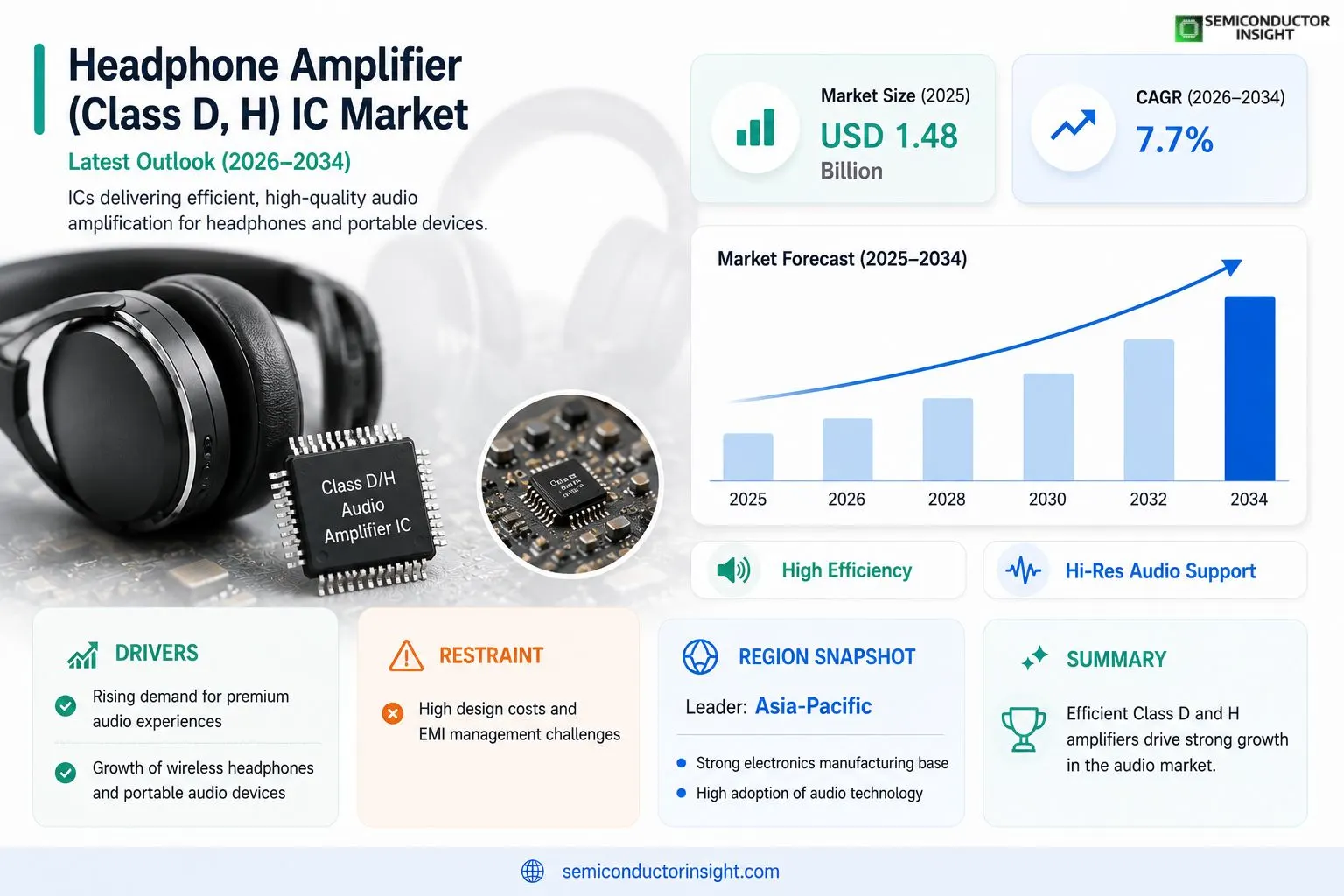
Global Headphone Amplifier (Class D, H) IC market size was valued at USD 1.48 billion in 2025. The market is projected to grow from USD 1.57 billion in 2026 to USD 2.85 billion by 2034, exhibiting a CAGR of 7.7% during the forecast period.
Headphone Amplifier (Class D, H) ICs are specialized integrated circuits designed to deliver high-quality audio amplification for headphones and portable audio devices. These amplifiers efficiently boost low-level audio signals to drive headphones with clarity, low distortion, and minimal power consumption. Class D architectures utilize switching technology for superior efficiency, while Class H variants dynamically adjust supply voltage to optimize performance and battery life in portable applications.
The market is experiencing steady growth due to several factors, including the rapid expansion of consumer electronics, rising demand for premium audio experiences in wireless headphones and earbuds, and increasing adoption of high-resolution audio formats. Furthermore, advancements in low-power design and integration with digital signal processing capabilities are contributing to market expansion. Initiatives by key players in the market are also expected to fuel the market growth. For instance, leading semiconductor companies continue to introduce compact, high-efficiency solutions tailored for smartphones, gaming headsets, and professional audio equipment. Texas Instruments, Cirrus Logic, Analog Devices, and STMicroelectronics are some of the key players that operate in the market with a wide range of portfolios.
MARKET DRIVERS
Rising Demand for Energy-Efficient Audio Solutions in Portable Devices
Headphone Amplifier (Class D, H) IC Market is experiencing robust growth driven by the increasing adoption of Class D and Class H architectures in consumer electronics. These technologies deliver superior power efficiency compared to traditional linear amplifiers, extending battery life in smartphones, wireless earbuds, and portable audio devices while maintaining high audio fidelity. Market participants note that Class D solutions can achieve efficiencies exceeding 85-90% in many applications, making them ideal for compact, battery-powered systems.
Proliferation of Wireless and High-Resolution Audio Devices
Growing consumer preference for premium audio experiences, including high-resolution formats and noise-canceling features, fuels demand for advanced headphone amplifier ICs. The expansion of true wireless stereo (TWS) earbuds and smart audio devices necessitates compact, low-power ICs capable of delivering clear sound without excessive heat generation. Integration of these amplifiers in automotive infotainment and gaming headsets further accelerates market expansion.
➤ Class D amplifiers provide significant advantages in size and thermal management, enabling sleeker product designs across multiple end-use segments.
The shift toward digital audio processing and integration with IoT-enabled devices continues to support steady market momentum, with analysts projecting consistent double-digit growth in relevant audio IC segments through the coming years.
MARKET CHALLENGES
Electromagnetic Interference and Design Complexity
Implementing Class D headphone amplifier ICs introduces challenges related to electromagnetic interference (EMI) management, which requires careful PCB layout and filtering to maintain signal integrity. Designers must balance efficiency gains with audio performance metrics such as total harmonic distortion plus noise (THD+N).
Other Challenges
Intense Competition and Price Pressure
Rapid technological advancements lead to commoditization in certain segments, pressuring margins for manufacturers while demanding continuous innovation in integration and power optimization.
Supply Chain Volatility for Semiconductors
Fluctuations in raw material availability and geopolitical factors affecting chip production can disrupt steady supply to audio device OEMs.
MARKET RESTRAINTS
Technical Trade-offs in Audio Performance
While Class D and Class H headphone amplifier ICs excel in efficiency, achieving the ultra-low distortion levels demanded by high-end audiophile applications can be more complex than with traditional Class AB designs. This restraint limits penetration in certain premium standalone headphone amplifier segments where linear performance remains preferred.Additionally, higher initial design costs for EMI mitigation and advanced modulation techniques can slow adoption among smaller manufacturers focused on cost-sensitive markets.
MARKET OPPORTUNITIES
Expansion in Automotive and Professional Audio Applications
Headphone Amplifier (Class D, H) IC Market presents substantial opportunities through deeper integration into next-generation automotive infotainment systems and professional audio equipment. Demand for efficient, high-channel-count solutions in vehicles and immersive audio setups creates avenues for specialized IC development. Growth in emerging markets, combined with the rise of AI-enhanced audio processing and virtual reality applications, positions manufacturers to capture new revenue streams through feature-rich, power-optimized amplifier ICs.
Headphone Amplifier (Class D, H) IC Market Trends
Rising Demand for High-Efficiency Audio Solutions in Portable Devices
Headphone Amplifier (Class D, H) IC Market continues to evolve as manufacturers prioritize efficient amplification technologies that deliver superior sound quality while minimizing power consumption. Class D architectures leverage switching technology to achieve high efficiency levels, making them ideal for battery-powered applications. Class H variants further enhance this by dynamically adjusting supply voltage, optimizing performance across varying audio demands in wireless headphones and earbuds.
Other Trends
Expansion of Premium Audio Experiences
Growth in the consumer electronics sector has accelerated adoption of Headphone Amplifier (Class D, H) IC solutions. Rising consumer preference for premium audio in wireless headphones, true wireless earbuds, and gaming headsets drives demand for integrated circuits capable of handling high-resolution audio formats with low distortion and clear signal reproduction. These amplifiers efficiently boost low-level audio signals to meet the performance expectations of modern portable audio devices.
Advancements in Low-Power Design and Integration
Technological progress in low-power design and digital signal processing integration represents a significant trend shaping Headphone Amplifier (Class D, H) IC Market. Semiconductor companies focus on compact solutions that combine amplification with advanced processing capabilities, enabling better battery life and enhanced audio performance in smartphones and professional audio equipment. This integration supports the development of smaller, more power-efficient devices without compromising sound clarity. Leading players such as Texas Instruments, Cirrus Logic, Analog Devices, and STMicroelectronics continue to expand their portfolios with innovative high-efficiency ICs tailored for diverse applications ranging from consumer electronics to specialized audio systems. These developments reflect the industry’s commitment to addressing the dual needs of performance and energy efficiency in an increasingly wireless audio landscape.
COMPETITIVE LANDSCAPE
Key Industry Players
Competitive Landscape of Headphone Amplifier (Class D, H) IC Market
Headphone Amplifier (Class D, H) IC Market is characterized by a competitive structure dominated by established semiconductor leaders with strong expertise in audio signal processing and power-efficient amplification technologies. Texas Instruments stands out as a leading player, leveraging its extensive portfolio of Class D and Class H solutions optimized for portable audio devices, smartphones, and high-resolution headphones. The market features moderate concentration, with top companies focusing on innovations in low-distortion, low-power designs to meet the demands of wireless earbuds and premium audio equipment.
Other significant players include specialized firms and diversified chipmakers that cater to niche segments such as professional audio, gaming headsets, and automotive infotainment. Companies like Cirrus Logic excel in high-fidelity solutions for consumer electronics, while Analog Devices and STMicroelectronics provide robust Class D and Class H ICs emphasizing integration with digital signal processing for enhanced battery life and audio clarity in portable applications.
List of Key Headphone Amplifier (Class D, H) IC Companies Profiled
- Texas Instruments
- Texas Instruments
- Analog Devices
- Cirrus Logic
- STMicroelectronics
- Infineon Technologies
- NXP Semiconductors
- ON Semiconductor
- Qualcomm Technologies
- ROHM Semiconductor
- Renesas Electronics
- Maxim Integrated
- Silicon Labs
- ESS Technology
Segment Analysis:
| Segment Category | Sub-Segments | Key Insights |
| By Type |
|
Class D amplifiers dominate due to their exceptional power efficiency achieved through switching technology, enabling extended battery life in portable devices. They deliver clear audio with minimal heat generation, making them ideal for compact designs. Key advantages include reduced power consumption during high-volume playback and seamless integration with modern digital audio sources. This architecture supports high-fidelity sound reproduction while maintaining thermal stability in densely packed consumer electronics. |
| By Application |
|
Wireless Headphones and Earbuds represent the leading application segment driven by consumer preference for immersive, high-resolution audio experiences in truly wireless designs. These amplifiers enable superior sound clarity and dynamic range essential for noise-cancelling features and spatial audio. Manufacturers prioritize low-latency performance and compact footprints to meet demands for premium personal audio devices. Integration with advanced codecs further enhances user satisfaction in active lifestyles. |
| By End User |
|
Consumer Electronics emerges as the primary end-user segment fueled by widespread adoption of portable audio devices and rising expectations for premium sound quality in everyday gadgets. End users benefit from enhanced audio fidelity, longer playback times, and compact form factors that align with modern mobility needs. This segment values seamless compatibility across multiple devices and consistent performance in varying usage scenarios. Demand continues to grow as consumers seek differentiated audio experiences in smartphones, wearables, and smart home audio systems. |
| By Channel Configuration |
|
Stereo configurations lead the market owing to their ability to provide rich, immersive soundscapes that enhance music listening and multimedia consumption. They offer balanced left-right channel separation critical for accurate audio imaging and depth perception. This setup supports advanced features like virtual surround sound in compact IC footprints. Stereo amplifiers are highly favored for their versatility across diverse headphone types and user preferences for natural stereo reproduction. |
| By Integration Level |
|
Integrated with DSP solutions are gaining strong traction by combining amplification with digital signal processing for enhanced audio customization and optimization. These highly integrated ICs reduce overall system complexity while delivering sophisticated features such as adaptive equalization, active noise cancellation support, and real-time audio enhancement. They enable manufacturers to create smarter, more responsive audio systems with minimal external components. This integration supports superior power management and improved total harmonic distortion performance across varying signal conditions. |
Regional Analysis: Headphone Amplifier (Class D, H) IC Market
Asia-Pacific
Asia-Pacific stands as the dominant force in Headphone Amplifier (Class D, H) IC Market, driven by its unparalleled concentration of consumer electronics manufacturing and rapid adoption of advanced audio technologies. The region benefits from a robust ecosystem where leading semiconductor foundries and audio component specialists collaborate closely to develop highly efficient Class D and Class H amplifier ICs optimized for wireless headphones, noise-cancelling devices, and premium earbuds. Countries like China, Japan, South Korea, and Taiwan lead in innovation, focusing on low-power consumption designs that extend battery life while delivering superior sound quality and thermal management.Local OEMs and global brands alike prioritize these ICs to meet the surging demand for sleek, high-performance personal audio devices. The integration of smart features such as adaptive equalization and seamless connectivity further accelerates market momentum. Supply chain efficiencies, skilled engineering talent, and supportive government initiatives for high-tech industries create a fertile environment for continuous advancement. Manufacturers in the region emphasize miniaturization and cost-effective production, enabling broader accessibility of premium audio experiences across diverse consumer segments. This dynamic positions Asia-Pacific not only as the production powerhouse but also as a trendsetter influencing global standards in headphone amplifier IC design and functionality.
Asia-Pacific hosts world-class innovation centers where engineers push the boundaries of Class D and Class H amplifier technologies. Focus areas include higher efficiency ratings, reduced electromagnetic interference, and seamless integration with AI-driven audio processing for next-generation headphones.
The region’s vertically integrated supply chains ensure rapid prototyping and scalable production of Headphone Amplifier (Class D, H) ICs. Close proximity between design teams, wafer fabrication plants, and assembly facilities minimizes lead times and supports customization for diverse audio applications.
Explosive growth in wireless audio devices fuels consistent demand for sophisticated amplifier ICs. Consumers seek immersive sound, longer playback, and compact designs, prompting manufacturers to refine Class D and Class H architectures for superior performance in everyday use.
Intense competition among regional players drives ongoing improvements in power efficiency and audio fidelity. Strategic partnerships with global brands accelerate the adoption of cutting-edge Headphone Amplifier (Class D, H) IC solutions across premium and mid-range market segments.
North America
North America maintains a strong position in Headphone Amplifier (Class D, H) IC Market through its emphasis on premium audio innovation and high-end consumer preferences. The region excels in research and development of advanced digital signal processing integrated with Class D and Class H amplifiers, targeting audiophile-grade headphones and professional gaming headsets. Major technology hubs foster collaboration between semiconductor designers and audio brands, resulting in ICs that deliver exceptional clarity, dynamic range, and energy efficiency. Demand is particularly robust in lifestyle and fitness segments where users prioritize wireless freedom combined with rich sound experiences. Regulatory focus on energy efficiency also encourages the adoption of optimized amplifier solutions. Companies leverage sophisticated software algorithms to enhance the performance of these ICs, creating differentiated products that command premium pricing in the market.
Europe
Europe demonstrates steady growth in Headphone Amplifier (Class D, H) IC Market, supported by a mature consumer electronics sector and stringent quality standards. The region places significant importance on sustainable design, pushing manufacturers toward low-power Class D and Class H solutions that minimize environmental impact while maintaining audio excellence. Key markets in Germany, the UK, and Nordic countries drive demand for high-fidelity personal audio devices used in both entertainment and professional applications. European firms often focus on customization and integration with smart ecosystems, ensuring amplifier ICs support advanced features like spatial audio and adaptive noise control. Collaborative initiatives between academia and industry accelerate innovation, helping position the region as a quality leader even as production volumes remain lower than in Asia-Pacific.
South America
South America is emerging as a promising market for Headphone Amplifier (Class D, H) IC Market with rising urbanization and expanding middle-class consumer spending on personal audio devices. Countries like Brazil and Argentina show increasing interest in affordable yet feature-rich headphones, creating opportunities for cost-effective Class D amplifier integrations. Local distributors and assemblers work to adapt global technologies to regional preferences, emphasizing durability and battery performance suited to diverse climates. While infrastructure challenges exist, growing e-commerce platforms and digital entertainment consumption fuel gradual adoption of advanced IC solutions. The market benefits from technology transfer initiatives that help bridge performance gaps, setting the foundation for future expansion as consumer expectations for sound quality continue to rise across the continent.
Middle East & Africa
The Middle East and Africa region presents evolving opportunities in Headphone Amplifier (Class D, H) IC Market, driven by young populations and rapid digital transformation. Urban centers in the GCC countries exhibit strong demand for premium wireless audio products incorporating efficient Class D and Class H amplifier ICs. Entertainment, gaming, and communication applications drive interest in compact, high-performance solutions tailored to mobile lifestyles. Infrastructure investments and expanding consumer electronics retail networks facilitate greater market penetration. Although the market is still developing compared to other regions, increasing awareness of audio quality and availability of mid-range devices create space for targeted growth. Strategic partnerships with Asian manufacturers help introduce suitable technologies adapted to local power and connectivity conditions.
Report Scope
This market research report provides a comprehensive analysis of the Headphone Amplifier (Class D, H) IC Market , covering the forecast period 2026–2034. It offers detailed insights into market dynamics, technological advancements, competitive landscape, and key trends shaping the industry.
Key focus areas of the report include:
- Market Overview: The report begins with an overview outlining its current market scenario, key growth indicators, and industry transformation drivers. It discusses macroeconomic factors, demand–supply balance, regulatory landscape, and the strategic role of semiconductors in powering advancements across industries such as automotive, telecommunications, consumer electronics, and industrial automation.
- Market Size & Forecast: Historical data and future projections for revenue, unit shipments, and market value across major regions and segments.
- Segmentation Analysis: Detailed breakdown by product type, technology, application, and end-user industry to identify high-growth segments and investment opportunities.
- Regional Insights: Insights into market performance across North America, Europe, Asia-Pacific, Latin America, and the Middle East & Africa, including country-level analysis where relevant.
- Competitive Landscape: Profiles of leading market participants, including their product offerings, R&D focus, manufacturing capacity, pricing strategies, and recent developments such as mergers, acquisitions, and partnerships.
- Technology Trends & Innovation: Assessment of emerging technologies, integration of AI/IoT, semiconductor design trends, fabrication techniques, and evolving industry standards.
- Market Drivers & Restraints: Evaluation of factors driving market growth along with challenges, supply chain constraints, regulatory issues, and market-entry barriers.
- Stakeholder Insights: Insights for component suppliers, OEMs, system integrators, investors, and policymakers regarding the evolving ecosystem and strategic opportunities.
Primary and secondary research methods are employed, including interviews with industry experts, data from verified sources, and real-time market intelligence to ensure the accuracy and reliability of the insights presented.
FREQUENTLY ASKED QUESTIONS:
What is the current market size of Headphone Amplifier (Class D, H) IC Market?
-> Headphone Amplifier (Class D, H) IC Market was valued at USD 1.48 billion in 2025 and is expected to reach USD 2.85 billion by 2034.
Which key companies operate in Headphone Amplifier (Class D, H) IC Market?
-> Key players include Texas Instruments, Cirrus Logic, Analog Devices, and STMicroelectronics, among others.
What are the key growth drivers?
-> Key growth drivers include rapid expansion of consumer electronics, rising demand for premium audio experiences in wireless headphones and earbuds, and advancements in low-power design.
Which region dominates the market?
-> Asia-Pacific is the fastest-growing region due to strong consumer electronics manufacturing base.
What are the emerging trends?
-> Emerging trends include integration with digital signal processing, high-efficiency Class D and Class H architectures, and support for high-resolution audio formats.

Get Sample Report PDF for Exclusive Insights
Report Sample Includes
- Table of Contents
- List of Tables & Figures
- Charts, Research Methodology, and more...