Headlamp LED Driver IC (Matrix, Pixel) Market Insights
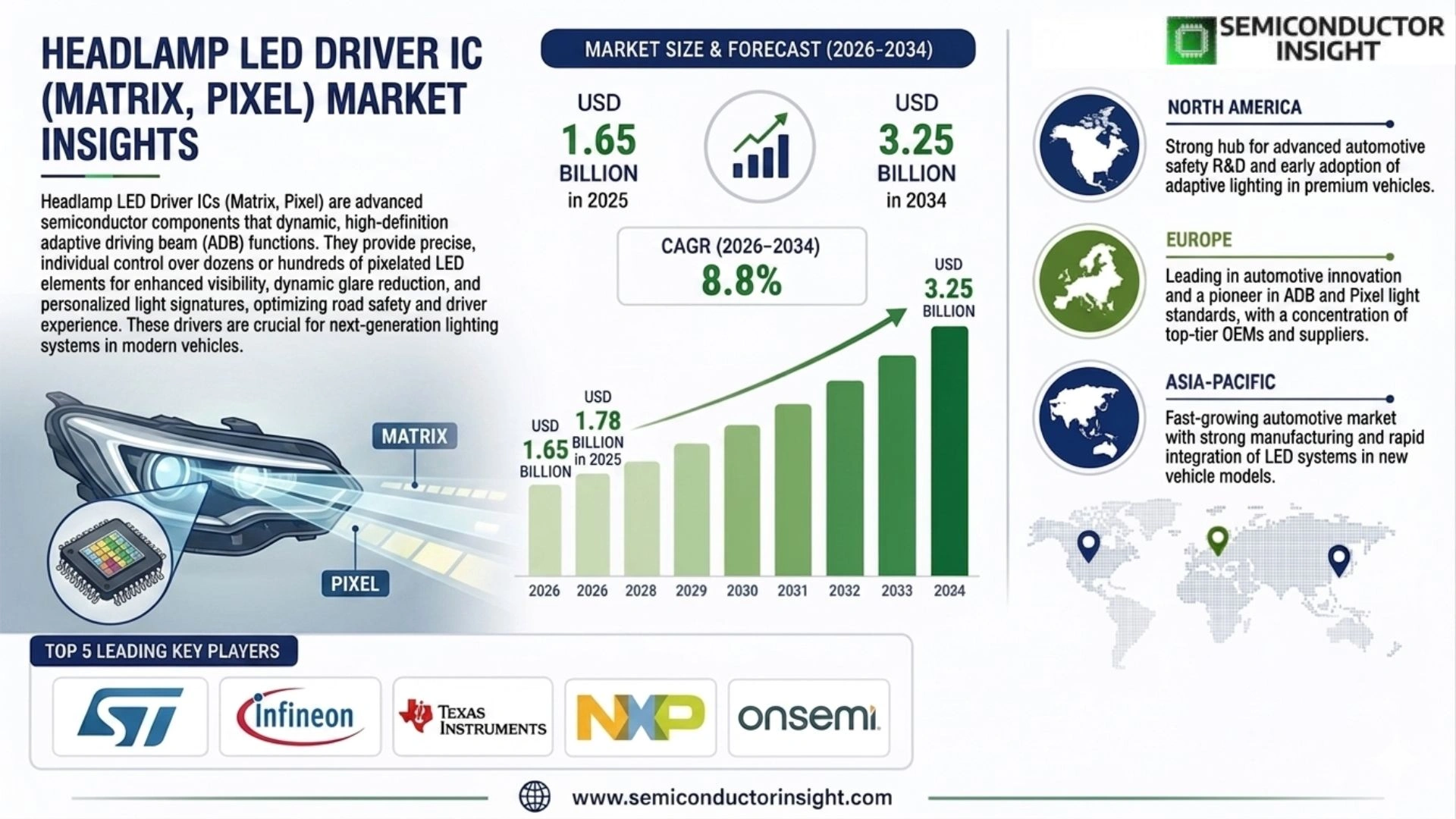
Headlamp LED Driver IC (Matrix, Pixel) Market size was valued at USD 1.65 billion in 2025. The market is projected to grow from USD 1.78 billion in 2026 to USD 3.25 billion by 2034, exhibiting a CAGR of 8.8% during the forecast period.
Headlamp LED Driver ICs for matrix and pixel configurations are specialized semiconductor components designed to precisely control individual LEDs or groups of LEDs within advanced automotive headlighting systems. These integrated circuits enable dynamic beam shaping, adaptive driving beam functionality, and pixel-level dimming, which are essential for modern matrix LED and high-resolution pixel headlamps that enhance visibility while preventing glare for oncoming traffic.
The market is experiencing steady growth due to several factors, including the rising adoption of advanced driver assistance systems, increasing demand for energy-efficient lighting solutions in vehicles, and stringent safety regulations promoting adaptive lighting technologies. Furthermore, the shift toward electric vehicles and premium automotive segments has accelerated the integration of sophisticated headlamp systems that rely on multi-channel LED driver ICs capable of handling complex control requirements with high precision and thermal efficiency. Key industry players continue to innovate with solutions featuring enhanced diagnostics, functional safety compliance, and integration with camera-based systems for real-time adaptive performance. Major participants in this space maintain broad portfolios supporting the transition from traditional lighting to intelligent matrix and pixel-based architectures.
MARKET DRIVERS
Rising Adoption of Adaptive Driving Beam (ADB) and Matrix LED Systems
Headlamp LED Driver IC (Matrix, Pixel) Market is propelled by the accelerating integration of advanced matrix and pixel LED technologies in automotive headlamps. These systems enable precise, individual control of numerous LED segments, supporting adaptive beam patterns that enhance nighttime visibility while minimizing glare for oncoming traffic. As premium and mid-range vehicles increasingly adopt these features, demand for high-channel-count LED driver ICs capable of managing dozens to hundreds of pixels per headlamp has surged.
Integration with ADAS and Safety Regulations
Growing emphasis on vehicle safety through Advanced Driver Assistance Systems (ADAS) further drives the market. Matrix LED headlamps work seamlessly with camera and sensor inputs to dynamically adjust lighting, contributing to improved pedestrian detection and overall road safety. Stringent global regulations promoting adaptive front lighting systems continue to accelerate OEM adoption of sophisticated LED driver solutions. [[2]](https://www.factmr.com/report/matrix-led-headlamp-modules-market)
➤ Multi-channel LED driver ICs are essential for independently controlling LED pixels in high-resolution matrix headlamp designs, supporting the transition toward software-defined lighting architectures.
The expansion of electric vehicles, which prioritize energy-efficient lighting to maximize range, also supports demand for optimized Headlamp LED Driver IC solutions that deliver precise current regulation and thermal management.
MARKET CHALLENGES
High Development and Integration Costs
Implementing advanced matrix and pixel LED driver ICs involves significant engineering investment due to the need for complex control algorithms, high-resolution pixel management, and seamless integration with vehicle electronics. These factors elevate overall system costs, limiting broader penetration primarily to higher vehicle segments.
Other Challenges
Thermal Management and Design Complexity
High-density pixel arrays generate substantial heat, requiring advanced thermal solutions and compact packaging within tight headlamp modules while maintaining reliability under automotive operating conditions.
Supply Chain and Semiconductor Constraints
Volatility in semiconductor supply, extended lead times for specialized automotive-grade driver ICs, and the need for full AEC-Q100 qualification create production planning difficulties for lighting module manufacturers.
MARKET RESTRAINTS
Cost Sensitivity in Mass-Market Vehicles
Despite technological benefits, the higher bill-of-materials associated with matrix and pixel LED driver ICs compared to conventional lighting solutions continues to restrain adoption in entry-level and price-sensitive vehicle segments. System complexity further increases development timelines and validation costs for automakers. The requirement for specialized high-channel-count ICs with robust diagnostics and functional safety compliance adds layers of expense that slow market expansion beyond premium platforms.
MARKET OPPORTUNITIES
Expansion into Mid-Range Vehicles and Emerging Markets
As matrix and pixel LED technologies mature and component costs decline through economies of scale, substantial opportunities exist for broader adoption in mid-range passenger vehicles. Growing automotive production in Asia-Pacific regions presents additional growth avenues for Headlamp LED Driver IC suppliers. Advancements in high-resolution pixel lighting, including micro-LED integration and software-defined functionalities, open new avenues for innovative lighting experiences, such as dynamic projections and vehicle-to-infrastructure communication, creating premium value propositions for driver IC manufacturers.
Headlamp LED Driver IC (Matrix, Pixel) Market Trends
Advancements in Adaptive Driving Beam Functionality
Headlamp LED Driver IC (Matrix, Pixel) Market continues to evolve as automotive manufacturers prioritize dynamic beam shaping and adaptive driving beam systems. These specialized integrated circuits enable precise control over individual LEDs or LED groups, allowing headlamps to adjust illumination patterns in real time. This capability significantly improves visibility for drivers while minimizing glare for oncoming traffic, representing a key advancement in vehicle lighting technology.
Other Trends
Integration with Camera-Based ADAS Systems
Headlamp LED Driver IC (Matrix, Pixel) solutions are increasingly integrated with camera-based advanced driver assistance systems. This synergy allows for real-time adaptive performance where lighting patterns respond instantly to road conditions, traffic, and pedestrian detection. Such integration enhances overall safety and supports the broader transition toward intelligent mobility solutions in both conventional and electric vehicles.
Focus on Energy Efficiency and Thermal Management
Energy-efficient designs remain a prominent trend Headlamp LED Driver IC (Matrix, Pixel) Market. Manufacturers emphasize multi-channel drivers that deliver high precision control while maintaining excellent thermal efficiency. This focus addresses the growing demand for sustainable lighting solutions that reduce power consumption without compromising performance in premium and mainstream vehicle segments.
Emphasis on Functional Safety and Diagnostics
Key players Headlamp LED Driver IC (Matrix, Pixel) Market are advancing solutions with enhanced diagnostics and compliance to functional safety standards. These features ensure reliable operation of matrix and pixel headlamp architectures under diverse operating conditions. The ongoing innovation supports the shift from traditional halogen and basic LED systems to sophisticated pixel-level dimming technologies that align with stringent global safety regulations and consumer expectations for premium lighting features.
COMPETITIVE LANDSCAPE
Key Industry Players
Dynamic Competition in Advanced Matrix and Pixel LED Headlamp Driver IC Technologies
Headlamp LED Driver IC (Matrix, Pixel) Market is led by semiconductor giants with strong automotive-grade portfolios, including Texas Instruments and Infineon Technologies, which dominate through extensive multi-channel driver solutions enabling precise pixel-level control, adaptive driving beam functionality, and seamless integration with camera-based ADAS systems. The market exhibits a consolidated structure among top-tier players who leverage functional safety compliance (ASIL), thermal efficiency, and diagnostics capabilities to secure design wins with premium OEMs and EV manufacturers transitioning to intelligent lighting architectures.
Other significant players, including onsemi, STMicroelectronics, NXP Semiconductors, and Analog Devices, focus on niche innovations such as high-resolution matrix managers, UART/CAN interfaces for distributed control, and compact solutions tailored for mid-to-high volume vehicle segments. These companies compete on differentiation through power density, EMI performance, and partnerships with lighting module integrators like Koito and Valeo to deliver complete ecosystem solutions for next-generation headlamps.
List of Key Headlamp LED Driver IC Companies Profiled
- Texas Instruments
- Texas Instruments
- Infineon Technologies
- onsemi
- STMicroelectronics
- NXP Semiconductors
- Analog Devices
- Monolithic Power Systems
- ROHM Semiconductor
- Melexis
- ams-OSRAM
- Diodes Incorporated
- Microchip Technology
- Allegro MicroSystems
Segment Analysis:
| Segment Category | Sub-Segments | Key Insights |
| By Type |
|
Pixel LED Driver ICs represent the cutting-edge solution enabling ultra-high resolution beam control through individual LED pixel management. These drivers excel in delivering precise dimming capabilities and dynamic light distribution that adapts instantaneously to driving conditions. Their advanced current regulation supports fine-grained control essential for glare-free high beams while maintaining optimal illumination. Integration of diagnostic features ensures reliable operation under varying thermal and electrical stresses typical in automotive environments. Manufacturers favor these for next-generation headlamps that combine safety with sophisticated styling. |
| By Application |
|
Adaptive Driving Beam (ADB) emerges as the dominant application driving innovation in LED driver ICs. This segment benefits from seamless integration with camera systems for real-time road monitoring and automatic beam adjustment. Drivers in this category offer superior multi-zone control that prevents dazzling oncoming traffic while maximizing visibility for the driver. Enhanced functional safety compliance and rapid response times make them indispensable for premium safety features. The technology supports smooth transitions between lighting patterns, contributing to overall driving comfort and regulatory adherence in modern vehicles. |
| By End User |
|
Luxury and Premium Cars lead adoption due to their emphasis on advanced aesthetics and superior safety technologies. End users in this category demand highly sophisticated matrix and pixel headlamp systems that enhance brand differentiation through intelligent lighting signatures. Driver ICs tailored here prioritize exceptional thermal efficiency and compact designs suitable for sleek vehicle architectures. They enable personalized lighting experiences and seamless connectivity with vehicle ADAS platforms. This segment continues to push boundaries in performance and reliability expectations. |
| By Architecture |
|
System-on-Chip (SoC) Solutions are gaining prominence by combining LED driving circuitry with advanced processing capabilities on a single chip. This architecture reduces overall system complexity and improves signal integrity for high-speed adaptive responses. Benefits include lower power consumption through optimized control algorithms and simplified ECU integration. Designers appreciate the reduced bill of materials and enhanced electromagnetic compatibility. These solutions facilitate easier implementation of future-proof features like over-the-air updates for lighting behavior. |
| By Feature Set |
|
Functional Safety Compliant variants stand out as critical for meeting stringent automotive safety standards. These ICs incorporate robust fault detection, redundancy mechanisms, and fail-safe operating modes essential for headlamp reliability. Key advantages include comprehensive self-testing capabilities that support ASIL ratings required in advanced vehicles. They ensure uninterrupted performance even under extreme conditions while providing detailed telemetry to vehicle control units. This focus on safety enhances consumer confidence and accelerates regulatory approvals for new models equipped with intelligent lighting. |
Regional Analysis: Headlamp LED Driver IC (Matrix, Pixel) Market
Asia-Pacific
Asia-Pacific excels in developing advanced matrix and pixel LED driver ICs with superior current control and diagnostics. Regional expertise in miniaturization allows seamless integration with vehicle ECUs, supporting real-time adjustments for various driving conditions while maintaining reliability in harsh environments.
The region features tightly integrated supply chains connecting LED chip producers, driver IC specialists, and headlamp module assemblers. This synergy reduces development cycles and enables cost-effective scaling of pixel-level lighting technologies across mass-market and premium vehicle segments.
Strong growth in electric vehicles and advanced driver assistance systems creates natural demand for intelligent headlamp solutions. Matrix LED driver ICs play a critical role in energy-efficient lighting that complements sensor fusion and camera-based systems prevalent in modern Asian automotive platforms.
Ongoing investments in R&D for higher pixel density and AI-enhanced beam control solidify the region’s dominance. Manufacturers continue to pioneer solutions that balance performance, regulatory compliance, and aesthetic design requirements for global export markets.
North America
North America demonstrates steady progress Headlamp LED Driver IC (Matrix, Pixel) Market, fueled by premium vehicle manufacturers emphasizing safety innovations and luxury features. The United States and Canada see growing integration of adaptive lighting systems in SUVs, trucks, and electric vehicles, where matrix LED drivers enable precise control for enhanced nighttime visibility. Regulatory focus on road safety encourages adoption of pixel-level technologies that minimize glare for oncoming traffic. Strong collaboration between domestic automakers and semiconductor suppliers drives customization of driver ICs for harsh weather conditions and diverse road environments typical across the continent.
Europe
Europe maintains a sophisticated position Headlamp LED Driver IC (Matrix, Pixel) Market with stringent safety regulations and a focus on sustainable automotive technologies. German, French, and other European manufacturers lead in deploying high-resolution matrix systems that integrate seamlessly with autonomous driving platforms. Emphasis on energy efficiency aligns well with regional environmental goals, promoting advanced driver ICs capable of dynamic light modulation. The region’s engineering excellence supports complex pixel architectures that deliver superior beam patterns while meeting rigorous ECE certification standards for international distribution.
South America
South America shows emerging potential Headlamp LED Driver IC (Matrix, Pixel) Market as automotive production expands and consumer demand for modern safety features increases. Brazil and other key markets witness gradual adoption of LED matrix technologies in mid-range vehicles, supported by international OEM investments. Local assembly operations benefit from technology transfer, incorporating driver ICs that improve lighting performance in challenging terrains and variable weather. While infrastructure development influences pace, growing awareness of advanced lighting benefits positions the region for accelerated uptake in coming years.
Middle East & Africa
The Middle East and Africa region presents developing opportunities for Headlamp LED Driver IC (Matrix, Pixel) Market, particularly in luxury and commercial vehicle segments. Gulf countries drive demand through premium imports featuring state-of-the-art adaptive headlamps suited for desert and urban environments. Infrastructure projects and rising vehicle modernization efforts stimulate interest in reliable matrix LED solutions. African markets focus on durability and cost-effectiveness, creating space for simplified yet effective driver IC implementations that withstand extreme conditions while delivering essential safety enhancements.
Report Scope
This market research report provides a comprehensive analysis of the Headlamp LED Driver IC (Matrix, Pixel) Market , covering the forecast period 2026–2034. It offers detailed insights into market dynamics, technological advancements, competitive landscape, and key trends shaping the industry.
Key focus areas of the report include:
- Market Overview: The report begins with an overview outlining its current market scenario, key growth indicators, and industry transformation drivers. It discusses macroeconomic factors, demand–supply balance, regulatory landscape, and the strategic role of semiconductors in powering advancements across industries such as automotive, telecommunications, consumer electronics, and industrial automation.
- Market Size & Forecast: Historical data and future projections for revenue, unit shipments, and market value across major regions and segments.
- Segmentation Analysis: Detailed breakdown by product type, technology, application, and end-user industry to identify high-growth segments and investment opportunities.
- Regional Insights: Insights into market performance across North America, Europe, Asia-Pacific, Latin America, and the Middle East & Africa, including country-level analysis where relevant.
- Competitive Landscape: Profiles of leading market participants, including their product offerings, R&D focus, manufacturing capacity, pricing strategies, and recent developments such as mergers, acquisitions, and partnerships.
- Technology Trends & Innovation: Assessment of emerging technologies, integration of AI/IoT, semiconductor design trends, fabrication techniques, and evolving industry standards.
- Market Drivers & Restraints: Evaluation of factors driving market growth along with challenges, supply chain constraints, regulatory issues, and market-entry barriers.
- Stakeholder Insights: Insights for component suppliers, OEMs, system integrators, investors, and policymakers regarding the evolving ecosystem and strategic opportunities.
Primary and secondary research methods are employed, including interviews with industry experts, data from verified sources, and real-time market intelligence to ensure the accuracy and reliability of the insights presented.
FREQUENTLY ASKED QUESTIONS:
What is the current market size of Headlamp LED Driver IC (Matrix, Pixel) Market?
-> Headlamp LED Driver IC (Matrix, Pixel) Market was valued at USD 1.65 billion in 2025 and is expected to reach USD 3.25 billion by 2034.
Which key companies operate Headlamp LED Driver IC (Matrix, Pixel) Market?
-> Key players include Infineon Technologies, Texas Instruments, ON Semiconductor, STMicroelectronics, NXP Semiconductors, among others.
What are the key growth drivers?
-> Key growth drivers include rising adoption of advanced driver assistance systems, increasing demand for energy-efficient lighting solutions in vehicles, and stringent safety regulations promoting adaptive lighting technologies.
Which region dominates the market?
-> Asia-Pacific is the fastest-growing region, while Europe remains a dominant market.
What are the emerging trends?
-> Emerging trends include enhanced diagnostics, functional safety compliance, and integration with camera-based systems for real-time adaptive performance.

Get Sample Report PDF for Exclusive Insights
Report Sample Includes
- Table of Contents
- List of Tables & Figures
- Charts, Research Methodology, and more...
 Download Sample Report PDF