Key Statistics
Key Takeaways
- Market trajectory: finished HBM2E stack revenue is modeled at USD 6,393.21 million in 2026 and USD 24,173.22 million in 2036, an endpoint-reconciled 14.2% annual rate; the later-year value is a scenario extrapolation, not a manufacturer shipment commitment.
- Technology boundary: HBM2E is 3D-stacked dynamic random-access memory with 1,024 parallel data channels and through-silicon vias. It is counted as memory stack revenue, excluding accelerator chips, packaging machinery, intellectual property licensing and newer HBM generations.
- 16 G products: the 16 G class leads with modeled ~65% of 2026 value because both Samsung Flashbolt and SK hynix mass-production disclosures describe 16 GB eight-die HBM2E configurations, while smaller 8 G parts remain in qualified older systems.
- Servers and accelerators: server platforms represent modeled ~67% of 2026 application revenue, and accelerator OEMs represent modeled ~61% of the buyer-channel axis. NVIDIA A100 and AMD MI200 product documentation confirms specific HBM2E-equipped systems.
- Regional distribution: Asia-Pacific leads with modeled ~53% of 2026 sales, followed by North America at ~29%, Europe at ~12%, South America at ~3%, and Middle East and Africa at ~3%; these are scenario allocations, not audited geographic sales.
- Replacement pressure: HBM3E mass production in 2024 and HBM4 commercial announcements in 2026 materially limit the confidence of a straight-line HBM2E forecast to 2036. Installed-system servicing may persist while new accelerator sockets migrate.
HBM2E DRAM Market Overview
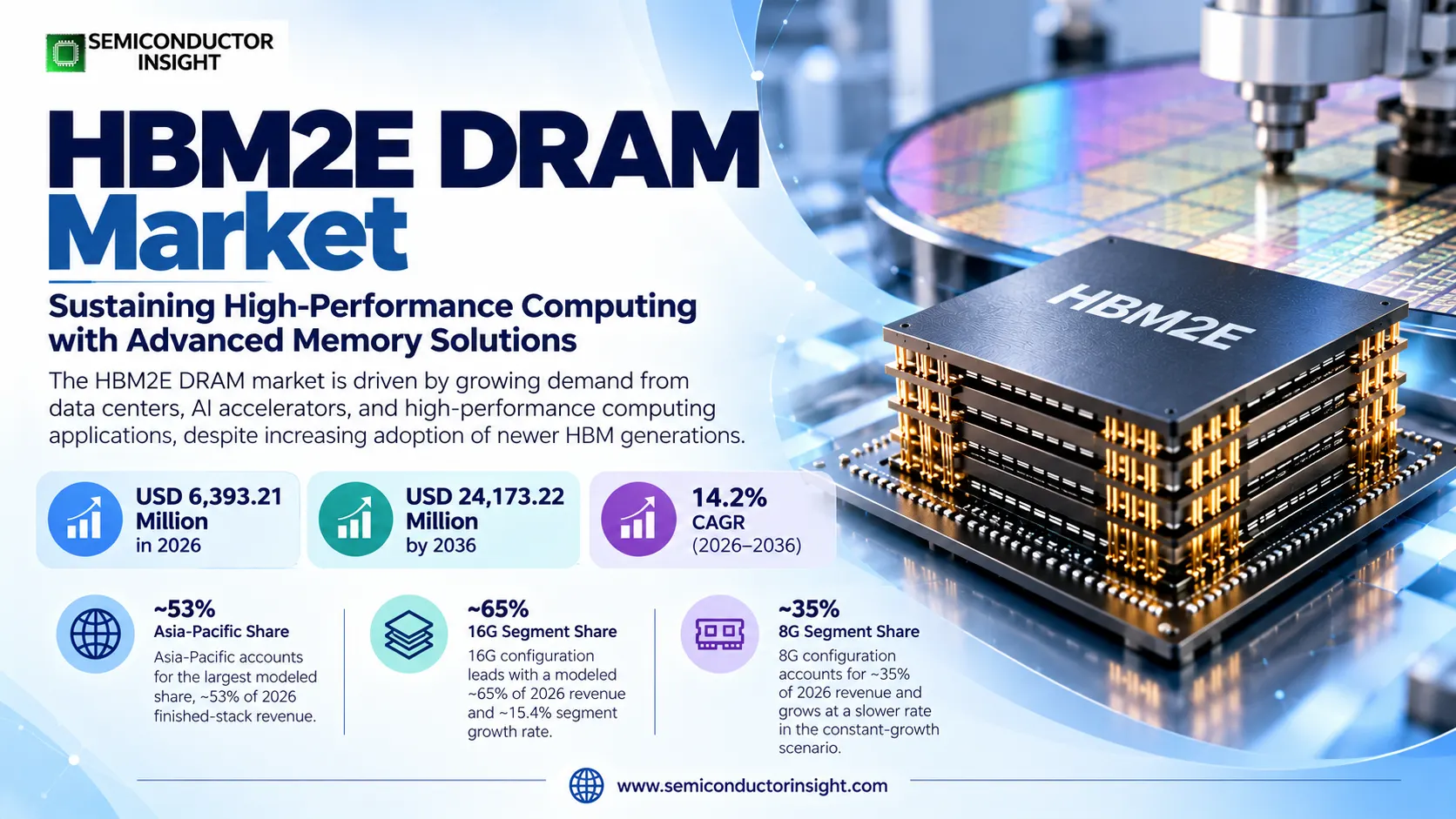
HBM2E DRAM market is modeled at USD 6,393.21 million in 2026 and USD 24,173.22 million by 2036, implying a 14.2% CAGR over the 2026–2036 modeling window. Asia-Pacific accounts for the largest modeled share, ~53% of 2026 finished-stack revenue; this long-range extension requires particular caution because HBM2E is no longer the newest high-bandwidth-memory generation.
HBM2E is a stacked DRAM architecture built to feed processors with much higher memory bandwidth than a conventional external memory bus can deliver at comparable pin counts. Through-silicon vias connect multiple DRAM dies vertically, while a wide 1,024-bit interface connects the stack to a processor on an advanced package substrate. The resulting memory component is purchased by accelerator and computing-system designers, not by ordinary consumer memory-module buyers. A finished HBM2E stack is therefore the appropriate unit of account for this market, rather than a complete graphics card or data-center server.
The commercial record begins with products rather than a continuously disclosed HBM2E revenue series. Samsung introduced its 16 GB Flashbolt HBM2E in February 2020, describing eight 16-gigabit DRAM layers, 3.2 gigabits per second per pin and 410 gigabytes per second of bandwidth per stack. SK hynix began HBM2E mass production in July 2020 and reported more than 460 gigabytes per second using 3.6 gigabits per second per pin. Those are vendor specifications and product milestones, not observations of annual worldwide merchant sales.
The 2026–2036 value trajectory is derived from the publisher’s headline 2024 and 2032 monetary endpoints rather than its separately printed growth label. The endpoint arithmetic yields an annualized rate of roughly 14.225%, rounded to one decimal for display. Other statements on the publisher product description use incompatible totals and refer to a different HBM2 product, so the two series cannot be combined. A model that extends these endpoints through 2036 should be read as a constant-growth sensitivity case, especially after newer HBM3E and HBM4 introductions.
Demand evidence is most concrete at the accelerator-platform level. NVIDIA announced an A100 accelerator variant with 80 GB of HBM2E in November 2020, while AMD lists 64 GB of HBM2E on its Instinct MI210 and disclosed higher-capacity HBM2E configurations across the MI200 family. Oak Ridge National Laboratory’s Frontier supercomputer and its AMD Instinct architecture illustrate the historical high-performance-computing role of the generation. None of these disclosures alone establishes a market-wide share for a memory supplier, a geography or a capacity class.
The competitive boundary is narrow: SK hynix and Samsung have direct documented HBM2E product and manufacturing evidence, whereas other companies appearing in the broader publisher roster occupy different positions across DRAM, processors and memory ecosystems. Micron’s publicly documented 2024 HBM3E volume production is evidence of the successor market, not proof of historical HBM2E merchant shipments. Treating the entire roster as direct HBM2E manufacturers would distort concentration and risk double-counting adjacent product revenue.
For planning purposes, the modeled 2026 mix assigns ~65% to 16 G products, ~71% to enhanced-bandwidth variants and ~43% to artificial-intelligence end users. These allocations reflect the documented product specifications and known accelerator deployments, but they are not audited. In the scenario, demand for replacement and service of qualified platforms continues, while new processor designs favor successor generations. This creates a central uncertainty: whether continuing memory-price and workload growth can offset shrinking HBM2E design wins across the 2027–2036 horizon.
Segment Analysis: By Type
By type, HBM2E DRAM is divided into 8 G and 16 G configurations, following the original publisher classification. The 16 G class leads with a modeled ~65% of 2026 revenue and a modeled ~15.4% segment growth rate; the 8 G class accounts for ~35% and grows more slowly in the constant-growth scenario. Actual shipment mixes are not publicly disclosed at this granularity.
| Type | Technical and qualification role | Market position and modeled outlook |
|---|---|---|
| 8 G | Eight-gigabyte configurations address older processor packages where qualified memory density and thermal limits constrain substitutions. They belong to the HBM2E family only when device speed and stack specifications meet that generation rather than ordinary HBM2. Platform owners generally preserve a tested memory bill of materials until a board redesign is justified, so service demand can outlast initial production. This category is modeled separately from 16 G stacks to avoid counting a lower-capacity system as a full-density product. | The modeled 2026 share is ~35%, with a modeled 11.6% annual rate through 2036. This smaller type class is exposed to end-of-life procurement and price dispersion: replacement stock can be costly even as total unit demand contracts. The value model does not assert that factories are adding 8 G HBM2E capacity. Instead, it represents a scenario in which qualified installed platforms and specialist systems continue to generate limited revenue after mainstream accelerators migrate to later generations. |
| 16 G | Sixteen-gigabyte HBM2E stacks were explicitly documented by both Samsung and SK hynix in 2020. Samsung described eight layers of 16-gigabit dies and 410 GB/s of per-stack throughput, while SK hynix reported 16 GB using eight 16-gigabit chips with more than 460 GB/s. These specifications explain why 16 G became an important high-density choice for accelerators that need memory close to compute engines. Capacity does not identify the maker of every assembled system. | The modeled 2026 share is ~65%, with a modeled 15.4% annual rate in the publisher-endpoint extension. Larger qualified stacks raise the value of a processor package and support workloads with substantial intermediate data, but future growth is limited by HBM3E and HBM4 socket substitution. The model assumes continuing use in established platforms rather than claiming HBM2E is the performance leader in 2026. Supplier qualification and wafer yield remain decisive commercial differentiators. |
Secondary segmentation: bandwidth and end-user industry
Bandwidth classification distinguishes standard HBM2E products near 307 GB/s from enhanced HBM2E designs around 410–460 GB/s per stack. The modeled enhanced class leads with ~71% of 2026 value, reflecting Samsung Flashbolt and SK hynix disclosed specifications. End-user classification assigns each finished-stack sale to its primary workload, rather than counting the same memory once for artificial intelligence and again for high-performance computing. Artificial intelligence leads at modeled ~43%, with high-performance computing at ~34%, graphics at ~16% and enterprise storage at ~7%.
The buyer-channel axis is separate from the workload axis. Accelerator original equipment manufacturers represent a modeled ~61% of 2026 revenue, server and networking integrators ~25%, and research or specialist customers ~14%. This segmentation identifies the commercial purchasing route, not the geographic location of the silicon fab. Supplier qualification typically happens at the processor package and board level, while downstream server builders may have little freedom to substitute a memory stack once an accelerator design has been validated.
Segment Analysis: By Application
By application, the publisher distinguishes Servers, Networking, Consumer and Others. Servers account for a modeled ~67% of 2026 finished-stack revenue because accelerator servers and high-performance computing nodes are the clearest documented users; networking represents ~17%, consumer ~4% and other specialist applications ~12%. These modeled shares should not be confused with total server or graphics-system revenue.
| Application | Demand characteristics |
|---|---|
| Servers | Servers lead at modeled ~67% of 2026 HBM2E stack revenue, with a modeled 15.0% annual rate in the extension. NVIDIA A100 80 GB and AMD MI200 systems demonstrate why processor memory bandwidth matters in AI training and scientific computation. Memory is embedded in the accelerator package, and its revenue is counted only at the memory-supplier transaction. The server chassis, CPU, network adapters and accelerator logic are excluded even when the complete system sells at a substantially higher price. |
| Networking | Networking represents modeled ~17% of 2026 revenue and an assumed 12.5% growth path. Network processing and specialized high-throughput computing can benefit from stacked memory, but direct HBM2E product evidence is much thinner here than for GPU accelerators. The category therefore carries higher uncertainty and is not represented as a documented manufacturer shipment total. Procurement is likely to depend on specialized hardware qualification, firmware support and the ability to secure replacement memory for long equipment lifetimes. |
| Consumer | Consumer applications represent modeled ~4% of 2026 revenue and an assumed 9.2% annual path. High cost, advanced package integration and relatively narrow compatibility make HBM2E unusual in mainstream desktop or mobile products. The consumer category primarily captures niche graphics and enthusiast systems that actually contain HBM2E, not all graphics DRAM or every device marketed as high performance. This boundary matters because including GDDR memory would greatly overstate the finished HBM2E stack market. |
| Others | Other uses account for modeled ~12% of 2026 revenue, covering scientific instruments, specialist visualization and limited defense or industrial computing applications where memory bandwidth is unusually valuable. The modeled 13.4% annual rate is a scenario rather than a shipment observation. System qualification and replacement cycles can sustain demand for older memory generations, but security, export-control and supply-continuity requirements may increase cost. No unsupported claim is made that these niche categories account for a verified share of global HBM2E production. |
Applications are mutually exclusive in this model even when a system serves several workloads. A supercomputer accelerator running both scientific simulation and machine learning remains assigned to its primary purchasing application; the end-user-industry axis then captures the intended workload separately. This avoids adding a single HBM2E stack multiple times. The modeled application allocation reproduces the 2036 scenario when the category growth paths are weighted by their 2026 values, but the result should not be interpreted as an independently observed market mix.
Regional Analysis
Asia-Pacific holds a modeled ~53% of 2026 HBM2E finished-stack value, followed by North America at ~29%, Europe at ~12%, South America at ~3%, and Middle East and Africa at ~3%. These allocations describe modeled demand by purchasing region, not fab locations or verified revenue disclosures. Historical HBM2E manufacturing is centered in South Korea, whereas final accelerator deployments span several continents.
How do HBM2E qualification and successor-generation migration differ by region?
Regional demand is best interpreted through the location of computing-system purchases and installed accelerators rather than through where stacked DRAM dies are fabricated. Samsung and SK hynix documented HBM2E production in South Korea, but NVIDIA and AMD platforms have buyers around the world. The modeled regional allocations total 100% and reconcile to the global scenario, while geographic growth assumptions differ to reflect procurement intensity and installed-system service cycles. These assumptions are not direct country sales measurements and should be revised when supplier shipment records become available.
| Region | Position | Growth outlook | Demand profile | What decides supplier selection |
|---|---|---|---|---|
| Asia-Pacific | Largest (~53%) | Modeled ~15.2% CAGR | South korean memory manufacturing and taiwanese advanced-packaging ecosystems | Vendor manufacturing and qualified package integration |
| North America | Second (~29%) | Modeled ~13.3% CAGR | Us accelerator architecture and procurement by large computing customers | Accelerator platform qualification and replacement support |
| Europe | Third (~12%) | Modeled ~12.0% CAGR | Research-computing installations and specialist industrial procurement | System lifetime and compliance-driven qualification |
| South America | Smaller (~3%) | Modeled ~11.5% CAGR | Small specialized computing installations and imported accelerator systems | Import costs and local support availability |
| Middle East & Africa | Emerging (~3%) | Modeled ~15.5% CAGR | Select national ai-computing and scientific-infrastructure programs | Project financing and platform availability |
HBM2E DRAM Manufacturers and Competitive Landscape
Direct HBM2E product and production documentation establishes Samsung Electronics and SK hynix as relevant manufacturers. Other firms in the publisher company roster have adjacent semiconductor, memory or processor positions, but the reviewed evidence does not establish that each independently sold finished HBM2E stacks. Competition is shaped by qualified package design, TSV yield, memory bandwidth and lifecycle supply.
SK hynix announced its HBM2E development in August 2019 and full-scale mass production in July 2020. Its 16 GB eight-high configuration supports 3.6 gigabits per second per pin and over 460 gigabytes per second of memory bandwidth. The product’s value proposition was tightly linked to advanced processor packaging and bandwidth-sensitive computing. These specifications demonstrate technological capability but cannot be converted into a global revenue share without shipment volume, price and customer mix disclosures.
Samsung introduced 16 GB Flashbolt HBM2E in February 2020, with eight 16-gigabit DRAM layers, more than 40,000 TSV microbumps and a nominal 410 gigabytes per second bandwidth. Samsung also described higher tested data rates under particular conditions. This places the company among directly documented product suppliers, although the press announcement did not publish a market-wide annual unit total. A buyer comparing suppliers must also assess known-good-die yield, stack thermals, interposer compatibility and the support period for qualified platforms.
NVIDIA and AMD are demand-shaping platform designers rather than HBM2E memory-stack vendors. NVIDIA’s A100 80 GB product and AMD’s MI210 and MI200 systems identify the memory generation used by specific accelerators, while Rambus disclosed HBM2E controller and physical-interface intellectual property. These are complementary commercial positions in the ecosystem. Counting accelerator revenue or IP licensing fees as finished HBM2E DRAM sales would inflate the denominator and distort any apparent manufacturer concentration.
Micron has direct public evidence for HBM3E production in 2024 and HBM4 activities later, but that evidence is not interchangeable with direct proof of HBM2E merchant manufacturing. Intel and CXMT appear in the original publisher roster without comparable direct HBM2E product disclosures in the inspected source set. The competitive table therefore distinguishes confirmed HBM2E suppliers from adjacent technology participants, and any inferred shares remain scenario allocations rather than audited company results.
Tier structure
| Tier | Companies | Basis of competition |
|---|---|---|
| Direct HBM2E suppliers | SK hynix; Samsung Electronics | Both published detailed 16 GB HBM2E specifications and product or mass-production milestones in 2020. Qualification for specific accelerators and advanced-package compatibility, rather than a general-purpose memory module channel, determined customer access. Public announcements do not disclose sufficient HBM2E-only annual revenue to establish precise relative supplier shares. |
| Platform and IP ecosystem | NVIDIA; AMD; Rambus | These companies document HBM2E-equipped accelerators or controller/PHY technologies that create or enable demand for finished memory stacks. Their revenues are not classified as memory-stack merchant sales, and they should not be counted as direct HBM2E DRAM manufacturers. Platform qualification determines which memory suppliers can serve each generation. |
| Adjacent or unverified roster | Micron Technology; Intel Corporation; ChangXin Memory Technologies | The original roster includes these names, but inspected disclosures do not establish comparable HBM2E merchant shipments for all of them. Micron successor-generation announcements concern HBM3E and HBM4, while Intel and CXMT require additional product-specific evidence before direct HBM2E supplier claims can be made. |
Key companies profiled
- SK hynix
- Samsung Electronics
- Micron Technology
- Intel Corporation
- ChangXin Memory Technologies (CXMT)
HBM2E DRAM Production Capacity and Packaging Analysis
HBM2E production depends on high-yield DRAM wafer fabrication, through-silicon-via processing, die stacking, known-good-die selection and advanced package integration. Samsung and SK hynix documented finished 16 GB stacks in 2020, but no reviewed source establishes 2026 HBM2E-only wafer capacity or a factory-by-factory output schedule. Capacity estimates must therefore remain distinct from the modeled market value.
A finished HBM2E stack combines multiple DRAM layers with a base die and vertical interconnects, so a memory supplier must control both semiconductor yield and assembly yield. Samsung described eight 16-gigabit layers and tens of thousands of TSV microbumps in Flashbolt, while SK hynix reported an eight-high architecture with a 1,024-bit interface. Defects in any layer can impair the finished stack, making testing and thermal performance as commercially important as raw wafer throughput. The reported bandwidth values are technical specifications, not production volumes.
HBM2E is ordinarily integrated next to an accelerator processor through an advanced package, and platform qualification can lock in memory electrical characteristics, thermals and mechanical dimensions. A change in stack supplier may require costly validation even if nominal capacity is identical. This produces a different sales model from commodity DDR modules: procurement is concentrated in a relatively small number of high-value processor designs. The model assigns ~61% of 2026 value to accelerator OEM channels without treating that allocation as independently verified.
The capacity outlook is constrained by substitution. SK hynix began HBM3E volume production in March 2024 and Samsung disclosed commercial HBM4 shipments in February 2026. Those milestones demonstrate why investment in leading-edge packaging and wafer capacity is increasingly directed toward successor products rather than toward an expanding HBM2E installed base. The 2036 HBM2E forecast is consequently an extrapolated sensitivity case, not a confirmed expansion plan for legacy-generation assembly lines.
HBM2E DRAM Market Dynamics: Drivers, Restraints and Opportunities
Historical HBM2E demand was supported by accelerator memory-bandwidth requirements, stacked-DRAM density and advanced-package adoption. The forward model extends the publisher monetary endpoints at the reconciled annualized rate, but actual HBM2E shipments face substitution from HBM3E and HBM4. Signed driver and restraint contributions below are modeled decomposition points, not empirically measured causal percentages.
MARKET DRIVERS
Drivers Impact Analysis*
| Market Drivers | Impact Rank | CAGR Contribution (%) | 2027–2029 | 2030–2032 | 2033–2036 |
|---|---|---|---|---|---|
| Qualified accelerator installed base | High | +5.00% | High | Medium | Low |
| Memory bandwidth needs in specialist HPC | High | +4.10% | High | Medium | Medium |
| Replacement and long-life system support | Medium-High | +3.20% | Medium | High | High |
| Advanced packaging service ecosystem | Medium | +2.40% | High | Medium | Low |
| Specialist compute deployment and upgrades | Low-Medium | +1.80% | Medium | Medium | Low |
| Others (legacy qualification, scientific workloads) | Low | +1.00% | Low | Medium | Medium |
Installed accelerator platforms sustain a service market
NVIDIA A100 80 GB and AMD MI200 generation products are direct examples of accelerators using HBM2E memory. Their existence creates a population of qualified systems for which replacement, maintenance and specialist reuse may remain relevant after new designs migrate to faster HBM. The modeled ~67% server application share reflects this historical platform concentration. It does not imply that every deployed accelerator requires new HBM2E stacks each year, because component lifetime and inventory can reduce replacement orders.
Scientific computing favors sustained memory bandwidth
HBM2E was designed for workloads that repeatedly move large arrays between processor cores and local memory. Oak Ridge National Laboratory’s Frontier platform demonstrates the wider high-bandwidth accelerator ecosystem in scientific computing, while AMD MI200 specifications document HBM2E capacity in that product generation. In the modeled end-user axis, high-performance computing represents ~34% of 2026 value. New scientific systems increasingly adopt successor memory, so this factor primarily supports existing qualification cycles rather than universal future HBM2E adoption.
Packaging qualification extends component lifetimes
Through-silicon-via stacking and 2.5D integration require a stable processor-to-memory electrical interface, and changing the memory device can force extensive validation. Samsung’s 2020 Flashbolt description and SK hynix’s production release show the technical complexity of eight-high stacks. This can sustain orders for a qualified legacy component where redesign costs exceed the benefit of switching. However, it is a conditional commercial driver, not proof that HBM2E remains the preferred memory for 2026 flagship accelerators.
Specialist systems create differentiated demand
Not every high-bandwidth computing platform follows the same replacement schedule as a hyperscale AI accelerator. Industrial visualization, research equipment and networking systems can prioritize proven qualification and long-term service over the newest throughput record. The model assigns ~12% of application revenue to other specialist uses and ~14% of buyer-channel revenue to research and specialist customers. These values are scenario allocations, and no public source in the inspected set measures the global HBM2E revenue of such niches directly.
MARKET RESTRAINTS
Restraints Impact Analysis*
| Market Restraints | Impact Rank | CAGR Contribution (%) | 2027–2029 | 2030–2032 | 2033–2036 |
|---|---|---|---|---|---|
| HBM3E and HBM4 socket replacement | High | -1.50% | High | High | High |
| Legacy-generation manufacturing economics | Medium-High | -0.80% | Medium | High | High |
| Advanced-package supply and qualification costs | Medium | -0.60% | High | Medium | Medium |
| Others (inventory, export compliance, price volatility) | Low | -0.40% | Medium | Medium | Low |
Successor generations displace HBM2E in new designs
SK hynix announced HBM3E volume production in March 2024 and Samsung disclosed HBM4 commercial shipments in February 2026. These are direct signs that the leading-edge accelerator ecosystem has moved beyond HBM2E. A model extrapolating legacy-generation revenue to 2036 can therefore diverge sharply from actual product shipments even when aggregate HBM demand grows. The impact is especially strong in AI training accelerators, where memory bandwidth and capacity improvements influence new architecture selection.
Low-volume legacy production can raise unit costs
A qualified memory device can become more expensive to support as manufacturing moves to later process generations and new stack configurations. Suppliers must retain testing capability, packaging know-how and inventory discipline for legacy customers, while wafer and assembly capacity is more attractive for higher-value current products. The modeled 8 G class, at ~35% of 2026 revenue, is particularly exposed to smaller production runs and end-of-life purchasing. These pressures may reduce units even if reported replacement prices rise.
Packaging qualification restricts interchangeability
HBM2E is not a drop-in substitute for newer HBM generations, and two nominally similar stacks can differ in timing, thermal behavior and package integration. Rambus’s HBM2E controller/PHY disclosure underscores the role of specialized interface design, while Samsung and SK hynix product specifications show differences in supported transfer rates. OEMs often qualify memory at the complete accelerator-package level, which limits secondary sourcing and can create lead-time risk for customers maintaining older systems.
Regional and policy constraints complicate sourcing
Cross-border accelerator procurement is influenced by export compliance, access to advanced packaging and the commercial availability of qualified products. The modeled ~29% North American demand share and ~53% Asia-Pacific share are not direct evidence of shipment flows or export licenses. Companies buying older accelerators must distinguish whether they need finished HBM2E components, whole accelerator cards or maintenance services, since the procurement channel and regulatory treatment can differ materially across those transactions.
MARKET OPPORTUNITIES
Service programs for installed accelerators
A vendor able to provide traceable HBM2E inventory, package-level failure analysis and tested replacements can serve customers maintaining NVIDIA A100 and AMD MI200 generation equipment. This is a lifecycle opportunity rather than a claim of large new greenfield HBM2E demand. Buyers value consistent electrical characteristics, verified thermal behavior and long-term documentation, while suppliers must avoid representing reclaimed or requalified parts as newly manufactured devices without clear disclosure.
Specialist scientific computing and instrumentation
Some research and instrumentation systems maintain qualified hardware for long periods because replacing an accelerator requires software validation and operational downtime. HBM2E’s 1,024-bit interface and documented 410–460 GB/s stack bandwidth can remain sufficient for these established workloads. The modeled ~34% high-performance-computing end-user share describes a scenario allocation, not a measured purchasing census, and the opportunity depends on platform continuity rather than general market-wide adoption.
Advanced package repair and validation services
HBM2E packaging complexity creates demand for test, inspection and failure-analysis expertise at the boundary between memory suppliers and system integrators. TSV connections, interposer interfaces and thermals must be assessed together when a package fails. These services are commercially relevant but are excluded from the finished-stack revenue boundary unless included in the memory selling price. Maintaining that distinction prevents service-market estimates from being incorrectly added to memory-stack revenue.
Transition planning across HBM generations
Customers operating legacy HBM2E systems may need a roadmap for eventual replacement with HBM3E or HBM4-based accelerators. Suppliers that can support old platforms while helping customers qualify new systems can preserve relationships across generations. The opportunity is strategic rather than evidence of a direct HBM2E shipment boom; newer-memory revenue belongs in its own generation-specific market, and the modeled 2036 legacy scenario should be sensitivity-tested against accelerated retirement.
HBM2E DRAM Supply Chain Analysis
The HBM2E value chain links DRAM wafer fabrication, TSV formation, die stacking, test and advanced-package integration to accelerator OEM qualification and specialist computing deployment. The finished DRAM stack is the only counted market product. Controller IP, GPU logic, package assembly services and the completed server are adjacent revenue streams, even when technically essential to the same processor.
Upstream. DRAM wafer quality, TSV formation and reliable base-die interconnection determine whether stacked memory can reach rated capacity and bandwidth. Samsung described eight 16-gigabit layers and more than 40,000 microbumps in Flashbolt, illustrating the complexity of the physical connection network. The manufacturing cost of a completed stack is therefore not equivalent to the cost of a single commodity DRAM die. Supplier yield and screening requirements shape price and availability, but public product specifications do not disclose global HBM2E wafer-start totals.
Manufacturing. Stack assembly combines multiple known-good DRAM dies with through-silicon vias, fine-pitch bonding and thermal management. SK hynix documented 16 GB eight-high HBM2E mass production in July 2020, while Samsung announced its Flashbolt product earlier that year. Testing must verify a wide memory interface under package operating conditions, not merely each bare die. As production priorities shift to HBM3E and HBM4, the ability to support legacy qualified devices can become a separate commercial challenge from developing the fastest new product.
Distribution. Finished HBM2E stacks generally enter the market through qualified accelerator and advanced-package supply chains rather than through retail memory channels. NVIDIA and AMD platform specifications identify the memory generation in their products, but they do not reveal the full stack supplier split or purchasing prices. The model assigns ~61% of value to accelerator OEMs and ~25% to server and networking integrators, using mutually exclusive buyer-channel definitions. Those allocations should not be confused with published company procurement data.
Downstream. Data-center AI and scientific computing users purchase accelerators or complete systems containing HBM2E, often without separately negotiating the memory stack. Oak Ridge National Laboratory’s Frontier deployment demonstrates the scale of computing workloads that rely on high-bandwidth accelerator memory, while later HBM generations change the available design options. Market revenue is counted at the finished memory component stage, so a server resale, a cloud-service subscription and a GPU board sale do not create additional HBM2E DRAM market value.
Recent Developments Affecting the HBM2E DRAM Market
- 12 February 2026 Successor launch
Samsung announced commercial HBM4 shipments, marking another step in the migration from HBM2E-era accelerator memory toward higher bandwidth and newer packaging. The event does not measure HBM2E sales, but it changes the competitive context for any long-range legacy-generation forecast. Procurement teams should treat the modeled 2036 HBM2E trajectory as a sensitivity case and test how rapidly qualified older platforms are retired. Source - 6 November 2024 Technology roadmap
SK hynix disclosed development of a 16-layer HBM3E stack at its AI Summit, extending stacking density beyond the eight-high HBM2E designs introduced in 2020. The announcement illustrates how capacity, package height and thermal management continue to evolve. It is successor-generation evidence, not proof of current HBM2E production growth, and it highlights the likelihood that new accelerator designs will move to newer memory specifications. Source - 26 September 2024 Production milestone
SK hynix announced volume production of a 12-high HBM3E product, underscoring the commercial shift toward higher-capacity stacked DRAM. For legacy HBM2E, the implication is a changing allocation of process-development and packaging resources. The event should not be included in HBM2E shipment totals, but it provides relevant evidence for replacement risk and for the importance of continued qualification support on existing systems. Source - 19 March 2024 Production milestone
SK hynix announced HBM3E volume production, documenting the successor generation entering commercial supply after the original HBM2E products had already been established for several years. This transition is material to forecast interpretation because overall demand for high-bandwidth memory can rise while the share of HBM2E in newly designed accelerators falls. The date supports a technology-substitution assessment rather than a direct HBM2E revenue estimate. Source - 26 February 2024 Production milestone
Micron announced HBM3E volume production, establishing its role in a newer generation of high-bandwidth DRAM. The announcement is not direct evidence that Micron manufactured finished HBM2E stacks, despite its inclusion in the original broad publisher company roster. The distinction matters for competitive-landscape accuracy, as generation-specific supplier qualification and product launches cannot automatically be carried backward to an older memory standard. Source - 17 August 2022 Computing deployment
Oak Ridge National Laboratory celebrated the Frontier supercomputer, illustrating the scale of scientific computing that relies on accelerator memory bandwidth. The system uses AMD Instinct MI250X accelerators from the MI200 generation, whose platform family documentation describes HBM2E memory. This is concrete deployment context, but neither the laboratory release nor accelerator specifications disclose a global annual HBM2E memory revenue series. Source - 8 November 2021 Platform launch
AMD introduced its Instinct MI200 accelerator family with HBM2E memory for high-performance computing and artificial-intelligence workloads. The release linked large on-package memory capacity with high throughput and the needs of exascale-class systems. It provides direct evidence for the historical server and scientific-computing application boundary, while revenue from the accelerator silicon and complete boards remains excluded from the finished HBM2E stack market. Source - 16 November 2020 Platform launch
NVIDIA announced the A100 80 GB accelerator using HBM2E memory, increasing available on-package capacity for AI training and scientific workloads. This is direct platform evidence for HBM2E demand in server accelerators, not a verified market share or annual stack shipment figure. Long-lived qualified systems can create replacement needs, but new NVIDIA architectures have subsequently moved toward faster HBM generations. Source
REPORT SCOPE & SEGMENTATION
| Attribute | Details |
|---|---|
| Study Period | 2024–2036 |
| Base Year | 2026 |
| Estimated Year | 2027 |
| Forecast Period | 2027–2036 |
| Historical Anchors | 2024 and 2032 publisher monetary endpoints |
| Market Size 2026 | USD 6,393.21 million |
| Market Size 2027 | USD 7,302.65 million |
| Market Size 2036 | USD 24,173.22 million |
| Growth Rate | CAGR of 14.2% over 2026–2036 |
| Revenue Unit | Finished HBM2E DRAM stacks, USD million |
| Revenue Boundary | Excludes GPUs, CPUs, servers, controller IP, equipment, HBM2, HBM3E and HBM4 |
| By Type | 8 G · 16 G |
| By Application | Servers · Networking · Consumer · Others |
| By Bandwidth | Standard HBM2E (307 GB/s) · Enhanced HBM2E (410–460 GB/s) |
| By End-User Industry | Artificial Intelligence · High Performance Computing · Graphics Processing · Enterprise Storage |
| By Buyer Channel | Accelerator OEMs · Server and networking integrators · Research and specialist customers |
| By Region | Each region analyzed by application, type and purchasing country North AmericaUnited States, Canada, Mexico EuropeGermany, France, United Kingdom, Rest of Europe Asia-PacificSouth Korea, Taiwan, Japan, China, Rest of Asia-Pacific South AmericaBrazil, Argentina, Chile, Rest of South America Middle East & AfricaSaudi Arabia, UAE, South Africa, Rest of MEA |
| Key Companies Profiled | SK hynix, Samsung Electronics, Micron Technology, Intel Corporation, ChangXin Memory Technologies (CXMT) |
| Customization Scope | Optional country and platform-level segmentation, sensitivity to HBM3E/HBM4 substitution, and differentiated replacement versus new-build demand analysis. |
Frequently Asked Questions
How large is the HBM2E DRAM market in the model?
The global finished-stack HBM2E DRAM market is modeled at USD 6,393.21 million in 2026 and USD 24,173.22 million by 2036, implying 14.2% CAGR from the publisher monetary endpoints. The 2036 value is a constant-growth scenario rather than a verified shipment forecast. HBM3E and HBM4 substitution creates a substantial downside risk for the legacy generation.
What is HBM2E DRAM and how does it work?
HBM2E is high-bandwidth dynamic random-access memory formed by stacking multiple DRAM dies and connecting them vertically through silicon vias. A 1,024-bit parallel interface enables very high bandwidth at the processor package. Samsung documented a 16 GB stack delivering 410 GB/s and SK hynix reported more than 460 GB/s. The product is sold as a qualified memory component, not as an ordinary retail memory module.
Which companies have documented HBM2E production?
Samsung Electronics and SK hynix have direct public HBM2E product and production documentation dating to 2020. Their announcements describe 16 GB eight-high stacks and different bandwidth ratings. The wider publisher roster also names Micron, Intel and CXMT, but the inspected evidence does not prove comparable merchant HBM2E shipments for all of them. NVIDIA and AMD are accelerator platform customers rather than finished HBM2E stack manufacturers.
Which HBM2E type leads by capacity?
The 16 G class leads with a modeled ~65% of 2026 finished-stack revenue, while 8 G products account for modeled ~35%. Samsung and SK hynix documented 16 GB eight-high HBM2E designs, supporting the commercial relevance of the larger capacity class. The allocation is not a manufacturer-reported shipment split, and its modeled growth path assumes continuing support for older accelerator designs despite newer memory alternatives.
Which applications use HBM2E most heavily?
Servers lead the modeled application mix at ~67% of 2026 value, with networking ~17%, consumer ~4% and other specialist systems ~12%. NVIDIA A100 80 GB and AMD MI200 generation accelerators provide direct evidence for server and high-performance-computing use. The application model counts the finished memory stack only; it does not include the selling price of the entire GPU, accelerator card or server.
Which region is the largest HBM2E market?
Asia-Pacific is the largest modeled purchasing region at ~53% of 2026 revenue, followed by North America at ~29% and Europe at ~12%. The regional distribution is an allocation model, not audited manufacturer sales by country. South Korean DRAM production should not be equated automatically with regional consumption, because finished accelerator systems are deployed worldwide through several procurement channels.
Why does the modeled CAGR differ from the publisher label?
The publisher headline monetary endpoints are USD 4.9 billion in 2024 and USD 14.2 billion in 2032, which imply about 14.225% annualized growth across eight years. The printed 14.1% rate differs slightly, and separate report-scope and FAQ statements contain incompatible values. The market model preserves the main endpoints and uses the reconciled rate rather than merging contradictory figures from different sections.
What are the main HBM2E growth drivers?
Installed accelerator qualification, bandwidth-sensitive scientific computing, package-level switching costs and specialist system maintenance can support HBM2E revenue after its initial deployment period. The modeled driver contributions total +17.5 percentage points before subtracting restraints, yielding the scenario headline CAGR. These are analytical decompositions, not causal effects measured from supplier sales records, and should be tested against faster technology retirement.
What threatens long-term HBM2E demand?
The primary risk is substitution by newer HBM3E and HBM4 in fresh accelerator designs. SK hynix documented HBM3E volume production in 2024, and Samsung announced commercial HBM4 shipments in 2026. Legacy manufacturing economics, packaging qualification and regional procurement constraints add further pressure. A constant-growth extrapolation to 2036 may overstate actual HBM2E shipments even if total HBM demand grows rapidly.
What is included in the HBM2E DRAM market scope?
The scope includes finished HBM2E DRAM stacks sold at the memory supplier stage, segmented by 8 G and 16 G type, application, bandwidth, end-user industry, buyer channel and five purchasing regions. It excludes the GPU, CPU, complete server, separately licensed memory IP, packaging equipment and other HBM generations. The base year is 2026, the estimate year 2027 and the scenario horizon extends through 2036.
Research Sources & Evidence Base
Get Sample Report PDF for Exclusive Insights
Report Sample Includes
- Table of Contents
- List of Tables & Figures
- Charts, Research Methodology, and more...
 Download Sample Report PDF