Key Statistics
Key Takeaways
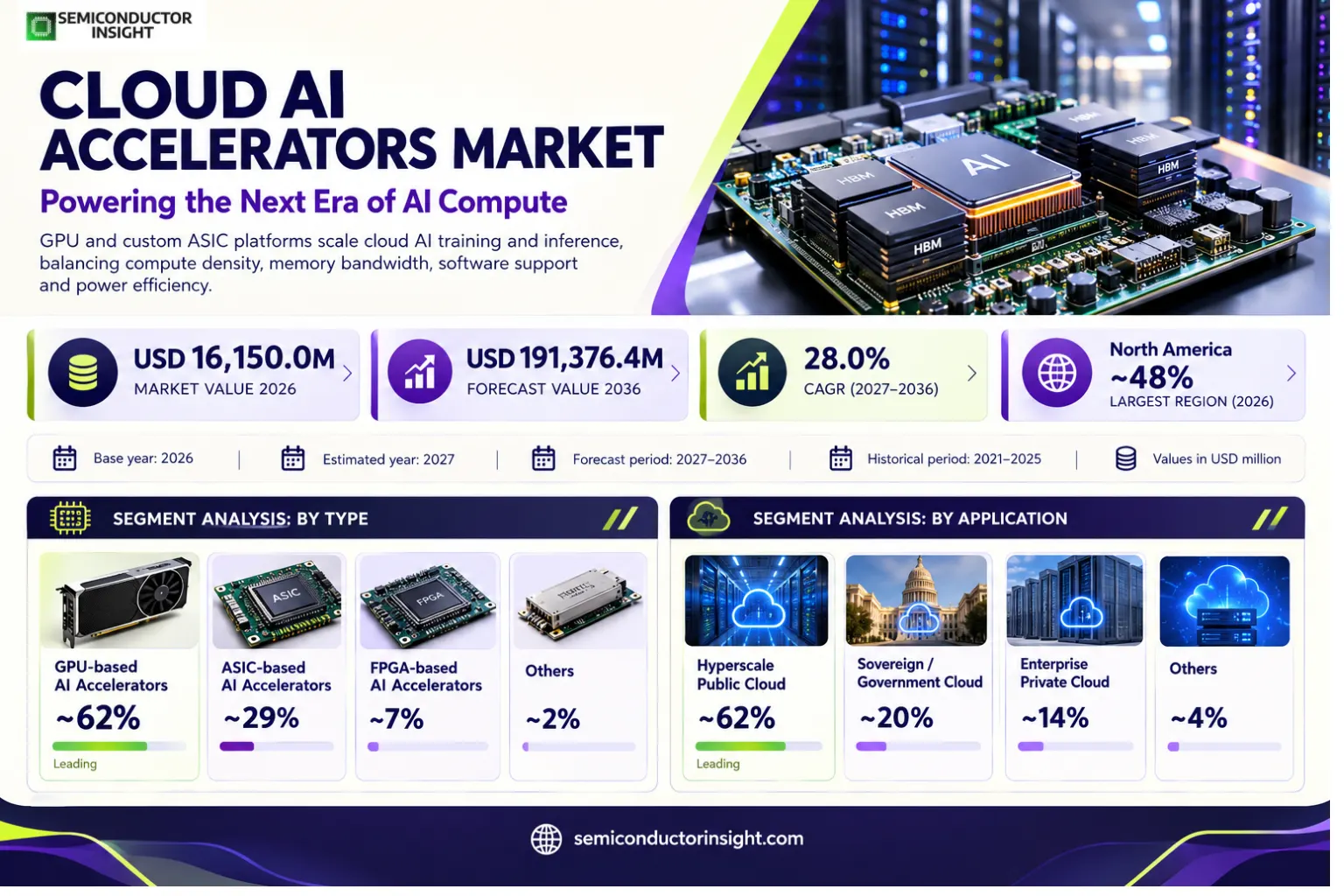
- Market size: The cloud ai accelerators market stands at USD 16,150.0 million in 2026 and is projected to reach USD 191,376.4 million by 2036, representing a CAGR of 28.0% over 2027–2036. For cloud ai accelerator systems, the addressable product boundary is focused on purchased accelerator silicon rather than cloud-service consumption, and procurement timing is shaped by operating constraints and large infrastructure programs.
- Dominant technology: GPU-based AI Accelerators accounts for an estimated ~62% of 2026 market value. ASIC-based AI Accelerators has the fastest modeled expansion at ~30.4% CAGR, reflecting differences in deployed software ecosystems, accelerator integration, workload specialization and replacement cycles.
- Largest application: Hyperscale Public Cloud represents an estimated ~62% of revenue in the modeled 2026 application split. The purchasing rationale depends on hyperscale cloud fleets, government cloud campuses and enterprise private-cloud operators order accelerators in batches aligned to infrastructure rollouts and software qualification. and on the value of faster computation relative to fabric, power and maintenance costs.
- Regional leadership: North America holds an estimated ~48% of 2026 revenue, while Asia-Pacific has the fastest modeled regional growth at ~30.2% annually. For cloud ai accelerator systems, deployment opportunities differ by national procurement rules, local grid access and the presence of cloud computing operators.
- Principal constraint: Packaging and hbm supply, restricted interconnect scaling, network and power buildout delays and vendor-specific programming environments constrain the conversion of announced AI infrastructure plans into actual deployments. For cloud ai accelerator systems, purchasers typically require software validation, delivery windows and life-cycle operating costs in addition to headline chip performance.
Cloud AI Accelerator Market Overview
Cloud AI accelerators market was valued at USD 16,150.0 million in 2026 and is projected to reach USD 191,376.4 million by 2036, growing at a CAGR of 28.0% over 2027–2036. North America leads with an estimated ~48% share in 2026, supported by concentrated compute procurement and installed-cloud infrastructure.
Cloud AI Accelerator consists of Compute engines are delivered on accelerator boards and integrated modules with local HBM, host interfaces and scale-up fabrics; operators measure delivered tokens, training time, reliability and power draw. For cloud ai accelerator systems, accelerators have become an essential way to scale artificial intelligence computing beyond CPU-only installations, but the addressable value lies in the specific processor systems that are delivered rather than the applications built on top of them. For cloud ai accelerator systems, buyers compare computation per watt, memory movement and model framework support across several technical approaches.
The revenue scope covers Accelerator hardware deployed in cloud, sovereign and enterprise data centers as merchant GPU cards or modules and custom AI-ASIC accelerators; excludes workstation processors, edge modules, networking and cloud-rental service receipts. For cloud ai accelerator systems, this separation prevents the same cloud AI spending from being counted as a processor sale, a fully installed server purchase and then again as a rental service. For cloud ai accelerator systems, integrators may report combined systems while silicon suppliers recognize components, creating a need for a consistent hardware-focused boundary when comparing product categories.
Core system architecture links logic design, semiconductor packaging and software. For cloud ai accelerator systems, compute engines are delivered on accelerator boards and integrated modules with local HBM, host interfaces and scale-up fabrics; operators measure delivered tokens, training time, reliability and power draw. For cloud ai accelerator systems, nVIDIA and AMD publish GPU platform roadmaps, while AWS and Google provide examples of custom accelerator stacks. For cloud ai accelerator systems, the IEA documents electricity demand in AI infrastructure, illustrating why component performance cannot be evaluated independently from cooling, network throughput and operating availability.
Demand originates in Hyperscale cloud fleets, government cloud campuses and enterprise private-cloud operators order accelerators in batches aligned to infrastructure rollouts and software qualification. For cloud ai accelerator systems, hardware ordering has shifted toward platform-level engineering: memory capacity, scale-up fabrics and driver maintenance influence total cost more than peak arithmetic throughput alone. For cloud ai accelerator systems, inference demand can favor models with lower token cost, while new large-scale training often favors dense compute and fabric designs with higher initial spending.
The market is changing through manufacturing readiness and system co-design. For cloud ai accelerator systems, nVIDIA reported production expansion for Rubin infrastructure in 2026, AMD described MI450 deployment agreements, AWS introduced Trainium3 and Microsoft introduced Maia 200. These official announcements reveal different commercialization paths, from merchant hardware to captive cloud accelerators, while packaging and HBM supply, restricted interconnect scaling, network and power buildout delays and vendor-specific programming environments determine the timing of realized procurement.
Segment Analysis: By Type
The type categories are GPU-based AI Accelerators, ASIC-based AI Accelerators, FPGA-based AI Accelerators, Others. GPU-based AI Accelerators leads at an estimated ~62% of 2026 revenue; ASIC-based AI Accelerators has the fastest modeled growth at ~30.4% CAGR. For cloud ai accelerator systems, the split reflects software compatibility and the price of delivered compute, not an assertion that each chip architecture can be compared solely on advertised peak operations.
| Type | Function | Market position |
|---|---|---|
| GPU-based AI Accelerators | GPU-based AI Accelerators is included within the documented type scope of Cloud AI Accelerator. For GPU-based AI Accelerators, gPU-based accelerators offer flexible training and serving throughput under CUDA and ROCm tooling, especially for rapidly changing model architectures. For GPU-based AI Accelerators, design decisions depend on compute precision, package topology, memory access and the maturity of frameworks serving the targeted customer workload. For GPU-based AI Accelerators, buyers examine model throughput and practical software support before committing to volume contracts for this category. | GPU-based AI Accelerators represents an estimated ~62% of 2026 market revenue and a modeled ~26.6% annual growth rate through 2036. For cloud ai accelerator GPU-based AI Accelerators, gPU-based accelerators offer flexible training and serving throughput under CUDA and ROCm tooling, especially for rapidly changing model architectures. For GPU-based AI Accelerators, supplier competitiveness is tied to operating power, supply agreements, usable memory throughput and fleet support. For GPU-based AI Accelerators, the revenue mix may change as training and inference usage evolve, so share and growth are distinct measures. |
| ASIC-based AI Accelerators | ASIC-based AI Accelerators is included within the documented type scope of Cloud AI Accelerator. For ASIC-based AI Accelerators, aSIC-based accelerators are tailored to specific operators and model-serving economics, including TPU, Trainium and Maia designs. For ASIC-based AI Accelerators, design decisions depend on compute precision, package topology, memory access and the maturity of frameworks serving the targeted customer workload. For ASIC-based AI Accelerators, buyers examine model throughput and practical software support before committing to volume contracts for this category. | ASIC-based AI Accelerators represents an estimated ~29% of 2026 market revenue and a modeled ~30.4% annual growth rate through 2036. For cloud ai accelerator ASIC-based AI Accelerators, aSIC-based accelerators are tailored to specific operators and model-serving economics, including TPU, Trainium and Maia designs. For ASIC-based AI Accelerators, supplier competitiveness is tied to operating power, supply agreements, usable memory throughput and fleet support. For ASIC-based AI Accelerators, the revenue mix may change as training and inference usage evolve, so share and growth are distinct measures. |
| FPGA-based AI Accelerators | FPGA-based AI Accelerators is included within the documented type scope of Cloud AI Accelerator. For FPGA-based AI Accelerators, fPGA accelerators support customizable low-latency pipelines and specialized inference where configuration flexibility has value. For FPGA-based AI Accelerators, design decisions depend on compute precision, package topology, memory access and the maturity of frameworks serving the targeted customer workload. For FPGA-based AI Accelerators, buyers examine model throughput and practical software support before committing to volume contracts for this category. | FPGA-based AI Accelerators represents an estimated ~7% of 2026 market revenue and a modeled ~29.4% annual growth rate through 2036. For cloud ai accelerator FPGA-based AI Accelerators, fPGA accelerators support customizable low-latency pipelines and specialized inference where configuration flexibility has value. For FPGA-based AI Accelerators, supplier competitiveness is tied to operating power, supply agreements, usable memory throughput and fleet support. For FPGA-based AI Accelerators, the revenue mix may change as training and inference usage evolve, so share and growth are distinct measures. |
| Others | Others is included within the documented type scope of Cloud AI Accelerator. For Others, other accelerators serve experimental or niche processor designs whose commercial scale remains smaller than GPU and ASIC products. For Others, design decisions depend on compute precision, package topology, memory access and the maturity of frameworks serving the targeted customer workload. For Others, buyers examine model throughput and practical software support before committing to volume contracts for this category. | Others represents an estimated ~2% of 2026 market revenue and a modeled ~28.2% annual growth rate through 2036. For cloud ai accelerator Others, other accelerators serve experimental or niche processor designs whose commercial scale remains smaller than GPU and ASIC products. For Others, supplier competitiveness is tied to operating power, supply agreements, usable memory throughput and fleet support. For Others, the revenue mix may change as training and inference usage evolve, so share and growth are distinct measures. |
Secondary segmentation: deployment and computing architecture
by end user separates Cloud Service Providers, Large Enterprises, Government Agencies; the modeled leader is Cloud Service Providers at an estimated ~67% in 2026. by workload type separates AI Training Accelerators, AI Inference Accelerators, Others; the modeled leader is AI Training Accelerators at an estimated ~58% in 2026. by business model separates Merchant Accelerators, Hyperscaler In-house Accelerators; the modeled leader is Merchant Accelerators at an estimated ~70% in 2026. For cloud ai accelerator systems, the secondary axes are parallel views of the same market, not additional revenue pools.
| Axis | Members | Commercial role |
|---|---|---|
| By End User | Cloud Service Providers; Large Enterprises; Government Agencies | Cloud Service Providers carries the highest modeled commercial position along by end user, an estimated ~67% of the 2026 category. For cloud ai accelerator systems, these categories are distinct from primary type and application definitions, so their percentages must not be added across different axes. For GPU accelerator cards, system integrators must verify thermal envelopes and connector compatibility before large-scale procurement. |
| By Workload Type | AI Training Accelerators; AI Inference Accelerators; Others | AI Training Accelerators carries the highest modeled commercial position along by workload type, an estimated ~58% of the 2026 category. For cloud ai accelerator cloud ai accelerator systems, these categories are distinct from primary type and application definitions, so their percentages must not be added across different axes. For purpose-built accelerator modules, operational acceptance depends on vendor runtimes, server validation and sustained performance under production workloads. |
| By Business Model | Merchant Accelerators; Hyperscaler In-house Accelerators | Merchant Accelerators carries the highest modeled commercial position along by business model, an estimated ~70% of the 2026 category. In cloud ai accelerator systems purchasing, these categories are distinct from primary type and application definitions, so their percentages must not be added across different axes. For programmable acceleration, buyers need a dependable model compilation route and predictable engineering support costs throughout deployment. |
Segment Analysis: By Application
Application demand is divided into Hyperscale Public Cloud, Sovereign/Government Cloud, Enterprise Private Cloud, Others. Hyperscale Public Cloud leads with an estimated ~62% share in 2026. For cloud ai accelerator systems, the split describes where the product is deployed, while type segments describe the compute component itself. For cloud ai accelerator systems, buyers select silicon based on workload intensity, residency requirements and software support instead of the nominal sector description alone.
| Application | Demand characteristics |
|---|---|
| Hyperscale Public Cloud | Hyperscale Public Cloud generates an estimated ~62% of 2026 Cloud AI Accelerator demand and has an estimated ~27.1% growth path to 2036. For Hyperscale Public Cloud, hyperscale public clouds continuously refresh accelerator pools and coordinate system validation with machine-learning software and rental capacity planning. Procurement triggers include accelerator availability, deployment commissioning and compatibility with model pipelines. For Hyperscale Public Cloud, equipment vendors typically qualify their stack with platform administrators before volume deployment, which differentiates recognized chip revenue from consumption of AI services. |
| Sovereign/Government Cloud | Sovereign/Government Cloud generates an estimated ~20% of 2026 Cloud AI Accelerator demand and has an estimated ~29.7% growth path to 2036. Sovereign and government clouds place additional emphasis on jurisdictional controls, procurement review and local data residency. Procurement triggers include accelerator availability, deployment commissioning and compatibility with model pipelines. For Sovereign/Government Cloud, equipment vendors typically qualify their stack with platform administrators before volume deployment, which differentiates recognized chip revenue from consumption of AI services. |
| Enterprise Private Cloud | Enterprise Private Cloud generates an estimated ~14% of 2026 Cloud AI Accelerator demand and has an estimated ~28.9% growth path to 2036. Private-cloud enterprises seek fixed capacity, security controls and predictable lifecycle maintenance for recurring workloads. Procurement triggers include accelerator availability, deployment commissioning and compatibility with model pipelines. For Enterprise Private Cloud, equipment vendors typically qualify their stack with platform administrators before volume deployment, which differentiates recognized chip revenue from consumption of AI services. |
| Others | Others generates an estimated ~4% of 2026 Cloud AI Accelerator demand and has an estimated ~30.1% growth path to 2036. Other cloud installations include smaller specialist service providers and research deployments with narrower workload portfolios. Procurement triggers include accelerator availability, deployment commissioning and compatibility with model pipelines. For Others, equipment vendors typically qualify their stack with platform administrators before volume deployment, which differentiates recognized chip revenue from consumption of AI services. |
For cloud ai accelerator systems, the sales channel combines component vendors, server integrators, distributors and cloud platform engineering teams. For cloud ai accelerator, purchasing decisions are generally made at the infrastructure program level, with accelerators qualified for specific host boards, memory, networking and software. For cloud ai accelerator systems, pricing is negotiated across hardware and support rather than a single nominal computation benchmark.
Regional Analysis
Regional sales of cloud ai accelerator are concentrated in North America with an estimated ~48% share in 2026; Asia-Pacific holds ~29% and Europe holds ~14%. The fastest modeled regional growth is Asia-Pacific at ~30.2% CAGR. For cloud ai accelerator systems, these differences reflect infrastructure ownership, access to advanced processors and data-center investment cycles rather than solely local semiconductor production.
How do regional priorities differ for cloud ai accelerator?
Five regional markets have distinct procurement profiles. For cloud ai accelerator systems, north America concentrates enterprise AI services and merchant accelerator sourcing; Asia-Pacific combines local cloud expansion with semiconductor and HBM manufacturing; Europe funds collaborative AI compute and regulated workloads; the Middle East invests in sovereign infrastructure; and South America depends heavily on regional cloud adoption and imported systems. Power and software constraints condition each region differently.
| Region | Position | Growth outlook | Demand profile | What decides supplier selection |
|---|---|---|---|---|
| North America | Rank 1 (~48%) | ~26.6% CAGR | Hyperscale cloud procurement | For cloud ai accelerator systems, north America buyers prioritize power access and reliable supply of rack-integrated compute; the applicable purchasing profile involves hyperscale campuses, established GPU cloud operators and inference platforms. Selecting suppliers requires customer references, qualified software and binding delivery commitments. For cloud ai accelerator systems, larger AI facilities also require sufficient electricity and cooling provision before compute hardware can be installed. For cloud ai accelerator systems, a comparison of accelerator benchmarks without data-center integration and operational support may misstate the effective value of the deployment. |
| Asia-Pacific | Rank 2 (~29%) | ~30.2% CAGR | Chip production and AI clouds | For cloud ai accelerator systems, asia-Pacific buyers prioritize packaging supply, domestic sourcing restrictions and service economics; the applicable purchasing profile involves GPU system assembly, semiconductor manufacturing and large local AI services. Selecting suppliers requires customer references, qualified software and binding delivery commitments. For cloud ai accelerator cloud ai accelerator systems, larger AI facilities also require sufficient electricity and cooling provision before compute hardware can be installed. For cloud ai accelerator cloud ai accelerator systems, a comparison of accelerator benchmarks without data-center integration and operational support may misstate the effective value of the deployment. |
| Europe | Rank 3 (~14%) | ~27.1% CAGR | Sovereign AI computing | For cloud ai accelerator systems, europe buyers prioritize energy cost, procurement compliance and access to qualified systems; the applicable purchasing profile involves sovereign AI computing, industrial research and EuroHPC AI Factories. Selecting suppliers requires customer references, qualified software and binding delivery commitments. In cloud ai accelerator systems purchasing, larger AI facilities also require sufficient electricity and cooling provision before compute hardware can be installed. In cloud ai accelerator systems purchasing, a comparison of accelerator benchmarks without data-center integration and operational support may misstate the effective value of the deployment. |
| Middle East & Africa | Rank 4 (~5%) | ~29.8% CAGR | Sovereign infrastructure | For cloud ai accelerator systems, middle East & Africa buyers prioritize power, financing and qualified infrastructure operations; the applicable purchasing profile involves planned AI infrastructure linked to sovereign cloud development. Selecting suppliers requires customer references, qualified software and binding delivery commitments. For cloud ai accelerator procurement in cloud ai accelerator systems, larger AI facilities also require sufficient electricity and cooling provision before compute hardware can be installed. For cloud ai accelerator procurement in cloud ai accelerator systems, a comparison of accelerator benchmarks without data-center integration and operational support may misstate the effective value of the deployment. |
| South America | Rank 5 (~4%) | ~28.4% CAGR | Enterprise cloud adoption | For cloud ai accelerator systems, south America buyers prioritize import costs, energy availability and currency exposure; the applicable purchasing profile involves cloud region investment and gradual enterprise AI hosting uptake. Selecting suppliers requires customer references, qualified software and binding delivery commitments. For cloud ai accelerator buyers examining cloud ai accelerator systems in 2026, larger AI facilities also require sufficient electricity and cooling provision before compute hardware can be installed. For cloud ai accelerator buyers examining cloud ai accelerator systems in 2026, a comparison of accelerator benchmarks without data-center integration and operational support may misstate the effective value of the deployment. |
Cloud AI Accelerator Competitive Landscape
Competition in cloud ai accelerator is shaped by component architecture, software integration and cost of running sustained compute workloads. The companies profiled include NVIDIA Corporation, Google (TPU), Amazon Web Services (Trainium/Inferentia), Microsoft (Maia AI Accelerator), Intel (Habana Labs), AMD (Instinct MI Series), Huawei (Ascend). For cloud ai accelerator competitive suppliers, direct merchant GPU suppliers compete differently from hyperscalers that design captive silicon for their own cloud platforms; supplier tiers therefore identify commercial roles rather than a single universal market-share ranking.
Product leadership depends on Compute engines are delivered on accelerator boards and integrated modules with local HBM, host interfaces and scale-up fabrics; operators measure delivered tokens, training time, reliability and power draw. For cloud ai accelerator competitive suppliers, nVIDIA and AMD invest in scalable GPU systems, while custom silicon programs from Google, Amazon and Microsoft target cloud-owned workload economics. For cloud ai accelerator competitive suppliers, buyers compare more than specifications: sustained utilization, model support and fleet operation shape processor choice.
Production competition reflects access to packaging and HBM supply, restricted interconnect scaling, network and power buildout delays and vendor-specific programming environments. For cloud ai accelerator competitive suppliers, advanced packaging combines logic dies, memory and high-speed links with stringent yield requirements. For cloud ai accelerator competitive suppliers, capacity allocation can restrict available cards even after a new processor has been announced; long-term contracts and qualification programs therefore influence competitive performance.
Software is a competitive asset for cloud ai accelerator. For cloud ai accelerator competitive suppliers, cUDA, ROCm, XLA and cloud-specific compiler runtimes determine how quickly users can migrate model code to different hardware. For cloud ai accelerator competitive suppliers, compatibility work creates costs beyond the acquisition price and can reduce the addressable customer base for products that lack mature frameworks.
Customers include Hyperscale cloud fleets, government cloud campuses and enterprise private-cloud operators order accelerators in batches aligned to infrastructure rollouts and software qualification. Their differing requirements yield merchant purchases, custom-chip deployments and integrated system contracts. For cloud ai accelerator competitive suppliers, public company revenue figures cannot be equated with the narrower product market because they include broader CPU, networking, cloud service or complete infrastructure receipts.
Tier structure
| Tier | Companies | Basis of competition |
|---|---|---|
| Tier 1 | NVIDIA Corporation, Google (TPU), Amazon Web Services (Trainium/Inferentia), Microsoft (Maia AI Accelerator) | Products used as primary compute devices in cloud ai accelerator, supported by active platform roadmaps and software stacks. These suppliers compete through qualified silicon, assembly partners and large customer accounts. For cloud ai accelerator competitive suppliers, direct supplier status does not automatically imply comparable market revenue because some operators consume their own designs. Commercial evaluation of Tier 1 requires attention to Compute engines are delivered on accelerator boards and integrated modules with local HBM, host interfaces and scale-up fabrics; operators measure delivered tokens, training time, reliability and power draw., packaging and HBM supply, restricted interconnect scaling, network and power buildout delays and vendor-specific programming environments, and the purchasing criteria of Hyperscale cloud fleets, government cloud campuses and enterprise private-cloud operators order accelerators in batches aligned to infrastructure rollouts and software qualification.. |
| Tier 2 | Intel (Habana Labs), AMD (Instinct MI Series), Huawei (Ascend), T-Head Semiconductor (Alibaba), Enflame Technology, Biren Technology | For cloud ai accelerator competitive suppliers, specialized architecture, cloud integration or regional qualification can position these participants in distinct customer groups. For cloud ai accelerator competitive suppliers, their economics depend on access to memory and integration partners plus software support. For cloud ai accelerator competitive suppliers, some names represent captive accelerator programs rather than merchant hardware sold externally, so commercial classification must remain clear. |
| Tier 3 | HBM, foundry, systems and platform ecosystem | Memory, fabrication, equipment and server ecosystem members enable shipments without necessarily selling cloud ai accelerator as standalone compute products. For cloud ai accelerator competitive suppliers, their packaging capacity, platform reference designs and service capabilities can constrain or unlock shipments. Tier classification here describes a supply-chain role, not a numeric market share. Commercial evaluation of Tier 3 requires attention to Compute engines are delivered on accelerator boards and integrated modules with local HBM, host interfaces and scale-up fabrics; operators measure delivered tokens, training time, reliability and power draw., packaging and HBM supply, restricted interconnect scaling, network and power buildout delays and vendor-specific programming environments, and the purchasing criteria of Hyperscale cloud fleets, government cloud campuses and enterprise private-cloud operators order accelerators in batches aligned to infrastructure rollouts and software qualification.. |
Key companies profiled
- NVIDIA Corporation
- Google (TPU)
- Amazon Web Services (Trainium/Inferentia)
- Microsoft (Maia AI Accelerator)
- Intel (Habana Labs)
- AMD (Instinct MI Series)
- Huawei (Ascend)
- T-Head Semiconductor (Alibaba)
- Enflame Technology
- Biren Technology
- Graphcore
- Groq
- Tenstorrent
- Cerebras Systems
- SambaNova Systems
Cloud AI Accelerator Production Capacity Analysis
Capacity for cloud ai accelerator depends on contracted leading-edge logic, advanced packaging, high-bandwidth memory and system-integration operations. For cloud ai accelerator production planning, tSMC and memory suppliers are important enabling participants even where branded accelerator design is performed in a separate region. For cloud ai accelerator production planning, component output is not directly comparable with completed rack or cloud service capacity.
Foundry manufacturing and advanced packaging have different constraints. For cloud ai accelerator production planning, dense GPU and AI ASIC designs require wafer starts, substrate capacity, memory integration and system-level electrical validation. For cloud ai accelerator production planning, a shortage at any one stage can delay final hardware, while improvements in one input do not necessarily lift the output of the entire manufacturing line.
For cloud ai accelerator production planning, production diversification includes hardware assembly and testing in multiple Asian and global facilities. For cloud ai accelerator production planning, nVIDIA described system manufacturing partners expanding Rubin infrastructure output in 2026, illustrating how cloud accelerator production spans silicon suppliers and rack builders. For cloud ai accelerator production planning, shipping destinations then depend on customer acceptance tests, software readiness and the local installation schedule.
Upstream limits remain important to cloud ai accelerator. For cloud ai accelerator production planning, sK hynix announced HBM4 development and qualification steps, while the IEA highlighted growth in electricity demand for data centers. For cloud ai accelerator production planning, the market therefore faces two separate capacity gates: component manufacture and availability of power-ready sites able to commission the resulting AI compute systems.
Cloud AI Accelerator Market Dynamics
The balance of drivers, restraints and opportunities for cloud ai accelerator depends on how rapidly hardware can be integrated into productive infrastructure. Training, inference and scientific workloads have different profitability and capacity requirements. For cloud ai accelerator systems, estimates of potential effects on annual growth below are directional commercial sensitivities, not an additive decomposition of the headline market rate.
MARKET DRIVERS
Drivers Impact Analysis*
| Driver | (~) % impact on CAGR forecast | Geographic relevance | Impact timeline |
|---|---|---|---|
| Demand for AI training | +1.8% | Global | 2027–2030 |
| Inference fleet deployment | +1.4% | North America / Europe | 2026–2034 |
| HBM performance improvement | +1.1% | Asia-Pacific | 2026–2032 |
| Custom silicon adoption | +0.9% | Global | 2027–2036 |
| Infrastructure availability | +0.8% | Global | 2026–2036 |
Demand for AI training
Demand for AI training creates a potential purchase trigger for cloud ai accelerator because hyperscale cloud fleets, government cloud campuses and enterprise private-cloud operators order accelerators in batches aligned to infrastructure rollouts and software qualification. For cloud ai accelerator demand for ai training, the commercial impact of faster accelerators depends on sustained model use, adequate memory and working infrastructure. For cloud ai accelerator demand for ai training, hardware orders advance when developers verify operational savings over existing equipment, and planned announcements can lag purchase recognition by several commissioning cycles.
Inference fleet deployment
Inference fleet deployment creates a potential purchase trigger for cloud ai accelerator because hyperscale cloud fleets, government cloud campuses and enterprise private-cloud operators order accelerators in batches aligned to infrastructure rollouts and software qualification. For cloud ai accelerator inference fleet deployment, the commercial impact of faster accelerators depends on sustained model use, adequate memory and working infrastructure. For cloud ai accelerator inference fleet deployment, hardware orders advance when developers verify operational savings over existing equipment, and planned announcements can lag purchase recognition by several commissioning cycles.
HBM performance improvement
HBM performance improvement creates a potential purchase trigger for cloud ai accelerator because hyperscale cloud fleets, government cloud campuses and enterprise private-cloud operators order accelerators in batches aligned to infrastructure rollouts and software qualification. For cloud ai accelerator hbm performance improvement, the commercial impact of faster accelerators depends on sustained model use, adequate memory and working infrastructure. For cloud ai accelerator hbm performance improvement, hardware orders advance when developers verify operational savings over existing equipment, and planned announcements can lag purchase recognition by several commissioning cycles.
Custom silicon adoption
Custom silicon adoption creates a potential purchase trigger for cloud ai accelerator because hyperscale cloud fleets, government cloud campuses and enterprise private-cloud operators order accelerators in batches aligned to infrastructure rollouts and software qualification. For cloud ai accelerator custom silicon adoption, the commercial impact of faster accelerators depends on sustained model use, adequate memory and working infrastructure. For cloud ai accelerator custom silicon adoption, hardware orders advance when developers verify operational savings over existing equipment, and planned announcements can lag purchase recognition by several commissioning cycles.
MARKET RESTRAINTS
Restraints Impact Analysis*
| Restraint | (~) % impact on CAGR forecast | Geographic relevance | Impact timeline |
|---|---|---|---|
| Power and cooling limits | −1.5% | Global | 2026–2034 |
| Memory and packaging capacity | −1.2% | Asia-Pacific | 2026–2030 |
| Software portability | −0.9% | Global | 2027–2036 |
| Trade and procurement compliance | −0.7% | Global | 2026–2036 |
Power and cooling limits
Power and cooling limits restricts purchases of cloud ai accelerator where packaging and HBM supply, restricted interconnect scaling, network and power buildout delays and vendor-specific programming environments. For cloud ai accelerator power and cooling limits, the most expensive chip is not necessarily the fastest usable system if the operator cannot obtain compatible memory, deliver sufficient electrical power or maintain trained support staff. For cloud ai accelerator power and cooling limits, such frictions can defer deployments and encourage customers to extend existing accelerator fleets.
Memory and packaging capacity
Memory and packaging capacity restricts purchases of cloud ai accelerator where packaging and HBM supply, restricted interconnect scaling, network and power buildout delays and vendor-specific programming environments. For cloud ai accelerator memory and packaging capacity, the most expensive chip is not necessarily the fastest usable system if the operator cannot obtain compatible memory, deliver sufficient electrical power or maintain trained support staff. For cloud ai accelerator memory and packaging capacity, such frictions can defer deployments and encourage customers to extend existing accelerator fleets.
Software portability
Software portability restricts purchases of cloud ai accelerator where packaging and HBM supply, restricted interconnect scaling, network and power buildout delays and vendor-specific programming environments. For cloud ai accelerator software portability, the most expensive chip is not necessarily the fastest usable system if the operator cannot obtain compatible memory, deliver sufficient electrical power or maintain trained support staff. For cloud ai accelerator software portability, such frictions can defer deployments and encourage customers to extend existing accelerator fleets.
Trade and procurement compliance
Trade and procurement compliance restricts purchases of cloud ai accelerator where packaging and HBM supply, restricted interconnect scaling, network and power buildout delays and vendor-specific programming environments. For cloud ai accelerator trade and procurement compliance, the most expensive chip is not necessarily the fastest usable system if the operator cannot obtain compatible memory, deliver sufficient electrical power or maintain trained support staff. For cloud ai accelerator trade and procurement compliance, such frictions can defer deployments and encourage customers to extend existing accelerator fleets.
MARKET OPPORTUNITIES
Higher-throughput inference
Higher-throughput inference is an opportunity in cloud ai accelerator as infrastructure operators seek efficiency and dependable performance. For cloud ai accelerator higher-throughput inference, the opportunity requires more than a laboratory benchmark: software integration, stable memory supply and security approval determine whether new hardware replaces installed equipment. For cloud ai accelerator higher-throughput inference, commercial winners can combine application-specific throughput with credible delivery schedules and long-term support.
Sovereign data-center procurement
Sovereign data-center procurement is an opportunity in cloud ai accelerator as infrastructure operators seek efficiency and dependable performance. For cloud ai accelerator sovereign data-center procurement, the opportunity requires more than a laboratory benchmark: software integration, stable memory supply and security approval determine whether new hardware replaces installed equipment. For cloud ai accelerator sovereign data-center procurement, commercial winners can combine application-specific throughput with credible delivery schedules and long-term support.
Heterogeneous software stacks
Heterogeneous software stacks is an opportunity in cloud ai accelerator as infrastructure operators seek efficiency and dependable performance. For cloud ai accelerator heterogeneous software stacks, the opportunity requires more than a laboratory benchmark: software integration, stable memory supply and security approval determine whether new hardware replaces installed equipment. For cloud ai accelerator heterogeneous software stacks, commercial winners can combine application-specific throughput with credible delivery schedules and long-term support.
Memory and packaging co-design
Memory and packaging co-design is an opportunity in cloud ai accelerator as infrastructure operators seek efficiency and dependable performance. For cloud ai accelerator memory and packaging co-design, the opportunity requires more than a laboratory benchmark: software integration, stable memory supply and security approval determine whether new hardware replaces installed equipment. For cloud ai accelerator memory and packaging co-design, commercial winners can combine application-specific throughput with credible delivery schedules and long-term support.
Cloud AI Accelerator Supply Chain Analysis
Production and delivery of cloud ai accelerator connect semiconductor fabrication with specialized packaging, server-system integration and customer operation. For cloud ai accelerator the supply chain, the sales boundary should be distinguished from cloud subscriptions and complete installed facilities. For cloud ai accelerator the supply chain, manufacturers need cooperation from memory makers, design-software providers and infrastructure operators before a modern AI processor can be deployed at high volume.
Upstream. Cloud AI accelerator procurement begins with processors, memory, high-speed board components, power electronics and interconnect interfaces qualified for cloud servers. Card and module manufacturers must secure compatible components at the same time, especially when advanced packaging and memory supply remain concentrated. A processor family does not become a deployable product until platform power limits and firmware requirements are understood. Upstream uncertainty can thus delay commercial accelerator shipments despite orders already being placed by cloud service operators.
Manufacturing. Accelerator manufacturing includes board or module assembly, validation of PCIe or dedicated interconnect interfaces, power-delivery checks and sustained-load thermal testing. Product qualification takes place in target server configurations because airflow, cooling and firmware behavior can differ from standalone laboratory results. Vendors with strong systems engineering are better positioned to resolve integration issues before volume rollout. The accepted product is the functional accelerator module delivered into the cloud installation, not simply its underlying compute die.
Channel. Cloud accelerator cards and modules move through semiconductor partners, approved server OEMs, dedicated system integrators and direct hyperscaler procurement contracts. Platforms are often qualified as tightly linked combinations of hardware, runtime tools and management firmware. This limits substitution even where competing cards advertise similar compute capability. Deployment schedules depend on cloud regions, data-centre power and the availability of compatible host systems, making the channel more technically demanding than conventional component distribution.
Downstream. Downstream demand comes from cloud operators providing training, inference and managed AI infrastructure to enterprises and developers. Accelerator operators monitor utilization, runtime compatibility, power efficiency and service availability across a large installed fleet. A purchased card can remain idle while its software or hosting infrastructure is prepared, so shipped hardware and productive cloud capacity are different measures. Sustainable revenue growth depends on translating accelerator deployments into workloads that customers are willing to use and pay for.
Cloud AI Accelerator Recent Developments
- October 12, 2026 Published
For the cloud ai accelerator supply chain, microsoft confirmed the Maia 200 accelerator was serving production workloads and outlined the expansion of Azure Maia systems toward multi-gigawatt deployments, alongside its Maia 300 roadmap for 2027. For the cloud ai accelerator supply chain, this adds a commercially significant alternative to merchant GPU accelerators for high-volume inference; capacity plans remain subject to implementation timing and realized utilization. Source - July 22, 2026 Announced
For the cloud ai accelerator supply chain, aMD and Anthropic announced a strategic partnership covering up to two gigawatts of AMD Instinct MI450 GPU systems in Helios racks, with the initial deployment expected during the first half of 2027. For the cloud ai accelerator supply chain, it establishes a potential source of major merchant-accelerator demand beyond the leading supplier, although stated capacity is a future commitment rather than current chip deliveries. Source - June 18, 2026 Announced
For the cloud ai accelerator supply chain, sK hynix reported sending twelve-layer HBM4E engineering samples to customers, with faster memory interfaces and improved power efficiency intended for AI processors. For the cloud ai accelerator supply chain, accelerator economics depend on this supply because memory bandwidth can constrain otherwise capable compute engines. For the cloud ai accelerator supply chain, the announcement marks progress in the supplier qualification cycle, not evidence that the new memory is fully deployed at scale. Source - May 31, 2026 Announced
For the cloud ai accelerator supply chain, nVIDIA reported that the Vera Rubin platform was ramping in manufacturing with global server and infrastructure partners. For the cloud ai accelerator supply chain, the program combines compute, switching, networking and storage into coordinated AI-factory systems, increasing the importance of rack-scale qualification alongside individual accelerator benchmarks. For the cloud ai accelerator supply chain, the planned production shipments emphasize supply-chain readiness, not immediate recognition of all announced hardware revenue. Source - February 6, 2026 Published
For the cloud ai accelerator supply chain, the Semiconductor Industry Association reported that worldwide semiconductor sales reached USD 791.7 billion in 2025, up 25.6% from the prior year. For the cloud ai accelerator supply chain, logic and memory demand strengthened as AI-related computing expanded, helping frame the fabrication and memory environment for accelerators. For the cloud ai accelerator supply chain, this is an industry-wide figure and should not be confused with sales of the particular accelerator class. Source - January 26, 2026 Announced
For the cloud ai accelerator supply chain, microsoft introduced Maia 200 for AI inference with a memory-centric design and a software stack intended to support cloud production workloads. For the cloud ai accelerator supply chain, its deployment illustrates a shift toward proprietary silicon for recurring inference tasks, while merchant accelerators remain important for portable applications. For the cloud ai accelerator supply chain, commercial success will depend on model support, utilization rates, deployment availability and production efficiency. Source - December 2, 2025 Announced
For the cloud ai accelerator supply chain, amazon Web Services introduced the general availability of EC2 Trn3 UltraServers powered by Trainium3, offering cloud customers an alternative design optimized for model training and inference. For the cloud ai accelerator supply chain, the product is delivered through a cloud instance and system offering rather than as a separately purchased merchant card. For the cloud ai accelerator supply chain, its significance is competition increasingly based on delivered compute economics and software support. Source
REPORT SCOPE & SEGMENTATION
| Attribute | Details |
|---|---|
| Market | Cloud AI Accelerator market |
| Study period | 2021–2036 |
| Historical period | 2021–2025 |
| Base year | 2026 |
| Estimated year | 2027 |
| Forecast period | 2027–2036 |
| Base market size | USD 16,150.0 million |
| Estimated market size | USD 20,679.7 million |
| Projected market size | USD 191,376.4 million |
| CAGR (2027–2036) | 28.0% |
| Unit | USD million |
| Market definition | For cloud ai accelerator systems, accelerator hardware deployed in cloud, sovereign and enterprise data centers as merchant GPU cards or modules and custom AI-ASIC accelerators; excludes workstation processors, edge modules, networking and cloud-rental service receipts. |
| By Type | GPU-based AI Accelerators · ASIC-based AI Accelerators · FPGA-based AI Accelerators · Others |
| By Application | Hyperscale Public Cloud · Sovereign/Government Cloud · Enterprise Private Cloud · Others |
| By End User | Cloud Service Providers · Large Enterprises · Government Agencies |
| By Workload Type | AI Training Accelerators · AI Inference Accelerators · Others |
| By Business Model | Merchant Accelerators · Hyperscaler In-house Accelerators |
| By Region | Global geographic demand categories; 2026 market shares are estimated. North AmericaUnited States, Canada, Mexico Asia-PacificChina, Japan, India, South Korea EuropeGermany, France, United Kingdom, Netherlands Middle East & AfricaSaudi Arabia, United Arab Emirates, South Africa South AmericaBrazil, Chile, Argentina |
| Key Companies Profiled | NVIDIA Corporation · Google (TPU) · Amazon Web Services (Trainium/Inferentia) · Microsoft (Maia AI Accelerator) · Intel (Habana Labs) · AMD (Instinct MI Series) · Huawei (Ascend) · T-Head Semiconductor (Alibaba) · Enflame Technology · Biren Technology · Graphcore · Groq · Tenstorrent · Cerebras Systems · SambaNova Systems |
| Customization Scope | For cloud ai accelerator systems, country demand, chipset configuration and application revenue breakdowns for enterprise and institutional buyers. |
Frequently Asked Questions
What is the size and forecast growth of the Cloud AI Accelerator market?
The global cloud ai accelerators market was valued at USD 16,150.0 million in 2026 and is projected to reach USD 191,376.4 million in 2036, growing at a CAGR of 28.0% during 2027–2036. For the cloud ai accelerator market, the market boundary covers a specific category of computing hardware, not every associated cloud service or system component; power and software qualification affect deployment pace.
Which type has the largest Cloud AI Accelerator share?
GPU-based AI Accelerators leads the modeled type distribution at an estimated ~62% of 2026 revenue. For the cloud ai accelerator market, gPU-based accelerators offer flexible training and serving throughput under CUDA and ROCm tooling, especially for rapidly changing model architectures. For the cloud ai accelerator market, buyers also weigh memory throughput, framework portability and supported configurations before standardizing across a fleet. Leadership by installed value is distinct from growth rate.
Which type of cloud ai accelerator is expanding fastest?
ASIC-based AI Accelerators has the fastest modeled type expansion, ~30.4% CAGR across the outlook. For the cloud ai accelerator market, adoption is influenced by the suitability of programming frameworks, machine-learning workloads and operator willingness to replace equipment. For the cloud ai accelerator market, a faster growth rate is not equivalent to the largest base-year share and may reflect a smaller starting installed base.
What application generates the most cloud ai accelerator demand?
Hyperscale Public Cloud leads at an estimated ~62% of 2026 application revenue. For the cloud ai accelerator market, hyperscale public clouds continuously refresh accelerator pools and coordinate system validation with machine-learning software and rental capacity planning. For the cloud ai accelerator market, procurement reflects configuration qualification and high-volume purchase agreements rather than the monetary value of resulting AI software services. The distinction helps limit double counting of cloud infrastructure spending.
Which region is the leading market for cloud ai accelerator?
North America leads with an estimated ~48% share in 2026. For the cloud ai accelerator market, its position is associated with computing infrastructure investment, deployment contracts and established operators. For the cloud ai accelerator market, regional supplier roles vary, since companies may design silicon in one territory, manufacture it elsewhere and deliver it to sites on multiple continents.
Which region is growing fastest for cloud ai accelerator?
Asia-Pacific has the fastest modeled regional outlook at ~30.2% annually. For the cloud ai accelerator market, the value of additional capacity depends on financing, electrical connections, customer software and local procurement restrictions. For the cloud ai accelerator market, regional growth comparisons should be interpreted as scenario estimates rather than independently published official market statistics. Commercial evaluation of Which region is growing fastest for cloud ai accelerator? requires attention to Compute engines are delivered on accelerator boards and integrated modules with local HBM, host interfaces and scale-up fabrics; operators measure delivered tokens, training time, reliability and power draw., packaging and HBM supply, restricted interconnect scaling, network and power buildout delays and vendor-specific programming environments, and the purchasing criteria of Hyperscale cloud fleets, government cloud campuses and enterprise private-cloud operators order accelerators in batches aligned to infrastructure rollouts and software qualification..
Who supplies technology used in cloud ai accelerator?
Profiled participants include NVIDIA Corporation, Google (TPU), Amazon Web Services (Trainium/Inferentia), Microsoft (Maia AI Accelerator), Intel (Habana Labs), AMD (Instinct MI Series). For the cloud ai accelerator market, product roles range from merchant GPU sales to proprietary cloud accelerators and software stacks; these routes should not be assigned identical revenue recognition. For the cloud ai accelerator market, memory, foundry and equipment partners also participate in the supply chain without necessarily selling the final accelerator as a branded product.
What constrains future demand for cloud ai accelerator?
Packaging and hbm supply, restricted interconnect scaling, network and power buildout delays and vendor-specific programming environments can affect order timing. For the cloud ai accelerator market, even if compute performance increases, operators must supply electrical capacity, adequate cooling, qualified interconnect and dependable model software. For the cloud ai accelerator market, constraints may move investment toward better utilization of installed fleets before customers expand their physical accelerator purchases.
How does accelerator architecture affect cloud ai accelerator?
For the cloud ai accelerator market, compute engines are delivered on accelerator boards and integrated modules with local HBM, host interfaces and scale-up fabrics; operators measure delivered tokens, training time, reliability and power draw. For the cloud ai accelerator market, the choice of a merchant GPU, FPGA or tailored ASIC changes compute density, framework support and procurement options. For the cloud ai accelerator market, infrastructure operators normally consider delivered performance and reliability at a system level rather than relying on a chip’s theoretical peak arithmetic rate.
What is included in the Cloud AI Accelerator market scope?
For the cloud ai accelerator market, accelerator hardware deployed in cloud, sovereign and enterprise data centers as merchant GPU cards or modules and custom AI-ASIC accelerators; excludes workstation processors, edge modules, networking and cloud-rental service receipts. For the cloud ai accelerator market, the study period extends from 2021 to 2036 and considers Type, Application and geographic demand. For the cloud ai accelerator market, revenues attributed to software-only services, cloud rental, general networking and unrelated processor classes should remain outside the specified hardware category to avoid overstating commercial activity.
Research Sources & Evidence Base
Get Sample Report PDF for Exclusive Insights
Report Sample Includes
- Table of Contents
- List of Tables & Figures
- Charts, Research Methodology, and more...
 Download Sample Report PDF