HBM4 Memory Ecosystem Market Insights
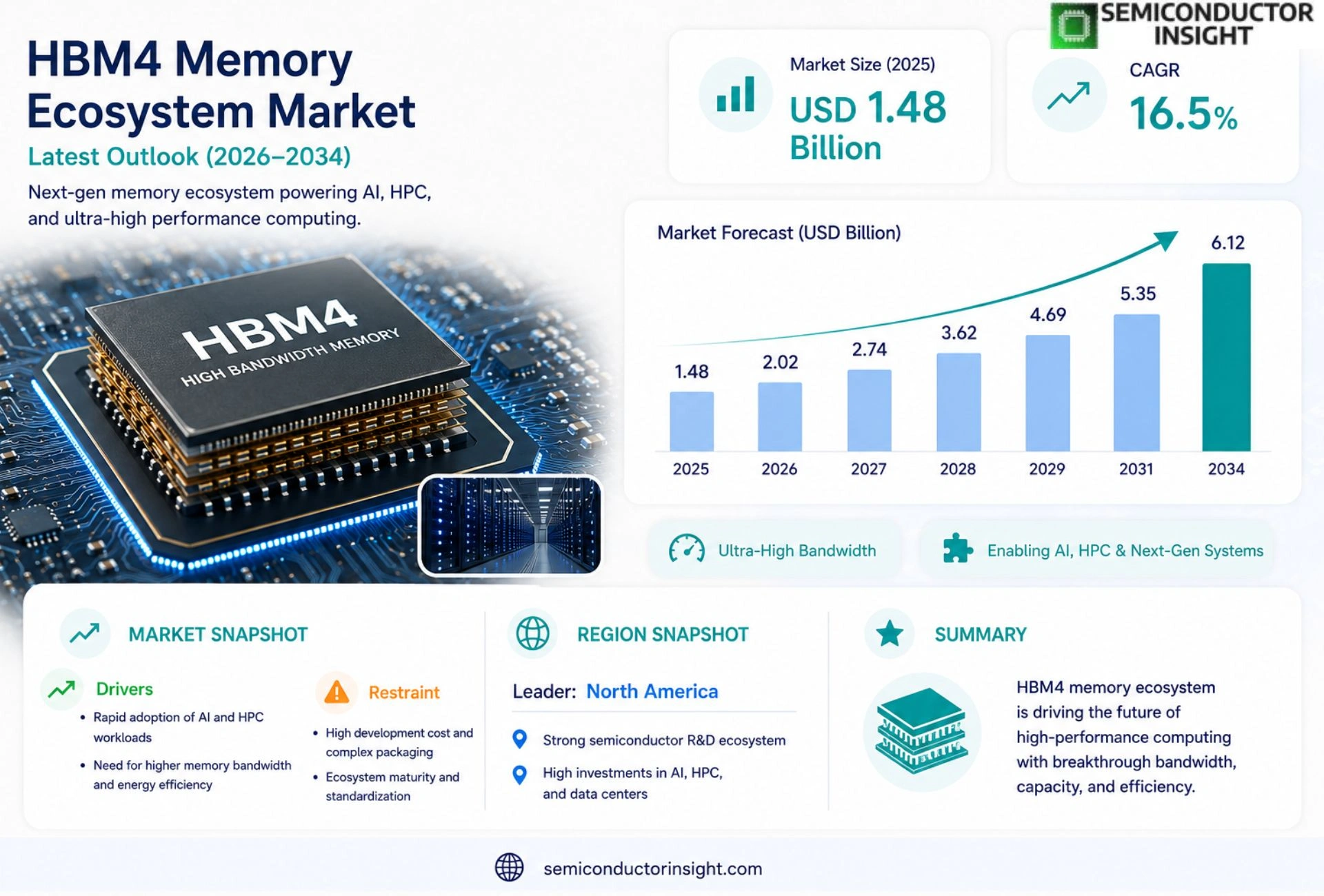
Global HBM4 Memory Ecosystem Market size was valued at USD 1.48 billion in 2025. The market is projected to grow from USD 2.02 billion in 2026 to USD 6.12 billion by 2034, exhibiting a CAGR of 16.5% during the forecast period.
HBM4 memory represents the fourth generation of high‑bandwidth memory stacks, integrating multiple DRAM dies through silicon interposers to deliver bandwidths exceeding 800 GB/s per stack while maintaining low power consumption. The ecosystem encompasses memory chips, advanced packaging technologies, controller IP, and validation tools required for AI accelerators, GPUs, and high‑performance computing platforms.
The market is accelerating because AI workloads demand ever‑higher data rates and energy efficiency; however, manufacturing complexity poses challenges that drive collaboration among foundries and OEMs. Furthermore, strategic partnerships,such as Samsung’s joint development with Nvidia on next‑gen GPUs and SK Hynix’s alliance with AMD,are expanding adoption across cloud datacenters and edge devices.
MARKET DRIVERS
Rapid Adoption of AI‑Accelerated Workloads
The surge in artificial intelligence inference and training workloads is driving demand for higher memory bandwidth. HBM4 Memory Ecosystem Market components enable GPU manufacturers to meet performance targets without disproportionate power increases.
Expansion of High‑Performance Computing (HPC) Infrastructure
Data‑center operators are upgrading legacy systems to support exascale computing, where HBM4 offers the required throughput to keep latency low. This shift fuels investments in silicon interposers, TSV technologies, and advanced packaging.
➤ Industry analysts project a compound annual growth rate above 20% for HBM4 ecosystem through 2030, driven by AI and HPC spend.
Strategic partnerships between memory vendors and semiconductor fabs are also accelerating time‑to‑market, ensuring a steady supply of qualified HBM4 stacks for emerging applications.
MARKET CHALLENGES
Manufacturing Yield Constraints
Producing high‑bandwidth memory with tight process windows remains complex, leading to lower initial yields. HBM4 Memory Ecosystem Market participants must balance cost pressures with the need for reliable volume output.
Other Challenges
Design Complexity
System architects face steep learning curves when integrating multi‑die HBM4 stacks, requiring advanced simulation tools and expertise.
MARKET RESTRAINTS
High Capital Expenditure for Advanced Packaging
The equipment and clean‑room upgrades necessary for TSV and interposer production represent significant upfront costs, limiting entry for smaller players.
Additionally, the reliance on a limited number of foundries creates supply bottlenecks, especially during periods of heightened demand for AI chips.
These financial and logistical barriers can slow the overall rollout of HBM4 solutions across broader market segments.
MARKET OPPORTUNITIES
Emerging Edge‑AI Devices
Edge inference platforms, such as autonomous drones and smart cameras, require compact, power‑efficient memory. HBM4 Memory Ecosystem Market can capture this niche by offering low‑latency stacks optimized for small form factors.
The rollout of 5G and the consequent rise of data‑intensive services present another growth vector. Network equipment that integrates AI for traffic management will benefit from HBM4’s bandwidth, opening new revenue streams for memory suppliers.
HBM4 Memory Ecosystem Market Trends
Rising Bandwidth Demands Drive Adoption
The shift toward increasingly data‑intensive artificial‑intelligence models is compelling system designers to seek memory solutions that exceed the bandwidth limits of previous generations. HBM4 delivers per‑stack bandwidth well beyond 800 GB/s while keeping power consumption modest, which directly addresses the throughput‑to‑energy ratio demanded by modern AI accelerators and high‑performance computing platforms. This performance envelope enables larger model parameters to be processed in‑situ, reducing latency and memory traffic across the compute fabric. As a result, cloud service providers and original equipment manufacturers are accelerating the integration of HBM4 into next‑generation GPU and ASIC products, positioning the ecosystem for rapid expansion.
Other Trends
Manufacturing Complexity and Collaborative Solutions
HBM4’s advanced silicon‑interposer architecture raises process complexity, requiring sub‑micron alignment and high‑yield 2.5‑D packaging. Foundries are responding by co‑investing in specialized equipment and offering multi‑project wafer services that spread risk among participating OEMs. These collaborative models reduce per‑unit cost and accelerate time‑to‑market, especially for niche AI workloads that demand custom memory‑controller IP. Validation tools have also matured, providing designers with predictive thermal and signal‑integrity analytics that mitigate early‑stage failures. Consequently, the ecosystem is witnessing a shift from isolated supply chains to integrated consortia where memory chipmakers, packaging specialists, and chipset designers jointly certify product stacks before volume production.
Strategic Partnerships Expand Ecosystem Reach
Strategic alliances are now a defining characteristic of HBM4 Memory Ecosystem Market. Samsung’s joint development program with Nvidia focuses on embedding HBM4 into the upcoming RTX series, promising a threefold increase in memory bandwidth for deep‑learning inference. Meanwhile, SK Hynix collaborates with AMD to align its HBM4 offerings with the next‑generation CDNA architecture, targeting both data‑center and edge deployments. These partnerships streamline the co‑design of controller IP, thermal solutions, and firmware, reducing integration risk for customers. As a result, adoption curves are steepening across cloud infrastructures and specialized AI edge devices, reinforcing the ecosystem’s momentum without relying on isolated product launches.
COMPETITIVE LANDSCAPE
Key Industry Players
HBM4 Memory Ecosystem Competitive Landscape
HBM4 ecosystem is dominated by a few vertically integrated memory manufacturers that control silicon‑interposer technology, high‑bandwidth DRAM stacking, and advanced packaging. Samsung Electronics leads the market with its aggressive roadmap and joint development programs with Nvidia for next‑generation GPUs, leveraging its 12‑inch fab capacity and proprietary TSV processes. Close behind, SK Hynix supplies large‑volume HBM4 stacks to AMD and partners with TSMC to secure advanced interposer services, while Micron Technology focuses on differentiated low‑power variants for AI accelerators. These incumbents benefit from deep R&D investment, control of critical IP, and long‑term supply agreements that shape market structure into a concentrated oligopoly, with entry barriers rooted in manufacturing complexity and capital intensity.
Beyond the dominant trio, a broader set of niche players contributes essential capabilities across HBM4 value chain. Intel Corporation is expanding its in‑house HBM4 integration for Xeon platforms, while Nvidia and AMD act as system‑level adopters that influence specification standards. Foundry specialists such as TSMC and GlobalFoundries provide cutting‑edge interposer services, and packaging experts including ASE Technology Holding and Amkor Technology deliver fan‑out and wafer‑level solutions. Research consortiums like IMEC and IP vendors such as Rambus and Netlist supply validation tools and high‑speed interfaces, while Qualcomm and Broadcom explore HBM4‑based solutions for edge computing and networking gear, enriching the ecosystem with specialized innovations.
List of Key Memory Ecosystem Companies Profiled
- Samsung Electronics
- SK Hynix
- Micron Technology
- Intel Corporation
- NVIDIA Corporation
- Advanced Micro Devices (AMD)
- TSMC
- GlobalFoundries
- IMEC
- ASE Technology Holding
- Amkor Technology
- Qualcomm
- Broadcom
- Rambus
- Netlist
Segment Analysis:
| Segment Category | Sub-Segments | Key Insights |
| By Type |
|
Stacked DRAM dominates HBM4 ecosystem because it delivers the highest raw bandwidth while preserving power efficiency.
|
| By Application |
|
AI Accelerators are the primary growth engine for HBM4 because the memory bandwidth directly influences model training speed and inference latency.
|
| By End User |
|
Cloud Service Providers lead the adoption curve as they seek to differentiate their AI offerings through superior throughput.
|
| By Technology |
|
Silicon Interposer Packaging remains pivotal because it provides the electrical density required for HBM4 stacks.
|
| By Integration |
|
On‑Die Integrated Controllers are gaining traction as they simplify board layout and reduce latency.
|
Regional Analysis: North America
United States
The data center sector in North America is experiencing rapid growth, creating a substantial demand for high-performance memory solutions like HBM4. The increasing reliance on cloud computing and big data analytics is driving the need for faster and more efficient data processing capabilities.
The HPC market in North America is a key driver for HBM4 adoption, particularly in areas such as scientific research, financial modeling, and weather forecasting. The demanding computational requirements of these applications necessitate the high bandwidth and low latency offered by HBM4.
The burgeoning AI and machine learning industries in North America represent a significant opportunity for HBM4. The intense computational demands of training and deploying AI models are a primary driver for the adoption of high-bandwidth memory technologies.
GPUs are increasingly leveraging HBM4 to enhance their performance in gaming, professional visualization, and AI applications. The increased memory bandwidth provided by HBM4 is crucial for achieving higher frame rates and faster processing times.
Europe
Europe is witnessing a steady rise in the adoption of HBM4 Memory Ecosystem Market, with key markets including Germany, France, the United Kingdom, and the Netherlands leading the way. The region’s strong industrial base and focus on technological advancement are propelling demand for high-performance computing and data processing solutions. Government initiatives supporting semiconductor manufacturing and research are also contributing to the growth of HBM4 market in Europe. The automotive sector is emerging as a significant application area, with increasing demand for HBM4 in advanced driver-assistance systems (ADAS) and autonomous driving technologies. The overall pace of HBM4 adoption is expected to accelerate in the coming years as data-intensive applications gain traction across various industries within Europe.
Asia-Pacific
The Asia-Pacific region is poised to become the largest and fastest-growing market for HBM4 Memory Ecosystem Market. Countries like China, South Korea, Taiwan, and Japan are driving this growth through significant investments in technology and manufacturing. The burgeoning electronics industry in China, coupled with increasing demand for high-performance computing and AI applications, is fueling the adoption of HBM4. South Korea and Taiwan, home to major memory manufacturers, are at the forefront of HBM4 development and production. The region’s strong focus on 5G infrastructure and the Internet of Things (IoT) is also creating demand for high-bandwidth memory solutions. The Asia-Pacific market presents a vast opportunity for both memory vendors and system integrators looking to capitalize on the growing demand for HBM4.
South America
South America represents a relatively nascent market for HBM4 Memory Ecosystem Market, but it is expected to see gradual growth in the coming years. Brazil and Argentina are the primary markets in the region, driven by increasing investments in technology and infrastructure. The growth of e-commerce and digital services is contributing to the demand for high-performance computing and data processing solutions. While the adoption of HBM4 is currently limited, the region has significant potential for future growth as its economies continue to develop and modernize.
Middle East & Africa
The Middle East and Africa market for HBM4 Memory Ecosystem Market is currently in its early stages of development. Countries like the United Arab Emirates, Saudi Arabia, and South Africa are exploring opportunities in high-performance computing, artificial intelligence, and data analytics. Government initiatives to diversify their economies and invest in technology are expected to drive future growth in the region. While the overall market size is currently small, the potential for growth is significant as the demand for advanced computing solutions increases.
Report Scope
This market research report provides a comprehensive analysis of the HBM4 Memory Ecosystem Market , covering the forecast period 2026–2034. It offers detailed insights into market dynamics, technological advancements, competitive landscape, and key trends shaping the industry.
Key focus areas of the report include:
- Market Overview: The report begins with an overview outlining its current market scenario, key growth indicators, and industry transformation drivers. It discusses macroeconomic factors, demand–supply balance, regulatory landscape, and the strategic role of semiconductors in powering advancements across industries such as automotive, telecommunications, consumer electronics, and industrial automation.
- Market Size & Forecast: Historical data and future projections for revenue, unit shipments, and market value across major regions and segments.
- Segmentation Analysis: Detailed breakdown by product type, technology, application, and end-user industry to identify high-growth segments and investment opportunities.
- Regional Insights: Insights into market performance across North America, Europe, Asia-Pacific, Latin America, and the Middle East & Africa, including country-level analysis where relevant.
- Competitive Landscape: Profiles of leading market participants, including their product offerings, R&D focus, manufacturing capacity, pricing strategies, and recent developments such as mergers, acquisitions, and partnerships.
- Technology Trends & Innovation: Assessment of emerging technologies, integration of AI/IoT, semiconductor design trends, fabrication techniques, and evolving industry standards.
- Market Drivers & Restraints: Evaluation of factors driving market growth along with challenges, supply chain constraints, regulatory issues, and market-entry barriers.
- Stakeholder Insights: Insights for component suppliers, OEMs, system integrators, investors, and policymakers regarding the evolving ecosystem and strategic opportunities.
Primary and secondary research methods are employed, including interviews with industry experts, data from verified sources, and real-time market intelligence to ensure the accuracy and reliability of the insights presented.
FREQUENTLY ASKED QUESTIONS:
What is the current market size of HBM4 Memory Ecosystem Market?
-> HBM4 Memory Ecosystem Market size was valued at USD 1.48 billion in 2025. The market is projected to grow from USD 2.02 billion in 2026 to USD 6.12 billion by 2034, exhibiting a CAGR of 16.5%
Which key companies operate in HBM4 Memory Ecosystem Market?
-> Key players include Samsung, Nvidia, SK Hynix, AMD, among others.
What are the key growth drivers?
-> Key growth drivers include AI workload demand for higher bandwidth and energy efficiency, manufacturing collaboration to address complexity, and strategic partnerships such as Samsung‑Nvidia and SK Hynix‑AMD.
Which region dominates the market?
-> North America and Asia‑Pacific are leading regions due to strong AI data‑center deployments, while the market remains globally widespread.
What are the emerging trends?
-> Emerging trends include integration of HBM4 with AI accelerators, advanced silicon interposer packaging, and the development of memory stacks delivering bandwidths exceeding 800 GB/s.

Get Sample Report PDF for Exclusive Insights
Report Sample Includes
- Table of Contents
- List of Tables & Figures
- Charts, Research Methodology, and more...
 Download Sample Report PDF