Haptic Driver (LRA, ERM) IC for Smartphones Market Insights
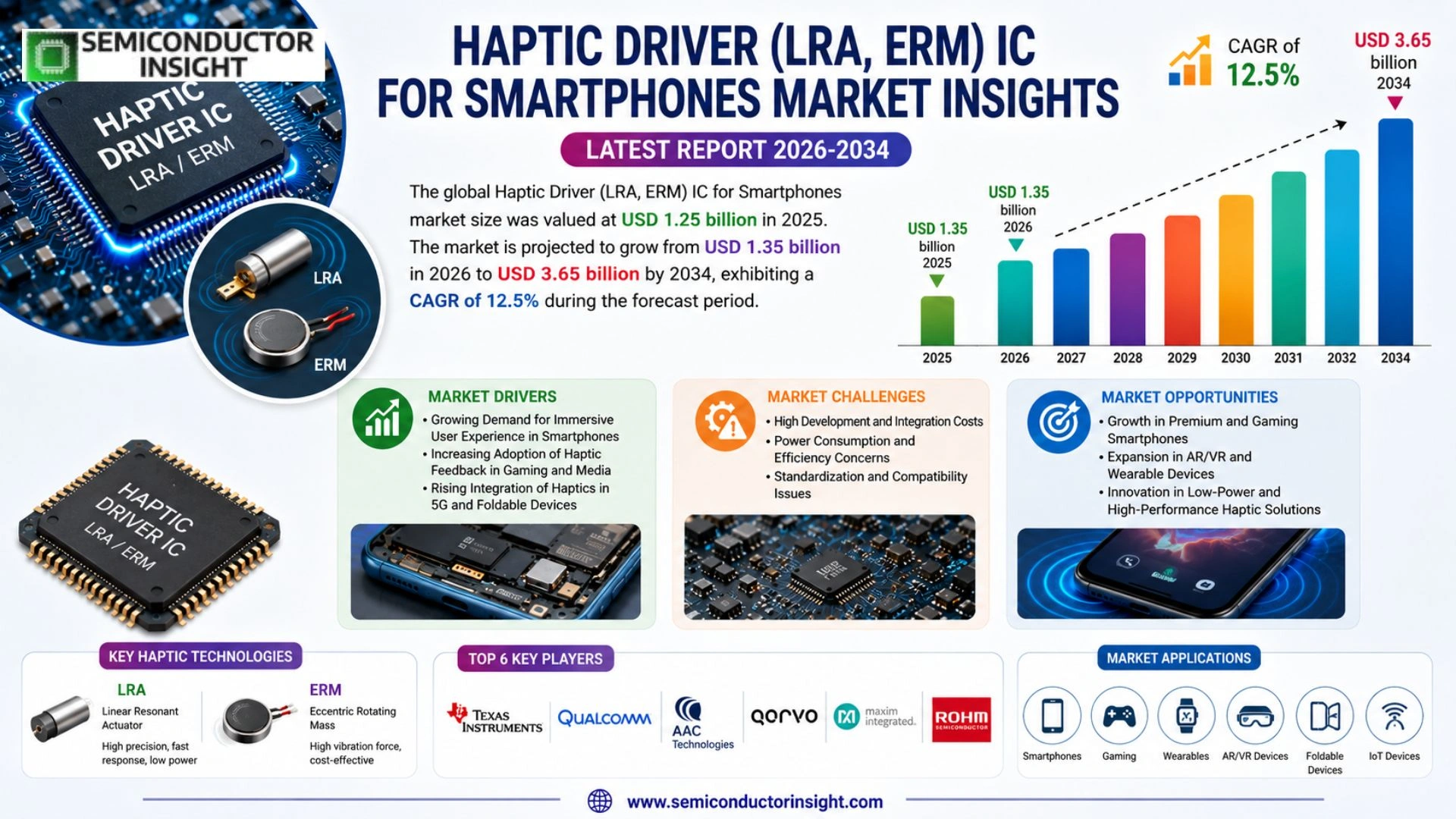
Global Haptic Driver (LRA, ERM) IC for Smartphones Market size was valued at USD 1.25 billion in 2025. The market is projected to grow from USD 1.35 billion in 2026 to USD 3.65 billion by 2034, exhibiting a CAGR of 12.5% during the forecast period.
Haptic Driver (LRA, ERM) ICs are specialized semiconductor components designed to control vibration motors in smartphones, delivering precise tactile feedback. These integrated circuits efficiently drive Linear Resonant Actuators (LRA) for sharp, high-fidelity haptics and Eccentric Rotating Mass (ERM) motors for broader vibration effects. They enable enhanced user experiences through customizable vibration patterns for notifications, typing feedback, gaming immersion, and media consumption.
The market is experiencing robust growth due to several factors, including the rising demand for immersive user interfaces in premium smartphones, increasing adoption of advanced haptic technologies in consumer electronics, and the proliferation of foldable and high-end mobile devices. Furthermore, the integration of high-definition haptics to differentiate flagship models drives innovation among manufacturers. Advancements in low-power, compact driver solutions support longer battery life while delivering richer tactile responses. Key players continue to invest in next-generation ICs that support both LRA and ERM actuators with features like closed-loop control, waveform libraries, and efficient power management. Texas Instruments, Cirrus Logic, and other semiconductor leaders operate in the market with extensive portfolios tailored for smartphone applications.
MARKET DRIVERS
Rising Demand for Immersive User Experiences in Smartphones
Haptic Driver (LRA, ERM) IC for Smartphones Market is propelled by the growing integration of advanced tactile feedback in premium and mid-range devices. Manufacturers increasingly adopt LRA drivers for their fast response times under 10 ms and precise vibration control, enhancing typing, gaming, and notification experiences. ERM solutions continue to serve cost-sensitive segments due to their established reliability and lower implementation costs.
Transition Toward Advanced Actuators and Integration with New Technologies
Shift from traditional ERM to LRA technologies supports superior energy efficiency and configurable haptic patterns, aligning with foldable phones, AR/VR features, and enhanced multimedia consumption. Smartphone OEMs prioritize these drivers to differentiate products in competitive markets, with LRA adoption particularly strong in flagship models.
➤ Consumer demand for richer tactile interactions continues to drive innovation in haptic driver ICs optimized for smartphone applications.
Overall market expansion benefits from broader consumer electronics trends, where haptic feedback elevates accessibility and engagement across diverse user segments.
MARKET CHALLENGES
Technical and Integration Complexities
Developing haptic driver ICs that deliver consistent performance across varying smartphone form factors and power constraints presents ongoing engineering hurdles. Balancing latency, vibration strength, and thermal management remains critical for maintaining battery life and device reliability in compact designs.
Other Challenges
Supply Chain and Component Miniaturization
Achieving further size reduction while preserving output quality challenges suppliers, particularly as devices trend thinner and incorporate multiple sensors.
Standardization Across Ecosystems
Fragmented software-hardware integration requirements among major smartphone platforms complicate widespread optimization of LRA and ERM driver performance.
MARKET RESTRAINTS
Smartphone Market Saturation and Cost Pressures
Maturation of the global smartphone market, with slower replacement cycles in key regions, limits volume growth opportunities for haptic driver ICs. High production costs for advanced LRA solutions can restrain adoption in budget segments where ERM remains dominant.
Advanced haptic implementations, especially those delivering high-definition effects, increase energy demands that impact battery performance. This technical restraint requires continuous optimization of driver IC efficiency to meet consumer expectations for all-day usage.
MARKET OPPORTUNITIES
Expansion in Premium and Emerging Device Segments
Growth in foldable smartphones, gaming-focused devices, and next-generation wearables creates substantial demand for sophisticated Haptic Driver (LRA, ERM) IC solutions capable of delivering nuanced, low-latency feedback. Emerging markets in Asia-Pacific offer further penetration potential as premium features cascade to mid-tier models.
Innovation in Software-Hardware Co-Development
Opportunities exist for driver ICs integrated with AI-driven haptic algorithms that generate dynamic, context-aware vibrations. Partnerships between semiconductor firms and smartphone brands can accelerate customization for specific use cases like gaming and accessibility features.
Trends
Rising Demand for Immersive User Interfaces in Premium Smartphones
Haptic Driver (LRA, ERM) IC for Smartphones Market continues to expand as manufacturers prioritize enhanced tactile feedback to differentiate premium devices. These specialized integrated circuits efficiently control Linear Resonant Actuators (LRA) for precise, high-fidelity vibrations and Eccentric Rotating Mass (ERM) motors for versatile effects. This technology enables richer user experiences across notifications, keyboard feedback, gaming immersion, and media consumption, meeting consumer expectations for more interactive smartphones.
Other Trends
Adoption of High-Definition Haptics in Foldable and Flagship Devices
Integration of advanced haptic technologies has become a key strategy for flagship and foldable smartphone models. Haptic Driver (LRA, ERM) IC for Smartphones solutions support customizable vibration patterns that enhance the overall interface quality. As device designs evolve toward more sophisticated form factors, the need for compact and responsive driver ICs grows to deliver consistent performance without compromising structural integrity.
Advancements in Low-Power and Efficient Haptic Control Solutions
Manufacturers are focusing on developing low-power Haptic Driver (LRA, ERM) IC for Smartphones that maintain strong tactile responses while optimizing battery consumption. Features such as closed-loop control systems and efficient power management allow for extended usage times alongside improved haptic precision. These innovations address the critical balance between performance and energy efficiency in modern mobile devices.
Expansion of Waveform Libraries and Multi-Actuator Support
Next-generation Haptic Driver (LRA, ERM) IC for Smartphones incorporate extensive waveform libraries and support for multiple actuator types. This capability enables device makers to create nuanced vibration profiles tailored to specific applications, from subtle alerts to intense gaming feedback. Such versatility strengthens the role of haptics in creating distinctive user experiences across different smartphone segments.
Innovation and Competition Among Semiconductor Leaders
Leading companies including Texas Instruments and Cirrus Logic continue to advance their portfolios Haptic Driver (LRA, ERM) IC for Smartphones Market. Their investments target solutions with enhanced integration, better thermal performance, and seamless compatibility with evolving smartphone architectures. This competitive landscape drives continuous improvement in haptic technology, benefiting both manufacturers and end consumers seeking more responsive devices.
COMPETITIVE LANDSCAPE
Key Industry Players
Competitive Dynamics Haptic Driver (LRA, ERM) IC for Smartphones Market
Texas Instruments stands as a dominant leader in the Haptic Driver (LRA, ERM) IC market for smartphones, offering a comprehensive portfolio of advanced driver solutions that support both Linear Resonant Actuators (LRA) and Eccentric Rotating Mass (ERM) motors. The company maintains a strong market position through its focus on power-efficient designs, closed-loop control systems, and integration capabilities that enable premium haptic experiences in flagship devices. The market structure is moderately concentrated among semiconductor specialists, with leading players competing on innovation in low-latency feedback, waveform customization, and battery optimization to meet the demands of high-end smartphone manufacturers.
Other significant players include Cirrus Logic, which provides specialized audio-haptic integrated solutions, alongside emerging competitors such as ON Semiconductor, Synaptics, and Dongwoon Anatech that target niche segments with cost-effective or highly customizable ICs. These companies contribute to market growth by advancing compact form factors and multi-actuator support, fostering increased adoption in premium and mid-range smartphones amid rising demand for immersive user interfaces.
List of Key Haptic Driver (LRA, ERM) IC Companies Profiled
- Texas Instruments
- Cirrus Logic
- ON Semiconductor
- Synaptics Incorporated
- Microchip Technology
- Dialog Semiconductor (Renesas)
- Dongwoon Anatech
- AAC Technologies
- Johnson Electric Holdings
- TDK Corporation
- Infineon Technologies
- Analog Devices
- STMicroelectronics
- Boréas Technologies
- Himax Technologies
Segment Analysis:
| Segment Category | Sub-Segments | Key Insights |
| By Type |
|
Leading Segment: LRA Drivers These integrated circuits excel in delivering sharp, precise, and high-fidelity tactile feedback that aligns perfectly with modern smartphone user expectations.
|
| By Application |
|
Leading Segment: Gaming and Immersive Experiences Haptic drivers play a transformative role in elevating mobile gaming by providing synchronized tactile responses that deepen player engagement.
|
| By End User |
|
Leading Segment: Flagship Smartphone Users Consumers of premium devices demand sophisticated haptic solutions that enhance every interaction from subtle alerts to dynamic feedback.
|
| By Technology |
|
Leading Segment: Closed-Loop Control This technology provides superior accuracy and consistency in haptic output by continuously monitoring and adjusting motor performance in real time.
|
| By Functionality |
|
Leading Segment: Multi-Actuator Support Drivers capable of managing multiple vibration motors simultaneously unlock richer and more spatially aware haptic experiences.
|
Regional Analysis: Haptic Driver (LRA, ERM) IC for Smartphones Market
Asia-Pacific
Asia-Pacific leads in developing next-generation haptic driver ICs optimized for LRA and ERM technologies, with engineering teams focusing on ultra-low power consumption and enhanced waveform precision to elevate smartphone user experiences in gaming and multimedia applications.
Close proximity between semiconductor fabs, assembly plants, and haptic component suppliers streamlines production of specialized driver ICs, enabling faster iteration cycles and cost-effective scaling for global smartphone brands targeting the region.
Strong preference for immersive haptic feedback in mobile gaming, augmented reality features, and daily interactions pushes manufacturers to integrate advanced Haptic Driver (LRA, ERM) IC solutions that deliver nuanced tactile responses.
Strategic partnerships between local IC designers, smartphone OEMs, and actuator manufacturers accelerate the adoption of customized haptic solutions, supporting innovative form factors while maintaining high reliability standards.
North America
North America maintains a significant position Haptic Driver (LRA, ERM) IC for Smartphones Market through its focus on premium device segments and software-hardware integration. The region emphasizes high-end haptic experiences in flagship smartphones, where advanced driver ICs enhance user interfaces for productivity tools, entertainment, and accessibility features. Innovation stems from close collaboration between semiconductor firms and major technology brands that prioritize refined tactile feedback. Research efforts target power optimization and integration with emerging AI-driven interaction systems, ensuring haptic responses feel natural and context-aware. Regulatory emphasis on energy efficiency further shapes development of sophisticated LRA and ERM driver solutions suitable for premium consumer electronics.
Europe
Europe exhibits steady growth Haptic Driver (LRA, ERM) IC for Smartphones Market, driven by demand for refined user experiences in mid-to-high-end devices. The region’s strong automotive cross-over influences expectations for precise haptic feedback in mobile applications. Focus areas include accessibility enhancements and immersive content consumption, prompting integration of advanced driver ICs that support nuanced vibration patterns. European manufacturers prioritize sustainable design principles, influencing choices toward energy-efficient haptic solutions. Collaborative R&D initiatives between universities and tech companies foster innovations that balance performance with environmental considerations in smartphone haptic systems.
South America
South America shows emerging potential Haptic Driver (LRA, ERM) IC for Smartphones Market as smartphone penetration deepens across urban centers. Growing interest in mobile gaming and multimedia drives gradual adoption of devices featuring improved haptic capabilities. Local distributors and assemblers work to incorporate cost-effective haptic driver solutions that meet regional consumer expectations for responsive interfaces. Economic development supports increasing demand for mid-range smartphones equipped with reliable LRA and ERM technologies. Market players adapt global innovations to suit local usage patterns, particularly in entertainment and social connectivity applications.
Middle East & Africa
The Middle East and Africa region demonstrates developing opportunities Haptic Driver (LRA, ERM) IC for Smartphones Market fueled by expanding digital infrastructure and youthful demographics. Rising smartphone usage for education, entertainment, and financial services creates demand for engaging haptic feedback. Markets prioritize durable and power-efficient solutions suitable for varied climatic conditions and connectivity environments. International brands introduce devices with enhanced tactile features to differentiate offerings, while local partners focus on adapting Haptic Driver IC implementations to regional preferences. Growth aligns with broader digital transformation initiatives across key economies.
Report Scope
This market research report provides a comprehensive analysis of the Haptic Driver (LRA, ERM) IC for Smartphones Market , covering the forecast period 2026–2034. It offers detailed insights into market dynamics, technological advancements, competitive landscape, and key trends shaping the industry.
Key focus areas of the report include:
- Market Overview: The report begins with an overview outlining its current market scenario, key growth indicators, and industry transformation drivers. It discusses macroeconomic factors, demand–supply balance, regulatory landscape, and the strategic role of semiconductors in powering advancements across industries such as automotive, telecommunications, consumer electronics, and industrial automation.
- Market Size & Forecast: Historical data and future projections for revenue, unit shipments, and market value across major regions and segments.
- Segmentation Analysis: Detailed breakdown by product type, technology, application, and end-user industry to identify high-growth segments and investment opportunities.
- Regional Insights: Insights into market performance across North America, Europe, Asia-Pacific, Latin America, and the Middle East & Africa, including country-level analysis where relevant.
- Competitive Landscape: Profiles of leading market participants, including their product offerings, R&D focus, manufacturing capacity, pricing strategies, and recent developments such as mergers, acquisitions, and partnerships.
- Technology Trends & Innovation: Assessment of emerging technologies, integration of AI/IoT, semiconductor design trends, fabrication techniques, and evolving industry standards.
- Market Drivers & Restraints: Evaluation of factors driving market growth along with challenges, supply chain constraints, regulatory issues, and market-entry barriers.
- Stakeholder Insights: Insights for component suppliers, OEMs, system integrators, investors, and policymakers regarding the evolving ecosystem and strategic opportunities.
Primary and secondary research methods are employed, including interviews with industry experts, data from verified sources, and real-time market intelligence to ensure the accuracy and reliability of the insights presented.
FREQUENTLY ASKED QUESTIONS:
What is the current market size of Haptic Driver (LRA, ERM) IC for Smartphones Market?
-> Haptic Driver (LRA, ERM) IC for Smartphones Market was valued at USD 1.25 billion in 2025 and is expected to reach USD 3.65 billion by 2034.
Which key companies operate Haptic Driver (LRA, ERM) IC for Smartphones Market?
-> Key players include Texas Instruments, Cirrus Logic, and other semiconductor leaders, among others.
What are the key growth drivers?
-> Key growth drivers include rising demand for immersive user interfaces in premium smartphones, increasing adoption of advanced haptic technologies in consumer electronics, and the proliferation of foldable and high-end mobile devices.
Which region dominates the market?
-> Asia-Pacific is the fastest-growing region, while North America remains a dominant market.
What are the emerging trends?
-> Emerging trends include low-power compact driver solutions, closed-loop control, waveform libraries, and efficient power management for LRA and ERM actuators.

Get Sample Report PDF for Exclusive Insights
Report Sample Includes
- Table of Contents
- List of Tables & Figures
- Charts, Research Methodology, and more...
 Download Sample Report PDF