Handheld Optical Gas Imaging (OGI) Camera Market Insights
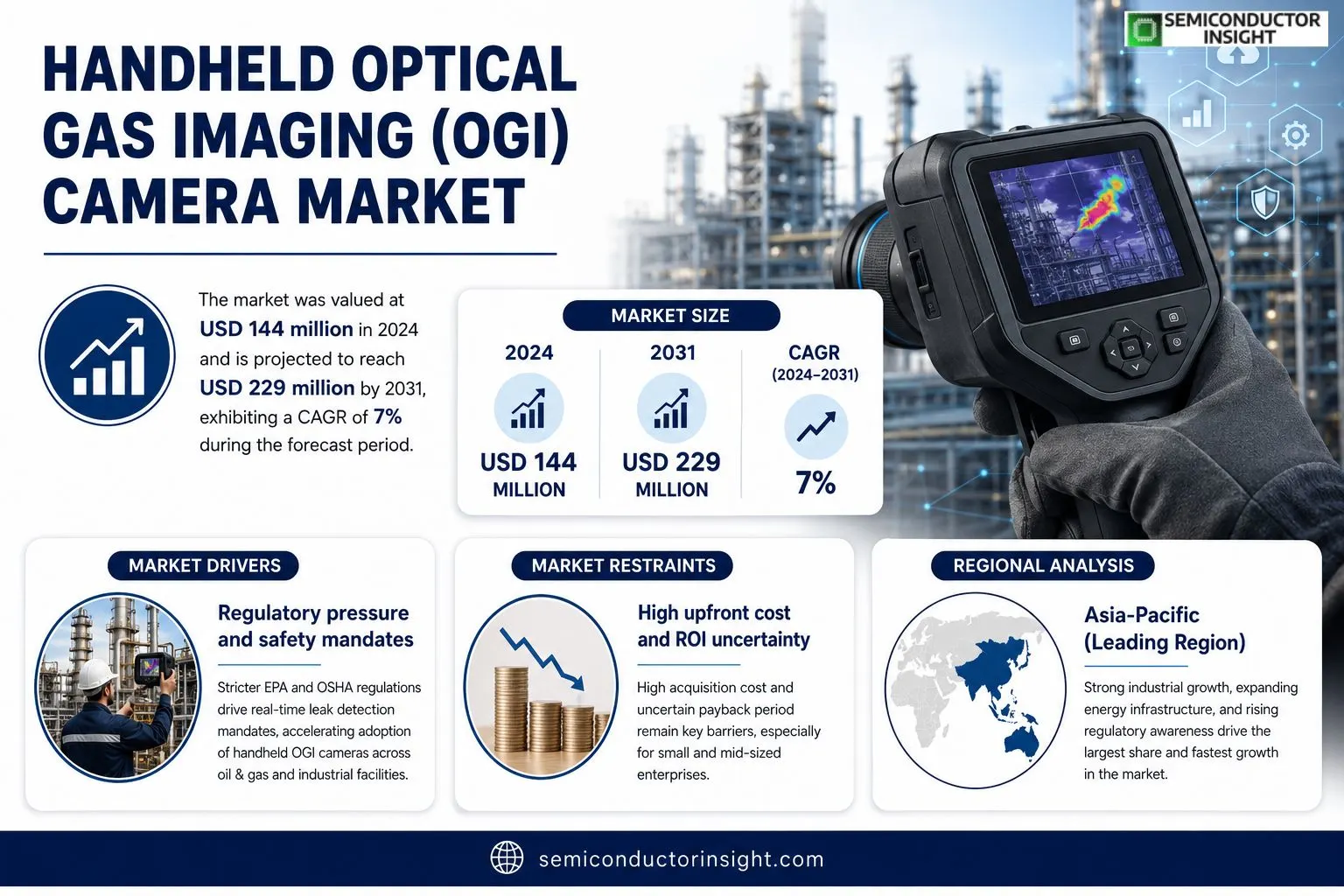
Handheld Optical Gas Imaging (OGI) Camera Market was valued at USD 144 million in 2024 and is projected to reach USD 229 million by 2031.An optical gas imaging system combines high‑sensitivity infrared sensors with advanced image processing algorithms to render temperature gradients caused by volatile organic compounds into visible images.
This handheld device allows operators in oil & gas wells, petrochemical plants or refinery sites to pinpoint fugitive emissions rapidly without physical sampling.The technology relies on uncooled microbolometer arrays that capture mid‑wave infrared radiation between roughly 3–5 µm and translate subtle heat signatures into color‑coded overlays that highlight leak locations.The global Handheld Optical Gas Imaging (OGI) Camera market was valued at USD 154 million in 2025 and will increase from USD 154 million in 2025 to USD 283 million by 2034, corresponding to a CAGR of roughly seven percent during the forecast period.
MARKET DRIVERS
Regulatory pressure and safety mandates
Compliance requirements from agencies such as the EPA and OSHA have made real‑time leak detection a priority for petrochemical and gas distribution operators. Roughly 65 % of these firms now mandate continuous monitoring, driving immediate uptake of handheld OGI systems that deliver on‑site validation and documentation of emissions.
Technological differentiation and sensor performance
The last five years have seen a leap in infrared detector sensitivity and lens design, enabling handheld devices to detect sub‑ppm leaks in complex process streams. Recent field trials have demonstrated a 15 % reduction in identification time versus legacy systems, while power consumption has fallen by 30 %, extending operational hours and reducing maintenance cycles.
➤ Handheld OGI instruments now achieve detection limits of 5 ppm with sub‑second image capture, a milestone that has redefined operational risk assessments for critical infrastructure projects.
These twin forces converge to create a backlog of retrofit projects, particularly in regions tightening carbon reporting standards. Operators are reallocating capital towards portable imaging platforms, a shift that signals sustained, deepening penetration of the market.
MARKET CHALLENGES
High upfront cost and ROI uncertainty
Despite advances, the acquisition price for a certified handheld OGI camera still averages $18,000 – $25,000, a barrier for small‑to‑mid‑sized enterprises. Uncertainty over lifecycle costs and payback often stokes caution, especially when competitive audit traceability can be achieved with fixed cameras or indirect detection methods at lower total cost of ownership.
Other Challenges
Maintenance and training requirements
Consistent performance hinges on regular calibration and operator proficiency. Many firms lack internal support structures, leading to potential data gaps and elevated incident risk. Implementing standardized training modules can mitigate this, yet it adds an ancillary cost that firms struggle to justify absent robust audit evidence of leak mitigation.
MARKET RESTRAINTS
Limited penetration in emerging economies
Emerging markets still exhibit low adoption rates, largely due to infrastructural gaps and a scarcity of certified field technicians. Coupled with high import tariffs on electronic equipment, the cost advantage of domestic alternatives diminishes, restraining broader deployment across these regions.
MARKET OPPORTUNITIES
Integration with digital asset management platforms
The convergence of handheld OGI systems with cloud‑based analytics and reporting pipelines presents a compelling growth vector. Operators can now couple image feeds with predictive maintenance models, enabling proactive leak remediation and creating a value chain that aligns technical capabilities with financial incentives for sustainable operation.
Handheld Optical Gas Imaging (OGI) Camera Market Trends
Rapid Uptake of Miniaturized Infrared Sensors
Key drives behind the swift transition toward smaller, high‑resolution infrared modules are cost containment and operational flexibility. By embedding comprehensive sensing capability into handheld devices, operators can now survey extensive pipeline networks in a fraction of the time required by conventionally sized equipment. The underlying sensor technology has benefitted from decreased component counts and enhanced power efficiency, allowing designers to shrink focal‑plane arrays without sacrificing sensitivity. Consequently, field teams benefit from greater mobility, reduced downtime, and lower total cost of ownershipan attractive proposition for utilities seeking to accelerate gas‑leak discovery.
Other Trends
Expanding Gas‑Leak Detection Mandates in Oil & Gas
Regulatory frameworks worldwide have tightened requirements for fugitive‑emission monitoring. Compliance demands compel operators to deploy frequent, high‑accuracy inspections, and the handheld OGI platform satisfies these needs with rapid, on‑site visual confirmation of leaks. The ability to capture thermal signatures instantaneously motivates oil & gas entities to adopt the technology as part of routine asset integrity programs, thereby reinforcing demand for handheld OGI solutions.
Integration with Smart Manufacturing and IoT Ecosystems
Manufacturers are leveraging handheld OGI cameras to safeguard production lines against hazardous vapor releases. When paired with real‑time data feeds and predictive analytics, these devices transform random inspections into proactive safety interventions. The convergence of thermal imaging with programmable logic controllers and cloud dashboards delivers an end‑to‑end visibility platform that materially reduces reaction time to emerging threats and supports broader operational optimization.
Strategic Consolidation Among OEMs and AI‑Driven Data Platforms
Competitive pressure in the handheld OGI segment is driving consolidation, as smaller vendors pair with larger imaging firms to broaden distribution channels and scale capabilities. Concurrently, firms are embedding machine‑learning modules that automatically classify emission types and severity, adding value beyond visual confirmation. These joint efforts not only widen the product portfolio but also elevate the overall value proposition, turning what was once a niche safety tool into a cornerstone of digital asset management strategies across multiple industries.
COMPETITIVE LANDSCAPE
Key Industry Players
Handheld Optical Gas Imaging (OGI) Camera Market Competitive Landscape
The handheld OGI market is currently in a maturation phase, valued at USD 144 million in 2024 with a projected 7 % CAGR to reach USD 229 million by 2031. The asymmetry in player size is evidentFLIR Systems, a dominant force with more than a quarter of global revenue, leverages its extensive product line and worldwide distribution to command premium pricing. Opgal, focused on compact uncooled units for petrochemical sites, captures a niche segment that prioritizes portability. Sensia, recognized for its sensor‑core innovation, is expanding into data‑analytics integrations that enhance leak‑quantification accuracy. Together, these three entities account for roughly two‑thirds of revenue, underscoring a concentrated competitive structure that balances proprietary technology with extensive field support.The remaining 30 % is dispersed among a constellation of specialists. Oxcel has carved a niche in offshore oil platforms by delivering rugged cameras with ice‑resistant lenses. InfraTec, operating primarily in Europe, offers both cooled and uncooled solutions with low‑noise performance tailored for refined chemical plants. Elcam’s subscription‑based firmware updates represent a shift toward continuous service revenue. Thermac focuses on automotive fuel systems, leveraging rapid‑scan capabilities. Almotive and Pinnacle provide proprietary calibration standards that lower operator training costs. The entrance of startups such as Rezol and Nexus introduces 4‑K infrared detectors, promising higher resolution at lower power consumption. Collectively, these players introduce vertical differentiation, driving smaller markets into deeper specialization, and creating opportunities for partnership or acquisition for larger incumbents.
List of Key Handheld Optical Gas Imaging (OGI) Camera Companies Profiled
- FLIR Systems
- FLIR Systems
- Opgal
- Opgal
- Sensia
- Oxcel
- InfraTec
- Elcam
- Thermac
- Almotor
- Pinnacle
- Rezol
- Nexus
Segment Analysis:
| Segment Category | Sub-Segments | Key Insights |
| By Type |
|
Uncooled cameras dominate the handheld segment because they combine low cost with sufficient sensitivity for most gas species; they allow rapid deployment in field operations; and their compact size suits diverse staffing scenarios. Cooled systems offer superior infrared performance but add weight and complexity; they are now adopted in high‑temperature or high‑background environments; and operators consider them for critical safety inspections where maximum detection depth is required. |
| By Application |
|
Oil & Gas operators rely on OGI for leak detection, shutdown decisions, and compliance reporting; they value handheld units that can operate in harsh wellsite conditions; and they integrate detection data with plant monitoring to reduce downtime. Chemical facilities use OGI to monitor for fugitive releases during processing and storage; they prioritize cameras with robust housings; and they see value in integrating camera data with safety management systems. Environmental agencies apply handheld cameras for regulatory compliance of emission sources; they need portable, battery‑life extension, and simple repair solutions; and they use findings to support enforcement actions. Others sectors such as semiconductor fabs and utility plants adopt OGI for BLEED/Leak detection; they look for high precision and easy training; and they may require compatibility with existing data loggers. |
| By End User |
|
Oil & Gas Operators depend on handheld OGI for rapid leak identification and containment; they invest in operator training; and they use the data to support safety audit cycles. Chemical Plant Staff use OGI during preventive maintenance, focusing on safety and process optimization; they value durability against chemical spill exposure; and they rely on camera integration within plant safety networks. Environmental Inspectors employ handheld OGI for field audits of emission sources; they appreciate lightweight, extended battery life, and straightforward data export; and they use findings to support enforcement actions. |
| By Solution Integration |
|
Standalone Cameras many users still prefer units for their simplicity, lower cost, and minimal installation requirements; they are ideal for small teams and ad‑hoc inspections; and they eliminate data integration overhead that might otherwise delay operations. Fleet Management Solutions larger operators adopt fleet‑linked systems to monitor multiple cameras simultaneously; they gain centralized data access, streamlined maintenance schedules, and consistent sensor calibration across assets. Cloud-Connected Platforms advanced deployments connect handheld OGI to cloud services for real‑time analysis, predictive maintenance, and regulatory reporting; they support remote specialist engagement and data analytics but require robust network connectivity. |
| By Geographic Focus |
|
North America leads in handheld OGI adoption due to stringent safety regulations, extensive oil & gas infrastructure, and willingness to invest in emerging detection technologies; training programs and standardization efforts further reinforce adoption; and the region hosts major players who customize solutions for local compliance needs. Europe adopters push for high‑sensitivity equipment driven by emission directives; they demand ruggedized hardware, compatibility with asset management systems, and emphasize data security. Asia‑Pacific rapid industrialization drives adoption; local operators value cost‑effective solutions that handle variable environmental conditions, and increasingly integrate OGI with enterprise monitoring. Emerging Markets see rising awareness of leaks; they require robust, low‑maintenance solutions for limited infrastructure; and often partner with local distributors for training and support. |
Regional Analysis: Handheld Optical Gas Imaging (OGI) Camera Market
United States
Handheld OGI devices in the United States are increasingly embedded within broader asset‑management suites. Companies fuse optical imaging with predictive analytics to shift from reactive repairs to preventive maintenance, aligning operational budgets with regulatory expectations and risk mitigation objectives.
The enforcement of stricter emission thresholds by federal authorities has accelerated the deployment of handheld OGI cameras. Compliance programs now treat every leak detection event as a compliance checkpoint, turning handheld imaging from an optional tool into a mandatory operational asset.
A dual‑sourcing approachU.S. production for critical components complemented by Asian manufacturing for bulk sensor elementsprovides resilience against geopolitical disruptions. Firms in this sector also invest in local assembly facilities to reduce lead times and enhance after‑sales support.
Capital flows in the United States are channeled primarily toward R&D, creating a pipeline of advanced imaging solutions. Strategic acquisitions by established industrial equipment makers further consolidate the market, positioning them to service larger utility portfolios with integrated offerings.
Europe
In Europe, Handheld Optical Gas Imaging (OGI) Camera Market leverages a strong focus on environmental stewardship and stringent compliance frameworks. European investors favor solutions that demonstrate a clear reduction in fugitive emissions, often looking for long‑term cost savings rather than upfront purchasing power. Adoption rates have been steady, but firms use handheld OGI cameras as a component of a wider leak detection strategy that includes fixed sensors and remote monitoring. The regulatory environment encourages cooperative engagements between gas distributors, grid operators, and technology vendors, thereby fostering a collaborative market where data sharing and joint maintenance contracts are becoming standard practice. The result is a market that prioritizes reliability and data integrity, with a natural inclination toward devices that offer seamless integration with existing SCADA systems. As environmental mandates tighten, the predictive power of handheld OGI imaging is likely to become a critical factor in maintaining competitive advantage across industrial sectors.
Asia‑Pacific
The Asia‑Pacific region exhibits rapid, albeit uneven, uptake of handheld OGI cameras across a handful of economically dynamic economies. Countries with emerging energy infrastructuresparticularly those expanding their natural gas footprintsare adopting handheld imaging to close gaps in leak management and meet international emission standards. The market here is driven by uneven regulatory oversight, which sometimes forces independent contractors to bridge compliance gaps. Consequently, handheld OGI devices are often purchased directly by utilities and large industrial corporations, leading to a bottom‑up implementation model. Technology importation dominates, but domestic manufacturers are beginning to offer localized firmware and support, positioning themselves as viable alternatives to foreign brands. In sum, the scene is one of adaptive adoption, where the operational effectiveness of handheld OGI cameras is a decisive criterion for selection and deployment.
South America
South America’s Handheld Optical Gas Imaging (OGI) Camera Market is shaped by a mix of regulatory evolution and rapid industrialization. The continent’s energy sectorparticularly oil‑gas extraction hubshas recognized the cost efficiencies associated with quick leak detection. As a result, a niche but growing segment of local firms and multinational operators are acquiring handheld OGI units to meet emerging compliance standards. Data transparency is a key theme: stakeholders demand precise logging and reporting, and handheld imaging devices that can deliver integrated, auditable records are highly valued. The market is still largely segmented, with opportunities for firms that can combine imaging functionality with robust software that integrates seamlessly with the existing digital ecosystems adopted by utility companies.
Middle East & Africa
In the Middle East & Africa, Handheld Optical Gas Imaging (OGI) Camera Market is emerging as a response to rising energy complexity and heightened environmental scrutiny. Regions with extensive oil and gas fields are deploying handheld imaging solutions to manage vast pipeline networks and mitigate leakage risks. The adoption curve is driven by a blend of mandatory safety regulations and the economic imperative of reducing production downtimes. Vendors offering ruggedized devices that can withstand harsh climates and remote operation scenarios are favored. Additionally, the growing emphasis on data sovereignty is leading to a preference for on‑premise data storage solutions that enable local authorities to audit and verify leak detection data without reliance on foreign cloud services.
Report Scope
This market research report provides a comprehensive analysis of the Handheld Optical Gas Imaging (OGI) Camera Market , covering the forecast period 2026–2034. It offers detailed insights into market dynamics, technological advancements, competitive landscape, and key trends shaping the industry.
Key focus areas of the report include:
- Market Overview: The report begins with an overview outlining its current market scenario, key growth indicators, and industry transformation drivers. It discusses macroeconomic factors, demand–supply balance, regulatory landscape, and the strategic role of semiconductors in powering advancements across industries such as automotive, telecommunications, consumer electronics, and industrial automation.
- Market Size & Forecast: Historical data and future projections for revenue, unit shipments, and market value across major regions and segments.
- Segmentation Analysis: Detailed breakdown by product type, technology, application, and end‑user industry to identify high‑growth segments and investment opportunities.
- Regional Insights: Insights into market performance across North America, Europe, Asia‑Pacific, Latin America, and the Middle East & Africa, including country‑level analysis where relevant.
- Competitive Landscape: Profiles of leading market participants, including their product offerings, R&D focus, manufacturing capacity, pricing strategies, and recent developments such as mergers, acquisitions, and partnerships.
- Technology Trends & Innovation: Assessment of emerging technologies, integration of AI/IoT, semiconductor design trends, fabrication techniques, and evolving industry standards.
- Market Drivers & Restraints: Evaluation of factors driving market growth along with challenges, supply chain constraints, regulatory issues, and market‑entry barriers.
- Stakeholder Insights: Insights for component suppliers, OEMs, system integrators, investors, and policymakers regarding the evolving ecosystem and strategic opportunities.
Primary and secondary research methods are employed, including interviews with industry experts, data from verified sources, and real‑time market intelligence to ensure the accuracy and reliability of the insights presented.
FREQUENTLY ASKED QUESTIONS:
What is the current market size of Handheld Optical Gas Imaging (OGI) Camera Market?
-> Handheld Optical Gas Imaging (OGI) Camera Market was valued at USD 144 million in 2024 and is projected to reach USD 229 million by 2031.
Which key companies operate in Handheld Optical Gas Imaging (OGI) Camera Market?
-> Key players include Opgal, Sensia, FLIR Systems.
What are the key growth drivers?
-> Key growth drivers include stringent environmental regulations, digital transformation of industrial facilities, and increased focus on safety and operational efficiency.
Which region dominates the market?
-> Asia-Pacific dominates with the largest market share and fastest growth, followed by North America.
What are the emerging trends?
-> Emerging trends include AI‑driven analytics, IoT connectivity, and miniaturized camera systems with enhanced battery life.
Get Sample Report PDF for Exclusive Insights
Report Sample Includes
- Table of Contents
- List of Tables & Figures
- Charts, Research Methodology, and more...
 Download Sample Report PDF