
Key Statistics
Key Takeaways
- Image Recognition and Signal Processing is the leading source-page type segment because event-driven processors are naturally suited to sparse vision, acoustic and sensor streams where computation can be triggered only when meaningful activity occurs.
- Brain-like Computer is the leading source-page application, while Autonomous Vehicles, Robotics and Industrial Automation provide the strongest near-term commercial pathways because they combine latency, power and local-decision requirements.
- Consumer Electronics leads the source-page end-user segmentation, with Automotive, Healthcare, Aerospace & Defense and Manufacturing providing higher-reliability or mission-specific opportunities where local inference and very low standby power matter.
- North America is the source-defined largest region at more than 40% share, supported by Intel, IBM, BrainChip and General Vision activity. Asia Pacific is the source-defined fastest-growing region, with South Korea and China contributing semiconductor and edge-AI development.
- The source page contains two incompatible market-size series. The headline USD 186.3 million in 2024 and USD 1.24 billion in 2032 imply approximately 26.7% CAGR and are used throughout; a later report-scope series of USD 69.8 million in 2023 to USD 1.2 billion in 2032 at 38.5% is treated as an inconsistent duplicate rather than silently blended.
Global Neuromorphic Processing Unit Market Overview
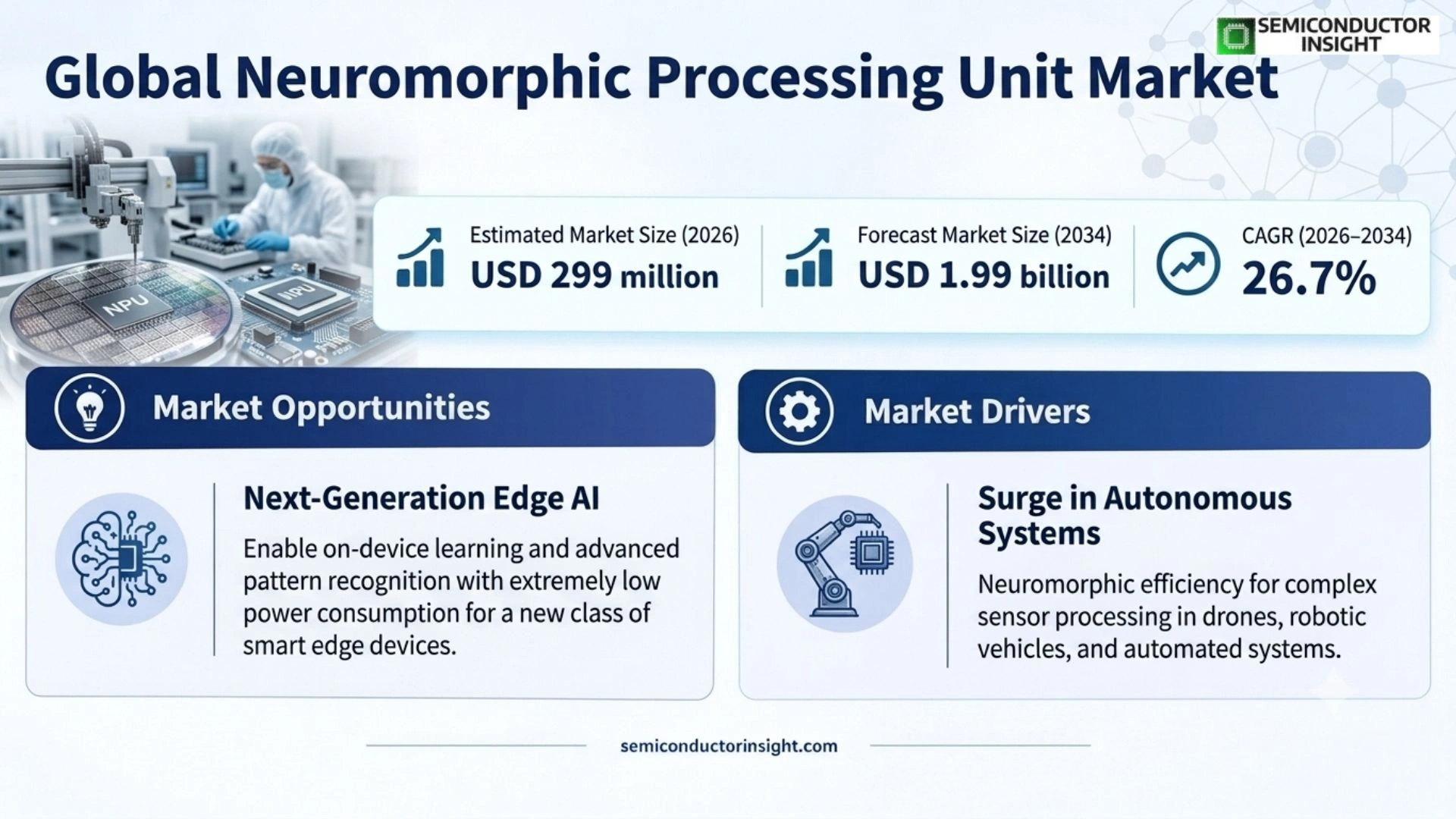
Global Neuromorphic Processing Unit market is valued at USD 236 million in 2025, increases to an estimated USD 299 million in 2026, and is projected to reach USD 1.99 billion by 2034. The selected source-page size anchors imply a 26.7% CAGR during 2026–2034. North America is the largest market in 2025 because the source page states that North America accounts for more than 40% of global market activity, while Asia Pacific is identified as the fastest-growing region, while current demand is being reshaped by event-driven edge AI, always-on sensing, robotics, autonomous systems, signal intelligence, spiking neural networks, near-sensor processing and software ecosystems that make neuromorphic hardware easier to evaluate and deploy.
Neuromorphic processing units are processors and accelerator architectures designed to emulate selected computational properties of biological neural systems, particularly sparse event-driven operation, distributed memory and compute, and spiking neural networks. Unlike conventional GPUs that execute dense matrix operations on clocked data streams, neuromorphic devices can remain mostly inactive until events arrive, making them attractive for always-on sensing, robotics, acoustic monitoring and other edge workloads in which energy spent moving or repeatedly sampling data can dominate useful computation.
The commercial market remains substantially smaller than mainstream AI accelerators, but the technology is moving from research platforms toward deployable modules and software-supported edge products. BrainChip released multiple 2026 Akida evaluation and deployment offerings, including compact M.2 hardware and communication-reference systems, while SynSense expanded event-based visual and structural-monitoring products. Intel’s Hala Point continues to provide a large research platform for neuromorphic scaling, and IBM’s research on memory-centric inference architectures reinforces the broader industry goal of reducing data movement in AI computing.
Commercial success depends on software and application fit as much as silicon architecture. A neuromorphic chip can offer excellent energy efficiency yet fail to gain adoption if customers cannot convert models, debug event streams, integrate sensors or deploy production software. The competitive market therefore spans production processors, research systems, IP, development kits, cloud evaluation and application-specific reference designs rather than one standardized benchmark. This makes ecosystem maturity a core market variable alongside neuron count, synapse capacity, latency and power.
Segment Analysis: By Type
The source page segments the market into Image Recognition and Signal Processing, Data Mining, Speech Recognition, Pattern Recognition and Others. Image Recognition and Signal Processing is identified as the leading type because event cameras, vibration sensors, RF streams and other sparse inputs can benefit directly from asynchronous processing and local temporal feature extraction.
| Type | Technical / commercial role | Market position |
|---|---|---|
| Image Recognition and Signal Processing | Neuromorphic processors can process event-camera pixels, vibration signatures, radar-like streams or RF features only when activity changes, reducing redundant computation. This is especially useful for always-on vision, machine monitoring and edge signal intelligence where latency and power must stay low. Application performance depends on sensor interface, event encoding and available spiking or convolutional operators. | Leading source-page segment. Current SynSense and BrainChip reference platforms demonstrate practical vision and signal-processing use cases, giving this category the clearest path from research architecture to embedded commercial design. |
| Data Mining | Neuromorphic architectures can perform sparse similarity, anomaly and associative-search workloads where memory locality matters more than dense floating-point throughput. The opportunity includes streaming industrial or cybersecurity data, but mainstream data mining is still dominated by CPUs, GPUs and conventional AI accelerators because software frameworks and datasets are optimized around those platforms. | Emerging niche. Adoption is strongest where continuous low-power edge analysis matters and data cannot be moved efficiently to the cloud. Wider use requires easier model conversion and clearer cost-per-inference advantages. |
| Speech Recognition | Always-on keyword spotting, acoustic-event detection and voice-trigger applications benefit from processors that remain at very low power until useful audio activity occurs. Neuromorphic temporal models can exploit timing information directly instead of repeatedly processing fixed-size frames, potentially reducing energy in battery-powered devices. | Commercially relevant edge segment. Consumer and industrial devices can justify neuromorphic hardware where microphone monitoring must remain active continuously, but conventional DSPs and tiny ML accelerators remain strong competitors. |
| Pattern Recognition | Associative memories and spiking classifiers can recognize temporal or spatial patterns with low latency and incremental learning characteristics. General Vision’s NeuroMem technology and other neuromorphic approaches illustrate this model, particularly for compact classifiers, anomaly recognition and sensor fusion. | Specialty segment with long research history. Its value is highest where deterministic low-latency recognition and low memory movement outweigh the advantages of mainstream deep-learning toolchains. |
| Others | Other types include tactile processing, motor-control primitives, olfactory-style sensing, event-based navigation and research workloads studying biologically inspired learning. These applications are fragmented but can create high-value design opportunities where conventional accelerators waste energy on sparse or asynchronous data. | Early-stage but strategically important. Novel sensor modalities can become a differentiator for neuromorphic platforms if developers gain access to robust hardware, software and reference applications. |
Secondary segmentation: By End User
The source page identifies Consumer Electronics, Automotive, Healthcare, Aerospace & Defense and Manufacturing. Consumer Electronics is described as the leading end-user group, while automotive, defense and manufacturing can support premium deployments because power, latency and local autonomy have direct operational value. For neuromorphic suppliers, the commercial consequence is that software usability, always-on power, event-processing latency, production hardware availability and application support determine revenue quality much more directly than headline AI benchmark performance.
| End user | Commercial characteristics |
|---|---|
| Consumer Electronics | Always-on voice, gesture, presence detection, earbuds, smart cameras and wearable sensing create large potential unit volumes. Adoption depends on whether neuromorphic hardware can beat conventional microcontrollers and NPUs on total device power and software-development cost rather than only peak efficiency. |
| Automotive | Event-based vision, driver monitoring, radar processing and in-cabin sensing can benefit from low latency and sparse data handling. Automotive qualification, deterministic safety behavior and long support cycles create high barriers but also higher switching costs once a platform is approved. |
| Healthcare | Wearable monitoring, prosthetics, neural interfaces and portable diagnostics can use low-power temporal processing close to the sensor. Clinical and regulatory requirements slow commercialization, so many applications remain research-driven despite attractive energy-efficiency characteristics. |
| Aerospace & Defense | Signal intelligence, autonomous platforms and remote sensing value local processing where bandwidth and power are constrained. BrainChip’s 2026 communication-reference platform specifically targets edge RF signal classification, illustrating a practical mission-oriented deployment path. |
| Manufacturing | Predictive maintenance, vibration monitoring, machine vision and robotics benefit from always-on local processing that avoids sending raw sensor data continuously. Industrial buyers prioritize deterministic operation, ruggedness and long product availability. |
Segment Analysis: By Application
By application, the source page segments demand into Brain-like Computer, Autonomous Vehicles, Robotics, Industrial Automation and Others. Brain-like Computer is identified as the leading application conceptually, while robotics and industrial automation currently provide more concrete deployment pathways because power, response time and local sensing are measurable operating constraints. This distinction matters because vision, audio, robotics and RF workloads have different sparsity and timing behavior, so the same neuromorphic architecture may provide a strong advantage in one application and little benefit in another.
| Application | Demand characteristics |
|---|---|
| Brain-like Computer | Large neuromorphic research systems attempt to model very large neural networks using distributed spiking architectures. Intel’s Hala Point contains 1.15 billion neurons across 1,152 Loihi 2 processors and provides a research platform for algorithm, scaling and sustainability studies. Commercial revenue remains limited because these systems are primarily experimental infrastructure rather than standardized data-center products. |
| Autonomous Vehicles | Event cameras and neuromorphic perception can reduce redundant visual data and react with very low latency to changing scenes. Commercial adoption requires automotive qualification, fusion with conventional cameras/radar and robust performance across lighting and weather conditions, making this a longer qualification path than laboratory demonstrations. |
| Robotics | Robots need low-latency perception, motion and tactile processing while operating under strict power budgets. SynSense’s Aeveon high-speed event-vision product and other neuromorphic sensors/processors are designed for drones, mobile robots and machine perception where sparse high-frame-rate information can improve response without continuous high-power image processing. |
| Industrial Automation | Condition monitoring, machine vision and anomaly detection can run locally for long periods with low data rates. SynSense’s bridge-monitoring work and BrainChip’s embedded edge platforms illustrate how event-driven computation can convert raw vibration or visual streams into actionable signals close to the asset. |
| Others | Other applications include smart infrastructure, cybersecurity, telecom signal intelligence, environmental monitoring and academic research. Commercial viability depends on whether the workload is sufficiently sparse or temporal to offset the cost and software friction of adopting a non-mainstream processor architecture. |
Regional Analysis
The source page states that North America accounts for more than 40% of global market activity and identifies the region as the current leader, while Asia Pacific is described as the fastest-growing market. Europe has strong academic and industrial research, South America is early-stage with Brazil representing more than 70% of regional activity on the source page, and MEA remains nascent but strategically interested in AI and autonomous systems.
Why does North America lead while Asia Pacific grows fastest?
North America has a dense combination of neuromorphic research, semiconductor design, AI startups, defense applications and venture funding, supporting early commercial experimentation. Asia Pacific combines large electronics manufacturing, robotics, automotive and edge-device markets that can scale deployment rapidly once architectures mature. Europe contributes research and specialty companies, while South America and MEA remain more dependent on imported hardware and university or government-led projects.
| Region | Position | Growth outlook | Demand profile | What decides supplier selection |
|---|---|---|---|---|
| North America | Largest – >40% source-page share | High | Research, edge AI and defense-led | Software ecosystem, application proof and funding |
| Asia Pacific | Fastest-growing | Very high from smaller base | Electronics, robotics and automotive-led | Manufacturing scale, sensor integration and local ecosystem |
| Europe | Research / specialty stronghold | High | Research, industrial and automotive-led | Algorithm depth, partnerships and commercialization |
| South America | Early-stage | Moderate from small base | Research and industrial pilot-led | Access to hardware, funding and integrators |
| Middle East & Africa | Nascent | Moderate from small base | Sovereign AI, defense and research-led | Project scale, local expertise and imported supply |
Competitive Landscape
The source page profiles nine companies: Intel Corporation, IBM Research, Nepes Corporation, GrAI Matter Labs, SynSense, BrainChip Holdings Ltd, Samsung Electronics, Qualcomm Technologies and General Vision Inc. The roster mixes research organizations, broad semiconductor companies and specialist commercial neuromorphic vendors, so the competitive analysis distinguishes current product roles rather than treating all nine as equivalent merchant-processor suppliers.
BrainChip and SynSense provide some of the clearest current commercial edge-neuromorphic products in the source list. BrainChip’s Akida portfolio includes production silicon, FPGA/cloud evaluation, M.2 modules and application reference platforms. SynSense combines neuromorphic processors with event-based vision and monitoring products. General Vision remains relevant through its NeuroMem technology and licensing relationship with Nepes, showing a different IP-centric commercialization model.
Intel and IBM represent large research-driven approaches. Intel’s Loihi 2 and Hala Point explore scalable spiking systems, while IBM’s brain-inspired accelerator research focuses on reducing data movement and improving inference efficiency. These platforms influence algorithms and architecture but should not be counted as equivalent to a mass-market embedded NPU shipment business because their current commercial delivery models differ.
Samsung and Qualcomm are broad semiconductor companies with substantial AI research and edge-processing portfolios, but dedicated current commercial neuromorphic-processor evidence is less direct than for BrainChip or SynSense. GrAI Matter Labs is preserved exactly because it appears on the source page, but current standalone corporate status is not asserted without clearer official evidence. This approach preserves source scope while keeping current competitive interpretation evidence-led.
| Competitive tier | Companies | Why they matter |
|---|---|---|
| Commercial / deployable neuromorphic specialists | BrainChip Holdings Ltd; SynSense; General Vision Inc.; Nepes Corporation | These participants provide processors, IP, modules or deployable neuromorphic solutions. Competitive advantage depends on ultra-low-power operation, developer tools, sensor integration and support for real edge applications. |
| Research-scale architecture leaders | Intel Corporation; IBM Research | These organizations operate major brain-inspired research programs and large experimental platforms. Their influence is strongest in architecture, algorithms and validation rather than standardized merchant neuromorphic processor volume. |
| Broad semiconductor / source-listed participants | Samsung Electronics; Qualcomm Technologies; GrAI Matter Labs | These names are preserved from the source profile list. Their current competitive role varies, and the article avoids overstating dedicated 2026 neuromorphic commercial revenue where official evidence is limited. |
Companies profiled in the report
The source page profiles Intel Corporation (U.S.); IBM Research (U.S.); Nepes Corporation (South Korea); GrAI Matter Labs (France); SynSense (China/Switzerland); BrainChip Holdings Ltd (Australia/U.S.); Samsung Electronics (South Korea); Qualcomm Technologies (U.S.); and General Vision Inc. (U.S.). Buyers therefore evaluate end-to-end sensor integration, model-conversion effort, lifecycle support, deterministic latency and total system energy rather than selecting hardware only from neuron count or theoretical efficiency.
Production Capacity Analysis
Production capacity for neuromorphic processing units is not adequately described by wafer starts alone. Effective capacity includes access to semiconductor fabrication, production silicon, packaged modules, development kits, cloud or FPGA evaluation, compiler/model-conversion tools, reference applications and customer engineering. The market remains early enough that software readiness and design-in support can constrain commercial deployment before physical fab capacity does.
BrainChip’s 2026 product activity illustrates the transition from architecture to deployable hardware. The company made Akida Pico available for remote FPGA-cloud evaluation, released AKD1500 reference platforms and added a compact M.2 form factor. These steps increase effective commercial capacity by allowing more developers to evaluate and integrate the technology without waiting for custom hardware or specialized laboratory access.
SynSense follows a system-oriented capacity model that combines event sensors, neuromorphic processors, development hardware and application algorithms. Products such as Aeveon and BridgeMonitoring demonstrate that commercialization can occur through complete sensing solutions rather than standalone processor shipments. In this market, application packaging and developer support can therefore be as important as chip fabrication throughput.
Intel’s Hala Point demonstrates research-scale capacity rather than merchant-volume capacity. With 1,152 Loihi 2 processors and more than one billion modeled neurons, the platform provides a large experimental environment for algorithm scaling. Its significance is the ability to validate workloads and programming approaches that may inform future products, not a directly comparable unit-production metric.
Market Dynamics
The market is driven by energy-efficient edge AI, sparse sensing, robotics and defense applications, but restrained by fragmented software, limited standard benchmarks, unfamiliar programming models and strong competition from conventional NPUs, GPUs and microcontrollers. Neuromorphic hardware wins when workload sparsity and temporal behavior create a clear system advantage rather than when customers simply need generic neural-network acceleration.
Market Drivers
| Driver | Directional impact* | Commercial mechanism |
|---|---|---|
| Always-on edge AI | High | Event-driven processors can remain at very low power while monitoring sensors continuously, supporting battery and remote applications. |
| Robotics & autonomous sensing | High | Low-latency event vision and temporal processing can reduce redundant data and improve response in mobile machines. |
| Industrial condition monitoring | Medium to High | Sparse vibration or visual events can be processed locally, reducing bandwidth and enabling continuous monitoring. |
| Defense & signal intelligence | Medium to High | Local RF or sensor classification is valuable where communications bandwidth, latency and energy are constrained. |
Always-on sensing rewards event-driven computation
Conventional processors often wake at fixed intervals and process large amounts of unchanged sensor data. Neuromorphic systems can compute only when events occur, reducing standby energy and memory traffic. This architecture is particularly attractive for microphones, event cameras, vibration sensors and remote monitoring that must remain active continuously. Through 2034, vendors that package neuromorphic silicon into familiar modules and supported reference platforms can convert more research interest into repeatable edge-AI production programs.
Robotics needs fast local perception under tight power budgets
Mobile robots and drones cannot always stream high-rate vision to a cloud server. Event-based sensors and neuromorphic processors can react locally to motion or changes with low latency. SynSense’s Aeveon and related products directly target this requirement, creating a tangible commercialization path beyond academic spiking-network benchmarks. The market implication is that a technically efficient processor creates sustainable revenue only when customers can evaluate, program, qualify and source it without building a proprietary development environment from scratch.
Industrial monitoring values local anomaly detection
Factories and infrastructure assets generate continuous sensor streams in which meaningful faults are rare. Processing every sample in a data center wastes bandwidth and power. Neuromorphic edge hardware can identify temporal anomalies locally and transmit only significant events, making it attractive where maintenance and network access are limited. For neuromorphic suppliers, the commercial consequence is that software usability, always-on power, event-processing latency, production hardware availability and application support determine revenue quality much more directly than headline AI benchmark performance.
Defense applications value autonomy and signal efficiency
RF, acoustic and visual systems deployed at the edge often face strict power and communication constraints. BrainChip’s 2026 communication-reference platform targets RF signal classification using Akida, showing how mission-oriented applications can justify specialized hardware if it reduces latency and data movement. This distinction matters because vision, audio, robotics and RF workloads have different sparsity and timing behavior, so the same neuromorphic architecture may provide a strong advantage in one application and little benefit in another.
Market Restraints
| Restraint | Directional impact* | Commercial mechanism |
|---|---|---|
| Software ecosystem fragmentation | High | Programming spiking or event-driven systems remains less standardized than mainstream TensorFlow/PyTorch deployment to conventional NPUs. |
| Benchmark comparability | High | Power and latency claims can depend heavily on workload sparsity, sensor type and accuracy targets, making vendor comparisons difficult. |
| Competition from conventional edge NPUs | High | MCUs, DSPs and tiny ML accelerators already offer strong efficiency with mature software and broad silicon availability. |
| Limited production scale | Medium to High | Many neuromorphic vendors remain small, raising customer concerns about lifecycle, supply assurance and application support. |
Software remains the largest adoption barrier
Developers already know conventional deep-learning frameworks, embedded compilers and GPU tooling. Neuromorphic architectures may require spike encoding, new training methods or specialized runtime behavior. Even large energy savings can be insufficient if the engineering team must rebuild an application stack or cannot debug production behavior easily. Buyers therefore evaluate end-to-end sensor integration, model-conversion effort, lifecycle support, deterministic latency and total system energy rather than selecting hardware only from neuron count or theoretical efficiency.
Benchmarks are difficult to compare fairly
A processor optimized for sparse event cameras may appear extremely efficient on one workload but less compelling on dense image classification. Accuracy, latency, power and preprocessing assumptions vary across demonstrations. Buyers therefore need system-level evaluation on their own sensor stream rather than relying on one headline TOPS-per-watt metric. Through 2034, vendors that package neuromorphic silicon into familiar modules and supported reference platforms can convert more research interest into repeatable edge-AI production programs.
Conventional edge AI is improving quickly
Modern microcontrollers and NPUs provide low-power neural acceleration while retaining familiar software, memory and sensor interfaces. Neuromorphic hardware must deliver a clear advantage in always-on power, latency or adaptability large enough to offset ecosystem risk, particularly in high-volume consumer devices. The market implication is that a technically efficient processor creates sustainable revenue only when customers can evaluate, program, qualify and source it without building a proprietary development environment from scratch.
Small vendor scale raises lifecycle concerns
Industrial and automotive customers may need parts for many years. Smaller neuromorphic specialists must demonstrate stable manufacturing, documentation, security and support. Modules, reference designs and partnerships can reduce this risk, but supplier viability remains part of the purchasing decision. For neuromorphic suppliers, the commercial consequence is that software usability, always-on power, event-processing latency, production hardware availability and application support determine revenue quality much more directly than headline AI benchmark performance.
Market Opportunities
Event-based vision for robotics
High-speed event sensors can produce far less redundant data than conventional cameras. Pairing them with local neuromorphic processing can enable drones and robots to react quickly within small power envelopes. This distinction matters because vision, audio, robotics and RF workloads have different sparsity and timing behavior, so the same neuromorphic architecture may provide a strong advantage in one application and little benefit in another.
Always-on acoustic and sensor hubs
Keyword spotting, machinery monitoring and presence detection can run continuously at sub-watt or milliwatt-class power. Neuromorphic processors can become companion devices to larger application processors that remain asleep most of the time. Buyers therefore evaluate end-to-end sensor integration, model-conversion effort, lifecycle support, deterministic latency and total system energy rather than selecting hardware only from neuron count or theoretical efficiency.
RF and communications intelligence
BrainChip’s signal-classification reference platform shows an opportunity in defense, spectrum monitoring and communications equipment where local classification can reduce backhaul and response latency. Through 2034, vendors that package neuromorphic silicon into familiar modules and supported reference platforms can convert more research interest into repeatable edge-AI production programs. This makes deployment economics directly dependent on application-specific qualification and sustained production support.
Enterprise heterogeneous acceleration
BrainChip’s Symphony bundle suggests neuromorphic devices can coexist with CPUs and GPUs under workload-management software. If standardized orchestration improves, neuromorphic accelerators may enter heterogeneous compute environments without requiring an all-or-nothing architecture choice. The market implication is that a technically efficient processor creates sustainable revenue only when customers can evaluate, program, qualify and source it without building a proprietary development environment from scratch.
Supply Chain Analysis
Neuromorphic architecture & model toolchain
Semiconductor fabrication & packaging
Modules, development kits & reference platforms
Application integration & lifecycle support
Neuromorphic architecture & model toolchain
Vendors design spiking cores, local memory, event routers and training or conversion tools. Software determines which conventional models or native SNN workloads can be deployed efficiently. For neuromorphic suppliers, the commercial consequence is that software usability, always-on power, event-processing latency, production hardware availability and application support determine revenue quality much more directly than headline AI benchmark performance.
Semiconductor fabrication & packaging
Designs are taped out through foundries and packaged into production devices. Process choice is generally mature enough that fab capacity is not the primary technology barrier, but yield and long-term supply remain important for commercial customers. This distinction matters because vision, audio, robotics and RF workloads have different sparsity and timing behavior, so the same neuromorphic architecture may provide a strong advantage in one application and little benefit in another.
Modules, development kits & reference platforms
M.2 boards, evaluation kits, FPGA/cloud access and sensor reference designs lower adoption friction. This layer converts processor capability into something an application engineer can test rapidly. Buyers therefore evaluate end-to-end sensor integration, model-conversion effort, lifecycle support, deterministic latency and total system energy rather than selecting hardware only from neuron count or theoretical efficiency.
Application integration & lifecycle support
Customers integrate sensors, firmware and host software, validate power/latency and deploy the solution. Long-term support, model updates and application engineering determine whether pilot projects become recurring production revenue. Through 2034, vendors that package neuromorphic silicon into familiar modules and supported reference platforms can convert more research interest into repeatable edge-AI production programs.
Recent Developments
Recent primary-source developments show the market moving toward compact deployable modules, application reference platforms and event-based sensing rather than relying only on laboratory-scale neuromorphic demonstrations. The developments below use official company sources and are listed newest first. The market implication is that a technically efficient processor creates sustainable revenue only when customers can evaluate, program, qualify and source it without building a proprietary development environment from scratch.
August 20, 2026 – BrainChip launched a Symphony Community Akida Bundle
BrainChip introduced a bundle integrating Akida neuromorphic acceleration with IBM Spectrum Symphony Community Edition workload management. The solution allows Akida to participate alongside CPU and GPU resources in heterogeneous workloads, reducing adoption friction for developers who want specialized edge or event-driven acceleration without replacing their entire compute environment. For neuromorphic suppliers, the commercial consequence is that software usability, always-on power, event-processing latency, production hardware availability and application support determine revenue quality much more directly than headline AI benchmark performance.
July 28, 2026 – BrainChip released AKD1500 in M.2 form factor
BrainChip announced AKD1500 availability in a compact M.2 module intended for fanless industrial and commercial edge designs. The standard form factor makes Akida easier to integrate into existing systems and turns a specialist neuromorphic processor into a more conventional embedded-hardware option for product developers. This distinction matters because vision, audio, robotics and RF workloads have different sparsity and timing behavior, so the same neuromorphic architecture may provide a strong advantage in one application and little benefit in another.
June 24, 2026 – SynSense introduced the Aeveon event-vision platform
SynSense introduced Aeveon for high-speed event-based visual processing aimed at robotics, drones and AR systems. The platform is designed for native high-frame-rate operation while discarding substantial redundant visual information, illustrating the practical benefit of event-driven sensing when latency and power are constrained. Buyers therefore evaluate end-to-end sensor integration, model-conversion effort, lifecycle support, deterministic latency and total system energy rather than selecting hardware only from neuron count or theoretical efficiency.
June 23, 2026 – BrainChip unveiled a communication reference platform
BrainChip launched a reference platform using AKD1500 for RF signal classification at the edge. The system targets defense and government communications use cases where local classification can reduce latency and backhaul and demonstrates a concrete signal-intelligence application for neuromorphic processing. Through 2034, vendors that package neuromorphic silicon into familiar modules and supported reference platforms can convert more research interest into repeatable edge-AI production programs.
May 21, 2026 – SynSense introduced event-based structural monitoring
SynSense announced a neuromorphic bridge-monitoring application using event-driven visual sensing to measure displacement and vibration with rapid response and very low power. The development broadens commercial neuromorphic use beyond robotics into infrastructure and industrial condition monitoring. The market implication is that a technically efficient processor creates sustainable revenue only when customers can evaluate, program, qualify and source it without building a proprietary development environment from scratch.
February 3, 2026 – BrainChip made Akida Pico available for remote evaluation
BrainChip announced immediate remote FPGA-cloud evaluation of Akida Pico, a product targeting always-on monitoring at very low power. Cloud-based access reduces hardware procurement friction and allows developers to test workloads before committing to a physical design, expanding the effective development ecosystem. For neuromorphic suppliers, the commercial consequence is that software usability, always-on power, event-processing latency, production hardware availability and application support determine revenue quality much more directly than headline AI benchmark performance.
Report Scope & Segmentation
| Attribute | Coverage |
|---|---|
| Market | Global Neuromorphic Processing Unit |
| Base Year | 2025 |
| Estimated Year | 2026 |
| Forecast Period | 2026–2034 |
| 2025 Market Size | USD 236 million |
| 2034 Forecast Size | USD 1.99 billion |
| CAGR | 26.7% (2026–2034) |
| Largest Market in 2025 | North America |
| By Type | Image Recognition and Signal Processing; Data Mining; Speech Recognition; Pattern Recognition; Others |
| By Application | Brain-like Computer; Autonomous Vehicles; Robotics; Industrial Automation; Others |
| By End User | Consumer Electronics; Automotive; Healthcare; Aerospace & Defense; Manufacturing |
| Regions | North America; Europe; Asia Pacific; South America; Middle East & Africa |
| Companies Profiled | Intel Corporation (U.S.); IBM Research (U.S.); Nepes Corporation (South Korea); GrAI Matter Labs (France); SynSense (China/Switzerland); BrainChip Holdings Ltd (Australia/U.S.); Samsung Electronics (South Korea); Qualcomm Technologies (U.S.); General Vision Inc. (U.S.) |
Frequently Asked Questions
What is the Global Neuromorphic Processing Unit market size in 2025?
Using the source page’s headline USD 186.3 million 2024 value and USD 1.24 billion 2032 endpoint, the market rebases to approximately USD 236.1 million in 2025. Applying the same compound factor gives an estimated USD 299.2 million in 2026 and approximately USD 1.99 billion in 2034. This distinction matters because vision, audio, robotics and RF workloads have different sparsity and timing behavior, so the same neuromorphic architecture may provide a strong advantage in one application and little benefit in another.
What is the projected market size by 2034?
The rebased 2034 market is approximately USD 1.99 billion. This extends the headline 2024–2032 endpoint relationship by two years and preserves a consistent annual compound factor across the required 2025 base year, 2026 estimate and 2034 forecast endpoint. Buyers therefore evaluate end-to-end sensor integration, model-conversion effort, lifecycle support, deterministic latency and total system energy rather than selecting hardware only from neuron count or theoretical efficiency.
Why is the CAGR 26.7%?
The source headline values of USD 186.3 million in 2024 and USD 1.24 billion in 2032 imply approximately 26.74% compound annual growth over eight years. The printed 26.84% is a small rounding difference, so the endpoint-derived 26.7% rate is used consistently. Through 2034, vendors that package neuromorphic silicon into familiar modules and supported reference platforms can convert more research interest into repeatable edge-AI production programs.
Why is the alternate 38.5% CAGR not used?
A later report-scope section on the same source page gives a conflicting series of USD 69.8 million in 2023 to USD 1.2 billion in 2032 at 38.5% CAGR. Because it conflicts materially with the headline series, the headline endpoints are treated as controlling and the alternate series is logged as inconsistent.
Which type leads the market?
The source page identifies Image Recognition and Signal Processing as the leading type. Event-driven vision, vibration, acoustic and RF streams can benefit from processing only meaningful changes, which reduces redundant memory movement and enables always-on operation under tight power constraints. The market implication is that a technically efficient processor creates sustainable revenue only when customers can evaluate, program, qualify and source it without building a proprietary development environment from scratch.
Which application is largest?
Brain-like Computer is the leading source-page application category. Commercially, robotics and industrial automation also provide important deployment paths because low-latency perception and continuous local sensing can justify specialized neuromorphic hardware before large brain-scale systems become mainstream products. For neuromorphic suppliers, the commercial consequence is that software usability, always-on power, event-processing latency, production hardware availability and application support determine revenue quality much more directly than headline AI benchmark performance.
Which end-user segment leads?
Consumer Electronics leads the source-page end-user segmentation, followed by Automotive, Healthcare, Aerospace & Defense and Manufacturing. Always-on sensing creates potential high volume, but conventional tiny-ML accelerators remain strong competitors, making software ecosystem and total device power critical. This distinction matters because vision, audio, robotics and RF workloads have different sparsity and timing behavior, so the same neuromorphic architecture may provide a strong advantage in one application and little benefit in another.
Which region dominates the market?
North America is the source-defined leader with more than 40% of global activity. The source page identifies Asia Pacific as the fastest-growing region, supported by electronics, robotics and semiconductor ecosystems in China, South Korea and Japan. Buyers therefore evaluate end-to-end sensor integration, model-conversion effort, lifecycle support, deterministic latency and total system energy rather than selecting hardware only from neuron count or theoretical efficiency.
Who are the companies profiled on the source page?
The source page profiles Intel, IBM Research, Nepes, GrAI Matter Labs, SynSense, BrainChip, Samsung Electronics, Qualcomm Technologies and General Vision. The list mixes research organizations, broad semiconductor companies and specialist neuromorphic vendors, so their commercial roles are differentiated in the competitive landscape. Through 2034, vendors that package neuromorphic silicon into familiar modules and supported reference platforms can convert more research interest into repeatable edge-AI production programs.
What is the main strategic risk through 2034?
The largest risk is that neuromorphic hardware remains technically compelling but commercially fragmented. Mainstream NPUs, GPUs and microcontrollers continue improving, so neuromorphic vendors must provide easier software, stable production hardware and compelling system-level energy or latency advantages on real customer workloads. The market implication is that a technically efficient processor creates sustainable revenue only when customers can evaluate, program, qualify and source it without building a proprietary development environment from scratch.
Get Sample Report PDF for Exclusive Insights
Report Sample Includes
- Table of Contents
- List of Tables & Figures
- Charts, Research Methodology, and more...
 Download Sample Report PDF





