\Edge AI Market Insights
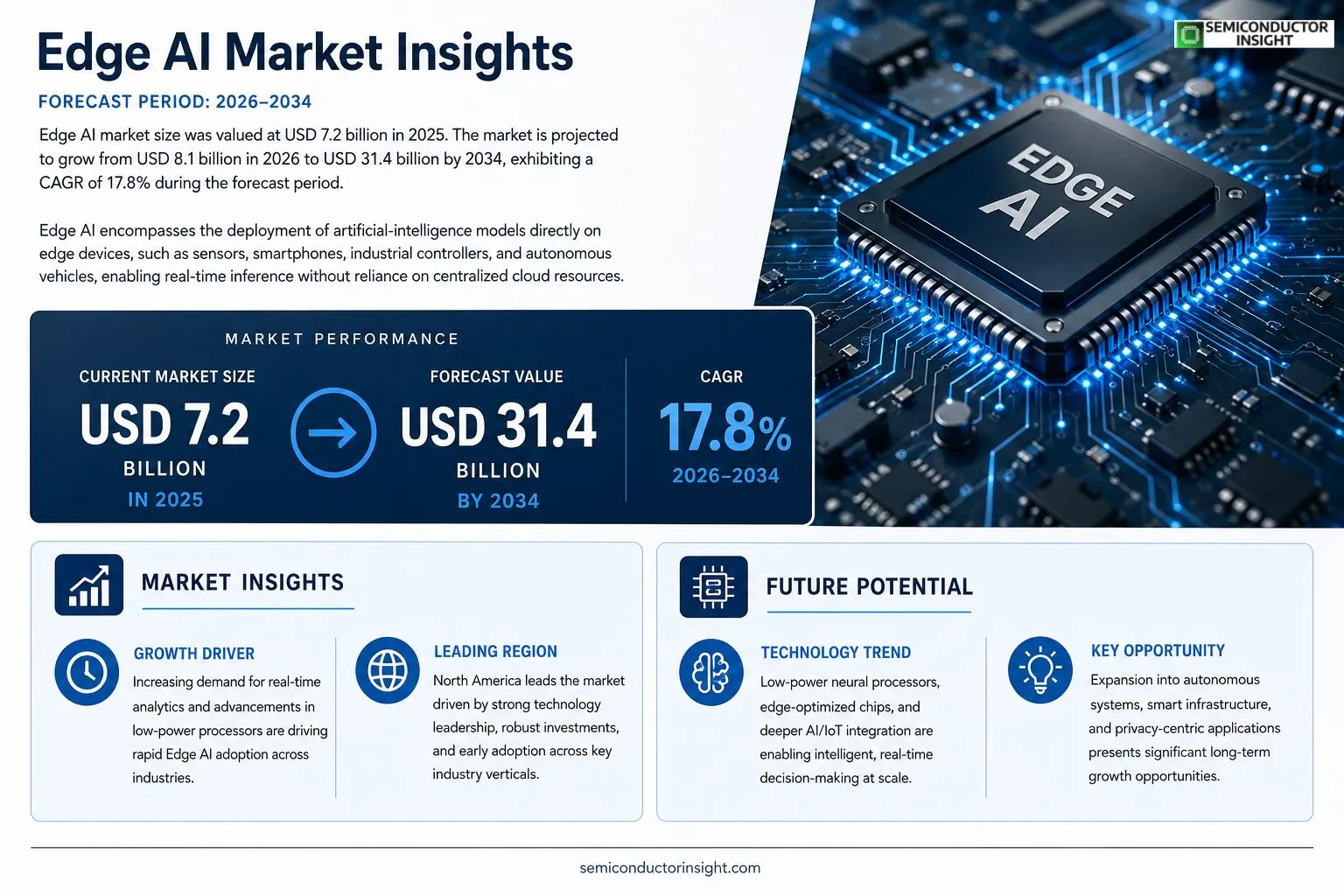
Edge AI market size was valued at USD 7.2 billion in 2025. The market is projected to grow from USD 8.1 billion in 2026 to USD 31.4 billion by 2034, exhibiting a CAGR of 17.8% during the forecast period.
Edge AI encompasses the deployment of artificial‑intelligence models directly on edge devices,such as sensors, smartphones, industrial controllers, and autonomous vehicles,enabling real‑time inference without reliance on centralized cloud resources.The market is experiencing rapid growth due to several factors, including soaring investment in IoT infrastructure, rising demand for low‑latency analytics in autonomous systems, and heightened focus on data privacy at the source. Furthermore, advancements in low‑power neural processors and strategic partnerships,e.g., Nvidia’s collaboration with Arm announced in February 2024 and Google’s launch of the third‑generation Edge TPU in March 2024,are accelerating adoption. Leading players such as Nvidia, Intel, Qualcomm, and Apple continue to expand their edge‑AI portfolios, further fueling market expansion.
MARKET DRIVERS
Increasing Demand for Real‑Time Analytics
Edge AI Market is propelled by enterprises that require instant insights from sensor data. By processing information at the source, organizations avoid the latency associated with cloud transmission, enabling faster decision‑making in manufacturing, retail, and healthcare environments.
Advancements in Low‑Power Processors
Recent breakthroughs in ultra‑efficient micro‑controllers and neural processing units allow sophisticated AI models to run on battery‑powered devices. This technological progress expands the deployment scope to edge devices such as drones, wearables, and industrial IoT gateways.
➤ “Edge AI reduces latency by up to 90 % compared with cloud‑centric approaches, delivering actionable insights where they matter most.”
As businesses recognize the cost savings from reduced bandwidth usage and the competitive edge from on‑device intelligence, investment in Edge AI Market continues to accelerate.
MARKET CHALLENGES
Security and Privacy Concerns
Deploying AI models on edge devices exposes sensitive data to new attack vectors. Organizations must implement robust encryption, secure boot, and continuous monitoring to safeguard information, which adds complexity to solution design.
Other Challenges
Regulatory Hurdles
Data residency laws and sector‑specific regulations (e.g., medical device directives) require that edge solutions comply with strict standards, often slowing time‑to‑market and increasing compliance costs.
MARKET RESTRAINTS
High Initial Capital Expenditure
Integrating AI capabilities into edge hardware demands upfront investment in specialized chips, development tools, and skilled talent. This cost barrier can deter small and medium‑size enterprises from early adoption.Furthermore, legacy systems often lack the necessary interfaces to support seamless edge AI integration, requiring additional retro‑fitting expenses.Despite these financial constraints, vendors are introducing modular solutions and financing models to lower the entry threshold for prospective buyers.
MARKET OPPORTUNITIES
Expansion into Autonomous Systems
Autonomous vehicles, robotics, and UAVs rely on instantaneous processing to navigate complex environments. Edge AI Market is uniquely positioned to supply the low‑latency, on‑device inference required for safe and reliable operation.Additionally, the growing demand for smart city infrastructure,such as traffic management and public safety analytics,creates new avenues for edge AI deployments that operate independently of centralized networks.Strategic partnerships between semiconductor manufacturers and AI software firms are accelerating the development of turnkey platforms, further unlocking market potential.
Edge AI Market Trends
Accelerating Adoption Fueled by Low‑Latency Requirements
Edge AI Market is witnessing rapid expansion as enterprises prioritize real‑time inference on devices ranging from industrial controllers to autonomous vehicles. Heightened investment in IoT infrastructure creates a dense network of edge nodes, allowing analytics to be performed locally and eliminating the latency associated with cloud round‑trips. This shift is particularly evident in sectors such as manufacturing and transportation, where milliseconds can determine operational safety and efficiency. The convergence of low‑power neural processors and increasingly capable edge CPUs enables sophisticated models to run on modest hardware, reinforcing the market’s momentum without compromising energy budgets.
Other Trends
Edge AI Hardware Advances
Hardware innovation remains a cornerstone of Edge AI Market’s trajectory. Recent collaborations, such as Nvidia’s partnership with Arm announced in early 2024, have produced reference designs that blend high‑throughput GPU cores with power‑efficient Arm architectures. Simultaneously, Google’s third‑generation Edge TPU, released in March 2024, delivers accelerated inference for vision and language workloads while maintaining a sub‑watt power envelope. Leading vendors,including Intel, Qualcomm, and Apple,continue to diversify their edge AI portfolios, integrating dedicated AI accelerators into smartphones, wearables, and edge gateways. These advances lower the barrier for developers to deploy complex models at the edge, driving broader adoption across verticals.
Privacy‑Centric Analytics and Data Sovereignty
Data privacy considerations are reshaping Edge AI Market, prompting organizations to process sensitive information directly on the device. By keeping raw data at the source, companies reduce exposure to network‑based breaches and comply with emerging data‑localization regulations. This approach also aligns with the growing demand for on‑device personalization, where user‑specific models adapt in real time without transmitting personal identifiers to external servers. As privacy‑first architectures gain traction, edge‑focused AI solutions are positioned to deliver compliant, high‑performance analytics that meet both regulatory and consumer expectations.
COMPETITIVE LANDSCAPEKey Industry Players
Edge AI Competitive Dynamics and Growth Outlook
Edge AI Market is currently dominated by a handful of ecosystem leaders that combine advanced semiconductor design with integrated software stacks. Nvidia, with its Jetson family and recent partnership with Arm, leverages high‑performance GPUs to deliver low‑latency inference on autonomous vehicles and industrial robots. Intel’s Xeon D and OpenVINO toolchain provide a broad portfolio for edge servers and IoT gateways, while Qualcomm’s Snapdragon processors embed neural processing units (NPUs) across billions of smartphones, translating consumer‑grade AI to the edge. Apple’s custom silicon, notably the A‑series and M‑series chips, pushes on‑device machine learning for privacy‑centric applications. Google’s third‑generation Edge TPU extends its cloud‑centric AI expertise to edge deployments, reinforcing a market structure where hardware innovators also supply developer ecosystems, creating high entry barriers for new entrants.Beyond the marquee firms, a diverse set of niche players is shaping specialized segments of the Edge AI landscape. Arm supplies CPU IP that powers many third‑party NPUs, enabling lightweight inference in wearables and smart sensors. Samsung’s Exynos and S‑Series platforms embed AI accelerators for mobile and automotive use cases. AMD, following its acquisition of Xilinx, offers programmable SoCs that blend FPGA flexibility with AI acceleration for industrial edge appliances. Huawei’s Ascend series targets 5G‑enabled edge nodes, while IBM’s Edge Application Manager focuses on enterprise‑level deployment orchestration. Baidu’s Kunlun chips, though China‑centric, contribute to autonomous driving and smart city projects, adding regional depth to the competitive field.
List of Key Edge AI Companies Profiled
Segment Analysis:
| Segment Category | Sub-Segments | Key Insights |
| By Type |
|
Inference Accelerators
|
| By Application |
|
Smart Cameras
|
| By End User |
|
Consumer Electronics
|
| By Deployment Model |
|
Standalone Edge Devices
|
| By Industry |
|
Retail
|
Regional Analysis: North America
United States
Edge AI is revolutionizing industrial processes by enabling real-time monitoring, predictive maintenance, and enhanced quality control. This leads to increased efficiency and reduced downtime for manufacturers.
The development of autonomous vehicles heavily relies on Edge AI for processing sensor data and making immediate decisions. This application is poised for significant growth in the coming years.
Edge AI powers intelligent retail solutions such as personalized customer experiences, inventory management, and fraud detection, leading to improved customer satisfaction and operational efficiency.
Edge AI is enabling faster and more accurate diagnostics, remote patient monitoring, and personalized treatment plans within the healthcare sector.
Europe
Europe presents a significant and expanding market for Edge AI, characterized by a strong focus on data privacy and security regulations. The region is witnessing increasing adoption in sectors like manufacturing, logistics, and smart cities. Government initiatives promoting digital transformation and industrial competitiveness are further driving the demand for Edge AI solutions. The emphasis on sustainable practices also contributes to the adoption of Edge AI for optimizing energy consumption and resource management. Businesses are exploring Edge AI to enhance their competitive edge and meet evolving market demands.
Asia-Pacific
The Asia-Pacific region is emerging as a dynamic hub for Edge AI growth, driven by rapid industrialization, growing adoption of IoT devices, and increasing digital penetration. Countries like China and Japan are investing heavily in Edge AI research and development, fostering innovation and creating new market opportunities. The demand for Edge AI is particularly strong in manufacturing, telecommunications, and consumer electronics sectors. The region’s large population and expanding economy provide a vast potential customer base for Edge AI solutions. Businesses are capitalizing on the growing demand for Edge AI to enhance their operational capabilities and expand their market reach.
South America
South America represents a nascent but promising market for Edge AI. The increasing availability of affordable computing devices and growing adoption of digital technologies are creating opportunities for Edge AI solutions in sectors such as agriculture, mining, and logistics. While the market is still in its early stages, there is significant potential for growth as more businesses recognize the benefits of Edge AI for optimizing operations and improving efficiency. The region’s challenges also present opportunities for Edge AI applications in areas like resource management and infrastructure monitoring.
Middle East & Africa
The Middle East & Africa region is witnessing a gradual but steady growth in the Edge AI market. Investments in smart city initiatives, industrial modernization, and increased adoption of IoT devices are driving the demand for Edge AI solutions. The region’s focus on diversification and economic growth is creating opportunities for Edge AI applications in sectors like energy, transportation, and healthcare. While the market is relatively small compared to other regions, it holds significant potential for future expansion. Businesses are beginning to explore Edge AI to enhance their operational efficiency and improve decision-making processes.
Report Scope
This market research report provides a comprehensive analysis of the Edge AI Market , covering the forecast period 2026–2034. It offers detailed insights into market dynamics, technological advancements, competitive landscape, and key trends shaping the industry.
Key focus areas of the report include:
- Market Overview: ✅ The report begins with an overview outlining its current market scenario, key growth indicators, and industry transformation drivers. It discusses macroeconomic factors, demand–supply balance, regulatory landscape, and the strategic role of semiconductors in powering advancements across industries such as automotive, telecommunications, consumer electronics, and industrial automation.
- ✅ Market Size & Forecast: Historical data and future projections for revenue, unit shipments, and market value across major regions and segments.
- ✅ Segmentation Analysis: Detailed breakdown by product type, technology, application, and end-user industry to identify high-growth segments and investment opportunities.
- ✅ Regional Insights: Insights into market performance across North America, Europe, Asia-Pacific, Latin America, and the Middle East & Africa, including country-level analysis where relevant.
- ✅ Competitive Landscape: Profiles of leading market participants, including their product offerings, R&D focus, manufacturing capacity, pricing strategies, and recent developments such as mergers, acquisitions, and partnerships.
- ✅ Technology Trends & Innovation: Assessment of emerging technologies, integration of AI/IoT, semiconductor design trends, fabrication techniques, and evolving industry standards.
- ✅ Market Drivers & Restraints: Evaluation of factors driving market growth along with challenges, supply chain constraints, regulatory issues, and market-entry barriers.
- ✅ Stakeholder Insights: Insights for component suppliers, OEMs, system integrators, investors, and policymakers regarding the evolving ecosystem and strategic opportunities.
Primary and secondary research methods are employed, including interviews with industry experts, data from verified sources, and real-time market intelligence to ensure the accuracy and reliability of the insights presented.
FREQUENTLY ASKED QUESTIONS:
What is the current market size of Edge AI Market?
-> Edge AI Market was valued at USD 7.2 billion in 2025 and is expected to reach USD 31.4 billion by 2034, exhibiting a CAGR of 17.8% during the forecast period.
Which key companies operate in Edge AI Market?
-> Key players include Nvidia, Intel, Qualcomm, Apple, among others.
What are the key growth drivers?
-> Key growth drivers include investment in IoT infrastructure, demand for low‑latency analytics in autonomous systems, heightened data‑privacy focus, and advancements in low‑power neural processors.
Which region dominates the market?
-> The reference does not specify a single dominant region; adoption is with strong activity across North America, Europe, and Asia‑Pacific.
What are the emerging trends?
-> Emerging trends include development of low‑power edge AI chips, strategic partnerships such as Nvidia‑Arm and Google Edge TPU, and deeper AI/IoT integration at the edge.
Get Sample Report PDF for Exclusive Insights
Report Sample Includes
- Table of Contents
- List of Tables & Figures
- Charts, Research Methodology, and more...
 Download Sample Report PDF