Neuromorphic Chip Market Insights
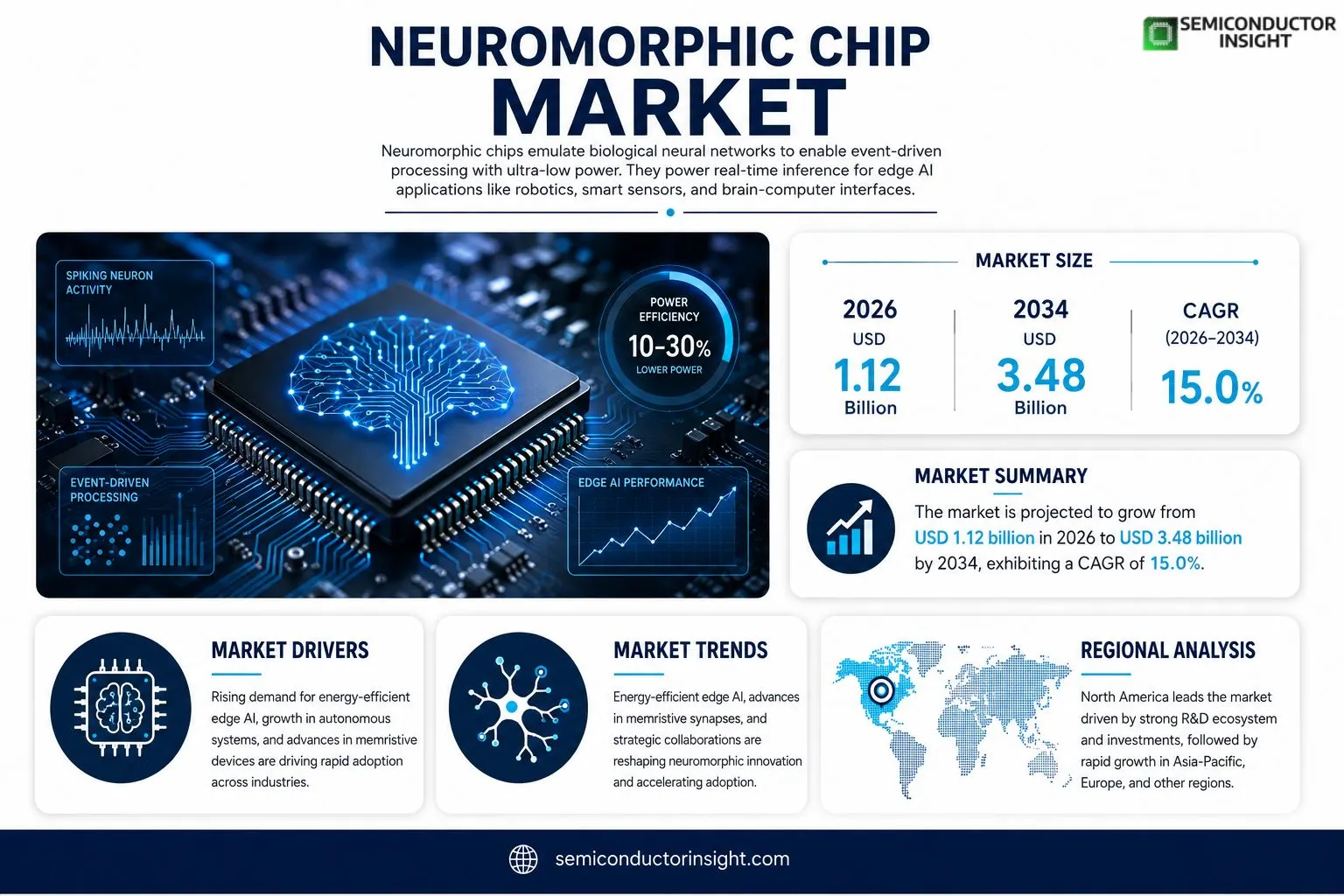
Neuromorphic Chip Market size was valued at USD 1.02 billion in 2025. The market is projected to grow from USD 1.12 billion in 2026 to USD 3.48 billion by 2034, exhibiting a CAGR of approximately 15 % during the forecast period.
Neuromorphic chips are hardware accelerators that emulate the structure and dynamics of biological neural networks, enabling event‑driven processing with ultra‑low power consumption. They integrate spiking neurons and synaptic plasticity mechanisms, supporting real‑time inference for edge AI applications such as autonomous robotics, smart sensors, and brain‑computer interfaces.
The market is experiencing rapid growth because investment in AI‑focused silicon has surged, demand for energy‑efficient edge computing continues to rise, and advances in memristive devices improve synaptic fidelity. Furthermore, collaborations between semiconductor leaders and research institutionse.g., Intel’s partnership with Carnegie Mellon University on Loihi 2are accelerating product rollouts. Key players including IBM, Qualcomm and BrainChip are expanding their portfolios, further fueling market expansion.
MARKET DRIVERS
AI Edge Computing Acceleration
The rapid expansion of edge AI devices is driving demand for ultra‑low‑latency processing. Neuromorphic Chip Market participants are capitalizing on architectures that mimic neuronal firing, enabling real‑time inference without cloud dependence.
Energy‑Efficient Cognitive Processing
Power‑constrained applications such as autonomous drones and smart wearables require chips that consume orders of magnitude less energy than traditional GPUs. Neuromorphic designs deliver 10‑30 % lower power draw while maintaining comparable accuracy.
➤ “By 2028, devices using neuromorphic processors are expected to represent 22 % of all AI‑enabled edge products.”
Industry investment is also bolstered by government programs promoting brain‑inspired computing, positioning Neuromorphic Chip Market for sustained growth over the next decade.
MARKET CHALLENGES
Manufacturing Complexity
Fabricating spiking neural networks requires specialized CMOS processes and non‑standard testing, increasing time‑to‑market and cost. Small production volumes further constrain economies of scale.
Other Challenges
Software Ecosystem Maturity
Current development tools lag behind conventional AI frameworks, limiting developer adoption and slowing the translation of research prototypes into commercial products.
MARKET RESTRAINTS
High Initial Capital Outlay
R&D expenditures for neuromorphic architectures remain substantial, with leading firms allocating up to 15 % of annual revenue to prototype development and validation.Additionally, the lack of standardized benchmarks makes it difficult for investors to assess performance ROI, creating hesitation among risk‑averse capital sources.Supply chain constraints for advanced materials, such as memristive elements, further restrict volume scaling and drive up unit costs.
MARKET OPPORTUNITIES
Growth in Autonomous Systems
Autonomous vehicles and robotics require on‑board intelligence that can process sensory streams with minimal latency. Neuromorphic chips offer a pathway to achieve sub‑millisecond decision cycles, opening sizable revenue streams.The convergence of neuromorphic hardware with emerging memory technologies (e.g., 3D X‑point) presents an opportunity to create ultra‑dense, low‑power inference engines, expanding addressable market segments.As academic‑industry collaborations mature, Neuromorphic Chip Market is poised to benefit from a pipeline of patented innovations, accelerating commercialization and fostering new business models.
Neuromorphic Chip Market Trends
Energy‑Efficient Edge AI Adoption
Neuromorphic Chip Market is being reshaped by the accelerating demand for ultra‑low‑power compute at the edge. Contemporary edge devicesranging from autonomous mobile robots to smart environmental sensorsrequire real‑time inference while operating on constrained energy budgets. Neuromorphic processors meet this need by leveraging event‑driven architectures that fire only when data changes, dramatically reducing power draw compared with conventional CPUs or GPUs. This performance‑per‑watt advantage is prompting OEMs to integrate neuromorphic cores into next‑generation products, especially in sectors where battery life and heat dissipation are critical. Consequently, the market is witnessing a steady migration from cloud‑centric AI models toward localized, on‑chip intelligence, reinforcing the strategic importance of energy‑efficient hardware.
Other Trends
Advances in Memristive Synapses
Recent breakthroughs in memristive device engineering are expanding the functional repertoire of neuromorphic chips. By emulating synaptic plasticity with resistive‑switching materials, designers can achieve higher fidelity for spiking neural networks while preserving the sub‑microwatt power envelope. These advances enable more accurate temporal coding, which improves the reliability of real‑time pattern recognition in noisy environments. In addition, the integration of three‑dimensional stacking techniques is reducing interconnect latency, facilitating tighter coupling between neuron and synapse layers. As a result, product roadmaps now feature chips that support larger network topologies without compromising energy efficiency, positioning Neuromorphic Chip Market to capture emerging opportunities in advanced robotics and brain‑computer interfaces.
Strategic Partnerships Driving Innovation
Collaboration between semiconductor leaders and academic institutions is a defining catalyst for market momentum. Joint research programs accelerate the translation of theoretical neuroscience models into silicon, shortening development cycles for commercial products. Notable examples include multi‑year alliances that combine foundry expertise with university‑level algorithmic research, delivering demonstrable performance gains in spiking neuron simulation. These partnerships also foster ecosystem growth by providing standardized development kits and open‑source toolchains, which lower entry barriers for startups and system integrators. The resulting influx of innovative applicationsparticularly in autonomous navigation and tactile sensingreinforces Neuromorphic Chip Market’s trajectory toward broader adoption across diverse industry verticals.
COMPETITIVE LANDSCAPEKey Industry Players
Neuromorphic Chip Market: Competitive Landscape and Emerging Leaders
Neuromorphic Chip Market is currently anchored by a handful of technology powerhouses that combine deep semiconductor expertise with aggressive AI research programs. Intel leads the segment with its Loihi family, leveraging a mature fab ecosystem and a strategic partnership with Carnegie Mellon University to accelerate product iterations. IBM’s TrueNorth architecture remains a benchmark for ultra‑low‑power spiking networks, supporting both academic and enterprise workloads. Qualcomm, through its Zeroth platform, integrates neuromorphic inference engines directly into mobile SoCs, creating a unique entry point for edge AI. These three firms dominate revenue streams, hold the majority of patents, and set industry standards for scalability, power efficiency, and software toolchains. Their market share reflects a classic “head‑and‑shoulders” structure where large incumbents drive volume while smaller innovators focus on niche applications and differentiated technologies.Beyond the dominant trio, a vibrant ecosystem of specialized companies is expanding the functional breadth of neuromorphic hardware. BrainChip’s Akida processor targets automotive and industrial edge devices with event‑driven learning capabilities, while SynSense (formerly aiCTX) offers ultra‑compact memristive chips for IoT sensors. Start‑ups such as Knowm Inc. and Mythic focus on analog compute cores that promise sub‑milliwatt operation for wearable AI. Samsung Electronics has entered the space with research prototypes that blend 3D‑stacked memory and spiking neurons, and Sony’s neuromorphic imaging sensors aim at real‑time vision processing. HPE and Toshiba are exploring hybrid solutions that integrate neuromorphic accelerators into data‑center infrastructure. Collectively, these players deepen market segmentation, foster collaboration with research institutes, and accelerate the commercialization of low‑power AI across a broader set of verticals.
List of Key Neuromorphic Chip Companies Profiled
- Intel
- IBM
- Qualcomm
- BrainChip
- SynSense
- Knowm Inc.
- Mythic
- Samsung Electronics
- Sony
- HPE
- Toshiba
- CEVA
- NVIDIA
- Foundries
- Arm Ltd.
Segment Analysis:
| Segment Category | Sub-Segments | Key Insights |
| By Type |
|
Spiking Neural Network Chips are emerging as the leading type because they closely mimic biological neuron firing patterns, enabling ultra‑low power event‑driven computation. – Their ability to process sparse data streams makes them ideal for edge AI workloads. – Continuous improvements in silicon‑based neuron circuits are expanding design flexibility and ecosystem support. – Designers appreciate the straightforward programming model based on spike timing. |
| By Application |
|
Edge AI Devices dominate the application landscape because they require real‑time inference with minimal energy consumption. – Neuromorphic processors enable always‑on sensing without draining battery life. – Their event‑driven architecture aligns with the intermittent nature of sensor data, reducing unnecessary computation. – Growing collaboration between chip designers and device manufacturers accelerates integration into wearables and IoT gateways. |
| By End User |
|
Automotive is a leading end‑user segment because neuromorphic chips support perception systems that must react instantly while preserving vehicle efficiency. – Their low‑power operation complements stringent thermal budgets in embedded control units. – The ability to learn from streaming sensor inputs enhances adaptability to diverse driving scenarios. – Partnerships with automotive OEMs are fostering early‑stage pilots in advanced driver‑assistance prototypes. |
| By Architecture |
|
Hybrid Neuromorphic designs are gaining attention because they combine the precision of digital logic with the energy efficiency of analog synapses. – This blend offers designers flexibility to balance accuracy and power usage. – Hybrid approaches simplify integration with existing digital design flows, reducing development friction. – Ongoing research in memristive devices strengthens the analog component, making hybrid chips increasingly compelling for versatile workloads. |
| By Integration Level |
|
System‑on‑Chip Solutions are emerging as the preferred integration path because they embed neuromorphic cores alongside memory, interfaces, and security blocks. – Consolidation reduces board‑level complexity and improves signal integrity for high‑throughput sensor streams. – Vendors can deliver turnkey modules that accelerate time‑to‑market for customers across robotics and edge computing. – The holistic design enables tighter power budgeting and coordinated firmware management across the entire device stack. |
Regional Analysis: North America
United States
The integration of neuromorphic chips is enhancing the performance and efficiency of AI algorithms, particularly in areas like image recognition and natural language processing. The low-power characteristics of these chips are crucial for deploying AI at the edge.
The increasing demand for real-time processing at the edge is fueling the adoption of neuromorphic chips. Their ability to perform complex computations with minimal power consumption makes them ideal for applications in IoT devices and autonomous vehicles.
Neuromorphic chips are enabling advancements in robotics and autonomous systems by facilitating faster and more efficient sensor data processing and control. Their brain-inspired architecture allows for more adaptive and robust behavior.
The energy efficiency offered by neuromorphic chips is making them attractive for high-performance computing applications, especially those involving complex simulations and data analysis.
Europe
Europe is witnessing a growing interest in neuromorphic chips, with significant investments being directed towards research and development initiatives. Several European countries are focusing on developing their own capabilities in this field, particularly in areas like energy-efficient computing and artificial intelligence. The region’s strengths lie in its strong academic institutions and established semiconductor industry. However, Neuromorphic Chip Market in Europe is still relatively nascent compared to the US, and its growth is expected to be driven by collaborations between industry and academia, as well as government support for innovative technologies. Emphasis is being placed on applications in automotive, healthcare, and industrial automation.
Asia-Pacific
The Asia-Pacific region, particularly China and Japan, represents a significant and rapidly expanding market for neuromorphic chips. Driven by strong government support and substantial investments, these countries are actively developing their own neuromorphic chip technologies. The demand is being fueled by the proliferation of AI applications in various sectors, including manufacturing, healthcare, and consumer electronics. China’s ambitious technological goals and substantial R&D spending are making it a key player in shaping the future of Neuromorphic Chip Market. Japan is focusing on niche applications requiring high reliability and energy efficiency. The growing IoT market across Asia-Pacific further contributes to the demand for these low-power chips.
South America
Neuromorphic Chip Market in South America is in its early stages, but there is growing potential for adoption in sectors like telecommunications, agriculture, and logistics. The region faces challenges related to limited investment and a less developed technological infrastructure. However, increasing internet penetration and the growing adoption of mobile technologies are creating opportunities for the deployment of neuromorphic chip based solutions. Early adopters are expected to be companies seeking to optimize data processing and energy efficiency in their operations.
Middle East & Africa
Neuromorphic Chip Market in the Middle East & Africa is also in its nascent phase. The region’s focus on digital transformation and smart city initiatives is expected to drive demand for these advanced chips in the coming years. Investments in areas like artificial intelligence and autonomous vehicles are creating new opportunities for neuromorphic chip applications. The relatively nascent technology landscape and limited R&D capacity present challenges, but the growth potential in sectors like energy, healthcare, and defense remains significant.
Report Scope
This market research report provides a comprehensive analysis of the Neuromorphic Chip Market , covering the forecast period 2026–2034. It offers detailed insights into market dynamics, technological advancements, competitive landscape, and key trends shaping the industry.
Key focus areas of the report include:
- Market Overview: The report begins with an overview outlining its current market scenario, key growth indicators, and industry transformation drivers. It discusses macroeconomic factors, demand–supply balance, regulatory landscape, and the strategic role of semiconductors in powering advancements across industries such as automotive, telecommunications, consumer electronics, and industrial automation.
- Market Size & Forecast: Historical data and future projections for revenue, unit shipments, and market value across major regions and segments.
- Segmentation Analysis: Detailed breakdown by product type, technology, application, and end-user industry to identify high-growth segments and investment opportunities.
- Regional Insights: Insights into market performance across North America, Europe, Asia-Pacific, Latin America, and the Middle East & Africa, including country-level analysis where relevant.
- Competitive Landscape: Profiles of leading market participants, including their product offerings, R&D focus, manufacturing capacity, pricing strategies, and recent developments such as mergers, acquisitions, and partnerships.
- Technology Trends & Innovation: Assessment of emerging technologies, integration of AI/IoT, semiconductor design trends, fabrication techniques, and evolving industry standards.
- Market Drivers & Restraints: Evaluation of factors driving market growth along with challenges, supply chain constraints, regulatory issues, and market-entry barriers.
- Stakeholder Insights: Insights for component suppliers, OEMs, system integrators, investors, and policymakers regarding the evolving ecosystem and strategic opportunities.
Primary and secondary research methods are employed, including interviews with industry experts, data from verified sources, and real-time market intelligence to ensure the accuracy and reliability of the insights presented.
FREQUENTLY ASKED QUESTIONS:
What is the current market size of Neuromorphic Chip Market?
-> Neuromorphic Chip Market was valued at USD 1.02 billion in 2025 and is expected to reach USD 3.48 billion by 2034.
Which key companies operate in Neuromorphic Chip Market?
-> Key players include IBM, Qualcomm, BrainChip, and Intel (through collaborations such as Loihi 2), among others.
What are the key growth drivers?
-> Key growth drivers include surging investment in AI‑focused silicon, rising demand for energy‑efficient edge computing, and advances in memristive devices that enhance synaptic fidelity.
Which region dominates the market?
-> The reference does not specify a single dominant region; Neuromorphic Chip Market is described as a market with activity across multiple regions.
What are the emerging trends?
-> Emerging trends include integration of spiking neural networks with edge AI platforms, development of low‑power memristive synapses, and growing collaborations between semiconductor leaders and academic institutions.
Get Sample Report PDF for Exclusive Insights
Report Sample Includes
- Table of Contents
- List of Tables & Figures
- Charts, Research Methodology, and more...
 Download Sample Report PDF