Glass Ceramic Substrates Market Insights
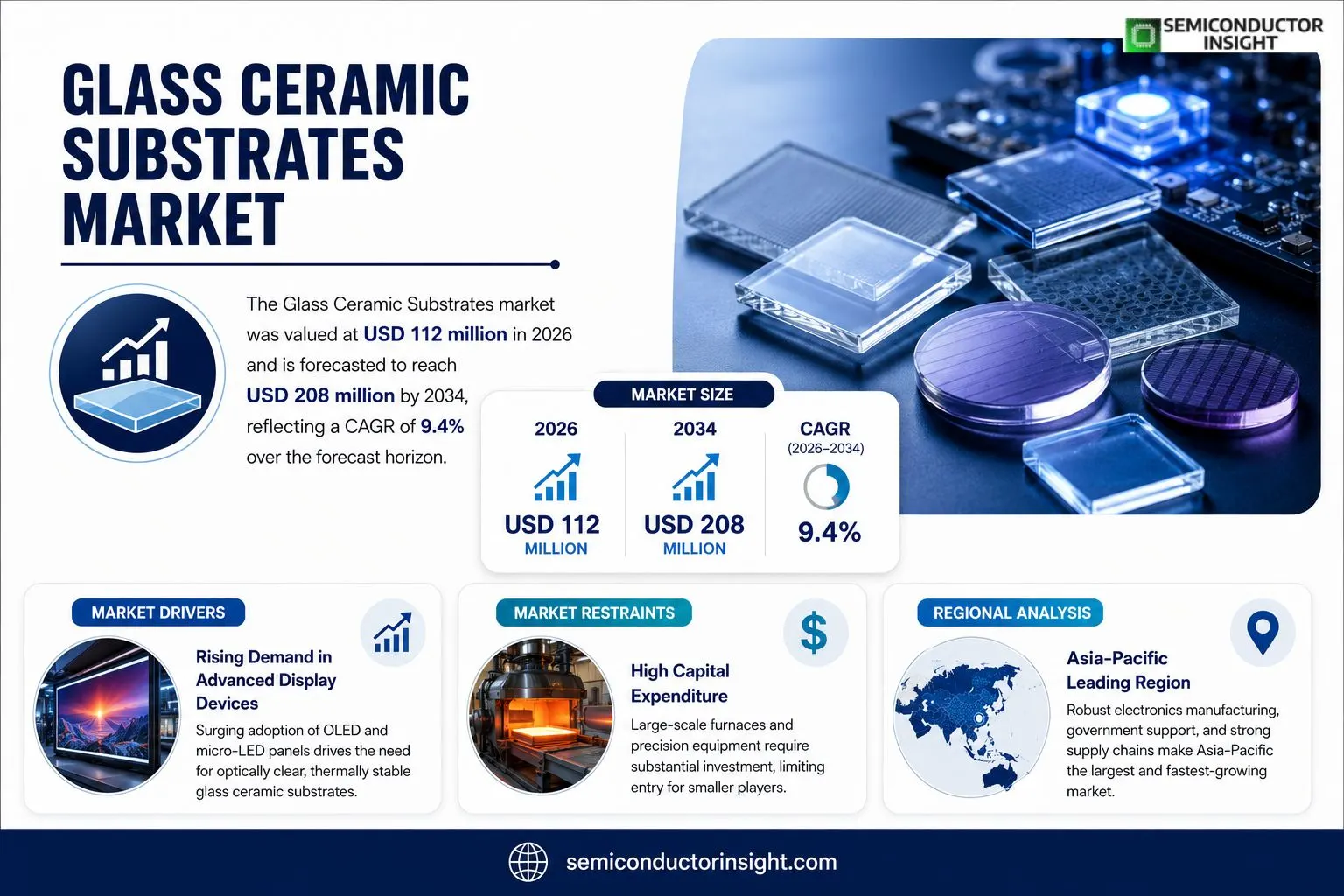
Glass Ceramic Substrates market size was valued at USD 112 million in 2026 and is forecasted to reach USD 208 million by 2034, reflecting a compound annual growth rate of 9.4% over the forecast horizon.
A glass ceramic substrate composed of transparent, coloured LAS glass ceramic is offered. The material features a gradient layer containing keatite solid solution together with an underlying core where high‑quartz solid solution constitutes the predominant crystal phase.The expansion stems from increasing adoption of high‑performance LED modules and semiconductor laser devices, prompting leading producers such as AGC, NEG, Adamant Namiki Precision Jewel and Ohara to scale output. Recent strategic partnerships announced in 2023 between substrate manufacturers and major display suppliers illustrate accelerating commercial activity across North America and Asia.
MARKET DRIVERS
Rising Demand in Advanced Display Devices
Glass Ceramic Substrates Market is buoyed by the surge in high‑resolution touchscreen panels, where manufacturers seek substrates that combine optical clarity with thermal stability. As OLED and micro‑LED panels become mainstream, the tolerance for thermal distortion tightens, prompting suppliers to favour glass‑ceramic solutions over conventional glass.
Expansion of Automotive Electronics
Automakers are integrating larger infotainment screens and heads‑up displays, environments that expose substrates to wide temperature swings and vibration. Glass‑ceramic substrates deliver the needed durability, which translates into higher unit orders from Tier‑1 suppliers seeking reliable components for next‑generation vehicle cabins.
➤ “Manufacturers cite a 12% year‑over‑year increase in glass‑ceramic substrate procurement for automotive HUDs, reflecting tighter performance specs.”
Beyond end‑product requirements, regional policy incentives aimed at reducing electronic waste have nudged OEMs toward longer‑lasting substrates. The resulting lifespan extension reduces replacement cycles, reinforcing demand for glass‑ceramic variants that meet stricter durability benchmarks.
MARKET CHALLENGES
High Capital Expenditure for Production Facilities
Deploying large‑scale glass‑ceramic furnaces demands substantial upfront investment, often exceeding $200 million for a full‑capacity line. Smaller players struggle to achieve economies of scale, leading to a market where a handful of incumbents dominate supply.
Other Challenges
Supply‑Chain Volatility
Fluctuations in raw‑material prices, particularly high‑purity silica and alkaline earth oxides, create cost unpredictability. When material costs rise, manufacturers may shift to less expensive glass alternatives, eroding market share.
MARKET RESTRAINTS
Stringent Qualification Processes
Automotive and aerospace customers enforce rigorous qualification protocols that can extend lead times by several months. These procedural hurdles discourage rapid adoption, especially among new entrants lacking certified test data.
MARKET OPPORTUNITIES
Emergence of Flexible Wearable Sensors
Flexible electronics for health monitoring and smart textiles require substrates that maintain structural integrity while conforming to curved surfaces. Glass‑ceramic sheets engineered with reduced thickness present a niche where performance‑driven customers are willing to pay a premium, opening a growth corridor for specialized manufacturers.
Glass Ceramic Substrates Market Trends
Increasing Adoption of Sub‑1 mm Substrates
Glass Ceramic Substrates Market is witnessing a pronounced move toward sub‑1 mm thicknesses. Manufacturers cite the lower thermal mass of thin substrates as a decisive element for high‑power LED arrays and semiconductor laser modules, where rapid heat extraction translates into longer device lifetimes and higher luminous efficacy. Production lines are being re‑engineered to accommodate tighter tolerances, prompting capital investment in precision polishing and inspection equipment. Customer specifications now frequently call for uniformity below 0.5 mm, pushing suppliers to refine melt‑composition controls. While yield pressures have intensified, the payoff appears in reduced material consumption and lighter end‑products, a combination that resonates with automotive and consumer‑electronics OEMs seeking weight‑critical designs. These dynamics are reshaping contract negotiations, as buyers increasingly demand just‑in‑time delivery of thin‑profile wafers to align with agile assembly schedules.
Other Trends
Advanced Keatite‑Quartz Composite Structures
Material innovation forms the second pillar of change within Glass Ceramic Substrates Market. Engineers are exploiting a gradient architecture that blends a keatite solid‑solution layer with a high‑quartz core, delivering a blend of low thermal expansion and elevated fracture toughness. This structure mitigates stress concentrations during rapid temperature cycling, a frequent occurrence in high‑intensity illumination platforms. Concurrently, the introduction of colored LAS glass‑ceramic variants expands the optical palette, allowing manufacturers to integrate filtering functions directly into the substrate. The cumulative effect is a portfolio of substrates that support higher drive currents without compromising optical clarity, thereby unlocking new design envelopes for photonics applications.
Geographic Shift Toward Asian Manufacturing Hubs
Geographic realignment is redefining the competitive terrain of Glass Ceramic Substrates Market. Production capacity in East Asia, particularly China, has accelerated, benefitting from mature supply chains for raw silica and government incentives for advanced ceramics. Meanwhile, North American facilities are consolidating around niche, high‑margin segments such as aerospace‑grade lasers, where strict certification regimes favor established local players. This bifurcation creates a pricing gradient: bulk orders from Asian plants are increasingly price‑competitive, whereas specialized orders retain a premium in Western markets. Companies that can orchestrate cross‑regional logistics while preserving specification fidelity are better positioned to capture the expanding demand from both volume‑driven and high‑specification customers.
COMPETITIVE LANDSCAPE
Key Industry Players
Competitive dynamics in the glass‑ceramic substrates market
AGC and NEG continue to anchor the market, together accounting for a sizeable share of revenue. Both firms leverage extensive intellectual‑property portfolios around LAS‑type glass‑ceramics, and maintain vertically integrated production lines that link raw‑glass melting to final substrate polishing. Their scale enables consistent supply to high‑volume downstream segments such as LED backlighting and semiconductor laser modules, while the depth of engineering expertise creates a barrier for new entrants. The concentration of capability around high‑temperature processing and precision grinding has produced an oligopolistic structure where strategic partnerships with display manufacturers further reinforce the incumbents’ market position.Beyond the two giants, a set of specialised manufacturers fills niche demand pockets. Adamant Namiki Precision Jewel focuses on sub‑millimetre substrates for advanced photonics, whereas Ohara supplies colour‑graded LAS glass for automotive lighting. Schott and Kyocera bring a legacy of optical‑grade glass‑ceramics, emphasizing low‑loss, thick (>1 mm) formats for high‑power laser systems. Corning’s recent entry targets the high‑precision sensor market, while Sumitomo, JNC, Hoya and Mitsubishi Electric compete on custom‑composition development for niche applications such as aerospace optics. These players differentiate through thickness control, crystal‑phase engineering, and targeted R&D programs, creating a fragmented layer of competition that can respond quickly to emerging technology standards.
List of Key Glass Ceramic Substrate Companies Profiled
- AGC
- NEG
- Adamant Namiki Precision Jewel
- Ohara
- Schott AG
- Kyocera Corporation
- Corning
- Sumitomo Electric Industries
- JNC Corporation
- Hoya Corporation
- Mitsubishi Electric
- Murata Manufacturing
- Showa Denko
- Daikin Industries
Segment Analysis:
| Segment Category | Sub-Segments | Key Insights |
| By Type |
|
Above 1 mm is the dominant type because it accommodates high‑performance laser and LED modules that demand robust thermal handling and mechanical stability.
|
| By Application |
|
LED applications drive the most strategic interest due to the need for uniform light emission and heat dissipation.
|
| By End User |
|
Industrial Equipment leads because high‑temperature processes and precision optics demand the durability of glass‑ceramic substrates.
|
| By Technology |
|
LAS Glass Ceramic is regarded as the most innovative technology because its gradient structure offers a unique combination of optical and mechanical properties.
|
| By Performance Requirement |
|
High Thermal Conductivity is the leading performance focus because efficient heat removal underpins reliability in high‑power LED and laser modules.
|
Regional Analysis: Glass Ceramic Substrates Market
Asia‑Pacific
Proximity between raw‑material suppliers and substrate fabs shortens order‑to‑delivery cycles, allowing manufacturers to respond to design changes within weeks rather than months, a capability prized by automotive and medical device makers.
Harmonised safety and environmental standards across the region reduce compliance uncertainty, enabling firms to certify products for multiple markets without duplicated testing regimes.
Universities with dedicated glass‑ceramic research centres feed a steady stream of PhDs, ensuring that innovative coating techniques and defect‑mitigation processes stay at the forefront of commercial production.
Close interaction between substrate makers and end‑device designers accelerates iteration cycles, resulting in bespoke thermal‑expansion profiles that meet the exacting tolerances of next‑generation displays.
North America
North American players rely on a mature aerospace and defense base that values the dimensional stability offered by glass‑ceramic substrates. Investment in pilot lines within the United States and Canada reflects a strategic aim to retain high‑value contracts domestically, rather than outsourcing to overseas foundries. Corporate R&D budgets focus on integrating substrates with emerging quantum‑computing modules, where thermal shock resistance becomes a decisive factor. While the market size is modest compared with Asia‑Pacific, the region’s emphasis on intellectual‑property protection and stringent certification pathways creates a niche where premium pricing can be sustained.
Europe
European manufacturers benefit from a tightly regulated environment that prioritises sustainability and circular‑economy principles. Companies are experimenting with recycled glass‑ceramic feedstocks to meet EU directives on waste reduction, a move that differentiates them in the premium‑segment market. Collaboration clusters in Germany and France link substrate producers with automotive OEMs developing heads‑up displays, driving specifications that balance thinness with mechanical robustness. The region’s emphasis on long‑term reliability, especially for rail and industrial automation, translates into multi‑year supply contracts that underpin stable revenue streams.
South America
In South America, growth is anchored by peripheral electronics assemblers that seek to upgrade legacy glass platforms without overhauling entire production lines. Brazil’s expanding consumer‑electronics sector has prompted local firms to adopt glass‑ceramic substrates for mid‑range smartphones, valuing the material’s resistance to thermal cycling in humid climates. However, limited access to high‑purity raw materials and fragmented logistics networks keep overall market penetration modest, prompting companies to focus on partnerships with Asian exporters to bridge capability gaps.
Middle East & Africa
The Middle East & Africa region is gradually embracing glass‑ceramic substrates as part of its broader diversification away from oil‑centric economies. United Arab Emirates and Saudi Arabia are investing in semiconductor‑adjacent parks where substrate technology is a critical enabler for display‑rich digital signage and smart‑city infrastructure. Local governments are offering tax incentives for equipment importation, yet the scarcity of specialised engineering talent means many projects rely on expatriate expertise, shaping a market that is still in its formative stage but poised for incremental expansion.
Report Scope
This market research report provides a comprehensive analysis of the Glass Ceramic Substrates Market , covering the forecast period 2026–2034. It offers detailed insights into market dynamics, technological advancements, competitive landscape, and key trends shaping the industry.
Key focus areas of the report include:
- Market Overview: The report begins with an overview outlining its current market scenario, key growth indicators, and industry transformation drivers. It discusses macroeconomic factors, demand–supply balance, regulatory landscape, and the strategic role of semiconductors in powering advancements across industries such as automotive, telecommunications, consumer electronics, and industrial automation.
- Market Size & Forecast: Historical data and future projections for revenue, unit shipments, and market value across major regions and segments.
- Segmentation Analysis: Detailed breakdown by product type, technology, application, and end-user industry to identify high-growth segments and investment opportunities.
- Regional Insights: Insights into market performance across North America, Europe, Asia-Pacific, Latin America, and the Middle East & Africa, including country-level analysis where relevant.
- Competitive Landscape: Profiles of leading market participants, including their product offerings, R&D focus, manufacturing capacity, pricing strategies, and recent developments such as mergers, acquisitions, and partnerships.
- Technology Trends & Innovation: Assessment of emerging technologies, integration of AI/IoT, semiconductor design trends, fabrication techniques, and evolving industry standards.
- Market Drivers & Restraints: Evaluation of factors driving market growth along with challenges, supply chain constraints, regulatory issues, and market-entry barriers.
- Stakeholder Insights: Insights for component suppliers, OEMs, system integrators, investors, and policymakers regarding the evolving ecosystem and strategic opportunities.
Primary and secondary research methods are employed, including interviews with industry experts, data from verified sources, and real-time market intelligence to ensure the accuracy and reliability of the insights presented.
FREQUENTLY ASKED QUESTIONS:
What is the current market size of Glass Ceramic Substrates Market?
-> Glass Ceramic Substrates Market was valued at USD 112 million in 2026 and is expected to reach USD 208 million by 2034, growing at a CAGR of 9.4% during the forecast period.
Which key companies operate in Glass Ceramic Substrates Market?
-> Key players include AGC, NEG, Adamant Namiki Precision Jewel, Ohara, among others.
What are the key growth drivers?
-> Key growth drivers include increasing demand in LED and semiconductor laser applications, and the development of advanced transparent colored LAS glass ceramic substrates.
Which region dominates the market?
-> While specific regional share is not detailed, the Asia region, particularly China, is a major market contributor.
What are the emerging trends?
-> Emerging trends include transparent colored LAS glass ceramic substrates with gradient keatite solid‑solution layers and high‑quartz core structures.
Get Sample Report PDF for Exclusive Insights
Report Sample Includes
- Table of Contents
- List of Tables & Figures
- Charts, Research Methodology, and more...
 Download Sample Report PDF