Key Statistics
Key Takeaways
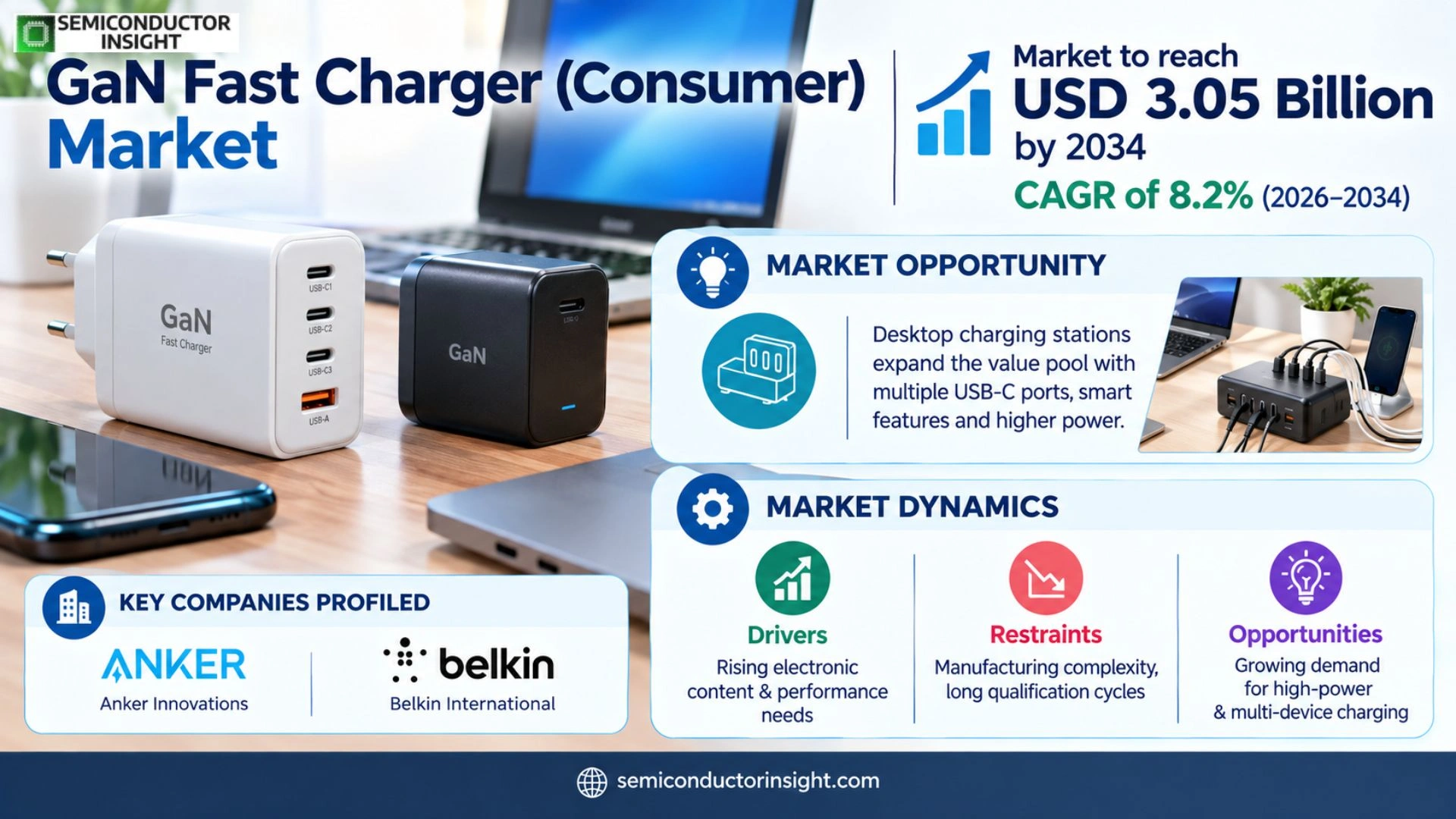
- The validated report forecast places the market at USD 1.45 billion in 2025 and USD 3.05 billion by 2034, representing an 8.2% CAGR during 2026–2034. The figures are carried directly from the report page and used consistently throughout this overview.
- Multi-port chargers lead value growth because households and mobile professionals increasingly want one compact adapter to serve phones, tablets, laptops, gaming devices, and accessories while reducing packed weight and outlet use.
- Smartphones remain the largest application base, while laptops and tablets raise the average wattage and selling value. USB Power Delivery and higher-power profiles extend third-party charging into notebook-class equipment.
- Asia Pacific leads through its concentration of GaN and power-electronics supply, contract manufacturing, consumer accessory brands, device production, and rapidly expanding regional demand.
- Complete-system execution determines competitiveness. GaN device performance must translate into sustained output, safe enclosure temperature, protocol compatibility, transparent port allocation, certified cables, reliable manufacturing, and credible warranty support.
GaN Fast Charger (Consumer) Market Overview
GaN Fast Charger (Consumer) Market was valued at USD 1.45 billion in 2025 and is projected to reach USD 3.05 billion by 2034, growing at a CAGR of 8.2% during 2026–2034. Asia Pacific held the largest regional position in 2025, supported by concentrated manufacturing, downstream electronics production and established component supply networks.
Consumer gallium-nitride fast chargers use high-frequency GaN power switches, controllers, magnetics, capacitors, thermal materials, and USB power-delivery interfaces to convert mains electricity into compact regulated output. Compared with a conventional silicon design at similar power, GaN can support higher switching frequency and lower switching loss, allowing smaller magnetic components and higher power density. Product performance still depends on the complete topology, layout, thermal design, firmware, cable, and safety implementation.
The report page already provides the requested base-year value, forecast endpoint, and compound growth rate. Those anchors are retained without importing estimates from another report seller or changing the report’s stated trajectory. The commercial outlook reflects rising USB-C power levels, multi-device charging, laptop adoption, and broader GaN availability, moderated by pricing, certification, counterfeit risk, the long useful life of adapters, and intense accessory competition.
The addressable category includes wall, travel, desktop, and vehicle chargers sold to consumers for smartphones, tablets, notebooks, handheld gaming devices, cameras, wearables, and other portable electronics. It excludes industrial power supplies and vehicle traction systems. Market value therefore follows retail and e-commerce sell-through, product mix, rated wattage, port count, protocol support, regional plug variants, brand trust, warranty coverage, and the replacement cycle of the devices being charged.
Segment Analysis: By Type
By type, the GaN Fast Charger market is segmented into Compact Chargers · Multi-Port Chargers. Each category represents a different degree of integration, qualification burden and value capture, so suppliers compete through a combination of material performance, design support, manufacturing consistency, package architecture and application-specific testing rather than through unit price alone. Procurement also reflects lifecycle support, interoperability, compliance evidence, warranty exposure, and the cost of unsuccessful qualification.
| Type | Market relevance |
|---|---|
| Compact Chargers | Distinct performance, condition, integration, and qualification requirements shape demand and supplier positioning. |
| Multi-Port Chargers | Distinct performance, condition, integration, and qualification requirements shape demand and supplier positioning. |
Segment Analysis: By Application
By application, the market covers Smartphones · Laptops and Tablets · Wearable Devices · Other Consumer Electronics. Demand varies by production volume and qualification intensity: consumer programmes reward scale and miniaturisation, while automotive, industrial, aerospace, medical or security designs place greater weight on reliability evidence, long product availability and system-level performance under demanding operating conditions. Channel design, documentation, service coverage, and total ownership economics further determine which application converts technical interest into repeat purchasing.
| Application | Market relevance |
|---|---|
| Smartphones | Purchasing criteria reflect use-case economics, technical requirements, warranty expectations, and channel support. |
| Laptops and Tablets | Purchasing criteria reflect use-case economics, technical requirements, warranty expectations, and channel support. |
| Wearable Devices | Purchasing criteria reflect use-case economics, technical requirements, warranty expectations, and channel support. |
| Other Consumer Electronics | Purchasing criteria reflect use-case economics, technical requirements, warranty expectations, and channel support. |
Regional Analysis
Asia Pacific is the largest regional market for GaN Fast Charger products, combining an established component-production ecosystem with major downstream customers. North America and Europe are strategically important for premium, automotive, aerospace, industrial and specialised applications, while South America and Middle East & Africa are primarily import- and project-led markets where distributor reach, local support and supply continuity shape vendor selection.
How does regional demand differ across this market?
For GaN Fast Charger, Asia Pacific holds the largest position, supported by an established customer base, supplier presence, and mature purchasing channels. Europe contributes regulation, industrial demand, and technical expertise, while Asia Pacific combines electronics manufacturing, large device populations, and expanding engineering capability. South America and the Middle East and Africa develop through targeted infrastructure, enterprise, research, consumer, or public-sector programs rather than uniform adoption.
| Region | Position |
|---|---|
| Asia Pacific | Largest and most established demand base |
| North America | Developing demand shaped by local applications, channels, and qualification conditions |
| Europe | Developing demand shaped by local applications, channels, and qualification conditions |
| South America | Developing demand shaped by local applications, channels, and qualification conditions |
| Middle East & Africa | Developing demand shaped by local applications, channels, and qualification conditions |
Key GaN Fast Charger Manufacturers and Competitive Landscape
The GaN Fast Charger competitive landscape includes global technology leaders, diversified semiconductor or component groups, RF and imaging specialists, and regional manufacturers. The report profiles every named company across product positioning, manufacturing footprint, application exposure, recent development activity and strategic strengths; the complete coverage list is reproduced below so the intended company universe is explicit.
Competition includes large consumer-accessory brands, channel-driven regional suppliers, and specialist charging companies. Anker and Belkin compete through brand recognition, retail access, safety positioning, and premium multi-port products. Baseus, Aukey, RAVPower, UGREEN-adjacent peers, Zendure, Hyper, Romoss, CHOETECH, Innergie, Nekteck, and Satechi address combinations of travel, desktop, mobile, and value demand. GaNPro represents technology-focused participation where compact design and power density are primary selling points.
Product differentiation has moved beyond simply printing a higher wattage on the enclosure. Buyers compare the sustained output of each port, simultaneous-load allocation, USB PD and programmable-power-supply support, cable rating, thermal throttling, idle consumption, protection behavior, plug stability, size, weight, warranty, and certification marks. Brands with disciplined platform engineering can reuse architectures across regional plugs and power tiers, while weak quality control can create returns, safety incidents, and rapid marketplace delisting.
Key companies profiled
- Anker Innovations
- Belkin International
- Aukey Innovations
- RAVPower
- GaNPro Technology
- Hyper
- Baseus
- Zendure
- Romoss
- CHOETECH
- Innergie
- Nekteck
- Satechi
GaN Fast Charger Production Capacity Analysis
Production capacity is a material competitive factor in the GaN Fast Charger market because electrical performance depends on specialised processes, qualified materials, repeatable yields and application-specific test capability. Capacity cannot be assessed only by nominal factory floor area: effective supply is the output that passes dimensional, electrical, reliability and customer qualification requirements at the required product mix.
Effective production capacity is measured in certified charger assemblies at a specified power and regional configuration, not in GaN device wafer starts alone. A charger requires qualified power semiconductors, controllers, magnetics, capacitors, connectors, plastics, thermal interfaces, printed circuit assemblies, firmware, cables, packaging, and final test. The binding constraint can shift from a power IC to transformers, USB-C connectors, safety laboratories, automated test fixtures, or an approved contract-manufacturing line.
High power density increases the importance of layout, electromagnetic compatibility, creepage and clearance, enclosure temperature, component derating, and fault protection. Capacity that produces acceptable samples may not yield stable mass production across ambient conditions and input voltages. Manufacturers therefore need automated functional testing, burn-in or stress screening where specified, thermal sampling, dielectric withstand testing, traceable component lots, and control of firmware versions that manage port negotiation and power allocation.
Regional variants multiply complexity because plug geometry, voltage range, labeling, efficiency rules, safety certification, packaging language, and included cables differ. Platform designs that share a common power stage while changing limited mechanical or compliance elements can improve utilization and inventory turns. Brands also need launch capacity at retailers and online marketplaces, since a technically available charger generates no revenue if certifications, localized packaging, reviews, or channel inventory are not ready at the same time.
GaN Fast Charger Market Dynamics: Drivers, Restraints and Opportunities
GaN Fast Charger market growth reflects expanding electronic content and higher performance requirements, moderated by manufacturing complexity, long qualification cycles and competing technologies. The impact ranges below are directional analytical estimates rather than additive forecasts; they show the relative pressure each factor can place on the baseline CAGR when other assumptions remain broadly stable.
Growth is driven by the convergence of phones, tablets, notebooks, gaming devices, and accessories around USB-C power delivery. The USB Power Delivery ecosystem extends into higher wattage and programmable voltage, while the European common-charger framework reinforces a standardized interface across many portable-device categories. These developments allow one multi-port GaN unit to replace several bundled adapters, creating a convenience and travel-value proposition beyond charging speed alone.
The baseline is moderated by the long useful life of chargers, device vendors removing adapters from some product boxes, and rapid price competition in online channels. GaN improves the engineering envelope but does not eliminate losses in magnetics, rectification, control electronics, or cables. Poorly matched devices may fall back to slower profiles, and high advertised aggregate wattage may be divided sharply across ports, making transparent power-allocation specifications important for consumer trust.
MARKET DRIVERS
Drivers Impact Analysis*
| Driver | (~) % impact on CAGR forecast | Geographic relevance | Impact timeline |
|---|---|---|---|
| USB-C and USB Power Delivery standardization | +2.0% | Global; strongest regulatory support in Europe | Short term (≤2 years) |
| Laptop-class charging and higher power profiles | +1.6% | North America, Europe, Asia Pacific | Medium term (2–4 years) |
| Multi-device ownership and adapter consolidation | +1.4% | Global consumer markets | Short term (≤2 years) |
| Improving GaN integration and reference designs | +1.1% | Asia Pacific and global brands | Medium term (2–4 years) |
| Premium desktop and travel charging stations | +0.8% | Developed consumer markets | Medium term (2–4 years) |
| Retail and e-commerce product diversification | +0.5% | Global | Short term (≤2 years) |
USB-C standardization expands the compatible device base. European common-charger rules apply to multiple portable radio-equipment categories and require USB-C interoperability and charging information, while laptops follow on the later regulatory schedule. A broader common interface improves the utility of third-party chargers and makes multi-device ownership easier to serve with one product. The demand mechanism is strongest when the charger supports widely implemented USB Power Delivery profiles rather than proprietary fast charging alone.
Higher notebook, gaming, and creator-device power requirements move the category beyond phone adapters. USB Power Delivery Extended Power Range supports substantially more power than earlier mainstream chargers, creating room for 140-watt and higher single-port products and desktop stations with several simultaneous outputs. GaN helps control size and thermal burden at these ratings, although cables and devices must also support the negotiated profile before the headline wattage can be used.
Multi-port ownership and travel convenience create a replacement motive even when existing adapters still function. Consumers can consolidate a laptop brick, phone charger, tablet adapter, and wearable supply into one unit, reducing packed weight and outlet use. The commercial opportunity depends on intelligent power allocation, clear port labeling, compact plugs, included high-current cables where necessary, and reliable performance when several devices connect or disconnect during a charging session.
MARKET RESTRAINTS
Restraints Impact Analysis*
| Restraint | (~) % impact on CAGR forecast | Geographic relevance | Impact timeline |
|---|---|---|---|
| GaN, control and certification cost premium | −1.4% | Price-sensitive global segments | Persistent |
| Protocol, cable and device compatibility variation | −1.0% | Global multi-device use | Medium term (2–4 years) |
| Safety risk and counterfeit certification marks | −0.8% | Online and informal channels | Persistent |
| Long useful life of existing chargers | −0.6% | Mature consumer markets | Long term (≥4 years) |
| Aggressive silicon charger price competition | −0.5% | Asia Pacific and value channels | Short term (≤2 years) |
GaN devices and sophisticated controllers can carry a cost premium relative to highly optimized silicon chargers, while compact construction raises demands on thermal materials, magnetics, assembly precision, and compliance testing. In price-sensitive segments, the efficiency or size benefit may not justify a higher retail price. Suppliers must translate semiconductor performance into a visible consumer advantage, such as smaller volume, more ports, higher sustained output, or a warranty strong enough to reduce purchase risk.
Protocol fragmentation and misleading wattage claims create compatibility risk. A charger may support USB Power Delivery yet omit a programmable profile preferred by a particular phone, or divide its total rating when multiple ports are active. Proprietary protocols, cable current limits, and device firmware add further variation. Returns rise when buyers expect the maximum label value on every port, making accurate matrices, qualified cables, firmware testing, and clear documentation essential operating requirements.
Safety and counterfeit concerns restrain unbranded channels. High power density places mains voltage and high current in a small enclosure, so poor insulation, inadequate spacing, weak components, or counterfeit certification marks can create fire or shock risk. Compliance with regional electrical-safety, electromagnetic-compatibility, efficiency, and substance rules adds cost and time. Established brands benefit from testing and warranty infrastructure, while small sellers face higher barriers to credible market access.
MARKET OPPORTUNITIES
Desktop charging stations are expanding the value pool beyond compact wall adapters. Products with four or more USB-C outputs, dynamic allocation, displays, application control, or a high-power primary port can serve households and hybrid workers with several notebooks and mobile devices. This segment supports higher average selling prices, but designers must communicate shared-output behavior and maintain acceptable temperature under sustained simultaneous load rather than relying on aggregate peak wattage alone.
Travel and regional plug solutions remain attractive because GaN reduces the space penalty of carrying several power stages. Interchangeable plugs, foldable pins, airline-friendly size, wide input voltage, and bundled certified cables can create defensible product packages. The opportunity is not simply smaller hardware: travelers value predictable compatibility, protection, documentation, and warranty service across countries, particularly when the charger replaces every other adapter in their bag.
Semiconductor and accessory-company collaboration can shorten development cycles. Reference designs that integrate GaN switches, drivers, controllers, protection, and magnetics guidance help brands reach higher efficiency and power density without building every function internally. Differentiation then shifts to industrial design, port mix, firmware, cable bundling, retail execution, and support. Suppliers that validate complete use cases can capture more value than vendors offering a discrete transistor without system-level evidence.
GaN Fast Charger Supply Chain Analysis
The GaN Fast Charger supply chain links specialty materials and wafer or ceramic processing equipment to high-precision manufacturing, packaging, distribution and downstream system integration. Commercial resilience depends on qualified alternate materials, realistic yield assumptions, geographic redundancy and traceable process controls because a nominal second source is not interchangeable until the customer has validated electrical behaviour, reliability and package compatibility.
The value chain begins with GaN epitaxy and device fabrication, silicon controllers, protection ICs, capacitors, magnetic cores and windings, printed circuit materials, thermal interfaces, USB-C connectors, cables, plastics, and packaging. Power-supply designers combine these inputs into electrical and mechanical platforms. Contract manufacturers assemble and test regional variants, while accessory brands, distributors, retailers, marketplaces, and device OEM channels convert certified inventory into consumer sales and manage warranty returns.
Supply resilience depends on qualified alternates because substituting a GaN switch, controller, transformer, capacitor, or connector can change efficiency, emissions, temperature, and safety margins. A nominal second source is not fully interchangeable until the charger is revalidated. Strong programs maintain approved bills of material, lot traceability, firmware control, tooling redundancy, component life-cycle monitoring, and sufficient regional packaging flexibility to prevent a localized certification or plug change from stranding finished inventory.
Recent Developments in the GaN Fast Charger Market
Developments tracked to September 2026 and linked to official company or industry sources.
- July 2025 Published
Navitas announced that its GaNFast power technology was selected for a next-generation Xiaomi 90-watt charger, linking advances in integrated GaN power devices with a high-volume consumer electronics ecosystem. Source - January 2025 Published
UGREEN presented a 500-watt six-port Nexode desktop charger with a 240-watt primary USB-C output, demonstrating how GaN is moving consumer charging from single-device wall plugs toward shared high-power desktop infrastructure. Source - September 2025 Published
Anker introduced a new Prime charging family with higher-output multi-device products, illustrating the market shift toward intelligent allocation, displays, application connectivity, and notebook-class power in consumer charging accessories. Source - September 2025 Published
Belkin expanded its BoostCharge Pro GaN portfolio with additional dual-USB-C power tiers, reinforcing demand for compact branded chargers that combine standardized fast charging with retail distribution and consumer warranty support. Source - December 2024 Published
European Union common-charger rules began applying to mobile phones and multiple portable electronics categories, strengthening USB-C interoperability and standardized charging information across a major consumer market. Source
REPORT SCOPE & SEGMENTATION
| Attribute | Details |
|---|---|
| Study Period | 2021–2034 |
| Base Year | 2025 |
| Estimated Year | 2026 |
| Forecast Period | 2026–2034 |
| Historical Period | 2021–2025 |
| Market Size 2025 | USD 1.45 billion |
| Market Size 2034 | USD 3.05 billion |
| Growth Rate | CAGR of 8.2% from 2026–2034 |
| Unit | Value in USD billion and shipment or production volume where disclosed |
| Segmentation | By Type, By Application, additional technology axis and By Region |
| By Type | Compact Chargers · Multi-Port Chargers |
| By Application | Smartphones · Laptops and Tablets · Wearable Devices · Other Consumer Electronics |
| By Charging Interface and Portability | USB Power Delivery · Proprietary Fast Charging · Wireless-Charging Power Adapters · Travel Chargers · Desktop Chargers · Car Chargers |
| By Region | Each region analysed by type, application and countryNorth AmericaU.S., Canada, MexicoEuropeGermany, France, U.K., Italy, Nordic Countries, BeneluxAsia PacificChina, Japan, South Korea, India, Southeast AsiaSouth AmericaBrazil, Argentina, Rest of South AmericaMiddle East & AfricaTurkey, Israel, Saudi Arabia, UAE, Rest of MEA |
| Key Companies Profiled | Anker Innovations; Belkin International; Aukey Innovations; RAVPower; GaNPro Technology; Hyper; Baseus; Zendure; Romoss; CHOETECH; Innergie; Nekteck; Satechi |
| Customization Scope | Free report customization equivalent to up to four analyst working days with purchase, including additions or alterations to country, regional and segment coverage. |
Frequently Asked Questions
What is a consumer GaN fast charger?
The GaN Fast Charger (Consumer) Market is valued at USD 1.45 billion in 2025 and is projected to reach USD 3.05 billion by 2034, representing a 8.2% CAGR during 2026–2034. The estimate covers the complete stated product, application, technology and regional scope, and the 2034 endpoint was extended from the report’s published anchors using the endpoint-implied compound annual relationship rather than an unrelated third-party forecast.
What is the market size through 2034?
The 2034 GaN Fast Charger projection extends the report’s published endpoint relationship through the requested horizon. It should be interpreted as a constant-rate rebasing scenario: actual annual results can vary with device production, qualification timing, technology substitution, pricing and regional investment, but the method keeps the terminal value mathematically consistent with the validated source anchors and the forecast period used throughout this overview.
Why does GaN enable smaller chargers?
GaN power devices can switch faster with lower switching losses than conventional silicon devices in suitable designs. Higher frequency allows smaller transformers, inductors, and filters, while lower loss can reduce cooling requirements. The benefit is not automatic: poor circuit topology, magnetic design, layout, control, or enclosure ventilation can erase the advantage. Buyers should compare sustained power, dimensions, weight, temperature, efficiency, and certified operating conditions.
Which charger type leads demand?
Multi-port chargers capture a growing share of value because households and mobile professionals own several USB-C devices and want to reduce adapter count. Compact single- or dual-port products remain the volume entry point for phones and travel. The right segmentation must distinguish total aggregate output from the maximum of an individual port, because power reallocation under simultaneous load materially changes the user experience and product price.
Which applications are most important?
Smartphones provide the broadest installed base, while laptops and tablets raise wattage and average selling value. Handheld gaming systems, cameras, headphones, wearables, and other accessories widen multi-port use. A single charger can serve several categories only when its output profiles, cable ratings, and port behavior match the connected devices. This is why USB Power Delivery interoperability and transparent allocation tables are central to product positioning.
Why does Asia Pacific lead?
Asia Pacific combines GaN and power-electronics supply, contract manufacturing, consumer-accessory brands, large smartphone and notebook production, and rapidly expanding regional demand. China and neighboring electronics clusters shorten the link between semiconductor reference design, magnetic-component sourcing, assembly, and online product launch. North America and Europe remain important premium markets, but much of the physical product engineering and manufacturing ecosystem is concentrated in Asia.
What are the main market restraints?
Major restraints include semiconductor and certification cost, aggressive silicon competition, misleading wattage claims, protocol fragmentation, cable limitations, counterfeit products, safety risk, and the long useful life of existing chargers. Consumers may not replace a functioning adapter for efficiency alone. Vendors must demonstrate a material improvement in size, port count, sustained output, travel convenience, compatibility, warranty, or price before GaN converts from an engineering feature into a purchase reason.
How do USB-C and USB Power Delivery affect demand?
USB-C provides a common connector, while USB Power Delivery negotiates voltage and current between charger, cable, and device. Higher-power and programmable profiles broaden the range of equipment one adapter can serve. European common-charger requirements reinforce interoperability and consumer information. However, connector similarity does not guarantee identical speed: every link must support the required profile, current, cable marking, and firmware behavior for the maximum power to be delivered safely.
How do brands compete?
Brands compete through power density, port mix, sustained thermal performance, charging protocol coverage, power-allocation logic, cable bundles, plug design, safety certification, warranty, online reviews, retail access, and price. Established accessory companies can spread engineering and compliance investment across product families. Smaller participants can win with a focused use case or aggressive value, but inconsistent quality and weak after-sales service increase returns and limit long-term channel access.
Which companies are covered?
The report covers Anker Innovations, Belkin International, Aukey Innovations, RAVPower, GaNPro Technology, Hyper, Baseus, Zendure, Romoss, CHOETECH, Innergie, Nekteck, and Satechi. Profiles assess power tiers, form factors, protocol support, product positioning, regional distribution, manufacturing approach, safety and warranty framework, partnerships, and recent launches. Inclusion defines the intended competitive universe and does not by itself assign a market-share ranking.

Get Sample Report PDF for Exclusive Insights
Report Sample Includes
- Table of Contents
- List of Tables & Figures
- Charts, Research Methodology, and more...
 Download Sample Report PDF