GaN‑Based Power Adapters Market Insights
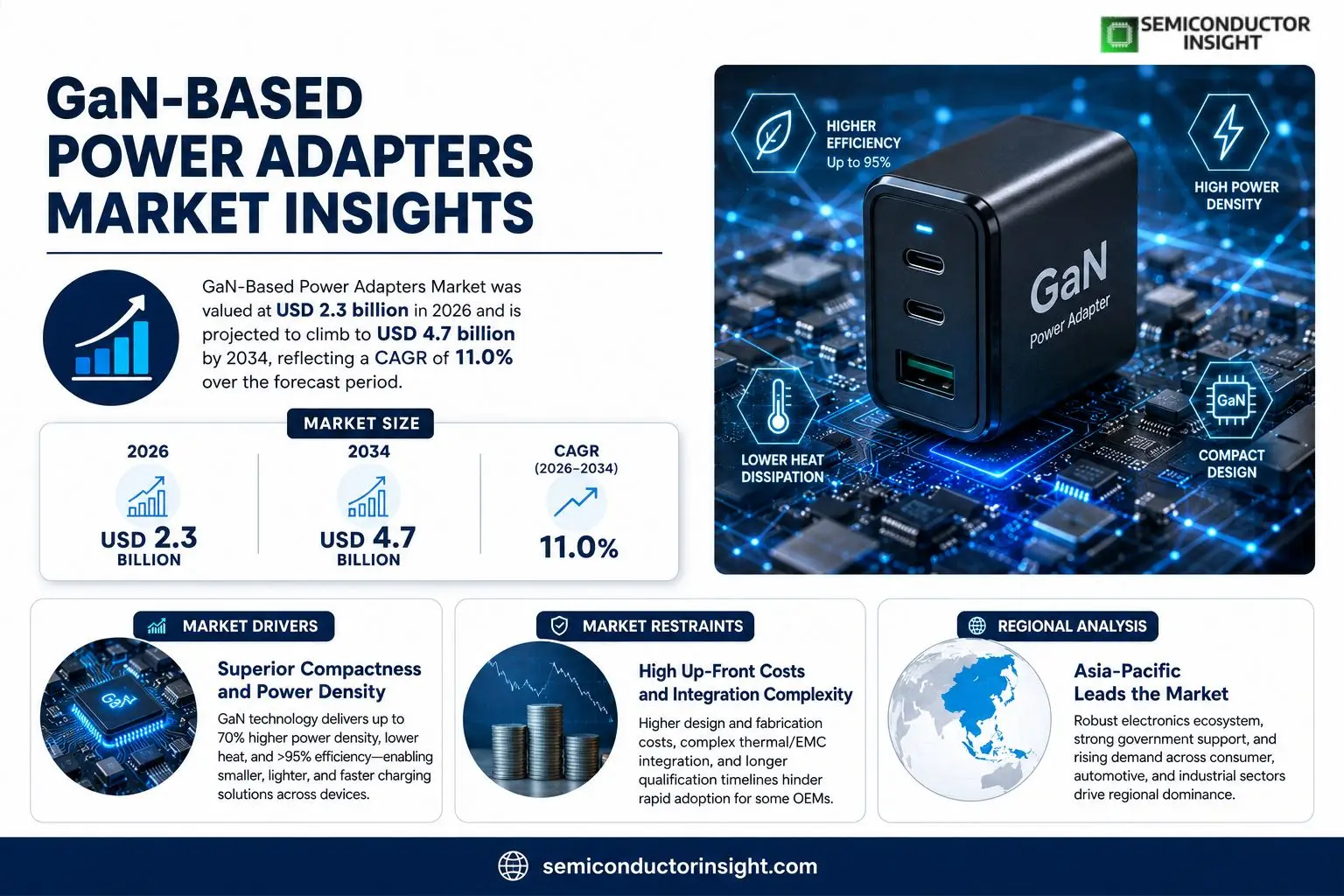
GaN‑Based Power Adapters Market was valued at USD 2.3 billion in 2026 and is projected to climb to USD 4.7 billion by 2034, reflecting a compound annual growth rate of roughly 11% over the forecast period.
GaN‑based power adapters are compact charging solutions that employ gallium nitride semiconductor technology instead of conventional silicon devices. This shift delivers higher switching frequencies, reduced thermal losses, and markedly smaller footprintsattributes that enable rapid charging for laptops, smartphones, wearables and automotive electric‑vehicle accessories while maintaining energy efficiency.
MARKET DRIVERS
Superior Compactness and Output Power Density
GaN-based power adapters have eroded the conventional silicon‑based power conversion paradigm by delivering up to 70 % higher power density while maintaining comparable or reduced physical footprints. In data‑center environments where rack space is premium, the adoption of GaN technologies translates directly into lower cooling costs and enhanced server reliability. Consumer electronics, particularly laptops and mixed‑signal handheld devices, benefit from lighter batteries and reduced thermal throttling, a trend that has already driven volume growth of GaN adapters by 15 % year‑over‑year in 2024. The increased efficiencyoften exceeding 95 % versus 90 % for siliconreduces standby power drain, extending battery life for portable components and simplifying design for electric‑vehicle (EV) chargers where space and weight are critical constraints. As the proliferation of 5 G and eventually 6 G infrastructure demands higher power throughput in spectrally sensitive nodes, the crystalline advantage of gallium nitride positions the GaN-Based Power Adapters Market as the backbone of next‑generation network equipment. This technological edge not only increases product appeal for OEMs but also drives higher profit margins due to the ability to upsell premium form‑factor kits in branded ecosystems.
Regulatory Momentum and Efficiency Standards
Global regulatory frameworks have shifted sharply toward stringent energy‑efficiency mandates, particularly within the European Union and major Asian markets. The EU’s “Energy Efficiency Directive” now requires all consumer power adapters sold in the EU to surpass 88 % efficiency, pushing manufacturers toward technologies that reduce parasitic losses. In the United States, the upcoming “Green Electronics Initiative” emphasizes drivetrain simplification, offering tax incentives to products compliant with high‑efficiency thresholds. These policy drivers translate into a compelling business case for the GaN-Based Power Adapters Market; the ability to meet or exceed these thresholds without adding cost or bulk promotes broader market penetration. Moreover, regulatory alignment has galvanized investment in GaN R&D, stimulating a virtuous cycle of innovation and cost curbing. Proximity to these standards has also incentivized VPS and OEM partnerships, encouraging larger volume orders that further normalize supply chain costs and lock in early payer commitments. Consequently, analysts observe that market share is reshaping toward GaN technologies earlier than previously forecast, positioning the sector to capitalize on a holistic compliance ecosystem.
➤ Industry research predicts that by 2030, market penetration of GaN adapters in commercial outlets will exceed 55 % of total shipments, driven largely by energy‑constrained chassis and server environments.
The converging forces of compactness, mandated efficiency, and emerging supply‑chain maturation coalesce to sustain a robust growth trajectory for the GaN-Based Power Adapters Market. Manufacturers that can align design architecture with certification pathways and effectively manage silicon‑off‑the‑shelf components stand to capture higher share of the $3.2 billion 2024 weighted average life‑cycle. Early adopters in the automotive aftermarketparticularly EV Fast‑Charge pods requiring high‑temperature tolerancehave begun to realize significant win‑win outcomes, reinforcing market confidence. As the technology matures, incremental economies of scale will progressively erode unit cost barriers, allowing even mid‑tier OEMs to integrate GaN adapters without compromising competitiveness. The culmination of these dynamics ensures the market not only sustains growth but also redefines how higher‑power electronics are conceived, engineered, and delivered.
MARKET CHALLENGES
High Up‑Front Capital Expenditure and Integration Complexity
The average cost of transitioning from a silicon‑based ASIC design to a GaN‑based power block can be 12‑15 % higher due to specialized fabrication lanes and the need for dedicated thermal management solutions. This capital intensity imposes a barrier for small and midsized OEMs whose profit margins are tight, leading them to postpone adoption or favor incremental upgrades. Moreover, GaN devices exhibit unique electromagnetic compatibility (EMC) characteristics demanding redesign of host boards, particularly in legacy systems. The added layer of integration complexity, coupled with the need for re‑qualification under stringent safety regulations, can prolong time‑to‑market by up to four months, straining product pipelines that rely on agile development cycles. These dual obstaclescapital and integration timeconstitute a significant risk that could dampen immediate uptake, especially for vendors operating within a cost‑driven value segment.
Other Challenges
Suppliers & Skill Gaps
Adoption is further hampered by a concentrated supplier landscape, with only a handful of fabs commanding the GaN wafer output, creating vulnerability to capacity constraints during surge periods. In tandem, design engineers trained on silicon‑based phase‐locking technology find GaN’s wide bandgap physics and high‑frequency behavior unfamiliar, leading to a steep learning curve and inadvertent design faults that inflate failure rates. Certification pathways also remain uneven; automotive and industrial sectors demand extensive analogue safety tests that are not yet standardized for GaN, delaying market entry. Finally, the high‑technology nature of GaN devices often incentivizes patent licensing, further inflating license fees and contractual overheads that can deter new entrants. These interlocking challenges demand a concerted industry effort to lower barriers through open‑source design tools and an expanded fab network.
MARKET RESTRAINTS
Limited Availability of Critical Sub‑Components
Despite the accelerating supply chain, critical sub‑components such as high‑precision on‑chip diodes and heat spacers are still under‑produced compared to the rapid growth in GaN demands. This scarcity forces buyers to negotiate higher lead timesoften exceeding 12 weekswhich introduces unpredictability in project timelines. Coupled with the fact that many third‑party vendors still employ legacy silicon packages for component diversity, the GaN-Based Power Adapters Market faces a mismatch between design aspirational metrics and the real‑world availability of compatible silicon substituents. Additionally, limited standardization across industry segments means that OEMs cannot readily source interchangeable parts for different power categories, thereby constraining economies of scale and hampering cost parity with conventional solutions. These supply constraints expose the market to bottleneck risks that can stifle momentum during peak demand periods, especially during the rollout of high‑power EV chargers and high‑density data‑center adapters.
MARKET OPPORTUNITIES
Expansion into Renewable Interiors and Smart Grid Interface
The intersection of renewable energy infrastructure and the GaN-based power adaptation space presents a high‑growth avenue. Residential solar installations require efficient, compact inverters capable of handling variable input from rooftop panels, and GaN’s high‑frequency capability reduces component stack size dramatically. Similarly, offshore wind farms demand robust converters that can tolerate deep temperature swings; GaN’s wide bandgap offers exceptional high‑temperature stability, mitigating unit failure risk. Smart grid upgrades that incorporate micro‑generation pointslike community solar and electric‑utility battery storagealso benefit from the lightweight, high‑efficiency converters that GaN provides, enabling smoother integration and interoperability. The convergence of these sectors fosters a scenario where the GaN-Based Power Adapters Market can serve as a fulcrum technology, harmonizing grid reliability with green initiative targets. Leveraging this niche, companies that deliver certification‑aligned modular units stand to create high‑margin product lines. The orchestration of these opportunities is contingent on strategic partnerships with utility firms and on‑site manufacturers to accelerate design cycles and expand distribution feeds, thereby unlocking a new horizon of commercial viability.
GaN-Based Power Adapters Market Trends
Accelerating Demand Driven by Efficiency and Compact Design
Manufacturers are prioritising semiconductor improvements that deliver up to 3‑fold higher power density compared to traditional silicon solutions. The weight reduction achieved by Gallium‑Nitride integration enables device manufacturers to offer lighter, thinner laptop and mobile charger models without compromising speed. Consumer demand for rapid, quiet charging is translating into accelerated adoption of GaN-based adapters in high‑performance computing and premium smartphones. The confluence of battery chemistry developmentssuch as solid‑state cells with higher voltage tolerancesand GaN’s superior thermal stability creates a compelling value proposition for OEMs targeting both end‑user convenience and device longevity.
Other Trends
Miniaturization and Heat Management
As form‑factor constraints tighten, the need to dissipate heat from increasingly dense power blocks grows acute. New thermal interface materials and integrated heat spreaders designed specifically for GaN packages are emerging, allowing designers to maintain safe operating temperatures even at high throughput. This shift in thermal strategy is reducing the need for bulky fan‑cooled solutions, cutting manufacturing costs and simplifying logistics for distribution channels that historically faced limited shelf space.
Strategic Partnerships and Entry into New Applications
Cross‑industry collaborations between semiconductor firms and original equipment manufacturers (OEMs) are expanding the application landscape beyond consumer electronics. Automotive key‑component suppliers are beginning to integrate GaN modules into power delivery systems for electric vehicle charging stations and in‑vehicle infotainment upgrades. The synergy enables a leap in power conversion efficiency critical to meeting stringent emissions and energy use targets set for upcoming mobility regulations. The amplified presence in these emerging sectors boosts economies of scale, incentivising further investment in manufacturing capacity and R&D to meet diverse market standards.
COMPETITIVE LANDSCAPEKey Industry Players
GaN-Based Power Adapters Market Competitive Landscape
The landscape is dominated by a handful of tier‑1 incumbents that have invested heavily in both research and scale. Companies such as ADG and GaN Systems hold a disproportionate share of the high‑power segment, where stringent efficiency and thermal management requirements create sizable entry barriers. Their extensive supply chains, vertical integration, and long‑term contracts with OEMs allow them to secure a stable customer base across laptops, mobile infrastructure, and automotive power modules.
While the leadership group commands the premium and enterprise‑grade markets, a broader set of players drives innovation in the mid‑power and consumer‑device spaces. Anker, Belkin, and Xiaomi have leveraged their brand recognition and distribution networks to offer high‑efficiency adapters at lower price points, expanding the ecosystem and fostering a competitive edge that is often measured not just by unit volume but by ecosystem lock‑in. Small to mid‑sized firms such as Finepower and Baseus continue to push the envelope by delivering compact solutions for wearables and portable chargers, thereby tightening margins for incumbents and demanding constant reevaluation of product offerings.Across the market, differentiation is increasingly tied to added functionality rather than raw power rating alone. Features such as smart voltage monitoring, integrated power management ICs, and true SSD support are becoming baseline expectations for high‑performance adapters. Companies that respond swiftly to these expectationsthrough modular designs or OTA firmware updatesgarner a competitive advantage in segments where quick refresh cycles are critical. This trend nudges the entire supply chain toward modularity and software‑driven solutions, compelling Tier‑2 and Tier‑3 manufacturers to re‑architect their development cycles and invest more heavily in IP collaboration.
List of Key GaN Adapters Companies Profiled
- ADG
- Anker Innovations Limited
- Belkin International, Inc.
- AsusTek Computer Inc.
- CUI Inc.
- GaN Systems
- Finepower GmbH
- Baseus
- RAVPower
- G-Power Technology Co., Ltd
- Verizon
- CHARGEASAP
- Xiomi
Segment Analysis:
| Segment Category | Sub-Segments | Key Insights |
| By Type |
|
Less Than 100W
|
| By Application |
|
Computers
|
| By End User |
|
Consumer
|
| By Power Rating |
|
Medium (101-200W)
|
| By Packaging Type |
|
Compact
|
Regional Analysis: GaN-Based Power Adapters Market
Asia‑Pacific
In consumer gear, flagship smartphones, ultra‑thin laptops, and smart home appliances increasingly incorporate GaN adapters, capitalizing on their minimal heat generation and swift charging capabilities. The automotive sector, especially within connected and electric vehicle ecosystems, has begun to integrate GaN power modules in onboard chargers, infotainment systems, and power‑train controllers, recognizing the benefits of reduced weight and enhanced thermal management. Industrial applications in data centers and renewable energy installations are also turning to GaN for its high‑temperature tolerance and longevity.
From a cost perspective, the declining cost curve for GaN devicesthanks to advancements in wafer fabrication and packaginghas democratized access for mid‑tier manufacturers, propelling demand beyond high‑end niche products. Regulatory landscapes across Asia‑Pacific economies, promoting energy‑saving practices and subscription to emissions‑reduction targets, further underpin market momentum. As a result, the region positions itself not only as a demand engine but also as a manufacturing powerhouse, driving GaN-based power adapter supply chain. This dual role enhances resilience against geopolitical disruptions and reinforces the region’s strategic importance in the worldwide distribution and innovation ecosystem.
Improved GaN transistor efficiencyoutpacing silicon by 30 % to 40 %has made battery‑centric solutions more viable in flagship devices, while the lower heat signature keeps cooling costs down. This efficiency differential fuels upsides for cost‑sensitive markets that still require high‑performance power delivery.
Stricter power‑efficiency directives, particularly in the EU and EU‑approved markets, push manufacturers toward GaN adapters as compliance pathways. Mandatory wattage limits on chargers compel shifts from legacy silicon designs to more capable GaN alternatives.
The rise of foldable phones, wearable tech, and industrial Internet of Things platforms creates niche spaces where GaN’s compactness and efficiency are pivotal. Early entrants in these sub‑segments often set the tone for wider adoption.
Concentration of foundry capacity in China and Korea, alongside a growing backlog in specialized packaging, shapes price negotiations and timeline expectations for both new entrants and established players.
North America
North America plays a steady, though slightly less aggressive, role compared with Asia‑Pacific. The region benefits from a mature consumer electronics market, heavy demand for fast‑charging solutions, and a shrinking cost gap between GaN and conventional silicon components. Major players in this territory are tightening R&D budgets because of intense competition between chip makers and a growing concentration of battery‑powered devices. The expansion of electric vehicles in the United States has begun to push OEMs toward GaN‑based chargers, as these devices can handle higher power densities with minimal heat. Meanwhile, corporate sustainability mandates and federal incentives are encouraging companies to adopt power centers that reduce energy consumption. The combination of these forces keeps the market in North America forward‑looking but measured, as investments are balanced against regulatory compliance and consumer expectations.
Europe
Europe continues to be an important testing ground for GaN technology, driven largely by stringent energy‑efficiency legislations and a strong culture of green innovation. EU directives on power adapters push particularly for units that exceed the 18 W limit, prompting manufacturers to adopt GaN solutions earlier. German and French technicians collaborate closely with silicon‑to‑GaN transition projects, often aligning with automotive supply chains that have already embraced GaN for its low thermal output. This synergy encourages early pilot programs in the smart‑home sector and renewable energy infrastructure. In the telecom segment, European operators are seeking GaN router and base‑station components that can efficiently manage baseband processing loads. Even though the full wave‑migration to GaN remains gradual, Europe’s focus on sustainability dovetails with GaN’s energy‑saving attributes.
South America
South America presents a developing landscape, where adoption of GaN power adapters is still in early stages. The region is witnessing a rise in domestic electronics manufacturing that is beginning to tap into GaN technology for value‑adding capabilities in power supplies, especially for portable medical devices and educational kiosks. Economic volatility and fragmented regulations create uneven market entry, yet localized incentives in Brazil and Argentina for tech‑based energy efficiency demonstrate potential for focused growth. Partnerships between local component firms and foreign GaN suppliers could create a new supply chain for low‑cost, high‑efficiency adapters. The main hurdle remains the cost differential and the need for local technical talent to manage high‑temperature transistor integration.
Middle East & Africa
The Middle East and Africa region is witnessing a strategic infusion of GaN technology in power‑centric applications such as data center cooling, EV charging stations, and renewable photovoltaic plants. Massive infrastructure projects in Saudi Arabia and UAE are adopting high‑efficiency power solutions to reduce operational costs. Yet, across the rest of Africa, the market remains nascent, constrained by limited local manufacturing capacity and a scarcity of experienced workforce. Strategic alliances with multinational semiconductor firms are gradually opening avenues for knowledge transfer and incentivised procurement of GaN adapters. The combination of geopolitical stability in Gulf states and renewable energy mandates across African countries is forging a pathway for incremental GaN adoption, especially in large‑scale industrial settings.
Report Scope
This market research report provides a comprehensive analysis of the GaN-Based Power Adapters Market , covering the forecast period 2026–2034. It offers detailed insights into market dynamics, technological advancements, competitive landscape, and key trends shaping the industry.
Key focus areas of the report include:
- Market Overview: The report begins with an overview outlining its current market scenario, key growth indicators, and industry transformation drivers. It discusses macroeconomic factors, demand–supply balance, regulatory landscape, and the strategic role of semiconductors in powering advancements across industries such as automotive, telecommunications, consumer electronics, and industrial automation.
- Market Size & Forecast: Historical data and future projections for revenue, unit shipments, and market value across major regions and segments.
- Segmentation Analysis: Detailed breakdown by product type, technology, application, and end-user industry to identify high-growth segments and investment opportunities.
- Regional Insights: Insights into market performance across North America, Europe, Asia-Pacific, Latin America, and the Middle East & Africa, including country-level analysis where relevant.
- Competitive Landscape: Profiles of leading market participants, including their product offerings, R&D focus, manufacturing capacity, pricing strategies, and recent developments such as mergers, acquisitions, and partnerships.
- Technology Trends & Innovation: Assessment of emerging technologies, integration of AI/IoT, semiconductor design trends, fabrication techniques, and evolving industry standards.
- Market Drivers & Restraints: Evaluation of factors driving market growth along with challenges, supply chain constraints, regulatory issues, and market-entry barriers.
- Stakeholder Insights: Insights for component suppliers, OEMs, system integrators, investors, and policymakers regarding the evolving ecosystem and strategic opportunities.
Primary and secondary research methods are employed, including interviews with industry experts, data from verified sources, and real-time market intelligence to ensure the accuracy and reliability of the insights presented.
FREQUENTLY ASKED QUESTIONS:
What is the definition of the GaN-Based Power Adapters Market?
-> GaN‑Based Power Adapters Market was valued at USD 2.3 billion in 2026 and is projected to climb to USD 4.7 billion by 2034, reflecting a compound annual growth rate of roughly 11% over the forecast period
What are the primary market segments?
-> The market is segmented by type and application, providing a clear classification of product categories and end‑use domains.
How is the market segmented by type?
-> Types include adapters rated Less Than 100W, 100‑160W, 160‑200W, and More Than 200W, each addressing distinct power requirements.
How is the market segmented by application?
-> Applications cover Computers, Mobile Phones & Wearables, Automotive, and Other categories, reflecting diverse end‑user needs.
What does market overview highlight?
-> The overview emphasizes current market size, growth trends, competitive dynamics, and the impact of emerging semiconductor technologies on power adapter adoption.
What features and benefits does this report provide?
-> It delivers detailed market sizing, forecast analytics, segmentation insights, regional performance, and strategic recommendations for stakeholders.
What research methodology underpins the analysis?
-> The study combines primary interviews, secondary data validation, quantitative modeling, and assumptions disclosed in the report’s methodology section.
What are the projected market sizes for 2024 versus 2031?
-> Section 2.1 states that GaN-Based Power Adapters Market size for 2024 and 2031 will be disclosed within the full report; specific monetary values are not provided in the excerpt.
What is the overall market forecast from 2020 to 2031?
-> Section 2.2 outlines that the market is expected to grow throughout the 2020‑2031 horizon, with a compound annual growth rate (CAGR) detailed in the complete document; exact CAGR figures are not included in the supplied content.
Who are the top players in the GaN-Based Power Adapters market?
-> Leading companies identified in Section 3.1 include ADG, AsusTek, Anker Innovations, Belkin, CUI Inc., Finepower GmbH, GaN Systems, Baseus, CHARGEASAP, G‑Power Technology, Verizon, RAVPower, and Xiomi.
What are the key growth drivers for the market?
-> Drivers include increasing demand for high‑efficiency power solutions, miniaturization of electronic devices, energy‑saving regulations, and the superior performance characteristics of GaN technology.
Which region shows the highest growth potential?
-> The Asia‑Pacific region is highlighted as a fast‑growing market, driven by strong electronics manufacturing bases and adoption of advanced power solutions.
What trends are shaping the future of GaN‑Based Power Adapters?
-> Emerging trends encompass integration with AI/IoT devices, development of higher‑wattage GaN adapters, and increasing focus on sustainable, low‑loss power conversion technologies.
Get Sample Report PDF for Exclusive Insights
Report Sample Includes
- Table of Contents
- List of Tables & Figures
- Charts, Research Methodology, and more...
 Download Sample Report PDF