G-Force Linear Acceleration Sensors Market Insights
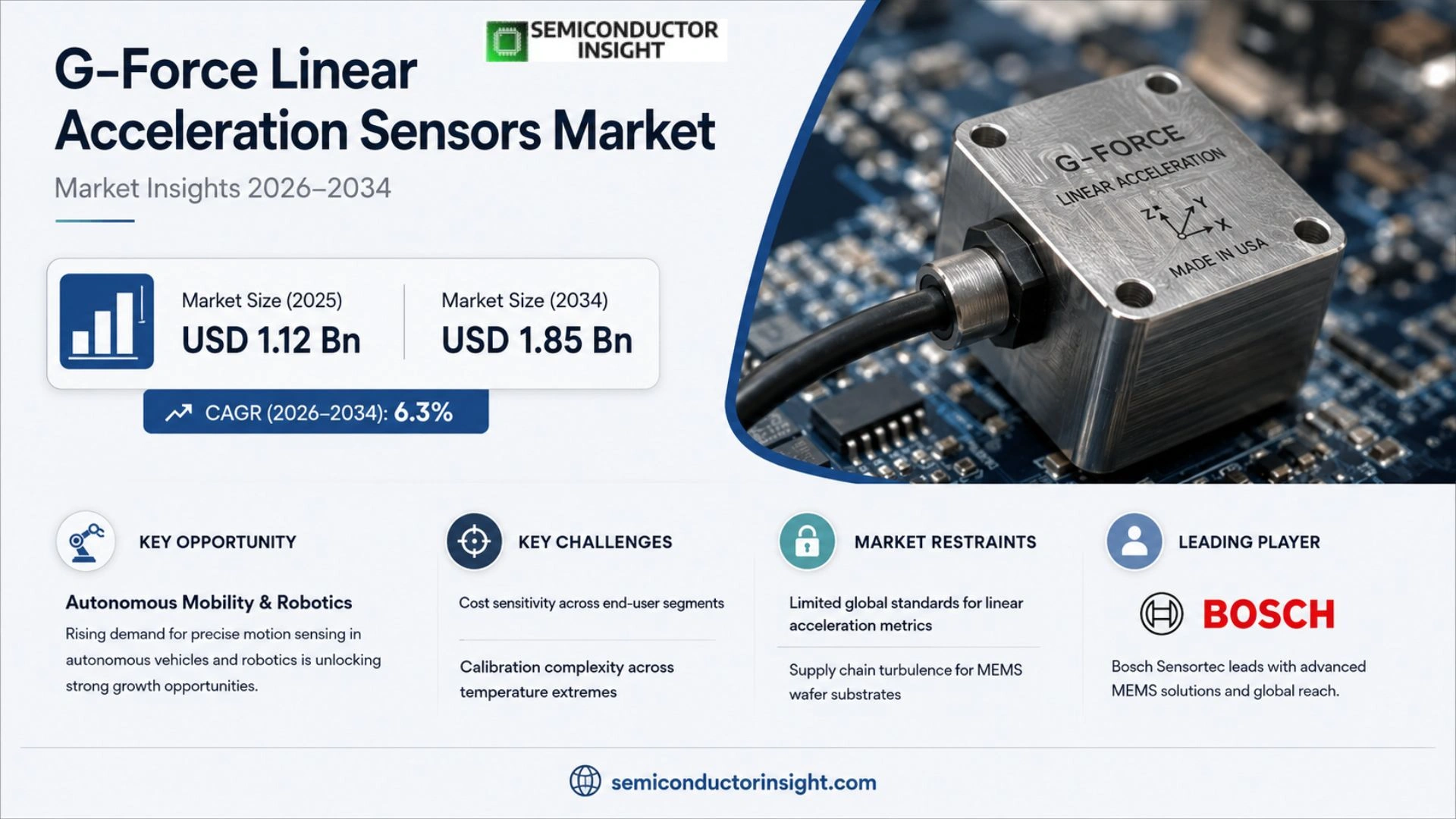
G-Force Linear Acceleration Sensors market was valued at USD 1.12 billion in 2025 and is forecasted to reach USD 1.85 billion by 2034, reflecting a CAGR of 6.3 % during the forecast period.
G‑Force linear accelerometer sensors are electromechanical devices that measure acceleration forces along one or multiple axes. Typical applications include detecting position, velocity, vibration and determining orientation in automotive systems, consumer electronics, aerospace platforms and industrial machinery.
The market gains momentum because automotive safety standards increasingly require precise motion sensing, while the proliferation of IoT devices drives demand for compact MEMS accelerometers. Major manufacturers such as Bosch, NXP Semiconductors, STMicroelectronics, Murata and Analog Devices continue expanding their portfolios through advanced MEMS designs and strategic partnerships.
MARKET DRIVERS
Automotive safety systems demand higher precision
The integration of advanced driver‑assistance systems (ADAS) has pushed OEMs to adopt sensors that capture linear acceleration with sub‑millisecond latency. G‑Force Linear Acceleration Sensors satisfy this requirement, enabling functions such as collision mitigation and rollover detection. As vehicle platforms become more software‑centric, the margin for sensor error narrows, making these devices a core component of safety architecture.
Industrial IoT and predictive maintenance
Manufacturers are embedding linear acceleration sensors into rotating machinery, conveyor belts, and robotic arms to monitor vibrational signatures. By feeding real‑time data into analytics engines, firms can forecast bearing wear or imbalance before a failure occurs, translating into reduced downtime and lower warranty costs. The trend reflects a broader shift toward data‑driven asset management.
➤ “When acceleration data is fused with temperature and pressure readings, the predictive model gains enough fidelity to cut unplanned outages by up to 30%.”
Beyond traditional sectors, consumer electronics,particularly next‑generation wearables,are exploiting compact, low‑power G‑Force sensors to enhance activity tracking and fall‑detection algorithms. The convergence of miniaturization and energy efficiency is widening the addressable market and encouraging cross‑industry collaboration.
MARKET CHALLENGES
Cost sensitivity across end‑user segments
While high‑end automotive and aerospace projects can absorb premium pricing, mass‑market applications such as smartphones and fitness devices operate on thin margins. Manufacturers therefore face pressure to lower bill‑of‑materials without compromising accuracy, a balance that often delays new product introductions.
Other Challenges
Calibration complexity
Achieving repeatable performance across temperature extremes requires multi‑point calibration rigs. Smaller suppliers lacking automated calibration infrastructure encounter longer lead times, which can bottleneck system integrators seeking rapid time‑to‑market.
MARKET RESTRAINTS
Limited global standards for linear acceleration metrics
The absence of universally accepted testing protocols hampers cross‑vendor comparability. End users must perform in‑house verification, adding engineering overhead and discouraging adoption in cost‑conscious projects.
Supply chain turbulence,particularly for MEMS wafer substrates,introduces lead‑time volatility. When capacity constraints arise, OEMs often resort to legacy sensor families, slowing the overall migration to newer G‑Force technologies.
MARKET OPPORTUNITIES
Autonomous mobility and robotics
Self‑driving platforms rely on a sensor fusion stack where linear acceleration data refines inertial navigation calculations. As regulatory frameworks mature, manufacturers that certify sensor performance for Level 4/5 autonomy will capture a premium segment of the market.
The defense sector is investing in high‑g shock sensors for missile telemetry and battlefield vehicle monitoring. These programs demand ruggedized packages capable of surviving extreme overloads, presenting a niche yet lucrative avenue for specialized sensor makers.
Emerging wearables targeting senior care are incorporating multi‑axis G‑Force modules to differentiate fall‑alert capabilities. Coupled with edge‑AI processors, these devices can trigger emergency services within seconds, creating a growth pathway driven by demographic shifts.
G-Force Linear Acceleration Sensors Market Trends
Increasing Adoption in Automotive Safety Systems
Automotive manufacturers are integrating G-Force Linear Acceleration Sensors more extensively to meet stricter safety regulations and to enhance active restraint technologies. The sensors provide precise measurement of crash dynamics, enabling air‑bag controllers to deploy with optimal timing. As vehicle platforms become increasingly modular, the demand for compact, low‑power sensors rises, prompting OEMs to replace legacy piezoelectric units with miniature MEMS devices. This shift is driven by the need for faster data processing and tighter packaging constraints, which together improve passenger protection without adding significant weight.
Other Trends
MEMS Accelerometer Segment Gains Momentum
MEMS‑based accelerometers are benefiting from advances in silicon‑on‑insulator processing and wafer‑scale integration. The result is a notable reduction in unit cost while maintaining high resolution across a broad frequency range. Suppliers are leveraging these efficiencies to penetrate price‑sensitive markets such as consumer wearables and industrial monitoring. The scalability of MEMS production lines also allows manufacturers to respond quickly to fluctuations in demand, reducing lead times for automotive and aerospace customers alike.
Diversification into Consumer Electronics
The proliferation of smartphones, drones, and virtual‑reality headsets has created a parallel demand curve for linear acceleration measurement. In handheld devices, the sensors enable motion‑based authentication and gesture recognition, while in drones they support stabilisation algorithms that improve flight safety. Companies that traditionally focused on heavy‑duty applications are allocating R&D resources to miniaturise their sensor portfolios, aiming to capture a share of the high‑volume consumer segment. This strategic pivot not only broadens revenue streams but also accelerates technology transfer across verticals, fostering innovation in sensor fusion and edge‑processing capabilities. The emerging trend of integrating sensor data directly into SoC architectures further reduces system complexity, positioning the market for sustained competitive advantage among early adopters.
COMPETITIVE LANDSCAPE
Key Industry Players
G-Force Linear Acceleration Sensors Market Competitive Overview
G‑Force Linear Acceleration Sensors market continues to be dominated by a handful of diversified semiconductor groups that leverage deep R&D budgets and global distribution networks. Bosch Sensortec, with its extensive automotive and consumer‑electronics portfolio, secures the largest share of revenue by bundling MEMS accelerometers with advanced signal‑processing firmware, allowing OEMs to reduce bill‑of‑materials while gaining reliable vibration monitoring. NXP Semiconductors follows closely, exploiting its position in automotive safety chips to embed linear acceleration modules directly into chassis control units, thereby shortening the time‑to‑market for active suspension systems. STMicroelectronics complements this tier by offering a broad product matrix that spans low‑cost piezoresistive devices to high‑precision MEMS units, which supports its strategy of cross‑selling to industrial automation customers. The concentration of market power among these three firms creates a barrier for newcomers, as they must either innovate on niche performance metrics or secure strategic partnerships to access tier‑1 supply chains. Recent patent filings reveal a focus on temperature‑stable silicon‑on‑glass processes, suggesting that competitive advantage will increasingly hinge on sensor fidelity under harsh environmental conditions.
Beyond the top tier, a dense layer of specialist manufacturers fuels differentiation across application segments. Murata’s expertise in ceramic‑based piezoelectric accelerometers positions it as a preferred supplier for aerospace vibration testing, where high‑frequency response and long‑term stability are paramount. PCB Piezotronics, with its strong foothold in test‑and‑measurement equipment, supplies customized sensor assemblies to defense contractors, leveraging its capability to integrate signal conditioning within the same package. Analog Devices, TDK and Kionix (a ROHM subsidiary) compete vigorously in the consumer‑electronics space, each pushing miniaturization limits to enable motion‑aware smartphones and wearables. Honeywell and TE Connectivity address the industrial and automotive safety markets by offering ruggedized designs that meet stringent ISO‑26262 certification. Emerging players such as MCube, Memsic, and Safran Colibrys are betting on ultra‑low‑power MEMS architectures that cater to IoT devices, where battery life is a decisive factor. This segmentation of the competitive field implies that strategic alliances, application‑specific engineering, and agile product cycles will be decisive for firms seeking to capture growth pockets.
List of Key G-Force Linear Acceleration Sensors Companies Profiled
- Bosch Sensortec
- NXP Semiconductors
- STMicroelectronics
- Murata Manufacturing
- PCB Piezotronics
- Analog Devices Inc.
- TDK Corporation
- Kionix (ROHM)
- Honeywell International Inc.
- TE Connectivity
- MCube
- KISTLER
- Meggitt Sensing Systems
- Memsic
- Safran Colibrys
Segment Analysis:
| Segment Category | Sub-Segments | Key Insights |
| By Type |
|
MEMS Accelerometer
|
| By Application |
|
Automobile
|
| By End User |
|
Vehicle Manufacturers
|
| By Technology |
|
Digital Output Sensors
|
| By Integration Level |
|
Embedded Modules
|
Regional Analysis: G-Force Linear Acceleration Sensors Market
North America
Tier‑1 car makers in the United States and Canada press sensor suppliers to deliver units that survive harsh vibration while delivering precise telemetry for active safety systems, encouraging a shift toward integrated sensor‑fusion architectures.
Factories adopting collaborative robots value linear acceleration sensors for real‑time motion monitoring, prompting vendors to package ruggedized devices that communicate seamlessly with PLC networks.
Defense contractors and commercial aircraft programs prioritize sensors that can endure extreme temperature cycles, leading to bespoke calibration services and long‑term support contracts.
Wearable device makers seek miniature linear acceleration units that can be embedded without compromising battery life, driving a niche but technically demanding segment of the market.
Europe
European manufacturers benefit from a regulatory environment that stresses safety validation, prompting early adoption of high‑precision G-Force Linear Acceleration Sensors. The region’s strong automotive heritage, especially in Germany and France, creates a demand for sensors that can be integrated into electric vehicle platforms and advanced driver‑assistance systems. Meanwhile, aerospace hubs in the United Kingdom and the Netherlands leverage local research labs to prototype sensors tailored for satellite attitude control. The collaborative culture between OEMs and academic institutions nurtures incremental advances, particularly in low‑noise MEMS designs. Although cost sensitivity is higher than in North America, the willingness to pay for compliant, certified components sustains a healthy market rhythm across the continent.
Asia‑Pacific
Asia‑Pacific’s growth engine stems from rapidly modernizing automotive factories in China, Japan, and South Korea, where manufacturers are upgrading assembly lines with smart diagnostics. Sensor providers are responding by localizing production to shorten lead times and align with regional standards. In addition, burgeoning drone and unmanned‑vehicle programs in India and Southeast Asia are creating fresh application niches for linear acceleration sensors. The region’s talent pool in semiconductor fabrication contributes to a cascade of design iterations that emphasize miniaturization and power efficiency. While price competition is intense, the sheer volume of emerging projects generates a robust demand pipeline for G-Force Linear Acceleration Sensors Market.
South America
South American demand is anchored by Brazil’s expanding automotive assembly sector, where manufacturers are incorporating linear acceleration sensors to meet global safety certifications for exported models. The mining industry also adopts sensor solutions to monitor equipment health in remote operations, reflecting a cross‑industry push for predictive maintenance. Limited domestic sensor fabrication capacity drives reliance on imports, yet local distributors are adding value through calibration services and after‑sales technical support. Market participants note a gradual shift from pure cost‑driven purchases to performance‑oriented specifications as multinational OEMs establish regional engineering centers.
Middle East & Africa
In the Middle East and Africa, the aerospace and defense segments drive the principal demand for G-Force Linear Acceleration Sensors, with several national space agencies initiating satellite programmes that require precise attitude sensors. Oil‑field equipment manufacturers incorporate robust linear acceleration devices to monitor drill‑string dynamics, improving safety in harsh environments. While overall market size remains modest, strategic partnerships with European and North American suppliers are accelerating technology transfer, allowing regional players to offer customized solutions for local infrastructure projects and emerging smart‑city initiatives.
Report Scope
This market research report provides a comprehensive analysis of the G-Force Linear Acceleration Sensors Market , covering the forecast period 2026–2034. It offers detailed insights into market dynamics, technological advancements, competitive landscape, and key trends shaping the industry.
Key focus areas of the report include:
- Market Overview: The report begins with an overview outlining its current market scenario, key growth indicators, and industry transformation drivers. It discusses macroeconomic factors, demand–supply balance, regulatory landscape, and the strategic role of semiconductors in powering advancements across industries such as automotive, telecommunications, consumer electronics, and industrial automation.
- Market Size & Forecast: Historical data and future projections for revenue, unit shipments, and market value across major regions and segments.
- Segmentation Analysis: Detailed breakdown by product type, technology, application, and end-user industry to identify high-growth segments and investment opportunities.
- Regional Insights: Insights into market performance across North America, Europe, Asia-Pacific, Latin America, and the Middle East & Africa, including country-level analysis where relevant.
- Competitive Landscape: Profiles of leading market participants, including their product offerings, R&D focus, manufacturing capacity, pricing strategies, and recent developments such as mergers, acquisitions, and partnerships.
- Technology Trends & Innovation: Assessment of emerging technologies, integration of AI/IoT, semiconductor design trends, fabrication techniques, and evolving industry standards.
- Market Drivers & Restraints: Evaluation of factors driving market growth along with challenges, supply chain constraints, regulatory issues, and market-entry barriers.
- Stakeholder Insights: Insights for component suppliers, OEMs, system integrators, investors, and policymakers regarding the evolving ecosystem and strategic opportunities.
Primary and secondary research methods are employed, including interviews with industry experts, data from verified sources, and real-time market intelligence to ensure the accuracy and reliability of the insights presented.
FREQUENTLY ASKED QUESTIONS:
What is the current market size of G-Force Linear Acceleration Sensors Market?
-> G-Force Linear Acceleration Sensors market is forecasted to reach USD 1.85 billion by 2034, reflecting a CAGR of 6.3 % during the forecast period.
Which key companies operate in G-Force Linear Acceleration Sensors Market?
-> Key players include Bosch, NXP Semiconductors, STMicroelectronics, Murata, PCB Piezotronics, Analog Devices Inc., TDK, Kionix (ROHM), Honeywell International Inc., TE, etc.
What are the key growth drivers?
-> Key growth drivers include rising demand for precise motion sensing in automotive, consumer electronics, aerospace and defense applications, and increasing adoption of IoT-enabled devices that require accurate acceleration measurement.
Which region dominates the market?
-> North America currently holds a leading position, driven by strong US market activity, while Asia-Pacific (especially China) is emerging rapidly.
What are the emerging trends?
-> Emerging trends include the rapid growth of MEMS accelerometer segment projected to reach significant revenue by 2036, integration of sensor data analytics with AI, and expanding use in autonomous vehicle and wearable technologies.
Get Sample Report PDF for Exclusive Insights
Report Sample Includes
- Table of Contents
- List of Tables & Figures
- Charts, Research Methodology, and more...
 Download Sample Report PDF