Fuel Gauge IC (Impedance Tracking) Market Insights
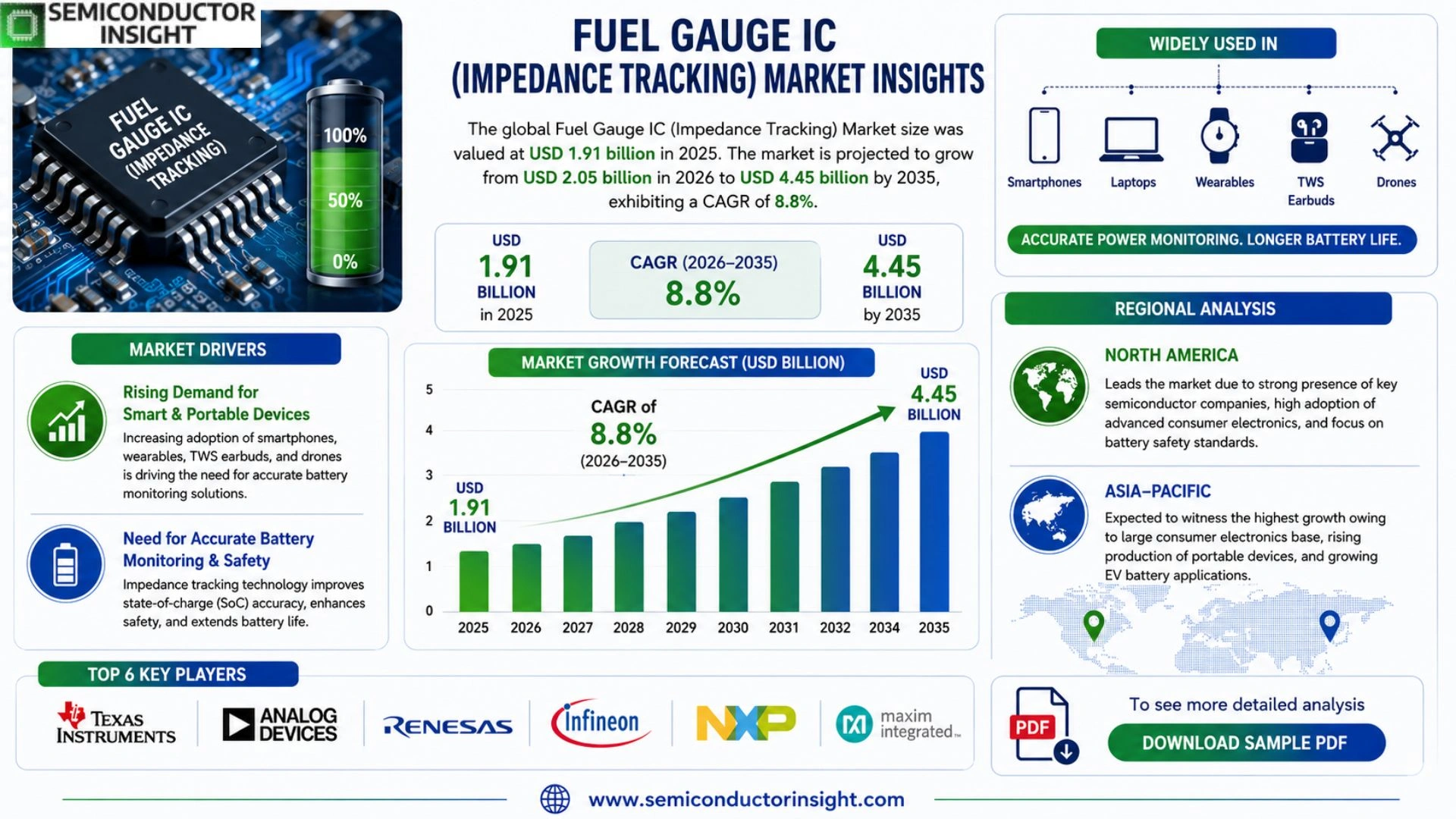
Fuel Gauge IC (Impedance Tracking) Market size was valued at USD 1.91 billion in 2025. The market is projected to grow from USD 2.05 billion in 2026 to USD 4.45 billion by 2035, exhibiting a CAGR of 8.8% during the forecast period.
Fuel Gauge ICs with Impedance Tracking technology are specialized semiconductor devices designed to accurately monitor and report the state of charge, state of health, and remaining capacity of lithium-ion and lithium-polymer batteries. These ICs utilize advanced impedance measurement techniques to dynamically adapt to battery aging, temperature variations, and varying load conditions, providing precise fuel gauging without extensive manual characterization.
The market is experiencing robust growth due to several factors, including the rapid expansion of portable consumer electronics, increasing adoption of electric vehicles, and growing demand for reliable battery management in energy storage systems. Furthermore, advancements in battery technologies and the need for extended runtime in wearable devices and industrial applications are contributing to market expansion. Key players continue to innovate with enhanced algorithms that improve accuracy and efficiency. For instance, Texas Instruments has introduced new fuel gauge solutions featuring Dynamic Z-Track technology, building upon its established Impedance Track platform to deliver up to 30% longer run times in battery-powered devices. Texas Instruments, Analog Devices, Maxim Integrated, and STMicroelectronics are among the leading companies operating in the market with comprehensive portfolios of high-precision fuel gauge ICs.
MARKET DRIVERS
Rising Demand for Accurate Battery Monitoring in EVs and Consumer Electronics
Fuel Gauge IC (Impedance Tracking) Market is propelled by the expanding adoption of lithium-ion batteries across electric vehicles, smartphones, laptops, and portable devices. Impedance tracking technology enables precise state-of-charge (SoC) and state-of-health (SoH) estimation by modeling battery impedance in real-time, adapting to aging and usage patterns for up to 99% accuracy in advanced solutions.
Growth in Renewable Energy Storage and IoT Applications
Integration of advanced fuel gauge ICs with impedance tracking supports efficient energy management in renewable storage systems and IoT devices. As battery packs face variable loads and temperatures, these ICs provide reliable runtime predictions and enhance overall system performance.
➤ Advancements such as Dynamic Z-Track technology allow real-time impedance calculations across wide frequency ranges, extending battery runtime by up to 30% in portable electronics.
The proliferation of wearables, medical devices, and industrial equipment further accelerates demand for low-power, high-precision fuel gauge solutions that maintain accuracy throughout the battery lifecycle.
MARKET CHALLENGES
Ensuring Accuracy Across Diverse Operating Conditions
Delivering consistent performance of Fuel Gauge IC (Impedance Tracking) solutions in extreme temperatures, dynamic loads, and varying battery chemistries remains a significant technical hurdle for manufacturers.
Other Challenges
High Development Costs and Integration Complexity
Designing impedance tracking algorithms that support emerging battery technologies like silicon-anode and solid-state cells requires substantial R&D investment and complex calibration processes.
Supply Chain and Raw Material Volatility
Fluctuations in semiconductor component availability and raw material prices impact production scalability and pricing stability for fuel gauge ICs.
MARKET RESTRAINTS
Competition from Alternative Battery Monitoring Technologies
While impedance tracking offers superior accuracy, simpler voltage-based or coulomb-counting methods continue to be used in cost-sensitive applications, restraining broader market penetration for advanced Fuel Gauge IC (Impedance Tracking) solutions.
The need for specialized expertise in battery modeling and ongoing firmware updates to accommodate new cell chemistries adds to implementation barriers for OEMs.
MARKET OPPORTUNITIES
Emerging Applications in Advanced Battery Chemistries and AI Integration
Fuel Gauge IC (Impedance Tracking) Market stands to benefit from the transition to next-generation batteries and incorporation of AI-driven adaptive algorithms. These enhancements improve SoC estimation under high-frequency loads and support electrochemical impedance spectroscopy for better health monitoring. Expansion into medical devices, drones, and grid-scale storage presents new avenues for high-reliability impedance tracking ICs that meet stringent regulatory and safety requirements.
Trends
Rising Adoption Driven by Battery-Powered Applications
Fuel Gauge IC (Impedance Tracking) Market is witnessing strong momentum as industries prioritize accurate battery monitoring solutions. These specialized ICs employ advanced impedance measurement techniques to deliver precise state of charge, state of health, and remaining capacity data for lithium-ion and lithium-polymer batteries. By dynamically adapting to battery aging, temperature changes, and load variations, impedance tracking technology eliminates the need for extensive manual characterization while ensuring reliable performance across diverse operating conditions.
Other Trends
Expansion in Consumer Electronics and Wearables
Portable consumer electronics and wearable devices are key growth areas for Fuel Gauge IC (Impedance Tracking) Market. Manufacturers seek extended runtime and improved user experience, driving demand for high-precision fuel gauge solutions that optimize battery utilization in compact form factors. The technology supports longer operation times under varying usage patterns common in smartphones, tablets, and fitness trackers.
Advancements in Electric Vehicles and Energy Storage
Electric vehicle adoption and stationary energy storage systems are accelerating the integration of sophisticated battery management. Fuel Gauge IC (Impedance Tracking) solutions provide critical insights that enhance safety, efficiency, and longevity of battery packs in these high-stakes applications. Temperature compensation and real-time impedance analysis enable better performance prediction and preventive maintenance strategies.
Innovation in Algorithm Development
Leading semiconductor companies are enhancing impedance tracking algorithms to improve accuracy and efficiency. Texas Instruments has developed solutions featuring Dynamic Z-Track technology, building on its Impedance Track platform to achieve significantly extended run times in battery-powered devices. Such innovations allow devices to maintain precise fuel gauging throughout the battery lifecycle without recalibration.
Other Trends
Competitive Landscape and Technology Differentiation
Fuel Gauge IC (Impedance Tracking) Market features active participation from established players including Texas Instruments, Analog Devices, Maxim Integrated, and STMicroelectronics. These companies offer comprehensive portfolios of high-precision ICs tailored for different voltage ranges and application requirements. Ongoing research focuses on integrating impedance tracking with additional battery management functions to create more versatile single-chip solutions for next-generation devices.
Industrial applications also contribute to sustained demand, where reliable battery monitoring ensures operational continuity in mission-critical equipment. As battery technologies evolve toward higher energy densities and faster charging, Fuel Gauge IC (Impedance Tracking) solutions continue to adapt, providing the measurement precision necessary for optimal system performance across consumer, automotive, and industrial sectors.
COMPETITIVE LANDSCAPE
Key Industry Players
Fuel Gauge IC (Impedance Tracking) Market Competitive Analysis
Texas Instruments dominates Fuel Gauge IC (Impedance Tracking) Market as the pioneer and leading innovator with its proprietary Impedance Track and advanced Dynamic Z-Track technologies. The company maintains a significant market share through its comprehensive portfolio of high-precision fuel gauge solutions that deliver superior state-of-charge and state-of-health accuracy, even under varying load, temperature, and aging conditions. This technological leadership, combined with strong integration capabilities for portable electronics, electric vehicles, and energy storage systems, positions TI as the benchmark provider in a market characterized by high barriers to entry due to complex algorithm development and semiconductor expertise.
Other significant players include Analog Devices, STMicroelectronics, and Maxim Integrated (now part of Analog Devices), which offer competitive fuel gauge ICs with advanced monitoring features tailored for consumer electronics and industrial applications. Niche participants such as Microchip Technology, Renesas Electronics, ON Semiconductor, and ROHM Semiconductor contribute specialized solutions focusing on cost-efficiency, multi-cell support, and integration with broader battery management systems, driving overall market innovation and expansion.
List of Key Fuel Gauge IC (Impedance Tracking) Companies Profiled
- Texas Instruments
- Analog Devices
- STMicroelectronics
- Maxim Integrated
- Microchip Technology
- Renesas Electronics
- ON Semiconductor
- NXP Semiconductors
- ROHM Semiconductor
- CellWise
- SinoWealth
- Richtek Technology
- Nordic Semiconductor
Segment Analysis:
| Segment Category | Sub-Segments | Key Insights |
| By Type |
|
Multi-Cell Fuel Gauge ICs stand out due to their capability to manage complex battery packs with multiple cells connected in series or parallel configurations. These solutions excel in providing synchronized impedance tracking across cells, ensuring balanced performance and extended operational reliability. Their advanced algorithms dynamically adjust to cell-to-cell variations caused by manufacturing tolerances or differential aging. This segment benefits from seamless integration with sophisticated battery management systems that prioritize safety and longevity in demanding environments. Manufacturers favor these ICs for their robust error correction and real-time state-of-health monitoring features. |
| By Application |
|
Consumer Electronics represents a leading segment driven by the need for precise runtime prediction in smartphones, tablets, and laptops. Impedance tracking technology enables these devices to deliver accurate battery information even under variable usage patterns and temperature fluctuations. The segment emphasizes compact designs that minimize power consumption while maximizing user experience through reliable fuel gauging. Innovations focus on rapid adaptation to fast-charging protocols and diverse load conditions typical in portable gadgets. This application area continues to prioritize fuel gauge ICs that enhance overall device efficiency and user satisfaction without compromising on size constraints. |
| By End User |
|
Automotive Manufacturers leverage these ICs extensively for electric vehicle battery packs where safety and range estimation are paramount. The impedance tracking functionality allows for precise monitoring across wide temperature ranges and high-current demands encountered during acceleration and regenerative braking. End users in this category value solutions that support long-term battery health tracking throughout the vehicle’s lifecycle. Integration with vehicle control units enables predictive maintenance alerts and optimized energy management strategies. This segment drives demand for highly durable and automotive-grade components that maintain accuracy despite vibration, thermal cycling, and extended operational periods. |
| By Battery Chemistry |
|
Lithium-Ion dominates as the primary chemistry supported by impedance tracking fuel gauge ICs. These ICs provide exceptional modeling accuracy by accounting for the unique impedance profiles that evolve as lithium-ion cells age and experience different discharge depths. The technology excels in compensating for temperature-induced variations that commonly affect lithium-ion performance. Key advantages include enhanced state-of-charge estimation that supports user confidence in battery-powered systems. Solutions tailored for this chemistry often incorporate advanced learning algorithms that refine predictions over multiple charge cycles, resulting in more consistent runtime reporting and better protection against over-discharge scenarios. |
| By Integration Level |
|
System-on-Chip Solutions gain prominence by combining impedance tracking fuel gauge functionality with additional power management features on a single die. This high integration reduces board space and simplifies design efforts for device manufacturers while maintaining superior measurement precision. The approach supports tighter coupling between gauging algorithms and charging control circuits, leading to optimized energy utilization. These solutions particularly appeal to compact devices requiring minimal external components. Enhanced communication interfaces within the SoC enable seamless data exchange with host processors, facilitating richer battery information displays and smarter power-saving modes across various operating conditions. |
Regional Analysis: Fuel Gauge IC (Impedance Tracking) Market
Asia-Pacific’s integrated semiconductor and battery ecosystem allows seamless development of impedance tracking fuel gauge ICs. Proximity between design houses, fabrication facilities, and end-product assemblers shortens development cycles and supports customization for diverse voltage and chemistry requirements.
Explosive growth in electric vehicles and portable devices fuels adoption of advanced impedance tracking technologies. Regional OEMs prioritize fuel gauge ICs that deliver real-time battery health insights, improving user experience and product reliability across premium and mass-market segments.
Leading technology firms invest heavily in refining impedance measurement algorithms within fuel gauge ICs. This focus drives breakthroughs in accuracy under varying temperature and load conditions, reinforcing the region’s competitive edge in battery intelligence solutions.
Supportive policies for clean technology and digital infrastructure encourage widespread deployment of smart battery systems. This environment nurtures demand for sophisticated impedance tracking fuel gauge ICs in renewable energy storage and next-generation mobility platforms.
North America
North America exhibits strong momentum Fuel Gauge IC (Impedance Tracking) Market, particularly through its emphasis on high-performance applications in automotive, aerospace, and premium consumer electronics. The region leverages advanced R&D capabilities to enhance impedance tracking precision, focusing on safety-critical systems where accurate battery monitoring prevents failures. Major technology companies and automotive manufacturers drive integration of these ICs into electric vehicles and data center backup power solutions. Collaborative ecosystems between semiconductor innovators and battery developers accelerate the adoption of sophisticated algorithms that adapt to complex usage patterns. While production volumes may trail Asia-Pacific, North America’s leadership in software integration and system-level optimization ensures fuel gauge ICs deliver superior intelligence for demanding environments.
Europe
Europe maintains a significant position Fuel Gauge IC (Impedance Tracking) Market, underpinned by stringent regulatory standards for battery safety and environmental sustainability. The region’s ambitious electric vehicle targets and renewable energy storage initiatives create steady demand for reliable impedance-based fuel gauging solutions. European manufacturers prioritize quality, longevity, and compliance, favoring ICs that provide detailed impedance data for predictive maintenance and extended battery life. Strong automotive heritage combined with growing investments in green technology fosters innovation in multi-chemistry impedance tracking approaches suitable for diverse applications across industrial and consumer sectors.
South America
South America is gradually expanding its role Fuel Gauge IC (Impedance Tracking) Market as local industries adopt modern battery technologies. Growth stems from increasing investments in telecommunications infrastructure, renewable energy projects, and emerging electric mobility programs. While the market remains developing, demand rises for cost-effective yet accurate impedance tracking solutions that withstand challenging environmental conditions. Regional players focus on adapting global technologies to local needs, particularly in off-grid power systems and agricultural equipment, laying foundations for future market expansion through partnerships with international technology providers.
Middle East & Africa
The Middle East and Africa region shows promising potential Fuel Gauge IC (Impedance Tracking) Market, driven by diversification efforts into renewable energy and smart infrastructure. Growing solar and energy storage deployments require robust battery management solutions where impedance tracking fuel gauge ICs excel in harsh climates. Urbanization and digital transformation initiatives further boost demand in telecommunications and data management sectors. Although currently smaller in scale, strategic investments and technology transfer programs are enhancing local capabilities, positioning the region for accelerated adoption as battery-dependent applications proliferate across key industries.
Report Scope
This market research report provides a comprehensive analysis of the Fuel Gauge IC (Impedance Tracking) Market , covering the forecast period 2026–2034. It offers detailed insights into market dynamics, technological advancements, competitive landscape, and key trends shaping the industry.
Key focus areas of the report include:
- Market Overview: The report begins with an overview outlining its current market scenario, key growth indicators, and industry transformation drivers. It discusses macroeconomic factors, demand–supply balance, regulatory landscape, and the strategic role of semiconductors in powering advancements across industries such as automotive, telecommunications, consumer electronics, and industrial automation.
- Market Size & Forecast: Historical data and future projections for revenue, unit shipments, and market value across major regions and segments.
- Segmentation Analysis: Detailed breakdown by product type, technology, application, and end-user industry to identify high-growth segments and investment opportunities.
- Regional Insights: Insights into market performance across North America, Europe, Asia-Pacific, Latin America, and the Middle East & Africa, including country-level analysis where relevant.
- Competitive Landscape: Profiles of leading market participants, including their product offerings, R&D focus, manufacturing capacity, pricing strategies, and recent developments such as mergers, acquisitions, and partnerships.
- Technology Trends & Innovation: Assessment of emerging technologies, integration of AI/IoT, semiconductor design trends, fabrication techniques, and evolving industry standards.
- Market Drivers & Restraints: Evaluation of factors driving market growth along with challenges, supply chain constraints, regulatory issues, and market-entry barriers.
- Stakeholder Insights: Insights for component suppliers, OEMs, system integrators, investors, and policymakers regarding the evolving ecosystem and strategic opportunities.
Primary and secondary research methods are employed, including interviews with industry experts, data from verified sources, and real-time market intelligence to ensure the accuracy and reliability of the insights presented.
FREQUENTLY ASKED QUESTIONS:
What is the current market size of Fuel Gauge IC (Impedance Tracking) Market?
-> Fuel Gauge IC (Impedance Tracking) Market was valued at USD 1.91 billion in 2025 and is expected to reach USD 4.45 billion by 2034.
Which key companies operate Fuel Gauge IC (Impedance Tracking) Market?
-> Key players include Texas Instruments, Analog Devices, Maxim Integrated, and STMicroelectronics, among others.
What are the key growth drivers?
-> Key growth drivers include rapid expansion of portable consumer electronics, increasing adoption of electric vehicles, and growing demand for reliable battery management in energy storage systems.
Which region dominates the market?
-> Asia-Pacific is the fastest-growing region, while North America remains a dominant market.
What are the emerging trends?
-> Emerging trends include Dynamic Z-Track technology, enhanced impedance measurement algorithms, and AI integration for improved accuracy and efficiency.

Get Sample Report PDF for Exclusive Insights
Report Sample Includes
- Table of Contents
- List of Tables & Figures
- Charts, Research Methodology, and more...