Force Sensing Resistor (FSR) for Touch Pressure Market Insights
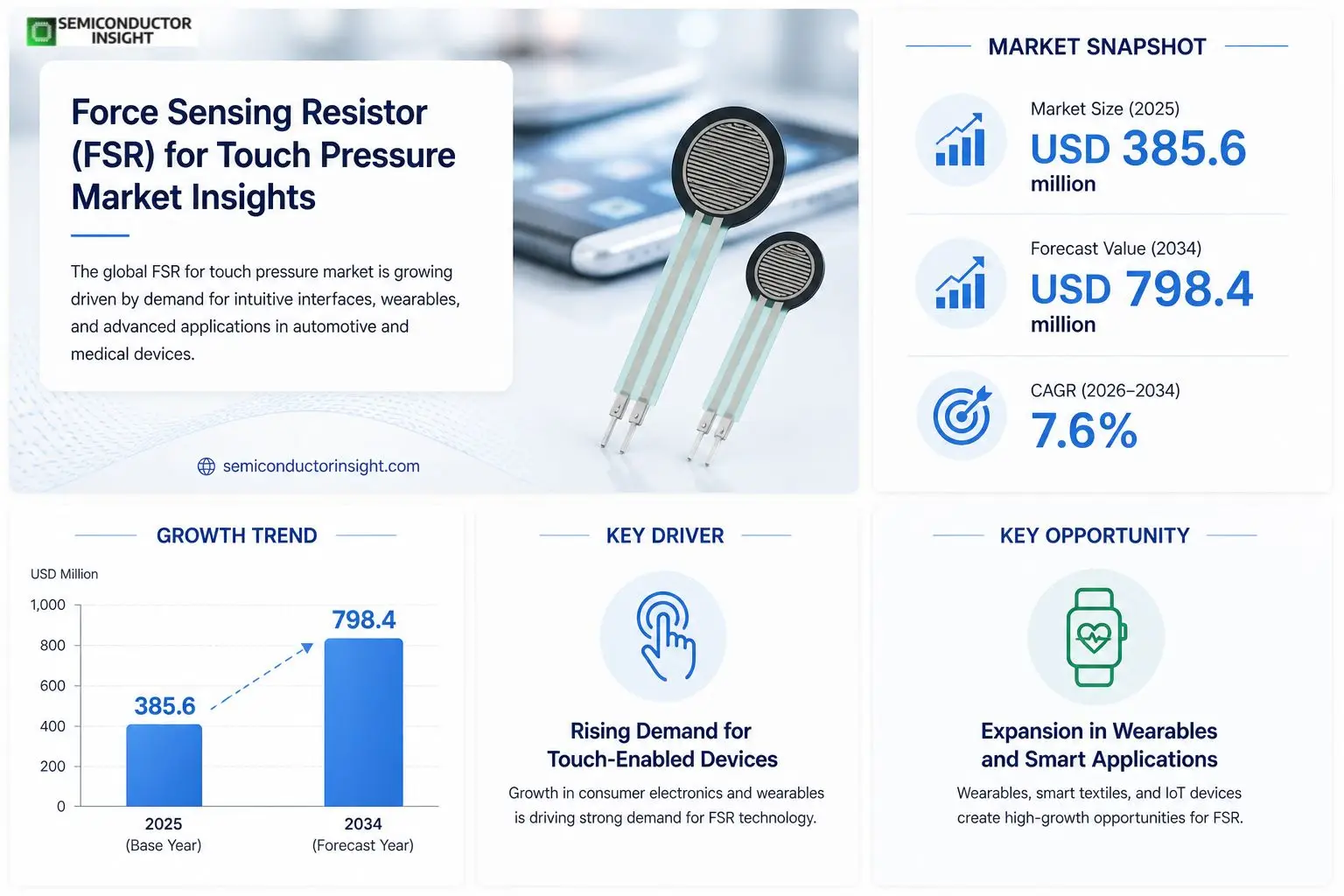
Global Force Sensing Resistor (FSR) for Touch Pressure market size was valued at USD 385.6 million in 2025. The market is projected to grow from USD 412.3 million in 2026 to USD 798.4 million by 2034, exhibiting a CAGR of 7.6% during the forecast period.
Force Sensing Resistors (FSRs) are polymer thick-film devices that exhibit a decrease in resistance when force or pressure is applied to their active sensing area. These sensors are widely used to measure touch, pressure, and force in human-machine interface applications. FSRs are available in various form factors, including round, square, and custom-shaped designs, and are commonly integrated into consumer electronics, medical devices, automotive systems, and industrial equipment.
The market is witnessing steady expansion driven by growing demand for intuitive touch-based interfaces across consumer electronics and the rapid proliferation of wearable devices. Furthermore, the increasing adoption of FSR technology in automotive seat occupancy detection and medical pressure monitoring applications is reinforcing market growth. Key players such as Interlink Electronics, Inc., Tekscan, Inc., and Sensitronics operate in this space with diverse product portfolios catering to a broad range of end-use industries.
MARKET DRIVERS
Rising Adoption of Touch-Enabled Devices Accelerating Demand for Force Sensing Resistor Technology
Global Force Sensing Resistor (FSR) for touch pressure market is experiencing significant momentum driven by the rapid proliferation of touch-enabled consumer electronics. As smartphones, tablets, wearables, and interactive displays continue to integrate more sophisticated human-machine interfaces, manufacturers are increasingly relying on FSR-based touch pressure sensing to deliver nuanced, responsive user experiences. Unlike conventional capacitive sensors, FSR technology offers distinct advantages in detecting varying levels of applied force, making it particularly valuable in applications where pressure differentiation is critical to device functionality.
Healthcare and Medical Device Integration Fueling Force Sensing Resistor Market Expansion
The healthcare sector represents one of the most consequential growth drivers for the Force Sensing Resistor (FSR) touch pressure market. Clinical applications such as prosthetics, rehabilitation equipment, surgical robotics, and patient monitoring systems increasingly depend on precise pressure measurement capabilities. FSR sensors embedded in wearable medical devices enable continuous, real-time monitoring of contact pressure, which is essential for preventing pressure ulcers in immobile patients and improving outcomes in orthopedic and physiotherapy applications. The push toward smarter, more connected medical devices is reinforcing investment in high-precision FSR components across hospital and home care settings.
➤ The automotive industry’s transition toward advanced driver-assistance systems (ADAS) and in-cabin touch interfaces is emerging as a significant demand vector for Force Sensing Resistor (FSR) touch pressure solutions, with manufacturers seeking sensors capable of withstanding vibration, temperature variation, and extended operational cycles.
Industrial automation and robotics constitute another powerful driver shaping the FSR for touch pressure market. As collaborative robots (cobots) become more prevalent on factory floors, the need for tactile sensing that enables safe human-robot interaction has grown substantially. Force sensing resistors provide cost-effective, thin-profile pressure detection that can be integrated into robotic grippers, end-effectors, and safety contact surfaces. The ongoing automation wave across manufacturing, logistics, and assembly sectors continues to stimulate procurement of FSR-based pressure sensing components at scale.
MARKET CHALLENGES
Accuracy Limitations and Signal Drift Posing Technical Barriers in the Force Sensing Resistor Touch Pressure Market
Despite growing adoption, the Force Sensing Resistor (FSR) touch pressure market faces meaningful technical challenges that constrain its deployment in high-precision applications. FSR sensors are inherently subject to hysteresis, creep, and signal drift over time, which can compromise measurement repeatability in demanding environments. These limitations are particularly pronounced in applications requiring consistent accuracy over extended operational periods, such as industrial quality control systems or advanced medical diagnostics. Engineers and product designers must often implement compensation algorithms or hybrid sensing architectures to mitigate these shortcomings, adding complexity and cost to end products.
Other Challenges
Calibration and Standardization Complexity
The absence of universally accepted calibration standards for FSR-based touch pressure sensors creates interoperability challenges across the supply chain. Different manufacturers produce FSR components with varying sensitivity curves, resistance ranges, and force thresholds, making it difficult for system integrators to achieve consistent performance across platforms. This fragmentation slows adoption in regulated industries such as healthcare and aerospace, where traceable, standardized measurement is a prerequisite for regulatory approval and product certification.
Competition from Alternative Sensing Technologies
FSR touch pressure Market faces intensifying competition from alternative pressure sensing technologies including piezoelectric sensors, capacitive force sensors, and micro-electromechanical systems (MEMS)-based pressure transducers. These alternatives often offer superior linearity, lower temperature sensitivity, and longer operational lifespans, making them attractive for high-end applications. As the cost of MEMS-based solutions continues to decrease, competitive pressure on FSR market participants is expected to intensify, particularly in consumer electronics and precision industrial segments.
MARKET RESTRAINTS
Temperature Sensitivity and Environmental Durability Constraints Limiting Force Sensing Resistor Deployment
A notable restraint affecting the Force Sensing Resistor (FSR) for touch pressure market is the technology’s susceptibility to environmental variables, particularly temperature fluctuations. FSR sensor output can vary considerably across temperature ranges, introducing measurement inconsistencies in outdoor, automotive, or industrial deployments where ambient conditions are unpredictable. This thermal sensitivity necessitates additional hardware or software compensation, increasing system-level complexity and overall bill-of-materials cost. For cost-sensitive applications, these requirements can make FSR technology less competitive relative to thermally stable alternatives.
Supply Chain Vulnerabilities and Raw Material Dependencies Impacting FSR Market Growth
The production of Force Sensing Resistor components relies on specialized conductive polymer materials and precision substrate films, the sourcing of which is concentrated among a limited number of global suppliers. Disruptions to these supply chains , whether stemming from geopolitical tensions, logistics constraints, or raw material price volatility , can significantly impact the availability and pricing of FSR sensors in Global touch pressure market. Smaller manufacturers and emerging market players are especially vulnerable to these disruptions, as they typically lack the procurement scale to negotiate favorable supply terms or maintain strategic inventory buffers that larger OEMs can sustain.
Additionally, the FSR touch pressure sensor market is restrained by the relatively limited lifespan of resistive polymer-based sensors under high-cycle-count conditions. In applications involving frequent, repeated force application , such as industrial keypads, gaming controllers, or fitness equipment , FSR sensors may exhibit performance degradation more rapidly than competing technologies. This durability concern influences design decisions among product engineers, particularly in markets where long warranty periods and low field failure rates are commercial imperatives.
MARKET OPPORTUNITIES
Expansion of Wearable Technology Creating High-Growth Opportunities for Force Sensing Resistor Touch Pressure Solutions
The accelerating adoption of wearable technology presents a compelling opportunity landscape for the Force Sensing Resistor (FSR) touch pressure market. Fitness trackers, smartwatches, augmented reality headsets, and smart textile applications are increasingly incorporating pressure-sensitive interfaces that benefit from the thin, flexible form factor inherent to FSR technology. As wearable device shipments continue to grow globally, demand for lightweight, conformable pressure sensors that can be integrated into curved surfaces and fabric substrates is expected to rise in parallel, opening new design and supply opportunities for FSR manufacturers and materials innovators.
Smart Packaging and Logistics Applications Offering Emerging Demand Channels for FSR Touch Pressure Technology
Beyond traditional electronics and medical markets, the Force Sensing Resistor touch pressure market is poised to benefit from emerging applications in smart packaging and supply chain management. Pressure-sensitive labels and embedded FSR elements are being explored as tools for monitoring product integrity during transit, detecting tampering, and ensuring proper handling of fragile goods. As e-commerce volumes expand and supply chain visibility becomes a competitive differentiator, investment in intelligent packaging solutions incorporating force sensing technology is anticipated to grow, providing FSR market participants with access to a novel and scalable demand segment.
The integration of FSR-based touch pressure sensing with Internet of Things (IoT) platforms and edge computing architectures represents a further strategic opportunity. By embedding FSR sensors within connected devices and systems, manufacturers can enable continuous data collection, predictive maintenance, and real-time process optimization across industrial, agricultural, and infrastructure applications. As IoT ecosystem investment accelerates globally, FSR technology positioned as an accessible, cost-effective sensing modality within these architectures stands to capture meaningful share of a rapidly expanding addressable market.
Force Sensing Resistor (FSR) for Touch Pressure Market Trends
Rising Demand for Intuitive Touch-Based Interfaces Driving Force Sensing Resistor (FSR) for Touch Pressure Market Growth
The Force Sensing Resistor (FSR) for Touch Pressure Market is experiencing notable momentum as industries across the globe increasingly prioritize intuitive, responsive, and compact sensing solutions. FSRs, which are polymer thick-film devices that register a decrease in resistance when pressure or force is applied to their active sensing area, have become foundational components in modern human-machine interface (HMI) design. The growing consumer preference for seamless touch-based interactions in everyday devices has positioned FSR technology as a critical enabler across multiple sectors, including consumer electronics, healthcare, automotive, and industrial automation.
Consumer electronics continues to serve as the dominant end-use segment within the Force Sensing Resistor for Touch Pressure Market. Smartphones, tablets, gaming peripherals, and wearable fitness devices are increasingly incorporating FSR-based pressure-sensitive controls to enhance user experience beyond conventional capacitive touch. As device manufacturers compete on the basis of interface sophistication, the integration of force-sensing capability into compact, flexible form factors has become a key product differentiator, sustaining strong demand within this segment.
Other Trends
Expansion of Wearable Technology Applications
The rapid proliferation of wearable devices represents one of the most significant emerging trends influencing the Force Sensing Resistor for Touch Pressure Market. Smartwatches, fitness bands, and health monitoring patches are increasingly adopting FSR sensors to enable accurate biometric measurements, gesture recognition, and activity tracking. The ability of FSRs to operate effectively in thin, flexible, and lightweight configurations makes them particularly well-suited for next-generation wearable form factors, where traditional rigid sensing technologies face inherent design limitations.
Growing Adoption in Automotive and Medical Sectors
Automotive seat occupancy detection systems and airbag deployment controls represent a well-established application domain for FSR technology, and continued vehicle production volumes are sustaining demand in this segment. Simultaneously, the medical industry is accelerating its adoption of pressure monitoring solutions for applications such as wound care management, prosthetics, and patient positioning systems. The precision, reliability, and cost-effectiveness of FSR sensors make them a preferred choice for medical device manufacturers seeking to develop non-invasive, patient-friendly monitoring tools.
Competitive Landscape and Technological Innovation
Key participants in the Force Sensing Resistor for Touch Pressure Market, including Interlink Electronics, Inc., Tekscan, Inc., and Sensitronics, are actively expanding their product portfolios to address the evolving requirements of diverse end-use industries. These companies are investing in the development of custom-shaped FSR designs, improved linearity, and enhanced durability to meet increasingly stringent performance specifications. As industrial automation and robotics sectors continue to integrate pressure sensing for collaborative robot (cobot) safety systems and precision assembly operations, the Force Sensing Resistor for Touch Pressure Market is expected to benefit from a broadening application base and sustained innovation activity.
COMPETITIVE LANDSCAPE
Key Industry Players
Force Sensing Resistor (FSR) for Touch Pressure Market: Competitive Dynamics and Leading Innovators
Global Force Sensing Resistor (FSR) for Touch Pressure market is moderately consolidated, with a handful of established technology companies commanding significant market share through proprietary polymer thick-film technologies, extensive patent portfolios, and long-standing relationships with OEMs across consumer electronics, automotive, and medical device sectors. Interlink Electronics, Inc. remains one of the most recognized pioneers in FSR technology, offering a broad catalog of standard and custom force sensing solutions widely adopted in human-machine interface applications. Tekscan, Inc. is another dominant force, distinguished by its high-resolution pressure mapping systems and thin-film sensor arrays that serve advanced medical diagnostics, biomechanics research, and industrial quality control. These market leaders continue to invest in miniaturization, flexible substrate integration, and multi-zone sensing capabilities to sustain their competitive advantage as the market expands toward an estimated USD 798.4 million by 2034, growing at a CAGR of 7.6%.
Beyond the leading incumbents, the competitive landscape also features a diverse set of niche and emerging players that address specialized application segments. Sensitronics has established a notable presence with customizable FSR designs tailored for wearables, robotics, and automotive seat occupancy detection systems. Companies such as Peratech Holdco Limited (now part of Tekscan) have contributed quantum tunneling composite-based force sensing technologies, while TE Connectivity and Honeywell International leverage their broad sensor portfolios to offer force and pressure sensing components to industrial and aerospace clients. Additionally, firms like Pressure Profile Systems, IEE S.A., and Butler Technologies serve targeted verticals including automotive human-machine interfaces and advanced seating systems. The competitive intensity is further heightened by regional manufacturers from Asia-Pacific , particularly in China, Japan, and South Korea , that offer cost-competitive FSR solutions for high-volume consumer electronics manufacturing.
List of Key Force Sensing Resistor (FSR) for Touch Pressure Companies Profiled
- Interlink Electronics, Inc.
- Tekscan, Inc.
- Sensitronics
- TE Connectivity Ltd.
- Honeywell International Inc.
- IEE S.A. (International Electronics & Engineering)
- Pressure Profile Systems, Inc.
- Butler Technologies, Inc.
- Thin Film Electronics ASA
- Ohmite Manufacturing Company
- Loadstar Sensors, Inc.
- Murata Manufacturing Co., Ltd.
- Alps Alpine Co., Ltd.
- Nitta Corporation
- Nano Vibronix, Inc.
Segment Analysis:
| Segment Category | Sub-Segments | Key Insights |
| By Type |
|
Round FSR holds a prominent position in the market owing to its highly versatile and compact form factor that suits a broad spectrum of human-machine interface applications.
|
| By Application |
|
Consumer Electronics represents the leading application segment for FSR technology, driven by the widespread transition toward intuitive touch-based and pressure-sensitive user interfaces across a multitude of devices.
|
| By End User |
|
Consumer Electronics Manufacturers constitute the dominant end-user group within the FSR for touch pressure market, underpinned by their continuous drive to differentiate products through advanced touch sensitivity and pressure-aware interaction capabilities.
|
| By Technology |
|
Polymer Thick-Film (PTF) FSR technology remains the foundational and most widely adopted platform within the FSR for touch pressure market, reflecting decades of proven performance and manufacturing maturity.
|
| By Form Factor |
|
Custom-Designed FSR solutions are gaining notable traction as end-use industries increasingly require application-specific sensing geometries and performance profiles that standard off-the-shelf products cannot adequately address.
|
Regional Analysis: Force Sensing Resistor (FSR) for Touch Pressure Market
Asia-Pacific
Asia-Pacific’s status as the world’s foremost consumer electronics manufacturing hub directly propels force sensing resistor adoption. The region’s established supply chains support seamless integration of FSR touch pressure components into smartphones, tablets, and gaming peripherals. High production volumes translate into competitive pricing, making FSR solutions accessible across both premium and mid-range device categories, broadening addressable market opportunities significantly.
The region’s rapidly modernizing automotive sector is embracing force sensing resistor technology for advanced driver assistance interfaces, in-cabin touch pressure controls, and seat occupancy detection systems. Industrial automation expansion across China, Japan, and South Korea is similarly driving demand for FSR-enabled robotic grippers and precision assembly equipment, reflecting the technology’s versatility across high-growth industrial applications in Asia-Pacific.
Asia-Pacific’s growing healthcare infrastructure and aging demographics are creating substantial demand for force sensing resistor applications in medical diagnostics, rehabilitation equipment, and wearable health monitors. FSR-based touch pressure sensors enable continuous, non-invasive patient monitoring. The wearable technology boom across the region, particularly in South Korea and Japan, further amplifies commercial opportunities for advanced force sensing solutions designed for personal wellness applications.
Strategic investment in research and development by leading Asian technology firms and academic institutions is advancing the next generation of force sensing resistor materials and fabrication processes. Focus areas include ultra-thin flexible FSR films, improved sensitivity at low pressure thresholds, and integration with IoT platforms. These innovation trajectories are positioning Asia-Pacific to maintain its technological edge in Global touch pressure sensing landscape through 2034.
North America
North America represents a highly sophisticated market for force sensing resistor technology within the touch pressure landscape, characterized by strong demand from the medical devices, aerospace, defense, and consumer technology sectors. The United States serves as the primary growth engine, with a dense network of technology startups, established sensor manufacturers, and world-class research universities advancing FSR capabilities. The region’s healthcare industry, in particular, has emerged as a critical adopter of touch pressure sensing solutions for prosthetics, surgical robotics, and patient monitoring equipment. Additionally, the expanding electric vehicle market across North America is generating new opportunities for FSR integration in advanced driver interfaces and pedal force detection systems. A favorable regulatory environment supporting medical device innovation and strong venture capital activity in the wearable technology space further bolster long-term market prospects. North America’s emphasis on premium product quality and precision performance positions it as a key revenue contributor in Global force sensing resistor for touch pressure market through the forecast period.
Europe
Europe occupies a significant position in Global force sensing resistor for touch pressure market, driven by its advanced automotive industry, strong industrial automation base, and progressive healthcare technology sector. Germany, France, and the United Kingdom are central to regional market development, with leading automotive original equipment manufacturers incorporating FSR touch pressure sensing into next-generation vehicle interiors and safety systems. Europe’s stringent quality and safety standards encourage manufacturers to adopt high-performance force sensing resistor solutions that meet demanding certification requirements. The region also benefits from a well-established robotics industry that leverages FSR technology for collaborative robot (cobot) applications in precision manufacturing. Growing investment in digital health infrastructure and smart rehabilitation devices is creating additional demand channels for force sensing resistor solutions. European sustainability mandates are also encouraging the development of eco-friendly FSR materials and production processes, aligning market growth with the region’s broader environmental commitments through 2034.
Latin America
Latin America represents an emerging but progressively important market for force sensing resistor technology in the touch pressure space. Brazil and Mexico serve as the primary growth anchors, supported by expanding consumer electronics adoption, gradual automotive sector modernization, and increasing healthcare infrastructure investment. While the region currently lags behind more mature markets in terms of FSR technology penetration, rising disposable incomes and growing awareness of smart device capabilities are accelerating demand for touch pressure sensing applications. Local manufacturing initiatives and favorable trade agreements are beginning to attract foreign investment in electronics assembly, creating indirect opportunities for FSR component integration. The medical sector, particularly in urban centers, is showing increasing interest in force sensing resistor-enabled diagnostic and rehabilitation tools. As digital transformation accelerates across Latin American industries, the force sensing resistor for touch pressure market in the region is expected to gain meaningful traction through the latter half of the 2026–2034 forecast period.
Middle East & Africa
The Middle East and Africa region is at an early yet promising stage of development within Global force sensing resistor for touch pressure market. Gulf Cooperation Council nations, particularly the United Arab Emirates and Saudi Arabia, are leading regional adoption through ambitious smart city initiatives, healthcare modernization programs, and technology-driven diversification strategies. Investments in advanced manufacturing and digital infrastructure are gradually creating an environment conducive to FSR touch pressure technology deployment across industrial automation and medical applications. Africa’s nascent but expanding electronics market, concentrated in South Africa and key West African economies, presents longer-term growth potential as connectivity improves and consumer demand for smart devices rises. The region’s increasing focus on healthcare accessibility is also opening avenues for affordable FSR-enabled diagnostic tools. While infrastructure challenges and import dependency continue to temper near-term growth, the Middle East and Africa’s strategic investments in technology ecosystems position the force sensing resistor market for gradual but sustained expansion through 2034.
Report Scope
This market research report provides a comprehensive analysis of the Force Sensing Resistor (FSR) for Touch Pressure Market , covering the forecast period 2026–2034. It offers detailed insights into market dynamics, technological advancements, competitive landscape, and key trends shaping the industry.
Key focus areas of the report include:
- Market Overview: The report begins with an overview outlining its current market scenario, key growth indicators, and industry transformation drivers. It discusses macroeconomic factors, demand–supply balance, regulatory landscape, and the strategic role of semiconductors in powering advancements across industries such as automotive, telecommunications, consumer electronics, and industrial automation.
- Market Size & Forecast: Historical data and future projections for revenue, unit shipments, and market value across major regions and segments.
- Segmentation Analysis: Detailed breakdown by product type, technology, application, and end-user industry to identify high-growth segments and investment opportunities.
- Regional Insights: Insights into market performance across North America, Europe, Asia-Pacific, Latin America, and the Middle East & Africa, including country-level analysis where relevant.
- Competitive Landscape: Profiles of leading market participants, including their product offerings, R&D focus, manufacturing capacity, pricing strategies, and recent developments such as mergers, acquisitions, and partnerships.
- Technology Trends & Innovation: Assessment of emerging technologies, integration of AI/IoT, semiconductor design trends, fabrication techniques, and evolving industry standards.
- Market Drivers & Restraints: Evaluation of factors driving market growth along with challenges, supply chain constraints, regulatory issues, and market-entry barriers.
- Stakeholder Insights: Insights for component suppliers, OEMs, system integrators, investors, and policymakers regarding the evolving ecosystem and strategic opportunities.
Primary and secondary research methods are employed, including interviews with industry experts, data from verified sources, and real-time market intelligence to ensure the accuracy and reliability of the insights presented.
FREQUENTLY ASKED QUESTIONS:
What is the current market size of Force Sensing Resistor (FSR) for Touch Pressure Market?
-> The Force Sensing Resistor (FSR) for Touch Pressure Market was valued at USD 385.6 million in 2025 and is expected to reach USD 798.4 million by 2034, growing at a CAGR of 7.6% during the forecast period from 2026 to 2034.
Which key companies operate in Force Sensing Resistor (FSR) for Touch Pressure Market?
-> Key players include Interlink Electronics, Inc., Tekscan, Inc., and Sensitronics, among others, operating with diverse product portfolios catering to a broad range of end-use industries.
What are the key growth drivers?
-> Key growth drivers include growing demand for intuitive touch-based interfaces across consumer electronics, rapid proliferation of wearable devices, increasing adoption of FSR technology in automotive seat occupancy detection, and medical pressure monitoring applications.
Which region dominates the market?
-> Asia-Pacific is the fastest-growing region driven by expanding consumer electronics manufacturing, while North America remains a significant market supported by strong demand in medical devices and automotive systems.
What are the emerging trends?
-> Emerging trends include integration of FSR sensors in wearable devices, expansion into human-machine interface applications, adoption of custom-shaped FSR designs, and increasing use of polymer thick-film technology across consumer electronics, medical devices, automotive systems, and industrial equipment.

Get Sample Report PDF for Exclusive Insights
Report Sample Includes
- Table of Contents
- List of Tables & Figures
- Charts, Research Methodology, and more...