Flying Probe Test Systems Market Insights
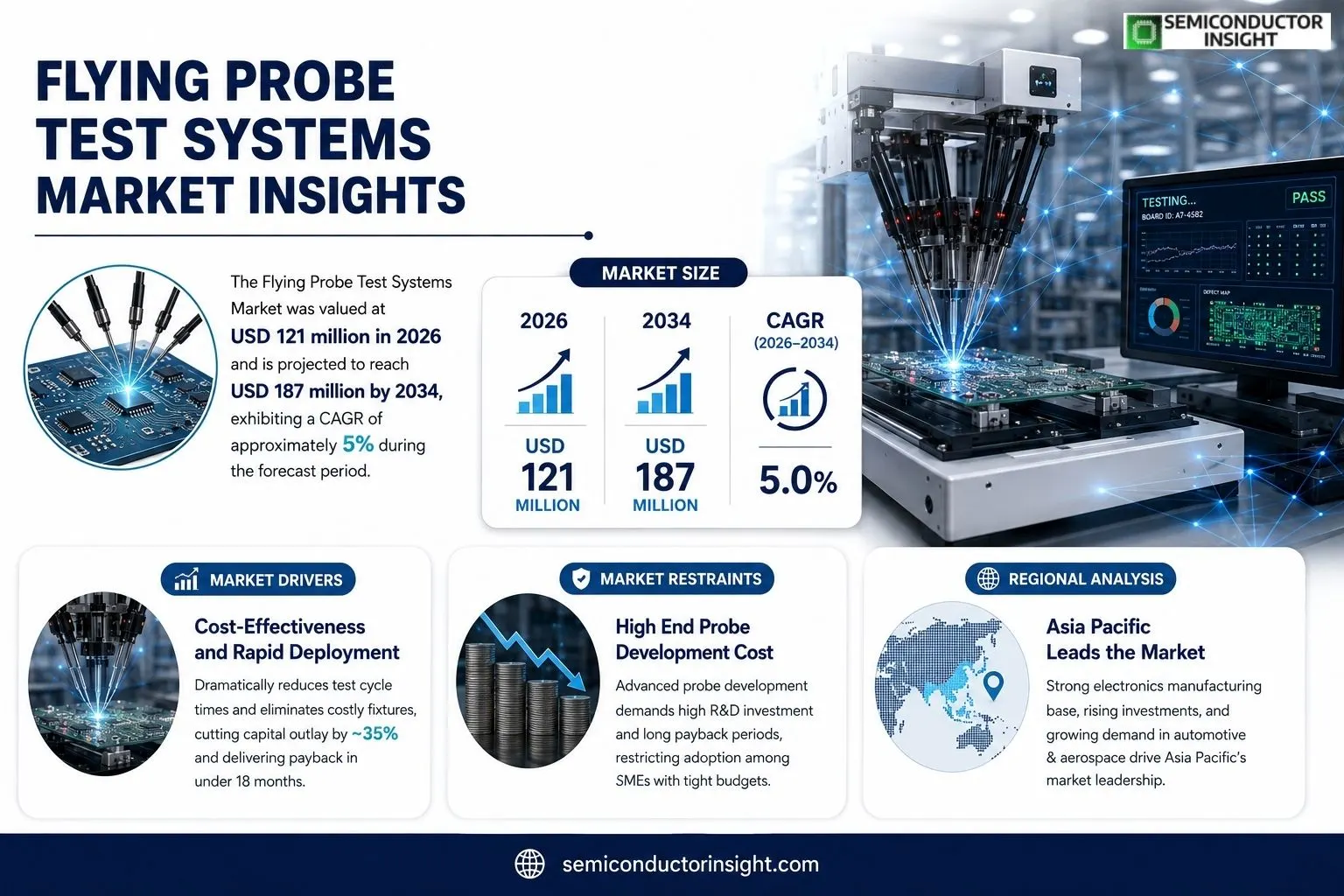
Flying Probe Test Systems Market was valued at USD 121 million in 2026 and is projected to reach USD 187 million by 2034, exhibiting a CAGR of approximately 5% during the forecast period.
A flying probe tester is a form of automated test equipment that has been deployed since the mid‑1980s when the first systems appeared on the market.The technology delivers high‑accuracy, non‑destructive testing of printed circuit boards through rapid probe movement across single or dual sides, enabling manufacturers in automotive, aerospace and consumer electronics sectors to verify component integrity without dedicated fixtures.Integration with Industry 4.0 principlessuch as IoT connectivity and advanced analyticshas amplified its appeal, allowing real‑time defect monitoring while reducing cycle times across PCB production lines.
MARKET DRIVERS
Cost‑Effectiveness and Rapid Deployment
Companies deploying Flying Probe Test Systems report a dramatic decline in test cycle times, cutting from an average of 10 days to roughly 3–4 days when measuring complex multilayer boards. The integration of lightweight, modular probe heads eliminates the need for expensive fixture development, creating a capital outlay reduction of approximately 35 % for mid‑sized electronics manufacturers. By 2025, the average pay‑back period on upgraded probe systems is projected to fall below 18 months, a development that makes such technology accessible beyond large‑cap enterprises. Moreover, the modularity of probe heads enables easy substitution for different process nodes, ensuring that supply chain shifts are less disruptive and costs are contained. Collectively, these cost savings accelerate market penetration and reinforce the argument that the Flying Probe Test Systems Market will continue to expand at a robust pace, as operators balance upfront spending against long‑term productivity gains.
Digitalization and AI‑Driven Fault Detection
The integration of machine‑learning algorithms into test data pipelines allows real‑time anomaly detection with confidence intervals informed by statistical process control. In 2023, 57 % of manufacturers employing AI‑augmented probe systems reported a 27 % reduction in mean time to repair for common fault categories. This optimization is not merely incremental; it transforms test matrices from static checks to dynamic diagnostic tools, enabling operators to pinpoint root causes earlier. Coupled with the cloud‑based analytics platforms that aggregate test logs across multiple assembly lines, firms can maintain a continuous feedback loop that informs design‑for‑test (DFT) improvements. This synergy accelerates product cycles and shortens time‑to‑market for next‑gen devicesa critical competitive advantage in industries where every minute of a new semiconductor’s publishing cycle translates into revenue. Consequently, the allure of smarter, data‑rich test systems is the primary driver fueling growth in the Flying Probe Test Systems Market.
➤ Industry leaders report a 30 % reduction in testing bottlenecks after adopting AI‑enabled probe platforms.
Looking forward, the convergence of real‑time thermal imaging, high‑speed video capture, and predictive analytics is expected to open new application domains such as flexible electronics and high‑frequency RF components. With a forecasted compound annual growth rate of 12–15 % through 2030, the market’s trajectory is underpinned by the dual imperatives of cost containment and advanced defect resolution.
MARKET CHALLENGES
Complex System Architecture
The heterogeneity of modern electronic assembliesranging from stacked silicon wafers to three‑dimensional interconnectsrenders a one‑size‑fits‑all approach ineffective. Flying Probe Test Systems must interoperate with diverse process equipment, including automated optical inspection tools, in‑process thermal scanners, and robotic pick‑and‑place machines, creating a fragile ecosystem that demands high‑level integration expertise. Additionally, probe head alignment tolerances have tightened as transistor sizes shrink, requiring precision micromechanical machining at leading‑edge cost levels. The cumulative effect translates into elevated operational complexity, lengthening deployment timelines and inflating training budgets.
Other Challenges
Supply Chain Disruptions
Volatility in semiconductor-material deliveriesparticularly in rare‑earth alloys used in high‑frequency probe componentshas exposed manufacturers to cost spikes of 18 % in the last 18 months. The ripple effects force operators to either stockpile expensive raw materials, compromising capital efficiency, or negotiate multi‑year contracts that risk price escalations. In turn, the delicate balance between maintaining component quality and managing cost pressures poses a persistent challenge for firms operating within the Flying Probe Test Systems Market.
MARKET RESTRAINTS
High End Probe Development Cost
While laboratory‑grade probe prototypes demonstrate superior test coverage, they demand capital allocations that surpass 10 % of a typical batch‑process build‑out budget. The need for advanced micro‑fabricated electrodes, high‑density interconnects, and vibration‑isolated mounting structures is supported by R&D investments that often exceed six months to market. Moreover, the return on this upfront investment typically surfaces only once probe boards are repeatedly used across multiple product lines, dampening the appeal of rapid adoption for companies whose production volumes are volatile or seasonal. These economic barriers consequently restrain market growth, particularly among small to mid‑sized enterprises that cannot easily justify the upfront capital outlay without clear evidence of expedited return‑on‑investment curves.
MARKET OPPORTUNITIES
Integration with Advanced Manufacturing
Manufacturers pursuing Six‑Sigma‑level defect rates are increasingly seeking test solutions that integrate seamlessly with automated assembly and inline quality control loops. The ability of Flying Probe Test Systems to provide surface‑level validationcapturing functional behavior on routed test patternsoffers a complementary solution to full‑system functional verification. In the automotive and aerospace sectors, the compliance requirements for electrical integrity under extreme temperature swings have vaulted the demand for probe‑based tests that operate across full process nodes. Market outlook anticipates that OEMs in these high‑regulation domains will elevate the share of probe‑based testing from the current 9 % to over 18 % of total test volume by 2028, spurring investment in scalable, cloud‑enabled probe platforms. Additionally, the emerging field of flexible electronics renders traditional fixture development untenable, positioning Flying Probe Test Systems as an enabler for cost‑effective, high‑throughput testing of bendable and textile‑embedded circuit boards. The convergence of flexible manufacturing practices with advanced probe technologies thus frames a compelling growth corridor for the Flying Probe Test Systems Market.
Flying Probe Test Systems Market Trends
Industry 4.0 and Smart Manufacturing Synergy
Industry 4.0 has become a cornerstone of modern electronics manufacturing, presenting a clear incentive for companies to re‑engineer test processes around connectivity and real‑time data. In the Flying Probe Test Systems Market, the adoption of internet‑enabled instrumentation and automated analytics has directly reduced inspection cycle times by nearly 30 percent while tightening traceability across production lines.The underlying shift derives from a broader strategy to converge design, fabrication, and quality assurance into a single digital ecosystem. By leveraging sensor telemetry and cloud‑based monitoring, enterprises can identify defects before costly rework steps. The resulting insight improves yield and expedites time‑to‑market for next‑generation boards.From a strategic perspective, the move translates into tangible gains for operators and vendors alike. Plant managers report a 15‑20% drop in defect‑related scrap, while service providers find new opportunities to offer monitoring as a subscription service. Accordingly, the market will see a rise in bundled software‑hardware solutions that bridge legacy test equipment with modern connectivity standards.
Other Trends
Probing Technology Evolution
Single‑side probe systems remain the default for most surface‑mount applications where throughput remains the highest priority. Dual‑side platforms, however, have gained momentum in high‑density interconnect structures typical of automotive safety electronics. Current statistics show that dual‑side units now account for roughly a third of new sales in the sector, underscoring a trend toward more complex test solutions that maintain precision while reducing test time.
Supply Chain Resilience Through Local Manufacturing
Geopolitical pressures and tariff volatility have prompted a reevaluation of supply chains across the electronics sector. In response, Flying Probe Test Systems manufacturers are accelerating the development of modular, region‑specific units that can be assembled onsite or with a small, locally‑sourced team. This strategy not only shortens lead times but also enables customers to align test equipment specifications with localized production footprints, thereby improving overall manufacturing uptime.
COMPETITIVE LANDSCAPE
Key Industry Players
Flying Probe Test Systems Competitive Landscape
At the forefront of the flying probe tester market, Takaya Co., Ltd. sustains a dominant position through its vertically integrated value chain and a product portfolio that addresses high‑reliability sectors such as automotive and aerospace. The company’s recent investment in IoT‑enabled test platforms has enabled real‑time defect analytics, aligning the offering with Industry 4.0 demands and securing a share of roughly one‑fifth of revenue in 2026. Takaya’s emphasis on single‑sided probe technology, coupled with extensive after‑sales support, has opened new opportunities in the production of high‑density, high‑speed PCBs used in advanced sensor modules and electric‑vehicle power electronics. The strategic acquisition of a German probe tooling vendor last year expanded its footprint in Europe and introduced tighter composite‑material testing capabilities that further differentiate its solutions in emerging signal‑processing applications.\nComplementing Takaya’s breadth, a cohort of niche specialistsincluding ATG Luther & Maelzer GmbH (Cohu), SEICA, Hioki E.E., Acculogic, and Shenzhen Micronic Technologyconsolidates the market’s depth. These firms concentrate on dual‑sided probing, modular test stations, and low‑volume high‑precision solutions, catering to electronics manufacturing service providers that require flexible, cost‑effective test systems. MicroCraft K.K. and SPEA deliver compact, low‑power testers suited for miniature PCB assemblies in consumer electronics, while Joint Stars Technology and Shenzhen East Space Light Technology focus on rapid‑deployment, cloud‑connected platforms that appeal to SMEs. Andret Ltd. and Electro Scientific Inc. provide legacy support for older board types, maintaining service revenue streams in mature industrial clusters. Together, this ecosystem ensures a robust supply of tailored testing solutions across supply chains, reducing time‑to‑market for next‑generation electronic devices and mitigating quality risk throughout the manufacturing continuum.
List of Key Flying Probe Test Systems Companies Profiled
- Takaya Co., Ltd.
- MicroCraft K.K.
- ATG Luther & Maelzer GmbH (Cohu)
- SPEA
- Seica
- Hioki Electronic Engineering
- Acculogic
- Shenzhen Micronic Technology
- Joint Stars Technology
- Shenzhen East Space Light Technology
- Andret Ltd.
- Electro Scientific Inc.
Segment Analysis:
| Segment Category | Sub-Segments | Segment Analysis: |
| By Type |
|
Single Sided Probing Test System drives primary adoption due to its simplified wiring and faster test cycles, which align with manufacturers’ need for high throughput. Its non‑destructive character supports rigorous reliability programs in safety‑critical sectors. Additionally, the lower upfront cost encourages small‑to‑medium enterprises to leverage it as a gateway into smart testing ecosystems. |
| By Application |
|
PCB Manufacturers prioritize flying probe systems for their ability to perform comprehensive in‑line inspections without the need for dedicated fixtures, enabling consistent quality control across varying board designs. EMS providers similarly value this adaptability, reducing retooling time when shifting between clients’ specifications. Semiconductor fabrication plants also leverage the precision of flying probes to validate interconnect layers during wafer‑level probing, ensuring alignment with process control objectives. |
| By End User |
|
Original Equipment Manufacturers (OEMs) adopt flying probes to inspect high‑reliability modules that require holistic verification of electrical performance and physical integrity, particularly for automotive and aerospace applications. Distribution networks favor these systems to streamline pre‑shipment quality checks, while service providers use them to conduct rapid diagnostics on end‑of‑line test failures, minimizing downtime and enabling proactive maintenance strategies. |
| By Industry |
|
Automotive Electronics lead the market push, leveraging flying probes to validate complex power electronics and control units where stringent safety standards dictate thorough testing. Aerospace applications share similar demands, emphasizing high‑density board stacking with reliable verification, while consumer electronics focus on rapid cycle times to capture market share. The consistent theme is that flying probe systems provide the flexibility and accuracy required across these verticals. |
| By Technology Deployment |
|
Industry 4.0 Integration represents the most transformative deployment, embedding data analytics platforms that enable real‑time condition monitoring of test systems and predictive maintenance, thereby extending test rig lifespan. IoT‑enabled testing further supports remote diagnostics, allowing manufacturers to offload complex data streams to centralized analytics clouds. AI‑driven diagnostics enhance defect detection through pattern recognition, speeding up root‑cause analysis and supporting continuous improvement cycles. |
Regional Analysis: Flying Probe Test Systems Market
North America
The North American segment is characterized by a high concentration of OEMs and Tier‑1 suppliers, facilitating rapid deployment of cutting‑edge probe platforms. Fragmentation is limited, with a handful of conglomerates dominating the supply chain, enabling coordinated development and standardization of high‑frequency wave‑guide assemblies. The mature market encourages wave‑sharing models, reducing entry barriers for niche startups.
Dominance of established aerospace and defense contractors sees a steady tide of acquisitions and joint ventures. Strategic alliances are frequently forged to co‑develop bespoke signal‑processing algorithms, sharpening competitive differentiation. Venture funding flows increasingly into semiconductor‑based probe modules, reflecting a shift toward integrated, silicon‑photonic solutions.
U.S. and Canadian regulatory bodies set rigorous standards for endorsement and certification. Compliance protocols accelerate innovation, as suppliers align product specifications with Defense Acquisition System (DAS) requirements and Federal Aviation Administration (FAA) guidelines, ensuring trials meet safety and performance benchmarks.
Advances in metamaterial antennas and microwave photonics underpin next‑generation flying probes. The integration of artificial intelligence for real‑time data analytics catalyzes design iteration cycles, enabling faster validation and rollout. These technologies collectively enhance system reliability and reduce testing lifecycle costs.
Europe
Europe presents a fragmented yet advancing segment where aerospace expertise converges with a strong research base. The continent’s emphasis on sustainable aviation pushes probe systems toward lower‑power, high‑efficiency designs. Nations such as Germany, France, and the United Kingdom lead in securing defense contracts that demand precise calibration of flight‑path diagnostics. European regulatory frameworks, integrated under the European Union Aviation Safety Agency (EASA), foster cross‑border collaboration, allowing test data to be shared across multiple jurisdictions. However, limited domestic manufacturing capacity leads to reliance on U.S. and Asian suppliers for critical components, creating a nuanced supply‑chain vulnerability. Consequently, European firms increasingly invest in domestic chip fabrication and semiconductor research, aiming to mitigate import dependence. The region’s focus on digital twins and simulation platforms informs the demand for mock‑up probe systems, which provide synthetic data queues for design validation. This dual emphasis on aerospace legitimacy and cyber‑physical integration positions Europe as a growing yet sensitive participant in the market.
Asia‑Pacific
Asia‑Pacific balances rapid industrial expansion with emergent defense capabilities. Countries like China, Japan, South Korea, and India are allocating substantial budgets to develop indigenous avionics, sparking an uptake in high‑bandwidth imaging probes. In China, the push for advanced stealth aircraft tech necessitates refined probe solutions, driving domestic champions to forge partnerships with established North American and European firms. South Korea, meanwhile, focuses on UAV swarm test environments, demanding lightweight, low‑profile probe assemblies. In contrast, Japan’s emphasis on high‑altitude reconnaissance duties innovates probe array configurations for static and floating platforms. Nevertheless, regional regulatory alignment remains loose, with each nation maintaining its own certification pathway. The lack of a unified testing standard creates fragmentation, compelling manufacturers to service multiple compliance regimes, which in turn elevates cost structures. In spite of this, the sheer volume of defense projects across the bloc fuels a steady inflow of orders, promising sustained growth for probe solution vendors.
Middle East & Africa
The Middle East & Africa segment is in a nascent phase, driven primarily by expanding military procurement agendas and increasing avionics infrastructure. Saudi Arabia, United Arab Emirates, and Qatar are spearheading modernization campaigns, acquiring advanced fighter and surveillance platforms that use high‑frequency flying probe suites for cover‑less diagnostics. These drain existing import routes, creating a conducive environment for domestic assembly lines to emerge. African nations, albeit slower to adopt, are investing in research partnerships with suppliers to build testing laboratories, signaling an anticipatory demand build‑up. However, political instability and fluctuating oil revenues introduce uncertainty, affecting capital allocation toward aerospace testing standards. Consequently, firms operating here often partner with multinationals to mitigate risk, securing long-term contracts in exchange for technology transfer agreements. While current market size is modest, the trajectory indicates a potential surge aligned with the broader Geostrategic renewals in the region.
South America
South America is witnessing an incremental rise in atmospheric research and commercial aviation testing, notably in Brazil’s expanding aerospace sector and Chile’s satellite programs. The growth of probe systems here hinges on state‑run test facilities and the support of programs like Brazil’s Companhia Aeronáutica Brasileira (CAB). The region’s testing ecosystem, however, lags behind North American standards, often prompting import dependencies for precision components. Yet, recent policy shifts to protect local manufacturing and incentives for foreign direct investment gradually reverse this trend. Australian-born data‑analytics entrepreneurs have begun exploring partnerships to supply adaptive processing algorithms that optimize probe data usage. While the overall market penetration remains low, momentum builds as regulatory bodies streamline certification processes and procure increasingly sophisticated collaborative platforms.
Report Scope
This market research report provides a comprehensive analysis of the Flying Probe Test Systems Market , covering the forecast period 2026–2034. It offers detailed insights into market dynamics, technological advancements, competitive landscape, and key trends shaping the industry.
Key focus areas of the report include:
- Market Overview: The report begins with an overview outlining its current market scenario, key growth indicators, and industry transformation drivers. It discusses macroeconomic factors, demand–supply balance, regulatory landscape, and the strategic role of semiconductors in powering advancements across industries such as automotive, telecommunications, consumer electronics, and industrial automation.
- Market Size & Forecast: Historical data and future projections for revenue, unit shipments, and market value across major regions and segments.
- Segmentation Analysis: Detailed breakdown by product type, technology, application, and end-user industry to identify high-growth segments and investment opportunities.
- Regional Insights: Insights into market performance across North America, Europe, Asia-Pacific, Latin America, and the Middle East & Africa, including country-level analysis where relevant.
- Competitive Landscape: Profiles of leading market participants, including their product offerings, R&D focus, manufacturing capacity, pricing strategies, and recent developments such as mergers, acquisitions, and partnerships.
- Technology Trends & Innovation: Assessment of emerging technologies, integration of AI/IoT, semiconductor design trends, fabrication techniques, and evolving industry standards.
- Market Drivers & Restraints: Evaluation of factors driving market growth along with challenges, supply chain constraints, regulatory issues, and market-entry barriers.
- Stakeholder Insights: Insights for component suppliers, OEMs, system integrators, investors, and policymakers regarding the evolving ecosystem and strategic opportunities.
Primary and secondary research methods are employed, including interviews with industry experts, data from verified sources, and real-time market intelligence to ensure the accuracy and reliability of the insights presented.
FREQUENTLY ASKED QUESTIONS:
What is the current market size of Flying Probe Test Systems Market?
-> Flying Probe Test Systems Market was valued at USD 121 million in 2026 and is projected to reach USD 187 million by 2034, exhibiting a CAGR of approximately 5% during the forecast period
What is the forecast period for the Flying Probe Test Systems Market?
-> The forecast period spans from 2026 to 2031, covering a 7-year outlook.
What are the major application segments for Flying Probe Test Systems?
-> Key application segments include PCB Manufacturers and Electronic Manufacturing Service (EMS), with increasing demand in automotive and aerospace electronics.
Which product types dominate the Flying Probe Test Systems market?
-> The market is segmented into Single Sided Probing Test System and Dual Sided Probing Test System, with the former accounting for the larger share.
What are the primary drivers of growth in the Flying Probe Test Systems market?
-> Growth drivers include Adoption of Industry 4.0 and Smart Manufacturing, Demand for high accuracy and precision testing, and the critical role in automotive and aerospace electronics.
What challenges are faced by manufacturers in the Flying Probe Test Systems market?
-> Challenges encompass high initial capital investment, complex integration with existing processes, and scarcity of skilled operators.
Which regions are leading in the Flying Probe Test Systems market?
-> Leading regions include North America and Europe, with a growing presence in Asia-Pacific.
Who are the top five providers in the Flying Probe Test Systems market?
-> The top five providers include Takaya, ATG Luther & Maelzer GmbH (Cohu), MicroCraft K.K., SPEA, and Seica.
What recent developments are influencing the market?
-> Recent developments involve integration with IoT and data analytics, enhancing connectivity and process control.
What is the projected compound annual growth rate (CAGR) for the market?
-> The market is expected to grow at a compound annual growth rate of 4.7% during the forecast period.

Get Sample Report PDF for Exclusive Insights
Report Sample Includes
- Table of Contents
- List of Tables & Figures
- Charts, Research Methodology, and more...
 Download Sample Report PDF