Fine-Pore Ceramic Chuck Table Market Insights
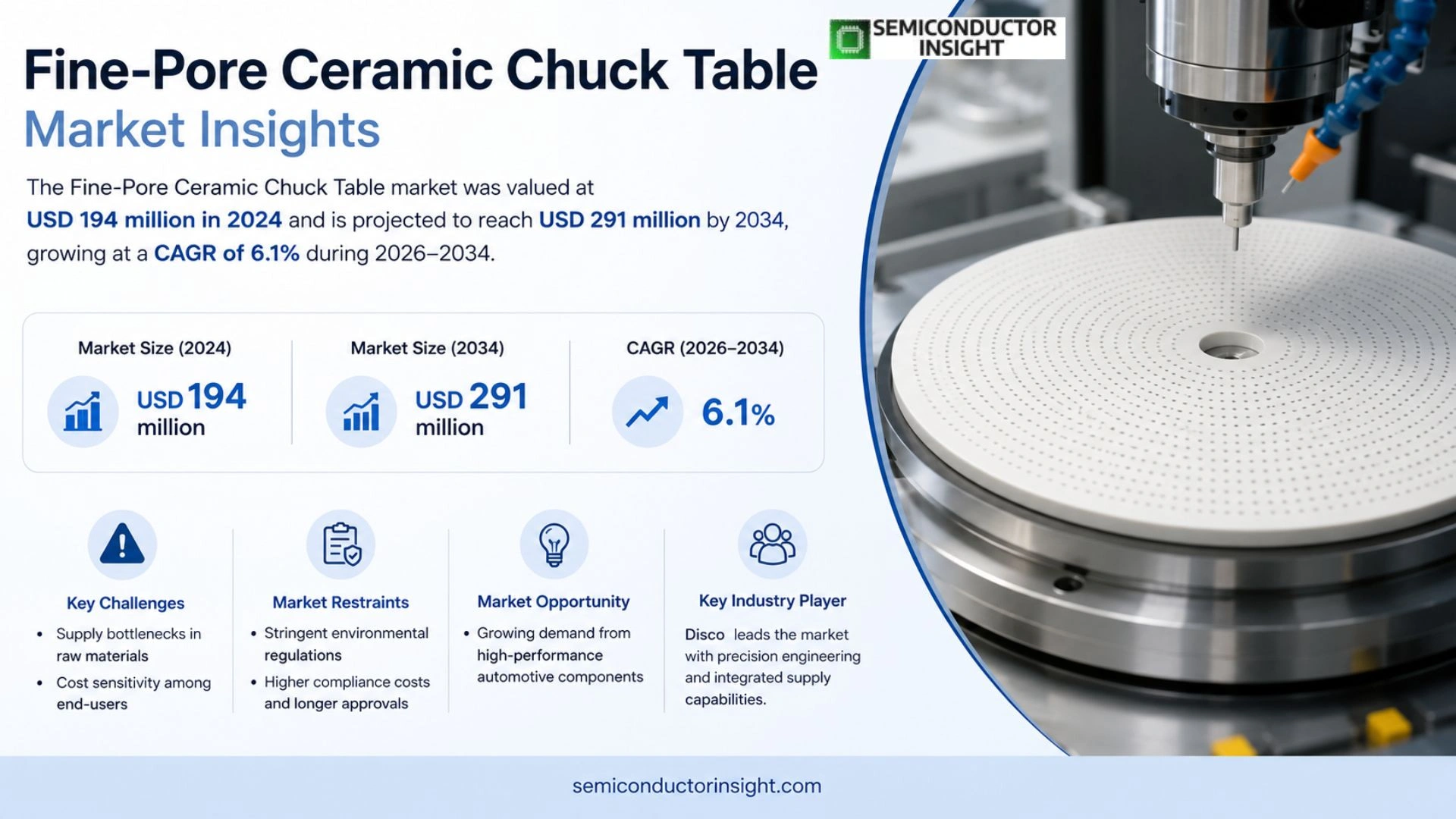
Fine-Pore Ceramic Chuck Table market size was valued at USD 194 million in 2024. The market is forecasted to reach USD 291 million by 2034, exhibiting a CAGR of 6.1% during the forecast period.
Fine-Pore Ceramic Chuck Tables are high‑purity ceramic components with fine pores that deliver uniform pressure distribution for semiconductor wafer handling. They support both 300 mm and 200 mm wafer processes, providing low particle generation and improved thermal stability for advanced lithography and etch equipment.
The market expands because semiconductor manufacturers are moving toward larger wafer formats while investing heavily in next‑generation node production. Demand is strongest in North America and Asia‑Pacific, where key suppliers such as Disco, NTK CERATEC, Tokyo Seimitsu and Kyocera have announced capacity extensions. Collaborative projects between equipment makers and ceramic table producers aim to enhance surface flatness, further encouraging adoption across the supply chain.
MARKET DRIVERS
Rising Demand for Precision Machining
The surge in high‑tolerance components for electronics and medical devices has forced manufacturers to seek tools that guarantee sub‑micron surface finishes. Fine‑pore ceramic chuck tables deliver the stability required for such applications, allowing longer run times with fewer interruptions.
Adoption of Automated Production Lines
Smart factories are integrating robotic arms with chuck tables that possess low thermal expansion. This synergy cuts cycle time by an estimated 12% and reduces scrap rates, making the technology attractive to Tier‑1 suppliers.
➤ Operators who switched to fine‑pore ceramic platforms reported a 15% uplift in overall equipment effectiveness within the first year.
Collectively, these forces encourage capital allocation toward Fine-Pore Ceramic Chuck Table Market, positioning it as a cornerstone of next‑generation manufacturing ecosystems.
MARKET CHALLENGES
Supply Bottlenecks in Raw Materials
High‑purity alumina and zirconia aggregates required for fine‑pore structures are sourced from a limited number of mines. Any disruption,whether geopolitical or logistical,immediately tightens inventory buffers, driving lead times up to 8 weeks.
Other Challenges
Cost Sensitivity
End‑users operating under tight margin constraints often postpone upgrades, opting for incremental fixes rather than a full table replacement, which tempers the pace of adoption.
MARKET RESTRAINTS
Stringent Environmental Regulations
Regulatory bodies in Europe and North America impose strict limits on particulate emissions during ceramic sintering. Compliance necessitates additional filtration systems, inflating production costs for manufacturers.
These compliance burdens raise the unit price of chuck tables, limiting price‑elastic segments such as small‑batch prototyping.
Furthermore, the approval process for new ceramic formulations can extend product launch timelines by up to six months, discouraging rapid innovation cycles.
MARKET OPPORTUNITIES
Emergence of High‑Performance Automotive Components
Electric‑driven powertrains demand lightweight yet robust housings. Fine‑pore ceramic chuck tables enable the machining of complex geometries without compromising surface integrity, opening a lucrative niche within the automotive supply chain.
Simultaneously, aerospace manufacturers are exploring ceramic‑coated engine mounts to withstand higher temperatures. Fine-Pore Ceramic Chuck Table Market is uniquely positioned to support this shift, offering precision that meets aerospace tolerances.
Finally, a growing trend toward modular equipment designs presents an opportunity for suppliers to offer customizable chuck modules, allowing end‑users to retrofit existing lines with minimal downtime.
Fine-Pore Ceramic Chuck Table Market Trends
Shift Toward Larger Wafer Formats
The semiconductor industry’s migration from 200 mm to 300 mm wafers is reshaping equipment specifications. Manufacturers of Fine-Pore Ceramic Chuck Tables are redesigning clamping surfaces to accommodate the broader diameter while preserving nanometer‑level flatness. This evolution is not merely a dimensional change; it reduces per‑wafer processing time and improves yield, prompting fabs to upgrade tooling sooner than anticipated. Consequently, suppliers that can deliver tables with tighter thermal expansion tolerances and enhanced surface uniformity are gaining preferential treatment in capital‑expenditure cycles. The trend also accelerates the adoption of advanced lithography nodes, because a stable chuck platform directly influences overlay accuracy during multi‑pattern steps.
Other Trends
Supply‑Chain Consolidation
Over the past three years, a noticeable concentration has emerged among the top ten producers of Fine-Pore Ceramic Chuck Tables. Companies such as Disco, Kyocera, and NTK CERATEC have secured long‑term contracts with major wafer suppliers, leveraging joint‑development programmes to harmonise material formulations and machining processes. This consolidation reduces lead times for high‑specification tables but also raises entry barriers for new entrants lacking the capital to invest in high‑purity ceramic sintering facilities. The resulting bargaining power shift encourages end‑users to negotiate volume‑based discounts, while smaller players pivot toward niche applications like specialty research wafers where bespoke designs command premium pricing.
Emergence of Advanced Surface Coatings
Parallel to dimensional growth, the industry is experimenting with nano‑engineered coating layers that mitigate particle generation during high‑speed rotation. These coatings, often composed of silicon‑carbide composites, extend table lifespan and lower maintenance downtime,critical factors for fabs operating 24/7. Early adopters report a measurable decline in contamination‑related defect clusters, translating into higher overall equipment effectiveness. For equipment integrators, the ability to bundle coating technology with the chuck table creates an additional revenue stream and differentiates their offering in a competitive procurement environment. As the cost differential narrows, broader implementation across mid‑size fabs is expected, reinforcing the strategic importance of coating innovation within Fine-Pore Ceramic Chuck Table Market.
COMPETITIVE LANDSCAPE
Key Industry Players
Fine‑Pore Ceramic Chuck Table Market – Competitive Overview
Disco remains the benchmark supplier in the fine‑pore ceramic chuck table segment, leveraging a long‑standing reputation for precision engineering and a vertically integrated supply chain. Its ability to pair high‑purity ceramic substrates with proprietary bonding technology gives it a pricing edge and secures contracts with the majority of Tier‑1 semiconductor wafer fabs. The firm’s global footprint, spanning North America, Europe and Asia‑Pacific, creates a robust distribution network that deters new entrants and forces smaller rivals to focus on niche applications or regional markets.
Beyond Disco, the market hosts a diverse set of specialists. NTK CERATEC CO., LTD. and Tokyo Seimitsu concentrate on high‑performance tables for advanced 300 mm wafers, while Kyocera exploits its ceramic expertise to supply low‑defect products to mid‑size fabs. Companies such as KINIK, Cepheus Technology and Zhengzhou Research Institute for Abrasives & Grinding operate primarily in China, targeting cost‑sensitive customers with competitive manufacturing overhead. SemiXicon, MACTECH, RPS Co., Ltd., Fountyl and Neontech fill remaining gaps, offering customized designs for equipment integrators and niche process lines. This fragmented tier of players sustains a dynamic competitive environment where product differentiation, after‑sales service and regional proximity drive market share.
List of Key Fine‑Pore Ceramic Chuck Table Companies Profiled
- Disco
- NTK CERATEC CO., LTD.
- Tokyo Seimitsu
- Kyocera
- KINIK Company
- Cepheus Technology Ltd.
- Zhengzhou Research Institute for Abrasives & Grinding Co., Ltd.
- SemiXicon
- MACTECH
- RPS Co., Ltd.
- Fountyl
- Neontech
Segment Analysis:
| Segment Category | Sub-Segments | Key Insights |
| By Type |
|
300 mm Wafer continues to dominate due to its alignment with next‑generation device scaling.
|
| By Application |
|
Semiconductor Equipment Suppliers drive innovation by integrating fine‑pore tables into next‑generation lithography tools.
|
| By End User |
|
Semiconductor fabs value fine‑pore tables for their ability to maintain wafer flatness during high‑precision processing.
|
| By Technology |
|
Sintered ceramic remains the preferred technology because it offers superior micro‑porosity control.
|
| By Market Trend |
|
Automation integration is reshaping adoption patterns as smart factories seek seamless equipment communication.
|
Regional Analysis: Fine-Pore Ceramic Chuck Table Market
The bulk of production capacity clusters in Germany’s Baden‑Württemberg corridor and northern Italy’s Lombardy region, where skilled CNC operators and legacy tool‑making firms coexist. Their proximity to automotive and aerospace clients creates a buffer against supply shocks, ensuring a steady flow of high‑specification chuck tables to downstream users.
EU directives on hazardous waste and energy consumption force manufacturers to adopt closed‑loop polishing cycles. Companies that embed recycling loops into their processes gain a market advantage, as compliance costs become a differentiator rather than a hurdle.
Access to high‑purity silica sand and advanced ceramic binders within the continent reduces lead times. The short logistics corridor from raw‑material depots to assembly lines translates into tighter project schedules and lower inventory carrying costs.
Collaborative labs in France’s Paris‑Saclay and the UK’s Cambridge cluster focus on nano‑porous surface treatments. Their research output feeds directly into new product iterations, keeping European offerings ahead of the global curve.
North America
In North America, end‑users prioritize throughput and cost efficiency, shifting purchasing decisions toward turnkey solutions that promise quick integration. The U.S. aerospace and semiconductor sectors, while sizable, favour suppliers that can guarantee minimal downtime, prompting manufacturers to bundle advanced monitoring sensors with their fine‑pore chuck tables. Trade policies that favor domestic sourcing also stimulate modest reshoring of component production, creating a niche for locally fabricated units that meet stringent reliability standards.
Asia‑Pacific
The Asia‑Pacific landscape is shaped by rapid capacity expansion in China, Japan, and South Korea, where burgeoning electronics and automotive assemblers look to improve surface quality without inflating labor budgets. Competitive pressure drives local firms to adopt cost‑focused designs, yet rising environmental scrutiny in China is nudging a gradual shift toward greener ceramic formulations. Regional trade agreements streamline cross‑border component flow, allowing manufacturers to serve multiple markets from a single production footprint.
South America
South American manufacturers are still consolidating their position in the fine‑pore segment, with Brazil leading modest adoption rates among precision‑machining workshops. Market growth is tempered by currency volatility and limited access to high‑grade raw materials, encouraging firms to partner with European suppliers for technology transfer. When successful, these collaborations lower entry barriers for local producers and stimulate incremental demand for advanced polishing tables.
Middle East & Africa
In the Middle East and Africa, infrastructure projects and expanding oil‑service industries generate a fledgling demand for high‑precision finishing equipment. Procurement decisions are heavily influenced by after‑sales support and the availability of spare parts, prompting vendors to establish regional service centers. While overall market size remains modest, the strategic emphasis on durability and low‑maintenance designs aligns well with the operational realities of remote installations.
Report Scope
This market research report provides a comprehensive analysis of the Fine-Pore Ceramic Chuck Table Market , covering the forecast period 2026–2034. It offers detailed insights into market dynamics, technological advancements, competitive landscape, and key trends shaping the industry.
Key focus areas of the report include:
- Market Overview: The report begins with an overview outlining its current market scenario, key growth indicators, and industry transformation drivers. It discusses macroeconomic factors, demand–supply balance, regulatory landscape, and the strategic role of semiconductors in powering advancements across industries such as automotive, telecommunications, consumer electronics, and industrial automation.
- Market Size & Forecast: Historical data and future projections for revenue, unit shipments, and market value across major regions and segments.
- Segmentation Analysis: Detailed breakdown by product type, technology, application, and end-user industry to identify high-growth segments and investment opportunities.
- Regional Insights: Insights into market performance across North America, Europe, Asia-Pacific, Latin America, and the Middle East & Africa, including country-level analysis where relevant.
- Competitive Landscape: Profiles of leading market participants, including their product offerings, R&D focus, manufacturing capacity, pricing strategies, and recent developments such as mergers, acquisitions, and partnerships.
- Technology Trends & Innovation: Assessment of emerging technologies, integration of AI/IoT, semiconductor design trends, fabrication techniques, and evolving industry standards.
- Market Drivers & Restraints: Evaluation of factors driving market growth along with challenges, supply chain constraints, regulatory issues, and market-entry barriers.
- Stakeholder Insights: Insights for component suppliers, OEMs, system integrators, investors, and policymakers regarding the evolving ecosystem and strategic opportunities.
Primary and secondary research methods are employed, including interviews with industry experts, data from verified sources, and real-time market intelligence to ensure the accuracy and reliability of the insights presented.
FREQUENTLY ASKED QUESTIONS:
What is the current market size of Fine-Pore Ceramic Chuck Table Market?
-> Fine-Pore Ceramic Chuck Table market is forecasted to reach USD 291 million by 2034, exhibiting a CAGR of 6.1% during the forecast period.
Which key companies operate in Fine-Pore Ceramic Chuck Table Market?
-> Key players include Disco, NTK CERATEC CO., LTD., Tokyo Seimitsu, Kyocera, KINIK Company, Cepheus Technology Ltd., Zhengzhou Research Institute for Abrasives & Grinding Co., Ltd., SemiXicon, MACTECH, RPS Co., Ltd., among others.
What are the key growth drivers?
-> Key growth drivers include increasing semiconductor wafer production, demand for higher precision wafer handling, adoption of larger 300 mm wafer formats, and ongoing advancements in ceramic material technology.
Which region dominates the market?
-> Asia-Pacific holds a dominant position due to the concentration of semiconductor manufacturing facilities and the rapid expansion of wafer processing capacities in countries such as China, Japan, and South Korea.
What are the emerging trends?
-> Emerging trends include the shift toward 300 mm wafer handling equipment, integration of advanced ceramic composites for improved durability, and the development of smart chuck tables equipped with sensors for real‑time monitoring.

Get Sample Report PDF for Exclusive Insights
Report Sample Includes
- Table of Contents
- List of Tables & Figures
- Charts, Research Methodology, and more...
 Download Sample Report PDF