Fine Pitch RDL Photosensitive Dielectric Market Insights
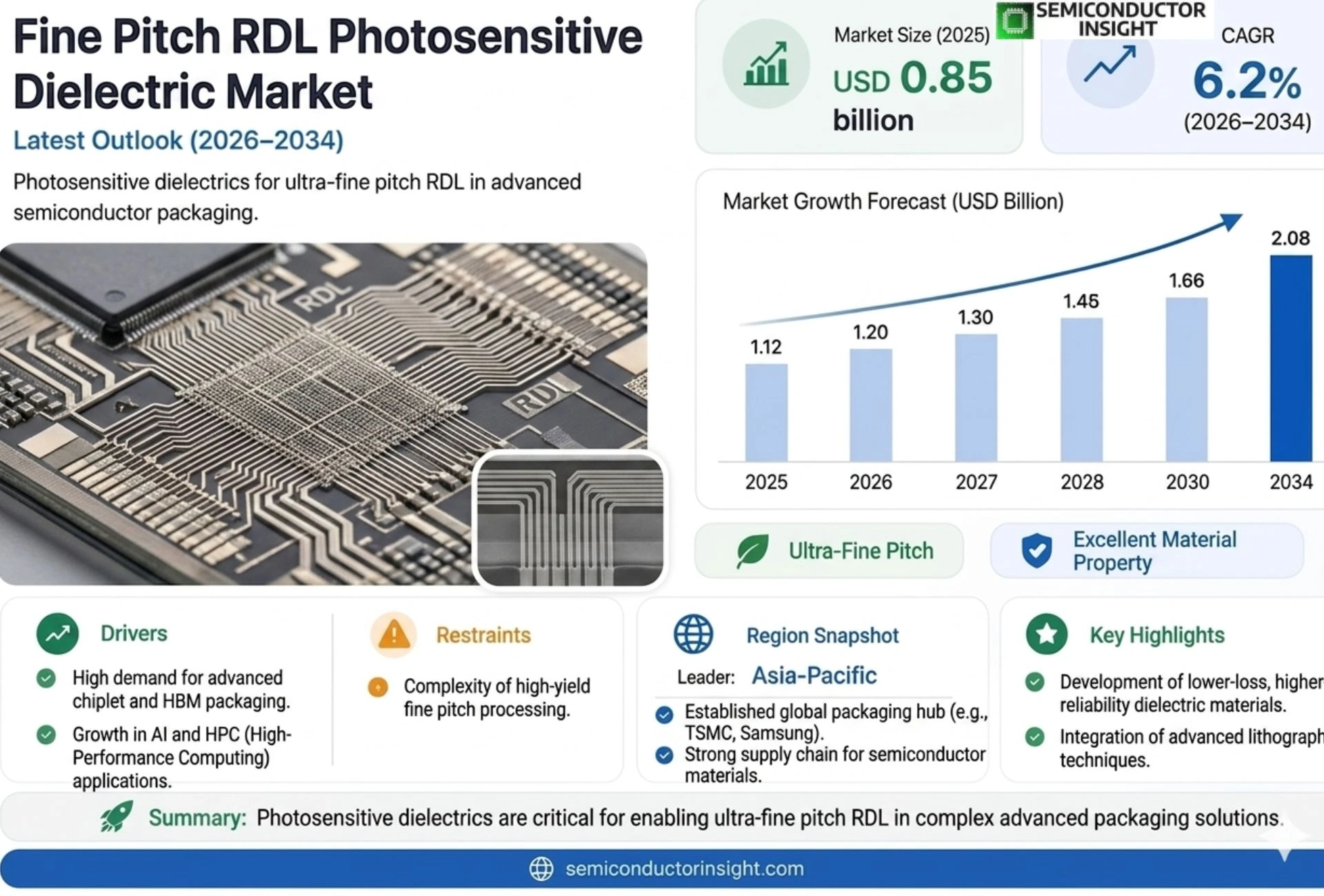
Global Fine Pitch RDL Photosensitive Dielectric Market size was valued at USD 0.85 billion in 2025. The market is projected to grow from USD 0.89 billion in 2025 to USD 1.52 billion by 2034, exhibiting a CAGR of 6.2% during the forecast period.
Fine Pitch Redistribution Layer (RDL) Photosensitive Dielectrics are specialized materials used in advanced semiconductor packaging to create ultra-fine conductive pathways. These photosensitive dielectrics enable precise patterning and insulation between circuit layers, facilitating higher density interconnects and improved electrical performance. They are critical in the production of high-performance integrated circuits, particularly in applications requiring miniaturization and enhanced reliability such as mobile devices, 5G communication modules, and high-end computing systems.
The market is witnessing steady growth driven by the increasing demand for miniaturized electronic components and the rapid adoption of advanced packaging technologies like fan-out wafer-level packaging (FOWLP). Furthermore, the surge in consumer electronics and automotive electronics is fueling the need for fine pitch RDL photosensitive dielectrics. However, challenges such as high production costs and stringent quality requirements persist. Key industry players continue to invest in research and development to improve material properties and process efficiencies, which is expected to further accelerate market expansion over the coming years.
MARKET DRIVERS
Advancements in Semiconductor Manufacturing
Fine Pitch RDL Photosensitive Dielectric Market is strongly driven by significant advancements in semiconductor manufacturing technologies. The increasing demand for higher-density integrated circuits necessitates the use of fine pitch redistribution layers (RDLs) with photosensitive dielectric materials that enable precision and reliability at micro and nano-scale dimensions. This market growth is facilitated by the continuous miniaturization trend in consumer electronics and automotive applications, where compact and powerful chips are crucial.
Rising Adoption of 5G and IoT Devices
The surge in 5G infrastructure deployment and the proliferation of Internet of Things (IoT) devices are key drivers for the market. These technologies demand advanced packaging solutions that Fine Pitch RDL Photosensitive Dielectric materials support by providing enhanced electrical performance and thermal management. The ability of these dielectrics to maintain integrity in complex multi-layered structures ensures the reliability required for next-generation communication devices.
➤ Increasing emphasis on device miniaturization and performance enhancement is catalyzing investments in fine pitch RDL photosensitive dielectrics.
Moreover, the fine pitch capability aids in improving circuit density, which is crucial for the manufacturing of sophisticated consumer electronics such as smartphones, wearables, and advanced computing systems, further driving the market forward.
MARKET CHALLENGES
Manufacturing Complexity and Cost
Fine Pitch RDL Photosensitive Dielectric Market faces challenges linked to the inherent complexity of manufacturing processes. Achieving fine pitch configurations requires precise lithography and process control, which contribute to increased production costs. These high costs sometimes deter small- and medium-scale manufacturers from adopting advanced photosensitive dielectrics, thereby limiting market penetration.
Other Challenges
Material Compatibility and Reliability
Ensuring compatibility of photosensitive dielectric materials with different substrates and maintaining long-term reliability under thermal and mechanical stress remains a challenge. Variations in material properties can cause defects during multilayer stacking, adversely affecting yield rates and product performance.
MARKET RESTRAINTS
Supply Chain Constraints and Raw Material Pricing
The market growth for Fine Pitch RDL Photosensitive Dielectric materials is restrained by volatile raw material prices and supply chain issues that affect the timely procurement of specialty chemicals and resins. Global disruptions in supply chains have occasionally led to increased lead times and elevated costs, limiting manufacturers’ ability to scale production efficiently. Additionally, stringent environmental regulations on chemical use in some regions impose further constraints on material sourcing and processing.
MARKET OPPORTUNITIES
Expansion in Advanced Packaging and Automotive Electronics
Fine Pitch RDL Photosensitive Dielectric Market holds promising opportunities in the expanding sectors of advanced semiconductor packaging and automotive electronics. The rising integration of electric vehicles and autonomous driving technology fosters demand for reliable and fine-pitched dielectric layers compatible with high-performance microchips. Ongoing developments in chiplet-based architectures and heterogeneous integration techniques also provide avenues for growth by requiring customized fine pitch RDL solutions.
Furthermore, collaborations between material suppliers and semiconductor manufacturers to develop environmentally friendly and process-optimized photosensitive dielectric materials present new growth prospects. Innovations aimed at reducing defect rates and enhancing throughput can unlock additional value across multiple end-user industries.
Trends
Advancements Driving Market Growth
Fine Pitch RDL Photosensitive Dielectric Market is experiencing consistent growth, propelled by the increasing need for miniaturization in semiconductor packaging. These dielectrics play a crucial role in fabricating ultra-fine conductive pathways, enabling enhanced electrical performance and higher interconnect density. As industries integrate advanced technologies such as fan-out wafer-level packaging (FOWLP), the demand for these specialized materials continues to rise. This trend aligns with the surge in consumer electronics and automotive segments, where compact and reliable electronic components are vital.
Other Trends
Technological Innovations
Research and development efforts remain a primary focus for key market players aiming to enhance the material properties of fine pitch photosensitive dielectrics. Innovations target improving patterning precision and insulating capabilities, which are essential for meeting stringent quality standards. These advancements are expected to mitigate challenges related to production costs and processing complexity, thereby fostering wider adoption across various high-performance applications including 5G communication modules and high-end computing systems.
Supply Chain and Market Dynamics
Although the market faces challenges such as elevated production expenses and rigorous quality control requirements, the steady growth in related sectors sustains demand. The increasing use of these dielectrics in emerging electronic technologies reinforces the relevance of robust supply chains and strategic partnerships. Manufacturers are investing in process efficiencies to maintain competitiveness while aligning with evolving industry standards and environmental regulations.
Future Outlook and Market Expansion
Looking ahead, Fine Pitch RDL Photosensitive Dielectric Market is positioned for continued expansion supported by technological progress and increased application scope. The integration of these materials in miniaturized device architectures will likely accelerate, responding to the growing complexity of electronic designs. As the market evolves, strengthening research activities and operational improvements will be critical factors enhancing product performance and supporting sustainable growth trajectories.
COMPETITIVE LANDSCAPE
Key Industry Players
Market Dynamics and Leading Manufacturers in Fine Pitch RDL Photosensitive Dielectric Sector
Fine Pitch RDL Photosensitive Dielectric Market is characterized by a competitive landscape dominated by a few established global chemical and semiconductor materials manufacturers, along with several niche players specializing in advanced polymer and photoresist technologies. Leading companies such as DuPont (formerly Dow Chemical) leverage their extensive R&D capabilities and global supply chains to maintain strong positions by delivering high-quality photosensitive dielectric solutions tailored for next-generation semiconductor packaging. Their products enable ultra-fine patterning and reliable electrical insulation critical to miniaturized device integration.
Other significant players emphasize innovation in material formulations, process efficiency, and regional market coverage. Companies like JSR Corporation and Sumitomo Chemical from Japan focus on advanced photoresist and dielectric chemistry to meet the stringent demands of fine pitch redistribution layers. Additionally, emerging firms such as Hitachi Chemical and MacDermid Alpha Electronics Solutions contribute niche products supporting fine line resolution and thermal stability. This competitive environment fosters continuous improvement, enabling market growth amid pressures from cost constraints and evolving semiconductor packaging architectures.
List of Key Fine Pitch RDL Photosensitive Dielectric Companies Profiled
- DuPont
- JSR Corporation
- Sumitomo Chemical
- MacDermid Alpha Electronics Solutions
- Hitachi Chemical
- Merck KGaA
- Tokyo Ohka Kogyo Co., Ltd. (TOK)
- Shin-Etsu Chemical Co., Ltd.
- MicroChemicals GmbH
- JSR Micro, Inc.
- Callaway Chemical Company
- AZ Electronic Materials
- Huntsman Corporation
- JSR Micro, Inc.
- Fujifilm Electronic Materials
Segment Analysis:
| Segment Category | Sub-Segments | Key Insights |
| By Type |
|
Negative-type Photosensitive Dielectrics dominate the market due to their finer resolution capabilities which allow for ultra-fine conductive pathways essential in high-density interconnects. This type offers superior insulation properties conducive to maintaining electrical integrity in advanced semiconductor packaging.
Positive-type dielectrics, while less prevalent, are valued for their ease of processing and adaptability to different substrate materials, which allows manufacturers flexibility in diverse packaging technologies. Their role remains significant in applications where cost-efficiency and process simplicity are critical. |
| By Application |
|
Mobile Devices represent the leading application segment propelled by the demand for miniaturization and high performance in smartphones and tablets. The need for compact, reliable, and high-density interconnects fosters the use of fine pitch photosensitive dielectrics.
5G communication modules are rapidly adopting fine pitch RDL photosensitive dielectrics to meet the stringent electrical performance and miniaturization needs critical for next-generation connectivity. High-end computing systems, including servers and advanced processors, benefit from these materials’ reliability and enhanced electrical insulation enabling complex, multi-layer packaging to support faster processing speeds. |
| By End User |
|
Semiconductor Manufacturers continue to be the primary end users as they integrate fine pitch RDL photosensitive dielectrics into advanced packaging processes to achieve finer interconnects and superior device performance.
Consumer electronics companies leverage these materials to support rising demands for smaller, more powerful devices, emphasizing innovation and miniaturization. Automotive electronics manufacturers increasingly adopt fine pitch photosensitive dielectrics to enhance reliability and performance in complex, safety-critical systems such as ADAS and infotainment. |
| By Packaging Technology |
|
Fan-Out Wafer-Level Packaging (FOWLP) stands out as the leading packaging technology facilitating the growth of fine pitch RDL photosensitive dielectrics due to its capability to support fine pitch interconnects and enhanced electrical performance.
Chip Scale Packaging offers a compact design alternative that benefits from these dielectrics’ fine patterning and insulating properties. System in Package technology integrates multiple components into a single package, creating demand for high-precision insulating materials to ensure signal integrity and reduce interconnect parasitics. |
| By Material Innovation |
|
Enhanced Electrical Insulation is crucial in maintaining signal integrity and preventing cross-talk in increasingly dense circuit designs, driving innovation in dielectric materials.
Improved Photolithographic Resolution enables the creation of ultra-fine patterns necessary for advanced packaging designs and greater miniaturization. Increased Thermal Stability supports the reliability of semiconductor devices operating under high temperatures and harsh conditions, extending device lifespan and performance consistency. |
Regional Analysis: Fine Pitch RDL Photosensitive Dielectric Market
Leading companies in Asia-Pacific are prioritizing the development of photosensitive dielectric materials with ultra-fine resolution capabilities to meet the increasing demand for fine pitch RDL. Enhanced photo-patterning techniques and multi-functional dielectric properties are being explored to stay competitive.
Collaborative efforts between semiconductor manufacturers and chemical suppliers in the region help accelerate product development cycles. These partnerships facilitate the integration of novel dielectric materials into high-volume production, enhancing product reliability and performance.
The rising adoption of fine pitch RDL technology in consumer electronic devices significantly propels market growth. Asia-Pacific’s dominance in smartphone and IoT device manufacturing fosters consistent demand for advanced photosensitive dielectric solutions.
Regional policies supporting semiconductor fabrication and material innovation provide advantageous conditions for market expansion. Investments in research centers and pilot production lines underpin advancements in fine pitch RDL dielectric technologies.
North America
North America maintains a vital role Fine Pitch RDL Photosensitive Dielectric Market through its strong R&D capabilities and presence of leading semiconductor companies in the U.S. Focus on next-generation packaging technologies and increased adoption of advanced materials in aerospace and defense applications drive regional demand. Industrial efforts concentrate on dielectric materials that offer high reliability under stringent operating conditions, emphasizing precision engineering and process optimization to remain competitive globally.
Europe
Europe’s market dynamics for fine pitch RDL photosensitive dielectrics benefit from the continent’s well-established semiconductor equipment manufacturers and research institutions. The emphasis on sustainable manufacturing processes and stringent environmental standards stimulates innovation in eco-friendly dielectric materials. Furthermore, collaborations between universities and industry players in Germany, France, and the Netherlands are fostering breakthroughs in photolithographic techniques and material homogeneity.
South America
South America’s Fine Pitch RDL Photosensitive Dielectric Market is emerging, driven mainly by growing electronic manufacturing clusters in Brazil and Argentina. Although market penetration remains in early stages, increasing investments in local fabrication facilities and government incentives encourage adoption of advanced packaging materials. The region focuses on cost-effective dielectric solutions to cater to expanding consumer electronics and automotive markets.
Middle East & Africa
The Middle East & Africa region presents niche opportunities withFine Pitch RDL Photosensitive Dielectric Market fueled by government efforts to develop local semiconductor capabilities. Investments in technology parks and collaborations with international semiconductor companies aim to reduce supply chain dependencies. Market growth is supported by rising demand from telecommunications and defense sectors, creating impetus for localized innovation in dielectric materials suited for fine pitch redistribution layers.
Report Scope
This market research report provides a comprehensive analysis of the Fine Pitch RDL Photosensitive Dielectric Market , covering the forecast period 2026–2034. It offers detailed insights into market dynamics, technological advancements, competitive landscape, and key trends shaping the industry.
Key focus areas of the report include:
- Market Overview: The report begins with an overview outlining its current market scenario, key growth indicators, and industry transformation drivers. It discusses macroeconomic factors, demand–supply balance, regulatory landscape, and the strategic role of semiconductors in powering advancements across industries such as automotive, telecommunications, consumer electronics, and industrial automation.
- Market Size & Forecast: Historical data and future projections for revenue, unit shipments, and market value across major regions and segments.
- Segmentation Analysis: Detailed breakdown by product type, technology, application, and end-user industry to identify high-growth segments and investment opportunities.
- Regional Insights: Insights into market performance across North America, Europe, Asia-Pacific, Latin America, and the Middle East & Africa, including country-level analysis where relevant.
- Competitive Landscape: Profiles of leading market participants, including their product offerings, R&D focus, manufacturing capacity, pricing strategies, and recent developments such as mergers, acquisitions, and partnerships.
- Technology Trends & Innovation: Assessment of emerging technologies, integration of AI/IoT, semiconductor design trends, fabrication techniques, and evolving industry standards.
- Market Drivers & Restraints: Evaluation of factors driving market growth along with challenges, supply chain constraints, regulatory issues, and market-entry barriers.
- Stakeholder Insights: Insights for component suppliers, OEMs, system integrators, investors, and policymakers regarding the evolving ecosystem and strategic opportunities.
Primary and secondary research methods are employed, including interviews with industry experts, data from verified sources, and real-time market intelligence to ensure the accuracy and reliability of the insights presented.
FREQUENTLY ASKED QUESTIONS:
What is the current market size of Fine Pitch RDL Photosensitive Dielectric Market?
-> Fine Pitch RDL Photosensitive Dielectric Market was valued at USD 0.85 billion in 2025 and is expected to reach USD 1.52 billion by 2034, exhibiting a CAGR of 6.2% during the forecast period.
Which key companies operate Fine Pitch RDL Photosensitive Dielectric Market?
-> Key players include Axalta Coating Systems, AkzoNobel, BASF SE, PPG, Sherwin-Williams, and 3M, among others.
What are the key growth drivers?
-> Key growth drivers include increasing demand for miniaturized electronic components, rapid adoption of advanced packaging technologies like fan-out wafer-level packaging (FOWLP), and the surge in consumer and automotive electronics.
Which region dominates the market?
-> Asia-Pacific is the fastest-growing region, driven by a strong electronics manufacturing base, while Europe remains a significant market due to advanced semiconductor technology development.
What are the emerging trends?
-> Emerging trends include the development of high-performance integrated circuits for 5G communication modules, miniaturization and enhanced reliability in mobile devices, and ongoing R&D efforts to improve material properties and processing efficiencies.

Get Sample Report PDF for Exclusive Insights
Report Sample Includes
- Table of Contents
- List of Tables & Figures
- Charts, Research Methodology, and more...
 Download Sample Report PDF