Film Dielectric Capacitor Market Insights
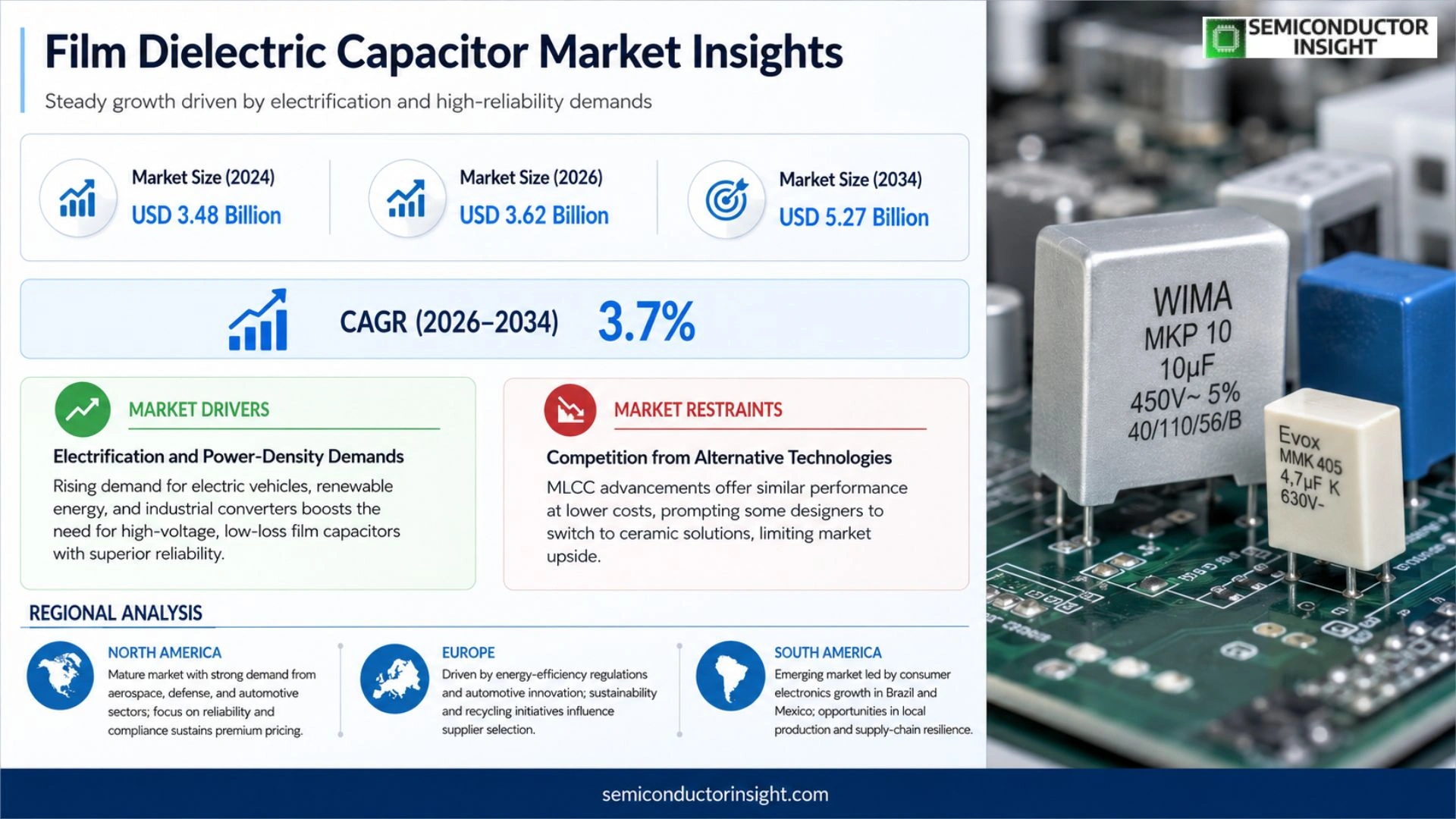
Film Dielectric Capacitor market size was valued at USD 3.48 billion in 2024. The market is projected to grow from USD 3.62 billion in 2026 to USD 5.27 billion by 2034, exhibiting a CAGR of 3.7% during the forecast period.
Film Dielectric Capacitors are electrical capacitors that employ an insulating plastic film as the dielectric medium; occasionally paper is used as a carrier for the electrodes.
The sector continues to expand because these components deliver reliable performance and superior dielectric characteristics across power‑management, signal‑filtering, data‑storage and communications applications. Ongoing efforts aim at boosting energy density while shrinking package dimensions, responding to trends toward miniaturized high‑performance electronics. Moreover, rising adoption of renewable‑energy systems and electric vehicles creates additional demand for high‑efficiency energy‑storage solutions where film capacitors can play a pivotal role.
MARKET DRIVERS
Electrification and Power‑Density Demands
The rise of electric‑propulsion systems in automotive and aerospace sectors forces designers to prioritize components that can tolerate high voltage stress while maintaining compact form‑factors. Film Dielectric Capacitor Market participants benefit from this shift because film capacitors offer low loss and excellent self‑healing characteristics, directly addressing the reliability concerns of high‑power converters.
Renewable‑Energy Integration
Grid‑scale solar and wind installations rely on power‑conditioning equipment that must handle fluctuating outputs without degradation. Film technology’s stable capacitance across temperature extremes makes it a preferred choice for inverter modules, creating sustained procurement cycles for manufacturers.
➤ “Design engineers increasingly cite dielectric stability as the decisive factor when selecting capacitors for high‑efficiency power converters.”
Beyond energy sectors, the surge in data‑center density drives adoption of film capacitors in DC‑link applications, where their low ESR translates into tangible energy‑cost savings for operators.
MARKET CHALLENGES
Cost Sensitivity in High‑Volume Segments
While film capacitors excel in performance, their material and processing costs remain higher than those of multilayer ceramic counterparts. OEMs producing consumer electronics press for price reductions, compelling manufacturers to streamline production without compromising dielectric integrity.
Other Challenges
Material Purity and Yield Management
Achieving consistent film thickness and eliminating microscopic defects require stringent clean‑room controls. Yield fluctuations can inflate unit costs, especially when demand spikes outpace capacity expansions.
MARKET RESTRAINTS
Competitive Pressure from Alternative Technologies
Advances in multilayer ceramic capacitor (MLCC) manufacturing have narrowed the performance gap that once favored film devices. With MLCCs now offering comparable voltage ratings at lower price points, some design teams migrate to ceramic solutions, limiting the upside potential for the Film Dielectric Capacitor Market.
MARKET OPPORTUNITIES
Advanced Manufacturing and Miniaturization
Emerging additive‑layer deposition techniques promise to reduce material waste and enable thinner dielectric films, directly addressing the size constraints of next‑generation electric‑vehicle power modules. Companies that successfully commercialize these processes can capture a differentiated niche within the Film Dielectric Capacitor Market.
Film Dielectric Capacitor Market Trends
Energy‑Density Push and Miniaturization
The most visible movement shaping the Film Dielectric Capacitor Market today is the race to raise energy density while shrinking package dimensions. Designers of mobile phones, wearables and IoT modules are demanding components that occupy less board space yet store enough charge to support longer runtimes. Manufacturers have responded by refining polymer film chemistries and tightening film‑to‑electrode tolerances, which translates into capacitors that can tolerate higher voltages in a footprint previously reserved for smaller values. This technical shift matters because it enables product developers to meet consumer expectations for thinner, lighter devices without compromising reliability. Companies that master this balance gain a foothold in high‑margin niche segments, prompting a re‑allocation of R&D budgets toward materials science and precision coating processes.
Other Trends
Renewable‑Energy Integration
As solar farms and wind installations scale, the power‑conditioning chain increasingly relies on components that can smooth intermittent output and protect downstream inverters. Film dielectric capacitors, with their low ESR and stable temperature performance, are being selected for medium‑voltage modules that bridge the gap between renewable generators and grid‑tie converters. The shift is not merely technical; it reshapes procurement strategies for utilities that now evaluate capacitor suppliers alongside turbine manufacturers. Firms that can certify long‑term endurance under fluctuating weather‑induced loads are positioning themselves as essential partners in the green‑energy supply chain, opening avenues for long‑term contracts and joint‑development projects.
Automotive Electrification Influence
Electrified powertrains are demanding a new class of film capacitors capable of handling higher ripple currents while surviving harsh automotive environments. In electric vehicles, these components appear in motor‑controller modules, DC‑DC converters and on‑board chargers, where they support fast charge cycles and regenerative‑braking energy recovery. The automotive push matters because it represents a volume‑driven market that can absorb incremental cost increases associated with higher‑spec capacitors. Suppliers that adapt their production lines for automotive‑grade quality standards,such as elevated temperature cycling and vibration resistance,are poised to capture a share of the expanding vehicle‑electronics budget. This trend also encourages cross‑industry collaboration, as automotive OEMs work closely with capacitor makers to co‑engineer parts that meet both performance and safety certifications.
COMPETITIVE LANDSCAPE
Key Industry Players
Competitive Overview of the Film Dielectric Capacitor Market
Panasonic continues to anchor the Film Dielectric Capacitor arena. Its extensive product breadth,covering AC, DC, automotive‑grade and high‑frequency variants,coupled with a vertically integrated supply chain, grants it leverage over pricing and technology cycles. The firm’s R&D pipeline emphasizes energy‑density improvements while preserving the low‑loss characteristics essential for power‑management modules, a combination that sustains its preferred‑supplier status among OEMs in consumer electronics and electric‑vehicle platforms. Market concentration remains moderate; Panasonic’s share is reinforced by longstanding relationships with Tier‑1 manufacturers, which translates into recurring volume contracts and a defensive moat against new entrants.
Beyond the dominant incumbent, a constellation of specialist and regionally strong firms is reshaping competitiveness. Yageo and TDK have expanded their film‑capacitor portfolios through strategic acquisitions, targeting niche automotive and renewable‑energy applications where miniaturisation and thermal stability are premium attributes. Vishay’s focus on high‑voltage, high‑reliability segments complements AVX’s push into data‑center power modules. Chinese manufacturers,Xiamen Faratronic, Anhui Tongfeng Electronic, Guangdong Fengming Electronic, JMX, Nantong Jianghai Capacitor, Guilin Power Capacitor, Knscha and Eagtop,leverage cost‑efficient production and rapid response to local demand, especially in the burgeoning EV and PV markets of Asia. Their ascent forces legacy players to accelerate innovation cycles and reconsider pricing strategies, while also creating partnership opportunities for technology transfer.
List of Key Film Dielectric Capacitor Companies Profiled
- Panasonic
- Yageo
- TDK
- Vishay
- AVX Corporation
- Nichicon
- Xiamen Faratronic
- Anhui Tongfeng Electronic
- Guangdong Fengming Electronic
- JMX
- Nantong Jianghai Capacitor
- Guilin Power Capacitor
- Knscha
- Eagtop
Segment Analysis:
| Segment Category | Sub-Segments | Key Insights |
| By Type |
|
By Type offers a clear functional distinction that drives product selection.
|
| By Application |
|
By Application reflects the broad adoption of film dielectric capacitors across high‑growth sectors.
|
| By End User |
|
By End User underscores how product adoption is shaped by design and supply‑chain dynamics.
|
| By Voltage Class |
|
By Voltage Class captures the strategic importance of voltage handling capabilities.
|
| By Innovation Focus |
|
By Innovation Focus reflects the forward‑looking drivers that shape product roadmaps.
|
Regional Analysis: Film Dielectric Capacitor Market
An integrated network of thin‑film equipment providers, substrate processors, and test labs fuels rapid prototyping, letting OEMs evaluate capacitor performance within weeks rather than months.
Engineers are leveraging advanced polymer formulations to push voltage ratings higher while preserving low ESR, a shift that expands applicability in EV power‑train modules.
Emerging safety standards in the electronics sector compel manufacturers to certify film capacitors against stricter dielectric‑breakdown criteria, accelerating material R&D.
Tier‑2 suppliers increasingly demand flexible form factors that can accommodate the miniaturization trend of portable devices, reshaping product roadmaps.
North America
The North American segment of the Film Dielectric Capacitor Market reflects a mature demand base anchored by aerospace, defense, and premium automotive sectors. Component buyers prioritize long‑term reliability and stringent compliance with federal safety codes, prompting suppliers to adopt rigorous validation protocols. While the overall volume growth is modest compared with Asia‑Pacific, the willingness to pay a premium for traceability and performance consistency sustains higher average selling prices. Industry players that embed advanced analytics into failure‑mode analysis are able to differentiate themselves, especially as OEMs seek to mitigate warranty risk in high‑value platforms.
Europe
Europe’s market dynamics are shaped by a regulatory environment that emphasizes energy efficiency and circular‑economy principles. Manufacturers are compelled to design film capacitors that meet the EU’s ecodesign directives, which in turn spurs material‑optimization initiatives. Concurrently, the region’s strong automotive engineering heritage drives demand for capacitors capable of withstanding harsh thermal cycles typical of hybrid powertrains. Suppliers that can demonstrate a robust end‑of‑life recycling pathway are gaining market favor, as OEMs integrate sustainability metrics into supplier selection criteria.
South America
In South America, the Film Dielectric Capacitor Market is still emerging, with growth anchored largely in expanding consumer‑electronics production hubs in Brazil and Mexico. Local manufacturers grapple with import‑tariff volatility, which pushes them toward developing domestic thin‑film capabilities. The competitive advantage rests on building supply‑chain resilience and offering flexible lead times, as regional OEMs often lack the inventory buffers of their Asian counterparts. Companies that invest in regional training programs for capacitor design are beginning to carve out niche positions, particularly in low‑cost, high‑volume applications.
Middle East & Africa
The Middle East & Africa region presents a fragmented yet opportunity‑rich landscape for film capacitors, primarily driven by renewable‑energy installations and emerging data‑center projects. Power‑grid modernization efforts demand capacitors that can endure high‑temperature environments, an attribute that aligns well with the intrinsic stability of film dielectric technology. However, limited local manufacturing infrastructure forces reliance on imports, making logistics a decisive factor. Market entrants that establish strategic partnerships with regional utilities and provide value‑added services such as on‑site testing are better positioned to convert nascent demand into sustainable revenue streams.
Report Scope
This market research report provides a comprehensive analysis of the Film Dielectric Capacitor Market , covering the forecast period 2026–2034. It offers detailed insights into market dynamics, technological advancements, competitive landscape, and key trends shaping the industry.
Key focus areas of the report include:
- Market Overview: The report begins with an overview outlining its current market scenario, key growth indicators, and industry transformation drivers. It discusses macroeconomic factors, demand–supply balance, regulatory landscape, and the strategic role of semiconductors in powering advancements across industries such as automotive, telecommunications, consumer electronics, and industrial automation.
- Market Size & Forecast: Historical data and future projections for revenue, unit shipments, and market value across major regions and segments.
- Segmentation Analysis: Detailed breakdown by product type, technology, application, and end-user industry to identify high-growth segments and investment opportunities.
- Regional Insights: Insights into market performance across North America, Europe, Asia-Pacific, Latin America, and the Middle East & Africa, including country-level analysis where relevant.
- Competitive Landscape: Profiles of leading market participants, including their product offerings, R&D focus, manufacturing capacity, pricing strategies, and recent developments such as mergers, acquisitions, and partnerships.
- Technology Trends & Innovation: Assessment of emerging technologies, integration of AI/IoT, semiconductor design trends, fabrication techniques, and evolving industry standards.
- Market Drivers & Restraints: Evaluation of factors driving market growth along with challenges, supply chain constraints, regulatory issues, and market-entry barriers.
- Stakeholder Insights: Insights for component suppliers, OEMs, system integrators, investors, and policymakers regarding the evolving ecosystem and strategic opportunities.
Primary and secondary research methods are employed, including interviews with industry experts, data from verified sources, and real-time market intelligence to ensure the accuracy and reliability of the insights presented.
FREQUENTLY ASKED QUESTIONS:
What is the current market size of Film Dielectric Capacitor Market?
-> Film Dielectric Capacitor market is projected to grow from USD 3.62 billion in 2026 to USD 5.27 billion by 2034, exhibiting a CAGR of 3.7%
Which key companies operate in Film Dielectric Capacitor Market?
-> Key players include Panasonic, Yageo, Xiamen Faratronic, Nichicon, TDK, Anhui Tongfeng Electronic, Guangdong Fengming Electronic, Vishay, JMX, AVX Corporation, Nantong Jianghai Capacitor, Guilin Power Capacitor, Knscha, and Eagtop.
What are the key growth drivers?
-> Key growth drivers include rising demand for high‑performance electronics, expansion of renewable energy and electric‑vehicle sectors, and the need for higher energy‑density and miniaturized capacitors.
Which region dominates the market?
-> Asia-Pacific is the dominant region, driven by strong electronics manufacturing bases in China, Japan, and South Korea.
What are the emerging trends?
-> Emerging trends include development of high‑energy‑density film capacitors, integration with power‑electronics for EVs, and advancements in sustainable, low‑loss dielectric materials.
Get Sample Report PDF for Exclusive Insights
Report Sample Includes
- Table of Contents
- List of Tables & Figures
- Charts, Research Methodology, and more...