Fetal Heart Rate Monitor (Doppler) IC Market Insights
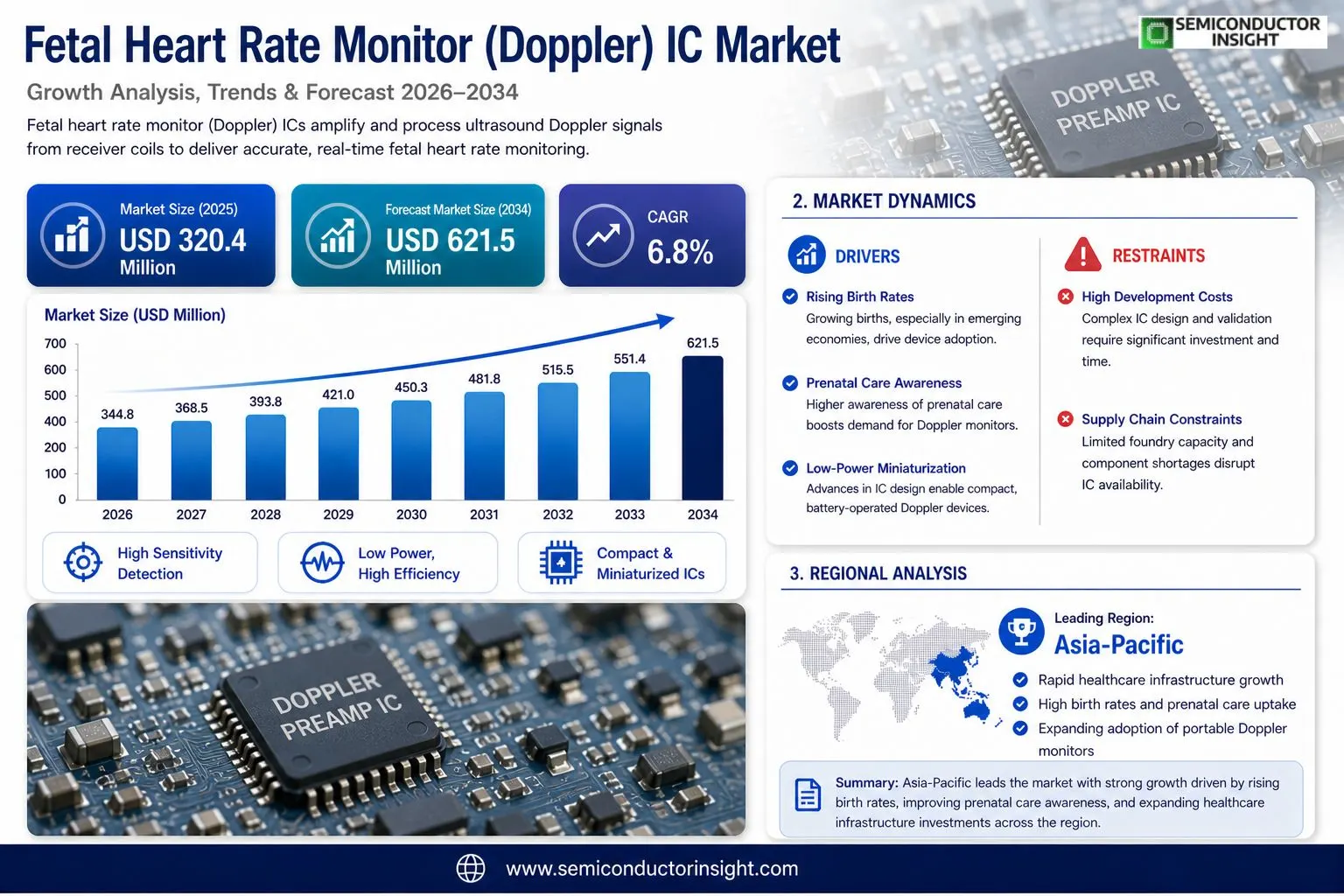
Global Fetal Heart Rate Monitor (Doppler) IC market size was valued at USD 320.4 million in 2025. The market is projected to grow from USD 344.8 million in 2026 to USD 621.5 million by 2034, exhibiting a CAGR of 6.8% during the forecast period.
Fetal Heart Rate Monitor (Doppler) ICs are specialized integrated circuits designed to enable non-invasive detection and monitoring of fetal cardiac activity using ultrasonic Doppler technology. These semiconductor components serve as the core signal processing elements within handheld and clinical-grade fetal Doppler devices, converting reflected ultrasonic waves into interpretable heart rate data. The IC category encompasses analog front-end chips, signal conditioning ICs, digital signal processors, and mixed-signal application-specific integrated circuits (ASICs) tailored for obstetric monitoring applications.
The market is witnessing steady expansion driven by rising global birth rates in emerging economies, increasing awareness of prenatal care, and the growing adoption of portable and home-use fetal monitoring devices. Furthermore, advancements in low-power IC design and miniaturization are enabling the development of compact, battery-operated Doppler monitors, broadening accessibility beyond hospital settings. Key industry participants such as Texas Instruments Inc., Analog Devices Inc., and STMicroelectronics maintain active portfolios of ultrasound front-end and signal processing ICs that serve this specialized medical application space.
MARKET DRIVERS
Rising Global Demand for Prenatal Monitoring Technologies
Global Fetal Heart Rate Monitor (Doppler) IC Market is experiencing sustained growth, driven primarily by the increasing emphasis on maternal and fetal health monitoring across both developed and emerging economies. Integrated circuits purpose-built for fetal Doppler devices play a critical role in enabling accurate, real-time heart rate detection, and the demand for such components has grown in tandem with rising birth rates in developing regions and heightened awareness of prenatal care in high-income nations. Governments and healthcare institutions worldwide have expanded antenatal care programs, creating a consistent and growing procurement channel for Doppler-enabled fetal monitoring equipment and the IC components that power them.
Technological Advancements in Low-Power and High-Sensitivity IC Design
A significant driver shaping Fetal Heart Rate Monitor (Doppler) IC Market is the rapid advancement in semiconductor design, particularly the development of low-power analog front-end ICs and digital signal processing chipsets optimized for ultrasound Doppler applications. Modern fetal Doppler ICs are engineered to deliver superior signal-to-noise ratios, enhanced sensitivity for detecting fetal heartbeats as early as the first trimester, and extended battery life , all critical features for portable and handheld fetal monitoring devices. The miniaturization of IC components has also enabled the development of compact, wearable fetal monitors, broadening the addressable market considerably.
➤ The integration of advanced analog and mixed-signal ICs into next-generation fetal Doppler devices is enabling clinically accurate home-use monitoring solutions, significantly expanding the consumer-grade segment of Fetal Heart Rate Monitor (Doppler) IC Market.
The proliferation of telehealth and remote patient monitoring platforms has further amplified IC demand, as device manufacturers seek to embed wireless connectivity and cloud-compatible data transmission capabilities directly into fetal Doppler hardware. This systemic shift toward connected prenatal care ecosystems is pushing IC vendors to develop increasingly integrated, multi-function chipsets that consolidate Doppler signal processing, power management, and communication functions onto a single platform, driving both design innovation and volume-based procurement growth across Fetal Heart Rate Monitor (Doppler) IC Market.
MARKET CHALLENGES
Technical Complexity in Fetal Signal Isolation and Noise Rejection
One of the most persistent technical challenges in Fetal Heart Rate Monitor (Doppler) IC Market is the accurate isolation of the fetal cardiac signal from competing maternal physiological signals and external acoustic noise. Designing ICs capable of reliably distinguishing fetal heart sounds , which are inherently weak and occur within a narrow frequency band , from maternal heartbeat, bowel sounds, and movement artifacts demands sophisticated analog filtering architectures and adaptive digital signal processing algorithms. This technical complexity translates into extended IC development cycles, higher validation costs, and elevated barriers to entry for new semiconductor vendors seeking to compete in this specialized market segment.
Other Challenges
Stringent Regulatory Compliance Requirements
Fetal monitoring ICs are subject to rigorous medical device regulations across major markets, including FDA requirements in the United States, CE marking mandates in the European Union, and evolving standards from bodies such as IEC and ISO relevant to active implantable and non-implantable medical devices. Achieving and maintaining compliance demands that IC manufacturers invest substantially in clinical validation, electromagnetic compatibility testing, and quality management systems, which increases both time-to-market and operational overhead throughout Fetal Heart Rate Monitor (Doppler) IC Market supply chain.
Supply Chain Vulnerabilities and Semiconductor Sourcing Constraints
Global semiconductor supply chain, which experienced significant disruptions in recent years, continues to present challenges for manufacturers operating within Fetal Heart Rate Monitor (Doppler) IC Market. Specialty analog and mixed-signal ICs used in fetal Doppler applications are often sourced from a limited number of qualified foundries, making supply continuity vulnerable to geopolitical pressures, raw material shortages, and capacity allocation decisions that prioritize higher-volume consumer electronics applications over lower-volume medical-grade IC production.
MARKET RESTRAINTS
High Development Costs and Limited Volume Economics in Medical-Grade IC Segments
A key restraint affecting growth momentum in Fetal Heart Rate Monitor (Doppler) IC Market is the inherently high cost structure associated with developing and manufacturing medical-grade semiconductor components. Unlike high-volume consumer IC applications that benefit from substantial economies of scale, fetal Doppler ICs serve a comparatively niche market, limiting the ability of manufacturers to amortize non-recurring engineering costs and mask tooling investments across large production volumes. This cost dynamic compresses margins for IC vendors and can impede competitive pricing, particularly in price-sensitive markets across South and Southeast Asia, Latin America, and Sub-Saharan Africa where affordable fetal monitoring solutions are most critically needed.
Limited Penetration in Low-Resource Healthcare Settings
Despite the clinical importance of fetal heart rate monitoring, the adoption of advanced Doppler IC-based devices remains constrained in low-resource healthcare environments due to affordability barriers, inadequate healthcare infrastructure, and insufficient technical training among frontline health workers. In many high-burden regions where maternal and neonatal mortality rates remain elevated, the availability of reliable Doppler fetal monitors is limited, and the sophisticated ICs that enable such devices are often inaccessible through standard procurement channels. This structural gap between clinical need and commercial market penetration represents a sustained restraint on the overall growth trajectory of Fetal Heart Rate Monitor (Doppler) IC Market, particularly as global health equity initiatives push for wider access to essential prenatal diagnostic tools.
MARKET OPPORTUNITIES
Expansion of Home-Use and Wearable Fetal Monitoring Device Categories
The growing consumer interest in self-managed prenatal care presents a compelling opportunity for IC vendors operating in Fetal Heart Rate Monitor (Doppler) IC Market. As expectant parents increasingly seek clinically reliable home monitoring options, device manufacturers are investing in the development of compact, battery-powered, and app-connected fetal Doppler units that demand highly integrated, low-power ICs. This trend is catalyzing demand for purpose-built Doppler IC platforms that consolidate ultrasound transceiver, signal conditioning, and wireless communication functions, opening a new and rapidly expanding commercial channel distinct from the traditional clinical device market.
Integration of AI-Assisted Signal Processing Capabilities into Next-Generation Fetal Doppler ICs
The convergence of artificial intelligence with medical-grade semiconductor design is emerging as a high-potential opportunity for Fetal Heart Rate Monitor (Doppler) IC Market. IC architectures that incorporate on-chip neural processing units or AI-accelerated digital signal processing engines can enable intelligent, adaptive filtering of fetal cardiac signals , improving diagnostic accuracy and reducing false-positive artifact detection without increasing power consumption. Semiconductor companies that invest in AI-integrated Doppler IC platforms are well-positioned to capture design wins with medical device OEMs seeking to differentiate their products in an increasingly competitive prenatal monitoring landscape.
Growing Healthcare Infrastructure Investment in Emerging Economies
Sustained government and multilateral investment in maternal healthcare infrastructure across emerging economies in Asia-Pacific, the Middle East, and Africa is creating expanding procurement opportunities for affordable, high-quality fetal Doppler devices , and by extension, for the IC components that enable them. National health programs focused on reducing maternal and neonatal mortality are driving bulk procurement of fetal monitoring equipment at the district and community health center level, creating volume-driven demand signals that IC manufacturers and their OEM partners can strategically address through cost-optimized, regionally tailored product offerings within the broader Fetal Heart Rate Monitor (Doppler) IC Market.
Fetal Heart Rate Monitor (Doppler) IC Market Trends
Rising Demand for Portable and Home-Use Fetal Doppler Devices Reshaping the IC Landscape
Fetal Heart Rate Monitor (Doppler) IC Market is undergoing a significant structural shift as demand for portable, battery-operated fetal monitoring solutions accelerates across both developed and emerging economies. Advancements in low-power integrated circuit design and semiconductor miniaturization are enabling manufacturers to develop compact Doppler monitors that maintain clinical-grade accuracy outside traditional hospital environments. This transition is directly influencing IC development priorities, with analog front-end chips, mixed-signal ASICs, and digital signal processors being increasingly optimized for size reduction and energy efficiency. The convergence of these engineering capabilities with broader prenatal care awareness is establishing a strong and sustained demand trajectory for specialized fetal Doppler ICs.
Other Trends
Expansion of Prenatal Care Awareness in Emerging Economies
Growing awareness of prenatal health management across emerging economies in Asia-Pacific, Latin America, and Sub-Saharan Africa is serving as a meaningful growth catalyst for Fetal Heart Rate Monitor (Doppler) IC Market. As healthcare infrastructure continues to expand in these regions, demand for affordable, non-invasive fetal cardiac monitoring devices is rising steadily. This trend is encouraging IC manufacturers to develop cost-optimized signal processing solutions that retain diagnostic reliability while meeting price-sensitive market requirements. The increasing birth rates in several developing nations further reinforce the commercial opportunity for both device manufacturers and their semiconductor supply chains.
Integration of Mixed-Signal ASICs and Advanced Signal Conditioning
A notable technical trend within Fetal Heart Rate Monitor (Doppler) IC Market is the growing preference for application-specific integrated circuits that combine analog and digital signal processing capabilities within a single package. Mixed-signal ASICs designed specifically for obstetric ultrasound applications offer improved noise immunity, reduced component count, and more precise fetal heart rate extraction from Doppler signals. Leading semiconductor companies including Texas Instruments Inc., Analog Devices Inc., and STMicroelectronics maintain active IC portfolios addressing ultrasound front-end processing, reinforcing the technical sophistication expected in this segment.
Shift Toward Non-Invasive Monitoring Driving Sustained IC Innovation
The broader clinical preference for non-invasive fetal assessment methods continues to reinforce innovation within Fetal Heart Rate Monitor (Doppler) IC Market. As healthcare providers and expectant parents increasingly favor monitoring solutions that eliminate procedural risk, demand for high-performance ultrasonic Doppler ICs capable of delivering reliable cardiac waveform data is strengthening. This preference is prompting continuous refinement of signal conditioning ICs and digital processing architectures to improve sensitivity and signal clarity. The result is a competitive environment in which semiconductor innovation remains central to product differentiation across both clinical-grade and consumer-oriented fetal Doppler device categories.
COMPETITIVE LANDSCAPE
Key Industry Players
Fetal Heart Rate Monitor (Doppler) IC Market: Competitive Dynamics and Leading Semiconductor Suppliers
Global Fetal Heart Rate Monitor (Doppler) IC market is characterized by the strong presence of established semiconductor giants that leverage their broad analog, mixed-signal, and digital signal processing portfolios to serve the obstetric monitoring space. Texas Instruments Inc., Analog Devices Inc., and STMicroelectronics emerge as dominant forces, each maintaining dedicated families of ultrasound analog front-end ICs, low-noise amplifiers, and signal conditioning components that are integral to clinical-grade and portable fetal Doppler devices. These industry leaders benefit from extensive R&D investments, robust global distribution networks, and longstanding relationships with medical device OEMs, enabling them to sustain competitive advantages in a market projected to grow from USD 344.8 million in 2026 to USD 621.5 million by 2034 at a CAGR of 6.8%. Their ongoing focus on low-power IC architectures and miniaturization directly supports the industry trend toward compact, battery-operated fetal monitors that extend prenatal care accessibility beyond hospital environments into home and community settings.
Beyond the tier-one semiconductor suppliers, a number of specialized and regional players contribute meaningfully to the competitive landscape of Fetal Heart Rate Monitor (Doppler) IC Market. Companies such as Maxim Integrated (now part of Analog Devices), NXP Semiconductors, and Renesas Electronics offer relevant mixed-signal and microcontroller solutions adopted in medical ultrasound front-end designs. Meanwhile, firms including Microchip Technology, Infineon Technologies, and ON Semiconductor supply supporting ICs such as power management and signal processing components widely integrated into fetal Doppler monitor architectures. Asian semiconductor manufacturers, notably Shenzhen-based design houses and CMOS IC specialists, are increasingly competing on cost efficiency to serve the growing demand for affordable fetal monitoring devices in emerging economies across Asia-Pacific, Latin America, and Sub-Saharan Africa. This competitive interplay between global incumbents and nimble regional challengers continues to drive innovation in IC performance, integration density, and energy efficiency across the market.
List of Key Fetal Heart Rate Monitor (Doppler) IC Companies Profiled
- Texas Instruments Inc.
- Analog Devices Inc.
- STMicroelectronics
- NXP Semiconductors
- Maxim Integrated (Analog Devices)
- Renesas Electronics Corporation
- Microchip Technology Inc.
- Infineon Technologies AG
- ON Semiconductor (onsemi)
- Qualcomm Technologies Inc.
- ROHM Semiconductor
- Cirrus Logic Inc.
- Silicon Laboratories Inc.
- Semtech Corporation
- Shenzhen Mindray Bio-Medical Electronics Co., Ltd.
Segment Analysis:
| Segment Category | Sub-Segments | Key Insights |
| By Type |
|
Mixed-Signal ASICs represent the leading segment within the type category, driven by their ability to consolidate multiple signal processing functions into a single chip architecture purpose-built for obstetric Doppler applications.
|
| By Application |
|
Handheld Fetal Doppler Devices dominate the application landscape, reflecting the widespread transition toward portable, point-of-care prenatal monitoring solutions across both developed and emerging healthcare markets.
|
| By End User |
|
Hospitals and Maternity Clinics constitute the leading end-user segment, underpinned by their role as the primary site for structured antenatal care and high-risk pregnancy monitoring on a global scale.
|
| By Technology |
|
Continuous Wave (CW) Doppler ICs lead the technology segment, owing to their well-established efficacy in capturing fetal cardiac signals reliably across diverse clinical and non-clinical monitoring environments.
|
| By Power Architecture |
|
Battery-Powered Low-Power ICs are emerging as the most dynamically growing segment within the power architecture category, reflecting the broader industry shift toward portable, user-friendly prenatal monitoring solutions.
|
Regional Analysis: Fetal Heart Rate Monitor (Doppler) IC Market
North America
Fetal Heart Rate Monitor (Doppler) IC Market in North America benefits from a robust regulatory ecosystem overseen by the U.S. FDA and Health Canada. Stringent device approval pathways ensure that only clinically validated, high-performance Doppler IC solutions reach the market, building strong physician and patient trust. This regulatory clarity also encourages sustained R&D investment from semiconductor developers targeting obstetric applications.
North America hosts a dense concentration of semiconductor and medical electronics firms actively advancing low-noise, high-sensitivity Doppler IC architectures suited for fetal heart rate monitoring. Investments in analog front-end optimization, ultra-low power consumption designs, and miniaturized chip form factors are reshaping device capabilities. These advancements position the region at the forefront of next-generation Fetal Heart Rate Monitor (Doppler) IC development through 2034.
A sophisticated network of hospitals, specialty clinics, and home care service providers across the United States and Canada creates multiple distribution touchpoints for Fetal Heart Rate Monitor (Doppler) IC-enabled devices. The expansion of telehealth and remote prenatal monitoring services further broadens market reach, allowing Doppler IC solutions to serve patients in underserved and rural areas with increasing effectiveness and reliability.
Rising maternal age at childbirth, growing incidences of high-risk pregnancies, and increasing clinical emphasis on continuous fetal surveillance are key demand drivers for Fetal Heart Rate Monitor (Doppler) IC technologies in North America. Venture capital inflows into maternal digital health startups, coupled with strategic partnerships between IC manufacturers and OEM device makers, are further energizing the region’s competitive and investment landscape.
Europe
Europe represents a highly significant regional market for Fetal Heart Rate Monitor (Doppler) IC Market, supported by universal healthcare systems across major economies including Germany, France, the United Kingdom, and the Nordic nations. European clinical guidelines place strong emphasis on systematic prenatal monitoring, creating consistent institutional demand for advanced Doppler IC-integrated fetal surveillance solutions. The region’s mature medical device manufacturing ecosystem, anchored in countries such as Germany and the Netherlands, ensures access to precision-engineered components that enhance Doppler signal acquisition and processing performance. EU regulatory harmonization through the Medical Device Regulation framework fosters market confidence while encouraging innovation. Additionally, European research institutions actively collaborate with semiconductor developers to explore next-generation IC architectures for obstetric monitoring, reinforcing the region’s position as a technology-forward market. Growing adoption of portable and wearable fetal monitoring devices further stimulates Fetal Heart Rate Monitor (Doppler) IC demand across European healthcare settings through the 2026–2034 period.
Asia-Pacific
Asia-Pacific is emerging as the fastest-evolving region within Global Fetal Heart Rate Monitor (Doppler) IC Market, propelled by demographic scale, expanding healthcare infrastructure, and rising awareness of maternal and fetal health management. China, India, Japan, and South Korea represent pivotal national markets, each contributing distinct growth dynamics. China’s large birth volume and government-driven healthcare modernization programs are accelerating the deployment of advanced fetal monitoring technologies in both urban hospitals and rural health centers. India’s growing private healthcare sector and increasing prenatal care awareness are creating new demand corridors for cost-effective Doppler IC-based devices. Japan and South Korea contribute through their advanced electronics manufacturing capabilities, positioning the sub-region as both a consumer and an exporter of Fetal Heart Rate Monitor (Doppler) IC solutions. Favorable government maternal health policies across the Asia-Pacific region are expected to sustain robust market momentum through 2034.
South America
South America presents a progressively developing landscape for Fetal Heart Rate Monitor (Doppler) IC Market, with Brazil and Argentina emerging as the primary demand centers. Expanding public health investments aimed at improving maternal and neonatal outcomes are driving institutional procurement of fetal heart rate monitoring equipment integrated with advanced Doppler IC technologies. Brazil, as the region’s largest healthcare market, is witnessing a gradual shift toward more sophisticated prenatal diagnostic tools within both public hospital networks and private obstetric clinics. Government-sponsored maternal health initiatives are playing a meaningful role in broadening access to Doppler-based fetal surveillance across underserved communities. However, economic variability, currency fluctuation, and import dependency for high-grade semiconductor components present ongoing challenges that may moderate the pace of Fetal Heart Rate Monitor (Doppler) IC Market expansion in certain South American economies through the forecast period.
Middle East & Africa
The Middle East and Africa region occupies an emerging yet strategically important position in Global Fetal Heart Rate Monitor (Doppler) IC Market. Gulf Cooperation Council nations, particularly Saudi Arabia and the UAE, are leading regional adoption driven by substantial healthcare capital expenditure, world-class hospital infrastructure, and proactive maternal health programs. These markets demonstrate a growing appetite for technologically sophisticated Doppler IC-enabled fetal monitoring systems across premium private healthcare facilities. Across sub-Saharan Africa, the market remains nascent but holds considerable long-term potential, supported by international health organization programs aimed at reducing maternal and neonatal mortality rates. Increasing NGO-backed healthcare interventions and improving distribution networks are gradually facilitating access to essential fetal heart rate monitoring technologies. As regional healthcare investments continue to grow and local clinical awareness around prenatal monitoring deepens, the Middle East and Africa are expected to register steady, if measured, growth within Fetal Heart Rate Monitor (Doppler) IC Market through 2034.
Report Scope
This market research report provides a comprehensive analysis of the Fetal Heart Rate Monitor (Doppler) IC Market , covering the forecast period 2026–2034. It offers detailed insights into market dynamics, technological advancements, competitive landscape, and key trends shaping the industry.
Key focus areas of the report include:
- Market Overview: The report begins with an overview outlining its current market scenario, key growth indicators, and industry transformation drivers. It discusses macroeconomic factors, demand–supply balance, regulatory landscape, and the strategic role of semiconductors in powering advancements across industries such as automotive, telecommunications, consumer electronics, and industrial automation.
- Market Size & Forecast: Historical data and future projections for revenue, unit shipments, and market value across major regions and segments.
- Segmentation Analysis: Detailed breakdown by product type, technology, application, and end-user industry to identify high-growth segments and investment opportunities.
- Regional Insights: Insights into market performance across North America, Europe, Asia-Pacific, Latin America, and the Middle East & Africa, including country-level analysis where relevant.
- Competitive Landscape: Profiles of leading market participants, including their product offerings, R&D focus, manufacturing capacity, pricing strategies, and recent developments such as mergers, acquisitions, and partnerships.
- Technology Trends & Innovation: Assessment of emerging technologies, integration of AI/IoT, semiconductor design trends, fabrication techniques, and evolving industry standards.
- Market Drivers & Restraints: Evaluation of factors driving market growth along with challenges, supply chain constraints, regulatory issues, and market-entry barriers.
- Stakeholder Insights: Insights for component suppliers, OEMs, system integrators, investors, and policymakers regarding the evolving ecosystem and strategic opportunities.
Primary and secondary research methods are employed, including interviews with industry experts, data from verified sources, and real-time market intelligence to ensure the accuracy and reliability of the insights presented.
FREQUENTLY ASKED QUESTIONS:
What is the current market size of Fetal Heart Rate Monitor (Doppler) IC Market?
-> Global Fetal Heart Rate Monitor (Doppler) IC Market was valued at USD 320.4 million in 2025 and is projected to grow from USD 344.8 million in 2026 to USD 621.5 million by 2034, exhibiting a CAGR of 6.8% during the forecast period.
Which key companies operate in Fetal Heart Rate Monitor (Doppler) IC Market?
-> Key players include Texas Instruments Inc., Analog Devices Inc., and STMicroelectronics, among others, all of which maintain active portfolios of ultrasound front-end and signal processing ICs serving this specialized medical application space.
What are the key growth drivers?
-> Key growth drivers include rising global birth rates in emerging economies, increasing awareness of prenatal care, growing adoption of portable and home-use fetal monitoring devices, and advancements in low-power IC design and miniaturization enabling compact, battery-operated Doppler monitors.
Which region dominates the market?
-> Asia-Pacific is among the fastest-growing regions driven by rising birth rates and expanding prenatal care awareness, while North America and Europe remain dominant markets due to advanced healthcare infrastructure and high adoption of clinical-grade fetal monitoring devices.
What are the emerging trends?
-> Emerging trends include miniaturization of IC components, development of low-power mixed-signal ASICs for obstetric monitoring, integration of digital signal processors in handheld Doppler devices, and broadening accessibility of fetal monitoring solutions beyond hospital settings into home-use applications.

Get Sample Report PDF for Exclusive Insights
Report Sample Includes
- Table of Contents
- List of Tables & Figures
- Charts, Research Methodology, and more...
 Download Sample Report PDF