Fan Parallel Dipole Antennas Market Insights
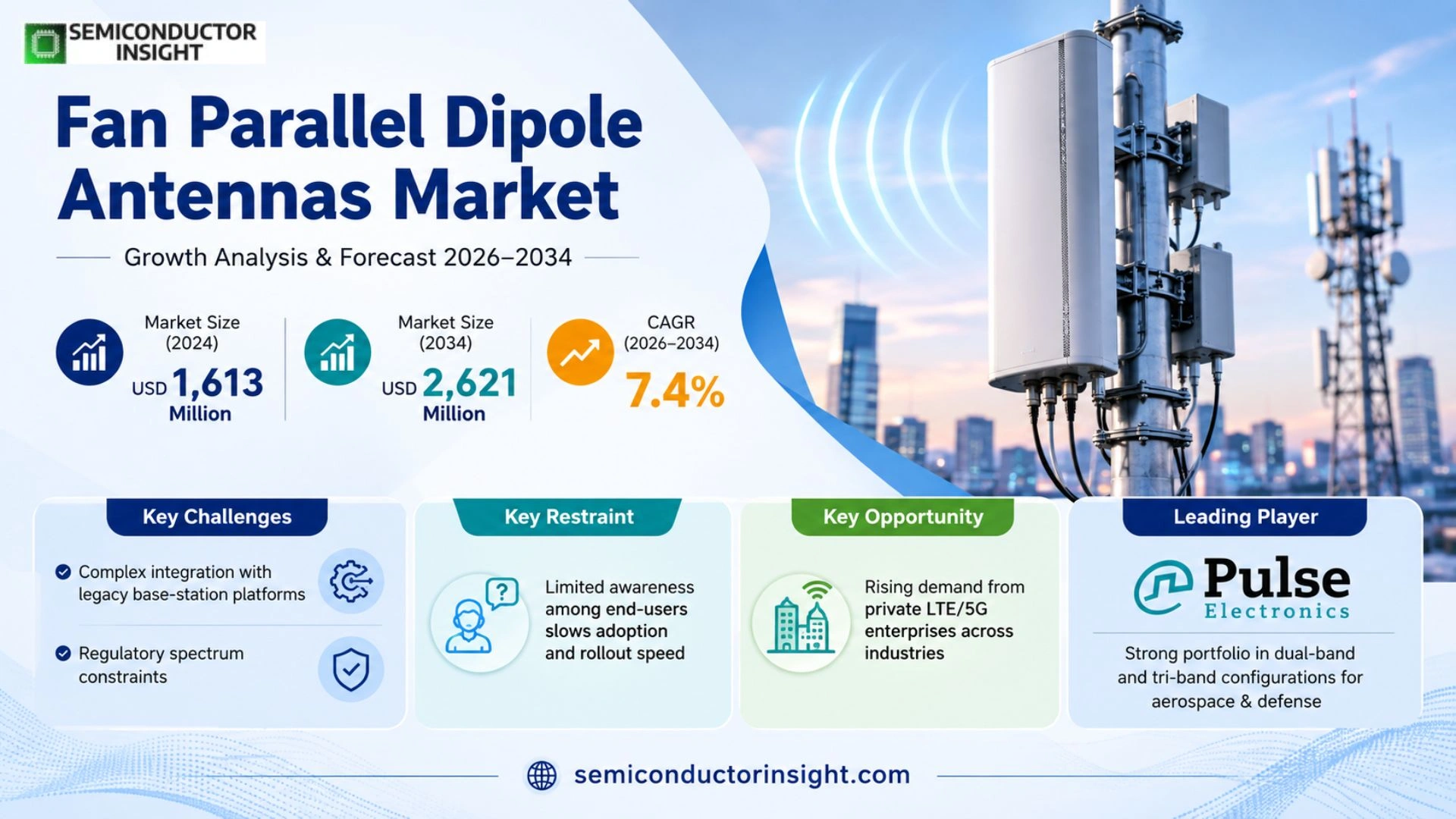
Fan Parallel Dipole Antennas market size was valued at USD 1,613 million in 2024 and will reach USD 2,621 million by 2034, exhibiting a CAGR of 7.4% during the forecast period.
A fan parallel dipole antenna is an antenna architecture that operates across multiple frequency bands; certain elements are optimized for a primary band while others serve alternate bands, enabling flexible deployment in diverse communication systems.
The market benefits from expanding IoT networks, rising demand for multi‑band solutions in automotive and aerospace sectors, and active development by manufacturers such as Pulse Electronics, PCTEL, Mobilemark, Siretta and TE Connectivity.
MARKET DRIVERS
High‑frequency communication demand
The surge in 5G rollout and microwave‑backhaul projects forces network operators to seek antennas that combine wide‑band performance with compact form factor. Fan Parallel Dipole Antennas meet this need by delivering stable gain across multiple bands while keeping array size manageable, a characteristic that telecom engineers value for dense urban deployments.
Cost‑effective manufacturing
Advances in printable circuit technology and low‑loss substrate materials have lowered the bill‑of‑materials for these antennas. Manufacturers can now produce large‑scale panels with consistent radiation patterns, which translates into lower CAPEX for service providers and faster time‑to‑market for equipment vendors.
➤ “The blend of performance and price makes fan‑type dipoles the go‑to choice for emerging fixed‑wireless access networks.”
Moreover, the growing emphasis on sustainable infrastructure pushes operators toward solutions that minimize tower load and power consumption. The inherently planar structure of fan parallel dipoles reduces wind‑load requirements, allowing lighter, greener deployments that comply with increasingly strict environmental guidelines.
MARKET CHALLENGES
Complex integration with existing base‑station platforms
Although the antenna element itself is straightforward, marrying it to legacy RF front‑ends often demands custom matching networks. This integration step can extend engineering cycles, especially when operators need to retrofit sites that were originally designed for traditional horn or panel antennas.
Other Challenges
Regulatory spectrum constraints
Many jurisdictions impose stringent out‑of‑band emission limits. Achieving compliance with a broadband fan dipole sometimes requires additional filtering, which adds cost and can erode the very efficiency advantage that the antenna promises.
MARKET RESTRAINTS
Limited awareness among end‑users
Despite technical merits, a sizable portion of smaller carriers and private‑network operators remain unfamiliar with fan parallel dipole technology. This knowledge gap slows adoption, as decision‑makers default to proven, albeit less efficient, antenna families.
Training programs and vendor‑led workshops have yet to reach a critical mass, leaving procurement teams uncertain about long‑term support and upgrade paths.
Consequently, forecasted rollout speeds are tempered by the need for market education, which diverts resources from pure deployment activities.
MARKET OPPORTUNITIES
Rise of private LTE/5G enterprises
Enterprises building private cellular networks,manufacturing plants, campuses, and logistics hubs,require antennas that can be mounted on existing structures without major civil works. The low profile of fan parallel dipoles fits neatly onto rooftops and indoor ceilings, opening a niche where Fan Parallel Dipole Antennas Market can capture fresh demand.
Satellite‑backhaul convergence
Hybrid solutions that blend terrestrial cell sites with low‑earth‑orbit (LEO) satellite backhaul are gaining traction. Fan parallel dipole arrays, with their wide‑angle coverage, are well‑suited to receive both ground‑based and satellite signals, positioning vendors to benefit from this convergence trend.
Finally, the push for modular, plug‑and‑play antenna kits creates an avenue for OEMs to bundle fan dipoles with ready‑made mounting brackets, RF cables, and software tools, delivering a complete solution that shortens deployment timelines and adds premium value.
Fan Parallel Dipole Antennas Market Trends
Rise of Multi‑Band Deployments in Metropolitan Networks
Fan Parallel Dipole Antennas market is seeing a shift toward broader frequency coverage as urban operators replace legacy narrow‑band solutions. Network planners favor antennas that can switch between two or three bands without hardware changes, which shortens rollout cycles and reduces inventory complexity. This preference stems from the increasing density of 5G small cells and the parallel growth of IoT gateways that require flexible spectral handling. Vendors that embed configurable matching networks into a single form factor are gaining contract wins with municipal utilities, because they can address both public safety and commercial backhaul in one installation. The trend reshapes procurement strategies, prompting OEMs to prioritize modular designs over fixed‑frequency kits.
Other Trends
Emergence of Defense‑Grade Dual‑Band Solutions
Military communications have traditionally relied on rugged, single‑frequency antennas, yet mission profiles now demand rapid band switching to evade electronic interference. Defense contractors are integrating hardened Fan Parallel Dipole Antennas that survive extreme temperature swings while supporting both C‑band and X‑band operations. The move is motivated by a heightened emphasis on spectrum agility in contested environments, which forces suppliers to certify components against stricter MIL‑STD requirements. Consequently, the supply chain is seeing increased collaboration between antenna manufacturers and specialized coating firms to meet these durability thresholds. Organizations that can demonstrate compliance early are positioning themselves as preferred providers for next‑generation battlefield radios and unmanned platforms.
Shift Toward Asia‑Pacific Production Hubs
Manufacturing footprints for Fan Parallel Dipole Antennas market are gradually relocating to Asia‑Pacific hubs, where labor costs and proximity to major telecom projects create a competitive edge. Companies are establishing tier‑1 assembly lines in China and Vietnam to serve both domestic carriers and export orders to emerging markets in Southeast Asia. This relocation reduces lead times for bulk orders and enables quicker iteration on design tweaks demanded by regional standards bodies. The strategic move also encourages joint‑venture arrangements with local electronics firms, fostering technology transfer that strengthens the overall ecosystem. Clients benefit from lower total cost of ownership while still accessing high‑performance antenna solutions that meet global reliability criteria.
COMPETITIVE LANDSCAPE
Key Industry Players
Fan Parallel Dipole Antennas – Market Concentration and Strategic Positioning
Pulse Electronics dominates the upper tier of Fan Parallel Dipole Antennas market, leveraging a portfolio that spans dual‑band and tri‑band configurations for aerospace and defense contracts. Its extensive global distribution network, combined with in‑house RF testing capabilities, establishes a barrier to entry for new entrants and squeezes margins for smaller OEMs. The firm’s focus on modular designs that can be retrofitted into legacy platforms has cemented its role as a preferred supplier for high‑volume programs in North America and Europe. This concentration around a few large manufacturers creates a competitive environment where differentiation rests on engineering agility, supply‑chain resilience, and the ability to secure long‑term procurement agreements.
Beyond the market leader, a cohort of specialized firms adds depth to the competitive field. PCTEL and Mobilemark cater to niche automotive and industrial IoT segments, offering compact form factors that address space‑constrained applications. Siretta and Bulgin concentrate on ruggedized solutions for military field deployments, emphasizing durability under extreme conditions. RF Solutions, Molex, and TE Connectivity supply highly integrated antenna modules that embed directly onto printed‑circuit boards, a trend that aligns with the miniaturization of modern communication devices. Chelton, SCAN Antenna, and Bosch Security Systems serve the commercial surveillance market, where cost‑effectiveness and rapid time‑to‑market are paramount. Emerging participants such as STI‑CO Industries, Amphenol Procom, Laird Connectivity, Meinberg, Lambda Antennas, WilsonPro, Multiband Antennas, and Huawei are expanding their product lines to capture share in regional telecom upgrades and next‑generation wireless infrastructures. Their collective activity underscores a fragmented yet dynamic landscape, where strategic partnerships and targeted R&D investments are essential for sustaining relevance.
List of Key Fan Parallel Dipole Antennas Companies Profiled
- Pulse Electronics
- PCTEL
- Mobilemark
- Siretta
- Bulgin
- RF Solutions
- Molex
- TE Connectivity
- Chelton
- SCAN Antenna
- Bosch Security Systems
- STI-CO Industries
- Amphenol Procom
- Laird Connectivity
- Huawei
Segment Analysis:
| Segment Category | Sub-Segments | Key Insights |
| By Type |
|
Dual‑Band Antennas
|
| By Application |
|
Military Communications
|
| By End User |
|
Aerospace OEMs
|
| By Frequency Band Strategy |
|
Mid‑Band Solutions
|
| By Technological Trend |
|
Smart Materials & Adaptive Metasurfaces
|
Regional Analysis: Fan Parallel Dipole Antennas Market
North America
Premium smartphones and wearable devices are integrating fan‑parallel dipole structures to meet the demand for compact, multi‑band antennas. Engineers favor the geometry for its ability to maintain stable radiation patterns despite the cramped chassis, allowing manufacturers to push higher data rates while preserving battery life.
Vehicle manufacturers are embedding these antennas into advanced driver‑assistance systems to achieve precise millimeter‑wave detection. The low‑profile form factor simplifies mounting on curved surfaces, reducing aerodynamic drag without compromising radar resolution.
Defense contracts increasingly specify fan parallel dipole antennas for airborne surveillance platforms because they offer wide bandwidth in a lightweight package. The specifications emphasize ruggedness and resistance to hostile electromagnetic environments.
Collaborative research programs among universities, industry consortia, and standards bodies are shaping the next iteration of design guidelines. Focus areas include metasurface integration and additive manufacturing techniques that could reduce lead times.
Europe
European manufacturers are leveraging the region’s strong regulatory framework to accelerate the certification of fan‑parallel dipole antennas for civilian aerospace applications. Collaboration between German precision‑engineering firms and French research institutes is delivering antenna modules that meet stringent weight and thermal constraints. Meanwhile, the United Kingdom’s focus on 5G and private‑network deployments creates a niche for broadband antenna solutions that can be retrofitted onto existing infrastructure, extending market reach beyond new-build projects. The combination of high‑value engineering talent and policy incentives for green communication technologies positions Europe as a strong secondary hub.
Asia‑Pacific
Asia‑Pacific’s rapid expansion of smart‑city initiatives and massive rollout of 6G testbeds is driving localized demand for compact antenna solutions. Companies in Japan and South Korea are embedding fan parallel dipole designs into high‑frequency IoT gateways, capitalizing on the technology’s ability to sustain performance across congested spectra. In addition, emerging manufacturing hubs in Vietnam and India are attracting investment due to lower labor costs, enabling cost‑effective production of antenna components for export to Western markets. The region’s blend of aggressive adoption and emerging supply chains suggests a steep upward trajectory for the market segment.
South America
South American telecom operators are modernizing legacy networks, prompting a shift toward modular antenna architectures that can be upgraded without extensive site overhaul. Brazil’s aerospace sector, in particular, is experimenting with fan‑parallel dipole antennas for satellite communication payloads, seeking to reduce launch mass while preserving bandwidth. Meanwhile, government incentives aimed at expanding broadband coverage in remote areas encourage the deployment of compact, easy‑to‑install antenna arrays, fostering incremental market penetration across the continent.
Middle East & Africa
The Middle East’s investment in defensive radar and high‑frequency communication infrastructure is creating targeted opportunities for fan parallel dipole antenna suppliers. Nations such as the United Arab Emirates are integrating these antennas into maritime surveillance platforms to enhance situational awareness across expansive coastlines. In Africa, burgeoning mobile‑network expansions in Kenya and Nigeria are prompting vendors to explore lightweight antenna solutions that can be rapidly deployed in rugged environments, thus opening a niche for cost‑effective, durable designs.
Report Scope
This market research report provides a comprehensive analysis of the Fan Parallel Dipole Antennas Market , covering the forecast period 2026–2034. It offers detailed insights into market dynamics, technological advancements, competitive landscape, and key trends shaping the industry.
Key focus areas of the report include:
- Market Overview: The report begins with an overview outlining its current market scenario, key growth indicators, and industry transformation drivers. It discusses macroeconomic factors, demand–supply balance, regulatory landscape, and the strategic role of semiconductors in powering advancements across industries such as automotive, telecommunications, consumer electronics, and industrial automation.
- Market Size & Forecast: Historical data and future projections for revenue, unit shipments, and market value across major regions and segments.
- Segmentation Analysis: Detailed breakdown by product type, technology, application, and end-user industry to identify high-growth segments and investment opportunities.
- Regional Insights: Insights into market performance across North America, Europe, Asia-Pacific, Latin America, and the Middle East & Africa, including country-level analysis where relevant.
- Competitive Landscape: Profiles of leading market participants, including their product offerings, R&D focus, manufacturing capacity, pricing strategies, and recent developments such as mergers, acquisitions, and partnerships.
- Technology Trends & Innovation: Assessment of emerging technologies, integration of AI/IoT, semiconductor design trends, fabrication techniques, and evolving industry standards.
- Market Drivers & Restraints: Evaluation of factors driving market growth along with challenges, supply chain constraints, regulatory issues, and market-entry barriers.
- Stakeholder Insights: Insights for component suppliers, OEMs, system integrators, investors, and policymakers regarding the evolving ecosystem and strategic opportunities.
Primary and secondary research methods are employed, including interviews with industry experts, data from verified sources, and real‑time market intelligence to ensure the accuracy and reliability of the insights presented.
FREQUENTLY ASKED QUESTIONS:
What is the current market size of Fan Parallel Dipole Antennas Market?
-> Fan Parallel Dipole Antennas market will reach USD 2,621 million by 2034, exhibiting a CAGR of 7.4% during the forecast period.
Which key companies operate in Fan Parallel Dipole Antennas Market?
-> Key players include Pulse Electronics, PCTEL, Mobilemark, Siretta, Bulgin, RF Solutions, Molex, TE Connectivity, Chelton, SCAN Antenna, among others.
What are the key growth drivers?
-> Key growth drivers include rising demand for multi‑band antenna solutions in military and commercial communications, expansion of IoT and 5G networks, and the need for compact, high‑performance antennas that operate across multiple frequency bands.
Which region dominates the market?
-> North America leads the market, driven primarily by strong demand in the United States, while Asia‑Pacific shows the fastest growth due to increasing adoption in China and other emerging economies.
What are the emerging trends?
-> Emerging trends include development of dual‑band and tri‑band antenna modules, integration of smart‑sensor capabilities, and miniaturization techniques to meet space‑constrained applications.

Get Sample Report PDF for Exclusive Insights
Report Sample Includes
- Table of Contents
- List of Tables & Figures
- Charts, Research Methodology, and more...
 Download Sample Report PDF