Event-Based Vision Sensor (Neuromorphic) Market Insights
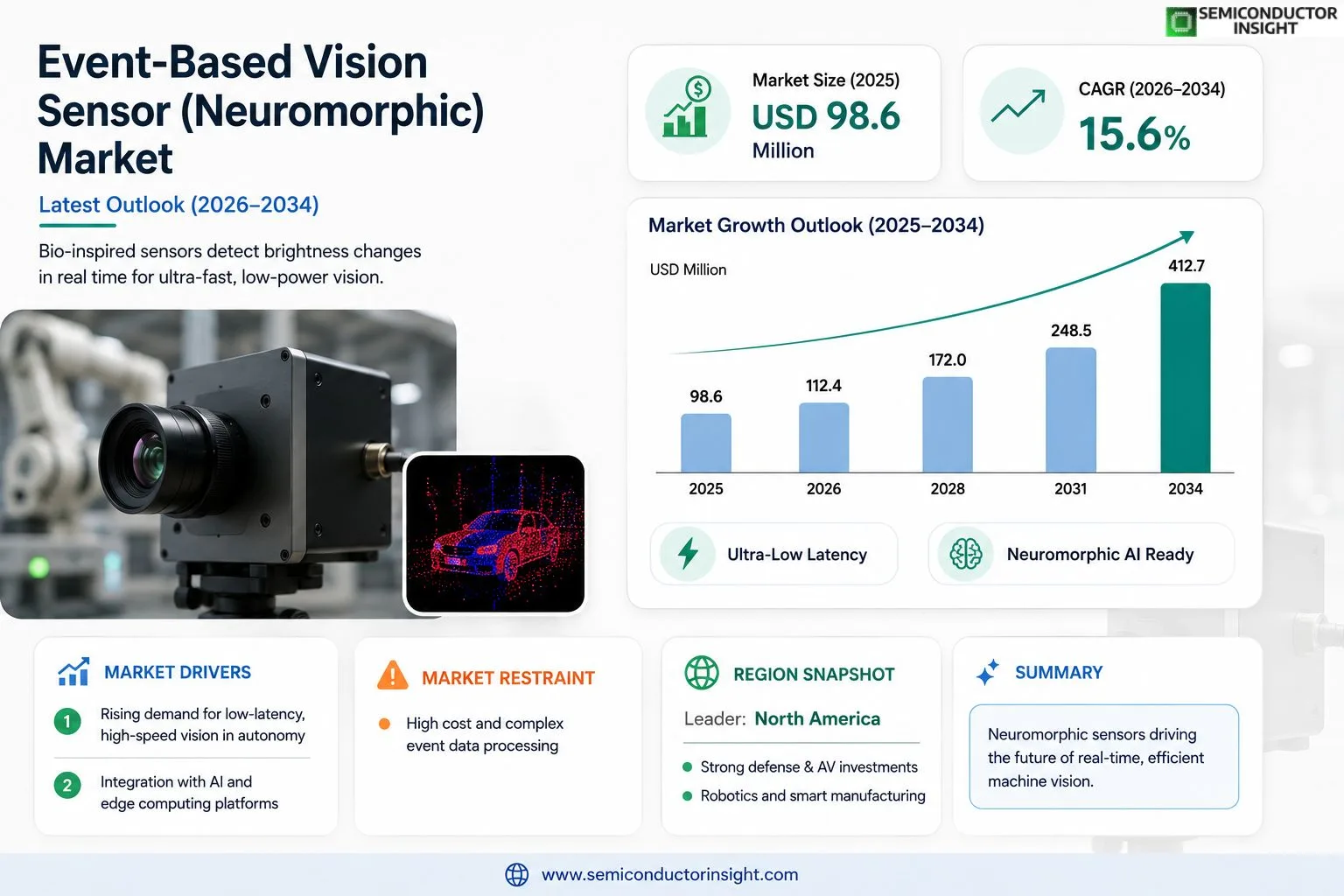
Global Event-Based Vision Sensor (Neuromorphic) market size was valued at USD 98.6 million in 2025. The market is projected to grow from USD 112.4 million in 2026 to USD 412.7 million by 2034, exhibiting a CAGR of 15.6% during the forecast period.
Event-based vision sensors, also known as neuromorphic cameras or dynamic vision sensors (DVS), are bio-inspired imaging devices that fundamentally differ from conventional frame-based cameras. Rather than capturing images at fixed intervals, these sensors asynchronously detect per-pixel brightness changes in real time, generating sparse, low-latency data streams that closely mimic the functioning of the human retina. The technology encompasses a range of sensor types, including dynamic vision sensors (DVS), dynamic and active pixel vision sensors (DAVIS), and spiking neural network-integrated platforms, finding application across robotics, autonomous vehicles, industrial automation, aerospace, and consumer electronics.
The market is gaining strong momentum due to the surging demand for high-speed, low-power vision processing in autonomous systems and edge AI applications. The limitations of conventional cameras in high-dynamic-range and motion-blur-prone environments have accelerated adoption of neuromorphic vision solutions. Furthermore, growing investment in autonomous vehicle development and the rapid expansion of robotics across manufacturing sectors are reinforcing demand. Key industry participants such as Prophesee SA, iniVation AG, Samsung Electronics, Sony Corporation, and Omnitek Partners are actively advancing the technology through product innovation and strategic collaborations, strengthening the overall competitive landscape of the event-based vision sensor market.
MARKET DRIVERS
Rising Demand for Low-Latency, High-Speed Machine Vision in Autonomous Systems
Event-Based Vision Sensor (Neuromorphic) Market is experiencing accelerating momentum driven by the growing need for ultra-low latency perception systems in autonomous vehicles, drones, and industrial robotics. Unlike conventional frame-based cameras, event-based vision sensors respond asynchronously to changes in pixel-level light intensity, enabling microsecond-level response times that are critical for high-speed object detection and navigation. As autonomous mobility solutions expand globally, the demand for neuromorphic sensing hardware capable of operating reliably in dynamic, unpredictable environments continues to intensify.
Increasing Integration with Artificial Intelligence and Edge Computing Architectures
A key driver propelling Event-Based Vision Sensor (Neuromorphic) Market forward is the deepening convergence of neuromorphic sensing with AI inference at the edge. Event-driven data streams are inherently sparse and temporally precise, making them well-suited for spiking neural networks (SNNs) and low-power edge AI chips. As semiconductor companies and AI research institutions invest heavily in brain-inspired computing paradigms, event-based sensors are increasingly being positioned as front-end perception modules in energy-constrained AI systems deployed in smart surveillance, industrial automation, and wearable computing.
➤ The neuromorphic vision sector is witnessing a paradigm shift as leading aerospace, defense, and consumer electronics manufacturers begin transitioning prototype-stage event-based sensor deployments into production-grade systems, validating the commercial maturity of this technology.
Government-backed research funding and defense procurement programs across North America, Europe, and the Asia-Pacific region are providing additional structural support to Event-Based Vision Sensor (Neuromorphic) Market. Agencies investing in next-generation situational awareness, border surveillance, and high-speed target tracking have identified neuromorphic vision as a strategic capability, encouraging both established defense contractors and specialized sensor startups to scale their development pipelines and accelerate time-to-deployment cycles.
MARKET CHALLENGES
Absence of Standardized Software Ecosystems and Developer Toolchains for Neuromorphic Sensor Integration
One of the most persistent challenges facing Event-Based Vision Sensor (Neuromorphic) Market is the lack of mature, standardized software frameworks capable of efficiently processing asynchronous event streams. Traditional computer vision libraries and deep learning pipelines are architected around synchronous frame-based data, creating a significant algorithmic compatibility gap when integrating event-based sensors into existing systems. Development teams must often build custom preprocessing layers, event-to-frame conversion utilities, or entirely new network architectures, substantially increasing engineering complexity, cost, and time-to-market for end-user applications.
Other Challenges
High Unit Costs and Limited Volume Manufacturing Capacity
Despite impressive technological capabilities, event-based vision sensors remain considerably more expensive than conventional CMOS imaging solutions at comparable resolutions. The specialized fabrication processes required for neuromorphic pixel arrays, combined with relatively low production volumes, result in elevated per-unit costs that restrict adoption among cost-sensitive commercial segments such as consumer electronics and entry-level industrial machine vision. Until manufacturing scale increases and foundry partnerships mature, pricing will remain a meaningful barrier to broader market penetration.
Limited Availability of Labeled Training Datasets for Event-Based AI Model Development
The development of robust AI models for event-based vision is constrained by a critical shortage of large-scale, annotated neuromorphic datasets. Unlike conventional imaging, where extensive public datasets exist for training object detection and classification models, the event-based domain lacks equivalent benchmark resources. This data scarcity slows algorithm development, limits model generalization across sensor types and environmental conditions, and increases the research and development burden placed on organizations seeking to deploy practical, production-ready neuromorphic vision solutions.
MARKET RESTRAINTS
Technical Complexity of Event-Based Signal Processing Limiting Mainstream Adoption
Event-Based Vision Sensor (Neuromorphic) Market faces a substantive restraint in the form of the inherent technical complexity associated with interpreting and processing asynchronous event streams. Engineering talent capable of working across neuromorphic hardware, spiking neural network theory, and real-time embedded systems remains scarce globally. This specialized skill gap creates organizational bottlenecks for enterprises seeking to internally develop neuromorphic vision capabilities, often pushing reliance onto a small number of specialized vendors and constraining the speed at which the broader market can scale.
Regulatory Uncertainty and Qualification Requirements in Safety-Critical Application Domains
In application sectors such as automotive ADAS, medical robotics, and aerospace, stringent functional safety standards and certification requirements impose significant time and cost burdens on the qualification of novel sensing technologies. Event-based vision sensors, as a relatively nascent technology category, have not yet accumulated the extensive field validation data and safety dossiers required for rapid regulatory approval in these domains. This certification lag acts as a meaningful restraint on deployment timelines, particularly in markets where regulatory frameworks such as ISO 26262 or DO-178C govern the acceptance of new sensing modalities in safety-critical environments.
MARKET OPPORTUNITIES
Expansion into High-Growth Industrial Automation and Smart Manufacturing Applications
Event-Based Vision Sensor (Neuromorphic) Market holds substantial untapped opportunity within the industrial automation sector, where manufacturers are actively seeking vision solutions capable of inspecting high-speed production lines with sub-millisecond precision and minimal motion blur. Neuromorphic sensors, with their inherent ability to capture rapid transient events without the limitations of frame-rate constraints, are uniquely positioned to address quality control challenges in semiconductor fabrication, precision electronics assembly, and pharmaceutical packaging , markets that collectively represent significant capital expenditure on advanced sensing infrastructure.
Strategic Partnerships Between Neuromorphic Sensor Developers and Automotive Tier-1 Suppliers
As Global automotive industry intensifies its investment in Level 3 and Level 4 autonomous driving capabilities, a compelling opportunity exists for event-based vision sensor developers to establish long-term supply agreements and co-development partnerships with Tier-1 automotive suppliers. The low power consumption profile and high dynamic range of neuromorphic sensors address persistent limitations of LiDAR and conventional cameras in challenging lighting and weather conditions. Early commercial design wins in the automotive perception stack could establish durable competitive positions and drive significant volume growth within Event-Based Vision Sensor (Neuromorphic) Market over the coming decade.
Growing Adoption in Space Exploration and Satellite-Based Earth Observation Systems
Emerging opportunities for Event-Based Vision Sensor (Neuromorphic) Market are materializing within the space and satellite industry, where extreme power constraints, radiation tolerance requirements, and the need for high-speed object tracking align closely with the intrinsic capabilities of neuromorphic sensing technology. Space agencies and commercial satellite operators exploring on-orbit servicing, debris avoidance, and high-resolution change-detection missions represent a nascent but strategically valuable end-market. The combination of low data throughput requirements and high temporal resolution offered by event-based sensors makes them a particularly attractive candidate for next-generation space-based vision systems.
Trends
Rising Adoption of Neuromorphic Vision in Autonomous Systems
Event-Based Vision Sensor (Neuromorphic) Market is witnessing accelerating momentum driven by the growing demand for high-speed, low-latency vision processing in autonomous systems and edge AI applications. Unlike conventional frame-based cameras that capture images at fixed intervals, event-based vision sensors asynchronously detect per-pixel brightness changes in real time, generating sparse data streams that closely mimic the human retina. This fundamental architectural advantage makes neuromorphic cameras highly suitable for environments where conventional imaging solutions fail , particularly in high-dynamic-range conditions and motion-blur-prone scenarios. Autonomous vehicle developers are increasingly integrating dynamic vision sensors (DVS) to improve obstacle detection and reaction times, reinforcing the importance of this technology in next-generation mobility solutions.
Other Trends
Expansion of Robotics and Industrial Automation Applications
The rapid expansion of robotics across manufacturing and logistics sectors is a significant trend shaping Event-Based Vision Sensor (Neuromorphic) Market. Industrial robots require vision systems capable of tracking fast-moving objects with minimal power consumption and processing latency. Neuromorphic cameras, including dynamic and active pixel vision sensors (DAVIS), fulfill these requirements by delivering continuous, event-driven visual data rather than discrete image frames. As smart factory deployments grow globally, the integration of event-based vision sensors in robotic arms, conveyor inspection systems, and human-robot collaboration platforms is becoming increasingly prevalent.
Strategic Collaborations and Product Innovation Among Key Players
Leading companies in Event-Based Vision Sensor (Neuromorphic) Market, including Prophesee SA, iniVation AG, Samsung Electronics, Sony Corporation, and Omnitek Partners, are actively advancing sensor capabilities through product innovation and strategic collaborations. These industry participants are investing in the development of spiking neural network-integrated platforms that enhance the computational efficiency of neuromorphic vision systems. Partnerships between sensor manufacturers and AI software developers are enabling end-to-end neuromorphic perception pipelines, broadening the commercial applicability of event-based vision across aerospace, consumer electronics, and industrial automation verticals.
Growing Role of Edge AI in Driving Neuromorphic Camera Deployment
The proliferation of edge AI infrastructure is emerging as a defining trend within Event-Based Vision Sensor (Neuromorphic) Market. As processing capabilities migrate closer to the data source, the low-power and low-bandwidth characteristics of event-based vision sensors align naturally with edge computing requirements. Applications in surveillance, wearable technology, and unmanned aerial vehicles are increasingly leveraging neuromorphic imaging to achieve real-time responsiveness without dependence on cloud connectivity. This convergence of edge AI and neuromorphic vision technology is expected to remain a central driver of market development throughout the forecast period.
COMPETITIVE LANDSCAPE
Key Industry Players
Event-Based Vision Sensor (Neuromorphic) Market: Competitive Dynamics and Leading Innovators Shaping the Future of Bio-Inspired Imaging
Global Event-Based Vision Sensor (Neuromorphic) market is characterized by a concentrated yet rapidly evolving competitive landscape, with a handful of specialized technology firms and semiconductor giants driving the pace of innovation. Prophesee SA, headquartered in Paris, France, stands as one of the foremost pioneers in neuromorphic vision technology, having developed its proprietary Metavision® Intelligence Sensor platform that sets a benchmark for event-driven imaging. The company’s strong intellectual property portfolio and strategic partnerships with automotive and industrial automation players have cemented its leadership position. Similarly, iniVation AG, a spin-off from ETH Zurich, has earned significant recognition for its Dynamic Vision Sensor (DVS) and DAVIS camera series, which are widely adopted in academic research and commercial robotics applications. On the semiconductor front, Samsung Electronics and Sony Corporation are leveraging their formidable R&D capabilities and manufacturing scale to integrate neuromorphic vision functionalities into next-generation imaging modules, intensifying competitive pressure on pure-play players.
Beyond the market leaders, several niche and emerging participants are carving out significant positions within the event-based vision sensor ecosystem. Inivation, Omnitek Partners, and Insightness AG (acquired by Sony) have contributed meaningfully to the commercialization of dynamic vision sensors across industrial automation, drone navigation, and edge AI applications. CelePixel Technology Co., Ltd., based in China, is emerging as a notable regional contender with its self-developed event-based sensor chips tailored for robotics and autonomous driving markets. Additionally, companies such as Hillhouse Technology, Prophesee, and research-driven entities like Intel’s neuromorphic computing division (Loihi) are advancing spiking neural network-integrated platforms that complement event-based vision hardware. The competitive landscape is further shaped by collaborations between sensor manufacturers and autonomous vehicle OEMs, academic institutions, and defense contractors, reflecting the broad cross-industry applicability of neuromorphic vision solutions. As the market accelerates toward USD 412.7 million by 2034 at a CAGR of 15.6%, competitive differentiation through latency reduction, power efficiency, and system-level integration will remain pivotal.
List of Key Event-Based Vision Sensor (Neuromorphic) Companies Profiled
- Prophesee SA
- iniVation AG
- Samsung Electronics Co., Ltd.
- Sony Corporation
- CelePixel Technology Co., Ltd.
- Omnitek Partners Ltd.
- Insightness AG (acquired by Sony)
- Intel Corporation (Neuromorphic Research – Loihi)
- Hillhouse Technology Group
- Zurich Eye AG
- Qualcomm Technologies, Inc.
- IBM Research (Neuromorphic Computing Division)
- Chronocam (merged with Prophesee SA)
- SynSense AG
- Metavision Intelligence Sensor (Prophesee Platform)
Segment Analysis:
| Segment Category | Sub-Segments | Key Insights |
| By Type |
|
Dynamic Vision Sensors (DVS) represent the foundational and most commercially mature sensor type within the neuromorphic vision landscape, consistently commanding the leading position across diverse use cases.
|
| By Application |
|
Autonomous Vehicles & ADAS stands as the most strategically pivotal application segment, driven by the urgent need for vision systems capable of processing complex, high-speed environments with minimal latency and power overhead.
|
| By End User |
|
Industrial & Manufacturing end users constitute a leading and rapidly expanding consumer base for event-based vision sensors, propelled by the accelerating deployment of intelligent robotics and automated inspection systems across global production facilities.
|
| By Interface & Connectivity |
|
Embedded & SoC-Integrated Sensors are emerging as the dominant interface category as the market transitions from laboratory-grade prototyping toward commercial-scale deployment in end products.
|
| By Technology Maturity |
|
Hybrid Neuromorphic-Conventional Vision Systems are gaining notable traction as a pragmatic bridge technology that enables enterprises to leverage the unique advantages of event-based sensing without entirely displacing established frame-based imaging infrastructure.
|
Regional Analysis: Event-Based Vision Sensor (Neuromorphic) Market
North America
North America’s defense sector represents one of the most compelling demand drivers for Event-Based Vision Sensor (Neuromorphic) Market. The unmatched temporal resolution and power efficiency of neuromorphic sensors make them ideally suited for surveillance, missile guidance, and unmanned aerial vehicle (UAV) navigation in contested environments. Sustained government procurement programs continue to embed event-based sensing into next-generation defense platforms.
The North American autonomous vehicle industry is actively evaluating Event-Based Vision Sensor (Neuromorphic) technologies as a critical complement to conventional LiDAR and camera systems. Neuromorphic sensors excel in capturing high-speed motion with minimal latency, addressing key perception challenges in dynamic traffic environments. Major automotive OEMs and Tier-1 suppliers headquartered in the region are piloting neuromorphic sensor integration within their advanced driver-assistance system roadmaps.
World-class research universities across North America,including MIT, Stanford, Caltech, and Carnegie Mellon,are advancing foundational neuromorphic computing research that directly informs event-based vision sensor design. Government-backed grants and public-private partnerships enable long-horizon basic research, ensuring that the region remains at the scientific frontier of bio-inspired sensing technologies that underpin the broader neuromorphic market.
North American manufacturers are progressively integrating Event-Based Vision Sensor (Neuromorphic) solutions into robotic assembly lines and quality inspection systems. The sensors’ ability to detect rapid micro-movements and operate effectively under variable lighting conditions offers tangible productivity advantages in smart factory environments. Industry 4.0 mandates across automotive, electronics, and pharmaceutical manufacturing are accelerating neuromorphic sensor deployment at the plant level.
Europe
Europe occupies a strategically significant position in Global Event-Based Vision Sensor (Neuromorphic) Market, underpinned by a strong tradition of scientific excellence and a coordinated approach to deep-technology investment. The European Union’s Horizon research funding framework has been instrumental in supporting collaborative neuromorphic research across member states, with institutions in Germany, Switzerland, France, and the Netherlands producing influential advancements in event-driven sensing architectures. The presence of globally recognized neuromorphic research centers,most notably the Institut de la Vision in Paris and ETH Zurich’s neuroinformatics laboratories,establishes Europe as a key intellectual hub for the market. Automotive powerhouses in Germany are evaluating neuromorphic sensors for next-generation ADAS applications, while European industrial automation firms are exploring bio-inspired sensing for precision robotics. Regulatory frameworks emphasizing data privacy and edge computing further incentivize the adoption of on-sensor processing capabilities inherent in neuromorphic architectures. Europe’s commitment to sovereign technology development and digital autonomy is expected to sustain steady market expansion throughout the forecast period.
Asia-Pacific
Asia-Pacific represents the most rapidly evolving geography within Event-Based Vision Sensor (Neuromorphic) Market, fueled by massive electronics manufacturing capabilities, aggressive government-led technology roadmaps, and surging demand across consumer electronics, robotics, and smart infrastructure verticals. China is investing heavily in neuromorphic chip research as part of its broader artificial intelligence national strategy, with state-backed laboratories and domestic semiconductor firms pursuing indigenous event-based sensor development. Japan’s precision engineering culture and established imaging technology heritage position it as a natural adopter and innovator in neuromorphic vision sensing. South Korea’s leading display and semiconductor manufacturers are exploring neuromorphic sensor integration within next-generation consumer devices. Meanwhile, India’s emerging deep-tech startup ecosystem is beginning to engage with event-based sensing for agricultural automation and surveillance applications. The region’s cost-competitive manufacturing infrastructure further enhances its attractiveness as a production base for neuromorphic sensor components, supporting both regional and global supply chains as the market matures through 2034.
South America
South America represents an early-stage but increasingly attentive market for Event-Based Vision Sensor (Neuromorphic) technologies, with adoption currently concentrated in academic research, select industrial applications, and exploratory defense programs. Brazil leads regional engagement, supported by federal research funding bodies such as FAPESP and CNPq, which have begun allocating resources toward neuromorphic computing studies within university engineering departments. The agricultural technology sector, one of South America’s most economically significant industries, presents a longer-term application opportunity for event-based sensors in precision farming machinery and autonomous crop monitoring systems. Infrastructure constraints, including limited domestic semiconductor manufacturing capability and relatively nascent venture capital ecosystems, moderate near-term commercial momentum. Nevertheless, growing international technology partnerships and increasing awareness of neuromorphic sensing advantages are gradually building a foundation for more structured market participation as the region’s digital transformation agenda advances through the forecast window.
Middle East & Africa
The Middle East and Africa region is at a nascent but forward-looking stage of engagement with Event-Based Vision Sensor (Neuromorphic) Market, with interest primarily emerging from smart city initiatives, border security programs, and defense modernization agendas. Gulf Cooperation Council nations, particularly the United Arab Emirates and Saudi Arabia, are incorporating advanced sensing technologies into their ambitious urban intelligence and national AI strategy frameworks, creating selective entry points for neuromorphic vision sensor suppliers. Israel’s highly innovative defense-tech sector demonstrates awareness of event-based sensing’s tactical advantages, and domestic research activity in neuromorphic computing is gradually building regional expertise. Sub-Saharan Africa’s engagement remains largely limited to academic interest and isolated pilot programs, constrained by infrastructure gaps and procurement budget limitations. However, the region’s long-term trajectory is supported by rising foreign direct investment in technology infrastructure and an expanding base of science and engineering talent, which may catalyze broader neuromorphic sensor adoption in the latter years of the 2026–2034 forecast period.
Report Scope
This market research report provides a comprehensive analysis of the Event-Based Vision Sensor (Neuromorphic) Market , covering the forecast period 2026–2034. It offers detailed insights into market dynamics, technological advancements, competitive landscape, and key trends shaping the industry.
Key focus areas of the report include:
- Market Overview: The report begins with an overview outlining its current market scenario, key growth indicators, and industry transformation drivers. It discusses macroeconomic factors, demand–supply balance, regulatory landscape, and the strategic role of semiconductors in powering advancements across industries such as automotive, telecommunications, consumer electronics, and industrial automation.
- Market Size & Forecast: Historical data and future projections for revenue, unit shipments, and market value across major regions and segments.
- Segmentation Analysis: Detailed breakdown by product type, technology, application, and end-user industry to identify high-growth segments and investment opportunities.
- Regional Insights: Insights into market performance across North America, Europe, Asia-Pacific, Latin America, and the Middle East & Africa, including country-level analysis where relevant.
- Competitive Landscape: Profiles of leading market participants, including their product offerings, R&D focus, manufacturing capacity, pricing strategies, and recent developments such as mergers, acquisitions, and partnerships.
- Technology Trends & Innovation: Assessment of emerging technologies, integration of AI/IoT, semiconductor design trends, fabrication techniques, and evolving industry standards.
- Market Drivers & Restraints: Evaluation of factors driving market growth along with challenges, supply chain constraints, regulatory issues, and market-entry barriers.
- Stakeholder Insights: Insights for component suppliers, OEMs, system integrators, investors, and policymakers regarding the evolving ecosystem and strategic opportunities.
Primary and secondary research methods are employed, including interviews with industry experts, data from verified sources, and real-time market intelligence to ensure the accuracy and reliability of the insights presented.
FREQUENTLY ASKED QUESTIONS:
What is the current market size of Event-Based Vision Sensor (Neuromorphic) Market?
-> Event-Based Vision Sensor (Neuromorphic) Market was valued at USD 98.6 million in 2025 and is expected to reach USD 412.7 million by 2034, growing at a CAGR of 15.6% during the forecast period from 2026 to 2034.
Which key companies operate in Event-Based Vision Sensor (Neuromorphic) Market?
-> Key players include Prophesee SA, iniVation AG, Samsung Electronics, Sony Corporation, and Omnitek Partners, among others.
What are the key growth drivers?
-> Key growth drivers include surging demand for high-speed, low-power vision processing in autonomous systems and edge AI applications, limitations of conventional cameras in high-dynamic-range and motion-blur-prone environments, growing investment in autonomous vehicle development, and rapid expansion of robotics across manufacturing sectors.
Which region dominates the market?
-> Asia-Pacific is the fastest-growing region driven by robotics and electronics manufacturing, while North America remains a significant market due to strong investment in autonomous vehicles and aerospace applications.
What are the emerging trends?
-> Emerging trends include dynamic vision sensors (DVS), dynamic and active pixel vision sensors (DAVIS), and spiking neural network-integrated platforms, as well as increasing integration of neuromorphic vision solutions in robotics, autonomous vehicles, industrial automation, aerospace, and consumer electronics.

Get Sample Report PDF for Exclusive Insights
Report Sample Includes
- Table of Contents
- List of Tables & Figures
- Charts, Research Methodology, and more...
 Download Sample Report PDF