SEMICONDUCTOR INSIGHT
MARKET RESEARCH REPORT

Epitaxial Growth Equipment Market

2026 to 2034
MARKET INTELLIGENCE
ACROSS KEY REGIONS
2026 EDITION
SEMICONDUCTOR EQUIPMENT Semiconductor Market Research

Epitaxial Growth Equipment Market

Emerging Trends, Technological Advancements, and Business Strategies 2026-2034

◷
UPDATED 30 September 2026
▤
REPORT LENGTH Detailed Report
▣
REPORT CODE 48e8a09ccd2c
▯
FORMATS PDF

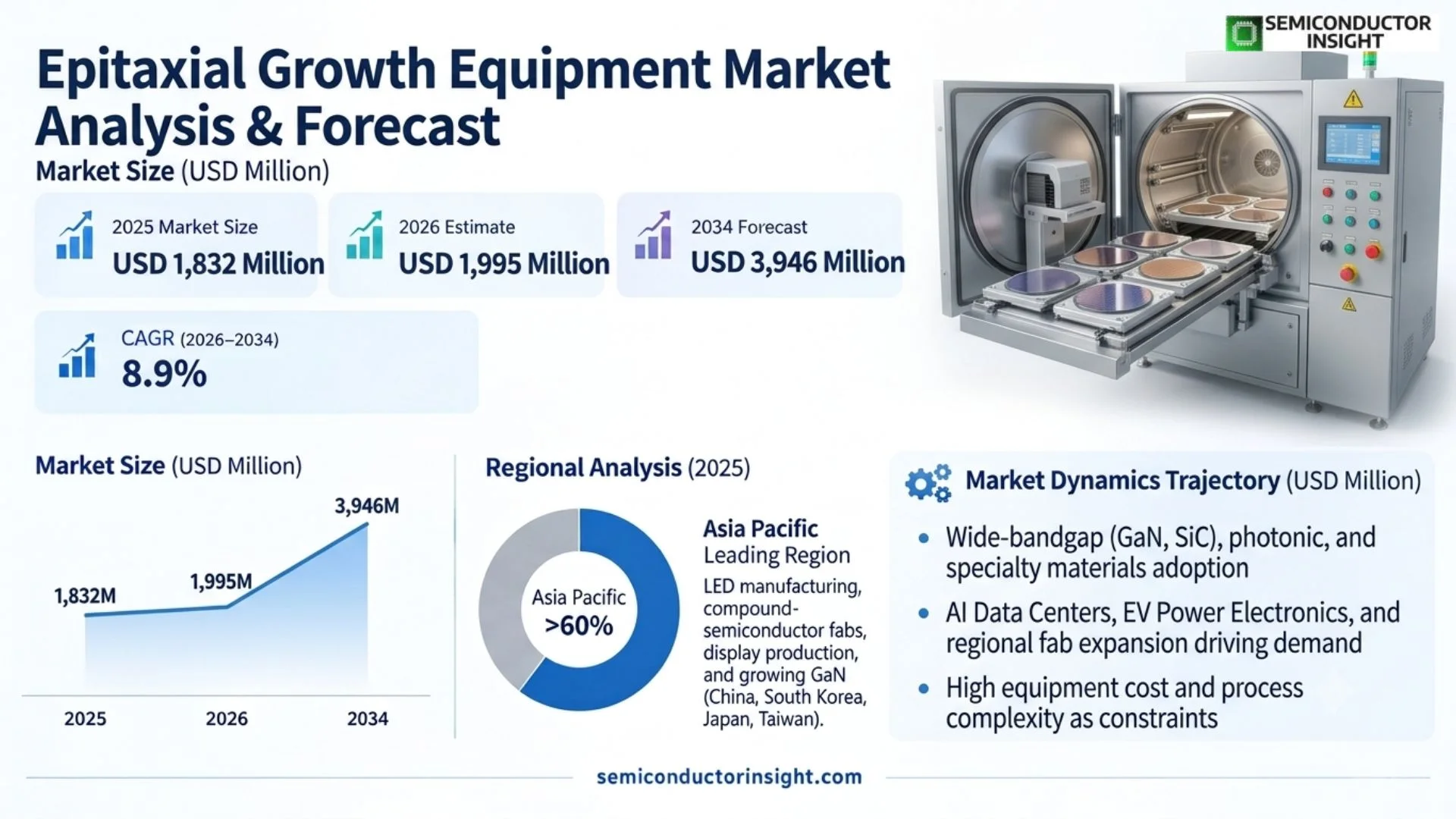
Epitaxial Growth Equipment Market is projected to reach USD 3,946 million by 2034, expanding at a 8.9% CAGR during 2026–2034. The 2026 market level is USD 1,995 million. Asia Pacific leads because semiconductor and compound-semiconductor manufacturing is concentrated across China, Japan, South Korea and Taiwan. Demand is broadening from conventional silicon epitaxy and LED production toward SiC power, GaN devices, high-speed InP lasers, MEMS and advanced photonics.

Get the sample PDF with study scope, segmentation and methodology details.

Key Statistics

2025 Market Size
USD 1,832 million
2034 Projected Market Size
USD 3,946 million
CAGR (2026–2034)
8.9%
Largest Market in 2025
Asia Pacific

Key Takeaways

  • Market size: The market stands at USD 1,832 million in 2025 and is projected to reach USD 3,946 million by 2034, representing a 8.9% CAGR across 2026–2034.
  • MOCVD is the largest equipment category across compound-semiconductor epitaxy, while CVD and MBE remain critical in silicon, SiC and research-intensive applications.
  • Asia Pacific leads installed demand because China, Japan, South Korea and Taiwan combine logic, memory, LED, power-device and compound-semiconductor manufacturing.
  • Wide-bandgap materials are reshaping equipment demand, with GaN and SiC investment supporting new epitaxy capacity for EVs, data centers, industrial power and RF.
  • Optical communication is creating a second major growth vector as InP epitaxy expands for high-speed lasers used in AI data-center transceivers.

Epitaxial Growth Equipment Market Overview

Epitaxial Growth Equipment Market is valued at USD 1,832 million in 2025 and is projected to reach USD 3,946 million by 2034, expanding at a 8.9% CAGR during 2026–2034. The 2026 market level is USD 1,995 million. Asia Pacific leads because semiconductor and compound-semiconductor manufacturing is concentrated across China, Japan, South Korea and Taiwan. Demand is broadening from conventional silicon epitaxy and LED production toward SiC power, GaN devices, high-speed InP lasers, MEMS and advanced photonics.

Base year: 2025 · Estimated year: 2026 · Forecast period: 2026–2034 · Values stated in U.S. dollars unless otherwise noted

Epitaxial growth equipment deposits single-crystal semiconductor layers with controlled composition, doping and thickness on crystalline substrates. The market spans MOCVD, molecular beam epitaxy and CVD-based systems used for silicon, SiGe, GaN, GaAs, InP, SiC and other material systems. Equipment must control temperature, gas or beam flux, pressure, contamination and wafer handling precisely because crystalline defects introduced during epitaxy can limit downstream device performance and yield.

The technology landscape is diversified by material and application. MOCVD dominates high-volume III-V epitaxy for LEDs, lasers and GaN devices, MBE remains important for research and high-precision compound-semiconductor structures, while CVD platforms are widely used for silicon and SiC epitaxy. Larger wafer diameters, better in-situ metrology, automated wafer handling and closed-loop process control are becoming more important as customers move from development toward high-volume power and photonics production.

Customers purchase epitaxy equipment as a process platform rather than a generic deposition tool. The vendor must prove wafer uniformity, defect density, run-to-run stability, throughput and compatibility with the customer’s substrate and device architecture. Qualification can take many months because device performance depends on epitaxial quality. This creates strong installed-base relationships and recurring service revenue but raises the barrier for new equipment suppliers entering advanced applications.

Segment Analysis: By Type

By type, the market is segmented into MOCVD, molecular beam epitaxy and CVD equipment. MOCVD is the most important category for III-V materials and high-volume optoelectronics, MBE provides exceptional interface and composition control for research and specialty devices, and CVD equipment is widely used for silicon, SiGe and SiC epitaxy in logic, power and specialty semiconductor manufacturing.

Type Technical / commercial role Market position
MOCVD Equipment High-volume epitaxy for GaN, GaAs and InP devices including LEDs, lasers, power and RF. Largest compound-semiconductor category with strong power and photonics growth.
Molecular Beam Epitaxy Equipment Ultra-high-vacuum epitaxy for precise III-V, quantum, RF and research structures. High-value specialist segment with lower throughput but exceptional material control.
CVD Equipment Silicon, SiGe, SiC and related epitaxial growth for logic, power and specialty devices. Large industrial segment tied to silicon and wide-bandgap device manufacturing.

Additional Segmentation: By Material System

Material system provides a practical segmentation because reactor design, temperature, precursor handling and chamber materials differ by epitaxial chemistry. Silicon and SiGe serve mainstream semiconductor and MEMS processes, GaN/GaAs/InP support compound-semiconductor power, RF and photonics, and SiC plus other wide-bandgap materials serve high-voltage and high-temperature applications. Vendors increasingly offer dedicated platforms rather than universal reactors.

Material System Demand characteristics
Silicon / SiGe Logic, analog, MEMS and specialty semiconductor epitaxy with high wafer-uniformity requirements.
GaN / GaAs / InP LED, laser, photonics, RF and GaN power epitaxy, primarily using MOCVD or MBE.
SiC & Other Wide-Bandgap Materials Power devices for EVs, industrial drives, renewable energy and high-temperature systems.

Segment Analysis: By Application

By application, semiconductor devices account for the broadest demand base, while wide-bandgap and optoelectronic uses are the strongest growth areas. MEMS uses epitaxy where controlled thickness, stress or crystal quality is required, and optoelectronics includes LEDs, laser diodes and photonic integrated circuits. The exact equipment architecture is determined by material system and production scale rather than application label alone.

Application Demand characteristics
Semiconductor Devices Logic, analog, power and specialty devices using silicon, SiGe, SiC or III-V epitaxial layers.
MEMS Sensors and microstructures requiring controlled crystalline films, stress and thickness.
Optoelectronic Devices LEDs, laser diodes, optical communications and photonic integrated circuits.
Others Research, quantum, detector and specialized compound-semiconductor applications.

Additional Segmentation: By Production Mode

Production mode separates flexible R&D and pilot equipment from high-volume manufacturing systems. Research tools prioritize configurability, material access and diagnostics, while production tools emphasize automation, wafer throughput, chamber matching, preventive maintenance and factory integration. Suppliers often use R&D systems to establish a process relationship that can later convert into multi-system volume orders when a new device enters commercial manufacturing.

Production Mode Commercial relevance
R&D / Pilot Systems Flexible, lower-throughput platforms for new materials, device structures and process development.
High-Volume Manufacturing Systems Automated multi-wafer or single-wafer production systems optimized for uptime, repeatability and factory integration.

Epitaxial Growth Equipment Market Trends

Regional Analysis

Asia Pacific leads because the region has the greatest concentration of semiconductor, LED, memory, foundry and compound-semiconductor capacity. North America is strong in advanced logic, photonics and equipment development, while Europe has major automotive power, compound-semiconductor and specialty production. Regional demand follows installed wafer capacity and material roadmaps more closely than final electronics consumption.

Why does regional demand differ across the Epitaxial Growth Equipment market?

Epitaxy equipment is purchased where wafers are grown, so regional demand tracks manufacturing capacity and process development. Asia combines the largest high-volume installed base, North America contributes advanced process and optical-communication demand, and Europe is strong in automotive power and specialty materials. A single new SiC or InP factory can create significant equipment orders because epitaxy is a capital-intensive, bottleneck process.

Region Position Growth outlook Demand profile Supplier selection
Asia Pacific Largest High Manufacturing + end-market demand Qualification and local support
North America High-value High Advanced technology + R&D Engineering support and platform access
Europe Strategic Steady-high Automotive, industrial, specialty Lifecycle and reliability
South America Emerging Selective Project-led Imported supply and support
Middle East & Africa Emerging Selective R&D and new projects Qualification and local service
Asia Pacific LARGEST

How does Asia Pacific participate in the Epitaxial Growth Equipment market?

Asia Pacific is the largest market because China, Japan, South Korea and Taiwan host extensive logic, memory, LED, compound-semiconductor and power-device manufacturing. Regional equipment demand spans silicon epitaxy, MOCVD, MBE and SiC CVD platforms. The commercial implication is that buyers in the Epitaxial Growth Equipment market evaluate the complete operating context, including validation history, integration effort, reliability, lifecycle support, supply continuity and measurable system-level value rather than a single headline specification.

Market positionLargest
Growth outlookHigh
Demand profileFoundry, memory, LED, power
Access gateQualification and local support
Country / submarket Commercial logic
China Fast capacity expansion across LEDs, GaN, SiC and mainstream semiconductor manufacturing.
Japan / South Korea / Taiwan Advanced materials, foundry, memory, laser and power-device ecosystems.

Market instances

  • The report identifies Asia Pacific as the leading regional market because of large-scale manufacturing in China and Japan.
  • Wide-bandgap investment in China, Japan and South Korea supports SiC and GaN epitaxy demand.
  • Taiwan’s foundry ecosystem provides stable demand for specialty and power-device epitaxy.
Asia Pacific is assessed from installed capability, end-market structure and verified industry activity rather than an unsupported percentage estimate.
North America STRATEGIC

How does North America participate in the Epitaxial Growth Equipment market?

North America is a high-value market for leading-edge semiconductor manufacturing, GaN power, optical communications, aerospace and research. U.S. fab expansion and AI-linked optical-transceiver capacity support new epitaxy tools and local service demand. The commercial implication is that buyers in the Epitaxial Growth Equipment market evaluate the complete operating context, including validation history, integration effort, reliability, lifecycle support, supply continuity and measurable system-level value rather than a single headline specification.

Market positionStrategic
Growth outlookHigh
Demand profileAdvanced logic, power, photonics
Access gateQualification and local support
Country / submarket Commercial logic
United States Advanced semiconductor, GaN power, photonics and equipment R&D.
Canada Photonics and research activity.

Market instances

  • U.S. semiconductor and optical-communication investment is supporting epitaxy capacity expansion.
  • Veeco’s 2026 InP equipment orders show direct demand from high-speed datacenter optics manufacturers.
  • Regional manufacturing incentives are creating new fabs that require local process and service support.
North America is assessed from installed capability, end-market structure and verified industry activity rather than an unsupported percentage estimate.
Europe STRATEGIC

How does Europe participate in the Epitaxial Growth Equipment market?

Europe has strong demand from automotive power electronics, industrial semiconductors, RF, photonics and equipment R&D. Germany and Italy are important power-semiconductor hubs, while the wider region supports compound-semiconductor and research facilities. The commercial implication is that buyers in the Epitaxial Growth Equipment market evaluate the complete operating context, including validation history, integration effort, reliability, lifecycle support, supply continuity and measurable system-level value rather than a single headline specification.

Market positionStrategic
Growth outlookSteady-high
Demand profileAutomotive power, specialty
Access gateQualification and local support
Country / submarket Commercial logic
Germany / Italy Power-semiconductor and automotive electronics investment.
France / UK / Nordics Photonics, research and specialty semiconductor activity.

Market instances

  • European EV and renewable-energy markets support SiC and GaN power-device investment.
  • AIXTRON’s equipment base in Germany anchors regional compound-semiconductor process expertise.
  • Automotive-grade qualification creates long equipment and service relationships.
Europe is assessed from installed capability, end-market structure and verified industry activity rather than an unsupported percentage estimate.
South America STRATEGIC

How does South America participate in the Epitaxial Growth Equipment market?

South America has limited front-end semiconductor capacity, so demand is concentrated in research and specialty projects rather than large production fabs. Brazil provides the strongest regional technology base but remains a small equipment market. The commercial implication is that buyers in the Epitaxial Growth Equipment market evaluate the complete operating context, including validation history, integration effort, reliability, lifecycle support, supply continuity and measurable system-level value rather than a single headline specification.

Market positionStrategic
Growth outlookSelective
Demand profileR&D, specialty
Access gateQualification and local support
Country / submarket Commercial logic
Brazil Research and limited specialty semiconductor demand.
Other markets Minimal front-end epitaxy capacity.

Market instances

  • South America demand reflects the location of manufacturing capacity, end users and qualification activity relevant to epitaxial growth equipment.
  • Supplier selection emphasizes reliability, application support and continuity because product or equipment changes can affect production performance.
  • New capacity and platform launches can create step changes in demand when customers commit to multi-year technology roadmaps.
South America is assessed from installed capability, end-market structure and verified industry activity rather than an unsupported percentage estimate.
Middle East & Africa STRATEGIC

How does Middle East & Africa participate in the Epitaxial Growth Equipment market?

Demand is emerging around research, semiconductor diversification and selected manufacturing projects. Israel has established device and photonics activity, while Gulf programs could create future greenfield demand if wafer-fabrication investment advances. The commercial implication is that buyers in the Epitaxial Growth Equipment market evaluate the complete operating context, including validation history, integration effort, reliability, lifecycle support, supply continuity and measurable system-level value rather than a single headline specification.

Market positionStrategic
Growth outlookSelective
Demand profileR&D, emerging fabs
Access gateQualification and local support
Country / submarket Commercial logic
Israel Established semiconductor and photonics ecosystem.
Gulf states / South Africa Research and potential future fab projects.

Market instances

  • Middle East & Africa demand reflects the location of manufacturing capacity, end users and qualification activity relevant to epitaxial growth equipment.
  • Supplier selection emphasizes reliability, application support and continuity because product or equipment changes can affect production performance.
  • New capacity and platform launches can create step changes in demand when customers commit to multi-year technology roadmaps.
Middle East & Africa is assessed from installed capability, end-market structure and verified industry activity rather than an unsupported percentage estimate.

Competitive Landscape

AIXTRON, Veeco, ASM, Applied Materials, Tokyo Electron, AMEC, LPE, NuFlare, NAURA, Riber and other specialist suppliers compete across different epitaxy methods and material systems. No single vendor leads every application because MOCVD, MBE, silicon CVD and SiC epitaxy require different reactor physics, process know-how and customer relationships. The commercial implication is that buyers in the Epitaxial Growth Equipment market evaluate the complete operating context, including validation history, integration effort, reliability, lifecycle support, supply continuity and measurable system-level value rather than a single headline specification.

The market is consolidating around suppliers that can support larger wafers, automation and high-volume production while retaining strong materials expertise. AIXTRON and Veeco are especially visible in III-V and wide-bandgap epitaxy, ASM and Applied Materials serve silicon-related platforms, and Riber remains a recognized MBE specialist. Chinese equipment companies are also expanding domestic market presence.

Competitive advantage is reinforced by qualification history. Once a epitaxial growth system is validated in a production environment, replacement can require process revalidation, software changes or reliability testing. This creates recurring revenue for incumbents but also rewards suppliers that solve a clear performance, yield, cost or integration problem. Technical service, roadmap continuity and supply assurance therefore influence purchasing alongside the headline product specification.

Competitive tier Representative companies Primary differentiation
Compound-semiconductor leaders AIXTRON, Veeco, AMEC MOCVD and related epitaxy for GaN, InP, LEDs, power and photonics.
Silicon / broad deposition leaders ASM, Applied Materials, Tokyo Electron Large-scale semiconductor equipment portfolios with silicon and specialty epitaxy capability.
MBE / specialist suppliers Riber, DCA, Scienta Omicron, Dr. Eberl High-precision research and specialty epitaxy platforms.

Key companies profiled

AIXTRON, Advanced Micro-Fabrication Equipment Inc., Veeco, LPE, Taiyo Nippon Sanso, ASM International, Applied Materials, NuFlare, Tokyo Electron, CETC, NAURA, Riber, DCA, Scienta Omicron, Pascal and Dr. Eberl MBE-Komponenten are included in the competitive scope. Their roles vary by epitaxy method, material system and production scale. The commercial implication is that buyers in the Epitaxial Growth Equipment market evaluate the complete operating context, including validation history, integration effort, reliability, lifecycle support, supply continuity and measurable system-level value rather than a single headline specification.

Production Capacity Analysis

Equipment manufacturing capacity depends on precision chamber fabrication, vacuum and gas subsystems, wafer handling, thermal management, sensors, automation and factory acceptance testing. Because epitaxy platforms are process-intensive, engineering resources and application laboratories can limit shipment capacity as much as mechanical assembly. Customers often require demonstration wafers or recipe performance before a final purchase decision.

Service and process-support capacity becomes increasingly valuable after installation. Epitaxy tools run in high-utilization semiconductor fabs and require preventive maintenance, consumables, wafer carriers, chamber parts and software updates. Suppliers with local field teams can reduce downtime and accelerate new material or wafer-size qualifications, which is particularly important during 200mm SiC, 300mm GaN and InP optical-capacity ramps.

Market Dynamics

The epitaxial growth equipment market is expanding as semiconductor manufacturing adds more wide-bandgap, photonic and specialty materials alongside mainstream silicon. GaN, SiC and InP are raising the strategic value of epitaxy because device performance depends directly on crystal quality. High equipment cost, process complexity and long qualification remain major constraints, while AI data centers, EV power electronics and regional fab expansion create strong demand for new high-volume platforms.

Market Drivers

Driver Impact Commercial mechanism
Wide-bandgap power devices High SiC and GaN power require dedicated epitaxy capacity.
AI optical communications High InP laser demand is expanding compound-semiconductor epitaxy.
Semiconductor capacity expansion Medium-High New fabs require silicon and specialty epitaxy tools.
Advanced optoelectronics Medium LED, laser and sensing applications require precise compound-semiconductor layers.

Wide-bandgap power devices

EVs, renewable energy, industrial drives and data-center power conversion are increasing demand for SiC and GaN devices. These materials require high-quality epitaxial layers before device fabrication, making epitaxy a critical capacity step. Manufacturers investing in larger wafers and higher output create demand for new CVD and MOCVD systems with tighter uniformity and automation.

AI optical communications

High-speed data-center networks need more InP lasers for 800G, 1.6T and future transceivers. Veeco announced substantial InP manufacturing-equipment orders in 2026, showing that epitaxy and related process tools are becoming a capacity priority for optical-component manufacturers serving AI infrastructure. The commercial implication is that buyers in the Epitaxial Growth Equipment market evaluate the complete operating context, including validation history, integration effort, reliability, lifecycle support, supply continuity and measurable system-level value rather than a single headline specification.

Semiconductor capacity expansion

Global foundry, memory and power-semiconductor investment adds epitaxy capacity for silicon, SiGe, SiC and III-V processes. Greenfield fabs purchase equipment before volume production begins, then generate recurring service and upgrade revenue. Regional localization programs in the United States, Europe and Asia broaden the addressable installation base. The commercial implication is that buyers in the Epitaxial Growth Equipment market evaluate the complete operating context, including validation history, integration effort, reliability, lifecycle support, supply continuity and measurable system-level value rather than a single headline specification.

Advanced optoelectronics

MicroLEDs, high-power lasers, photonic integrated circuits and sensing devices depend on tightly controlled epitaxial stacks. As device structures become more complex, tool vendors can create value through better uniformity, in-situ monitoring and repeatable multilayer growth even when total wafer volumes remain smaller than mainstream silicon. The commercial implication is that buyers in the Epitaxial Growth Equipment market evaluate the complete operating context, including validation history, integration effort, reliability, lifecycle support, supply continuity and measurable system-level value rather than a single headline specification.

Market Restraints

Restraint Impact Commercial consequence
High capital cost High Advanced epitaxy systems require significant equipment and facility investment.
Process complexity Medium-High Epitaxial quality is highly sensitive to temperature and flow conditions.
Raw-material and gas constraints Medium-High Specialty precursors and substrates can limit tool utilization.
Energy and environmental burden Medium High-temperature and hazardous-precursor processes increase operating cost.

High capital cost

MOCVD, MBE and high-temperature SiC epitaxy tools combine vacuum, gas delivery, thermal control, automation and contamination management. Customers must also install utility and exhaust infrastructure. Smaller manufacturers may delay purchases until production volume is proven, particularly in emerging compound-semiconductor markets. The commercial implication is that buyers in the Epitaxial Growth Equipment market evaluate the complete operating context, including validation history, integration effort, reliability, lifecycle support, supply continuity and measurable system-level value rather than a single headline specification.

Process complexity

Uniform single-crystal growth requires precise control of surface preparation, temperature, pressure, gas or beam flux and chamber history. The process window can be narrow, and defects propagate into later device steps. Long recipe-development and chamber-matching cycles make process support a significant barrier to new suppliers. The commercial implication is that buyers in the Epitaxial Growth Equipment market evaluate the complete operating context, including validation history, integration effort, reliability, lifecycle support, supply continuity and measurable system-level value rather than a single headline specification.

Raw-material and gas constraints

Epitaxy depends on high-purity wafers, metal-organic precursors, hydride gases and specialty source materials. Supply interruptions or purity variation can delay qualification and lower equipment utilization. Customers therefore evaluate not only the reactor but also the surrounding materials ecosystem when planning new capacity. The commercial implication is that buyers in the Epitaxial Growth Equipment market evaluate the complete operating context, including validation history, integration effort, reliability, lifecycle support, supply continuity and measurable system-level value rather than a single headline specification.

Energy and environmental burden

MOCVD and SiC epitaxy can consume substantial energy and require abatement for toxic or pyrophoric gases. Environmental rules and utility costs influence total cost of ownership. Equipment suppliers are responding with lower precursor use, better thermal efficiency and process monitoring that reduces failed runs. The commercial implication is that buyers in the Epitaxial Growth Equipment market evaluate the complete operating context, including validation history, integration effort, reliability, lifecycle support, supply continuity and measurable system-level value rather than a single headline specification.

Market Opportunities

200mm SiC epitaxy

Power-device makers are moving toward larger SiC wafers to lower cost per die. Equipment suppliers that deliver stable temperature uniformity, low defect density and high throughput on 200mm substrates can participate in a long qualification cycle that may support multiple generations of automotive and industrial devices. The commercial implication is that buyers in the Epitaxial Growth Equipment market evaluate the complete operating context, including validation history, integration effort, reliability, lifecycle support, supply continuity and measurable system-level value rather than a single headline specification.

300mm GaN-on-silicon

GaN grown on 300mm silicon can leverage established silicon fab infrastructure and increase chip output per wafer. Production-oriented tool orders show that this is becoming a real equipment opportunity rather than only a research concept. The commercial implication is that buyers in the Epitaxial Growth Equipment market evaluate the complete operating context, including validation history, integration effort, reliability, lifecycle support, supply continuity and measurable system-level value rather than a single headline specification.

InP lasers for AI networking

Data-center optical bandwidth is increasing rapidly, creating direct demand for InP laser epitaxy. Suppliers can benefit from larger wafer adoption, high-uniformity reactors and turnkey process support for DFB and EML structures used in 800G, 1.6T and future optical modules. The commercial implication is that buyers in the Epitaxial Growth Equipment market evaluate the complete operating context, including validation history, integration effort, reliability, lifecycle support, supply continuity and measurable system-level value rather than a single headline specification.

R&D-to-production platform migration

Equipment vendors can win early process-development systems at universities, device startups and pilot lines, then convert those relationships into production tools as the technology scales. Common software and chamber architecture reduce process-transfer risk for customers moving from research to high-volume manufacturing. The commercial implication is that buyers in the Epitaxial Growth Equipment market evaluate the complete operating context, including validation history, integration effort, reliability, lifecycle support, supply continuity and measurable system-level value rather than a single headline specification.

Supply Chain Analysis

Vacuum, gas, thermal & wafer-handling components
Epitaxy tool assembly and process qualification
Customer recipe transfer and production ramp
Semiconductor, MEMS and photonic device manufacturing

Components. Epitaxy equipment depends on vacuum hardware, heaters, gas delivery, mass-flow controllers, wafer carriers, pumps, sensors, plasma or source components and high-purity chamber materials. Different growth methods require different component stacks, but contamination control and thermal stability are universal requirements because they affect crystal quality directly. The commercial implication is that buyers in the Epitaxial Growth Equipment market evaluate the complete operating context, including validation history, integration effort, reliability, lifecycle support, supply continuity and measurable system-level value rather than a single headline specification.

System integration. Equipment makers assemble chambers, automation and control software, then qualify temperature distribution, gas flow, vacuum integrity and wafer handling. Process demonstrations are often required before shipment because customers buy an epitaxial result, not only a mechanical platform. This makes application engineering part of manufacturing capacity. The commercial implication is that buyers in the Epitaxial Growth Equipment market evaluate the complete operating context, including validation history, integration effort, reliability, lifecycle support, supply continuity and measurable system-level value rather than a single headline specification.

Process transfer. Installation includes facility hookup, recipe tuning, chamber matching and device-level qualification. New wafer diameters or material systems can require months of engineering. Vendors with local application laboratories and field teams can shorten the path to production and support faster learning during early ramps. The commercial implication is that buyers in the Epitaxial Growth Equipment market evaluate the complete operating context, including validation history, integration effort, reliability, lifecycle support, supply continuity and measurable system-level value rather than a single headline specification.

End use. Logic, power, RF, LED, laser, MEMS and photonic manufacturers operate epitaxy tools through long equipment lifecycles. Service, spare parts and chamber upgrades create recurring revenue. Once a process is qualified, customers tend to maintain the same equipment family to avoid unnecessary device requalification. The commercial implication is that buyers in the Epitaxial Growth Equipment market evaluate the complete operating context, including validation history, integration effort, reliability, lifecycle support, supply continuity and measurable system-level value rather than a single headline specification.

Recent Developments in the Epitaxial Growth Equipment Market

Developments tracked through September 2026. Entries are limited to events that materially affect product capability, manufacturing capacity, customer adoption, channel access or the competitive structure of the market.

  • 5 May 2026
    Veeco announced more than USD 250 million of orders for equipment used to manufacture InP lasers for high-speed optical transceivers, including Lumina MOCVD systems. The orders are tied to 800G and 1.6T datacenter demand and show rapid capacity expansion in compound-semiconductor epitaxy. Source
  • 2025 Annual Report
    AIXTRON reported that 57% of its 2025 systems revenue came from GaN/SiC power-electronics equipment and 23% from optoelectronics systems. The mix demonstrates how wide-bandgap power and optical communications are reshaping epitaxy equipment demand. Source
  • 14 October 2025
    Veeco announced multiple Lumina MOCVD orders from an optical-communications laser manufacturer for InP epitaxy on both 4-inch and 6-inch wafers, reinforcing the transition of InP laser production toward larger, higher-throughput formats. Source

Report Scope & Segmentation

Attribute Scope
Base year 2025
Estimated year 2026
Forecast period 2026–2034
2025 market size USD 1,832 million
2026 estimated size USD 1,995 million
2034 projected size USD 3,946 million
CAGR (2026–2034) 8.9%
Largest market in 2025 Asia Pacific
By Type MOCVD Equipment; Molecular Beam Epitaxy Equipment; CVD Equipment
By Application Semiconductor Devices; MEMS; Optoelectronic Devices; Others
By Material System Silicon/SiGe; GaN/GaAs/InP; SiC and Other Wide-Bandgap Materials
By Production Mode R&D/Pilot Systems; High-Volume Manufacturing Systems
Companies profiled AIXTRON; AMEC; Veeco; LPE; Taiyo Nippon Sanso; ASM; Applied Materials; NuFlare; Tokyo Electron; CETC; NAURA; Riber; DCA; Scienta Omicron; Pascal; Dr. Eberl

Frequently Asked Questions

What is the epitaxial growth equipment market size in 2025?

The global epitaxial growth equipment market is valued at USD 1,832 million in 2025. The scope includes MOCVD, MBE and CVD equipment used for semiconductor, MEMS and optoelectronic epitaxy. The commercial implication is that buyers in the Epitaxial Growth Equipment market evaluate the complete operating context, including validation history, integration effort, reliability, lifecycle support, supply continuity and measurable system-level value rather than a single headline specification.

What is the market forecast for 2034?

The market is projected to reach USD 3,946 million by 2034, representing an 8.9% CAGR during 2026–2034. The corresponding 2026 market level is USD 1,995 million. The commercial implication is that buyers in the Epitaxial Growth Equipment market evaluate the complete operating context, including validation history, integration effort, reliability, lifecycle support, supply continuity and measurable system-level value rather than a single headline specification.

Which region leads the market?

Asia Pacific leads because China, Japan, South Korea and Taiwan contain the largest concentration of semiconductor, LED, power-device and compound-semiconductor manufacturing capacity. The commercial implication is that buyers in the Epitaxial Growth Equipment market evaluate the complete operating context, including validation history, integration effort, reliability, lifecycle support, supply continuity and measurable system-level value rather than a single headline specification.

Which equipment types are included?

The market covers MOCVD equipment, molecular beam epitaxy systems and CVD-based epitaxial growth equipment used across silicon, SiGe, III-V and wide-bandgap materials. The commercial implication is that buyers in the Epitaxial Growth Equipment market evaluate the complete operating context, including validation history, integration effort, reliability, lifecycle support, supply continuity and measurable system-level value rather than a single headline specification.

What is driving the strongest growth?

SiC and GaN power electronics plus InP optical-communication lasers are the strongest structural growth areas because their device performance depends directly on epitaxial material quality. The commercial implication is that buyers in the Epitaxial Growth Equipment market evaluate the complete operating context, including validation history, integration effort, reliability, lifecycle support, supply continuity and measurable system-level value rather than a single headline specification.

Why is epitaxy important?

Epitaxy creates controlled single-crystal layers with specific composition and doping. Defects in these layers can limit downstream device efficiency, voltage capability, optical performance and yield. The commercial implication is that buyers in the Epitaxial Growth Equipment market evaluate the complete operating context, including validation history, integration effort, reliability, lifecycle support, supply continuity and measurable system-level value rather than a single headline specification.

Who are the major equipment suppliers?

Major suppliers include AIXTRON, Veeco, ASM, Applied Materials, Tokyo Electron, AMEC, LPE, NuFlare, NAURA and Riber, with specialized vendors serving MBE and research applications. The commercial implication is that buyers in the Epitaxial Growth Equipment market evaluate the complete operating context, including validation history, integration effort, reliability, lifecycle support, supply continuity and measurable system-level value rather than a single headline specification.

How do R&D and production tools differ?

R&D systems prioritize flexibility and diagnostics, while high-volume systems emphasize automation, chamber matching, throughput, preventive maintenance and stable process transfer across many wafers. The commercial implication is that buyers in the Epitaxial Growth Equipment market evaluate the complete operating context, including validation history, integration effort, reliability, lifecycle support, supply continuity and measurable system-level value rather than a single headline specification.

What limits market growth?

High equipment cost, complex process control, specialty material supply and environmental requirements can delay capacity expansion and extend customer qualification cycles. The commercial implication is that buyers in the Epitaxial Growth Equipment market evaluate the complete operating context, including validation history, integration effort, reliability, lifecycle support, supply continuity and measurable system-level value rather than a single headline specification.

What will drive growth through 2034?

Growth will come from 200mm SiC, 300mm GaN, AI-driven optical interconnects, global fab expansion and migration of new compound-semiconductor technologies from pilot lines into volume manufacturing. The commercial implication is that buyers in the Epitaxial Growth Equipment market evaluate the complete operating context, including validation history, integration effort, reliability, lifecycle support, supply continuity and measurable system-level value rather than a single headline specification.

Research Sources & Evidence Base

View research sources used in this market overview
  1. Veeco – InP laser manufacturing equipment orders. 2026 optical-communication capacity evidence.
  2. AIXTRON – Annual Report 2025. 2025 equipment revenue mix across power electronics and optoelectronics.
  3. Veeco – Lumina MOCVD order for InP epitaxy. 4-inch and 6-inch InP epitaxy production evidence.
  4. Semiconductor Insight – Epitaxial Growth Equipment Market. Market anchors, type/application segmentation and company scope.
Epitaxial Growth Equipment Market, Emerging Trends, Technological Advancements, and Business Strategies 2026-2034

Get Sample Report PDF for Exclusive Insights

Report Sample Includes

  • Table of Contents
  • List of Tables & Figures
  • Charts, Research Methodology, and more...

PDF Icon Download Sample Report PDF

Download Sample Report

Table of Content

1 Introduction to Research & Analysis Reports
1.1 Epitaxial Growth Equipment Market Definition
1.2 Market Segments
1.2.1 Segment by Type
1.2.2 Segment by Application
1.3 Global Epitaxial Growth Equipment Market Overview
1.4 Features & Benefits of This Report
1.5 Methodology & Sources of Information
1.5.1 Research Methodology
1.5.2 Research Process
1.5.3 Base Year
1.5.4 Report Assumptions & Caveats
2 Global Epitaxial Growth Equipment Overall Market Size
2.1 Global Epitaxial Growth Equipment Market Size: 2024 VS 2031
2.2 Global Epitaxial Growth Equipment Market Size, Prospects & Forecasts: 2020-2031
2.3 Key Market Trends, Opportunity, Drivers and Restraints
2.3.1 Market Opportunities & Trends
2.3.2 Market Drivers
2.3.3 Market Restraints
3 Company Landscape
3.1 Top Epitaxial Growth Equipment Players in Global Market
3.2 Top Global Epitaxial Growth Equipment Companies Ranked by Revenue
3.3 Global Epitaxial Growth Equipment Revenue by Companies
3.4 Top 3 and Top 5 Epitaxial Growth Equipment Companies in Global Market, by Revenue in 2024
3.5 Global Companies Epitaxial Growth Equipment Product Type
3.6 Tier 1, Tier 2, and Tier 3 Epitaxial Growth Equipment Players in Global Market
3.6.1 List of Global Tier 1 Epitaxial Growth Equipment Companies
3.6.2 List of Global Tier 2 and Tier 3 Epitaxial Growth Equipment Companies
4 Sights by Product
4.1 Overview
4.1.1 Segmentation by Type – Global Epitaxial Growth Equipment Market Size Markets, 2024 & 2031
4.1.2 LED Epitaxial Growth Equipment
4.1.3 Laser Diode Epitaxial Growth Equipment
4.1.4 RF Epitaxial Growth Equipment
4.1.5 MEMS Epitaxial Growth Equipment
4.2 Segmentation by Type – Global Epitaxial Growth Equipment Revenue & Forecasts
4.2.1 Segmentation by Type – Global Epitaxial Growth Equipment Revenue, 2020-2025
4.2.2 Segmentation by Type – Global Epitaxial Growth Equipment Revenue, 2026-2031
4.2.3 Segmentation by Type – Global Epitaxial Growth Equipment Revenue Market Share, 2020-2031
5 Sights by Application
5.1 Overview
5.1.1 Segmentation by Application – Global Epitaxial Growth Equipment Market Size, 2024 & 2031
5.1.2 Semiconductor
5.1.3 Wide-bandgap Material
5.1.4 Photonics Products
5.1.5 Other
5.2 Segmentation by Application – Global Epitaxial Growth Equipment Revenue & Forecasts
5.2.1 Segmentation by Application – Global Epitaxial Growth Equipment Revenue, 2020-2025
5.2.2 Segmentation by Application – Global Epitaxial Growth Equipment Revenue, 2026-2031
5.2.3 Segmentation by Application – Global Epitaxial Growth Equipment Revenue Market Share, 2020-2031
6 Sights by Region
6.1 By Region – Global Epitaxial Growth Equipment Market Size, 2024 & 2031
6.2 By Region – Global Epitaxial Growth Equipment Revenue & Forecasts
6.2.1 By Region – Global Epitaxial Growth Equipment Revenue, 2020-2025
6.2.2 By Region – Global Epitaxial Growth Equipment Revenue, 2026-2031
6.2.3 By Region – Global Epitaxial Growth Equipment Revenue Market Share, 2020-2031
6.3 North America
6.3.1 By Country – North America Epitaxial Growth Equipment Revenue, 2020-2031
6.3.2 United States Epitaxial Growth Equipment Market Size, 2020-2031
6.3.3 Canada Epitaxial Growth Equipment Market Size, 2020-2031
6.3.4 Mexico Epitaxial Growth Equipment Market Size, 2020-2031
6.4 Europe
6.4.1 By Country – Europe Epitaxial Growth Equipment Revenue, 2020-2031
6.4.2 Germany Epitaxial Growth Equipment Market Size, 2020-2031
6.4.3 France Epitaxial Growth Equipment Market Size, 2020-2031
6.4.4 U.K. Epitaxial Growth Equipment Market Size, 2020-2031
6.4.5 Italy Epitaxial Growth Equipment Market Size, 2020-2031
6.4.6 Russia Epitaxial Growth Equipment Market Size, 2020-2031
6.4.7 Nordic Countries Epitaxial Growth Equipment Market Size, 2020-2031
6.4.8 Benelux Epitaxial Growth Equipment Market Size, 2020-2031
6.5 Asia
6.5.1 By Region – Asia Epitaxial Growth Equipment Revenue, 2020-2031
6.5.2 China Epitaxial Growth Equipment Market Size, 2020-2031
6.5.3 Japan Epitaxial Growth Equipment Market Size, 2020-2031
6.5.4 South Korea Epitaxial Growth Equipment Market Size, 2020-2031
6.5.5 Southeast Asia Epitaxial Growth Equipment Market Size, 2020-2031
6.5.6 India Epitaxial Growth Equipment Market Size, 2020-2031
6.6 South America
6.6.1 By Country – South America Epitaxial Growth Equipment Revenue, 2020-2031
6.6.2 Brazil Epitaxial Growth Equipment Market Size, 2020-2031
6.6.3 Argentina Epitaxial Growth Equipment Market Size, 2020-2031
6.7 Middle East & Africa
6.7.1 By Country – Middle East & Africa Epitaxial Growth Equipment Revenue, 2020-2031
6.7.2 Turkey Epitaxial Growth Equipment Market Size, 2020-2031
6.7.3 Israel Epitaxial Growth Equipment Market Size, 2020-2031
6.7.4 Saudi Arabia Epitaxial Growth Equipment Market Size, 2020-2031
6.7.5 UAE Epitaxial Growth Equipment Market Size, 2020-2031
7 Companies Profiles
7.1 II-VI Incorporated
7.1.1 II-VI Incorporated Corporate Summary
7.1.2 II-VI Incorporated Business Overview
7.1.3 II-VI Incorporated Epitaxial Growth Equipment Major Product Offerings
7.1.4 II-VI Incorporated Epitaxial Growth Equipment Revenue in Global Market (2020-2025)
7.1.5 II-VI Incorporated Key News & Latest Developments
7.2 AIXTRON
7.2.1 AIXTRON Corporate Summary
7.2.2 AIXTRON Business Overview
7.2.3 AIXTRON Epitaxial Growth Equipment Major Product Offerings
7.2.4 AIXTRON Epitaxial Growth Equipment Revenue in Global Market (2020-2025)
7.2.5 AIXTRON Key News & Latest Developments
7.3 AMEC-INC
7.3.1 AMEC-INC Corporate Summary
7.3.2 AMEC-INC Business Overview
7.3.3 AMEC-INC Epitaxial Growth Equipment Major Product Offerings
7.3.4 AMEC-INC Epitaxial Growth Equipment Revenue in Global Market (2020-2025)
7.3.5 AMEC-INC Key News & Latest Developments
7.4 Applied Materials
7.4.1 Applied Materials Corporate Summary
7.4.2 Applied Materials Business Overview
7.4.3 Applied Materials Epitaxial Growth Equipment Major Product Offerings
7.4.4 Applied Materials Epitaxial Growth Equipment Revenue in Global Market (2020-2025)
7.4.5 Applied Materials Key News & Latest Developments
7.5 Cree, Inc
7.5.1 Cree, Inc Corporate Summary
7.5.2 Cree, Inc Business Overview
7.5.3 Cree, Inc Epitaxial Growth Equipment Major Product Offerings
7.5.4 Cree, Inc Epitaxial Growth Equipment Revenue in Global Market (2020-2025)
7.5.5 Cree, Inc Key News & Latest Developments
7.6 DOWA Electronics Materials
7.6.1 DOWA Electronics Materials Corporate Summary
7.6.2 DOWA Electronics Materials Business Overview
7.6.3 DOWA Electronics Materials Epitaxial Growth Equipment Major Product Offerings
7.6.4 DOWA Electronics Materials Epitaxial Growth Equipment Revenue in Global Market (2020-2025)
7.6.5 DOWA Electronics Materials Key News & Latest Developments
7.7 DuPont
7.7.1 DuPont Corporate Summary
7.7.2 DuPont Business Overview
7.7.3 DuPont Epitaxial Growth Equipment Major Product Offerings
7.7.4 DuPont Epitaxial Growth Equipment Revenue in Global Market (2020-2025)
7.7.5 DuPont Key News & Latest Developments
7.8 IntelliEPI
7.8.1 IntelliEPI Corporate Summary
7.8.2 IntelliEPI Business Overview
7.8.3 IntelliEPI Epitaxial Growth Equipment Major Product Offerings
7.8.4 IntelliEPI Epitaxial Growth Equipment Revenue in Global Market (2020-2025)
7.8.5 IntelliEPI Key News & Latest Developments
7.9 IQE
7.9.1 IQE Corporate Summary
7.9.2 IQE Business Overview
7.9.3 IQE Epitaxial Growth Equipment Major Product Offerings
7.9.4 IQE Epitaxial Growth Equipment Revenue in Global Market (2020-2025)
7.9.5 IQE Key News & Latest Developments
7.10 LPE
7.10.1 LPE Corporate Summary
7.10.2 LPE Business Overview
7.10.3 LPE Epitaxial Growth Equipment Major Product Offerings
7.10.4 LPE Epitaxial Growth Equipment Revenue in Global Market (2020-2025)
7.10.5 LPE Key News & Latest Developments
7.11 MACOM
7.11.1 MACOM Corporate Summary
7.11.2 MACOM Business Overview
7.11.3 MACOM Epitaxial Growth Equipment Major Product Offerings
7.11.4 MACOM Epitaxial Growth Equipment Revenue in Global Market (2020-2025)
7.11.5 MACOM Key News & Latest Developments
7.12 Merck
7.12.1 Merck Corporate Summary
7.12.2 Merck Business Overview
7.12.3 Merck Epitaxial Growth Equipment Major Product Offerings
7.12.4 Merck Epitaxial Growth Equipment Revenue in Global Market (2020-2025)
7.12.5 Merck Key News & Latest Developments
7.13 Mitsubishi Chemical
7.13.1 Mitsubishi Chemical Corporate Summary
7.13.2 Mitsubishi Chemical Business Overview
7.13.3 Mitsubishi Chemical Epitaxial Growth Equipment Major Product Offerings
7.13.4 Mitsubishi Chemical Epitaxial Growth Equipment Revenue in Global Market (2020-2025)
7.13.5 Mitsubishi Chemical Key News & Latest Developments
7.14 NAURA
7.14.1 NAURA Corporate Summary
7.14.2 NAURA Business Overview
7.14.3 NAURA Epitaxial Growth Equipment Major Product Offerings
7.14.4 NAURA Epitaxial Growth Equipment Revenue in Global Market (2020-2025)
7.14.5 NAURA Key News & Latest Developments
7.15 NuFlare Technology
7.15.1 NuFlare Technology Corporate Summary
7.15.2 NuFlare Technology Business Overview
7.15.3 NuFlare Technology Epitaxial Growth Equipment Major Product Offerings
7.15.4 NuFlare Technology Epitaxial Growth Equipment Revenue in Global Market (2020-2025)
7.15.5 NuFlare Technology Key News & Latest Developments
7.16 Optowell
7.16.1 Optowell Corporate Summary
7.16.2 Optowell Business Overview
7.16.3 Optowell Epitaxial Growth Equipment Major Product Offerings
7.16.4 Optowell Epitaxial Growth Equipment Revenue in Global Market (2020-2025)
7.16.5 Optowell Key News & Latest Developments
7.17 Riber
7.17.1 Riber Corporate Summary
7.17.2 Riber Business Overview
7.17.3 Riber Epitaxial Growth Equipment Major Product Offerings
7.17.4 Riber Epitaxial Growth Equipment Revenue in Global Market (2020-2025)
7.17.5 Riber Key News & Latest Developments
7.18 Shin-Etsu
7.18.1 Shin-Etsu Corporate Summary
7.18.2 Shin-Etsu Business Overview
7.18.3 Shin-Etsu Epitaxial Growth Equipment Major Product Offerings
7.18.4 Shin-Etsu Epitaxial Growth Equipment Revenue in Global Market (2020-2025)
7.18.5 Shin-Etsu Key News & Latest Developments
7.19 Siltronic
7.19.1 Siltronic Corporate Summary
7.19.2 Siltronic Business Overview
7.19.3 Siltronic Epitaxial Growth Equipment Major Product Offerings
7.19.4 Siltronic Epitaxial Growth Equipment Revenue in Global Market (2020-2025)
7.19.5 Siltronic Key News & Latest Developments
7.20 Strem Chemicals
7.20.1 Strem Chemicals Corporate Summary
7.20.2 Strem Chemicals Business Overview
7.20.3 Strem Chemicals Epitaxial Growth Equipment Major Product Offerings
7.20.4 Strem Chemicals Epitaxial Growth Equipment Revenue in Global Market (2020-2025)
7.20.5 Strem Chemicals Key News & Latest Developments
7.21 Sumitomo Electric Industries
7.21.1 Sumitomo Electric Industries Corporate Summary
7.21.2 Sumitomo Electric Industries Business Overview
7.21.3 Sumitomo Electric Industries Epitaxial Growth Equipment Major Product Offerings
7.21.4 Sumitomo Electric Industries Epitaxial Growth Equipment Revenue in Global Market (2020-2025)
7.21.5 Sumitomo Electric Industries Key News & Latest Developments
7.22 Taiyo Nippon Sanso
7.22.1 Taiyo Nippon Sanso Corporate Summary
7.22.2 Taiyo Nippon Sanso Business Overview
7.22.3 Taiyo Nippon Sanso Epitaxial Growth Equipment Major Product Offerings
7.22.4 Taiyo Nippon Sanso Epitaxial Growth Equipment Revenue in Global Market (2020-2025)
7.22.5 Taiyo Nippon Sanso Key News & Latest Developments
7.23 Tokyo Electron Ltd
7.23.1 Tokyo Electron Ltd Corporate Summary
7.23.2 Tokyo Electron Ltd Business Overview
7.23.3 Tokyo Electron Ltd Epitaxial Growth Equipment Major Product Offerings
7.23.4 Tokyo Electron Ltd Epitaxial Growth Equipment Revenue in Global Market (2020-2025)
7.23.5 Tokyo Electron Ltd Key News & Latest Developments
7.24 Umicore
7.24.1 Umicore Corporate Summary
7.24.2 Umicore Business Overview
7.24.3 Umicore Epitaxial Growth Equipment Major Product Offerings
7.24.4 Umicore Epitaxial Growth Equipment Revenue in Global Market (2020-2025)
7.24.5 Umicore Key News & Latest Developments
7.25 ULVAC
7.25.1 ULVAC Corporate Summary
7.25.2 ULVAC Business Overview
7.25.3 ULVAC Epitaxial Growth Equipment Major Product Offerings
7.25.4 ULVAC Epitaxial Growth Equipment Revenue in Global Market (2020-2025)
7.25.5 ULVAC Key News & Latest Developments
8 Conclusion
9 Appendix
9.1 Note
9.2 Examples of Clients
9.3 DisclaimerList of Tables
Table 1. Epitaxial Growth Equipment Market Opportunities & Trends in Global Market
Table 2. Epitaxial Growth Equipment Market Drivers in Global Market
Table 3. Epitaxial Growth Equipment Market Restraints in Global Market
Table 4. Key Players of Epitaxial Growth Equipment in Global Market
Table 5. Top Epitaxial Growth Equipment Players in Global Market, Ranking by Revenue (2024)
Table 6. Global Epitaxial Growth Equipment Revenue by Companies, (US$, Mn), 2020-2025
Table 7. Global Epitaxial Growth Equipment Revenue Share by Companies, 2020-2025
Table 8. Global Companies Epitaxial Growth Equipment Product Type
Table 9. List of Global Tier 1 Epitaxial Growth Equipment Companies, Revenue (US$, Mn) in 2024 and Market Share
Table 10. List of Global Tier 2 and Tier 3 Epitaxial Growth Equipment Companies, Revenue (US$, Mn) in 2024 and Market Share
Table 11. Segmentation by Type – Global Epitaxial Growth Equipment Revenue, (US$, Mn), 2024 & 2031
Table 12. Segmentation by Type – Global Epitaxial Growth Equipment Revenue (US$, Mn), 2020-2025
Table 13. Segmentation by Type – Global Epitaxial Growth Equipment Revenue (US$, Mn), 2026-2031
Table 14. Segmentation by Application– Global Epitaxial Growth Equipment Revenue, (US$, Mn), 2024 & 2031
Table 15. Segmentation by Application – Global Epitaxial Growth Equipment Revenue, (US$, Mn), 2020-2025
Table 16. Segmentation by Application – Global Epitaxial Growth Equipment Revenue, (US$, Mn), 2026-2031
Table 17. By Region– Global Epitaxial Growth Equipment Revenue, (US$, Mn), 2024 & 2031
Table 18. By Region – Global Epitaxial Growth Equipment Revenue, (US$, Mn), 2020-2025
Table 19. By Region – Global Epitaxial Growth Equipment Revenue, (US$, Mn), 2026-2031
Table 20. By Country – North America Epitaxial Growth Equipment Revenue, (US$, Mn), 2020-2025
Table 21. By Country – North America Epitaxial Growth Equipment Revenue, (US$, Mn), 2026-2031
Table 22. By Country – Europe Epitaxial Growth Equipment Revenue, (US$, Mn), 2020-2025
Table 23. By Country – Europe Epitaxial Growth Equipment Revenue, (US$, Mn), 2026-2031
Table 24. By Region – Asia Epitaxial Growth Equipment Revenue, (US$, Mn), 2020-2025
Table 25. By Region – Asia Epitaxial Growth Equipment Revenue, (US$, Mn), 2026-2031
Table 26. By Country – South America Epitaxial Growth Equipment Revenue, (US$, Mn), 2020-2025
Table 27. By Country – South America Epitaxial Growth Equipment Revenue, (US$, Mn), 2026-2031
Table 28. By Country – Middle East & Africa Epitaxial Growth Equipment Revenue, (US$, Mn), 2020-2025
Table 29. By Country – Middle East & Africa Epitaxial Growth Equipment Revenue, (US$, Mn), 2026-2031
Table 30. II-VI Incorporated Corporate Summary
Table 31. II-VI Incorporated Epitaxial Growth Equipment Product Offerings
Table 32. II-VI Incorporated Epitaxial Growth Equipment Revenue (US$, Mn) & (2020-2025)
Table 33. II-VI Incorporated Key News & Latest Developments
Table 34. AIXTRON Corporate Summary
Table 35. AIXTRON Epitaxial Growth Equipment Product Offerings
Table 36. AIXTRON Epitaxial Growth Equipment Revenue (US$, Mn) & (2020-2025)
Table 37. AIXTRON Key News & Latest Developments
Table 38. AMEC-INC Corporate Summary
Table 39. AMEC-INC Epitaxial Growth Equipment Product Offerings
Table 40. AMEC-INC Epitaxial Growth Equipment Revenue (US$, Mn) & (2020-2025)
Table 41. AMEC-INC Key News & Latest Developments
Table 42. Applied Materials Corporate Summary
Table 43. Applied Materials Epitaxial Growth Equipment Product Offerings
Table 44. Applied Materials Epitaxial Growth Equipment Revenue (US$, Mn) & (2020-2025)
Table 45. Applied Materials Key News & Latest Developments
Table 46. Cree, Inc Corporate Summary
Table 47. Cree, Inc Epitaxial Growth Equipment Product Offerings
Table 48. Cree, Inc Epitaxial Growth Equipment Revenue (US$, Mn) & (2020-2025)
Table 49. Cree, Inc Key News & Latest Developments
Table 50. DOWA Electronics Materials Corporate Summary
Table 51. DOWA Electronics Materials Epitaxial Growth Equipment Product Offerings
Table 52. DOWA Electronics Materials Epitaxial Growth Equipment Revenue (US$, Mn) & (2020-2025)
Table 53. DOWA Electronics Materials Key News & Latest Developments
Table 54. DuPont Corporate Summary
Table 55. DuPont Epitaxial Growth Equipment Product Offerings
Table 56. DuPont Epitaxial Growth Equipment Revenue (US$, Mn) & (2020-2025)
Table 57. DuPont Key News & Latest Developments
Table 58. IntelliEPI Corporate Summary
Table 59. IntelliEPI Epitaxial Growth Equipment Product Offerings
Table 60. IntelliEPI Epitaxial Growth Equipment Revenue (US$, Mn) & (2020-2025)
Table 61. IntelliEPI Key News & Latest Developments
Table 62. IQE Corporate Summary
Table 63. IQE Epitaxial Growth Equipment Product Offerings
Table 64. IQE Epitaxial Growth Equipment Revenue (US$, Mn) & (2020-2025)
Table 65. IQE Key News & Latest Developments
Table 66. LPE Corporate Summary
Table 67. LPE Epitaxial Growth Equipment Product Offerings
Table 68. LPE Epitaxial Growth Equipment Revenue (US$, Mn) & (2020-2025)
Table 69. LPE Key News & Latest Developments
Table 70. MACOM Corporate Summary
Table 71. MACOM Epitaxial Growth Equipment Product Offerings
Table 72. MACOM Epitaxial Growth Equipment Revenue (US$, Mn) & (2020-2025)
Table 73. MACOM Key News & Latest Developments
Table 74. Merck Corporate Summary
Table 75. Merck Epitaxial Growth Equipment Product Offerings
Table 76. Merck Epitaxial Growth Equipment Revenue (US$, Mn) & (2020-2025)
Table 77. Merck Key News & Latest Developments
Table 78. Mitsubishi Chemical Corporate Summary
Table 79. Mitsubishi Chemical Epitaxial Growth Equipment Product Offerings
Table 80. Mitsubishi Chemical Epitaxial Growth Equipment Revenue (US$, Mn) & (2020-2025)
Table 81. Mitsubishi Chemical Key News & Latest Developments
Table 82. NAURA Corporate Summary
Table 83. NAURA Epitaxial Growth Equipment Product Offerings
Table 84. NAURA Epitaxial Growth Equipment Revenue (US$, Mn) & (2020-2025)
Table 85. NAURA Key News & Latest Developments
Table 86. NuFlare Technology Corporate Summary
Table 87. NuFlare Technology Epitaxial Growth Equipment Product Offerings
Table 88. NuFlare Technology Epitaxial Growth Equipment Revenue (US$, Mn) & (2020-2025)
Table 89. NuFlare Technology Key News & Latest Developments
Table 90. Optowell Corporate Summary
Table 91. Optowell Epitaxial Growth Equipment Product Offerings
Table 92. Optowell Epitaxial Growth Equipment Revenue (US$, Mn) & (2020-2025)
Table 93. Optowell Key News & Latest Developments
Table 94. Riber Corporate Summary
Table 95. Riber Epitaxial Growth Equipment Product Offerings
Table 96. Riber Epitaxial Growth Equipment Revenue (US$, Mn) & (2020-2025)
Table 97. Riber Key News & Latest Developments
Table 98. Shin-Etsu Corporate Summary
Table 99. Shin-Etsu Epitaxial Growth Equipment Product Offerings
Table 100. Shin-Etsu Epitaxial Growth Equipment Revenue (US$, Mn) & (2020-2025)
Table 101. Shin-Etsu Key News & Latest Developments
Table 102. Siltronic Corporate Summary
Table 103. Siltronic Epitaxial Growth Equipment Product Offerings
Table 104. Siltronic Epitaxial Growth Equipment Revenue (US$, Mn) & (2020-2025)
Table 105. Siltronic Key News & Latest Developments
Table 106. Strem Chemicals Corporate Summary
Table 107. Strem Chemicals Epitaxial Growth Equipment Product Offerings
Table 108. Strem Chemicals Epitaxial Growth Equipment Revenue (US$, Mn) & (2020-2025)
Table 109. Strem Chemicals Key News & Latest Developments
Table 110. Sumitomo Electric Industries Corporate Summary
Table 111. Sumitomo Electric Industries Epitaxial Growth Equipment Product Offerings
Table 112. Sumitomo Electric Industries Epitaxial Growth Equipment Revenue (US$, Mn) & (2020-2025)
Table 113. Sumitomo Electric Industries Key News & Latest Developments
Table 114. Taiyo Nippon Sanso Corporate Summary
Table 115. Taiyo Nippon Sanso Epitaxial Growth Equipment Product Offerings
Table 116. Taiyo Nippon Sanso Epitaxial Growth Equipment Revenue (US$, Mn) & (2020-2025)
Table 117. Taiyo Nippon Sanso Key News & Latest Developments
Table 118. Tokyo Electron Ltd Corporate Summary
Table 119. Tokyo Electron Ltd Epitaxial Growth Equipment Product Offerings
Table 120. Tokyo Electron Ltd Epitaxial Growth Equipment Revenue (US$, Mn) & (2020-2025)
Table 121. Tokyo Electron Ltd Key News & Latest Developments
Table 122. Umicore Corporate Summary
Table 123. Umicore Epitaxial Growth Equipment Product Offerings
Table 124. Umicore Epitaxial Growth Equipment Revenue (US$, Mn) & (2020-2025)
Table 125. Umicore Key News & Latest Developments
Table 126. ULVAC Corporate Summary
Table 127. ULVAC Epitaxial Growth Equipment Product Offerings
Table 128. ULVAC Epitaxial Growth Equipment Revenue (US$, Mn) & (2020-2025)
Table 129. ULVAC Key News & Latest Developments

List of Figures
Figure 1. Epitaxial Growth Equipment Product Picture
Figure 2. Epitaxial Growth Equipment Segment by Type in 2024
Figure 3. Epitaxial Growth Equipment Segment by Application in 2024
Figure 4. Global Epitaxial Growth Equipment Market Overview: 2024
Figure 5. Key Caveats
Figure 6. Global Epitaxial Growth Equipment Market Size: 2024 VS 2031 (US$, Mn)
Figure 7. Global Epitaxial Growth Equipment Revenue: 2020-2031 (US$, Mn)
Figure 8. The Top 3 and 5 Players Market Share by Epitaxial Growth Equipment Revenue in 2024
Figure 9. Segmentation by Type – Global Epitaxial Growth Equipment Revenue, (US$, Mn), 2024 & 2031
Figure 10. Segmentation by Type – Global Epitaxial Growth Equipment Revenue Market Share, 2020-2031
Figure 11. Segmentation by Application – Global Epitaxial Growth Equipment Revenue, (US$, Mn), 2024 & 2031
Figure 12. Segmentation by Application – Global Epitaxial Growth Equipment Revenue Market Share, 2020-2031
Figure 13. By Region – Global Epitaxial Growth Equipment Revenue Market Share, 2020-2031
Figure 14. By Country – North America Epitaxial Growth Equipment Revenue Market Share, 2020-2031
Figure 15. United States Epitaxial Growth Equipment Revenue, (US$, Mn), 2020-2031
Figure 16. Canada Epitaxial Growth Equipment Revenue, (US$, Mn), 2020-2031
Figure 17. Mexico Epitaxial Growth Equipment Revenue, (US$, Mn), 2020-2031
Figure 18. By Country – Europe Epitaxial Growth Equipment Revenue Market Share, 2020-2031
Figure 19. Germany Epitaxial Growth Equipment Revenue, (US$, Mn), 2020-2031
Figure 20. France Epitaxial Growth Equipment Revenue, (US$, Mn), 2020-2031
Figure 21. U.K. Epitaxial Growth Equipment Revenue, (US$, Mn), 2020-2031
Figure 22. Italy Epitaxial Growth Equipment Revenue, (US$, Mn), 2020-2031
Figure 23. Russia Epitaxial Growth Equipment Revenue, (US$, Mn), 2020-2031
Figure 24. Nordic Countries Epitaxial Growth Equipment Revenue, (US$, Mn), 2020-2031
Figure 25. Benelux Epitaxial Growth Equipment Revenue, (US$, Mn), 2020-2031
Figure 26. By Region – Asia Epitaxial Growth Equipment Revenue Market Share, 2020-2031
Figure 27. China Epitaxial Growth Equipment Revenue, (US$, Mn), 2020-2031
Figure 28. Japan Epitaxial Growth Equipment Revenue, (US$, Mn), 2020-2031
Figure 29. South Korea Epitaxial Growth Equipment Revenue, (US$, Mn), 2020-2031
Figure 30. Southeast Asia Epitaxial Growth Equipment Revenue, (US$, Mn), 2020-2031
Figure 31. India Epitaxial Growth Equipment Revenue, (US$, Mn), 2020-2031
Figure 32. By Country – South America Epitaxial Growth Equipment Revenue Market Share, 2020-2031
Figure 33. Brazil Epitaxial Growth Equipment Revenue, (US$, Mn), 2020-2031
Figure 34. Argentina Epitaxial Growth Equipment Revenue, (US$, Mn), 2020-2031
Figure 35. By Country – Middle East & Africa Epitaxial Growth Equipment Revenue Market Share, 2020-2031
Figure 36. Turkey Epitaxial Growth Equipment Revenue, (US$, Mn), 2020-2031
Figure 37. Israel Epitaxial Growth Equipment Revenue, (US$, Mn), 2020-2031
Figure 38. Saudi Arabia Epitaxial Growth Equipment Revenue, (US$, Mn), 2020-2031
Figure 39. UAE Epitaxial Growth Equipment Revenue, (US$, Mn), 2020-2031
Figure 40. II-VI Incorporated Epitaxial Growth Equipment Revenue Year Over Year Growth (US$, Mn) & (2020-2025)
Figure 41. AIXTRON Epitaxial Growth Equipment Revenue Year Over Year Growth (US$, Mn) & (2020-2025)
Figure 42. AMEC-INC Epitaxial Growth Equipment Revenue Year Over Year Growth (US$, Mn) & (2020-2025)
Figure 43. Applied Materials Epitaxial Growth Equipment Revenue Year Over Year Growth (US$, Mn) & (2020-2025)
Figure 44. Cree, Inc Epitaxial Growth Equipment Revenue Year Over Year Growth (US$, Mn) & (2020-2025)
Figure 45. DOWA Electronics Materials Epitaxial Growth Equipment Revenue Year Over Year Growth (US$, Mn) & (2020-2025)
Figure 46. DuPont Epitaxial Growth Equipment Revenue Year Over Year Growth (US$, Mn) & (2020-2025)
Figure 47. IntelliEPI Epitaxial Growth Equipment Revenue Year Over Year Growth (US$, Mn) & (2020-2025)
Figure 48. IQE Epitaxial Growth Equipment Revenue Year Over Year Growth (US$, Mn) & (2020-2025)
Figure 49. LPE Epitaxial Growth Equipment Revenue Year Over Year Growth (US$, Mn) & (2020-2025)
Figure 50. MACOM Epitaxial Growth Equipment Revenue Year Over Year Growth (US$, Mn) & (2020-2025)
Figure 51. Merck Epitaxial Growth Equipment Revenue Year Over Year Growth (US$, Mn) & (2020-2025)
Figure 52. Mitsubishi Chemical Epitaxial Growth Equipment Revenue Year Over Year Growth (US$, Mn) & (2020-2025)
Figure 53. NAURA Epitaxial Growth Equipment Revenue Year Over Year Growth (US$, Mn) & (2020-2025)
Figure 54. NuFlare Technology Epitaxial Growth Equipment Revenue Year Over Year Growth (US$, Mn) & (2020-2025)
Figure 55. Optowell Epitaxial Growth Equipment Revenue Year Over Year Growth (US$, Mn) & (2020-2025)
Figure 56. Riber Epitaxial Growth Equipment Revenue Year Over Year Growth (US$, Mn) & (2020-2025)
Figure 57. Shin-Etsu Epitaxial Growth Equipment Revenue Year Over Year Growth (US$, Mn) & (2020-2025)
Figure 58. Siltronic Epitaxial Growth Equipment Revenue Year Over Year Growth (US$, Mn) & (2020-2025)
Figure 59. Strem Chemicals Epitaxial Growth Equipment Revenue Year Over Year Growth (US$, Mn) & (2020-2025)
Figure 60. Sumitomo Electric Industries Epitaxial Growth Equipment Revenue Year Over Year Growth (US$, Mn) & (2020-2025)
Figure 61. Taiyo Nippon Sanso Epitaxial Growth Equipment Revenue Year Over Year Growth (US$, Mn) & (2020-2025)
Figure 62. Tokyo Electron Ltd Epitaxial Growth Equipment Revenue Year Over Year Growth (US$, Mn) & (2020-2025)
Figure 63. Umicore Epitaxial Growth Equipment Revenue Year Over Year Growth (US$, Mn) & (2020-2025)
Figure 64. ULVAC Epitaxial Growth Equipment Revenue Year Over Year Growth (US$, Mn) & (2020-2025)