Market Insights
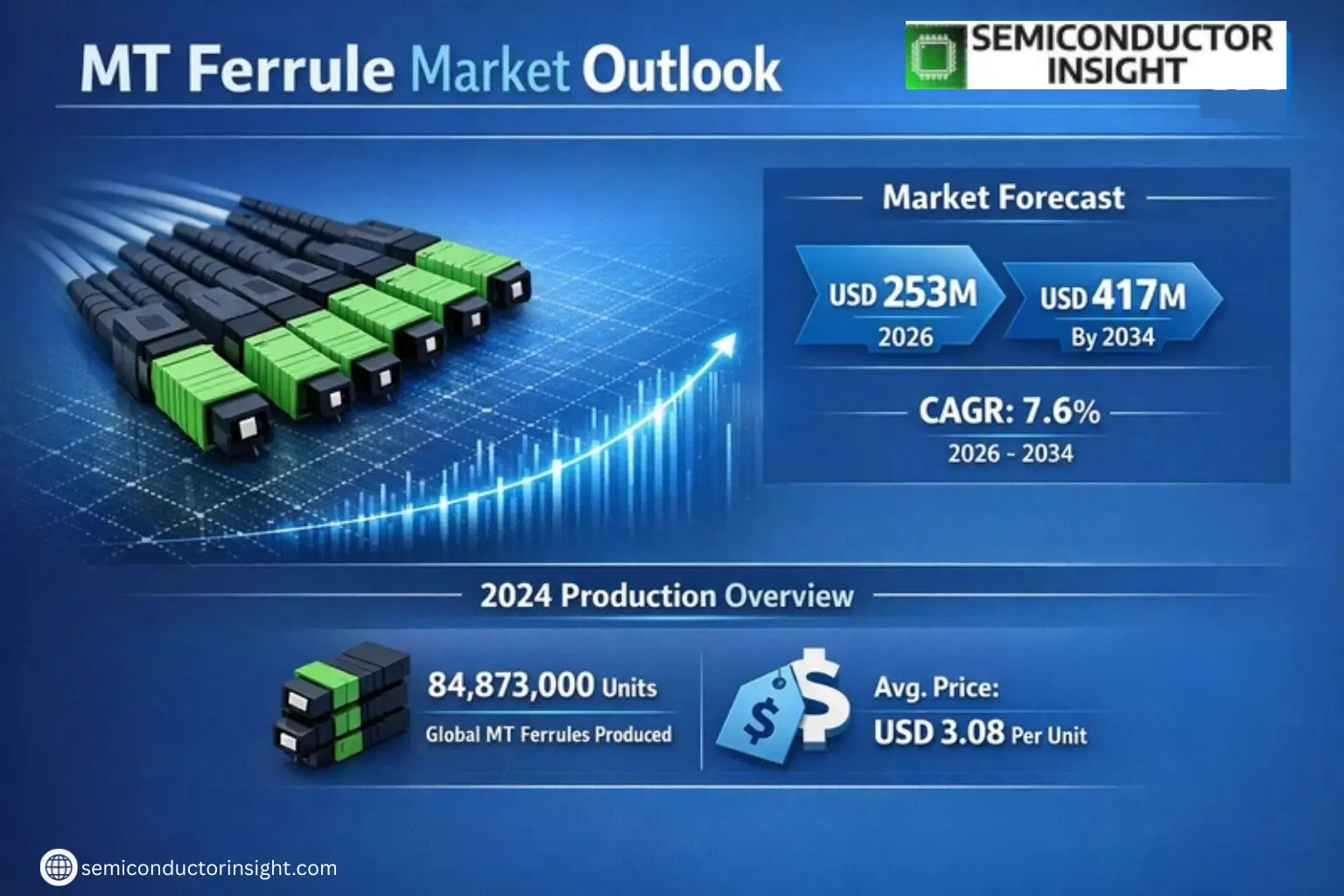
Global MT Ferrule Market was valued at USD 253 million in 2026 and is projected to reach USD 417 million by 2034, exhibiting a CAGR of 7.6% during the forecast period.
In 2024, global production of MT ferrules reached 84,873,000 units, with an average selling price of USD 3.08 per unit.
MT ferrules are precision components widely used in fiber optic connectors and high-performance electronic equipment. These ferrules serve as the core element in multi-fiber connectors, enabling precise alignment and signal transmission through their V-groove design. Typically constructed with metal housings and precision plastic bases, MT ferrules protect internal fibers while ensuring connection stability and interference resistance. The technology supports multiple fiber channels (commonly 12 or 24 fibers) for simultaneous optical signal handling.
The market growth is driven by increasing demand for high-speed data transmission in telecommunications and data centers, particularly with the transition to 400G, 800G, and emerging 1.6T networks. Manufacturers are focusing on developing higher-density configurations (48-72 fibers), ultra-low loss solutions, and advanced polishing techniques like APC to meet evolving industry requirements. Key players including US Conec, Furukawa Electric, and Sumitomo are investing in automated production technologies to maintain quality standards while scaling production capacity.
MARKET DRIVERS
Growing Demand in Fiber Optic Communications
MT Ferrule Market is experiencing significant growth due to the rapid expansion of fiber optic networks worldwide. With increasing data consumption and 5G deployment, telecom operators are investing heavily in high-density connectivity solutions, where MT ferrules play a critical role in ensuring precise optical alignment.
Technological Advancements in Manufacturing
Improved manufacturing techniques have enhanced the precision and durability of MT ferrules, making them more reliable for high-performance applications. The development of multi-fiber connectors with 12, 24, or even 72 fibers in a single ferrule has driven adoption across datacenters and enterprise networks.
Stringent quality standards in the telecommunications industry further ensure that only high-performance MT ferrules meeting exacting specifications are adopted, creating consistent demand from OEMs.
MARKET CHALLENGES
Precision Manufacturing Requirements
The production of MT ferrules demands micron-level accuracy in hole spacing and surface finish, making the manufacturing process complex and costly. Even minor defects can result in significant optical loss, requiring expensive rework or replacement.
Other Challenges
Material Costs Fluctuations
The price volatility of zirconia ceramic and other advanced materials used in high-quality MT ferrules creates pricing challenges for manufacturers and buyers alike.
MARKET RESTRAINTS
Competition from Alternative Connector Types
While MT ferrules dominate high-density applications, alternative connector solutions continue to penetrate niche markets. Some end-users opt for less expensive single-fiber solutions when ultra-high density isn’t required, limiting market expansion in certain segments.
MARKET OPPORTUNITIES
Expansion in Data Center Applications
MT Ferrule Market stands to benefit significantly from the ongoing hyperscale data center boom, where high-fiber-count connectors are essential for efficient space utilization. Market leaders are developing next-generation MT ferrules capable of handling 400G and 800G optical transceivers to meet this demand.
MT Ferrule Market Trends
Rapid Growth in High-Speed Fiber Optic Networks
Global MT Ferrule Market is experiencing significant growth, projected to expand from USD 253 million in 2026 to USD 417 million by 2034 at a 7.6% CAGR. This surge is driven by increasing demand for high-speed data transmission in data centers and telecommunications, particularly with the transition to 400G, 800G, and 1.6T optical communication systems. Production volumes are expected to reach 84.9 million units in 2024, reflecting the critical role of MT Ferrules in modern connectivity solutions.
Other Trends
Advancements in Fiber Channel Density
MT Ferrules are evolving to support higher fiber counts, with new designs accommodating 48, 72, or more channels compared to traditional 12-24 fiber configurations. Manufacturers are investing in precision engineering to maintain signal integrity in these high-density applications, particularly for data center interconnects where space optimization is crucial.
Technological Innovations in End Face Processing
The market shows clear segmentation by end face types, with super-polished and convex end faces gaining share due to their superior signal performance. APC (Angled Physical Contact) polishing is becoming standard for single-mode applications to reduce back reflection, while multi-mode applications are adopting specialized polishing techniques for short-reach, high-bandwidth requirements in data centers.
Supply Chain Integration Strategies
Leading manufacturers are vertically integrating MT Ferrule production to ensure quality control and supply security. Companies like US Conec and Furukawa Electric are developing proprietary molding and polishing technologies to maintain competitive advantage in this precision-driven market segment.
Regional Market Developments
Asia Pacific dominates MT Ferrule production with over 60% market share, led by Chinese manufacturers specializing in cost-effective solutions. Meanwhile, North American and European suppliers focus on high-precision ferrules for telecommunications infrastructure. The market shows particular strength in data center applications, which accounted for 38% of 2026 demand.
COMPETITIVE LANDSCAPE
Key Industry Players
Strategic Positioning in the High-Growth MT Ferrule Market
MT Ferrule Market is dominated by established optical component manufacturers with strong technological capabilities in precision engineering and fiber optic connectivity. US Conec leads the sector with its patented MPO/MTP connector technology, holding approximately 22% global revenue share in 2026. Japanese manufacturers Hakusan and Sumitomo Electric follow closely, leveraging their advanced ceramic injection molding expertise for high-precision ferrule production. The competitive landscape shows increasing vertical integration, with leading players like Furukawa Electric controlling the entire production chain from zirconia ceramics to finished connectors.
Several specialized manufacturers have carved out profitable niches through product differentiation. SANWA Technologies focuses on ultra-low-loss (<0.2dB) ferrules for hyperscale data centers, while ACON OPTICS has gained traction in the Asia-Pacific region with cost-optimized solutions. Emerging Chinese players like Chaozhou Three-Circle and Jiangsu UNIKIT are rapidly expanding their high-accuracy ferrule production capacities, challenging traditional suppliers with competitive pricing strategies targeted at 5G infrastructure deployments.
List of Key MT Ferrule Companies Profiled
- US Conec
- Hakusan
- Nissin Kasei
- Sumitomo Electric
- Furukawa Electric
- SANWA Technologies
- FSG
- Chaozhou Three-Circle
- ACON OPTICS
- Jiangsu UNIKIT Optical Technologies
- OE-TEK
- Senko Advanced Components
- Amphenol Fiber Systems International
- HS Fibers
- Shenzhen Light Link Technologies
Segment Analysis:
| Segment Category | Sub-Segments | Key Insights |
| By Type |
|
16 Fiber-24 Fiber dominates as the standard configuration for most MPO connectors:
|
| By Application |
|
Data Center represents the most strategic growth area:
|
| By End User |
|
Cloud Service Providers demonstrate most aggressive adoption:
|
| By End Face Shape |
|
Super-Polished End Face is gaining significant traction:
|
| By Accuracy Class |
|
Very High Accuracy ferrules are increasingly demanded:
|
Regional Analysis: MT Ferrule Market
China accounts for over half of global MT Ferrule production, specializing in cost-competitive solutions. The country’s vertically integrated supply chain enables rapid prototyping and mass production capabilities that serve both domestic and international markets.
Japanese manufacturers focus on high-precision MT Ferrules for specialized applications, maintaining technological advantages in ceramic and composite materials. Their R&D investments drive innovations in low-loss ferrule designs and miniaturization.
India’s digital transformation initiatives are creating substantial MT Ferrule demand, with telecom operators rapidly expanding fiber networks. Local production is increasing but still relies heavily on Chinese components for cost efficiency.
Southeast Asian nations are emerging as important MT Ferrule consumers, with Thailand and Malaysia developing robust electronics manufacturing bases that incorporate ferrule-intensive connectivity solutions.
North America
The North American MT Ferrule Market emphasizes high-reliability solutions for data centers and enterprise networks. U.S. manufacturers focus on mil-spec and ruggedized ferrule designs, with strong R&D collaboration between component makers and end-users. Canada sees growing demand from telecom infrastructure upgrades, while Mexico benefits from nearshoring trends that boost local electronics manufacturing. The region maintains strict quality standards that favor established suppliers with certified production facilities.
Europe
European demand for MT Ferrules centers on industrial and medical applications requiring precision alignment. Germany’s photonics industry drives specialized ferrule requirements, while the UK and France see steady telecom sector consumption. EU regulations on material sustainability are shaping regional product development, with manufacturers increasing focus on recyclable ferrule materials and cleaner production processes.
Middle East & Africa
Gulf nations are investing heavily in fiber infrastructure, creating MT Ferrule opportunities in smart city projects. Africa’s market remains nascent but shows growth potential as terrestrial fiber networks expand. The region relies predominantly on imports, with limited local manufacturing capabilities for optical components.
South America
Brazil leads South America’s MT Ferrule consumption, driven by broadband expansion initiatives. The region faces challenges with component affordability, leading to preference for budget-oriented Chinese products. Local assembly operations are emerging in Argentina and Colombia to serve regional demand with shorter lead times.
Report Scope
This market research report provides a comprehensive analysis of the MT Ferrule Market, covering the forecast period 2026–2034. It offers detailed insights into market dynamics, technological advancements, competitive landscape, and key trends shaping the industry.
Key focus areas of the report include:
- Market Overview: The report begins with an overview outlining its current market scenario, key growth indicators, and industry transformation drivers. It discusses macroeconomic factors, demand–supply balance, regulatory landscape, and the strategic role of MT ferrules in powering advancements across industries such as telecommunications, data centers, consumer electronics, and industrial automation.
- Market Size & Forecast: Historical data and future projections for revenue, unit shipments, and market value across major regions and segments.
- Segmentation Analysis: Detailed breakdown by product type (≤16 Fiber, 16-24 Fiber, ≥24 Fiber), end face shape (Flat, Convex, Super-Polished), accuracy class (Standard, High, Very High), and application (Data Centers, Telecom, Consumer Electronics, Others).
- Regional Insights: Insights into market performance across North America, Europe, Asia, South America, and Middle East & Africa, including country-level analysis.
- Competitive Landscape: Profiles of leading market participants, including their product offerings, manufacturing capacity, pricing strategies, and recent developments.
- Technology Trends & Innovation: Assessment of emerging technologies, higher fiber counts (48-72 fibers), ultra-low loss solutions, and precision manufacturing techniques.
- Market Drivers & Restraints: Evaluation of factors driving market growth along with challenges in materials, molds, and process requirements.
- Stakeholder Insights: Strategic insights for component suppliers, OEMs, system integrators, and investors in the fiber optic ecosystem.
Primary and secondary research methods are employed, including interviews with industry experts and data from verified sources to ensure accuracy and reliability.
FREQUENTLY ASKED QUESTIONS:
What is the current market size of MT Ferrule Market?
-> MT Ferrule Market was valued at USD 253 million in 2026 and is projected to reach USD 417 million by 2034, exhibiting a CAGR of 7.6% during the forecast period.
Which key companies operate in MT Ferrule Market?
-> Key players include US Conec, Hakusan, Nissin Kasei, Sumitomo, Furukawa Electric, SANWA Technologies, FSG, Chaozhou Three-Circle, ACON OPTICS, Jiangsu UNIKIT Optical Technologies, and OE-TEK.
What are the key growth drivers?
-> Key growth drivers include increasing demand for high-speed optical communication (400G/800G/1.6T), expansion of data centers, and evolution toward higher fiber count ferrules (48/72 fibers).
Which region dominates the market?
-> Asia is the largest market, with China, Japan, and South Korea being major contributors, driven by telecom infrastructure development.
What are the emerging trends?
-> Emerging trends include ultra-low loss solutions, angled end-face polishing (APC), automated production processes, and vertical integration in supply chains.
Get Sample Report PDF for Exclusive Insights
Report Sample Includes
- Table of Contents
- List of Tables & Figures
- Charts, Research Methodology, and more...
 Download Sample Report PDF