Electronic Skin (e-skin) Strain & Pressure Sensor Array Market Insights
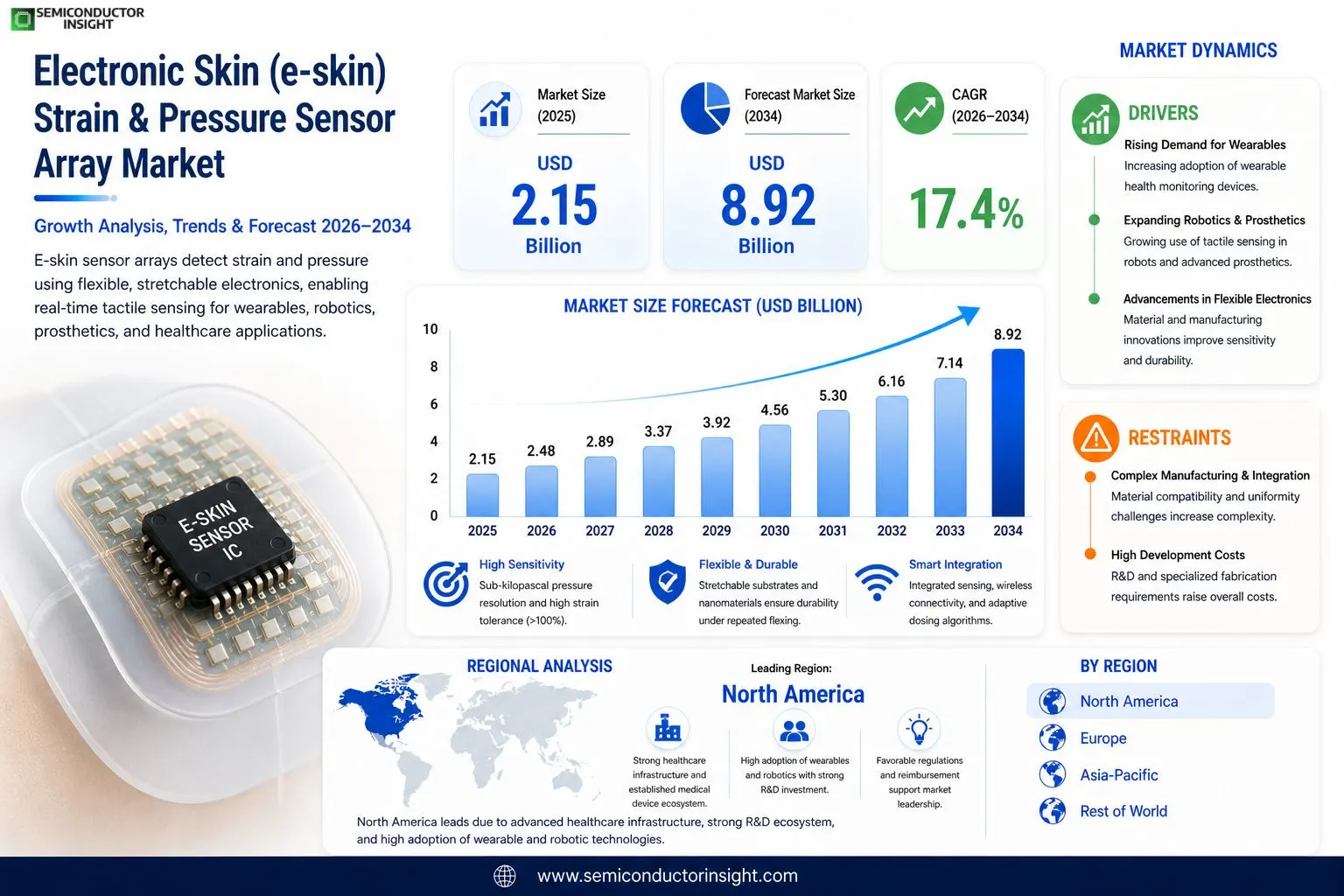
Global Electronic Skin (e-skin) Strain & Pressure Sensor Array Market size was valued at USD 2.15 billion in 2025. The market is projected to grow from USD 2.48 billion in 2026 to USD 8.92 billion by 2034, exhibiting a CAGR of 17.4% during the forecast period.
Electronic Skin (e-skin) strain and pressure sensor arrays represent advanced flexible sensing platforms designed to mimic the tactile capabilities of human skin. These systems integrate arrays of strain gauges and pressure-sensitive elements onto thin, stretchable substrates, enabling real-time detection of mechanical deformations, contact forces, and distributed pressure across surfaces. Key technologies include piezoresistive, capacitive, and piezoelectric materials, often combined with nanomaterials such as graphene, carbon nanotubes, or conductive polymers to achieve high sensitivity, wide dynamic range, and mechanical durability under repeated flexing.
The market is experiencing rapid growth due to several factors, including surging demand for advanced wearable health monitoring devices, expanding applications in robotics and prosthetics, and increasing adoption in human-machine interfaces for virtual and augmented reality systems. Furthermore, ongoing advancements in flexible electronics manufacturing and materials science are lowering production costs while improving sensor performance, such as achieving sub-kilopascal pressure resolution and high strain tolerance exceeding 100%. These developments support broader integration into conformal patches for continuous physiological monitoring and tactile feedback in next-generation devices. Initiatives by key players in the market are also expected to fuel the market growth. For instance, collaborations focused on integrating multimodal sensor arrays with wireless connectivity have accelerated commercialization in healthcare and consumer electronics sectors. Leading companies such as MC10, VivaLNK, iRhythm Technologies, and Medtronic operate in the market with a wide range of portfolios addressing strain mapping and pressure distribution needs.
MARKET DRIVERS
Rising Adoption of Wearable and Health Monitoring Technologies
Electronic Skin (e-skin) Strain & Pressure Sensor Array Market is primarily driven by increasing demand for advanced wearable health monitoring systems that provide continuous physiological data. As healthcare providers shift toward remote monitoring and early diagnostics, e-skin platforms are gaining traction for their ability to measure subtle biomechanical signals with high sensitivity. Growing interest in non-invasive sensors among medical device manufacturers further strengthens market momentum.
Advancements in Flexible and Stretchable Electronics
Recent improvements in stretchable substrates, nanomaterials, and flexible circuitry have accelerated innovation in e-skin sensor technologies. These advancements enable performance levels approaching those of human skin, attracting investment from robotics, prosthetics, and smart materials industries. As research institutions and technology firms refine material durability and signal accuracy, commercial adoption is expanding across multiple application areas.
➤ Technological convergence in AI, soft robotics, and nanosensor design continues to boost integration capabilities for next-generation e-skin platforms.
Growing collaboration between electronics manufacturers, biomedical engineers, and robotics developers is helping streamline commercialization pipelines. Enhanced production techniques, including scalable printing methods, support broader deployment of e-skin systems across industrial, medical, and consumer markets.
MARKET CHALLENGES
Complex Manufacturing and Material Integration
Despite strong growth prospects, Electronic Skin (e-skin) Strain & Pressure Sensor Array Market faces challenges regarding material compatibility, structural durability, and sensor uniformity. Producing highly flexible arrays with consistent performance across varying environmental conditions remains technically demanding. Manufacturers must balance elasticity, conductivity, and long-term reliability, which increases engineering complexity and overall production cost.
Other Challenges
High Development Costs
Research, prototyping, and specialized fabrication for e-skin systems require significant investment, which can hinder scalability for small and mid-sized companies.
MARKET RESTRAINTS
Limited Standardization Across Sensor Technologies
A key restraint in Electronic Skin (e-skin) Strain & Pressure Sensor Array Market is the absence of unified performance and safety standards, which complicates regulatory approval and commercialization. Sensor response characteristics, material types, and integration protocols vary widely across manufacturers, creating barriers for interoperability and quality assurance.
MARKET OPPORTUNITIES
Expansion into Robotics, Prosthetics, and Advanced Human–Machine Interfaces
Electronic Skin (e-skin) Strain & Pressure Sensor Array Market presents strong opportunities as industries pursue next-generation soft robotics, intelligent prosthetics, and immersive human–machine interfaces. E-skin systems enable more natural interaction by providing sensors that detect pressure, strain, and tactile feedback with high fidelity. Growing investment in robotic assistance, industrial automation, and augmented reality technologies continues to open new pathways for commercialization, supporting long-term market expansion.
Electronic Skin (e-skin) Strain & Pressure Sensor Array Market Trends
Advancements in Flexible Sensing Materials
Electronic Skin (e-skin) Strain & Pressure Sensor Array Market is undergoing rapid transformation as innovations in flexible sensing materials significantly enhance performance, durability, and precision. The integration of piezoresistive, capacitive, and piezoelectric technologies with nanomaterials such as graphene, carbon nanotubes, and conductive polymers continues to improve sensitivity and responsiveness. These advancements enable precise detection of pressure variations, mechanical deformation, and strain distribution, making e-skin arrays more capable of replicating the tactile functions of human skin. Ongoing progress in material science is reducing signal noise, enhancing stretchability, and allowing sensors to maintain functionality under repeated flexing, which strengthens their utility in healthcare monitoring patches, robotics, and next‑generation human-machine interfaces.
Other Trends
Growing Adoption in Robotics and Prosthetics
There is an increasing focus on integrating e-skin strain and pressure sensor arrays into robotic systems and advanced prosthetics to improve tactile perception and feedback accuracy. Robotics developers are utilizing these sensors to enhance grip control, object recognition, and environmental interaction, enabling more natural and adaptive responses. In prosthetics, e-skin technologies support more intuitive limb control by delivering distributed pressure and strain data that facilitate better alignment and user comfort. The capability of these sensor arrays to provide real-time, high-resolution feedback strengthens their role in creating more lifelike and responsive assistive technologies.
Advances in Wearable Health Monitoring
Wearable health monitoring remains a major driver of market trends as e-skin sensor arrays are increasingly integrated into thin, flexible patches that support continuous physiological monitoring. These systems allow measurement of parameters such as subtle body movement, muscle activity, and pressure distribution, contributing to more accurate and comfortable long-term monitoring solutions. Developments in flexible electronics manufacturing are reducing production costs and improving device reliability, enabling broader adoption across remote health monitoring, rehabilitation, and chronic condition management. Collaborations among technology developers are further accelerating commercialization of wireless, multimodal e-skin platforms.
Human-Machine Interface Innovations
The expansion of augmented reality and virtual reality applications is driving research into tactile-enabled human-machine interfaces that incorporate e-skin pressure and strain sensors. These sensors offer precise feedback capabilities that enhance immersion and interaction accuracy. As demand for intuitive gesture control and tactile simulation grows, these sensor arrays are becoming central components in next-generation interface systems.
Integration of Multimodal Sensing Architectures
Multimodal sensor arrays that combine strain, pressure, and other sensing elements within a single flexible platform are gaining momentum. This trend supports higher data fidelity and enables more complex interaction mapping for applications in healthcare, robotics, and consumer electronics. Companies working on integrating multimodal sensing with wireless communication technologies are advancing product readiness and broadening use cases across both clinical and commercial sectors. These developments are positioning Electronic Skin (e-skin) Strain & Pressure Sensor Array Market for continued expansion as cross‑industry adoption strengthens.
COMPETITIVE LANDSCAPE
Key Industry Players
Competitive dynamics shaping Global e-skin strain and pressure sensor ecosystem
Electronic Skin (e-skin) Strain & Pressure Sensor Array Market is led by companies that specialize in flexible electronics, wearable health systems, and advanced tactile sensing technologies. Players such as MC10, VivaLNK, iRhythm Technologies, and Medtronic have established strong positions due to their extensive portfolios in medical-grade wearable patches and high-resolution sensor arrays. Their competitive advantage is supported by proprietary materials engineering, scalable manufacturing capabilities, and long-term collaboration with healthcare and robotics OEMs. These global leaders are also accelerating commercialization through strategic partnerships aimed at integrating multimodal tactile sensors with wireless connectivity and AI-driven analytics.
Beyond the dominant incumbents, several specialized firms and research-driven manufacturers are contributing significantly to market innovation, particularly in high-sensitivity nanomaterial-based sensor arrays and stretchable substrates. Organizations such as Xenoma, StretchSense, Rotex Global, and SmartLife Incorporation are emerging with niche solutions for robotics, soft prosthetics, industrial safety, and human–machine interfaces. These companies are differentiating through innovations in graphene-enhanced sensing layers, capacitive and piezoresistive architectures, and ultra-thin conformal patches suited for long-term physiological monitoring. As the market continues to expand, these players are expected to influence new standards for sensor reliability, biocompatibility, and tactile performance.
List of Key Electronic Skin (e-skin) Strain & Pressure Sensor Array Companies Profiled
- MC10
- VivaLNK
- iRhythm Technologies
- Medtronic
- StretchSense
- Xenoma
- Rotex Global
- SmartLife Incorporation
- Konica Minolta
- Plastic Logic
- Holst Centre (TNO)
- Tekscan
- Biovotion
- Quad Industries
- Epicore Biosystems
Segment Analysis:
| Segment Category | Sub-Segments | Key Insights |
| By Type |
|
Piezoresistive Sensors
|
| By Application |
|
Wearable Health Monitoring
|
| By End User |
|
Healthcare Providers
|
| By Technology |
|
Nanomaterial‑Enhanced Sensors
|
| By Component Architecture |
|
Sensing Layer
|
Regional Analysis: Electronic Skin (e-skin) Strain & Pressure Sensor Array Market
Asia-Pacific
Asia-Pacific benefits from deeply entrenched flexible electronics manufacturing infrastructure. The region’s established printed electronics and thin-film fabrication capabilities allow producers of e-skin strain and pressure sensor arrays to achieve cost efficiencies unmatched elsewhere. Dense supplier networks across China and Taiwan ensure consistent access to conductive polymers, nanomaterials, and substrate components critical to advanced sensor array production.
Rapidly aging populations across Japan, South Korea, and China are generating sustained demand for wearable health monitoring solutions incorporating e-skin pressure sensor arrays. Simultaneously, the region’s aggressive push toward collaborative robotics and surgical automation is expanding application frontiers, with tactile sensing arrays becoming indispensable for safe human-robot interaction and dexterous manipulation in industrial and medical environments.
State-backed funding programs across China, Japan, and South Korea are actively nurturing electronic skin sensor research at both university and enterprise levels. National roadmaps targeting smart healthcare, next-generation wearables, and advanced manufacturing directly stimulate commercialization of e-skin strain and pressure sensor array technologies, reducing time-to-market and encouraging domestic intellectual property development at an accelerating pace.
Beyond established verticals, Asia-Pacific is pioneering novel use cases for Electronic Skin (e-skin) Strain & Pressure Sensor Array Market, including smart textile integration, augmented reality haptic feedback, and intelligent prosthetic limbs. Startup ecosystems in Shenzhen, Tokyo, and Seoul are actively translating academic breakthroughs into scalable products, attracting venture capital and fostering a self-reinforcing cycle of innovation and commercialization.
North America
North America represents a highly mature and technologically sophisticated participant in Electronic Skin (e-skin) Strain & Pressure Sensor Array Market. The United States, in particular, commands a strong presence through its concentration of elite research universities, federally funded defense and healthcare innovation programs, and a dynamic venture capital ecosystem. Institutions such as MIT, Stanford, and Caltech have produced foundational research in stretchable electronics and bioinspired sensing systems that continue to influence global e-skin development trajectories. The region’s medical device industry is a critical demand driver, with pressure sensor arrays increasingly embedded in next-generation prosthetics, rehabilitation wearables, and surgical robotics. Defense research agencies are actively exploring electronic skin applications for soldier health monitoring and unmanned systems tactile feedback. Canada contributes through emerging cleantech and biomedical innovation hubs, particularly in Ontario and British Columbia. Strong intellectual property frameworks and favorable regulatory pathways for medical-grade wearable sensors support sustained commercialization activity across the North American Electronic Skin (e-skin) Strain & Pressure Sensor Array Market landscape through 2034.
Europe
Europe occupies a strategically important position within Global Electronic Skin (e-skin) Strain & Pressure Sensor Array Market, characterized by rigorous regulatory standards, deep materials science expertise, and a strong emphasis on sustainable and biocompatible sensor development. Germany, the United Kingdom, the Netherlands, and Sweden are among the primary contributors, leveraging well-established research infrastructure and cross-border academic consortia to advance flexible and stretchable sensor technologies. The European Union’s Horizon research funding framework has channeled significant resources into projects exploring e-skin applications in rehabilitation medicine, human augmentation, and soft robotics. Europe’s medical device regulatory environment, while demanding, ultimately raises product quality benchmarks and encourages clinically validated e-skin pressure sensor solutions. The region’s commitment to data privacy and patient safety further shapes product design priorities within Electronic Skin (e-skin) Strain & Pressure Sensor Array Market, fostering development of secure, minimally invasive wearable sensing platforms that align with stringent GDPR and medical device directive requirements.
United States
Within the broader North American landscape, the United States warrants distinct recognition as a nucleus of Electronic Skin (e-skin) Strain & Pressure Sensor Array Market innovation and commercialization. The convergence of world-class semiconductor expertise, deep-pocketed defense procurement, and a thriving digital health investment climate positions the U.S. as a key architect of e-skin technology standards and application paradigms. Silicon Valley and Boston’s Route 128 corridor host numerous startups and scale-ups translating flexible sensor breakthroughs into commercially viable products. The National Institutes of Health and DARPA continue to catalyze research at the intersection of bioelectronics and human performance monitoring, directly advancing pressure and strain sensor array capabilities. The U.S. prosthetics and orthotics sector represents one of the most commercially immediate application domains, with e-skin arrays enabling unprecedented levels of tactile feedback and adaptive control. Growing consumer interest in continuous health tracking wearables further broadens the addressable market for electronic skin strain and pressure sensor technologies across the American marketplace through the forecast horizon.
Middle East & Africa
The Middle East & Africa region represents an emerging frontier for Electronic Skin (e-skin) Strain & Pressure Sensor Array Market, currently characterized by nascent adoption but meaningful long-term growth potential. Gulf Cooperation Council nations, particularly the United Arab Emirates and Saudi Arabia, are channeling sovereign wealth and national transformation agendas into advanced healthcare infrastructure and smart city development, creating nascent but growing demand for sophisticated wearable and robotic sensing technologies. Israel stands out as a disproportionately influential innovation hub within the region, with a vibrant deep-tech startup ecosystem producing competitive flexible electronics and biomedical sensing solutions. Across Sub-Saharan Africa, the primary growth catalyst for electronic skin pressure sensor adoption lies in expanding healthcare access and telemedicine infrastructure, where low-cost, flexible diagnostic wearables could address significant unmet clinical needs. While manufacturing capacity and local supply chains remain underdeveloped relative to leading regions, increasing foreign direct investment in technology sectors and growing academic partnerships with European and Asian institutions are gradually building the foundational capabilities necessary for broader Electronic Skin (e-skin) Strain & Pressure Sensor Array Market participation through 2034.
Report Scope
This market research report provides a comprehensive analysis of Electronic Skin (e-skin) Strain & Pressure Sensor Array Market, covering the forecast period 2026–2034. It offers detailed insights into market dynamics, technological advancements, competitive landscape, and key trends shaping the industry.
Key focus areas of the report include:
- Market Overview: The report begins with an overview outlining its current market scenario, key growth indicators, and industry transformation drivers. It discusses macroeconomic factors, demand–supply balance, regulatory landscape, and the strategic role of flexible electronics in powering advancements across industries such as healthcare, robotics, consumer electronics, and human-machine interfaces.
- Market Size & Forecast: Historical data and future projections for revenue, unit shipments, and market value across major regions and segments.
- Segmentation Analysis: Detailed breakdown by product type, technology, application, and end-user industry to identify high-growth segments and investment opportunities.
- Regional Insights: Insights into market performance across North America, Europe, Asia-Pacific, Latin America, and the Middle East & Africa, including country-level analysis where relevant.
- Competitive Landscape: Profiles of leading market participants, including their product offerings, R&D focus, manufacturing capacity, pricing strategies, and recent developments such as mergers, acquisitions, and partnerships.
- Technology Trends & Innovation: Assessment of emerging technologies, integration of AI/IoT, flexible electronics design trends, fabrication techniques, and evolving industry standards.
- Market Drivers & Restraints: Evaluation of factors driving market growth along with challenges, supply chain constraints, regulatory issues, and market-entry barriers.
- Stakeholder Insights: Insights for component suppliers, OEMs, system integrators, investors, and policymakers regarding the evolving ecosystem and strategic opportunities.
Primary and secondary research methods are employed, including interviews with industry experts, data from verified sources, and real-time market intelligence to ensure the accuracy and reliability of the insights presented.
FREQUENTLY ASKED QUESTIONS:
What is the current market size of Electronic Skin (e-skin) Strain & Pressure Sensor Array Market?
-> Electronic Skin (e-skin) Strain & Pressure Sensor Array Market was valued at USD 2.15 billion in 2025 and is expected to reach USD 8.92 billion by 2034, growing at a CAGR of 17.4% during the forecast period from 2026 to 2034.
Which key companies operate in Electronic Skin (e-skin) Strain & Pressure Sensor Array Market?
-> Key players include MC10, VivaLNK, iRhythm Technologies, and Medtronic, among others, operating with wide-ranging portfolios addressing strain mapping and pressure distribution needs.
What are the key growth drivers?
-> Key growth drivers include surging demand for advanced wearable health monitoring devices, expanding applications in robotics and prosthetics, increasing adoption in human-machine interfaces for virtual and augmented reality systems, and ongoing advancements in flexible electronics manufacturing and materials science.
Which region dominates the market?
-> Asia-Pacific is among the fastest-growing regions driven by strong electronics manufacturing capabilities, while North America remains a significant market supported by leading healthcare and robotics innovation ecosystems.
What are the emerging trends?
-> Emerging trends include integration of nanomaterials such as graphene and carbon nanotubes, multimodal sensor arrays with wireless connectivity, conformal patches for continuous physiological monitoring, and tactile feedback systems for next-generation wearable and robotic devices.

Get Sample Report PDF for Exclusive Insights
Report Sample Includes
- Table of Contents
- List of Tables & Figures
- Charts, Research Methodology, and more...
 Download Sample Report PDF