Electronic Filters Market Insights
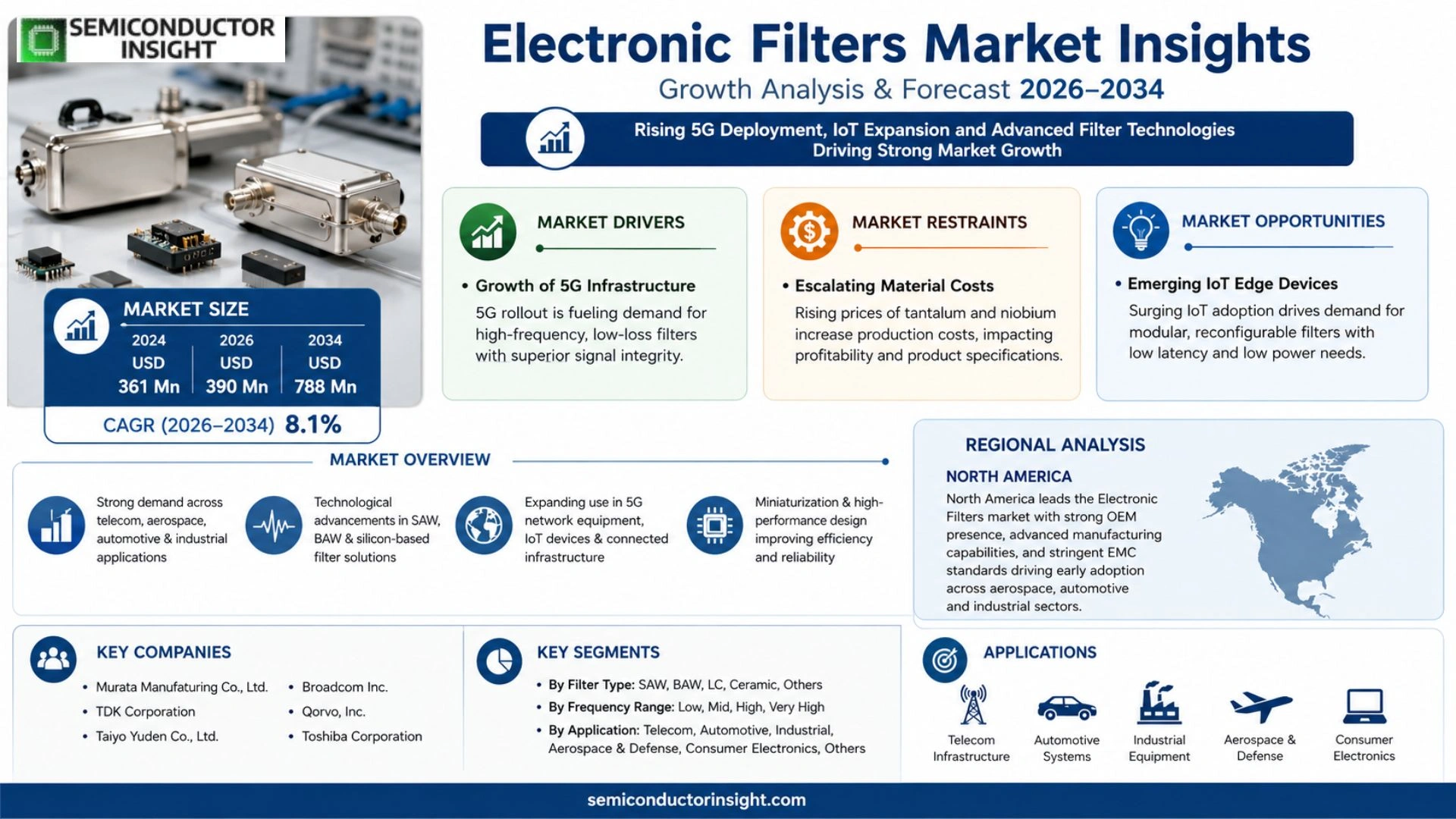
Electronic Filters market size was valued at USD 361 million in 2024 and will grow from approximately USD 390 million in 2026 to about USD 788 million by 2034, exhibiting a CAGR of roughly 8.1%.
This increase represents an annual rise of close to eight percent since the mid‑2020s, underscoring steady adoption across multiple end‑markets.
Electronic filters are four‑terminal devices that permit electrical current to flow between source and load within a specified frequency range, thereby shaping signal spectra for diverse applications. By attenuating unwanted frequencies while allowing desired bands to pass, these components are essential for signal integrity in radios, power supplies and sensor interfaces.
The expansion reflects broader adoption of automotive electronics, heightened deployment of Internet‑of‑Things devices, and escalating requirements for high‑frequency communication components across consumer and industrial sectors. Leading suppliers such as Murata, TDK and Delta continue to broaden their portfolios through advanced ceramic and surface‑mount technologies.
MARKET DRIVERS
Growth of 5G Infrastructure
The rollout of 5G networks has forced equipment manufacturers to adopt filters that can operate at millimeter‑wave frequencies while preserving signal integrity. Electronic Filters Market players that can deliver low‑loss, high‑Q components are seeing a surge in demand from telecom operators seeking to meet dense‑cell deployment targets. This shift is not merely a volume effect; it reshapes design architectures, prompting vendors to invest in silicon‑based filter technologies that are compatible with advanced packaging.
Regulatory Pressure on Electromagnetic Interference
Stringent EMI/EMC standards across automotive, aerospace, and medical sectors compel OEMs to integrate more stringent filtering solutions. Electronic Filters Market growth is therefore linked to compliance cycles, where each new regulation creates a fresh procurement wave for high‑precision LC and SAW filters. Companies that pre‑qualify their products against forthcoming standards gain a competitive edge by shortening time‑to‑market for their customers.
➤ “Robust filter performance has become the gateway for product certification in high‑frequency domains,” an industry senior noted.
In parallel, the proliferation of edge‑computing nodes fuels the need for compact, power‑efficient filters that can operate under limited thermal budgets. This demand drives R&D spending toward monolithic integration, positioning innovators that can merge filtering functions directly onto mixed‑signal ASICs at the forefront of Electronic Filters market evolution.
MARKET CHALLENGES
Complexity of Multi‑Band Design
Designing filters that simultaneously cover sub‑6 GHz, mid‑band, and high‑band spectra forces engineers to juggle trade‑offs between insertion loss, selectivity, and board‑space. The steep learning curve limits the pool of capable design houses, slowing adoption for customers who lack in‑house RF expertise. Consequently, Electronic Filters Market firms must offer extensive design‑support services to lower entry barriers.
Other Challenges
Supply‑Chain Volatility
The reliance on specialty ceramics and rare‑earth substrates makes the filter supply chain vulnerable to geopolitical fluctuations. Sudden tariff changes or export restrictions can inflate component costs by 15‑20 %, eroding margin for manufacturers that cannot quickly re‑source alternative materials.
MARKET RESTRAINTS
Escalating Material Costs
The price trajectory of high‑purity tantalum and niobium,key ingredients for high‑Q resonators,has risen steadily, squeezing profitability for filter makers that depend on bulk purchases. As Electronic Filters Market participants grapple with these cost pressures, some opt to shift production to lower‑spec segments, potentially compromising product performance.
Design Trade‑Off Constraints
Achieving ultra‑compact footprints often forces a compromise on out‑of‑band rejection, which is unacceptable for safety‑critical applications such as automotive radar. The necessity to balance size and performance limits the range of viable solutions, curbing the pace at which new form‑factor innovations can be introduced into Electronic Filters market.
MARKET OPPORTUNITIES
Emerging IoT Edge Devices
The explosion of IoT sensors operating at diverse frequencies creates a niche for modular filter kits that can be quickly re‑configured. Companies that provide plug‑and‑play filter libraries stand to capture a sizable share of Electronic Filters market, especially as edge deployments prioritize low latency and minimal power draw.
Custom Integrated‑Circuit Solutions
Integrating filtering functions directly into system‑on‑chip (SoC) architectures reduces bill‑of‑materials and shortens board layout cycles. Start‑ups that have mastered on‑chip acoustic wave resonators are poised to channel this capability into automotive telematics and wearable health monitors, unlocking a high‑margin segment of Electronic Filters market.
Finally, the gradual adoption of AI‑driven design automation tools promises to accelerate time‑to‑prototype for next‑generation filters. Firms that embed these tools into their product‑development pipelines can respond faster to emerging standards, translating technical agility into sustainable market share gains.
Electronic Filters Market Trends
Shift Toward Integrated Filter Solutions
Electronic Filters market recorded $361 million in 2024 and is forecasted to climb to $615 million by 2031. This upward trajectory is largely tied to the migration from discrete components toward highly integrated filter modules that combine multiple functions on a single silicon die. Designers in automotive, consumer wearables and industrial IoT are rewarding suppliers who can shrink bill‑of‑materials while preserving performance across tight frequency bands. The resulting economies of scale enable lower per‑unit pricing, yet they also raise entry barriers for smaller players lacking advanced packaging capabilities. Companies that can align product roadmaps with automotive electrification cycles and 5G‑enabled edge devices are likely to capture incremental revenue as OEMs redesign platform architectures.
Other Trends
Emergence of High‑Frequency Applications
High‑frequency segments such as 5G front‑haul, millimeter‑wave radar and satellite‑grade communication are reshaping demand patterns. Filters operating above 6 GHz must meet stricter insertion‑loss and phase‑noise specifications, prompting manufacturers to invest in new ceramic and MEMS technologies. The shift is not merely technical; it influences supply chain decisions, with firms relocating production of premium substrates closer to key design hubs in Japan and South Korea. End‑users are also prioritizing reliability metrics, leading to longer qualification cycles but higher average contract values. Consequently, firms that can demonstrate robust high‑frequency performance while maintaining cost discipline are positioned to benefit from this niche yet expanding segment.
Regional Realignment of Supply Chains
Geographically, the United States and China continue to dominate demand, yet recent trade adjustments have encouraged a diversification of manufacturing footprints. While the U.S. market is projected to sustain steady growth through 2027, Chinese buyers are expanding capacity to service domestic automotive and smart‑city initiatives. This dual‑track development forces original equipment manufacturers to negotiate parallel sourcing strategies, balancing tariff exposure against lead‑time advantages. European players are capitalising on this by offering localized assembly services that mitigate cross‑border complexities. The overall effect is a more fragmented supply network, where agility and proximity to end‑users become decisive factors in securing market share.
COMPETITIVE LANDSCAPE
Key Industry Players
Electronic Filters Market – Competitive Overview
Murata stands out as the benchmark supplier, leveraging a vertically integrated model that spans material sourcing to final module assembly. Its broad catalog,covering low‑pass, high‑pass, band‑pass and band‑reject designs,serves automotive infotainment, telecom infrastructure and consumer wearables alike. By aligning R‑D investments with the accelerating shift toward 5G and electric‑vehicle architectures, Murata has fortified its pricing power and secured long‑term contracts with tier‑one OEMs. This structural advantage translates into a de‑facto market leadership position, compelling rivals to pursue niche differentiation or channel partnerships to retain margin. The company’s global footprint, especially strong presence in Japan, Europe and North America, also cushions it against regional demand volatility, making it a bellwether for industry health.
Beyond the market leader, a cohort of specialized firms injects competitive vigor. Delta and TDK concentrate on high‑frequency ceramic filters that cater to data‑center and satellite communications, while Phoenix excels in modular filter solutions for industrial automation. Block Transformatoren‑Elektronik and CD Automation dominate the European high‑power segment, offering ruggedized units for rail and defense applications. DETI Microwave, EPA GmbH and FEAS GmbH differentiate through custom‑tuned microwave filters that address niche aerospace contracts. Murrelektronik, Schaffner and Schurter focus on safety‑rated components for automotive and rail, capitalising on stringent certification regimes. Emerging Asian players such as KR Electronics, Suntsu Electronics, Rasmi Electronics, Captor Corporation and Shenzhen Sikes are expanding capacity to meet the surge in consumer‑electronics demand, often leveraging aggressive cost structures to gain market share.
List of Key Electronic Filters Companies Profiled
- Murata
- Phoenix Contact
- Delta Electronics
- TDK
- Block Transformatoren‑Elektronik
- CD Automation
- DETI Microwave
- EPA GmbH
- FEAS GmbH
- Murrelektronik
- Schaffner
- Schurter
- KR Electronics
- Suntsu Electronics
- Rasmi Electronics
- Captor Corporation
- Shenzhen Sikes
Segment Analysis:
| Segment Category | Sub-Segments | Key Insights |
| By Type |
|
Low Pass Filter
|
| By Application |
|
Automobile
|
| By End User |
|
OEMs
|
| By Frequency Range |
|
Low‑kHz to MHz
|
| By Technology |
|
Passive
|
Regional Analysis: Electronic Filters Market
North America
Federal communications authorities have tightened emission limits for wireless modules, prompting filter makers to certify devices against more stringent benchmarks. Concurrently, automotive safety directives require higher isolation between power and signal lines, pushing manufacturers toward multi‑stage designs that balance insertion loss with stop‑band attenuation.
Silicon‑based filter technologies are gaining traction as designers seek miniaturized solutions that occupy less board real estate. Research labs across the continent are experimenting with MEMS resonators, aiming to blend mechanical stability with electronic tunability, a combination that could redefine performance baselines.
Recent disruptions highlighted the importance of dual‑sourcing critical substrate materials. Companies are now investing in domestic production capacities, reducing lead times and insulating themselves from geopolitical volatility that previously forced longer procurement cycles.
End‑user engineers are prioritizing filters that can survive harsher thermal cycles, particularly in electric‑vehicle power modules. This shift encourages vendors to qualify components under more severe environmental tests, thereby raising overall product robustness.
Europe
European manufacturers focus on harmonizing component specifications across the EU, which smooths cross‑border sales but also imposes a baseline of performance that some niche players find restrictive. The continent’s strong emphasis on sustainability drives a preference for filters that can be produced with lower‑impact materials, prompting R&D teams to explore biodegradable substrates. Additionally, the automotive sector’s rapid electrification creates pressure for compact, high‑Q filters that support fast‑charging infrastructures. Companies that align product roadmaps with these environmental and efficiency criteria stand to capture premium contracts from Tier‑1 suppliers seeking compliant solutions.
Asia‑Pacific
In Asia‑Pacific, the surge of consumer electronics manufacturing continues to shape Electronic Filters market, especially in fast‑growing hubs such as Vietnam and India. While cost considerations remain paramount, customers are increasingly valuing performance consistency, encouraging local firms to upgrade testing capabilities. The region also benefits from a burgeoning renewable‑energy sector, where power‑inverter applications demand filters that can handle wide frequency ranges without degradation. Players that can blend competitive pricing with reliable, high‑frequency performance are likely to deepen relationships with both OEMs and contract manufacturers.
South America
South America’s market is defined by a mix of legacy infrastructure and emerging telecom projects. Nations investing in 4G‑plus and early 5G rollouts require filters that can mitigate interference in densely populated urban zones. At the same time, industrial automation initiatives call for rugged filter designs able to operate under variable humidity and temperature. Suppliers who tailor their product portfolios to these dual demands,offering both low‑cost, high‑volume variants and premium, environment‑hardened options,create a competitive edge in a market still seeking scale.
Middle East & Africa
The Middle East & Africa region presents a distinct set of opportunities centered on oil‑and‑gas extraction and increasing data‑center deployments. Harsh desert conditions test the durability of conventional components, prompting a shift toward filters with enhanced sealing and corrosion resistance. Meanwhile, the rise of edge‑computing installations in emerging economies fuels demand for compact, low‑latency filtering solutions. Companies that embed robust protective coatings and offer modular designs adaptable to diverse climatic profiles are positioned to win contracts in both the energy and digital infrastructure segments.
Report Scope
This market research report provides a comprehensive analysis of the Electronic Filters Market , covering the forecast period 2026–2034. It offers detailed insights into market dynamics, technological advancements, competitive landscape, and key trends shaping the industry.
Key focus areas of the report include:
- Market Overview: The report begins with an overview outlining its current market scenario, key growth indicators, and industry transformation drivers. It discusses macroeconomic factors, demand–supply balance, regulatory landscape, and the strategic role of semiconductors in powering advancements across industries such as automotive, telecommunications, consumer electronics, and industrial automation.
- Market Size & Forecast: Historical data and future projections for revenue, unit shipments, and market value across major regions and segments.
- Segmentation Analysis: Detailed breakdown by product type, technology, application, and end-user industry to identify high-growth segments and investment opportunities.
- Regional Insights: Insights into market performance across North America, Europe, Asia-Pacific, Latin America, and the Middle East & Africa, including country-level analysis where relevant.
- Competitive Landscape: Profiles of leading market participants, including their product offerings, R&D focus, manufacturing capacity, pricing strategies, and recent developments such as mergers, acquisitions, and partnerships.
- Technology Trends & Innovation: Assessment of emerging technologies, integration of AI/IoT, semiconductor design trends, fabrication techniques, and evolving industry standards.
- Market Drivers & Restraints: Evaluation of factors driving market growth along with challenges, supply chain constraints, regulatory issues, and market-entry barriers.
- Stakeholder Insights: Insights for component suppliers, OEMs, system integrators, investors, and policymakers regarding the evolving ecosystem and strategic opportunities.
Primary and secondary research methods are employed, including interviews with industry experts, data from verified sources, and real-time market intelligence to ensure the accuracy and reliability of the insights presented.
FREQUENTLY ASKED QUESTIONS:
What is the current market size of Electronic Filters Market?
-> Electronic Filters market will grow from approximately USD 390 million in 2026 to about USD 788 million by 2034, exhibiting a CAGR of roughly 8.1%
Which key companies operate in Electronic Filters Market?
-> Key players include Murata, Phoenix, Delta, TDK, Block Transformatoren‑Elektronik, CD Automation, DETI Microwave, EPA GmbH, FEAS GmbH, Murrelektronik, Schaffner, Schurter, KR Electronics, Suntsu Electronics, Rasmi Electronics, Captor Corporation, Shenzhen Sikes.
What are the key growth drivers?
-> Key growth drivers include rising demand for high‑frequency communication modules, expanding automotive electrification, growth of consumer electronics, and increased adoption of IoT devices that require precise filter performance.
Which region dominates the market?
-> Asia-Pacific holds the largest market share, driven by strong manufacturing bases in China, Japan, and South Korea, while North America and Europe remain important growth regions.
What are the emerging trends?
-> Emerging trends include miniaturization of filter packages, integration of filters with semiconductor modules, development of tunable and adaptive filter technologies, and the use of advanced materials to improve performance at higher frequencies.
Get Sample Report PDF for Exclusive Insights
Report Sample Includes
- Table of Contents
- List of Tables & Figures
- Charts, Research Methodology, and more...
 Download Sample Report PDF