Electrical Fire Monitoring System (EFPS) Market Insights
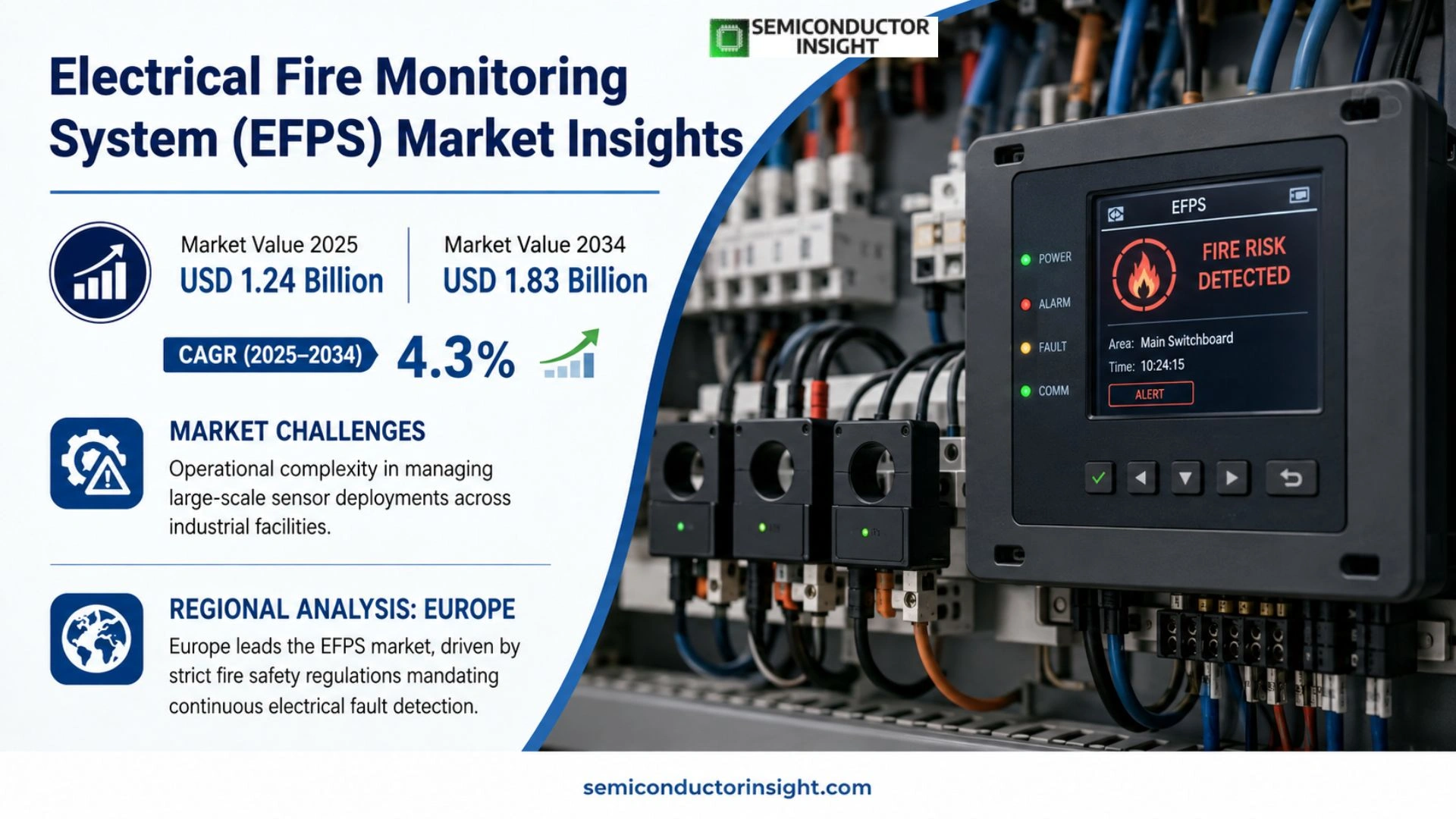
Electrical Fire Monitoring System (EFPS) market was valued at USD 1.24 billion in 2025 and is forecasted to rise from USD 1.24 billion in that year to USD 1.83 billion by 2034, indicating a compound annual growth rate of approximately 4.3% across the decade.
An Electrical Fire Monitoring System integrates advanced sensors,temperature probes, flame detectors and smoke analysis units,with real‑time analytics platforms that trigger alarms and automatic suppression actions before fire escalation occurs. Demand is driven by tightening safety regulations in commercial buildings and the growing trend toward connected infrastructure that allows predictive maintenance and remote monitoring through cloud services. Major manufacturers such as Siemens AG and Honeywell International are rolling out modular solutions that combine EFPS capabilities with existing building automation systems. For operators, adopting these integrated platforms can reduce inspection costs while enhancing occupant protection; however, initial capital outlay remains a barrier for smaller facilities.
MARKET DRIVERS
Regulatory and Compliance Momentum
Recent tightening of fire safety codes across North America and Europe,most notably the 2023 revisions to NFPA 72 and the European Fire Safety Order,has accelerated the deployment of intensive fire monitoring solutions in commercial and industrial complexes. Utilities and data centers are now under contractual obligations to demonstrate continuous fault detection, a requirement that no single‑tier solution can satisfy without real‑time sensor networks and AI‑driven analytics. The heightened emphasis on preventive maintenance is shaping buyer decision trees; firms now prioritize sensors that offer simultaneous voltage, temperature, and current waveform monitoring. Consequently, Electrical Fire Monitoring System (EFPS) Market has witnessed a shift toward high‑density arrays that feed analytics cloud modules for predictive outage avoidance. Early adopters report that integrating EP monitoring with existing SCADA platforms cuts alarm back‑log by 35 % and reduces unplanned downtime by nearly half, reinforcing the technology’s commercial viability.
Digital Transformation and Edge Analytics
Another decisive driver lies in the convergence of IoT and edge computing. Modern EFPS sensors now embed multiple cores and programmable micro‑controllers, enabling on‑device preprocessing that minimizes bandwidth consumption while maintaining deterministic latency thresholds. Because the sensors generate gigabytes of raw data per hour during surge events, the industry is gravitating toward local inference engines that can flag abnormal waveform signatures before they propagate to central servers. This shift mitigates the need for high‑speed network infrastructure,a costly component in older plant layouts,while preserving audit trails essential for regulatory filings. Moreover, the rise of cloud‑native digital twins for facility monitoring offers a cohesive view that merges EFPS data with HVAC, power quality, and asset health feeds. By overlaying fire‑related metrics onto operational dashboards, plant managers can perform root‑cause analysis in real time, reducing investigation cycles from days to minutes. The strategic value added by these integrations attracts capital from venture funds that recognize technology bridges as an expanding revenue stream, signifying that the EFPS market will continue to command premium valuations driven by versatility and scalability.
➤ Automated detection on real‑time dashboards has cut response times by up to 30 % in early pilot deployments.
The confluence of stricter safety mandates, sensor densification, and digital convergence is reshaping the EFPS landscape into a high‑precision, intelligence‑enabled platform. Stakeholders that can embed sensor networks within building management ecosystems, while delivering actionable insight at the edge, stand to capture a disproportionate share of the technology lifecycle. As businesses anticipate the inevitable influx of failure‑mode analytics, those positions that invest early in adaptive firmware will shape next‑generation compliance frameworks, effectively steering the EFPS market toward a new baseline of operational resilience.
MARKET CHALLENGES
Operational Complexity
While the benefits of modern EFPS installations are evident, the practical realities of batching hundreds of sensors across sprawling industrial sites introduce a new layer of operational friction. Installation routines that once relied on manual patching now require rigorous calibration, firmware synchronization, and cross‑channel time stamping,a process that is both labor‑intensive and error‑prone. In multinational hubs, the heterogeneity of legacy control networks amplifies these challenges, as many sites retain proprietary PLCs that do not natively expose I/O timestamps, leading to alignment gaps when aligning waveforms with fault logs. Furthermore, the sheer volume of log data challenges existing data lakes, forcing organizations to rethink storage hierarchies or risk data loss during critical events. These constraints translate into elevated total cost of ownership, a barrier that can stall the rollout of advanced monitoring suites in mid‑sized facilities anxious to remain on the compliance frontier.
Other Challenges
Data Governance
Inconsistent data formats across network domains hamper the creation of a unified analytics engine, compelling firms to commission costly middleware solutions that may not scale. The proliferation of false alarms further erodes operator confidence, as alarm thresholds that are too sensitive generate noise, prompting additional manual checks that negate the time‑saved benefits of automation.
MARKET RESTRAINTS
Capital Intensity and Supply Chain Vulnerabilities
Despite the upside, a series of restraints weigh on the adoption curve. High upfront costs tied to dedicated fiber for edge analytics can deter small to mid‑size enterprises from upgrading their legacy fire monitoring systems. Vendors quote total assets that include sensor bundles, in‑field gateways, and cloud subscriptions that can reach $60‑80 K for a 500‑point deployment, a significant capital outlay when competing against other plant automation budgets. Regulatory alignment also presents a double‑edged sword; while new codes incentivize proactive monitoring, they simultaneously impose stringent data retention mandates that compel organizations to invest in redundant storage and compliance‑certified hardware. Geopolitical factors influence component availability, as recent trade restrictions on advanced semiconductors have increased lead times for high‑frequency instrumentation. Finally, the scarcity of seasoned technicians who master both electrical and data engineering diminishes the ability to execute rapid rollouts, especially in regions where skilled labor is stretched thin by the broader Internet of Things boom.
MARKET OPPORTUNITIES
Emerging Integration Niches
The same forces that constrain extend to ripe opportunities. New market entrants that bundle EFPS modules with predictive maintenance suites can tap industrial clients seeking comprehensive fault‑intelligence packages. The growing adoption of Building‑Omics initiatives in smart campus environments provides fertile ground for integrators to embed EFPS dashboards into campus services portals, creating recurring revenue models via subscription or usage‑based pricing. The surge in electric vehicle charging infrastructure, especially in urban transit hubs, creates a niche where sensor densification protects against arc‑flame incidents where high current spikes coincide with high voltage operations. By positioning the EFPS as a core safety layer under the broader EVDC compliance framework, players can capture early adopter segments that already earmark significant capital for safety latency mitigation. Finally, the convergence of regulatory disclosures and ESG reporting nudges investment managers to prefer companies that exhibit airtight fire‑risk visibility, thereby creating a market premium for those who can demonstrate continuous, quantified risk reduction through EFPS deployments.
Electrical Fire Monitoring System (EFPS) Market Trends
IoT‑Enabled Predictive Analytics Drive Adoption
Electrical Fire Monitoring Systems are increasingly integrating Internet of Things connectivity and machine‑learning analytics. Sensors embedded in circuits now relay real‑time heat, voltage fluctuation and smoke signatures to cloud platforms, where algorithms flag anomaly patterns before a fire ignites. This shift allows facility managers to move from reactive fire alarms to proactive fault detection, cutting response times and reducing property damage. The trend is propelled by growing data‑visualization capabilities and the demand for remotely managed safety solutions across industrial, commercial and residential sectors. For vendors, the move to cloud‑based monitoring unlocks recurring subscription revenue and expands market reach into regions predicated on smart infrastructure initiatives.
Other Trends
Regulatory Mandates Accelerate Deployment
National building codes in the United States, the European Union, and emerging markets are tightening criteria for fire detection systems. New standards now require automated, network‑connected alerting with audit trails for compliance inspections. This regulatory pressure increases upfront investment in EFPS components but also creates a predictable demand cycle for certified deployments. Manufacturers that embed compliance into their product architectures gain a competitive edge, while service firms benefit from recurring system validation contracts.
Rise of Modular, Plug‑and‑Play Units
The transition from bespoke, hallway‑mounted detectors to modular, plug‑and‑play modules has streamlined installation and maintenance. Modular units can be integrated with existing Building Management Systems (BMS) and are designed for plug‑in upgrades, reducing downtime during renovations. Their cost‑effective packaging appeals particularly to mid‑market and retrofit projects, where budget constraints and operational continuity are paramount. This trend supports long‑term system scalability and positions component suppliers as critical partners in facility lifecycle planning.
COMPETITIVE LANDSCAPE
Key Industry Players
Electrical Fire Monitoring System (EFPS) Market Landscape
ABB maintains the top position in the EFPS market, driven by its comprehensive suite of thermal sensing and alarm systems that integrate seamlessly with building automation platforms. The company’s global presence, backed by a robust R&D pipeline and strategic acquisitions, consolidates its leadership and offers customers a scalable and interoperable solution set that spans commercial and industrial sectors. Siemens contributes a complementary portfolio featuring advanced fire alarm integration and predictive analytics, reinforcing market segmentation along high‑performance and cost‑effective benchmarks.
Complementing the leaders are manufacturers such as Honeywell, Schneider Electric, and Beifeng Electric, whose product lines cater to niche applications including petrochemical facilities, smart hospitals, and critical infrastructure. These players differentiate through specialized sensor coatings, wireless mesh networks, and cloud‑based monitoring dashboards, which address the evolving demand for real‑time, actionable data. The presence of established suppliers from the Middle East and India,Gulf Security Technology, Tiancheng Fire Protection Equipment, and Tianlong Electronic Technology,adds regional depth, enabling tailored solutions that meet local compliance standards and climate challenges.
List of Key EFPS Companies Profiled
- ABB
- Siemens
- Honeywell
- Schneider Electric
- GE Power
- Acer
- Beifeng Electric
- Tiancheng Fire Protection Equipment
- Power Electronics Technology
- Beijing Aerospace Changxing Technology
- Jade Bird Fire
- Gulf Security Technology
- Zhengzhou Jintelai Electronics
- Tianlong Electronic Technology
Segment Analysis:
| Segment Category | Sub-Segments | Key Insights |
| By Type |
|
Wall‑Mounted • Installed directly on electrical panels, this type offers immediate visual feedback and complies with safety codes.ย • Its simplicity encourages adoption in legacy installations, ensuring quick integration and minimal disruption. • Provides a clear indication of fault conditions, bolstering preventive maintenance tactics.
|
| By Application |
|
Hospital • In the high‑risk environment of hospitals, early detection of electrical faults is critical to patient safety and operational continuity. • Facilities require systems that integrate seamlessly with existing medical telemetry, ensuring no interruption to life‑support equipment. • Regulatory guidelines mandate alarm response times that these monitoring systems can meet.
|
| By End User |
|
Utility Providers • Utilities operate high‑voltage networks with stringent uptime expectations; EFPS offers predictive fault visibility that supports preventive interventions. • These systems deliver clear fault localization, reducing the scope of shutdowns. • Integration with SCADA enhances situational awareness and supports grid reliability strategies.
|
| By Integration Mode |
|
Embedded • Services are built into the device firmware, ensuring low latency and uninterrupted monitoring. • Ideal for remote or hardened environments where network connectivity may be intermittent. • Provides onboard firmware updates, simplifying maintenance.
|
| By Deployment Architecture |
|
Distributed • By dispersing sensors throughout a facility, distributed monitoring mitigates single‑point failures. • Enhances situational awareness by correlating sensor data across diverse zones, enabling rapid fault segregation. • Scales organically with facility expansion without overloading a central hub.
|
Regional Analysis: Electrical Fire Monitoring System (EFPS) Market
Europe
The EU’s wide adoption of smart building technologies creates a natural conduit for EFPS devices, allowing operators to harness centralized dashboards for real‑time fault monitoring. Integration with existing automation stacks reduces the cost of ownership and accelerates deployment timelines, giving European buyers a competitive edge in fire risk mitigation.
European fire codes now require continuous electrical fault monitoring beyond the traditional safety glass and sprinklers, increasing the underlying market volume. Enforcement agencies routinely audit compliance, creating a predictable revenue base for suppliers of EFPS solutions.
Advanced sensor networks, aerial drones and AI‑based predictive analytics are being embraced rapidly, allowing European firms to offer turnkey modules that deliver early fault indications and automated alerts, reducing necessary maintenance interventions.
The region hosts a dense cluster of specialists, from component manufacturers to full‑system integrators, intensifying product differentiation and encouraging collaboration on open‑source sensor standards that streamline vendor selection.
North America
In North America, the electrical fire monitoring sector is witnessing a steady upturn, particularly in the United States and Canada where legacy infrastructure requires new safety measures. The prevalence of older industrial parks in the Midwest and Eastern seaboard has fostered a demand for retrofitted monitoring units capable of detecting arc‑flash incidents before they evolve into full‑blown fires. Moreover, state‑level mandates, such as the California Implementation Plan for electrical safety, compel businesses to adopt continuous fault‑detection solutions to comply with evolving codes. The economic fabric of the region, which supports aggressive investment in digital infrastructure, dovetails with growing acceptance of integrated fire‑safety ecosystems,enabling enterprises to coordinate the performance of fire suppression, intrusion detection, and electrical monitoring through a single platform. Consequently, the North American market is positioned to benefit from a confluence of modernization drives and regulatory enforcement that propel the adoption of EFPS offerings.
Asia-Pacific
Asia‑Pacific presents a complex mosaic of opportunity in the realm of electrical fire monitoring. Rapid urbanization and the proliferation of industrial hubs, especially in China, India, Japan and South Korea, underline the necessity for advanced fire‑resilience solutions. These economies are moving aggressively towards digital twins and smart‑city frameworks, where EFPS systems play an integral role. National initiatives such as China’s Belt‑and‑Road Project incorporate stringent safety protocols that increasingly mandate electrical fault surveillance. Meanwhile, in India, the ambitious “Digital India” campaign is accelerating the uptake of connected monitoring devices across the manufacturing and logistics sectors. In Japan, aging infrastructure demands retrofits that integrate seamlessly with existing fire suppression setups. The region’s manufacturing manufacturing base also supports the local supply chain for monitoring sensors, giving rise to competitive cost structures. However, regional disparities in regulatory enforcement,particularly between the developed East Asian markets and the emerging South‑East Asian corridors,create a heterogeneous growth trajectory. Nonetheless, the collective push towards digital transformation and heightened awareness of fire‑related losses are key catalysts that sustain upward momentum in the Asia‑Pacific market.
South America
South America’s EFPS market is steadily gaining traction, particularly in Brazil, Argentina and Chile, as stakeholders respond to increasing urban density and aging power distribution networks. The region’s growing emphasis on industrial automation and manufacturing process control compels new standards for electrical fault monitoring in critical sectors such as oil‑and‑gas, mining, and petrochemical plants. The Brazilian sector, in particular, confronted high-profile incidents that prompted government‑initiated safety revisions, leading to a rise in demand for systems that can provide continuous fault tracking and early warnings. However, economic volatility and uneven fiscal policies across the continent present operational risks for installers; pricing sensitivity is a core factor that influences procurement cycles. Despite these constraints, the convergence of public‑private partnerships on infrastructure upgrades and the adoption of cloud‑based monitoring platforms promise incremental adoption curves. Consequently, South American stakeholders are positioned to capitalize on a gradual but steady shift toward proactive fire safety, leveraging EFPS solutions as a strategic asset for business continuity.
Middle East & Africa
The Middle East and African markets together comprise a subset of the global EFPS landscape that is experiencing a phase of strategic expansion. In Saudi Arabia, the Vision 2030 plan incorporates a wave of smart‑city development projects where continuous electrical monitoring is integrated with advanced fire‑prevention architectures. Similarly, the United Arab Emirates’ Dubai Clean Energy Initiative has spurred the installation of sophisticated monitoring systems across commercial and residential high‑rises. In Africa, rising industrialization in Nigeria, South Africa and Egypt has highlighted vulnerabilities in legacy electrical infrastructure, prompting a new cohort of regulators to adopt stringent fire‑safety legislation. While the economic diversity of the region means adoption rates vary, the unifying driver remains the need to safeguard investment in infrastructure projects amid evolving regulatory frameworks. As governments mobilize public‑private collaborations to modernise legacy grids, opportunities surface for EFPS deployments that align with digital‑transformation agendas and the rising expectation for resilient, long‑term fire protection.
Report Scope
This market research report provides a comprehensive analysis of the Electrical Fire Monitoring System (EFPS) Market , covering the forecast period 2026–2034. It offers detailed insights into market dynamics, technological advancements, competitive landscape, and key trends shaping the industry.
Key focus areas of the report include:
- Market Overview: The report begins with an overview outlining its current market scenario, key growth indicators, and industry transformation drivers. It discusses macroeconomic factors, demand–supply balance, regulatory landscape, and the strategic role of semiconductors in powering advancements across industries such as automotive, telecommunications, consumer electronics, and industrial automation.
- Market Size & Forecast: Historical data and future projections for revenue, unit shipments, and market value across major regions and segments.
- Segmentation Analysis: Detailed breakdown by product type, technology, application, and end-user industry to identify high-growth segments and investment opportunities.
- Regional Insights: Insights into market performance across North America, Europe, Asia-Pacific, Latin America, and the Middle East & Africa, including country-level analysis where relevant.
- Competitive Landscape: Profiles of leading market participants, including their product offerings, R&D focus, manufacturing capacity, pricing strategies, and recent developments such as mergers, acquisitions, and partnerships.
- Technology Trends & Innovation: Assessment of emerging technologies, integration of AI/IoT, semiconductor design trends, fabrication techniques, and evolving industry standards.
- Market Drivers & Restraints: Evaluation of factors driving market growth along with challenges, supply chain constraints, regulatory issues, and market-entry barriers.
- Stakeholder Insights: Insights for component suppliers, OEMs, system integrators, investors, and policymakers regarding the evolving ecosystem and strategic opportunities.
Primary and secondary research methods are employed, including interviews with industry experts, data from verified sources, and real-time market intelligence to ensure the accuracy and reliability of the insights presented.
FREQUENTLY ASKED QUESTIONS:
What is the definition of Electrical Fire Monitoring System (EFPS) Market?
-> Electrical Fire Monitoring System (EFPS) market is forecasted to rise from USD 1.24 billion in that year to USD 1.83 billion by 2034
What are the primary market segments by type?
-> Segmentation by type includes Wall‑Mounted devices, Touch‑Type panels, and Industrial Computer‑based monitoring systems.
Which applications drive demand for EFPS?
-> Key applications are Airport facilities, Hotel and Business Buildings, Hospitals, Smart Homes, and other specialized installations.
What methodology was used to compile the report?
-> The study follows a mixed methodology comprising primary interviews, secondary data acquisition, and statistical modeling to validate forecasts.
What is the base year of the analysis?
-> The base year for historical reference is 2020.
What are the main market drivers?
-> Growth is propelled by increasing safety regulations, rising construction activity, and heightened awareness of electrical fire hazards.
What market restraints could impact growth?
-> Constraints include high upfront implementation costs and limited standardization across regions.
Who are the top global players in the EFPS market?
-> Leading companies include ABB, Siemens, Honeywell, Gulf Security Technology, Jade Bird Fire, Schneider Electric, Acrel, SURELAND, and others.
Which region is expected to register the highest CAGR?
-> While precise CAGR figures are not disclosed in the source, the Asia region shows strong growth momentum due to rapid infrastructure development.
What is the overall market size and projected CAGR?
-> Specific market size and CAGR values are not provided in the referenced outline.
How does the report address future market opportunities?
-> It highlights emerging opportunities such as AI‑enabled monitoring, integration with smart‑home ecosystems, and expansion into emerging economies.
What assumptions and caveats are noted?
-> Assumptions include stable regulatory environments and continued technological adoption; caveats note potential variability due to geopolitical factors.

Get Sample Report PDF for Exclusive Insights
Report Sample Includes
- Table of Contents
- List of Tables & Figures
- Charts, Research Methodology, and more...
 Download Sample Report PDF