Key Statistics
Key Takeaways
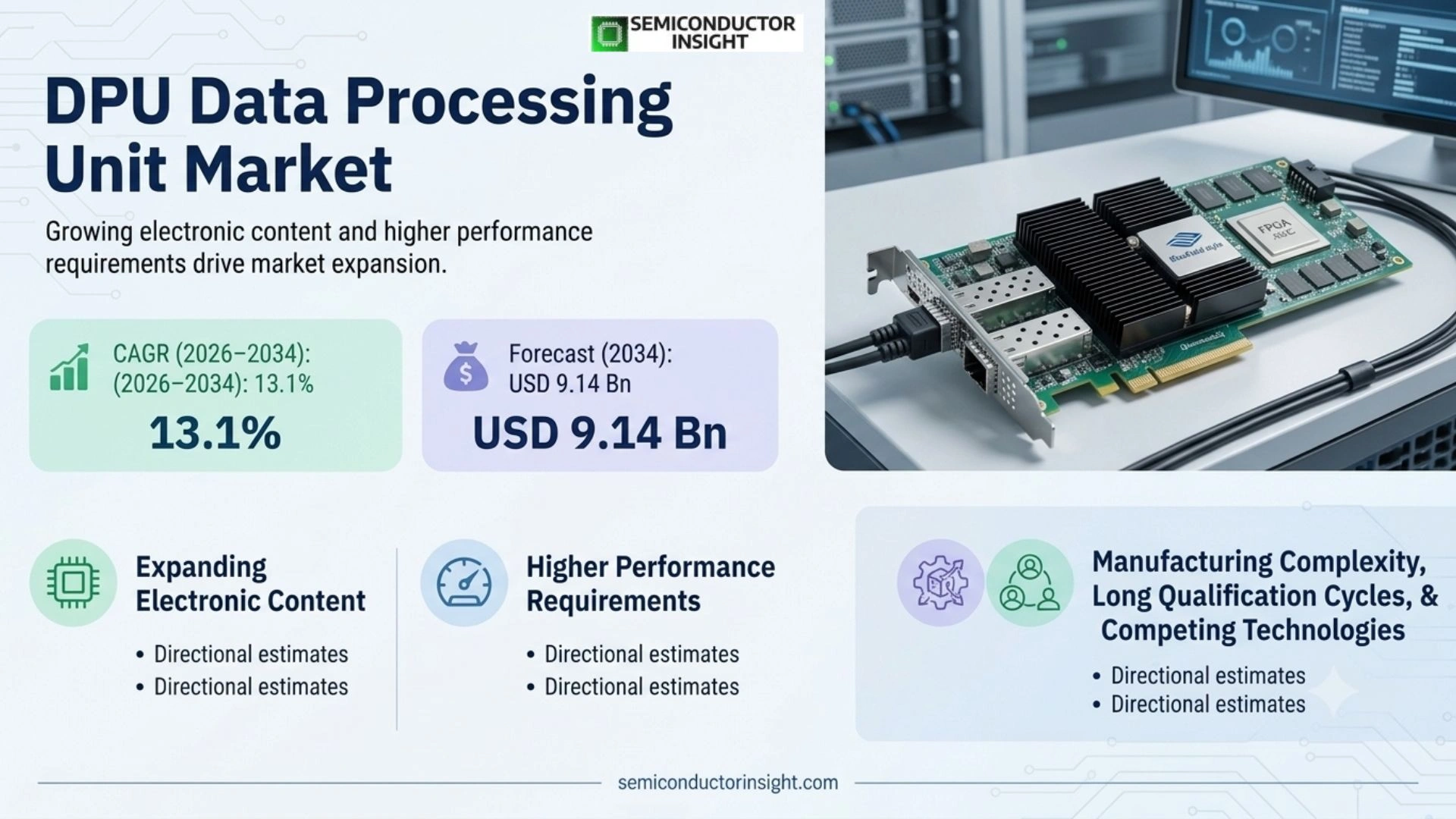
- The DPU Data Processing Unit Market 2 Market was valued at USD 3.02 billion in 2025 and is projected to reach USD 9.14 billion by 2034, expanding at a 13.1% CAGR during 2026–2034.
- Networking DPUs is a leading product grouping because buyers prioritize measurable performance, integration readiness, and lifecycle support.
- Cloud Data Centers is a major demand centre, while adjacent applications broaden the addressable market.
- North America leads the regional market through concentrated technology suppliers, customers, manufacturing, and infrastructure investment.
- Software, reliability, qualification, and service shape competition. Buyers evaluate total ownership economics as well as headline specifications.
DPU Data Processing Unit Market 2 Market Overview
DPU Data Processing Unit Market 2 Market was valued at USD 3.02 billion in 2025 and is projected to reach USD 9.14 billion by 2034, growing at a CAGR of 13.1% during 2026–2034. North America held the largest regional position in 2025, supported by concentrated manufacturing, downstream electronics production and established component supply networks.
Data processing units are programmable infrastructure processors that offload networking, storage, security, virtualization, telemetry, and data-movement tasks from general-purpose CPUs. Products combine packet engines, memory controllers, cryptography, accelerators, high-speed Ethernet or InfiniBand interfaces, management firmware, and software frameworks for servers, AI clusters, telecom systems, and enterprise data centers. The analysis also considers qualification requirements, supplier capability, regional purchasing conditions, technology substitution, operating economics, implementation risk, customer procurement cycles, lifecycle support, and the practical evidence required for sustained commercial adoption through the forecast period.
The 2026 estimated year begins with customers balancing AI-cluster scale, power efficiency, software maturity, and infrastructure control. DPUs isolate tenant traffic, accelerate storage services, enforce security policy, and free CPU cycles for applications. Adoption is strongest where predictable latency, host protection, high-bandwidth data movement, and fleet automation justify new hardware and integration work.
DPU purchasing is an ecosystem decision rather than a silicon-only transaction. Buyers assess hardware throughput with SDKs, APIs, hypervisor support, orchestration, observability, security updates, server qualification, cloud compatibility, and lifecycle commitments. Open programming can widen adoption, while proprietary software may increase performance but also switching costs. The analysis also considers qualification requirements, supplier capability, regional purchasing conditions, technology substitution, operating economics, implementation risk, customer procurement cycles, lifecycle support, and the practical evidence required for sustained commercial adoption through the forecast period.
Segment Analysis: By Type
By type, the DPU Data Processing Unit Market 2 market is segmented into Networking DPUs · Storage DPUs · Security and Infrastructure DPUs. Each category represents a different degree of integration, qualification burden and value capture, so suppliers compete through a combination of material performance, design support, manufacturing consistency, package architecture and application-specific testing rather than through unit price alone. Procurement also reflects lifecycle support, interoperability, compliance evidence, warranty exposure, and the cost of unsuccessful qualification.
| Type | Market relevance |
|---|---|
| Networking DPUs | Distinct performance, condition, integration, and qualification requirements shape demand and supplier positioning. |
| Storage DPUs | Distinct performance, condition, integration, and qualification requirements shape demand and supplier positioning. |
| Security and Infrastructure DPUs | Distinct performance, condition, integration, and qualification requirements shape demand and supplier positioning. |
Segment Analysis: By Application
By application, the market covers Cloud Data Centers · AI and High-performance Computing · Telecom Edge · Enterprise Security. Demand varies by production volume and qualification intensity: consumer programmes reward scale and miniaturisation, while automotive, industrial, aerospace, medical or security designs place greater weight on reliability evidence, long product availability and system-level performance under demanding operating conditions. Channel design, documentation, service coverage, and total ownership economics further determine which application converts technical interest into repeat purchasing.
| Application | Market relevance |
|---|---|
| Cloud Data Centers | Purchasing criteria reflect use-case economics, technical requirements, warranty expectations, and channel support. |
| AI and High-performance Computing | Purchasing criteria reflect use-case economics, technical requirements, warranty expectations, and channel support. |
| Telecom Edge | Purchasing criteria reflect use-case economics, technical requirements, warranty expectations, and channel support. |
| Enterprise Security | Purchasing criteria reflect use-case economics, technical requirements, warranty expectations, and channel support. |
Regional Analysis
North America is the largest regional market for DPU Data Processing Unit Market 2 products, combining an established component-production ecosystem with major downstream customers. North America and Europe are strategically important for premium, automotive, aerospace, industrial and specialised applications, while South America and Middle East & Africa are primarily import- and project-led markets where distributor reach, local support and supply continuity shape vendor selection.
How does regional demand differ across this market?
For DPU Data Processing Unit Market 2, North America holds the largest position, supported by an established customer base, supplier presence, and mature purchasing channels. Europe contributes regulation, industrial demand, and technical expertise, while Asia Pacific combines electronics manufacturing, large device populations, and expanding engineering capability. South America and the Middle East and Africa develop through targeted infrastructure, enterprise, research, consumer, or public-sector programs rather than uniform adoption.
| Region | Position |
|---|---|
| North America | Largest and most established demand base |
| Europe | Developing demand shaped by local applications, channels, and qualification conditions |
| Asia Pacific | Developing demand shaped by local applications, channels, and qualification conditions |
| South America | Developing demand shaped by local applications, channels, and qualification conditions |
| Middle East & Africa | Developing demand shaped by local applications, channels, and qualification conditions |
Key DPU Data Processing Unit Market 2 Manufacturers and Competitive Landscape
The DPU Data Processing Unit Market 2 competitive landscape includes global technology leaders, diversified semiconductor or component groups, RF and imaging specialists, and regional manufacturers. The report profiles every named company across product positioning, manufacturing footprint, application exposure, recent development activity and strategic strengths; the complete coverage list is reproduced below so the intended company universe is explicit.
The competitive landscape covers NVIDIA, Intel, AMD Pensando, Broadcom, Marvell Technology, Cisco, Huawei, Amazon Web Services, Microsoft, Google, Fungible, Netronome, and Napatech. Profiles cover merchant silicon, cloud developers, network equipment companies, and specialist infrastructure-processor vendors across networking, storage, security, AI, and edge deployments. The analysis also considers qualification requirements, supplier capability, regional purchasing conditions, technology substitution, operating economics, implementation risk, customer procurement cycles, lifecycle support, and the practical evidence required for sustained commercial adoption through the forecast period.
Suppliers compete on packet rate, bandwidth, latency, CPU offload, cryptography, storage acceleration, programmability, memory capacity, power efficiency, virtualization, telemetry, and software support. Cloud providers may favor custom designs, while enterprises and OEMs value standards, portability, validation, and long product lifecycles. The analysis also considers qualification requirements, supplier capability, regional purchasing conditions, technology substitution, operating economics, implementation risk, customer procurement cycles, lifecycle support, and the practical evidence required for sustained commercial adoption through the forecast period.
Key companies profiled
- NVIDIA
- Intel
- AMD Pensando
- Broadcom
- Marvell Technology
- Cisco
- Huawei
- Amazon Web Services
- Microsoft
- Fungible
- Netronome
- Napatech
DPU Data Processing Unit Market 2 Production Capacity Analysis
Production capacity is a material competitive factor in the DPU Data Processing Unit Market 2 market because electrical performance depends on specialised processes, qualified materials, repeatable yields and application-specific test capability. Capacity cannot be assessed only by nominal factory floor area: effective supply is the output that passes dimensional, electrical, reliability and customer qualification requirements at the required product mix.
Production capacity depends on advanced logic wafers, high-speed SerDes, memory interfaces, substrates, advanced packaging, board assembly, thermal solutions, firmware validation, and system testing. Effective capacity means validated boards and systems that pass interoperability, workload, security, and reliability tests. The analysis also considers qualification requirements, supplier capability, regional purchasing conditions, technology substitution, operating economics, implementation risk, customer procurement cycles, lifecycle support, and the practical evidence required for sustained commercial adoption through the forecast period.
Chiplet packaging, signal integrity, optical or copper connectivity, and cloud-specific configurations create engineering bottlenecks. Suppliers improve throughput with reusable IP, common software layers, reference designs, automated test, and manufacturing partnerships, although hyperscaler qualification can still constrain output. The analysis also considers qualification requirements, supplier capability, regional purchasing conditions, technology substitution, operating economics, implementation risk, customer procurement cycles, lifecycle support, and the practical evidence required for sustained commercial adoption through the forecast period.
Support capacity is part of supply. Deployment teams integrate firmware, drivers, orchestration, telemetry, storage services, and security policy. Regional solution architects, validated server configurations, replacement inventory, and long-term software maintenance reduce adoption risk and convert hardware placements into recurring platform revenue. The analysis also considers qualification requirements, supplier capability, regional purchasing conditions, technology substitution, operating economics, implementation risk, customer procurement cycles, lifecycle support, and the practical evidence required for sustained commercial adoption through the forecast period.
DPU Data Processing Unit Market 2 Market Dynamics: Drivers, Restraints and Opportunities
DPU Data Processing Unit Market 2 market growth reflects expanding electronic content and higher performance requirements, moderated by manufacturing complexity, long qualification cycles and competing technologies. The impact ranges below are directional analytical estimates rather than additive forecasts; they show the relative pressure each factor can place on the baseline CAGR when other assumptions remain broadly stable.
DPU demand is shaped by AI factories, cloud-native virtualization, storage disaggregation, zero-trust security, 5G edge computing, and rising data movement between CPUs, GPUs, memory, and network fabrics. Growth is strongest where infrastructure offload improves utilization, latency, isolation, or power consumption. The analysis also considers qualification requirements, supplier capability, regional purchasing conditions, technology substitution, operating economics, implementation risk, customer procurement cycles, lifecycle support, and the practical evidence required for sustained commercial adoption through the forecast period.
Networking DPUs emphasize programmable packet pipelines, storage DPUs prioritize NVMe and data services, and security-oriented designs add encryption, attestation, and policy enforcement. Custom cloud ASICs optimize narrow fleets, while merchant cards offer broader portability. The analysis also considers qualification requirements, supplier capability, regional purchasing conditions, technology substitution, operating economics, implementation risk, customer procurement cycles, lifecycle support, and the practical evidence required for sustained commercial adoption through the forecast period.
MARKET DRIVERS
Drivers Impact Analysis*
| Driver | (~) % impact on CAGR forecast | Geographic relevance | Impact timeline |
|---|---|---|---|
| AI cluster scale and data movement | +2.8% | North America, Asia Pacific, Europe | Long term (≥4 years) |
| Cloud virtualization and multi-tenancy | +2.2% | Global hyperscale and enterprise clouds | Medium term (2–4 years) |
| Storage disaggregation | +1.6% | North America, Europe, Asia Pacific | Long term (≥4 years) |
| Zero-trust infrastructure security | +1.3% | Regulated industries worldwide | Medium term (2–4 years) |
| 5G and edge-network modernization | +1.0% | Asia Pacific, Europe, North America | Long term (≥4 years) |
| Open software ecosystems | +0.7% | Global server markets | Short term (≤2 years) |
AI cluster scale and data movement is influencing demand, investment and adoption across the North America, Asia Pacific, Europe region over the long term (≥4 years). The analysis also considers qualification requirements, supplier capability, regional purchasing conditions, technology substitution, operating economics, implementation risk, customer procurement cycles, lifecycle support, and the practical evidence required for sustained commercial adoption through the forecast period.
Cloud virtualization and multi-tenancy is influencing demand, investment and adoption across the Global hyperscale and enterprise clouds region over the medium term (2–4 years). The analysis also considers qualification requirements, supplier capability, regional purchasing conditions, technology substitution, operating economics, implementation risk, customer procurement cycles, lifecycle support, and the practical evidence required for sustained commercial adoption through the forecast period.
Storage disaggregation is influencing demand, investment and adoption across the North America, Europe, Asia Pacific region over the long term (≥4 years). The analysis also considers qualification requirements, supplier capability, regional purchasing conditions, technology substitution, operating economics, implementation risk, customer procurement cycles, lifecycle support, and the practical evidence required for sustained commercial adoption through the forecast period.
MARKET RESTRAINTS
Restraints Impact Analysis*
| Restraint | (~) % impact on CAGR forecast | Geographic relevance | Impact timeline |
|---|---|---|---|
| Software integration complexity | −1.8% | Enterprise data centers | Persistent |
| Specialized skills | −1.3% | All regions | Medium term (2–4 years) |
| Unclear economics for small deployments | −1.0% | Small data centers | Medium term (2–4 years) |
| Platform lock-in and migration cost | −0.9% | Cloud and enterprise fleets | Long term (≥4 years) |
| Security qualification burden | −0.7% | Critical infrastructure | Persistent |
Software integration complexity can delay purchasing, reduce utilisation, or increase qualification and lifecycle cost for enterprise data centers customers over the persistent. The analysis also considers qualification requirements, supplier capability, regional purchasing conditions, technology substitution, operating economics, implementation risk, customer procurement cycles, lifecycle support, and the practical evidence required for sustained commercial adoption through the forecast period.
Specialized skills can delay purchasing, reduce utilisation, or increase qualification and lifecycle cost for all regions customers over the medium term (2–4 years). The analysis also considers qualification requirements, supplier capability, regional purchasing conditions, technology substitution, operating economics, implementation risk, customer procurement cycles, lifecycle support, and the practical evidence required for sustained commercial adoption through the forecast period.
Unclear economics for small deployments can delay purchasing, reduce utilisation, or increase qualification and lifecycle cost for small data centers customers over the medium term (2–4 years). The analysis also considers qualification requirements, supplier capability, regional purchasing conditions, technology substitution, operating economics, implementation risk, customer procurement cycles, lifecycle support, and the practical evidence required for sustained commercial adoption through the forecast period.
MARKET OPPORTUNITIES
Custom cloud processors, AI-factory networking, composable storage, telecom edge, confidential computing, and security services provide opportunities. Integrated hardware and software can automate deployment, policy, telemetry, and updates. The analysis also considers qualification requirements, supplier capability, regional purchasing conditions, technology substitution, operating economics, implementation risk, customer procurement cycles, lifecycle support, and the practical evidence required for sustained commercial adoption through the forecast period.
Energy-efficiency measurement and migration tools can help buyers quantify CPU savings, latency improvements, and utilization. Partnerships with server OEMs, cloud operators, hypervisor providers, storage companies, and cybersecurity vendors can expand deployment. The analysis also considers qualification requirements, supplier capability, regional purchasing conditions, technology substitution, operating economics, implementation risk, customer procurement cycles, lifecycle support, and the practical evidence required for sustained commercial adoption through the forecast period.
Open APIs, development kits, reference servers, managed operations, regional support, and compliance capabilities can reduce switching risk and broaden adoption among enterprises and regulated infrastructure operators. The analysis also considers qualification requirements, supplier capability, regional purchasing conditions, technology substitution, operating economics, implementation risk, customer procurement cycles, lifecycle support, and the practical evidence required for sustained commercial adoption through the forecast period.
DPU Data Processing Unit Market 2 Supply Chain Analysis
The DPU Data Processing Unit Market 2 supply chain links specialty materials and wafer or ceramic processing equipment to high-precision manufacturing, packaging, distribution and downstream system integration. Commercial resilience depends on qualified alternate materials, realistic yield assumptions, geographic redundancy and traceable process controls because a nominal second source is not interchangeable until the customer has validated electrical behaviour, reliability and package compatibility.
The supply chain covers foundry wafers, processor IP, high-speed interfaces, substrates, advanced packaging, memory, power components, thermal hardware, boards, firmware, operating systems, orchestration, and test equipment. The analysis also considers qualification requirements, supplier capability, regional purchasing conditions, technology substitution, operating economics, implementation risk, customer procurement cycles, lifecycle support, and the practical evidence required for sustained commercial adoption through the forecast period.
Resilience depends on multi-source components, package capacity, secure firmware signing, documented software branches, regional inventory, and predictable upgrade policies. Changes in SerDes, memory, substrate, board layout, or drivers can affect throughput and compatibility, requiring configuration control and regression testing. The analysis also considers qualification requirements, supplier capability, regional purchasing conditions, technology substitution, operating economics, implementation risk, customer procurement cycles, lifecycle support, and the practical evidence required for sustained commercial adoption through the forecast period.
Recent Developments in the DPU Data Processing Unit Market 2 Market
Developments tracked to September 2026 and linked to official company or industry sources.
- July 2026 Published
NVIDIA updated BlueField-3 DPU platform configuration and lifecycle documentation. Source - October 2025 Published
NVIDIA introduced BlueField-4 DPUs with up to 800Gb/s connectivity for AI-factory networking, storage, and security acceleration. Source - June 2025 Published
Intel and Google expanded collaboration on custom ASIC-based infrastructure processing units for AI infrastructure efficiency. Source - May 2025 Published
NVIDIA published BlueField-3 materials describing infrastructure offload for networking, storage, security, and management. Source - March 2025 Published
Intel positioned FPGA IPU platforms for telecom and infrastructure acceleration with programmable networking and security functions. Source
REPORT SCOPE & SEGMENTATION
| Attribute | Details |
|---|---|
| Study Period | 2021–2034 |
| Base Year | 2025 |
| Estimated Year | 2026 |
| Forecast Year | 2034 |
| Historical Period | 2021–2025 |
| Market Size 2025 | USD 3.02 billion |
| Market Size 2034 | USD 9.14 billion |
| Growth Rate | CAGR of 13.1% from 2026–2034 |
| Unit | Value in USD billion and shipment or production volume where disclosed |
| Segmentation | By Type, By Application, additional technology axis and By Region |
| By Type | Networking DPUs · Storage DPUs · Security and Infrastructure DPUs |
| By Application | Cloud Data Centers · AI and High-performance Computing · Telecom Edge · Enterprise Security |
| By Deployment Model and End User | Merchant DPU Adapters · Embedded Infrastructure Processors · Custom Cloud ASICs · Cloud Service Providers · Enterprises · Telecom Operators |
| By Region | Each region analysed by type, application and countryNorth AmericaU.S., Canada, MexicoEuropeGermany, France, U.K., Italy, Nordic Countries, BeneluxAsia PacificChina, Japan, South Korea, India, Southeast AsiaSouth AmericaBrazil, Argentina, Rest of South AmericaMiddle East & AfricaTurkey, Israel, Saudi Arabia, UAE, Rest of MEA |
| Key Companies Profiled | NVIDIA; Intel; AMD Pensando; Broadcom; Marvell Technology; Cisco; Huawei; Amazon Web Services; Microsoft; Google; Fungible; Netronome; Napatech |
| Customization Scope | Free report customization equivalent to up to four analyst working days with purchase, including additions or alterations to country, regional and segment coverage. |
Frequently Asked Questions
What is a DPU?
The DPU Data Processing Unit Market 2 Market is valued at USD 3.02 billion in the 2025 base year and is projected to reach USD 9.14 billion by 2034, expanding at a CAGR of 13.1% during 2026–2034. The outlook covers networking, storage, and security infrastructure processors deployed in cloud, AI, telecom edge, and enterprise environments, with North America holding the leading regional position.
What is the market outlook through 2034?
Demand should expand through 2034 as AI factories, hyperscale clouds, storage platforms, telecom networks, and regulated enterprises offload infrastructure services from host CPUs. Growth will depend on deployable software, server qualification, interoperability, security lifecycle support, and measurable improvements in CPU utilization, latency, energy efficiency, and tenant isolation. The analysis also considers qualification requirements, supplier capability, regional purchasing conditions, technology substitution, operating economics, implementation risk, customer procurement cycles, lifecycle support, and the practical evidence required for sustained commercial adoption through the forecast period.
Which product type leads?
Networking DPUs lead because packet processing, virtual switching, load balancing, telemetry, and tenant isolation are common infrastructure requirements. Storage and security products grow as customers adopt disaggregated NVMe, confidential computing, encryption, and attestation. The analysis also considers qualification requirements, supplier capability, regional purchasing conditions, technology substitution, operating economics, implementation risk, customer procurement cycles, lifecycle support, and the practical evidence required for sustained commercial adoption through the forecast period.
Where are DPUs deployed?
DPUs are deployed in hyperscale and enterprise data centers, AI factories, telecom edge sites, storage systems, financial infrastructure, government environments, and security-sensitive clouds. The analysis also considers qualification requirements, supplier capability, regional purchasing conditions, technology substitution, operating economics, implementation risk, customer procurement cycles, lifecycle support, and the practical evidence required for sustained commercial adoption through the forecast period.
Why does North America lead?
North America combines hyperscale cloud operators, semiconductor companies, AI infrastructure investment, server OEMs, software developers, and early DPU deployments. The analysis also considers qualification requirements, supplier capability, regional purchasing conditions, technology substitution, operating economics, implementation risk, customer procurement cycles, lifecycle support, and the practical evidence required for sustained commercial adoption through the forecast period.
What drives growth?
AI data movement, cloud-native virtualization, storage acceleration, zero-trust security, 5G edge networks, and server-utilization goals drive growth. Open SDKs and reference servers reduce integration work. The analysis also considers qualification requirements, supplier capability, regional purchasing conditions, technology substitution, operating economics, implementation risk, customer procurement cycles, lifecycle support, and the practical evidence required for sustained commercial adoption through the forecast period.
What limits adoption?
Integration effort, specialized skills, hardware cost, security qualification, platform lock-in, unclear small-deployment benefits, and uncertain software support can delay adoption. The analysis also considers qualification requirements, supplier capability, regional purchasing conditions, technology substitution, operating economics, implementation risk, customer procurement cycles, lifecycle support, and the practical evidence required for sustained commercial adoption through the forecast period.
How do suppliers compete?
Suppliers compete on bandwidth, latency, packet rate, CPU offload, programmable pipelines, storage services, cryptography, power efficiency, observability, and lifecycle support. The analysis also considers qualification requirements, supplier capability, regional purchasing conditions, technology substitution, operating economics, implementation risk, customer procurement cycles, lifecycle support, and the practical evidence required for sustained commercial adoption through the forecast period.
Where are opportunities?
AI-factory networking, composable storage, confidential computing, telecom edge, security services, custom cloud ASICs, and energy-efficiency programs offer opportunities. The analysis also considers qualification requirements, supplier capability, regional purchasing conditions, technology substitution, operating economics, implementation risk, customer procurement cycles, lifecycle support, and the practical evidence required for sustained commercial adoption through the forecast period.
Which companies are covered?
The report covers NVIDIA, Intel, AMD Pensando, Broadcom, Marvell Technology, Cisco, Huawei, Amazon Web Services, Microsoft, Google, Fungible, Netronome, and Napatech. Profiles assess architecture, software, applications, service, partnerships, and positioning. The analysis also considers qualification requirements, supplier capability, regional purchasing conditions, technology substitution, operating economics, implementation risk, customer procurement cycles, lifecycle support, and the practical evidence required for sustained commercial adoption through the forecast period.
Get Sample Report PDF for Exclusive Insights
Report Sample Includes
- Table of Contents
- List of Tables & Figures
- Charts, Research Methodology, and more...
 Download Sample Report PDF