Key Statistics
Key Takeaways
- LCD Driver ICs remain the largest type because LCD panels still ship at very large volumes across televisions, monitors, notebooks, automotive displays and value-oriented mobile devices, even as OLED gains share in premium categories.
- OLED Driver ICs are the faster-growing type as OLED adoption expands from flagship smartphones into notebooks, tablets, automotive displays and premium monitors, increasing demand for compensation algorithms, low-power operation and high-speed interfaces.
- Smartphones remain the largest application because each handset requires highly integrated driver functionality, while high refresh rates, foldable formats and variable-refresh operation raise the performance burden placed on the display driver.
- Asia Pacific leads demand and supply through the concentration of panel production, fabless DDIC design and semiconductor manufacturing across China, South Korea and Taiwan, with Japan retaining strength in automotive and industrial displays.
- Power efficiency and system integration are becoming central design criteria as higher resolution and higher refresh rates increase display-side energy use; advanced process nodes, TDDI and integrated Tcon functions help control component count and power.
- Automotive displays create a structurally attractive growth pool because digital cockpits use larger, higher-resolution and more numerous screens, while automotive qualification raises switching costs and supports longer product lifecycles than consumer devices.
Display Driver IC (DDIC) Market Overview
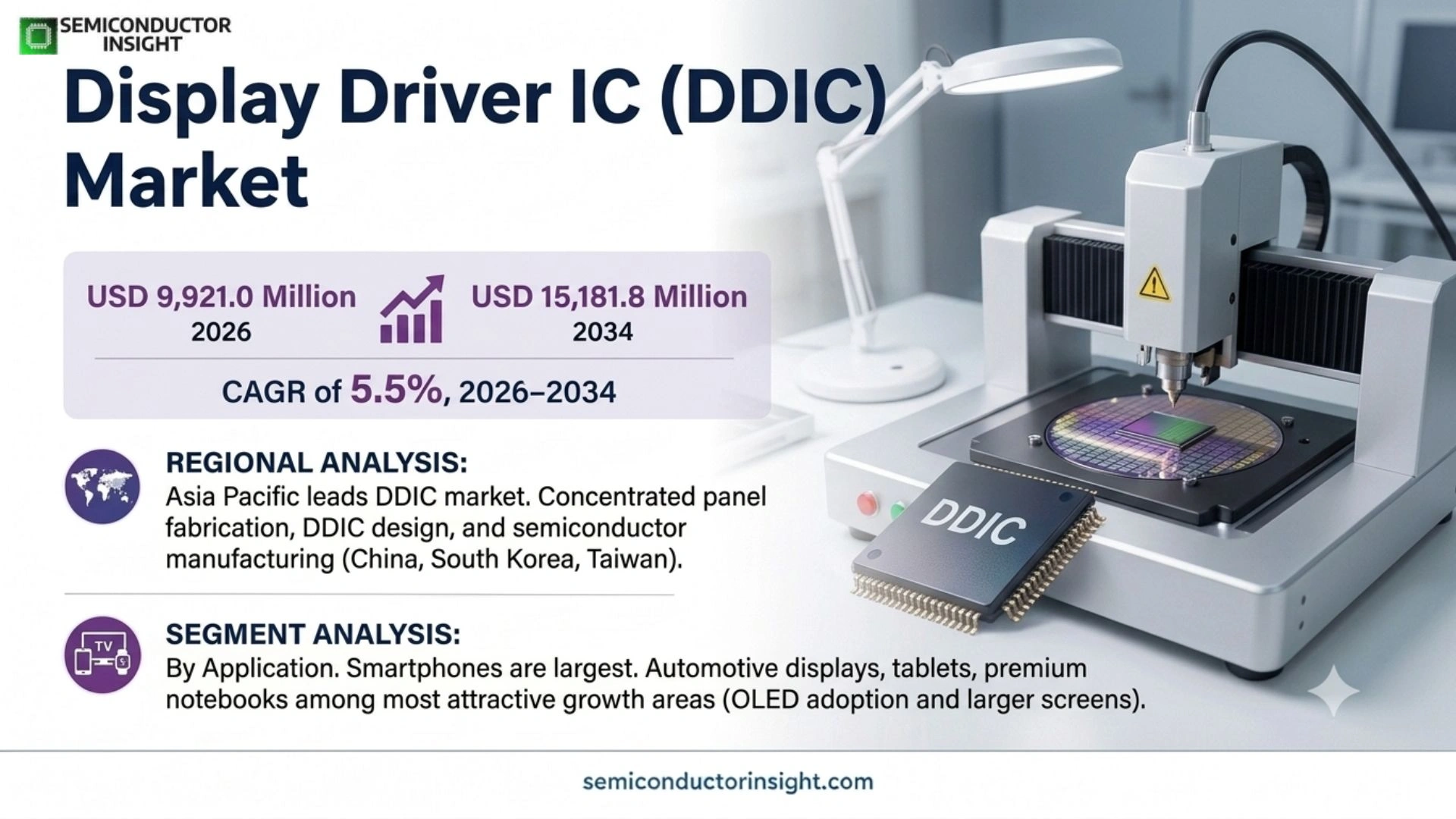
Display Driver IC (DDIC) Market was valued at USD 9,407.2 million in 2025, is estimated at USD 9,921.0 million in 2026, and is projected to reach USD 15,181.8 million by 2034, representing a CAGR of 5.5% during 2026–2034. Asia Pacific is the largest regional market in 2025, while the commercial growth mechanism is increasingly shaped by OLED penetration, high-refresh-rate mobile and IT displays, larger automotive cockpits, integrated touch/display architectures, and continuing requirements for lower display power.
Display Driver ICs translate digital image data into the precisely timed voltage or current waveforms required to drive individual pixels in LCD, OLED and related display panels. The device sits between the application processor, timing-control logic and the display backplane, so its performance directly affects brightness uniformity, grayscale accuracy, color rendering, refresh rate, image stability and power consumption. Modern DDICs increasingly incorporate compensation, interface and power-management functions that were previously distributed across several chips.
The technical requirements of the market are rising because display quality continues to improve even in mature device categories. Smartphones now combine high pixel density with variable refresh rates and foldable form factors, notebooks are adopting OLED at a faster pace in premium models, gaming monitors are moving toward higher frame rates, and automotive displays are becoming wider, brighter and more safety critical. Each trend increases data bandwidth and the need for accurate analog drive while the system designer simultaneously demands lower power and smaller package area.
Commercial competition therefore depends on more than nominal resolution support. Suppliers must qualify with panel makers, tune driver algorithms to specific TFT backplanes, support interfaces such as MIPI or proprietary point-to-point links, and maintain yield across mixed-voltage semiconductor processes. Once a DDIC is co-developed around a panel architecture, the engineering effort involved in image-quality tuning, compensation and timing can make supplier replacement costly, particularly in automotive, OLED and high-end IT programs.
Segment Analysis: By Type
By type, the market is segmented into LCD Driver IC, OLED Driver IC, and Others. LCD Driver ICs hold the largest installed and revenue base because LCD remains pervasive across television, monitor, notebook, automotive and mass-market mobile panels. OLED Driver ICs are growing faster as OLED adoption moves into larger IT and automotive form factors that demand sophisticated compensation and lower-power drive schemes.
| Type | Technical role | Market position |
|---|---|---|
| LCD Driver IC | LCD drivers deliver source and gate-drive signals to TFT backplanes and increasingly combine timing, touch, level-shifting or power-management functions. They must support several backplane technologies including a-Si, LTPS and oxide while maintaining uniform grayscale and timing across large panels and high refresh rates. | The largest type by current volume and revenue. Television, monitor, notebook and automotive LCD production provides a broad installed base. Price competition is intense in standardized products, while higher-value opportunities remain in high-refresh gaming, low-power notebook panels, automotive displays and highly integrated large-panel solutions. |
| OLED Driver IC | OLED DDICs regulate current to self-emissive pixels and incorporate compensation for TFT variation, organic-material aging, mura and burn-in effects. Premium devices also require variable refresh rate, high bit depth, high peak brightness and low-power modes without visible image artifacts. | The faster-growing type. Smartphone OLED is well established, while notebooks, tablets, automotive displays and premium monitors are expanding the addressable market. Supplier qualification is more demanding than for commodity LCD drivers because compensation algorithms, panel tuning and power behavior materially affect image quality. |
| Others | This group includes driver architectures for Mini LED backlights, Micro LED, ePaper and specialized display formats that do not fit conventional LCD or OLED panel-driver categories. These devices may control many dimming zones, unusual pixel geometries or application-specific voltage and timing requirements. | A smaller but strategically important segment. Mini LED and emerging Micro LED systems increase the number of controlled channels and create opportunities for specialized driver and timing products. Commercial volumes vary widely by application, so suppliers must balance custom engineering with the ability to reuse IP across several panel programs. |
How do process technology and integration change DDIC economics?
Display drivers combine dense digital logic with high-voltage analog circuits, so they do not follow the same scaling path as logic processors. Moving logic functions to finer process nodes can reduce power and die area, while the analog output section still needs devices capable of driving the panel voltage. Samsung has commercialized a 22 nm mobile DDI to lower logic power, while other suppliers continue to optimize mixed-voltage 28 nm, 40 nm, 55 nm and related processes. Integration of touch, timing control and power functions can offset higher wafer cost by reducing total system components and simplifying panel design.
Segment Analysis: By Application
By application, the market is segmented into Smartphone, Smart Wearable Device, TV, Laptop, and Others. Smartphones remain the largest application because of very high annual shipment volumes and rapid display refresh cycles. Automotive displays, tablets and premium notebooks within the broader application base are among the most attractive growth areas because OLED adoption and larger interactive screens increase semiconductor content per device.
| Application | Demand characteristics |
|---|---|
| Smartphone | Smartphones combine high resolution, high refresh rate, variable refresh, low-power always-on modes and increasingly foldable panel formats. DDICs must manage tight power budgets while supporting complex compensation and high-speed MIPI interfaces. Design wins are concentrated among a small number of panel makers and handset platforms, so qualification can generate substantial volume but also exposes suppliers to inventory cycles and pricing pressure. |
| Smart Wearable Device | Wearables require extremely low standby power, compact packages and support for small OLED or LTPO panels that operate across a wide refresh-rate range. Battery capacity is limited, making display-side energy savings commercially important. The market favors highly integrated devices and suppliers able to tune driver behavior to unusual round, curved or always-on display formats. |
| TV | Televisions use multiple source-driver devices and timing-control functions across large panels, creating substantial unit demand even though replacement cycles are longer than for phones. 4K remains mainstream, while premium 8K, OLED and Mini LED systems require higher data bandwidth, finer local-dimming control and more sophisticated image processing. Cost per panel is critical because large-screen products use several driver devices. |
| Laptop | Notebook displays are shifting toward higher resolution, higher refresh rate and premium OLED options. Power is particularly important because panel consumption directly affects battery life. OLED notebook adoption also increases the need for compensation and touch integration, while gaming notebooks demand high frame rates and low latency. These requirements create an opportunity for higher-value DDIC, Tcon and integrated touch solutions. |
| Others | Automotive, tablets, monitors, industrial displays, AR/VR systems and digital signage create diverse demand. Automotive is especially attractive because display area per vehicle is increasing and qualification requirements support longer lifecycles. Industrial and medical displays emphasize long-term availability, temperature range and image stability, while AR/VR requires small form factors and very high pixel density. |
Why are automotive and IT displays becoming more valuable to DDIC suppliers?
Mobile phones remain the largest volume application, but automotive and premium IT devices can support a higher semiconductor value per display. Vehicles increasingly use multiple screens for instrument clusters, center consoles, passenger entertainment and mirrors, while safety requirements demand fault detection and long operating life. Premium notebooks and tablets are adopting OLED, which adds compensation and touch challenges. Suppliers that offer DDIC, timing controller and touch products together can capture more content per panel and build deeper technical relationships with panel makers and OEMs.
Regional Analysis
Asia Pacific leads the Display Driver IC market because panel fabrication, DDIC design and semiconductor manufacturing are concentrated across China, South Korea and Taiwan. The region also hosts the largest smartphone, television and notebook supply chains. North America contributes high-value design demand and major device brands, while Europe is particularly important for automotive and industrial displays.
What makes regional DDIC demand structurally different?
Asia Pacific is both a manufacturing and design-in market, so local technical support, wafer supply and relationships with panel makers determine commercial success. North America is more heavily influenced by premium device architecture, platform design and automotive innovation, even though most panels are manufactured in Asia. Europe is centered on automotive, industrial and premium electronics with long qualification cycles. South America is largely import dependent, while the Middle East and Africa consume DDICs indirectly through finished smartphones, televisions, vehicles and digital-infrastructure projects.
| Region | Position | Growth outlook | Demand profile | What decides supplier selection |
|---|---|---|---|---|
| Asia Pacific | Largest | Above market average | Panel-manufacturing and design-in led | Panel-maker relationships, cost, foundry access, low power and rapid qualification |
| North America | High-value demand market | Moderate | Premium consumer, automotive and technology design led | Power efficiency, feature integration, software compatibility and supply assurance |
| Europe | Automotive and industrial specialist | Moderate | Automotive, industrial and premium-display led | Qualification, functional safety, long lifecycle and image quality |
| South America | Smaller import-dependent market | Selective | Consumer electronics and vehicle assembly led | Landed cost, distributor support and finished-device production |
| Middle East & Africa | Emerging consumption market | Selective | Smartphone, signage, automotive and infrastructure led | Device affordability, distributor reach and system availability |
Competitive Landscape
The competitive landscape is semi-consolidated around Samsung LSI, Novatek, Synaptics, LX Semicon, Himax and a group of Taiwanese and Korean specialists. Competitive advantage is built through panel-maker design relationships, mixed-voltage process expertise, OLED compensation algorithms, high-speed interfaces and the ability to integrate touch, timing and power functions while meeting aggressive cost targets.
Samsung LSI benefits from deep OLED and mobile-display expertise and has pushed mobile DDIC logic to a 22 nm process to reduce power and die area. Novatek has a broad presence across large-panel and mobile display semiconductors and continues to optimize OLED notebook and television drivers. LX Semicon combines mobile, television, IT and automotive products across LCD and OLED, while Himax provides a particularly broad automotive display portfolio that includes DDIC, TDDI, Tcon and touch products.
Synaptics differentiates through integrated touch and display control and established mixed-signal expertise, while Raydium, Fitipower, Sitronix, ILITEK and FocalTech compete across mobile, touch and regional panel opportunities. Magnachip and Anapass maintain specialized positions in display semiconductors. The large number of capable Asian suppliers puts sustained pressure on standardized LCD pricing, making software-like compensation IP, automotive qualification and OLED design expertise increasingly important to margin preservation.
The most important competitive shift is increasing content integration. Panel makers want fewer ICs, lower power and thinner modules, which encourages products that combine display driving with touch sensing, timing control, level shifting, power management or local dimming. Integration can reduce total bill of materials even if the semiconductor itself is more complex, and it strengthens supplier relationships because the device becomes more deeply embedded in panel operation and image-quality tuning.
| Competitive tier | Representative companies | Commercial basis |
|---|---|---|
| Global and regional leaders | Samsung LSI, Novatek Microelectronics, LX Semicon, Himax Technologies, Synaptics | Large panel-maker relationships, broad LCD/OLED portfolios, mixed-signal design, automotive qualification, integration and advanced low-power development. |
| Taiwan specialist suppliers | Raydium Semiconductor, Fitipower Integrated Technology, Sitronix Technology, ILITEK Corporation, FocalTech Systems | Competitive cost, mobile and touch expertise, close proximity to foundries and Chinese/Taiwanese panel customers, and rapid product customization. |
| Korean and specialist competitors | Magnachip Semiconductor, Anapass | OLED and display-interface specialization, differentiated analog design and targeted customer relationships in premium display applications. |
Key Market Participants
Samsung LSI, Novatek Microelectronics, Synaptics Incorporated, LX Semicon, Himax Technologies, Raydium Semiconductor, Fitipower Integrated Technology, Sitronix Technology, ILITEK Corporation, Magnachip Semiconductor, FocalTech Systems, Anapass.
Production Capacity Analysis
DDIC capacity is governed by mixed-signal wafer availability, process-node suitability, backend packaging and the ability to match semiconductor output with panel demand. The market does not require leading-edge logic nodes across the entire die; instead, suppliers combine dense logic with high-voltage analog devices on cost-effective processes. Foundry allocation, long display-industry cycles and panel inventory corrections can therefore create periods of tightness or oversupply even when underlying device demand remains healthy.
Wafer fabrication is concentrated in Asian foundries and integrated semiconductor manufacturers with process platforms capable of supporting both digital logic and high-voltage analog output. A DDIC may use 22 nm, 28 nm, 40 nm, 55 nm or other mature-to-advanced mixed-voltage nodes depending on application. Process migration is justified when power and die-area savings outweigh mask cost, qualification effort and the need to redesign analog circuitry.
Backend assembly typically uses chip-on-film, chip-on-glass or related thin-package formats that place the driver close to the display edge. Large panels may require several driver devices, so package thickness, bump pitch and bonding yield directly influence module cost. Automotive and high-resolution OLED applications add more test content because electrical functionality alone does not guarantee correct image quality under temperature and lifetime conditions.
Capacity planning is closely tied to panel-maker inventory. DDIC suppliers can experience rapid order swings when television or smartphone customers adjust panel production, making foundry commitments and inventory control commercially important. Diversification toward automotive, notebooks, industrial displays and integrated touch solutions helps reduce dependence on a single consumer cycle, but these applications require longer qualification and more engineering support.
| Capacity layer | Where it concentrates | Commercial constraint |
|---|---|---|
| Mixed-signal wafer fabrication | Taiwan, South Korea, China and other Asian foundry hubs | Process platforms must combine dense logic with high-voltage analog while maintaining competitive wafer cost and stable long-term availability. |
| DDIC design & IP | South Korea, Taiwan, United States and specialist Asian design centers | OLED compensation, timing, interfaces, low-power logic and automotive safety features require experienced mixed-signal and algorithm teams. |
| COF/COG packaging & test | China, Taiwan, South Korea and Southeast Asian assembly clusters | Fine-pitch bonding, thin packages, panel-specific testing and large-volume yield determine module economics. |
| Panel qualification & integration | China, South Korea, Taiwan, Japan and global automotive/IT engineering centers | Image tuning, touch interference, temperature performance and long lifecycle create application-specific validation bottlenecks. |
Market Dynamics
Market growth is supported by richer display specifications rather than by unit volume alone. Resolution, refresh rate, OLED penetration, touch integration and automotive screen count are increasing semiconductor content per panel. At the same time, DDIC suppliers face price pressure in mature LCD products, foundry-cycle volatility and strong dependence on a concentrated group of panel makers, making product-mix improvement essential.
Market Drivers
| Factor | Directional impact | Why it matters |
|---|---|---|
| OLED penetration across mobile, IT and automotive | High | OLED requires sophisticated current control and compensation, increasing driver-IC value as adoption expands beyond smartphones. |
| Higher resolution and refresh rates | High | More pixels and faster refresh increase data bandwidth, analog drive complexity and power-management requirements. |
| Automotive cockpit digitalization | High | More and larger vehicle displays increase DDIC content and favor long-lifecycle, qualified solutions. |
| Touch/display and system integration | Medium-High | TDDI and integrated timing/power functions reduce component count and strengthen supplier design-in positions. |
OLED expands into larger display categories
OLED already dominates many premium smartphones and is moving into notebooks, tablets, monitors and vehicles. Larger panels require more driver channels and more complex compensation for TFT variation and organic-material aging. Suppliers that have already built OLED algorithms for mobile can extend that IP into new form factors, but they must adapt power, interface and touch behavior to different panel sizes and lifecycles.
High refresh rates increase data and power complexity
Gaming, premium mobile and automotive displays increasingly operate above traditional 60 Hz refresh rates. Higher refresh improves motion clarity but increases interface bandwidth and switching activity. DDIC designers respond with finer process nodes, data compression, variable refresh and clock-control techniques that reduce logic power. These functions make the driver a more important contributor to overall panel efficiency.
Digital cockpits increase semiconductor content per vehicle
A modern vehicle can include a digital instrument cluster, large center display, passenger screen, rear-seat entertainment and electronic mirror systems. Each display needs driver and timing functions, while automotive qualification requires wide-temperature operation and fault handling. The result is a growing revenue pool with longer program duration and lower supplier churn than many smartphone designs.
Integration reduces total panel bill of materials
Combining display drive with touch sensing, timing control, level shifting or power-management functions reduces PCB area, connectors and external components. The integration challenge is technically demanding because high-voltage display signals can interfere with sensitive touch measurement. Vendors able to solve this interaction can justify a more complex IC while lowering the overall module cost for the panel maker.
Market Restraints
| Factor | Directional impact | Why it matters |
|---|---|---|
| Consumer display inventory cycles | High | Smartphone and television panel corrections can rapidly reduce DDIC orders and pressure foundry utilization. |
| Price competition in mature LCD drivers | High | A large supplier base and mature designs limit pricing power in standardized LCD applications. |
| Foundry dependence and mixed-voltage process constraints | Medium-High | DDICs need specialized analog processes that cannot always be moved quickly between foundries. |
| Long OLED and automotive qualification cycles | Medium | Panel-specific compensation and reliability testing slow customer conversion even when a new device offers better specifications. |
Inventory corrections can overwhelm underlying end demand
Display supply chains often build inventory ahead of product launches or seasonal sales. When television or smartphone sell-through weakens, panel makers can reduce orders sharply, and DDIC suppliers feel the correction before end-market volumes stabilize. Fabless vendors must balance foundry commitments against uncertain forecasts, while excessive inventory can force price concessions and delay adoption of newer devices.
Commodity LCD products face structural price pressure
Many mature LCD driver functions are well understood and can be supplied by several Asian semiconductor vendors. Panel makers therefore negotiate aggressively on cost, especially in televisions and value smartphones. Suppliers protect margins by moving toward OLED, automotive, high-refresh, low-power and integrated solutions where tuning expertise and qualification create barriers beyond simple wafer cost.
Mixed-voltage processes restrict manufacturing flexibility
The analog output stage must drive voltages that are incompatible with a pure leading-edge logic process. DDICs therefore depend on foundry platforms with suitable high-voltage devices and reliability data. Moving production between foundries requires electrical requalification and panel tuning, so manufacturing cannot always be shifted rapidly when capacity, trade policy or pricing changes.
Qualification can delay revenue in high-value segments
OLED and automotive customers require extensive validation of image uniformity, touch interference, temperature behavior and long-term reliability. The engineering burden is worthwhile because successful programs can last for years, but it slows the conversion of R&D spending into volume shipments. Smaller suppliers may struggle to support several simultaneous panel-specific qualification programs.
Market Opportunities
OLED notebooks and tablets
Premium IT devices are increasing OLED adoption because the technology offers thin designs, high contrast and strong image quality. Each new panel program needs driver, timing and often touch solutions optimized for larger display area and battery life. Suppliers that can provide an integrated OLED chipset can increase content per device and reduce panel-maker engineering complexity.
Automotive OLED and wide cockpit displays
Vehicle makers are expanding display area and using more free-form and panoramic screens. OLED adds design flexibility, while local dimming and advanced LCD architectures remain relevant in lower-cost platforms. Automotive-qualified DDIC, Tcon and touch products can capture a growing semiconductor value pool with longer lifecycles and greater resistance to consumer price competition.
Lower-power mobile and wearable drivers
On-device AI and higher refresh rates increase system power, making the display an important optimization target. Finer DDIC logic nodes, variable refresh, adaptive drive and improved compensation can lower power without sacrificing image quality. Wearables provide an especially strong use case because small batteries magnify the commercial value of every milliwatt saved.
Mini LED and emerging Micro LED control
Advanced backlights and emissive Micro LED architectures require many precisely controlled channels. Driver vendors can extend analog and timing expertise into local dimming, pixel control and integrated display management. The opportunity remains application specific, but premium televisions, monitors, automotive systems and AR devices can support higher semiconductor content than conventional edge-lit LCDs.
Supply Chain Analysis
Foundry & Process. DDIC suppliers depend on semiconductor processes that balance digital logic scaling with reliable high-voltage analog operation. Finer nodes can reduce power and area, but mature processes remain attractive for cost-sensitive LCD products. Long-term capacity agreements and multiple qualified process options help fabless vendors protect supply during semiconductor upcycles.
DDIC Design. The design layer captures substantial value through panel-specific mixed-signal expertise. OLED compensation, image-quality algorithms, interface timing and low-power modes must work with the exact TFT backplane. Integrated touch and Tcon functions add further engineering depth, making experienced design teams and reusable IP central to competitive performance.
Packaging & Bonding. Display drivers require thin, fine-pitch interconnects that can be bonded close to the active panel area. Chip-on-film and chip-on-glass processes must maintain yield across many output channels while controlling package dimensions. High-resolution and automotive panels add reliability requirements that increase inspection and test content.
Panel & OEM Qualification. Panel makers tune voltage levels, compensation, refresh behavior and interface timing before a DDIC enters volume production. Automotive OEMs and premium device brands add system-level reliability and safety reviews. These steps create switching costs because replacing the semiconductor can require meaningful panel requalification even when pin compatibility appears similar.
Recent Developments in the Display Driver IC (DDIC) Market
Developments tracked to September 2026. Entries are dated to the official publication date where available.
- 4 February 2026 Mass production
Himax announced mass production of its HX85200-series on-cell OLED touch controller for high-end notebook and tablet applications. The device supports rigid, flexible and hybrid OLED panels and is designed to suppress display-generated noise while maintaining accurate multi-touch performance. The expansion of OLED touch technology into IT devices increases the value of coordinated display-driver, timing and touch portfolios. Source - October 2025 Product
Novatek introduced a lower-power OLED notebook DDIC based on a 55 nm mixed-voltage process. The company reported a substantial reduction in driver power compared with its previous generation and also advanced OLED TV driver products supporting high refresh rates. The development reflects the industry shift toward panel-level power optimization as OLED expands into larger displays. Source - 30 September 2025 Automotive
Himax reported automotive TDDI quality and safety certifications for next-generation cockpit applications. Automotive display programs increasingly require functional safety, long lifecycle and operation across harsh conditions, raising qualification barriers for display semiconductor suppliers and supporting greater value per design win than many consumer products. Source - 16 April 2025 Ecosystem
Taiwan’s Ministry of Economic Affairs showcased 27 display-industry R&D outcomes with panel and technology companies. The program included automotive displays, advanced display materials and panel-level technologies, reinforcing Taiwan’s role as a dense engineering ecosystem for next-generation displays and the semiconductor devices that control them. Source - 5 March 2025 Partnership
Tata Electronics, Himax and PSMC announced an alliance to develop display semiconductor and ultralow-power sensing solutions in India. The collaboration spans chip design, semiconductor manufacturing, packaging and electronics manufacturing services, illustrating how DDIC suppliers are diversifying production ecosystems while pursuing large emerging device markets. Source
Report Scope & Segmentation
| Attribute | Coverage |
|---|---|
| Report title | Display Driver IC (DDIC) Market, Trends, Business Strategies 2025-2032 |
| Base / estimate / forecast | 2025 base year; 2026 estimated year; 2034 forecast end year; CAGR measured for 2026–2034. |
| By Type | LCD Driver IC; OLED Driver IC; Others |
| By Application | Smartphone; Smart Wearable Device; TV; Laptop; Others |
| By Technology | a-Si (Amorphous Silicon); LTPS (Low-Temperature Polycrystalline Silicon); Oxide; Others |
| By Panel Size | Small (<10 inches); Medium (10-20 inches); Large (>20 inches) |
| Regions | North America, Europe, Asia-Pacific, South America, and Middle East & Africa, with country-level analysis across the principal national markets. |
| Companies | Samsung LSI, Novatek Microelectronics, Synaptics Incorporated, LX Semicon, Himax Technologies, Raydium Semiconductor, Fitipower Integrated Technology, Sitronix Technology, ILITEK Corporation, Magnachip Semiconductor, FocalTech Systems, Anapass |
| Customization Scope | Free report customization (equivalent to up to 4 analyst working days) with purchase. Addition or alteration to country, regional and segment scope. |
Frequently Asked Questions
What is the size of the Display Driver IC market?
The global Display Driver IC market is estimated at approximately USD 9,407.2 million in 2025, USD 9,921.0 million in 2026, and USD 15,181.8 million by 2034, representing a 5.5% CAGR during 2026–2034. Growth is supported by OLED adoption, high-refresh displays, automotive cockpit digitalization and greater integration of touch, timing and power functions.
Which region leads the DDIC market?
Asia Pacific leads because China, South Korea and Taiwan combine the world’s largest display-panel manufacturing base with major DDIC design companies and semiconductor foundries. Regional panel makers provide the scale required for smartphones, televisions and notebooks, while strong automotive and OLED ecosystems support higher-value driver solutions.
Which DDIC type has the largest share?
LCD Driver ICs remain the largest type because LCD panels continue to ship in large volumes across televisions, monitors, notebooks, automotive displays and mass-market mobile products. OLED Driver ICs are growing faster as OLED expands into premium notebooks, tablets, automotive displays and monitors, where compensation and low-power requirements raise the value of the driver.
What is the largest DDIC application?
Smartphones remain the largest application because of very high shipment volumes and rapid display specification upgrades. High pixel density, 120 Hz and higher refresh rates, foldable panels and variable-refresh operation increase the data and power-management burden on the DDIC, while OLED adoption adds compensation for panel non-uniformity and aging.
Why are OLED DDICs more complex than LCD drivers?
OLED pixels are self-emissive and their output changes with TFT variation and organic-material aging. The DDIC must therefore control current precisely while compensating for mura, color shift and burn-in behavior. Higher brightness, variable refresh and flexible panel structures add further complexity, making algorithms and panel tuning more important competitive factors than in standardized LCD driver designs.
How does TDDI change the display semiconductor value chain?
Touch and Display Driver Integration combines touch sensing and display-driving functions in a single semiconductor or tightly integrated chipset. The approach can reduce component count, module thickness and system cost, but it must manage interference between high-voltage display signals and sensitive touch measurements. Suppliers that solve this interaction can capture more value per panel and deepen relationships with panel makers.
Why are automotive displays important for DDIC growth?
Vehicles are using more and larger displays for instrument clusters, infotainment, passenger entertainment and digital mirrors. Each screen needs driver and timing functions, while automotive qualification adds wide-temperature operation, fault handling and long lifecycle requirements. These barriers create longer programs and higher switching costs than many consumer applications, making automotive an attractive source of sustained DDIC revenue.
What limits DDIC market growth?
The main constraints are consumer display inventory cycles, price competition in mature LCD drivers, dependence on specialized mixed-voltage foundry capacity and long qualification cycles for OLED and automotive products. Panel makers can change orders rapidly when smartphone or television inventory builds, so DDIC suppliers must manage wafer commitments carefully while continuing to invest in higher-value differentiated products.
Who are the major Display Driver IC companies?
Major companies include Samsung LSI, Novatek Microelectronics, Synaptics, LX Semicon, Himax Technologies, Raydium Semiconductor, Fitipower Integrated Technology, Sitronix Technology, ILITEK, Magnachip Semiconductor, FocalTech Systems and Anapass. Their competitive positions differ across LCD, OLED, mobile, large-panel, touch-integrated and automotive applications.
Where are the strongest opportunities in DDICs?
The strongest opportunities are in OLED notebooks and tablets, automotive OLED and panoramic cockpit displays, lower-power mobile drivers, integrated touch/display solutions, and Mini LED or Micro LED control. These applications increase semiconductor content and reward suppliers that combine mixed-signal design, image-quality algorithms, low power and long-term qualification capability.
Research Sources & Evidence Base
Get Sample Report PDF for Exclusive Insights
Report Sample Includes
- Table of Contents
- List of Tables & Figures
- Charts, Research Methodology, and more...