AI Smartphone Chipset Market Insights
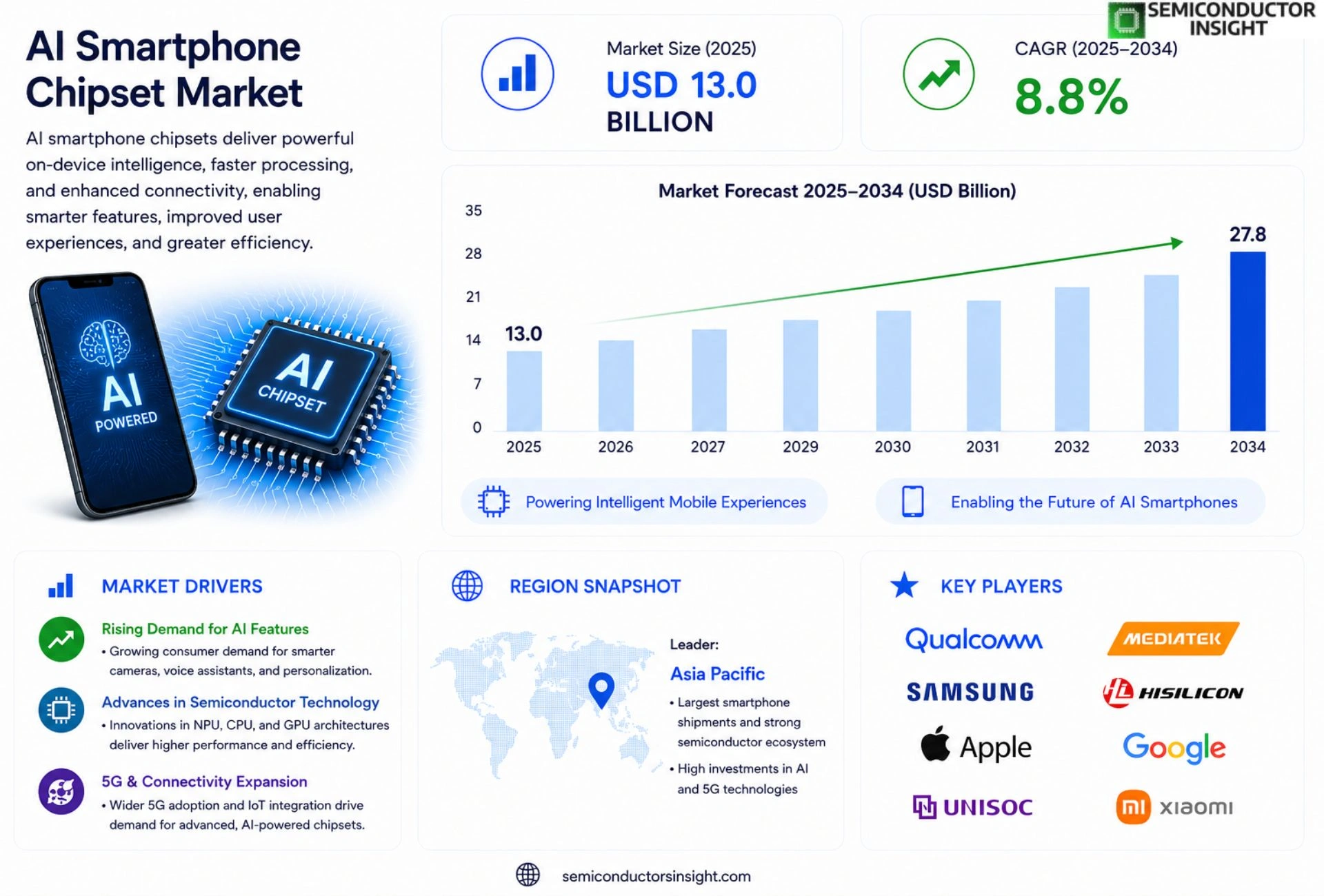
Global AI Smartphone Chipset Market size was valued at USD 12.4 billion in 2025. The market is projected to grow from USD 13.0 billion in 2026 to USD 27.8 billion by 2034, exhibiting a CAGR of 8.8% during the forecast period.
AI Smartphone Chipsets are specialized integrated circuits that embed neural processing units (NPUs), digital signal processors (DSPs) and graphics cores optimized for on‑device artificial‑intelligence tasks such as image recognition, voice assistants and real‑time translation.
The market is experiencing rapid growth because smartphone manufacturers are investing heavily in AI‑driven user experiences, while consumers demand faster, more power‑efficient devices.
Furthermore, advances in semiconductor fabrication, particularly the shift to sub‑3 nm processes, are lowering power consumption and enabling richer AI features.
However, supply‑chain constraints and rising component costs pose challenges that manufacturers must navigate.
Key players such as Qualcomm, Apple, MediaTek and Samsung are expanding their AI chipset portfolios through strategic R&D partnerships and aggressive product rollouts.
MARKET DRIVERS
Rising Demand for On‑Device AI Processing
Smartphone manufacturers are integrating AI accelerators to support features such as real‑time image enhancement, voice assistants, and predictive battery management. Recent forecasts show that more than 55 % of flagship devices launched in 2025 will embed dedicated AI cores, driving a compound annual growth rate of roughly 12 % for AI Smartphone Chipset Market.
Advancements in Fabrication Technology
The transition to 5 nm and emerging 3 nm process nodes has slashed power consumption by up to 40 % while delivering double the compute density. These gains enable manufacturers to embed sophisticated neural‑network inference engines without compromising battery life, strengthening the value proposition of AI‑enabled smartphones.
➤ AI‑powered features are now a baseline expectation for premium smartphones, turning chipset differentiation into a competitive advantage.
Overall, the convergence of consumer appetite for intelligent experiences and the availability of ultra‑efficient silicon is propelling AI Smartphone Chipset Market toward sustained expansion.
MARKET CHALLENGES
High Development Costs
Designing custom AI accelerators requires substantial R&D investment, often exceeding $200 million for a new chipset generation. Smaller OEMs struggle to allocate such capital, leading to a concentration of capability among a few tier‑1 players.
Other Challenges
Limited Software Ecosystem
Fragmented AI frameworks and the need for device‑specific optimization increase time‑to‑market. Without a unified SDK, developers face higher integration overhead, which can dampen the adoption rate of new AI chips.
MARKET RESTRAINTS
Regulatory and Privacy Concerns
Stringent data‑privacy regulations, such as GDPR and emerging AI‑specific laws, impose limits on on‑device data processing and cross‑border model updates. Compliance requirements add complexity to chipset design and can delay product launches, restraining market velocity.
MARKET OPPORTUNITIES
Emergence of Edge‑AI in AR/VR Applications
Augmented‑reality (AR) and virtual‑reality (VR) experiences demand low‑latency, on‑device inference for gesture recognition and scene understanding. AI Smartphone Chipset Market stands to benefit from this surge, as developers seek power‑efficient processors capable of handling high‑resolution sensor streams in real time, opening a sizeable growth niche beyond traditional camera and voice use cases.
AI Smartphone Chipset Market Trends
Integration of Neural Processing Units
AI Smartphone Chipset Market is being reshaped by the widespread embedding of dedicated neural processing units (NPUs) within system‑on‑chip designs. These NPUs work alongside digital signal processors and graphics cores to execute on‑device inference for image recognition, voice assistants, and real‑time translation without relying on cloud resources. Manufacturers prioritize these components because they deliver lower latency and reduced power draw, directly supporting premium user experiences that differentiate flagship devices. The strategic focus on AI‑driven functionalities has accelerated R&D investment, leading to a steady pipeline of chips that combine higher computational density with energy‑efficient architectures.
Other Trends
Advancements in Fabrication Technology
Recent moves to sub‑3 nm semiconductor processes have a noticeable impact on AI Smartphone Chipset Market. Smaller node geometries reduce leakage currents and enable higher transistor counts, allowing designers to pack more AI‑specific engines into the same silicon footprint. This progression not only supports richer on‑device features but also aligns with the broader industry push for power‑efficient designs, a key requirement for battery‑constrained smartphones. As fab facilities ramp up capacity, component yields improve, helping to mitigate earlier supply‑chain bottlenecks and offering manufacturers a more predictable path to volume production.
Supply Chain Resilience and Cost Management
While technological advances drive optimism, AI Smartphone Chipset Market must contend with lingering supply‑chain constraints and rising material costs. Semiconductor fabs face periodic capacity shortages, and the reliance on advanced lithography equipment adds financial pressure on chip makers. Companies such as Qualcomm, Apple, MediaTek, and Samsung are responding by diversifying their sourcing strategies, entering strategic partnerships, and investing in in‑house manufacturing capabilities. These efforts aim to secure component availability, stabilize pricing, and maintain the momentum of AI‑centric product rollouts despite macro‑economic fluctuations. The balance between cost control and continued innovation remains a central managerial focus across the sector.
COMPETITIVE LANDSCAPE
Key Industry Players
Dominated by a Handful of Semiconductor Giants, AI Smartphone Chipset Market Remains Intensely Competitive as Innovation in Neural Processing Accelerates
AI Smartphone Chipset Market is largely shaped by a concentrated group of highly capable semiconductor leaders. Qualcomm leads the Android ecosystem with its Snapdragon series, which integrates advanced Hexagon Neural Processing Units (NPUs) purpose-built for on-device AI inference tasks including real-time image recognition, voice processing, and generative AI applications. Apple commands a dominant position in the premium segment with its proprietary A-series and M-series Bionic chips, which are widely recognized for delivering industry-leading performance-per-watt ratios through tightly integrated hardware and software optimization. Samsung’s Exynos lineup and MediaTek’s Dimensity platform round out the top tier, collectively accounting for a substantial share of global AI chipset shipments. These market leaders are heavily investing in sub-3 nm fabrication processes, enabling richer AI capabilities while simultaneously reducing power consumption , a critical competitive differentiator in the evolving smartphone landscape.
Beyond the dominant players, several specialized and regional semiconductor companies are carving out significant positions within distinct market niches. HiSilicon, a Huawei subsidiary, continues to develop its Kirin AI chipsets tailored for the Chinese market, while UNISOC is gaining traction in the mid-range and entry-level segments across emerging economies. Google’s Tensor chipset series, developed in partnership with Samsung Foundry, is purpose-engineered to optimize AI and machine learning workloads on Pixel devices, representing a vertically integrated approach gaining industry attention. Arm Holdings plays a foundational role by supplying CPU and GPU IP that underpins virtually every major AI chipset architecture globally. MediaTek has also expanded its AI capabilities through dedicated APU (AI Processing Unit) cores embedded across its Dimensity product range, targeting both premium and mass-market device manufacturers. Collectively, these players are intensifying competition through strategic R&D collaborations, patent portfolios, and aggressive product roadmap execution, driving the overall market toward its projected value of USD 27.8 billion by 2034.
List of Key AI Smartphone Chipset Companies Profiled
- Qualcomm Technologies, Inc.
- Apple Inc.
- Samsung Electronics Co., Ltd. (Exynos)
- MediaTek Inc.
- HiSilicon Technologies Co., Ltd. (Huawei)
- Google LLC (Tensor)
- Arm Holdings plc
- UNISOC Technologies Co., Ltd.
- Taiwan Semiconductor Manufacturing Company (TSMC)
- Intel Corporation
- NVIDIA Corporation
- Marvell Technology, Inc.
- Broadcom Inc.
- NXP Semiconductors N.V.
Segment Analysis:
| Segment Category | Sub-Segments | Key Insights |
| By Type |
|
Integrated NPU SoCs
|
| By Application |
|
Camera Image Enhancement
|
| By End User |
|
Premium Flagship Consumers
|
| By Integration Level |
|
Embedded AI within SoC
|
| By Ecosystem Support |
|
Android‑Centric AI Toolchains
|
Regional Analysis: North America
United States
The primary drivers in the US market include increasing smartphone penetration, growing consumer awareness of AI features, and the development of advanced mobile applications.
Challenges in the US market include intense competition from established players, rapid technological advancements, and evolving consumer preferences.
The competitive landscape is characterized by a mix of major semiconductor companies and emerging players, each vying for market share with innovative AI chipset solutions.
Future trends in the US market point towards greater integration of on-device AI processing, advancements in chip architecture, and a focus on enhancing user privacy and security.
North America
The North American market for AI smartphone chipset is experiencing significant expansion, propelled by a confluence of factors. The region’s high smartphone adoption rates and a strong consumer inclination towards technologically advanced devices are key contributors. Businesses are increasingly focusing on developing and deploying chips that can efficiently handle complex AI tasks, such as image recognition, voice assistance, and predictive analytics, directly on smartphones. This trend is supported by the growing availability of 5G networks, which enable faster data processing and seamless connectivity for AI-powered applications. Furthermore, the region’s robust research and development infrastructure fosters innovation in AI chipset technology, attracting both established and emerging players. The demand for power-efficient chips is particularly prominent, as smartphone manufacturers strive to extend battery life while incorporating more sophisticated AI features.
Europe
Europe represents a substantial and steadily growing market for AI smartphone chipsets. The region’s strong emphasis on data privacy and security is a defining characteristic influencing chipset development. European manufacturers are prioritizing the design of chips that offer enhanced on-device processing capabilities while adhering to stringent data protection regulations, such as GDPR. The automotive industry’s increasing integration of AI features, such as autonomous driving and advanced driver-assistance systems, is also driving demand for specialized AI chipsets that can be adapted for smartphone applications. A key aspect of the European market is the collaboration between research institutions and industry players, leading to the development of innovative and sustainable AI solutions. The focus on energy efficiency is paramount, with manufacturers pursuing chip designs that minimize power consumption to extend battery life, aligning with European environmental concerns.
Asia-Pacific
Asia-Pacific is the largest and fastest-growing market for AI smartphone chipsets globally. Driven by the massive smartphone user base in countries like China and India, the region presents significant opportunities for chipset manufacturers. The demand for AI-powered smartphones is particularly robust in emerging markets, where consumers are increasingly seeking advanced features at affordable price points. The region is witnessing a surge in local chipset designers and manufacturers, competing with established global players. Government initiatives promoting technological innovation and the development of domestic semiconductor industries are further fueling market growth. The proliferation of 5G infrastructure across Asia-Pacific is also a key driver, enabling the deployment of more sophisticated AI applications on smartphones. The focus is on developing cost-effective AI chips that can cater to the diverse needs of the regional market.
South America
South America presents a promising, albeit relatively nascent, market for AI smartphone chipsets. While smartphone penetration rates are increasing across the region, the demand for advanced AI features is still in its early stages. However, the growing affordability of smartphones and increasing consumer awareness of AI capabilities are creating a favorable environment for market expansion. The region’s increasing digital literacy and the rise of e-commerce platforms are also contributing to smartphone adoption. The focus is on providing AI-powered solutions that cater to the specific needs of the South American market, with an emphasis on value for money and affordability. Challenges include infrastructure limitations and varying economic conditions across different countries within the region.
Middle East & Africa
The Middle East and Africa represent a high-growth potential market for AI smartphone chipsets. The region is experiencing rapid smartphone adoption, particularly among younger generations, driven by increasing disposable incomes and improved connectivity. The demand for AI-powered features is rising, fueled by a growing interest in mobile gaming, social media, and e-commerce. The region’s increasing focus on digital transformation and the government’s initiatives to promote technology adoption are also supporting market growth. The focus is on providing AI solutions that cater to the specific needs of the region, with an emphasis on affordability and accessibility. Challenges include infrastructure limitations and varying economic conditions across different countries within the region.
Report Scope
This market research report provides a comprehensive analysis of the AI Smartphone Chipset Market , covering the forecast period 2026–2034. It offers detailed insights into market dynamics, technological advancements, competitive landscape, and key trends shaping the industry.
Key focus areas of the report include:
- Market Overview: The report begins with an overview outlining its current market scenario, key growth indicators, and industry transformation drivers. It discusses macroeconomic factors, demand–supply balance, regulatory landscape, and the strategic role of semiconductors in powering advancements across industries such as automotive, telecommunications, consumer electronics, and industrial automation.
- Market Size & Forecast: Historical data and future projections for revenue, unit shipments, and market value across major regions and segments.
- Segmentation Analysis: Detailed breakdown by product type, technology, application, and end-user industry to identify high-growth segments and investment opportunities.
- Regional Insights: Insights into market performance across North America, Europe, Asia-Pacific, Latin America, and the Middle East & Africa, including country-level analysis where relevant.
- Competitive Landscape: Profiles of leading market participants, including their product offerings, R&D focus, manufacturing capacity, pricing strategies, and recent developments such as mergers, acquisitions, and partnerships.
- Technology Trends & Innovation: Assessment of emerging technologies, integration of AI/IoT, semiconductor design trends, fabrication techniques, and evolving industry standards.
- Market Drivers & Restraints: Evaluation of factors driving market growth along with challenges, supply chain constraints, regulatory issues, and market-entry barriers.
- Stakeholder Insights: Insights for component suppliers, OEMs, system integrators, investors, and policymakers regarding the evolving ecosystem and strategic opportunities.
Primary and secondary research methods are employed, including interviews with industry experts, data from verified sources, and real-time market intelligence to ensure the accuracy and reliability of the insights presented.
FREQUENTLY ASKED QUESTIONS:
What is the current market size of AI Smartphone Chipset Market?
-> AI Smartphone Chipset Market was valued at USD 12.4 billion in 2025 and is expected to reach USD 27.8 billion by 2034.
Which key companies operate in AI Smartphone Chipset Market?
-> Key players include Qualcomm, Apple, MediaTek, Samsung, among others.
What are the key growth drivers?
-> Key growth drivers include investment in AI‑driven user experiences, sub‑3 nm semiconductor processes that lower power consumption, and rising consumer demand for faster, more power‑efficient smartphones.
Which region dominates the market?
-> Asia-Pacific is the fastest‑growing region, while North America remains a dominant market.
What are the emerging trends?
-> Emerging trends include on‑device AI acceleration, integration of AI/IoT in chipset designs, advanced NPU architectures, and the shift toward ultra‑low‑power sub‑3 nm fabrication technologies.

Get Sample Report PDF for Exclusive Insights
Report Sample Includes
- Table of Contents
- List of Tables & Figures
- Charts, Research Methodology, and more...
 Download Sample Report PDF