Digital Coherent Optical (DCO) Transceiver Modules Market Insights
Digital Coherent Optical (DCO) Transceiver Modules market size was valued at USD 4.729 billion in 2024. The market is projected to reach USD 8.346 billion by 2034, exhibiting a CAGR of 8.7% during the forecast period.
Digital Coherent Optical (DCO) transceiver modules enable multi‑rate coherent transmission for data‑center interconnect, metro networks and long‑haul transport applications. On the host side, they accommodate signal formats such as 100GE, 200GE, 400GE, OTU4 and OTUCn (FlexO).
The expansion is fueled by escalating bandwidth requirements from cloud service providers, increasing deployment of AI workloads demanding low‑latency links, and ongoing investments in coherent optics R&D across North America and Asia‑Pacific. Recent product introductions from leading suppliers,including II‑VI Incorporated, Lumentum and Zhongji Innolight,have broadened portfolio options while standardization efforts around OpenROADM accelerate adoption across carriers.
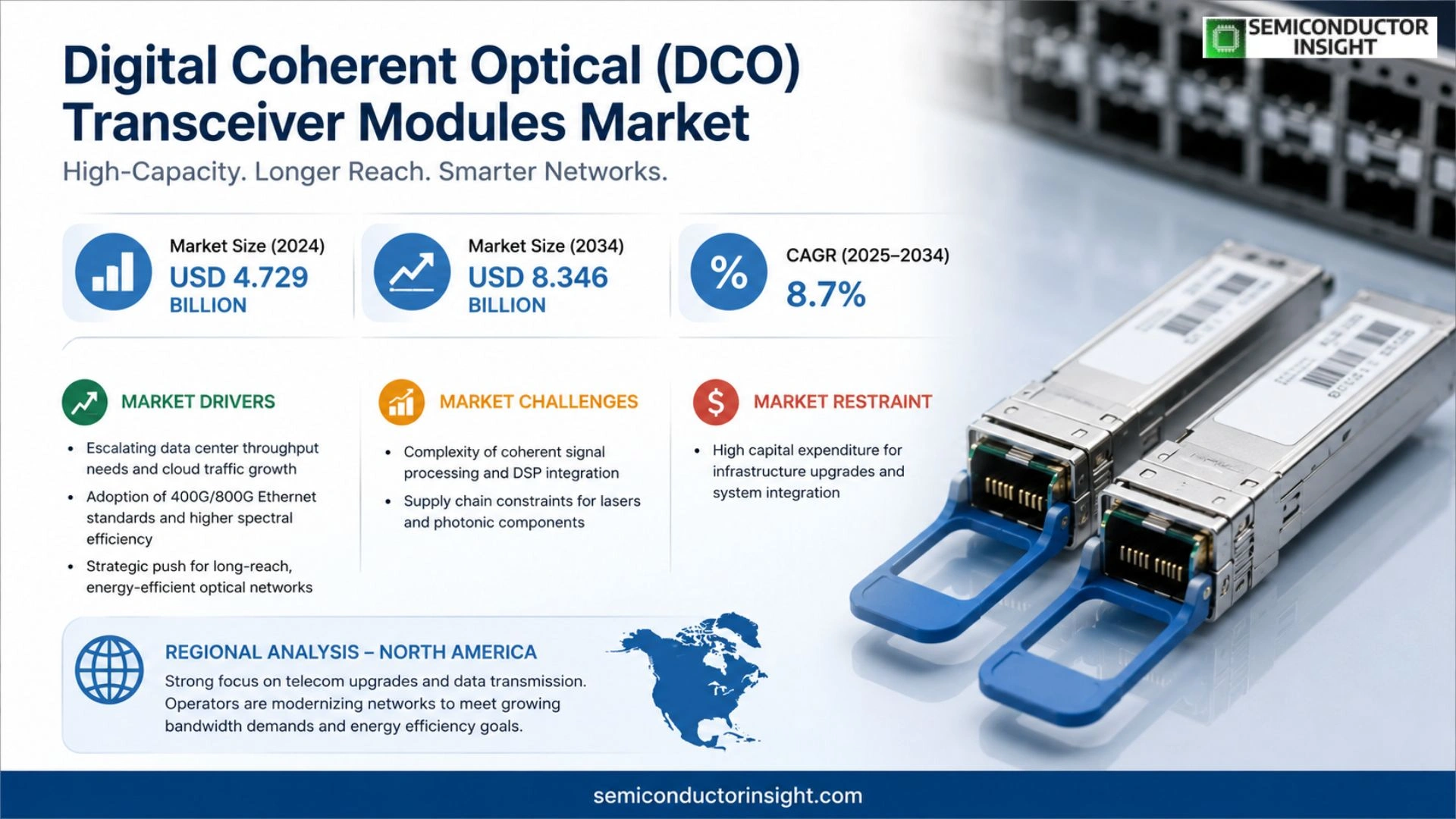
MARKET DRIVERS
Escalating Data Center Throughput Requirements
The surge in hyperscale cloud services forces operators to stretch fiber capacity beyond traditional limits. Digital Coherent Optical (DCO) Transceiver Modules Market responds by delivering spectral efficiencies that exceed 8 bits/s/Hz, allowing carriers to multiplex more traffic without laying additional fiber. This technical advantage translates into measurable cost avoidance for network owners, especially as traffic growth outpaces the deployment of new routes.
Adoption of 400G and Beyond Ethernet Standards
Industry roadmaps now endorse 400 Gbps and 800 Gbps Ethernet as baseline for backbone upgrades. Digital Coherent Optical (DCO) Transceiver Modules Market offers modules that integrate higher‑order QAM formats, making the transition to these standards smoother and more power‑efficient. Network planners value the ability to reuse existing DWDM grids while meeting the new line‑rate targets, a factor that accelerates procurement cycles.
➤ Coherent technology is becoming the default choice for high‑capacity links because it consolidates reach, data rate, and power consumption into a single, upgradeable platform.
Consequently, operators view DCO transceivers as a strategic lever to future‑proof their optical layers, prompting multi‑year budgeting that favours vendors with proven coherent portfolios.
MARKET CHALLENGES
Complexity of Coherent Signal Processing
The advanced DSP algorithms required for coherent detection add layers of hardware and software intricacy. Companies must invest in specialized engineering talent to calibrate phase noise and polarization mode dispersion, which elongates time‑to‑market for new module variants. This technical burden can deter smaller players from entering Digital Coherent Optical (DCO) Transceiver Modules Market.
Other Challenges
Supply Chain Constraints
Component shortages,particularly for high‑performance lasers and silicon‑photonic ASICs,tighten lead times. Manufacturers that cannot secure a reliable supply chain risk losing contracts to rivals with diversified vendor bases, a risk that becomes pronounced during periods of rapid capacity expansion.
MARKET RESTRAINTS
High Capital Expenditure for Upgrading Infrastructure
Deploying Digital Coherent Optical (DCO) Transceiver Modules Market solutions often entails replacing legacy OEO equipment, rewiring terminal boards, and retraining operations personnel. The upfront financial outlay,sometimes exceeding 30 % of the total upgrade budget,creates hesitation among carriers operating under tight capex constraints, slowing the overall market tempo.
MARKET OPPORTUNITIES
Open Line Systems (OLS) Architecture
The shift toward disaggregated, software‑defined transport layers opens a niche for Digital Coherent Optical (DCO) Transceiver Modules Market vendors that provide open‑API compliant optics. Service providers can now mix and match transceiver, DSP, and management software from different suppliers, fostering a competitive ecosystem that accelerates innovation and price erosion.
Emerging Metro‑Edge Use Cases
5G fronthaul and metro‑core extensions demand latency‑critical, high‑capacity links. Coherent modules engineered for shorter reach,yet retaining full‑rate performance,address this gap, enabling operators to densify their edge networks without resorting to costly parallel fiber deployments.
Digital Coherent Optical (DCO) Transceiver Modules Market Trends
Accelerating Deployment in Data Center Interconnects
Data‑center operators are accelerating the migration from legacy copper and single‑mode fiber links to coherent transceivers that deliver higher spectral efficiencies and lower power footprints. This shift stems from the relentless push for ultra‑high‑density cloud services, edge computing, and the next wave of artificial‑intelligence workloads that require petabyte‑scale transfer rates. Coherent modules, especially 100G and 200G variants, are now integrated into multi‑rate platforms that support 400G and beyond through flexible optics (FlexO) adaptations. By 2025, the forecast for one‑to‑two‑channel units is projected to surpass 5 million kits, underscoring the urgency for carriers to upgrade backplanes and maintain competitive latency profiles. Additionally, the convergence of photonic integrated circuits with edge‑cloud architecture has reduced the NRE cost, making early adoption financially feasible for mid‑sized operators.
Other Trends
Scale to 200G/400G and Beyond
While 100G transceivers dominated the early adoption curve, the market is now shifting toward mixed‑rate solutions that accommodate 200G/400G and even 800G streams on the same chassis. This transition is fueled by the need for cost‑effective scalability in metro and regional networks, where physical lane densities remain high but capacity demands eclipse existing single‑rate offerings. The introduction of modular chipsets from players such as Lumentum, and the scaling of silicon photonics yield cost reductions that are critical for operators seeking to balance capital expenditure with future throughput needs. Consequently, the allocation of budget toward larger‑bandwidth transceivers is increasing, even as smaller modules remain in the mix for legacy nodes. Industry surveys suggest that over 70 % of surveyed network managers favor hybrid‑rate modules for their ability to trade off launch power versus bandwidth without hardware replacement.
Emerging Flexible Transceiver Architectures
The rise of flexible transceiver architectures, including modular optics and programmable signal processing, signals a strategic pivot for vendors willing to invest in long‑term roadmap alignment. By decoupling front‑end photonics from digital baseband, operators gain the ability to upgrade bandwidth through firmware, rather than replacing entire hardware suites, thereby stretching capital cycles. OEMs such as Intel and Broadcom are spearheading this approach by integrating adaptive modulation codecs that can support 10λ‑800G services on a single 20 nm silicon substrate. The resulting cost‑per‑gigabit advantage will likely make 400G/800G deployments viable in data centers that were previously constrained by thermal budgets and rack density limitations. Emerging optical spectrum management protocols, such as dynamic wavelength sharing, further enhance the ROI by allowing shared access to underutilized spectral slots across multiple service providers. Therefore, long‑term growth signals are anchored not solely on raw throughput but on the agility of the underlying architecture to evolve with network demands.
COMPETITIVE LANDSCAPE
Key Industry Players
DCO Transceiver Module Market Competitive Landscape
Digital Coherent Optical (DCO) transceiver modules is currently dominated by a handful of large‑scale component suppliers that have layered their catalogues across data‑center interconnect, metro‑grade and long‑haul backhaul segments. II‑VI Incorporated, Lumentum, and Broadcom collectively command more than two‑thirds of worldwide revenue, weighing heavily on price benchmarks and contractual expectations. These incumbents have pursued aggressive R&D pipelines that emphasise power‑efficient 200‑Gbit/s and 400‑Gbit/s serial links, positioning them to capture the majority of the $4,700‑million market as it advances toward the 8.7% CAGR forecast. In addition, their longstanding global distribution networks and long‑term service agreements mitigate entry barriers for competitors. The consolidation of product lines under a single platform, coupled with recurring revenue models from software‑controlled firmware updates, reinforces their dominant standing across North America and Western Europe, where premium infrastructure spending remains high.
While the core segment remains concentrated, a cohort of mid‑tier and regional players is expanding their reach by targeting specific niches and emerging markets. Accelink Technologies, Hisense Broadband, and Zhongji Innolight specialise in flexible‑rate OTU4/OTUCn modules that deliver lower power budgets, capturing growth in submarine cable projects and cost‑sensitive Asian data‑center deployments. Companies such as Hgtech, FIBERSTAMP, and GIGALIGHT leverage modular silicon photonics to offer rapid prototyping and reduced time‑to‑market, appealing to telecom operators that demand on‑demand capacity in 100 Gbit/s tiers. Meanwhile, the entrance of cloud‑service giants like Intel and Kunpeng‑based platforms into the optical subsystem supply chain signals a shift toward vertical integration, where processor vendors provide end‑to‑end edge‑to‑edge connectivity. These dynamics necessitate that new entrants invest in flexible silicon photonic ASICs and strategic alliances to overcome the entrenched supply chain advantage of the incumbents.
List of Key DCO Transceiver Module Companies Profiled
- II‑VI Incorporated
- Lumentum
- Broadcom
- Accelink Technologies
- Hisense Broadband
- Zhongji Innolight
- Hgtech
- FIBERSTAMP Technology
- GIGALIGHT
- Intel
- Cisco
- Juniper
- NEC
- Fujitsu Optical Components Limited
- HiLink Technology
Segment Analysis:
| Segment Category | Sub-Segments | Key Insights |
| By Type |
|
High‑Capacity Optical Modules enable seamless scaling for data‑center interconnects, metropolitan networks, and long‑haul transport. Their multi‑rate capability ensures future‑proof architecture and reduced fiber footprints. They are increasingly chosen where latency, energy efficiency, and 100% spectral utilization are critical. |
| By Application |
|
Data Center Interconnect remains the core driver, demanding high spectral efficiency and resilience. Metro networks leverage DCO for densification and service aggregation, while long‑haul deployments prioritize reach, BER performance, and robustness against fiber impairments. Emerging use cases include edge‑cloud gateways and 5G backhaul. |
| By End User |
|
Telecom Operators adopt DCO to meet growing bandwidth demands and to upgrade legacy systems without fiber repointing. Enterprise operators rely on DCO to connect datacenters and branch campuses, focusing on cost per bit and error‑rate tolerance. Cloud providers prioritize the densification capability and operational simplicity that DCO delivers for multi‑tenant environments. |
| By Market Adoption |
|
Early Adopter segments drive innovation by testing next‑generation DCO features, influencing standards and vendor road‑maps. Mainstream users balance performance with cost, driving volume sales. Late adopters emphasize reliability, support, and proven integration, often lagging in adoption but providing a stabilizing base for niche solutions. |
| By Technology Generation |
|
2nd Generation DCO combines enhanced modulation formats with improved power consumption, meeting the evolving demands of 400G and beyond. 3rd Generation focuses on integrated photonics and AI‑driven signal processing, promising higher resilience and lower operational costs. First‑generation modules still serve legacy infrastructure requiring careful migration planning. |
Regional Analysis: Digital Coherent Optical (DCO) Transceiver Modules Market
North America
Technological progress in silicon‑based photonics forms the backbone of DCO module evolution, especially in mainstream silicon‑on‑insulator platforms that deliver higher modulation sensitivity and lower insertion loss. Engineers now leverage mixed‑mode circuits that combine coherent detection with digital signal processing, effectively extending reach while trimming optical power budgets. This convergence spurs modular designs that can be rapidly replicated across telecom and data‑center deployments.
Industry use cases for DCO modules span high‑capacity metro backbones, submarine cable systems, and data‑center interconnects. The fixed‑cost advantage of coherent detection reduces the need for dense wavelength division multiplexer stage counts, freeing spectrum for higher‑order modulation formats. In 5G, operators deploy DCO‑based stations to connect aggregation points over 20 km links, pushing transport ceilings beyond conventional 100 G solutions.
Competitive dynamics in the DCO transceiver arena are increasingly defined by tier‑two suppliers closing the performance gap relative to legacy optical modules. Late‑comer vendors invest heavily in heterogeneous integration, pairing laser sources with high‑fidelity modulators in a single package. Partnerships between test‑equipment manufacturers and photonic foundries enable rapid hardware‑verification, shortening the overall door‑to‑service time for operators seeking next‑generation capacity.
The regulatory climate surrounding fiber‑optic transmission is shaped by international standards that mandate interoperability and spectral harmonization. Recent revisions to the ITU‑P G.933 series emphasize coherent system validation, compelling OEMs to adopt rigorous test sets to prove roll‑off margins. In North America, federal agencies collaborate with industry consortia to map certification pathways, ensuring that new DCO technologies meet data‑rate and energy‑efficiency thresholds before mass rollout.
Europe
Asia‑Pacific presents a contrasting mix for Digital Coherent Optical (DCO) Transceiver Modules Market, with Japan and South Korea investing heavily in metro‑OTN upgrades while Southeast Asian carriers focus on incremental capacity to support emerging cloud‑edge nodes. Adoption is influenced by spectrum licensing costs and power‑budget constraints, prompting local vendors to co‑develop compact, energy‑efficient DCO solutions. In China, the metro‑OTN ring is a focal point due to stringent power limits, whereas in India the market remains price‑sensitive. Consequently, growth trajectories vary, with mature markets accelerating while nascent regions maintain cautious progress.
Asia‑Pacific
Middle East & Africa remain in early development for Digital Coherent Optical (DCO) Transceiver Modules Market, with GCC hubs and sub‑Saharan backbone rollouts focusing on network densification first. Pilot projects in Saudi Arabia and Egypt show a willingness to test low‑draw, modular DCO units, but existing terrestrial links impose strict power constraints that tighten adoption. Manufacturers therefore tailor compact, energy‑efficient packages, and progress is measured as early adopters validate performance before committing to large‑scale deployments. Additionally, regional regulatory frameworks encourage the use of fiber to reduce carbon emissions, implicitly fostering DCO module adoption when cost barriers lower. Telecom operators also explore collaborations with local universities to develop field‑test stations, leveraging the DCO technology’s low leakage to meet stricter operational cost guidelines. While growth appears conservative, incremental upgrades in urban core networks indicate a gradual shift toward coherent systems, especially in Saudi Arabia’s newly built metro‑OTN expansions and Egypt’s expanding data‑center corridors.
Report Scope
This market research report provides a comprehensive analysis of the Digital Coherent Optical (DCO) Transceiver Modules Market , covering the forecast period 2026–2034. It offers detailed insights into market dynamics, technological advancements, competitive landscape, and key trends shaping the industry.
Key focus areas of the report include:
- Market Overview: The report begins with an overview outlining its current market scenario, key growth indicators, and industry transformation drivers. It discusses macroeconomic factors, demand – supply balance, regulatory landscape, and the strategic role of semiconductors in powering advancements across industries such as automotive, telecommunications, consumer electronics, and industrial automation.
- Market Size & Forecast: Historical data and future projections for revenue, unit shipments, and market value across major regions and segments.
- Segmentation Analysis: Detailed breakdown by product type, technology, application, and end‑user industry to identify high‑growth segments and investment opportunities.
- Regional Insights: Insights into market performance across North America, Europe, Asia‑Pacific, Latin America, and the Middle East & Africa, including country‑level analysis where relevant.
- Competitive Landscape: Profiles of leading market participants, including their product offerings, R&D focus, manufacturing capacity, pricing strategies, and recent developments such as mergers, acquisitions, and partnerships.
- Technology Trends & Innovation: Assessment of emerging technologies, integration of AI/IoT, semiconductor design trends, fabrication techniques, and evolving industry standards.
- Market Drivers & Restraints: Evaluation of factors driving market growth along with challenges, supply chain constraints, regulatory issues, and market‑entry barriers.
- Stakeholder Insights: Insights for component suppliers, OEMs, system integrators, investors, and policymakers regarding the evolving ecosystem and strategic opportunities.
Primary and secondary research methods are employed, including interviews with industry experts, data from verified sources, and real‑time market intelligence to ensure the accuracy and reliability of the insights presented.
FREQUENTLY ASKED QUESTIONS:
What is the current market size of Digital Coherent Optical (DCO) Transceiver Modules Market?
-> Digital Coherent Optical (DCO) Transceiver Modules market is projected to reach USD 8.346 billion by 2034, exhibiting a CAGR of 8.7%
Which key companies operate in Digital Coherent Optical (DCO) Transceiver Modules Market?
-> Key players include II‑VI Incorporated, Lumentum, Zhongji Innolight, Hisense Broadband, Accelink Technologies, Cisco, Broadcom, Intel, Hgtech, and Eoptolink.
What are the key growth drivers?
-> Key growth drivers include the rising demand for high‑capacity data center interconnects, metro and long‑haul transport applications, and the adoption of multi‑rate coherent transmission technologies such as 100GE, 200GE, and 400GE across infrastructure networks.
Which region dominates the market?
-> North America remains the dominant region with substantial market share, while the Asia‑Pacific region shows the fastest growth trajectory driven by expanding data center and telecom infrastructure investments.
What are the emerging trends?
-> Emerging trends include the integration of coherent optics in data center interconnects, the development of 100G+ and beyond transceiver modules, energy‑efficient designs, and the convergence of optical networking with AI/IoT technologies.

Get Sample Report PDF for Exclusive Insights
Report Sample Includes
- Table of Contents
- List of Tables & Figures
- Charts, Research Methodology, and more...
 Download Sample Report PDF