Digital Circuit Breaker Analyzer Market Insights
Digital Circuit Breaker Analyzer market was valued at USD 1742 million in 2025 and will reach USD 3398 million by 2034, exhibiting a CAGR of 7.7% during the forecast period.
A circuit breaker analyzer is an instrument that measures key electrical parameters,voltage drop, fault current levels, impedance characteristics, insulation resistance,across different operating states of circuit breakers.
By providing real‑time diagnostics and performance profiling, these analyzers support preventive maintenance strategies and help utilities meet stringent safety standards such as IEC 61008‑3 and IEEE 1586.
In power generation plants where high‑voltage breakers operate under continuous stress accurate analysis reduces downtime by identifying early signs of degradation while also enhancing reliability across railway systems through precise fault detection.
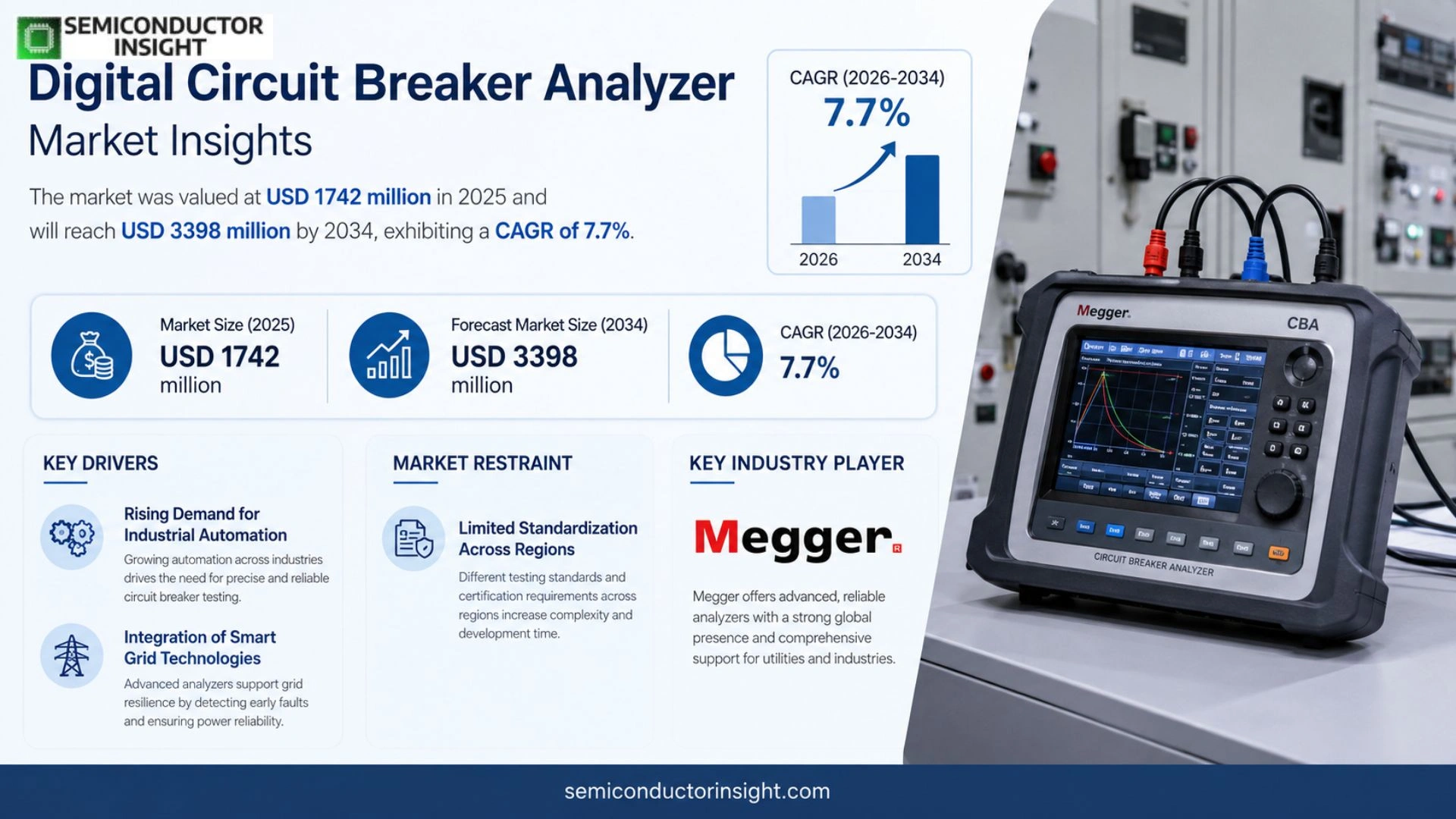
MARKET DRIVERS
Rising Demand for Industrial Automation
Manufacturing and process‑control sectors are accelerating the deployment of automation solutions, creating a direct need for precise diagnostic tools that can monitor and validate circuit integrity. Digital Circuit Breaker Analyzer Market participants report that businesses are increasingly preferring electronic test rigs that deliver rapid, repeatable results, thereby reducing downtime and compliance hurdles.
Integration of Smart Grid Technologies
Power utilities are investing in distributed generation and renewable energy farms, which introduce variable loads into the grid. This shift is driving adoption of advanced analyzers capable of detecting subtle impedance shifts and early fault indicators, positioning Digital Circuit Breaker Analyzer Market to support grid resilience initiatives.
➤ Key Insight: The convergence of digital test instruments with cloud‑based data analytics unlocks predictive maintenance capabilities that were previously unattainable with legacy methods.
Overall, the convergence of automation and renewable integration creates a compelling use case for reliable, fast, and data‑rich testing platforms, ensuring that operators can preempt failures before they impact critical infrastructure.
MARKET CHALLENGES
High Upfront Capital Expenditure
While the benefits of deploying digital analyzers are clear, the initial purchase and calibration costs remain prohibitive for small‑to‑mid‑size enterprises. The need for periodic firmware updates and dedicated support contracts compounds the financial burden, limiting broader market uptake.
Other Challenges
Limited Skilled Workforce
There is a noticeable shortage of technicians trained in both circuit breaker systems and digital diagnostic technology, forcing companies to invest in specialized training or outsource testing, which can delay project timelines.
MARKET RESTRAINTS
Limited Standardization Across Regions
Global variations in testing standards and certification requirements create a fragmented regulatory landscape. Manufacturers must tailor their analytical solutions to meet region‑specific criteria, which increases development cycles and dilutes economies of scale across Digital Circuit Breaker Analyzer Market.
MARKET OPPORTUNITIES
Emerging AI‑Driven Fault Detection
The integration of machine‑learning algorithms into analyzers offers the promise of autonomous fault classification and real‑time anomaly alerts. This capability positions market players to differentiate their offerings, capture premium pricing, and open new service‑based revenue streams especially in critical infrastructure segments.
Digital Circuit Breaker Analyzer Market Trends
Increasing Adoption of Advanced Fault Detection Capabilities
Digital Circuit Breaker Analyzer Market has sharpened its focus on fault diagnostics, as utilities and industrial operators demand instruments capable of capturing micro‑currents and synchronizing breaker performance with grid stability. In 2024, valuations reached $1.6 billion, with a backlog projected to raise revenue beyond $2.6 billion by 2029. The acceleration is fueled by stricter safety regulations in power plants, high‑voltage network expansion, and the growing use of predictive analytics. Machine‑learning models now flag abnormal arc signatures before fault events, cutting downtime for high‑load utilities. By 2026, roughly 40% of new breaker installations in North America will feature advanced analyzers, rising to nearly 60% by decade’s end. This intelligence shift underpins ongoing growth.
Other Trends
Regional Growth Disparities
Asia‑Pacific remains the dominant arena for electronic components, yet Digital Circuit Breaker Analyzer segment shows regional disparities. China and Japan account for about 35 % of global sales, driven by reforms that mandate digital fault logging. Europe and North America present steadier growth, tied to mature grids that rely on incremental upgrades rather than wholesale deployments. Middle‑East and Latin America, though modest, are set for rapid expansion as renewable projects and LNG pipelines require breaker diagnostics. Digital twins have created a feedback loop where breaker data feeds load‑forecasting models, and European grid‑resilience directives push utilities to integrate analyzers into compliance reporting. Middle‑Eastern LNG facilities are deploying analyzers to meet evolving safety standards. These contrasting trajectories urge manufacturers to customize distribution and support plans that align with each region’s regulatory ecosystem.
Emerging Cost-Effective Modular Solutions
Manufacturers face mounting cost pressures, prompting a shift toward modular analyzers that balance performance with affordability. Bundling data‑analysis platforms with hardware offers a competitive advantage, as operators seek integration with existing SCADA systems. Price competition pushes firms to optimize yields and secure reliable component supply chains. Open‑source firmware can speed feature rollouts while trimming R&D expense. New entrants can gain traction by delivering AI‑enabled predictive insights, provided they navigate evolving safety standards and certification hurdles. Strategic alliances with software vendors help maintain price resilience. Yet the fast pace of regulatory change, especially in emerging markets, demands vigilant compliance monitoring to avoid costly setbacks. Proactive engagement with regulators can convert compliance into a strategic advantage, turning compliance documentation into a market differentiator.
COMPETITIVE LANDSCAPE
Key Industry Players
Digital Circuit Breaker Analyzer Market Competitive Landscape
The competitive core of Digital Circuit Breaker Analyzer market is dominated by a handful of established instrumentation firms that leverage advanced metrology technology to capture breaker health metrics. Megger, headquartered in the United Kingdom, has built a resilient market presence through its comprehensive portfolio of handheld and portable analyzers, reinforced by a global supply network that supports both utility and industrial clients. Vanguard Instruments, a Swiss manufacturer known for precision testing solutions, complements Megger’s reach by supplying high‑performance digital analytics platforms to the North American and European sectors, amplifying its share in the premium segment that demands rigorous compliance with stringent regulatory standards. Together, they capture approximately a third of global sales, setting a benchmark for product reliability and service coverage, while maintaining a price‑discriminating strategy that balances affordability for emerging markets with value‑added features for high‑speed grid applications.
The remainder of the market space is populated by a diversified constellation of niche firms that exploit specific application segments and regional opportunities. Companies such as Zensol, Camlin Energy, and HighTest Technology focus on railway and power generation utilities, offering specialized battery‑powered analyzers that integrate with legacy protection systems. Emerging entities like SMCint, KoCoS, and Amperis cater to industrial automation and renewable energy installations, integrating Internet‑of‑Things connectivity for predictive maintenance. Meanwhile, Huatian Electric, Wuhan Huaying Power, and Shijiazhuang Handy Technology strengthen the Asia‑Pacific footprint with competitive pricing and localized after‑sales support, targeting the burgeoning new‑energy vehicle and smart grid sectors. This mosaic of players demonstrates a market that is technically mature yet remains fragmented, encouraging continued innovation and regional adaptation.
List of Key Digital Circuit Breaker Analyzer Companies Profiled
- Megger
- Megger
- Vanguard Instruments
- Vanguard Instruments
- HighTest Technology
- Zensol
- Camlin Energy
- SMCint
- KoCoS
- Amperis
- Huatian Electric
- Wuhan Huaying Power
- Shijiazhuang Handy Technology
- Group CBS
- Scope T and M
- Crest Test Systems
Segment Analysis:
| Segment Category | Sub-Segments | Key Insights |
| By Type |
|
Handheld devices continue to dominate Digital Circuit Breaker Analyzer segment due to their compact form factor and rapid deployment in remote sites. Field technicians appreciate the instant connectivity to diagnostics, enabling real‑time fault analysis before scheduling maintenance. Their lightweight design allows extended operation without fatigue, while advanced sensors support multi‑parameter monitoring, ensuring compliance with evolving safety standards. |
| By Application |
|
Power Generation Industry utilities rely heavily on digital circuit breaker analyzers to guarantee reliability across increasingly complex grid infrastructures. The analyzers provide detailed diagnostic metrics, helping operators preempt breaker failures and optimize system performance. Their integration with SCADA systems facilitates seamless data exchange, while scheduled tests ensure compliance with regulatory mandates and improve overall plant efficiency. |
| By End User |
|
Utilities companies remain the predominant end‑user for digital circuit breaker analyzers, driven by the need for stringent quality assurance and fault isolation in extensive distribution networks. The analyzers enable proactive maintenance planning, reducing outage durations and minimizing service disruptions. Their ability to log historical performance data supports predictive analytics and enhances decision‑making for grid upgrades. |
| By Deployment Mode |
|
Field Deployment represents the leading scenario for digital circuit breaker analyzers, as on‑site technicians require portable instruments that combine accuracy with ruggedness. The analyzers often include wireless connectivity, allowing instantaneous data transfer to central monitoring hubs and reducing downtime. Their durability features, such as shock resistance and IP protection, make them suitable for harsh industrial environments. |
| By Industry Sectors |
|
Renewable Energy sector employs digital circuit breaker analyzers to maintain stability across wind turbines and solar farms. They facilitate rapid assessment of breaker integrity amid variable load conditions, enabling operators to detect early signs of wear or degradation. The integration of smart‑grid interfaces allows seamless coordination with energy storage systems, thereby enhancing overall grid resilience. |
Regional Analysis: Digital Circuit Breaker Analyzer Market
North America
Adoption of AI‑driven analytics and edge computing is accelerating fault detection precision across North American utilities. Early‑stage deployments of neural‑network classifiers for breaker fault signatures cut inspection downtime and enable real‑time decision making. These breakthroughs place the U.S. digital circuit breaker analyzer market on the cutting edge, prompting manufacturers to accelerate product roadmaps to keep ahead of competitive pressure.
Stringent safety regulations, such as the updated IEEE 859 standards, mandate comprehensive transformer and breaker testing to prevent cascading failures. Compliance demands frequent, systematic checks that are increasingly fulfilled through automated analyzers. The regulatory focus on fault tolerance fuels demand for diagnostic solutions that deliver high‑accuracy, reproducible results, compelling utilities to migrate from legacy instruments to digital platforms.
High‑voltage transmission networks, renewable integration hubs, and critical industrial facilities constitute the main segments powering adoption. Utilities deploying advanced breaker analyzers report reduced outage risks and improved asset lifespan. In the industrial space, process reliability gains from early fault detection directly translate into cost savings, attracting a broader range of high‑value customers eager for data‑centric safety solutions.
Domestic vendors such as GE Edison and Siemens Power are aggressively partnering with utility labs, while newer entrants bring modular, cloud‑connected solutions. Intense R&D races, fueled by venture capital and corporate alliances, push firms to innovate around real‑time analytics, edge‑processing capabilities, and interoperable data suites, shaping a high‑velocity ecosystem that rewards early movers.
Europe
Europe’s powerful energy transition agenda, coupled with stringent grid resilience directives, is nudging a cascade of infrastructure upgrades that generate a reliable demand for digital inspection tools. Market players target industrial plants, offshore wind farms, and multi‑household distribution networks. The regulatory emphasis on field‑deployable monitoring, aligned with the European Union’s Digital Asset Management framework, pushes utilities toward more sophisticated, accurate circuit‑breaker analyzers. Consequently, European firms are seeking cross‑border collaborations to pool expertise and share high‑volume parts, offering a market that, while still emerging, presents robust long‑term upside for technology providers. The investment climate is boosted by national grant schemes and strategic public‑private partnerships devoted to grid modernization, prompting firms to align R&D priorities with the region’s decarbonisation timeline. As a consequence, digital circuit breaker analyzer solutions that incorporate adaptive learning algorithms and compliance‑ready interfaces stand to capture notable share across the continent’s fragmented utilities.
Asia‑Pacific
Asia‑Pacific utilities wrestle with aging assets while pushing new renewable projects, creating a demand for reliable breaker testing before HVDC upgrades. A key uplift comes from green bond financing that supports grid‑modernisation, allowing operators to opt for modular inspection tools able to run in remote sites. Local OEMs partner with North American and European suppliers to leverage service networks and meet local regulations. Digital analyzers now form part of regional asset‑management suites, enabling predictive maintenance and reduced outage costs. The Inter‑American Development Bank’s sustainability checklists also incentivise adoption of tools that provide traceable performance data, giving utilities a clear competitive edge.
South America
South American utilities wrestle with aging assets while pushing new renewable projects, creating a demand for reliable breaker testing before HVDC upgrades. A key uplift comes from green bond financing that supports grid‑modernisation, allowing operators to opt for modular inspection tools able to run in remote sites. Local OEMs partner with North American and European suppliers to leverage service networks and meet local regulations. Digital analyzers now form part of regional asset‑management suites, enabling predictive maintenance and reduced outage costs. The Inter‑American Development Bank’s sustainability checklists also incentivise adoption of tools that provide traceable performance data, giving utilities a clear competitive edge.
Middle East & Africa
Middle East and African grids are undergoing extensive scaling to accommodate regional energy security initiatives and emerging renewable megaprojects. The expanding mobile‑based markets, however, demand rugged, portable analyzers capable of rapid deployment across vast infrastructural spreads. Demand is driven by the region’s focus on resilience, as utilities aim to mini‑grid the isolated areas of Africa and support surge‑protected power in the GCC. OEMs, including local distributors and major manufacturers, are tailoring solutions to meet local climate constraints and frequent maintenance schedules. The pace of adoption is accelerated by multilateral development banks that fund grid resilience and clean‑energy ventures, providing a steady pipeline of capital. Integrating intelligent analytics into these devices is central to maximizing asset longevity and minimizing expensive downtime – a decisive factor for utilities striving to balance cost pressures with regulatory compliance.
Report Scope
This market research report provides a comprehensive analysis of the Digital Circuit Breaker Analyzer Market , covering the forecast period 2026–2034. It offers detailed insights into market dynamics, technological advancements, competitive landscape, and key trends shaping the industry.
Key focus areas of the report include:
- Market Overview: The report begins with an overview outlining its current market scenario, key growth indicators, and industry transformation drivers. It discusses macroeconomic factors, demand–supply balance, regulatory landscape, and the strategic role of semiconductors in powering advancements across industries such as automotive, telecommunications, consumer electronics, and industrial automation.
- Market Size & Forecast: Historical data and future projections for revenue, unit shipments, and market value across major regions and segments.
- Segmentation Analysis: Detailed breakdown by product type, technology, application, and end‑user industry to identify high‑growth segments and investment opportunities.
- Regional Insights: Insights into market performance across North America, Europe, Asia-Pacific, Latin America, and the Middle East & Africa, including country‑level analysis where relevant.
- Competitive Landscape: Profiles of leading market participants, including their product offerings, R&D focus, manufacturing capacity, pricing strategies, and recent developments such as mergers, acquisitions, and partnerships.
- Technology Trends & Innovation: Assessment of emerging technologies, integration of AI/IoT, semiconductor design trends, fabrication techniques, and evolving industry standards.
- Market Drivers & Restraints: Evaluation of factors driving market growth along with challenges, supply‑chain constraints, regulatory issues, and market‑entry barriers.
- Stakeholder Insights: Insights for component suppliers, OEMs, system integrators, investors, and policymakers regarding the evolving ecosystem and strategic opportunities.
Primary and secondary research methods are employed, including interviews with industry experts, data from verified sources, and real‑time market intelligence to ensure the accuracy and reliability of the insights presented.
FREQUENTLY ASKED QUESTIONS:
What is the current market size of Digital Circuit Breaker Analyzer Market?
-> Digital Circuit Breaker Analyzer market will reach USD 3398 million by 2034, exhibiting a CAGR of 7.7% during the forecast period.
What is a Digital Circuit Breaker Analyzer?
-> A Digital Circuit Breaker Analyzer is an instrument that measures the parameters of a circuit breaker, including its electrical characteristics, operational behavior, and failure modes, to assess performance and ensure reliability.
Which key companies operate in Digital Circuit Breaker Analyzer Market?
-> Key players include Vanguard Instruments, Megger, DV Power, HighTest Technology, Amperis, KoCoS, Zensol, Camlin Energy, SMCint, Group CBS, Scope T and M, Crest Test Systems, Huatian Electric, Wuhan Huaying Power, Shijiazhuang Handy Technology, among others.
What are the key drivers of market growth?
-> Key drivers include increasing demand for reliable power system protection, adoption of digital solutions in industrial automation, growth of the electrical and electronic components sector, and regulatory initiatives promoting advanced testing equipment.
Which region dominates Digital Circuit Breaker Analyzer Market?
-> Asia‑Pacific is the fastest‑growing region, while Europe remains a significant market due to advanced industrial infrastructure.
What are the emerging trends in the market?
-> Emerging trends include integration of IoT and AI for predictive diagnostics, development of handheld and portable analyzer models, and focus on energy efficiency and smart grid compatibility.

Get Sample Report PDF for Exclusive Insights
Report Sample Includes
- Table of Contents
- List of Tables & Figures
- Charts, Research Methodology, and more...
 Download Sample Report PDF