Dielectric Fill (Spin-on Glass, Flowable Oxide) Market Insights
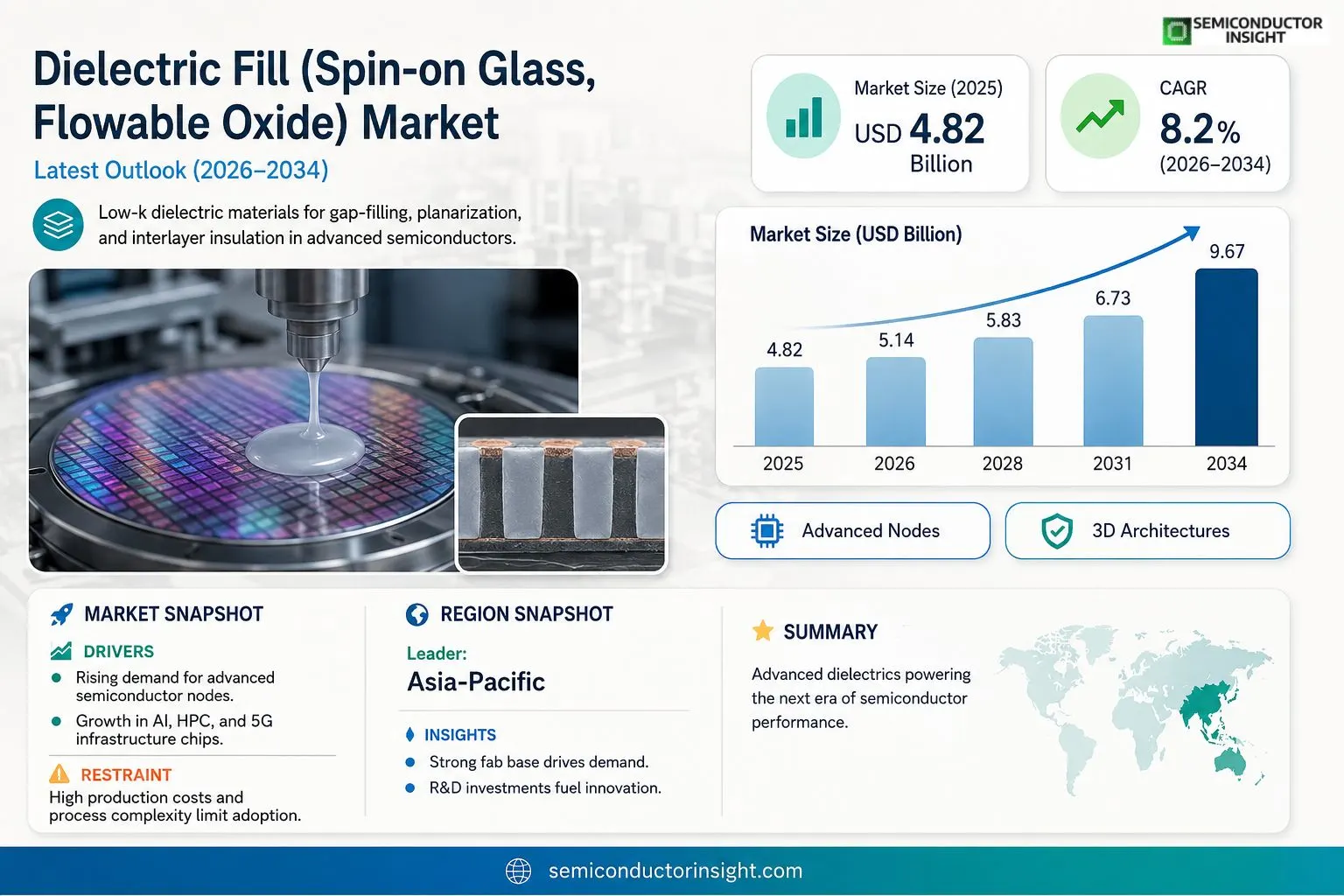
Global dielectric fill (spin-on glass, flowable oxide) market size was valued at USD 4.82 billion in 2025. The market is projected to grow from USD 5.14 billion in 2026 to USD 9.67 billion by 2034, exhibiting a CAGR of 8.2% during the forecast period.
Dielectric fill materials, encompassing spin-on glass (SOG) and flowable oxide (FOX), are specialized low-k dielectric solutions employed in semiconductor manufacturing for gap-filling and planarization applications. These materials enable uniform deposition into high-aspect-ratio features between metal interconnects, effectively eliminating voids and reducing capacitance-induced signal delays in advanced integrated circuits. Spin-on glass delivers excellent gap-filling capability through liquid-phase deposition followed by thermal curing, while flowable oxide leverages chemical vapor deposition chemistries with enhanced fluidity for sub-20nm node applications.
The market is experiencing robust expansion driven by escalating demand for advanced semiconductor nodes and the proliferation of artificial intelligence accelerators, high-performance computing chips, and 5G infrastructure components. While conventional plasma-enhanced chemical vapor deposition methods remain prevalent, the transition toward three-dimensional architectures and ever-shrinking feature sizes necessitates superior gap-fill performance that only spin-on and flowable dielectrics can reliably deliver. Furthermore, leading foundries including TSMC and Samsung have accelerated adoption of these materials at the 3nm and below process nodes because device scaling demands increasingly stringent interlayer dielectric specifications. Industry initiatives continue to shape competitive dynamics; for instance, Brewer Science expanded its PermeSelect® line of advanced dielectrics in 2023 to address EUV lithography patterning requirements, while Merck KGaA strengthened its portfolio through strategic acquisitions targeting semiconductor materials vertical integration.
MARKET DRIVERS
Growing Demand for Advanced Semiconductor Devices
Dielectric Fill (Spin-on Glass, Flowable Oxide) Market is primarily driven by the expanding semiconductor industry, which requires advanced dielectric materials for improved device performance. These materials provide critical insulation and gap-filling properties essential for miniaturized integrated circuits and 3D packaging technologies.
Technological Advancements in Dielectric Materials
Continuous innovation in dielectric fill formulations, including enhanced purity and lower thermal budget requirements, is propelling the market. Spin-on glass (SOG) and flowable oxides are favored for their conformality and compatibility with submicron features, ensuring superior electrical insulation and mechanical stability.
➤ The integration of Dielectric Fill materials in next-generation semiconductors is anticipated to boost process efficiency and device reliability significantly.
Moreover, rising investments in research and development by key industry players aim to develop tailored dielectric solutions for emerging applications such as flexible electronics and high-frequency devices, further stimulating market growth.
MARKET CHALLENGES
Complexity in Integration with Advanced Node Technologies
Integrating Dielectric Fill (Spin-on Glass, Flowable Oxide) materials with advanced semiconductor nodes below 7nm presents challenges such as achieving ultra-thin, defect-free layers while maintaining electrical integrity. Process compatibility issues can lead to higher fabrication costs and lower yields.
Other Challenges
Material Compatibility Concerns
Variation in the thermal expansion coefficients and chemical properties between dielectric fill and adjacent layers can induce stress and reliability issues, particularly during high-temperature processes.
MARKET RESTRAINTS
High Production Costs and Process Complexity
Dielectric Fill (Spin-on Glass, Flowable Oxide) Market faces restraints from the high costs associated with specialized equipment and stringent process controls required for spin-on and flowable oxide depositions. These factors limit adoption, especially among smaller semiconductor manufacturers.Additionally, stringent environmental regulations regarding chemical waste and emissions from spin-on processes increase operational costs, thus restraining overall market expansion despite the growing demand.
MARKET OPPORTUNITIES
Expansion into Emerging Applications and Regions
Dielectric Fill (Spin-on Glass, Flowable Oxide) Market presents significant opportunities in emerging applications such as flexible electronics, 5G components, and MEMS devices, where dielectric performance is critical. Additionally, growth in semiconductor manufacturing hubs across Asia-Pacific, including Vietnam and India, offers substantial regional opportunities.Advancements in low-k dielectric integration techniques and adoption of environmentally friendly deposition processes are expected to further open avenues for growth, enabling manufacturers to meet evolving industry demands.
Dielectric Fill (Spin-on Glass, Flowable Oxide) Market Trends
Advancements in Dielectric Materials Drive Semiconductor Innovation
Dielectric Fill (Spin-on Glass, Flowable Oxide) Market continues to evolve alongside the semiconductor industry’s relentless pursuit of smaller, faster, and more efficient integrated circuits. Spin-on glass (SOG) and flowable oxide (FOX) remain critical dielectric materials supporting high-aspect-ratio gap-filling and planarization in advanced semiconductor nodes. Their low-k properties effectively reduce capacitance-induced signal delays, addressing the growing demands of cutting-edge applications including artificial intelligence accelerators, high-performance computing, and 5G infrastructure deployment. Leading foundries such as TSMC and Samsung have actively accelerated the integration of these materials at the 3nm node and beyond, highlighting their indispensable role in meeting increasingly stringent interlayer dielectric specifications required by three-dimensional architectures.
Other Trends
Transition to 3D Architectures and Nanoscale Features
As device scaling approaches sub-20nm dimensions, traditional plasma-enhanced chemical vapor deposition techniques face limitations in gap-fill performance and defect mitigation. Dielectric Fill (Spin-on Glass, Flowable Oxide) Market benefits from the superior fluidity and conformal deposition characteristics of spin-on and flowable dielectrics, which ensure void-free filling of narrow trenches and vias. This trend fosters enhanced yield and reliability in semiconductor fabrication, enabling sustained innovation in chip design and functionality.
Strategic Industry Initiatives and Portfolio Expansion
Market participants are focusing on advancing their product portfolios to align with emerging lithography and patterning technologies. For example, Brewer Science’s expansion of its PermeSelect® line in 2023 addresses specific challenges associated with extreme ultraviolet (EUV) lithography, enhancing dielectric performance and process compatibility. Meanwhile, Merck KGaA’s strategic acquisitions aim to reinforce its vertical integration in semiconductor materials supply chains, intensifying competitive dynamics within Dielectric Fill (Spin-on Glass, Flowable Oxide) Market.
Outlook for Enhanced Semiconductor Material Solutions
The future trajectory of Dielectric Fill (Spin-on Glass, Flowable Oxide) Market hinges on continued innovation tailored to the evolving demands of advanced semiconductor node fabrication. The integration of improved low-k dielectric materials with superior gap-fill capabilities will be essential to support the escalating complexity of 3D integrated circuits and high-performance chips. Sustained investment in research and development, coupled with close collaboration between semiconductor foundries and material suppliers, will underscore the market’s role in facilitating next-generation electronics.
COMPETITIVE LANDSCAPEKey Industry Players
Competitive dynamics shaping Dielectric Fill (Spin-on Glass, Flowable Oxide) Market
Dielectric Fill (Spin-on Glass, Flowable Oxide) Market is primarily led by prominent semiconductor materials suppliers and chemical manufacturers that have established vertically integrated capabilities with advanced semiconductor fabs. Leading global players such as Merck KGaA and Brewer Science dominate through innovation in low-k dielectric materials tailored for sub-20nm node applications and advanced process nodes including 3nm and below. Their strategic focus on portfolios addressing critical gap-filling and planarization challenges enhances their competitive positioning amidst escalating demand driven by AI accelerators, HPC chips, and 5G infrastructure. The market remains moderately consolidated with intense focus on R&D and partnerships with leading foundries like TSMC and Samsung, which further shape growth trajectories and technological standards within the sector.
Alongside these industry giants, a range of specialized and niche players contribute significant innovation and market penetration, particularly in the development of novel spin-on and flowable oxides with superior gap-filling capabilities and EUV lithography compatibility. Companies such as JSR Corporation and Panasonic Corporation have made considerable advances in dielectric material chemistry that complement mainstream offerings. Other notable firms including Tokyo Ohka Kogyo Co., AGC Inc., and Versum Materials (now part of Merck) provide focused solutions that enhance competitive diversity. Continuous technological advancements and strategic acquisitions underline the competitive intensity, while regional players in Asia and North America maintain critical roles in meeting the evolving semiconductor fabrication requirements globally.
List of Key Dielectric Fill Companies Profiled
- Merck KGaA
- Brewer Science
- JSR Corporation
- Panasonic Corporation
- Tokyo Ohka Kogyo Co., Ltd.
- AGC Inc.
- Dow Inc.
- Sumitomo Chemical Co., Ltd.
- DuPont
- Evonik Industries AG
- Applied Materials, Inc.
- Versum Materials (part of Merck Group)
- Merck Group
- Entegris, Inc.
- FujiFilm Electronic Materials
Segment Analysis:
| Segment Category | Sub-Segments | Key Insights |
| By Type |
|
Spin-on Glass (SOG) is valued for its excellent liquid-phase gap-filling capabilities and thermal curing process, making it suitable for planarization in high-aspect-ratio features. It effectively minimizes voids and improves device performance through low dielectric constants. Flowable Oxide (FOX) employs chemical vapor deposition with enhanced fluidity, optimized for sub-20nm semiconductor nodes, addressing the increasing challenges of device scaling. Both types are critical in mitigating capacitance-induced delays, supporting advanced IC manufacturing and evolving 3D architectures. |
| By Application |
|
Gap Filling remains a leading application due to the necessity of eliminating voids within tight interconnect spaces, crucial for maintaining signal integrity and reducing capacitance. Planarization applications benefit from dielectric fills that provide smooth layering surfaces, supporting further lithography and device layering processes. Interlayer Dielectric Formation is a vital function where these materials enable superior electrical isolation between metal layers, accommodating the semiconductor industry’s shift to finer nodes and 3D designs. |
| By End User |
|
Semiconductor Foundries are primary consumers, adopting advanced dielectric fills to meet stringent node requirements particularly at 3nm and below, driven by leaders such as TSMC and Samsung. IDMs utilize these materials to enhance their in-house manufacturing process capabilities and improve device reliability. OSAT providers leverage dielectric fill technologies during packaging for performance optimization and miniaturization of chips supporting 5G and AI applications. |
| By Semiconductor Node Technology |
|
Sub-20nm nodes represent the leading focus area due to escalating complexity and miniaturization demands necessitating advanced dielectric fill materials with superior gap-fill and planarization properties. Mid-range nodes sustain demand by balancing performance improvements and cost efficiency in mature chip designs. Higher nodes continue to use traditional solutions, yet gradual adoption of spin-on and flowable oxides is observed to enhance device consistency in evolving applications. |
| By End Market |
|
Artificial Intelligence accelerators drive the need for advanced dielectric fill materials that support increased transistor density and faster signal transmission. 5G Infrastructure chips require reliable dielectric solutions to meet aggressive performance and miniaturization targets for network equipment. High-Performance Computing benefits from dielectric fills that reduce parasitic capacitance and enhance power efficiency in complex processor architectures. |
Regional Analysis: Global Dielectric Fill (Spin-on Glass, Flowable Oxide) Market
Asia-Pacific
Asia-Pacific’s extensive semiconductor fabrication infrastructure offers a significant competitive advantage. This manufacturing prowess supports efficient production of dielectric fill materials, enabling rapid scaling with high quality standards tailored to new device architectures.
Strong investments in research centers and partnerships facilitate continuous innovation in spin-on glass and flowable oxide formulations. This leads to enhanced dielectric properties that meet evolving performance requirements and device integration challenges.
Geographic concentration of materials suppliers and manufacturers enables streamlined logistics but also necessitates mitigation strategies against disruptions. The region is developing diversified sourcing and local supply networks to ensure steady production flow.
Environmental regulations and corporate responsibility drive adoption of eco-friendly dielectric materials and waste reduction measures. These initiatives aim to balance industry growth with ecological considerations, fostering sustainable market development.
North America
North America holds a vital position in the Dielectric Fill Market, supported by its advanced technology companies and semiconductor fabrication plants predominantly in the United States. The region focuses heavily on innovation and high-quality production standards, driving growth in specialized spin-on glass and flowable oxide materials. Extensive collaboration between industry and research institutions supports the development of custom dielectric solutions optimized for cutting-edge applications such as AI and 5G. Regulatory frameworks ensure product safety and environmental compliance, while growing demand from aerospace and defense sectors expands the market landscape. Although competition from Asia-Pacific remains intense, North America continues to invest strategically to maintain its technological leadership and address emerging market needs.
Europe
Europe’s Dielectric Fill Market benefits from robust automotive and industrial electronics sectors requiring reliable and high-performance dielectric materials. Countries such as Germany, France, and the Netherlands drive demand for spin-on glass and flowable oxide to enhance device durability and energy efficiency. The region emphasizes sustainability and eco-innovation, promoting green manufacturing processes and reducing hazardous emissions related to dielectric fill production. Strong research institutions contribute to progressive material sciences, aiding adaptation to new semiconductor node requirements. Europe’s smaller scale compared to Asia-Pacific is offset by high-value applications and stringent quality controls that drive focused market growth.
South America
South America is an emerging player in Dielectric Fill (Spin-on Glass, Flowable Oxide) Market, primarily fueled by increasing electronics manufacturing activities in Brazil and Argentina. While still developing its semiconductor fabrication capabilities, the region benefits from growing consumer electronics demand and government support for technology sector expansion. Challenges include limited infrastructure and higher import reliance, but rising awareness of advanced dielectric materials improves adoption rates. South America is positioning itself to participate increasingly in regional supply chains and niche applications, though substantial growth will depend on investment in technical skills and manufacturing facilities.
Middle East & Africa
The Middle East & Africa region’s Dielectric Fill Market is in a nascent stage, characterized by gradual investments into semiconductor-related manufacturing and research initiatives mainly in the UAE and South Africa. Strategic partnerships with global technology firms aim to build local expertise and infrastructure. Market growth is anticipated to be moderate, driven by increasing digital transformation projects and government-led innovation agendas. Focus remains on developing foundational supply chains and attracting foreign direct investment to support future dielectric material market expansion aligned with semiconductor industry development objectives.
Report Scope
This market research report provides a comprehensive analysis of the Dielectric Fill (Spin-on Glass, Flowable Oxide) Market , covering the forecast period 2026–2034. It offers detailed insights into market dynamics, technological advancements, competitive landscape, and key trends shaping the industry.
Key focus areas of the report include:
- Market Overview: The report begins with an overview outlining its current market scenario, key growth indicators, and industry transformation drivers. It discusses macroeconomic factors, demand–supply balance, regulatory landscape, and the strategic role of semiconductors in powering advancements across industries such as automotive, telecommunications, consumer electronics, and industrial automation.
- Market Size & Forecast: Historical data and future projections for revenue, unit shipments, and market value across major regions and segments.
- Segmentation Analysis: Detailed breakdown by product type, technology, application, and end-user industry to identify high-growth segments and investment opportunities.
- Regional Insights: Insights into market performance across North America, Europe, Asia-Pacific, Latin America, and the Middle East & Africa, including country-level analysis where relevant.
- Competitive Landscape: Profiles of leading market participants, including their product offerings, R&D focus, manufacturing capacity, pricing strategies, and recent developments such as mergers, acquisitions, and partnerships.
- Technology Trends & Innovation: Assessment of emerging technologies, integration of AI/IoT, semiconductor design trends, fabrication techniques, and evolving industry standards.
- Market Drivers & Restraints: Evaluation of factors driving market growth along with challenges, supply chain constraints, regulatory issues, and market-entry barriers.
- Stakeholder Insights: Insights for component suppliers, OEMs, system integrators, investors, and policymakers regarding the evolving ecosystem and strategic opportunities.
Primary and secondary research methods are employed, including interviews with industry experts, data from verified sources, and real-time market intelligence to ensure the accuracy and reliability of the insights presented.
FREQUENTLY ASKED QUESTIONS:
What is the current market size of Dielectric Fill (Spin-on Glass, Flowable Oxide) Market?
-> Dielectric Fill (Spin-on Glass, Flowable Oxide) Market was valued at USD 4.82 billion in 2025 and is expected to reach USD 9.67 billion by 2034, exhibiting a CAGR of 8.2% during the forecast period.
Which key companies operate in Dielectric Fill (Spin-on Glass, Flowable Oxide) Market?
-> Key players include Brewer Science, Merck KGaA, TSMC, Samsung, among others actively investing and innovating in this sector.
What are the key growth drivers?
-> Key growth drivers include escalating demand for advanced semiconductor nodes, proliferation of artificial intelligence accelerators, high-performance computing chips, and 5G infrastructure components.
Which region dominates the market?
-> Asia-Pacific is the fastest-growing region, driven by leading foundries such as TSMC and Samsung accelerating adoption of dielectric fill materials at advanced process nodes.
What are the emerging trends?
-> Emerging trends include the transition toward three-dimensional semiconductor architectures, enhancement of gap-fill performance through spin-on glass and flowable dielectrics, and strategic portfolio expansions addressing EUV lithography patterning requirements.

Get Sample Report PDF for Exclusive Insights
Report Sample Includes
- Table of Contents
- List of Tables & Figures
- Charts, Research Methodology, and more...
 Download Sample Report PDF