Defibrillator (Charge & Discharge) HV Switch IC Market Insights
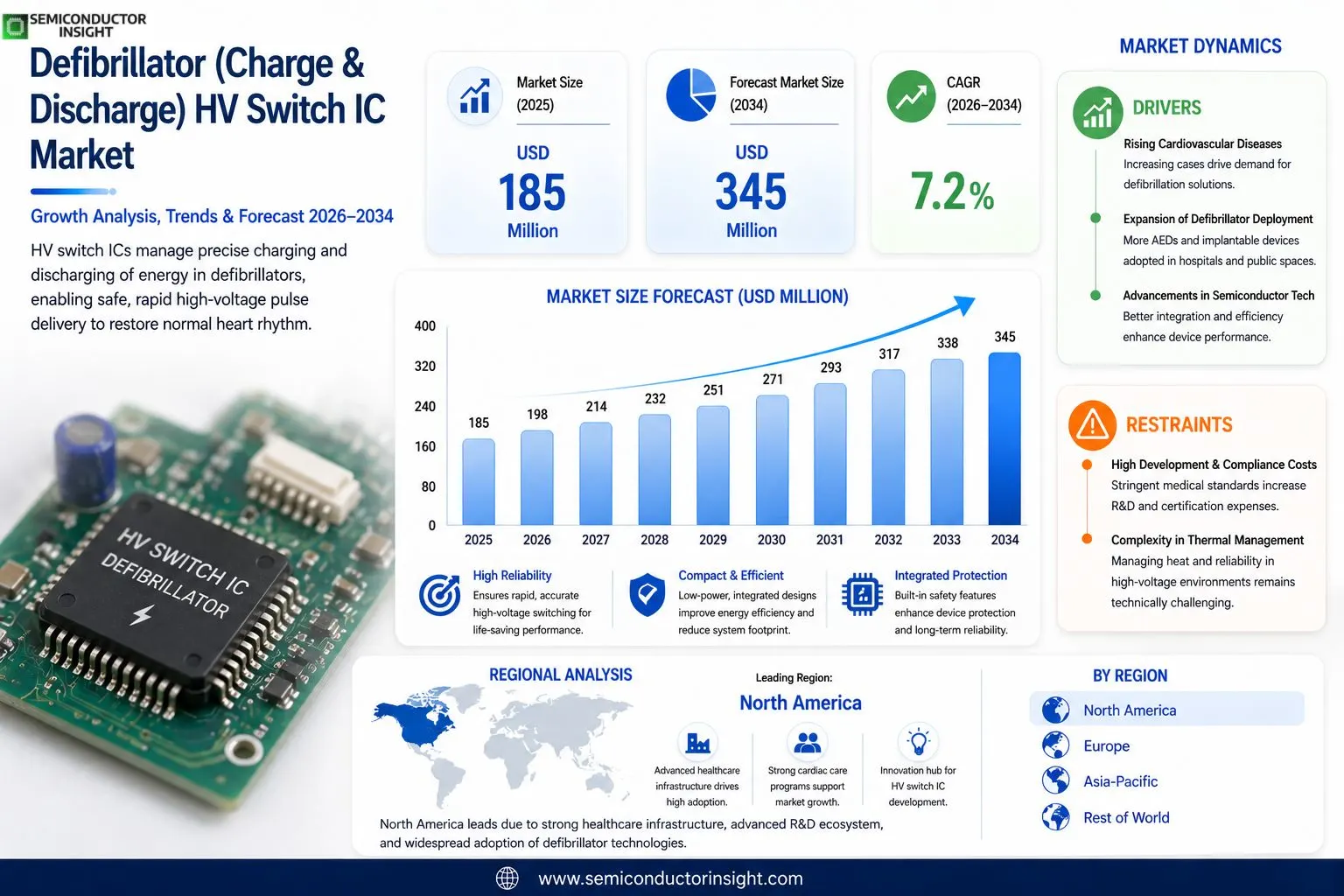
Global Defibrillator (Charge & Discharge) HV Switch IC market size was valued at USD 185 million in 2025. The market is projected to grow from USD 198 million in 2026 to USD 345 million by 2034, exhibiting a CAGR of 7.2% during the forecast period.
Defibrillator (Charge & Discharge) HV Switch ICs are specialized high-voltage integrated circuits designed to manage the precise charging and discharging of energy in defibrillation devices. These components play a critical role in controlling the high-voltage pulses required to restore normal heart rhythm during sudden cardiac arrest, ensuring rapid energy delivery while maintaining device safety and reliability.
The market is experiencing steady growth due to several factors, including the rising global prevalence of cardiovascular diseases and the increasing deployment of both implantable and external defibrillators in hospitals, ambulances, and public spaces. Advancements in semiconductor technology have enabled more compact, efficient, and integrated HV switch solutions that improve charge times and overall device performance. Furthermore, growing investments in healthcare infrastructure and public access defibrillation programs continue to support demand for advanced components. Key players are focusing on innovation to meet stringent medical safety standards and enhance integration with modern defibrillator systems.
MARKET DRIVERS
Growing Integration of Advanced HV Switching Components
Defibrillator (Charge & Discharge) HV Switch IC Market is experiencing sustained growth as medical device manufacturers increasingly integrate high‑reliability semiconductor components into modern defibrillator systems. The rising emphasis on precision-controlled charging and discharging cycles, improved switching response times, and enhanced component durability has strengthened adoption across both implantable and external defibrillator platforms. This increasing shift toward advanced IC-based switching architectures is contributing to consistent market expansion.
Increasing Global Demand for Defibrillator Devices
Growing deployment of automated external defibrillators in public infrastructure and expanding availability of advanced cardiac care equipment in hospitals have led to higher demand for specialized HV switch ICs that ensure reliable operating cycles. As defibrillators become more compact, energy-efficient, and digitally integrated, manufacturers rely on HV switch ICs that provide stable high-voltage performance within optimized power management frameworks.
➤ Continuous innovation in power electronics and medical-grade IC design is directly accelerating demand for high-performance HV switch ICs used in defibrillator charge–discharge systems.
Growing investments in medical electronics development, combined with increased regulatory focus on component safety and reliability, further strengthens market momentum. As OEMs prioritize longevity, precision, and consistent high-voltage operation, the adoption of purpose-built HV switch ICs continues to rise.
MARKET CHALLENGES
Stringent Regulatory and Certification Requirements
Defibrillator (Charge & Discharge) HV Switch IC Market faces considerable challenges due to rigorous global regulatory standards governing medical-grade electronics. Certification pathways require extensive testing related to electrical safety, performance reliability, and long-term durability, which increases development timelines and cost burdens for manufacturers. Ensuring consistent compliance across multiple regions further complicates production cycles.
Other Challenges
Supply Chain and Component Complexity
The high precision required for HV switch ICs used in defibrillators creates supply chain constraints, as only a limited number of semiconductor suppliers produce components meeting medical-grade specifications. This increases vulnerability to material shortages and extends lead times for OEMs.
MARKET RESTRAINTS
High Development and Production Costs
The need for specialized, tightly controlled manufacturing processes significantly restrains Defibrillator (Charge & Discharge) HV Switch IC Market. These ICs must meet exacting performance thresholds, including high-voltage isolation, rapid switching, and minimal thermal losses, all of which demand sophisticated fabrication technologies. This leads to elevated production costs that can limit broader market accessibility.Manufacturers also incur substantial costs related to lifecycle testing, reliability validation, and product miniaturization. As defibrillator systems become more compact, achieving these requirements without compromising thermal performance or switching stability remains a substantial restraint for component suppliers.
MARKET OPPORTUNITIES
Advancements in Miniaturization and Power Efficiency
Advances in semiconductor engineering are opening new opportunities in Defibrillator (Charge & Discharge) HV Switch IC Market, particularly through next-generation designs that offer improved energy efficiency, reduced thermal footprints, and enhanced integration potential with digital control systems. The growing transition toward compact defibrillators, including wearable and portable models, reinforces demand for smaller yet more capable HV switch ICs.Manufacturers that innovate in high-voltage isolation, long-cycle reliability, and low-loss switching technologies are positioned to benefit from increasing OEM adoption. Furthermore, ongoing modernization of healthcare equipment, combined with expanding access to emergency cardiac care in developing regions, presents substantial long-term growth prospects for the market.
Trends
Technology-Driven Integration Trends
Defibrillator (Charge & Discharge) HV Switch IC Market is experiencing measurable momentum as manufacturers shift toward more efficient, compact, and integration-ready components designed for next-generation defibrillation systems. The increasing prevalence of cardiovascular disorders and the heightened utilization of both implantable and external defibrillators continue to influence design priorities. Leading suppliers are focusing on innovations that enhance precision in high-voltage switching, optimize charging cycles, and reduce losses during energy discharge. These advancements support improved response times and device reliability, which are essential for life-saving interventions. Additionally, continued adoption of automated external defibrillators worldwide has encouraged IC developers to refine safety mechanisms and long-term operational stability. The enhanced demand for miniaturized components also aligns with broader medical device trends toward portability and ergonomic design.
Other Trends
Increased Emphasis on Safety and Fail-Safe Architecture
Safety-focused engineering remains a defining trend as regulatory expectations grow more stringent. High-voltage switching components used in defibrillation systems must demonstrate consistent performance under repetitive load cycles, requiring highly controlled charge and discharge behavior. Manufacturers are increasingly incorporating redundant safety elements and advanced insulation techniques to mitigate risks associated with voltage spikes. This shift is also driven by medical device designers who prioritize patient protection and reliability during emergency events. As a result, IC solutions with built‑in diagnostics and real-time monitoring capabilities are gaining wider acceptance.
Advancements in Semiconductor Materials and Power Efficiency
Steady improvements in semiconductor fabrication have contributed to more efficient Defibrillator (Charge & Discharge) HV Switch IC architectures. Refined layouts and optimized switching pathways reduce thermal stress and enhance energy transfer accuracy, which is crucial for achieving rapid and controlled output pulses. These developments support decreasing charge times in modern defibrillator systems while maintaining the stringent safety requirements of medical environments. The move toward higher integration also enables simplified assembly for device manufacturers and supports longer product lifecycles.
Greater Deployment of Defibrillation Devices in Public and Clinical Settings
Growing emphasis on fast-response cardiac intervention has accelerated the placement of automated and professional defibrillation systems across public spaces, ambulances, and clinical facilities. As deployment increases, demand for reliable high‑voltage switch ICs that can operate consistently under varied conditions rises correspondingly. This trend encourages suppliers to develop components that balance durability with precision control, ensuring stable performance across a wide range of usage frequencies and environmental factors.
Innovation Supporting Next-Generation Medical Device Design
Innovation in Defibrillator (Charge & Discharge) HV Switch IC Market is increasingly aligned with the broader evolution of medical electronics. Manufacturers are working to integrate digital control interfaces, improved protection circuits, and enhanced compatibility with advanced defibrillator architectures. These developments reflect a long-term industry shift toward smarter, more responsive life‑saving equipment. As healthcare infrastructures expand and accessibility initiatives broaden, the need for refined component technology is expected to remain strong, reinforcing the importance of high‑performance HV switch ICs in modern defibrillation systems.
COMPETITIVE LANDSCAPE
Key Industry Players
Defibrillator (Charge & Discharge) HV Switch IC Market Competitiveness
Defibrillator (Charge & Discharge) HV Switch IC Market is shaped by a concentrated group of semiconductor manufacturers with deep expertise in high-voltage power management and medical‑grade integrated circuits. Leading companies such as Analog Devices, Texas Instruments, and STMicroelectronics maintain strong positions through their broad portfolios of precision HV switching components, extensive reliability testing capabilities, and established relationships with top defibrillator OEMs. These players leverage advanced semiconductor process technologies to deliver ICs that provide faster charge rates, reduced energy loss, and high system safety—key performance requirements in both implantable cardioverter defibrillators (ICDs) and external automated external defibrillators (AEDs).
Alongside the market leaders, several niche but technically significant companies contribute to competitive diversity by developing specialized high‑voltage ICs optimized for medical applications. Firms such as Microchip Technology (including former Supertex), Renesas Electronics, Littelfuse IXYS, and Infineon Technologies offer HV switching devices designed for compact footprints and precise energy‑delivery control. Other participants, including Onsemi, NXP Semiconductors, and Vishay Intertechnology, continue to expand their relevance through innovation in HV semiconductor reliability, integration capabilities, and long‑term supply stability. Collectively, these companies support a market driven by medical regulatory compliance, rising global cardiovascular incidence, and increasing deployment of portable defibrillation systems.
List of Key Defibrillator (Charge & Discharge) HV Switch IC Market Companies Profiled
- Analog Devices
- Texas Instruments
- STMicroelectronics
- Microchip Technology
- Infineon Technologies
- Onsemi
- Renesas Electronics
- Littelfuse IXYS
- NXP Semiconductors
- Vishay Intertechnology
- Maxim Integrated (Analog Devices)
- Supertex (Microchip Technology)
- ROHM Semiconductor
- TDK-Lambda
- Advanced Energy Industries
Segment Analysis:
| Segment Category | Sub-Segments | Key Insights |
| By Type |
|
Integrated HV Switch ICs dominate due to several qualitative advantages:
|
| By Application |
|
Automated External Defibrillators (AEDs) represent the most influential application area because:
|
| By End User |
|
Hospitals & Clinics lead demand due to:
|
| By [Segment Category 3]] |
|
High-Performance Voltage-Class ICs stand out because:
|
| By [Segment Category 4]] |
|
Integrated Power-Management Modules emerge as the leading segment due to:
|
Regional Analysis: Defibrillator (Charge & Discharge) HV Switch IC Market
North America
North America’s stringent yet well-defined regulatory environment, governed primarily by the U.S. FDA, provides a structured pathway for HV switch IC integration into defibrillation systems. Manufacturers benefit from clear pre-market approval processes, enabling faster product iterations. This regulatory maturity fosters confidence among device developers and end-users alike, ensuring consistent quality and performance standards across Defibrillator (Charge & Discharge) HV Switch IC Market ecosystem.
The region commands a significant share of global R&D investment directed toward HV switch IC miniaturization, switching speed enhancement, and power efficiency optimization. Collaborative efforts between semiconductor companies and academic medical centers are yielding breakthrough circuit architectures tailored specifically for cardiac rhythm management devices, reinforcing North America’s competitive edge in the broader Defibrillator HV Switch IC Market landscape.
A dense and well-funded hospital network, combined with mature emergency medical services, drives consistent demand for high-performance defibrillation equipment embedded with advanced HV switch ICs. Growing awareness of public access defibrillation programs and favorable insurance coverage policies accelerate device penetration in both clinical and out-of-hospital settings, sustaining strong market uptake for associated semiconductor components throughout the forecast horizon.
North America hosts several globally recognized semiconductor and medical device companies actively developing and supplying HV switch ICs for defibrillation applications. A resilient and mature supply chain, supported by domestic fabrication capabilities and established distribution networks, ensures consistent component availability. This industrial depth positions the region as a reliable innovation and supply hub within Global Defibrillator (Charge & Discharge) HV Switch IC Market.
Europe
Europe represents the second most significant market for Defibrillator (Charge & Discharge) HV Switch ICs, underpinned by an aging population, progressive public health mandates, and widespread cardiac care infrastructure across key economies including Germany, France, the United Kingdom, and the Nordic countries. The European Union’s Medical Device Regulation (MDR) framework, while stringent, promotes the adoption of high-quality, thoroughly validated HV switch IC solutions in defibrillation devices. European governments have consistently expanded public access defibrillation programs in public transportation hubs, schools, and commercial facilities, generating sustained demand for AED-grade semiconductor components. Moreover, the region’s emphasis on energy-efficient medical electronics and environmentally responsible manufacturing aligns well with the performance requirements of modern HV switch ICs. A growing base of regional semiconductor design firms and collaborative Horizon-funded research programs is further strengthening Europe’s innovative capacity in the Defibrillator HV Switch IC Market, ensuring that the continent remains a critical contributor to global market development through the 2026–2034 forecast period.
Asia-Pacific
Asia-Pacific is emerging as one of the fastest-evolving regions in Global Defibrillator (Charge & Discharge) HV Switch IC Market, fueled by rapidly expanding healthcare infrastructure, rising cardiovascular disease prevalence, and significant government investment in modernizing emergency medical services. Countries such as Japan, China, South Korea, and Australia are at the forefront of this growth, each demonstrating increasing uptake of advanced defibrillation systems in both hospital and community settings. Japan’s technologically sophisticated healthcare ecosystem and established AED culture have long positioned it as a mature sub-market, while China’s large-scale hospital expansion programs and domestic semiconductor ambitions are driving accelerated adoption of locally developed and imported HV switch ICs. South Korea’s strong electronics manufacturing base provides additional momentum. As per capita healthcare expenditure rises and regulatory frameworks mature across the region, Asia-Pacific is expected to narrow the gap with established markets, making it an increasingly strategic focus for global Defibrillator HV Switch IC Market participants.
South America
South America occupies a developing but progressively important position within Defibrillator (Charge & Discharge) HV Switch IC Market. Brazil and Argentina serve as the primary demand centers, benefiting from government-led healthcare modernization initiatives and growing awareness of sudden cardiac arrest management in urban populations. While budget constraints and import dependency on advanced semiconductor components present ongoing challenges, international medical device companies are increasingly channeling resources into the region through partnerships and localized distribution strategies. The expansion of private hospital networks and a gradual increase in regulatory alignment with global standards are creating a more conducive environment for the adoption of advanced defibrillation technologies embedded with high-performance HV switch ICs. As economic conditions stabilize and healthcare investment grows, South America is poised to register incremental but meaningful gains in the Defibrillator HV Switch IC Market landscape over the forecast period.
Middle East & Africa
The Middle East & Africa region represents an early-stage yet increasingly noteworthy segment of Global Defibrillator (Charge & Discharge) HV Switch IC Market. Gulf Cooperation Council nations, particularly Saudi Arabia and the UAE, are leading regional development through ambitious healthcare infrastructure programs, hospital construction initiatives, and growing investments in emergency cardiac care. Government-backed health vision strategies across the GCC are fostering demand for internationally certified defibrillation equipment, indirectly stimulating interest in advanced HV switch IC components. Africa, while currently limited by healthcare expenditure constraints and fragmented supply chains, presents long-term potential as international health organizations and development programs direct resources toward improving cardiac emergency response capabilities. Awareness campaigns targeting healthcare professionals and first responders are gradually building the foundation for broader defibrillator adoption. As regional healthcare ecosystems mature, the Middle East & Africa is expected to emerge as a promising frontier market within Global Defibrillator HV Switch IC Market through the latter years of the forecast window.
Report Scope
This market research report provides a comprehensive analysis of the Defibrillator (Charge & Discharge) HV Switch IC Market , covering the forecast period 2026–2034. It offers detailed insights into market dynamics, technological advancements, competitive landscape, and key trends shaping the industry.
Key focus areas of the report include:
- Market Overview: The report begins with an overview outlining its current market scenario, key growth indicators, and industry transformation drivers. It discusses macroeconomic factors, demand–supply balance, regulatory landscape, and the strategic role of semiconductors in powering advancements across industries such as automotive, telecommunications, consumer electronics, and industrial automation.
- Market Size & Forecast: Historical data and future projections for revenue, unit shipments, and market value across major regions and segments.
- Segmentation Analysis: Detailed breakdown by product type, technology, application, and end-user industry to identify high-growth segments and investment opportunities.
- Regional Insights: Insights into market performance across North America, Europe, Asia-Pacific, Latin America, and the Middle East & Africa, including country-level analysis where relevant.
- Competitive Landscape: Profiles of leading market participants, including their product offerings, R&D focus, manufacturing capacity, pricing strategies, and recent developments such as mergers, acquisitions, and partnerships.
- Technology Trends & Innovation: Assessment of emerging technologies, integration of AI/IoT, semiconductor design trends, fabrication techniques, and evolving industry standards.
- Market Drivers & Restraints: Evaluation of factors driving market growth along with challenges, supply chain constraints, regulatory issues, and market-entry barriers.
- Stakeholder Insights: Insights for component suppliers, OEMs, system integrators, investors, and policymakers regarding the evolving ecosystem and strategic opportunities.
Primary and secondary research methods are employed, including interviews with industry experts, data from verified sources, and real-time market intelligence to ensure the accuracy and reliability of the insights presented.
FREQUENTLY ASKED QUESTIONS:
What is the current market size of Defibrillator (Charge & Discharge) HV Switch IC Market?
-> Defibrillator (Charge & Discharge) HV Switch IC Market was valued at USD 185 million in 2025 and is expected to reach USD 345 million by 2034, growing at a CAGR of 7.2% during the forecast period from 2026 to 2034.
Which key companies operate in Defibrillator (Charge & Discharge) HV Switch IC Market?
-> Key players in Defibrillator (Charge & Discharge) HV Switch IC Market are focused on innovation to meet stringent medical safety standards and enhance integration with modern defibrillator systems, developing more compact, efficient, and integrated HV switch solutions.
What are the key growth drivers?
-> Key growth drivers include rising global prevalence of cardiovascular diseases, increasing deployment of implantable and external defibrillators in hospitals, ambulances, and public spaces, advancements in semiconductor technology, and growing investments in healthcare infrastructure and public access defibrillation programs.
Which region dominates the market?
-> Asia-Pacific is the fastest-growing region driven by expanding healthcare infrastructure investments, while North America remains a dominant market due to high adoption of advanced defibrillation technologies and well-established public access defibrillation programs.
What are the emerging trends?
-> Emerging trends include more compact and efficient HV switch IC designs, integration of advanced semiconductor technologies to improve charge times and device performance, and the development of next-generation solutions that meet stringent medical safety and reliability standards for modern defibrillator systems.

Get Sample Report PDF for Exclusive Insights
Report Sample Includes
- Table of Contents
- List of Tables & Figures
- Charts, Research Methodology, and more...
 Download Sample Report PDF