CVD/ALD Metal Precursors (W, Co, Ru, Mo) Market Insights
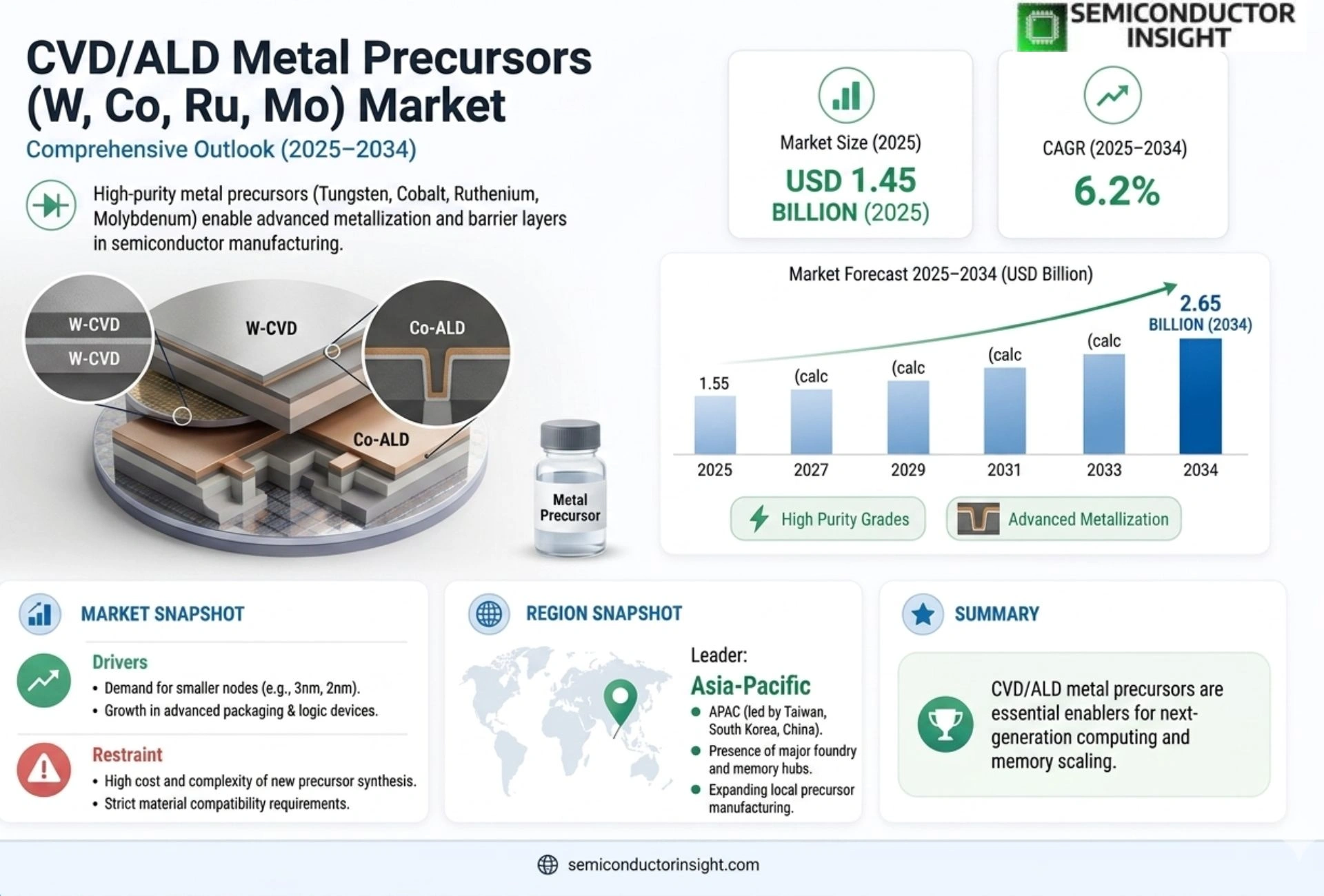
Global CVD/ALD Metal Precursors (W, Co, Ru, Mo) Market size was valued at USD 1.45 billion in 2025. The market is projected to grow from USD 1.55 billion in 2025 to USD 2.65 billion by 2034, exhibiting a CAGR of 6.2% during the forecast period.
CVD/ALD Metal Precursors (W, Co, Ru, Mo) are specialized chemical compounds utilized in semiconductor manufacturing processes. These precursors facilitate the deposition of thin films of Tungsten, Cobalt, Ruthenium, and Molybdenum, which are essential for creating advanced interconnects, barrier layers, and contact points in microelectronics.
The market is experiencing robust expansion driven by the relentless miniaturization of semiconductor nodes and the rising demand for high-performance computing. Furthermore, the transition to EUV lithography has significantly increased the requirement for Ruthenium-based barriers. Recent developments in 2023 and 2024 highlight a shift towards low-toxicity precursors to meet stringent environmental regulations. Key players are focusing on supply chain security and process optimization to support the growing demand for 3D NAND and HBM memory technologies.
MARKET DRIVERS
Scaling of Semiconductor Nodes Drives Demand
The rapid advancement in microelectronics and the continuous push for Moore’s Law have significantly increased the demand for advanced CVD/ALD Metal Precursors (W, Co, Ru, Mo) Market solutions. As transistor densities increase, the required thermal stability and chemical purity of barrier and seed layers have necessitated the adoption of specific metals like Ruthenium and Molybdenum. Tungsten remains a cornerstone for gate engineering, while the unique properties of Ruthenium are increasingly being utilized in contact plugs due to its superior resistance to plasma etching compared to alternatives. This technological evolution ensures a robust growth trajectory for the market.
Shift towards High-Performance Dielectrics
The electronics industry is shifting away from silicon dioxide towards high-k dielectrics and low-resistance materials, creating a direct dependency on metal precursors processed via chemical vapor deposition. In the context of CVD/ALD Metal Precursors (W, Co, Ru, Mo) Market, the demand for high-purity Cobalt complexes is rising due to their application in diffusion barriers and magnetic layers. These materials require atomic-level precision, which is only achievable through the ALD processes facilitated by the consistent release of these metal precursors, thereby ensuring superior film conformality and device performance.
➤ The introduction of Metal-Organic CVD (MOCVD) has reduced the thermal budget required for deposition, making it viable for more sensitive substrates.
Furthermore, the integration of these precursors into FinFET and gate-all-around (GAA) transistor architectures is a critical driver, as these structures demand ultra-thin, uniform depositions that traditional methods fail to match.
MARKET CHALLENGES
Precursor Volatility and Handling Complexity
One of the primary obstacles CVD/ALD Metal Precursors (W, Co, Ru, Mo) Market is the intrinsic volatility and moisture sensitivity of many metal-organic compounds. Ruthenium and Tungsten precursors often require stringent air-free handling protocols, necessitating expensive vacuum and inert gas systems. This complexity increases the total cost of ownership for fabs and research facilities, acting as a barrier to rapid adoption among smaller manufacturers or in regions with less established infrastructure.
Other Challenges
Process engineers frequently face issues related to the purity and stability of the precursor vapors. Impurities in the precursor stream can lead to device defects, such as pinholes in barrier layers, which compromise the overall reliability of the semiconductor chip. Additionally, the high cost of synthesizing these specialized organometallic compounds makes them significantly more expensive than standard industrial chemicals, impacting profit margins for semiconductor foundries.
Thermal and Plasma Instability
The high reactivity of certain Co and Ru precursors can sometimes lead to unwanted side reactions during deposition, resulting in non-uniform films or contamination of the process chamber. overcoming these specific chemical challenges requires rigorous optimization of precursor formulations and reactor conditions, which limits the speed of process scaling.
MARKET RESTRAINTS
Volatility of Raw Material Supply Chains
The availability and pricing of strategic metals, including Tungsten, Molybdenum, and Ruthenium, are influenced by global geopolitical tensions and mining disruptions. Since these metals are essential feedstocks for CVD/ALD Metal Precursors (W, Co, Ru, Mo) Market, supply chain fluctuations directly impact the stability of precursor pricing. Manufacturers often struggle to maintain consistent supply flows, which hinders large-scale production planning for integrated device manufacturers.
Stringent Environmental and Safety Regulations
The production and handling of toxic heavy metals and volatile organic compounds often subject this market to rigorous environmental compliance standards. Regulations regarding the disposal of chemical waste and occupational health safety for workers handling corrosive or carcinogenic precursors add significant operational overhead. Companies must invest heavily in safety infrastructure and waste management technologies, which can stifle profitability, particularly in emerging markets.
MARKET OPPORTUNITIES
Expansion of Advanced Memory Technologies
The rapid evolution of Non-Volatile Memory (NVM) technologies, particularly 3D NAND and Resistive RAM (ReRAM), offers a prime growth avenue for CVD/ALD Metal Precursors (W, Co, Ru, Mo) Market. These technologies require precise metal electrode manufacturing and barrier layers that ensure data retention and device longevity. Molybdenum precursors are gaining traction in these applications due to their ability to form stable diffusion barriers, creating a distinct opportunity for market expansion into the memory sector.
Growth in Energy Storage and Flexible Electronics
Beyond traditional semiconductors, the increasing demand for solid-state batteries, supercapacitors, and flexible electronics is driving innovation in metal deposition. Cobalt precursors are essential for creating high-capacity electrode materials in next-generation batteries. This shift towards alternative energy solutions creates a diversified demand base that is less reliant on traditional logic device cycles, providing a stable long-term trajectory for the market.
Innovations in precursor chemistries that reduce carbon contamination are also opening doors for wider application in solar photovoltaics and optoelectronics, further broadening the commercial landscape for metal film deposition technologies.
Trends
Expansion Driven by Miniaturization and High Performance
CVD/ALD Metal Precursors (W, Co, Ru, Mo) are specialized chemical compounds utilized predominantly in semiconductor manufacturing. These advanced agents facilitate the precise deposition of thin films covering Tungsten, Cobalt, Ruthenium, and Molybdenum. Such components are vital for creating robust advanced interconnects, effective barrier layers, and reliable contact points within complex microelectronics. The increasing complexity of chip fabrication drives the necessity for high-purity materials capable of supporting next-generation electronic architectures and ensuring signal integrity across integrated circuits.
Other Trends
Key Role of Semiconductor Miniaturization
The relentless advancement in semiconductor nodes significantly propels the growth of the advanced metallization technologies required by the global market. As electronic devices demand higher processing power, manufacturers rely on more sophisticated deposition techniques. This evolution ensures that essential contact points and interconnects function efficiently within significantly smaller geometries. The adoption of these technologies is particularly crucial for industries requiring high-performance computing capabilities, creating a steady trajectory for market expansion alongside hardware upgrades.
Implementation of Low-Toxicity Solutions
Recent developments in 2023 and 2024 highlight a critical shift towards low-toxicity precursors to meet stringent environmental regulations. Key industry players are actively focusing on environmental compliance by adopting cleaner chemical alternatives. This shift is essential for long-term viability and ensuring that the sector remains resilient against evolving legislative pressures. Furthermore, manufacturers are prioritizing process optimization to support the growing demand for 3D NAND and HBM memory technologies, ensuring that material delivery supports innovation without environmental compromise.
COMPETITIVE LANDSCAPE
Key Industry Players
cvd/ald metal precursors (w, co, ru, mo) competitive landscape insights
CVD/ALD metal precursors (W, Co, Ru, Mo) are specialized chemical compounds utilized in semiconductor manufacturing processes to facilitate the deposition of thin films. These chemical compounds facilitate the deposition of Tungsten, Cobalt, Ruthenium, and Molybdenum, which are essential for creating advanced interconnects and barrier layers in microelectronics.
The market is experiencing robust expansion driven by the relentless miniaturization of semiconductor nodes and the rising demand for high-performance computing. Furthermore, the transition to EUV lithography has significantly increased the requirement for Ruthenium-based barriers. Recent developments highlight a strategic shift towards low-toxicity precursors to meet stringent environmental regulations, with key players focusing on supply chain security.
List of Key Metal Precursor Manufacturers
- Alfa Aesar (Thermo Fisher Scientific)
- BASF SE
- UBE Corporation
- Entegris, Inc.
- Umicore
- ADEKA Corporation
- Merck KGaA
- Air Liquide
- Strem Chemicals (Ascensus Specialties)
- Gelest, Inc. (Mitsubishi Chemical)
- Hansol Chemical Co., Ltd.
- Avantor, Inc.
Segment Analysis:
| Segment Category | Sub-Segments | Key Insights |
| By Type |
|
Tungsten Precursors maintain a dominant market position due to their critical role in gate stacks and local interconnects. Ruthenium precursors are gaining significant traction driven by the shift to EUV lithography which requires specialized barrier materials. Molybdenum precursors are increasingly utilized for advanced logic nodes requiring superior diffusion resistance. Cobalt precursors are seeing niche adoption in specialized interconnect applications. |
| By Application |
|
High Bandwidth Memory (HBM) And 3D NAND represent the most aggressive growth vectors within the semiconductor manufacturing landscape. The demand for high conductivity layers in these memory technologies is driving substantial capital expenditure. EUV lithography applications necessitate atomic layer precision, favoring ALD specific precursors. Advanced packaging processes are expanding the application horizon for thin-film metal deposition. |
| By End User |
|
Major Semiconductor Foundries drive the bulk volume requirements due to their continuous manufacturing cycles. R&D laboratories focus intensely on the development of next-generation precursors with lower toxicity profiles. Advanced packaging houses are increasingly integrating these metal layers for heterogeneous chip stacking solutions. The end-user landscape is shifting towards a requirement for highly reliable and volatile chemical delivery mechanisms. |
| By Chemical Form |
|
Volatility and Physical State dictate the selection criteria for process integration. Volatile liquid precursors are preferred for standard CVD processes due to efficient vaporization and handling properties. Solid precursors offer superior shelf life and ambient stability but often require higher deposition temperatures. Gaseous versions are specialized offerings designed for tight integration within ultra-clean vacuum chambers. |
| By Regulatory Standard |
|
Environmental Compliance has emerged as a primary strategic differentiator in the market. Major players are pivoting towards green chemistry solutions to eliminate hazardous organometallics from their production lines. Stricter global environmental directives are acting as a barrier to entry for non-compliant precursors. The regulatory landscape is effectively reshaping the R&D portfolio focusing on sustainability and safety. |
Regional Analysis: CVD/ALD Metal Precursors (W, Co, Ru, Mo) Market
North America
Market participants are aggressively pursuing vertical integration to secure control over the synthesis of complex metal complexes. Companies are prioritizing the acquisition of specialized manufacturing capabilities to reduce dependency on external suppliers, thereby ensuring consistent availability and quality for integrated device manufacturers.
The adoption of these precursors is accelerating within the semiconductor industry, particularly for damascene processes in copper interconnects and barrier layer deposition. As device architectures become increasingly complex, the application of tungsten and molybdenum precursors is expanding beyond traditional logic nodes to include advanced packaging and 3D NAND structures.
Regional regulatory frameworks are emphasizing environmental compliance and workplace safety regarding hazardous chemicals. There is growing momentum towards utilizing metal precursors that offer lower volatility and reduced hazardous byproducts, pushing manufacturers to develop formulations that meet stringent RoHS and REACH standards.
Supply chain resilience remains a primary focus, with heightened transparency initiatives throughout the sourcing network. Stakeholders are actively exploring alternative raw material extraction methods to address geopolitical risks associated with the availability of specific alloying elements, particularly for Ruthenium and Cobalt precursors.
Europe
The European market is characterized by a strong emphasis on sustainable manufacturing and environmental stewardship. There is significant momentum towards utilizing metal precursors that offer lower volatility and reduced hazardous byproducts, aligning with the region’s stringent industrial emission standards and green technology initiatives. Automotive electronics and industrial applications are driving demand, with local manufacturers seeking chemical vapor deposition solutions that minimize environmental impact without compromising deposition thickness or efficiency.
Asia-Pacific
The Asia-Pacific region stands as the dominant manufacturing powerhouse, exhibiting the highest volume consumption of metal precursors due to the presence of massive fabrication campuses and foundries. The rapid pace of technological adoption in this region ensures a consistent drive for higher purity W, Co, Ru, and Mo derivatives to support next-generation chip production cycles. Government subsidies for indigenous semiconductor development have further solidified this area as a critical hub for the global adoption of advanced deposition techniques.
South America
Southern Cone markets are witnessing a gradual evolution in industrial electronics fabrications, with regional hubs showing increased interest in adopting CVD/ALD technologies for protective coatings and surface treatments. Driven largely by the expanding textile and automotive sectors in countries like Brazil and Argentina, the local infrastructure is gradually integrating these chemical vapor deposition technologies to enhance product durability and performance. The focus remains on cost-effective processing methods to serve a maturing manufacturing base.
Middle East & Africa
While still developing, the region is leveraging its natural resource abundance of certain transition metals to position itself as a potential hub for precursor raw material supply. Local infrastructure projects are beginning to require specialized surface modification processes, slowly integrating these chemical vapor deposition technologies into the industrial value chain. Collaboration with international suppliers is essential to transfer the necessary technical knowledge required for handling these sophisticated materials safely.
Report Scope
This market research report provides a comprehensive analysis of the CVD/ALD Metal Precursors (W, Co, Ru, Mo) Market , covering the forecast period 2026–2034. It offers detailed insights into market dynamics, technological advancements, competitive landscape, and key trends shaping the industry.
Key focus areas of the report include:
- Market Overview: The report begins with an overview outlining its current market scenario, key growth indicators, and industry transformation drivers. It discusses macroeconomic factors, demand–supply balance, regulatory landscape, and the strategic role of semiconductors in powering advancements across industries such as automotive, telecommunications, consumer electronics, and industrial automation.
- Market Size & Forecast: Historical data and future projections for revenue, unit shipments, and market value across major regions and segments.
- Segmentation Analysis: Detailed breakdown by product type, technology, application, and end-user industry to identify high-growth segments and investment opportunities.
- Regional Insights: Insights into market performance across North America, Europe, Asia-Pacific, Latin America, and the Middle East & Africa, including country-level analysis where relevant.
- Competitive Landscape: Profiles of leading market participants, including their product offerings, R&D focus, manufacturing capacity, pricing strategies, and recent developments such as mergers, acquisitions, and partnerships.
- Technology Trends & Innovation: Assessment of emerging technologies, integration of AI/IoT, semiconductor design trends, fabrication techniques, and evolving industry standards.
- Market Drivers & Restraints: Evaluation of factors driving market growth along with challenges, supply chain constraints, regulatory issues, and market-entry barriers.
- Stakeholder Insights: Insights for component suppliers, OEMs, system integrators, investors, and policymakers regarding the evolving ecosystem and strategic opportunities.
Primary and secondary research methods are employed, including interviews with industry experts, data from verified sources, and real-time market intelligence to ensure the accuracy and reliability of the insights presented.
FREQUENTLY ASKED QUESTIONS:
What is the current market size of CVD/ALD Metal Precursors (W, Co, Ru, Mo) Market?
-> Global CVD/ALD Metal Precursors (W, Co, Ru, Mo) Market size was valued at USD 1.45 billion in 2025. The market is projected to grow from USD 1.55 billion in 2025 to USD 2.65 billion by 2034, exhibiting a CAGR of 6.2% during the forecast period.
Which key companies operate CVD/ALD Metal Precursors (W, Co, Ru, Mo) Market?
-> Key players are industry leaders focusing on supply chain security and process optimization to support advanced semiconductor fabrication technologies.
What are the key growth drivers?
-> Key growth drivers include the relentless miniaturization of semiconductor nodes and the rising demand for high-performance computing.
Which region dominates the market?
-> Asia-Pacific is the primary manufacturing hub for semiconductor fabrication, while North America and Europe drive significant R&D demand.
What are the emerging trends?
-> Emerging trends include low-toxicity precursors and increased requirements for Ruthenium-based barriers due to EUV lithography adoption.

Get Sample Report PDF for Exclusive Insights
Report Sample Includes
- Table of Contents
- List of Tables & Figures
- Charts, Research Methodology, and more...
 Download Sample Report PDF